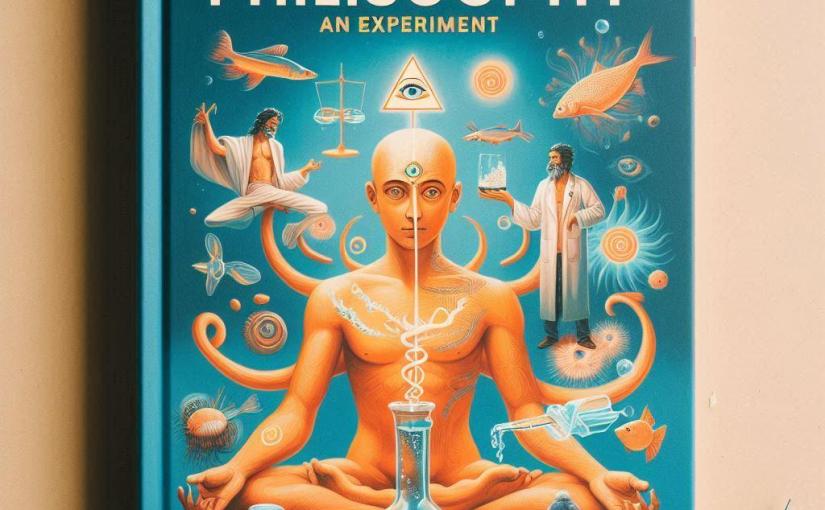
Friends, nothing can be created from Purusha. It is actually the void sky. The visible empty and physical sky is also not actually the void sky. If the world is considered to have originated from Purusha, then it will be against the basic scientific principle according to which no substance can be created or destroyed, but can only change its form. The world being born from Purusha means being born from the void, because Purusha is the real void. But, it is the principle of Vedanta philosophy that the world dissolves into Brahma i.e. Purusha. This is actually about the mental picture of the world, not about the real or gross and physical world. This has been explained in the scriptures, especially in Yoga Vashishtha, with examples like flowers or gardens cannot bloom in the sky or horns cannot grow on the head of a rabbit, etc. It has been explained with many such examples.
Contradictions are seen between Sankhya and Vedanta philosophy due to ignorance. This happens because we impose their principles on each other. The principles of both are complete and logical within their respective philosophies. If we impose the Vedanta’s world-falsity on the Sankhya philosophy, then there will be a problem. The Vedanta world is a subtle reflection of the world felt inside the brain and formed on the soul. The reflection is always false. Is the mountain seen in the mirror true? Absolutely not. But the Sankhya world is the real, gross and physical world outside. How can we consider it false? Is the rock lying on the side of the road false? Absolutely not. If the car driver considers it false like a reflection, then he can crash his car into it.
Vedanta says that Brahma is the only truth, the world is false. Brahma means the soul is the only truth, the world is a reflection formed on it, means it is false. It is like the mirror itself is the truth, and the images of the world seen in it are false, meaning they do not exist. But this principle cannot be applied to the gross world outside. There is a cause-effect tradition outside. It means that the effect cannot exist without a cause. There is a physical existence of the original nature aka mool prakriti outside, only then the physical world can be formed from it. It is like water is formed from ice and clouds from water. Water or clouds do not suddenly appear from nowhere without a reason. The image of any object is formed suddenly in a mirror, without any reason. But the object from which that image is formed, that object is formed from its parent i.e. the cause. It has not appeared suddenly. Similarly, the image of all the objects of the world is formed on the soul suddenly and without any cause. But those real worldly objects have taken millions and billions of years to be formed. If we keep pulling this cause-effect tradition back, then in the end the mool prakriti remains. The creation of the world starts from this. It cannot merge in the purusha, because the purusha is the real empty sky. Merging of the mool prakriti in it means that the mool prakriti becomes void, i.e. its destruction. And the creation of the mool prakriti from it at the time of creation means the creation of the mool prakriti. But this is against the scientific principle that nothing can be created or destroyed. It can only change its form.
What the Vedantic people say that the mool prakriti merges with the soul, is for the individual mool prakriti, not for the collective mool prakriti. Former is actually the reflection of the later made on the soul, not the real and physical mool prakriti. If you remove everything from in front of the mirror, then all the reflections of the mirror will disappear immediately. Similarly, if you remove the soul from worldly affairs, then all the reflections of the world will disappear. Of course, the reflection of the mool prakriti takes more time to disappear, because it is created from the illusion or ignorance of the soul. The disappearance of the reflection of the mool prakriti is called its merging with the soul or the Supreme Soul. Nothing was merged, because when nothing was created, then what would be merged. It appears to be created and merged from illusion only.
Kundalini Yogi marries the philosophy of Sankhya and Vedanta. First, the Yogi worships prakriti as per Sankhya and considers it to be real and distinct, and remains engrossed in it. Then when he likes some object, lover, Guru, God etc., he becomes attached to it and keeps thinking about it all the time, even while being fully active in worldly affairs. This makes his attention towards it firm. Then he himself reaches the higher level of yoga and starts doing Kundalini Yoga. This makes that object his meditation picture and gives him immense joy and peace. Then, inspired by this, he himself climbs one more step higher and takes additional help from Tantra. This makes the meditation picture become Kundalini picture. Soon his Kundalini awakens. This means that he gets so lost in the memory of that picture that it becomes one with his soul. The nature or prakriti which was earlier separate from Purusha as per Sankhya, now merges with Purusha as per Vedanta. Meaning Sankhya philosophy is transformed into Vedanta philosophy.
Of course, each Vedic philosophy outlines a different kind of religion or way of life, but to me they all seem to be interconnected. The development of these philosophies exactly matches the development of a man’s life. In childhood, when a man learns and adopts calculations and rationality to acquire knowledge, he should be considered to be situated in purely physical and logical philosophies like Nyaya philosophy and Vaisheshika philosophy. When he reaches the loving adolescence and early householder stage, he should be considered to be situated in Sankhya philosophy. In the later householder stage, he should be considered to be situated in Yoga philosophy, because then he also practices Yoga. Along with Yoga, he also starts performing Sanatan religious acts like rituals, because both have an unbreakable relationship with each other. This should be considered to be the stage of Purva Mimamsa philosophy. Then when he gets awakened, after that he is promoted to Vedanta philosophy i.e. Uttar Mimamsa philosophy. In this way, all the six Vedic philosophies come in his lifetime. It also advocates mutually cooperative existence of all darshans and all religions.
Many people believe that these philosophies have developed gradually in different periods in the above mentioned order. This view is also correct, because the development of the entire human race has also happened in a sequential manner, almost like the development of a single human being in his lifetime. First of all, in the primitive human era, materialistic philosophies like Nyaya and Vaisheshika came into existence. Then when human civilization developed a bit, the Sankhya and Yoga philosophies emerged. At the peak of intellectual development of human civilization, they got merged in the Purva Mimamsa and Vedanta philosophies. Be it individual or society, everything is seen developing gradually from ignorance to knowledge.
Sankhya philosophy says that prakriti first misleads a man and then liberates him. Actually, it is like a beautiful girl who first charms a man with her beauty, grace and gestures and makes him dance, and later leaves him or marries him. When a man understands prakriti and the worldliness born from it fully in a practical way, only then can he overcome it with the help of further philosophies, otherwise not. We have also said the same thing in this post from our personal experience. This is a web of bookish words. But everything looks very clear and beautiful in practice. Sankhya philosophy may seem materialistic, but its aim is spiritual. Therefore, it is completely opposite to common and stupid materialism. Although both are same but differs in mental attitude. Pure physical beings adopt materialism solely for enjoyment while sankhya based physical beings adopt it mainly for liberation in the end, enjoyment being the secondary or as a by-product.

 Demystifying Kundalini