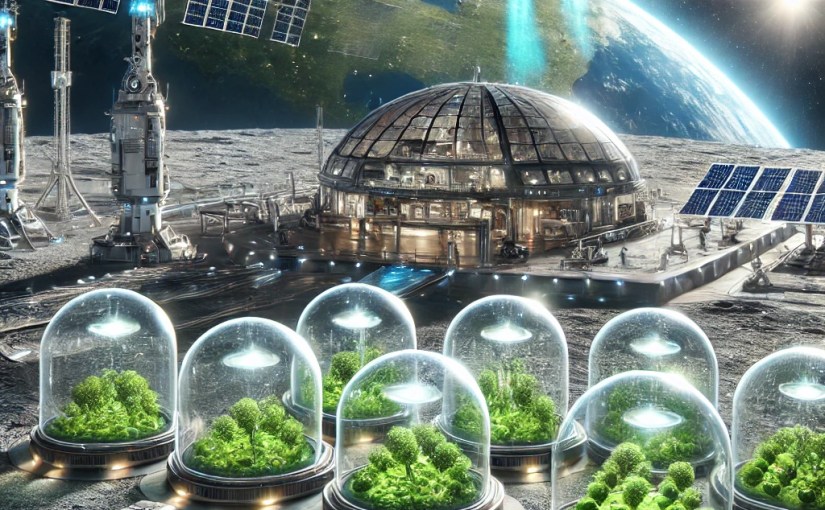
The Verma family had begun to settle into their new lunar home, embracing the unique rhythm of life on the Moon. The initial awe of low-gravity adventures and the serene, meditative environment had started to blend into their daily routine. Yet, amidst this adaptation, Dr. Aryan Verma found himself grappling with pangs of homesickness. The vast distance between the Moon and Earth felt insurmountable at times, and he often mused about the possibility of instantaneous teleportation, yearning for the comfort of his earthly belongings and the familiar embrace of home. The 12-hour spacecraft journey, though a marvel of modern technology, seemed too lengthy and exhausting to undertake frequently, making spontaneous visits to Earth an impractical dream.
This longing was further exacerbated by the whispers of some who viewed their relocation as a permanent exile, a one-way ticket away from the cradle of humanity. Aryan’s desire to debunk this notion, to prove that their move was not an abandonment but an expansion of horizons, weighed heavily on his mind.
In an attempt to bridge this emotional chasm, Aryan delved into understanding the intricate web of trade that connected the Moon to Earth. This exchange was not merely a transfer of goods but a lifeline that tethered the two celestial bodies in a symbiotic relationship. Earth supplied the Moon with essential commodities such as grains, vegetables, and milk—staples that were challenging to produce in the lunar environment. The Moon, in return, offered Earth’s industries a wealth of minerals, including lithium and gold, extracted from its regolith. This trade was not just about resources but a testament to human ingenuity and the relentless pursuit of progress.
Trade between Earth and the Moon felt like something out of ancient myths, where gods traveled between worlds with ease. Today, science had created its own magical ways to move goods across space. The Lunar Mass Driver worked like a giant slingshot, launching gold, lithium, and other minerals from the Moon toward Earth. It didn’t even need fuel—just magnetism and precision, much like a divine weapon hitting its target perfectly. Then came the Skyhook Stations, huge floating structures in space that caught these shipments mid-air and safely guided them down to Earth, just like Hanuman carrying the Sanjeevani herb from the mountains in mythological stories. For important goods that needed to arrive quickly, fusion-powered space shuttles—like the flying chariots of old legends—sped between the planets, reducing travel time to just a few hours. And in the most futuristic development, scientists were working on quantum teleportation, which seemed almost like the magic used by ancient sages, allowing objects to appear instantly in another place.
This new way of trading was not just about technology. It felt like a blend of science and ancient wisdom, where space travel was turning myths into reality, making life between Earth and the Moon more connected than ever. Gravity-defying transport had also started revolutionizing trade. Advanced anti-gravity carriers, inspired by ancient myths of celestial chariots, floated effortlessly between lunar domes and Earth-bound cargo ships. Using quantum levitation and electromagnetic propulsion, these silent gliders transported gold, lithium, and minerals from the Moon while returning with fresh produce, grains, and dairy from Earth. The seamless, fuel-free movement not only made trade faster but also preserved the lunar environment, proving that technology, when aligned with nature, could create a harmonious balance between worlds.
Although the Moonites had mastered the art of living purely on subtle prana, requiring nothing external for survival, they sometimes desired a slight taste of earthly chaos. Unlike the deep stillness of their lunar existence, Earth carried a different vibration—one of movement, emotion, and unpredictability. To invite a touch of this dynamic energy into their otherwise serene minds, they engaged in limited trade with Lunar Colonists. It wasn’t for survival, but for experience. A small intake of Eartherian food, scents, or artifacts was enough to stir a ripple of thought, breaking their deep mental silence just enough to interact with the colonists. This balance allowed them to maintain their wisdom while briefly tasting the restless curiosity of Earth, before dissolving once again into their vast ocean of tranquility. Thus, trade wasn’t just about material exchange—it was an exchange of energies. The Moonites offered their advanced knowledge, minerals, and rare elements, while the Lunar Colonists provided food, books, and art to stir the Moonites’ silent minds just a little—before they returned to their meditative stillness.
You can better understand their behavior through the analogy of gods. You might have heard the way divine idols functioned. Though they neither eat, drink, nor breathe, the moment prasad or food, water, and incense are offered with devotion, they seem to accept it, coming alive with divine presence and bestowing blessings upon their devotees. Similarly, the Moonites, though self-sustained on pure prana, would partake in earthly offerings—not out of necessity, but out of a willful choice. A slight exposure to Eartherian food, aromas, or artifacts stirred their deep stillness just enough to interact, much like deities responding to worship. Once their purpose was fulfilled, they effortlessly returned to their meditative silence, as if dissolving back into the cosmic vastness from which they emerged.
However, Aryan couldn’t ignore the irony that many on Earth clung to outdated practices in the name of honoring their ancestors, often at the expense of the environment and personal well-being. This resistance to change had hindered efforts to combat pressing issues like overpopulation, poverty, extremism, radicalism, war mongering, blind faith, global warming etc. Aryan reflected on how humanity’s attachment to tradition sometimes blinded them to necessary evolution, spiritual as well as material, a mindset that their move to the Moon symbolically challenged. Aryan knew well that it was more important to keep ancestors in the heart rather than attach them only to unnecessary and mortal material things.
The lunar society they had joined was markedly different. The inhabitants valued introspection and maintained a respectful distance, allowing each individual the space to explore their inner selves. This environment, devoid of unnecessary social intrusions, was a sanctuary for contemplation. The locals’ preference for solitude was not born out of disdain but a deep respect for personal boundaries and a collective understanding of the value of inner peace. This cultural trait was perhaps a defense mechanism, developed over time to protect themselves from past invasions by outsiders seeking the Moon’s rich resources, such as gold and lithium. Those attacks were mostly from neighbouring barren lands like jupiter and venus.
This societal structure suited Aryan perfectly. Freed from the constant buzz of social obligations, he found ample time to turn inward, to meditate and reflect—a practice that had always been a part of him but now found fertile ground to flourish. Contemplating on their past legendry ancestors was in the blood of people there. Along with, the Moon’s universal reputation as the abode of ancestors also called as pitru loka or chandra loka added a spiritual dimension to his contemplation. Lunar tantraic yoga was an unmatched gift given to moon by the ancestors. There were moments during his meditative practices when Aryan felt a profound connection to his lineage, as if the spirits of his forebears were present, guiding and comforting him. Call it awakening, samadhi, Guru visualization or meditative contemplation, experience doesn’t differ. This deepened his appreciation for the Moon’s cultural significance and the ancient belief that ancestors resided there.
His professional life also benefited from this tranquil environment. Leading a team of highly skilled and dedicated individuals, Aryan adopted a holistic approach to management. He encouraged his team to pursue personal and spiritual growth alongside their professional duties, understanding that a fulfilled individual contributes more meaningfully to the collective goal. This philosophy fostered a harmonious work environment where employees felt valued and motivated, resulting in exceptional productivity and innovation. This holistic approach was different from common earthly instinct where only professional growth is counted on floor neglecting the personal and spiritual growth.
The indigenous inhabitants of the Moon, a type of divine aliens, characterized by their large heads—a physical trait attributed to their advanced evolution—embodied the pinnacle of meditative practice. It seemed the lack of gravity had resulted in saving of their lot of body energy that had driven their exceptional brain growth. They had mastered spontaneous breath retention yoga, existing in a state akin to keval kumbhak or Samadhi, where breathing ceased naturally, and life was sustained by subtle prana. This profound control over their physiology contributed to their calm demeanor and deep spiritual presence. Their DNA had adapted to these practices over millennia, making such traits inherent from birth. Their tranquil and introspective nature served as a living testament to the possibilities of spiritual evolution, offering Aryan a glimpse into a state of being that transcended the physical limitations of the human form.
Immersed in this unique blend of technological advancement and spiritual depth, Aryan’s initial homesickness began to wane. He realized that their journey to the Moon was not an escape from Earth but an expansion into a new realm of possibilities—a chance to redefine their existence and contribute to a burgeoning society that harmoniously blended the material and the spiritual. The Moon had become more than a new home; it was a canvas upon which they could paint the next chapter of human evolution.

 Demystifying Kundalini