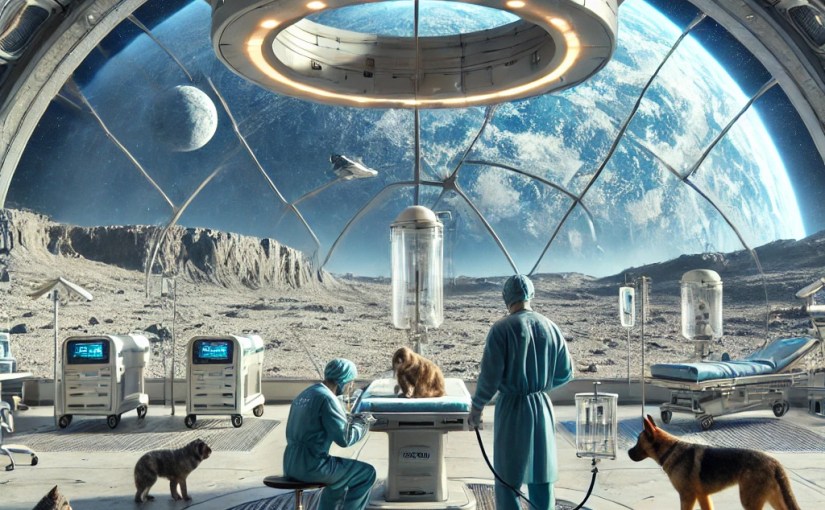
Part 2: Life and Work as a Veterinarian on the Moon
Veterinarian on the Moon
As Aryan walked through the quiet corridors of the lunar habitat, his mind remained divided between two worlds—the Earth he had left behind and the Moon that now shaped his existence. The trade routes had been established, and life on the Moon was gradually settling into its rhythm. Yet, something kept gnawing at him—what was his true purpose here? Treating animals in space was undoubtedly a fascinating challenge, but the larger questions of existence, contemplation, and transformation were becoming equally important.
One thing that struck him deeply was how the Moon’s calm and undisturbed environment encouraged deep meditation. There was no daily chaos, no distractions, only the vast silence stretching endlessly beyond the domes. It was the perfect place to sink into the depths of contemplation. But then a thought arose—what would he even contemplate if he hadn’t first absorbed the images, memories, and emotions from Earth? The Moon felt like the second half of a movie, but could the second half even exist without the first? How could he ignore the role of Earth in shaping his spiritual path?
The moonites—those original inhabitants with large heads and an aura of tranquility—lived in a breathless state of pure prana. They were beyond the need for food, air, or water, existing in a state similar to Kevala Kumbhaka. Yet, something fascinating was happening. The influence of earthly colonists had started disturbing their stillness. Some of them, for the first time, were drawn to the practice of contemplating visible images—mainly of ancestors. It was as if the subtle chaos of Earth had reached even this meditative civilization, pulling them slightly away from their formless awareness into a more structured form of devotion. However, they had always contemplated their ancestors, but not out of compulsion or a need for growth. It was merely a way to receive a slight meditative stimulus, a gentle touch of form within their vast formless awareness. It means they used to oscillate between Nirvikalpa and Savikalpa Samadhi as a form of meditative play—shifting effortlessly between pure awareness and subtle form contemplation, not out of necessity but as a kind of spiritual amusement.
This shift fascinated Aryan. It made him realize that pure awareness, without any visible mark or symbol, could be directly contemplated—just as the moonites had done for eons. But when chaos arose, even the most subtle minds found comfort in visible symbols. It was as if they had momentarily forgotten their pure awareness, and contemplation of form was a way to regain that lost depth. It reminded him of the gods on Earth—silent and untouched, requiring neither food nor breath. Yet, when devotees offered prasad, water, or incense, the divine forms seemed to respond, becoming alive in their presence and bestowing blessings.
Amid these thoughts, Aryan found himself returning to his work. His task was unlike anything he had ever done on Earth. Treating animals in space came with unique challenges—gravity played tricks on their bodies, food digestion patterns changed, and even their biological clocks struggled to adapt. The livestock brought from Earth had initially faced severe difficulties. Cows produced less milk under reduced gravity, and birds struggled to fly in enclosed habitats. But Aryan, with his deep experience, adapted quickly. He experimented with customized diet plans, artificial gravity systems, and even subtle pranic healing techniques inspired by the moonites’ breath mastery.
On one day, a particular Moonite had been found weak, barely able to hold its form together. When Aryan was called in to help, he realized that it was not suffering from any disease—it was experiencing a kind of “pranic depletion,” something that had no equivalent in earthly medicine. With a carefully controlled approach, Aryan introduced a mild electromagnetic pulse, simulating Earth’s natural energy fields. The Moonite, which had been fading, slowly regained its form, pulsing gently as if breathing once more. It was a success, yet it left Aryan pondering—what did it mean to be alive? Were prana and awareness the true essence of existence?
While working among different types of peculiar and strange lunar creatures never seen and heard about on earth, one question haunted him: Why did life continue to push beings toward survival and reproduction? He had observed that when people or creatures found themselves dissatisfied with their own growth, they instinctively turned toward procreation—as if passing the baton to the next generation would ensure victory. But he knew nature had a higher demand. Instead of just multiplying endlessly, what if humanity learned to divert that energy toward inner transformation? The Moon, with its meditative aura, seemed to whisper this very lesson.
Aryan often reflected on the nature of prana itself. Prana down means death, prana up means life. But what about a state beyond both? If prana was neither up nor down, it meant neither life nor death—just pure awareness. The constant up-and-down movement of prana created the experience of life and death in cycles. When someone died, their prana did not completely vanish. It was said to exit through the lower chakras, meaning it still functioned but at an extremely low frequency—too subtle to produce conscious thoughts. That’s why the world felt dark and empty after death. But the subconscious mind, powered by this low-level prana, remained active. If it wasn’t dissolved through yogic samadhi before death, it carried forward into the next birth.
This made Aryan realize something profound. Prana is never truly absent—it only becomes unmanifested. And that’s why the Moon felt so meditative. The entire environment was pranaless—not in the sense of being dead, but in the sense of prana being undisturbed by agitated breathing beings. Whether it was the lifeless landscapes or the breathless moonites, all existed in a kind of silent equilibrium. In contrast, Earth was chaotic because prana was constantly being stirred, disturbed, and reshaped by the countless beings breathing upon it.
His thoughts deepened as he observed the subtle changes in the moonites. Many had begun interacting with the colonists and adopting their ways. The influence of earthly life had introduced new ideas—both good and bad. Was it inevitable? History had shown that civilizations untouched by outside forces remained pure but also stagnant. Could it be that a little chaos was necessary for evolution?
Aryan, though deeply introspective, did not let these thoughts interfere with his work. He had built a strong team—highly skilled and dedicated individuals who shared his holistic approach. Unlike Earth’s rigid professional culture, where only technical skills were valued, Aryan encouraged personal and spiritual growth as well. He gave his team full freedom to explore their potential, knowing that true excellence came from inner fulfillment, not just external discipline. In return, his workforce worked with full dedication, free from unnecessary resistance.
Meanwhile, lunar society functioned with an introverted and self-contained style. People rarely interfered with one another’s affairs, and unnecessary criticism was absent. Their nonviolent, silent, and contemplative culture reminded Aryan of ancient sages who withdrew from the world to seek the ultimate truth. But he also knew that withdrawal was not the complete answer. One had to experience life in order to transcend it.
Looking back at his own journey, he realized he had come to the Moon for many reasons—scientific, professional, and spiritual. But now, he saw the deeper significance. It was not just about treating animals in space or adapting to a new world. It was about learning from a civilization that had mastered stillness, while also recognizing that change was inevitable. Even the moonites, as timeless as they seemed, were beginning to shift under the influence of earthly life.
For Aryan, this meant one thing: Nothing remains untouched forever—not even the Moon.
And perhaps, in that truth, lay the greatest lesson of all.

 Demystifying Kundalini