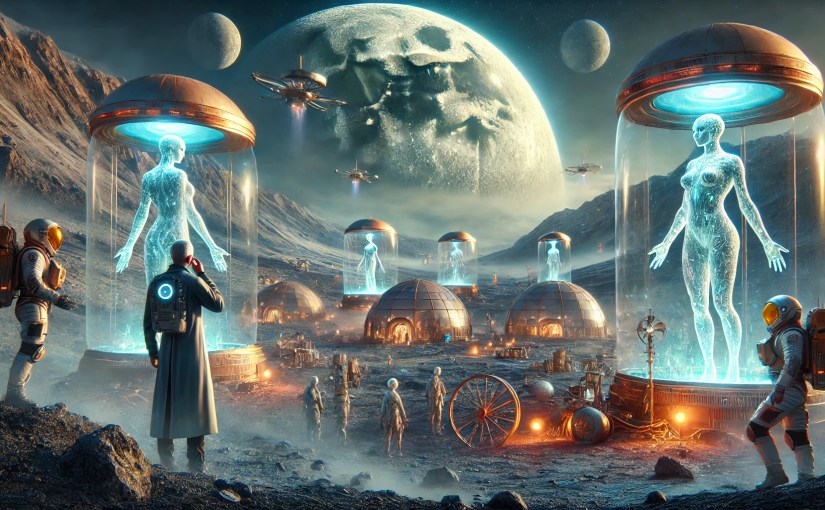
Dr. Aryan Verma sat on the edge of his lunar home’s terrace, gazing at the brilliant blue Earth suspended in the sky. The sight never failed to stir something deep inside him—memories, emotions, attachments, everything that still connected him to his ancestors on Earth. His parents, his extended family, their voices, their traditions—everything still existed on that distant world, yet it all felt like a different lifetime.
He had spoken to them many times through holographic calls, had seen their wrinkled yet loving faces, heard their laughter, their concern for him, Meera, Avni, and Ansh. And yet, something was missing. They were still bound by time, while here on the Moon, time itself felt like an illusion. The tranquility was so vast, so immersive, that years felt like days. The more he lived here, the more he lost touch with the sense of linear time.
Meera joined him, placing a warm hand on his shoulder. “You’re thinking about them again, aren’t you?”
Aryan nodded, sighing. “I can’t help it. Time here moves so fast, Meera. Every time I talk to them, they seem older, frailer. But for me… it feels like just yesterday that we left Earth.”
Meera sat beside him, wrapping her arms around her knees. “They must feel the opposite. For them, we’ve been gone for years, and they must wonder how we have changed.”
Ansh, who had overheard them, walked up, curiosity in his young eyes. “Why don’t they come here, Papa? We have everything—oxygen domes, food, Moonites who help us.”
Aryan ruffled his son’s hair. “It’s not just about comfort, beta. It’s about belonging. They belong to Earth, just like we are slowly belonging here. The air, the soil, the memories—everything ties them to that world. And even if they came here, they wouldn’t feel at home.”
Avni, who had been quietly listening, added thoughtfully, “Maybe they are afraid. Afraid of losing what makes them feel human. The Moon… it’s peaceful, but it’s also unsettling. Too much silence. Too much stillness.”
Meera nodded. “Even I feel it sometimes. It’s like the whole Moon is in deep meditation, and we are intruding.”
The Rising Need for Oxygenated Domes
Their conversation was interrupted by a call from the lunar administration. Aryan picked up the communicator, and a familiar voice crackled through.
“Dr. Verma, we have a problem. More and more Moonites are starting to breathe. The oxygen demand is rising, and our dome expansion projects are behind schedule. We need immediate solutions before it gets out of hand.”
Aryan exchanged a worried glance with Meera before responding. “Understood. I’ll be there soon.”
The need for more oxygenated domes was becoming a serious issue. The Moonites, the native beings of this land, had always existed without the need for breathing. But as they interacted with humans, some of them had started learning this biological function.
At first, it was an astonishing discovery—breathless beings suddenly experiencing the sensation of inhaling and exhaling. But with breathing came hunger, thirst, exhaustion—sensations alien to their existence. This was why the lunar settlers had initially limited their direct contact with Moonites. Teaching them to breathe meant changing their very nature, and if too many of them learned, the consequences could be catastrophic.
Terraforming the Moon was still an ongoing plan, but until it was completed, resources were limited. If every Moonite became a breather, the entire colony could collapse under the strain.
The Silent Helpers
Despite this growing crisis, the Moonites had been incredibly helpful to earthly settlers. They had provided rare minerals, built roads, constructed homes, developed food systems, and even assisted in medical research.
But their help was different—it was not given with expectation or obligation. They served with an extreme level of selflessness, as if it was their very nature to do so.
One day, Aryan had asked a Moonite, “Why do you help us so much without asking for anything in return?”
The Moonite had simply replied, “We do not help. We do not give. It simply happens.”
Their selflessness was beyond human comprehension. They didn’t have hunger, desires, or any personal needs, which made their service purely instinctive—a manifestation of their pure awareness. They were completely satisfied with whatever they had, much like a true Karmayogi.
Yet, many settlers refused to see them as living beings.
“Advanced robots,” some argued. “They’re just like artificial humanoids on Earth. Either they evolved on their own or were created by some ancient alien civilization that later went extinct.”
Others, like Aryan, disagreed. “They’re not robots. They evolve, they learn, they feel—but in a way different from us. Their spirituality is untouched by corruption. They are alive, just breathless.”
Some colonists even believed the Moonites were the remnants of an old alien war—beings who had survived, while their creators perished. The theories varied, but none could deny one thing—the Moonites were changing.
The Dangerous Consequence of Breathing
As more Moonites learned to breathe, their minds began changing.
One day, a Moonite stumbled into Aryan’s lab, confusion evident in his usually calm eyes. “Doctor… something is wrong. There is… an emptiness inside me.”
Aryan studied him carefully. “What do you feel?”
The Moonite hesitated before answering. “Something inside… it needs to be filled.”
Aryan’s heart sank. “That’s called hunger.”
With hunger came the need for food. With food came the need for resources. And with limited resources came conflict.
The settlers had been so overwhelmed by the Moonites’ kindness that, in their gratitude, they had started teaching them how to breathe. But they hadn’t foreseen the consequences. If every Moonite started breathing, the Moon would soon face the same struggles as Earth—overpopulation, hunger, inequality, crime, wars.
Meera voiced what they were all thinking. “Are we corrupting them?”
Aryan exhaled heavily. “It’s not corruption. It’s evolution. But the question is—how do we control it before it destroys everything?”
A Looming Crisis
There was an irony in the situation. While some settlers were trying to learn the breathless way of life from the Moonites, many more Moonites were learning breathing from humans. The balance was tilting dangerously.
Avni, always perceptive, mused, “Maybe some things should never be taught.”
Ansh, still innocent, asked, “But they just want to be like us, right?”
Aryan looked at his son, then back at the Moonites working tirelessly in the distance. “Or maybe we should have wanted to be like them.”
He turned to Meera. “We have to find a way to preserve their nature while protecting ours. If we let things continue unchecked, the Moon will soon become another Earth, and all the purity of this place will be lost.”
Meera squeezed his hand. “Then we have to act fast, before history repeats itself.”
Aryan nodded. The Moonites had prepared for their arrival for millions of years. They had welcomed them with open arms, with nothing but selflessness in their hearts. But now, humanity’s presence was altering them. The future was uncertain, and it was up to them to decide whether it would be one of harmony or disaster.
And for the first time, Aryan truly wondered—who was saving whom?

 Demystifying Kundalini