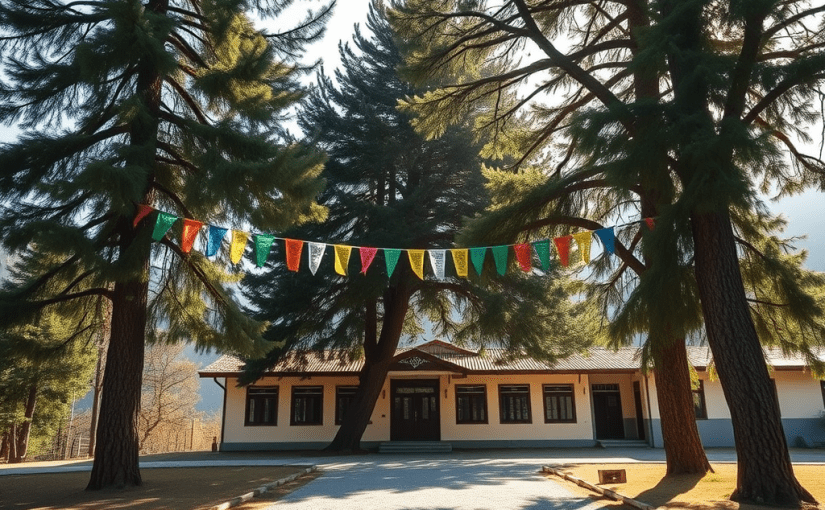
The scent of resinous pine hung softly in the air, like the memory of something sacred.
As Ishaan stepped down from the last rickety bus that had brought him up the winding roads from the comfort of home, a silence greeted him—one that wasn’t empty, but full. It was as if the mountains themselves were holding their breath. The sunlight filtered through tall deodars, dappling the gravel path like blessings from the sky. His city-worn shoes crunched over dry needles and hidden pebbles, but even that sound felt respectful here, hushed by nature’s quiet grandeur.
He paused. His gaze wandered to the fluttering prayer flags strung between two oaks—tired from the wind, but still dancing. Somewhere nearby, a bird sang just once, then flew off, its wings slicing the silence like a whisper.
This was not the city. Not even close.
Not the crowded school he had tried earlier in Chandigarh even though for a very brief period—a place full of vehicles, vending machines, and voices louder than thoughts. That city school had promised everything—facilities, computers, science labs, even a swimming pool—but the noise! The endless, soul-numbing hum of engines, gossip, mobile phones, and ambition. There, no one really studied. They competed. No one really listened. They just waited for their turn to speak. Ishaan’s heart, already too soft for that world, had shrunk into itself like a turtle under threat.
This, however, was different. That’s why the mountains, his inborn mates, were calling him back once again—away from the hustle of the city.
Here, amidst the thick woods of Himachal Pradesh, was a modest civilian school nestled within a cantonment area—a strange blend of order and calm. Though the buildings wore no army badge, the air carried discipline, a certain stillness of routines long practiced. The cantonment itself was mostly civilian now, with shops and households run by locals, but the army’s subtle influence hung in the backdrop like a prayer woven into the air—never loud, never pushy, just present.
Even the wind seemed to move with purpose.
He approached the school gate, where two children—perhaps from the senior classes—stood chatting softly, their uniforms neat and their postures straight. One of them looked at Ishaan and gave a small, sincere smile. Not the polished, indifferent half-smile of city kids, but something more human.
“Ishaan Sharma?” a voice called from the porch.
He turned. A teacher, tall and lean, with streaks of silver in his hair and eyes that had clearly seen more than textbooks, stepped down the stairs and offered a hand. “Welcome to Pine Crest School.”
Pine Crest.
Even the name carried dew.
As Ishaan walked beside him toward the main building, he noticed everything—the prayer flags near the flagpole, the scent of turmeric wafting from the kitchen, the rhythmic chirping of crickets from somewhere behind the library. No noise. No rush.
For the first time in many weeks, his heartbeat matched the rhythm of his steps
A Different Kind of Routine
The days that followed were unlike anything he had imagined. Here, students stood up when teachers entered not out of fear, but habit. The morning assembly wasn’t a chore—it was an invocation. Each student spoke something—a quote, a poem, a prayer—not to impress, but to share. And the teachers, though firm, seemed like mountain guides—always watching, but never pushing too hard.
The classrooms were modest—no smartboards, no plush seating—but what they had was attention. Focus. A kind of warmth that even broken desks couldn’t hide. Ishaan would often catch himself staring at the window during lectures, only to realise that the lessons were somehow seeping in even as he drifted. It was as though the very air here whispered equations and metaphors.
One day, during recess, a curious boy named Gagan plopped down next to him with a lunchbox full of pickled lingdu and chapatis.
“You’re the city guy?” he asked, mouth already full.
“I was,” Ishaan smiled. “Now I’m here.”
Gagan squinted like a monk considering a riddle. “You’ll stay. People like you always stay.”
“Why?”
“Because you look like you came searching for something.”
That line stayed with him longer than the taste of wild fern pickle.
The Silent Guru
The school had no formal guru. But in the silence between lectures, during the morning PT runs under foggy skies, or while sitting alone on the sun-warmed steps of the old temple behind the school, Ishaan found teachings more profound than words could ever deliver.
Once, during a class on moral science—a subject often laughed off elsewhere—the teacher, Mr. Dutt, placed a pebble on the table.
“What is this?” he asked.
“A stone,” someone replied.
“A weapon,” said another, giggling.
Mr. Dutt smiled. “Yes. But it is also a reminder. This came from a river nearby. Rolled, shaped, softened over decades. Like you. Life will toss you, polish you, bruise you—but if you allow it, it’ll shape you. Into what? That’s your choice.”
Something stirred in Ishaan’s heart.
He had thought transformation was loud, like lightning splitting the sky. But here, it arrived on little feet. Quiet. Patient.
That evening, he wrote in his journal—a habit he had picked up from the school’s curious emphasis on self-reflection:
> “I thought I needed a guru in saffron robes, speaking mantras. But maybe the pine trees are my gurus. Maybe the wind that wakes me up is. Maybe I am.”
Whispers in the Forest
There was a trail behind the hostel—a winding path that led to an abandoned British-era stone bungalow half-swallowed by moss. Rumor had it a saint once lived there. Some said it was haunted. Others said it was blessed. Naturally, the boys were forbidden to go.
Naturally, Ishaan went.
One misty Sunday morning, he followed the deer-trodden trail alone. With each step, the air thickened—not with fear, but with a kind of electric stillness. The kind you feel before a revelation. Or a memory.
The bungalow appeared like a forgotten temple, cradled in vines and secrets. He stepped inside. Dust motes floated like souls in sunlight. There were no ghosts, but in the silence, he heard something deeper.
His own breath.
His own heartbeat.
And then—nothing.
A strange emptiness bloomed inside, and for a fleeting second, he felt his “I” dissolve. No name, no class, no boy from the hills—just an awareness. Expansive. Eternal. Not frightening, but freeing. Like falling into the sky and finding it soft.
Then a bird chirped.
And the moment passed.
But it had happened. He couldn’t un-feel it.
The Awakening
Back at school, things seemed the same—but something inside had changed.
When he looked at classmates, he saw not competition, but stories. When teachers scolded him, he didn’t shrink—he listened. When the school’s peon, old Lalaji, limped across the corridor, Ishaan no longer ignored him. He offered a hand. And a smile.
“Something’s different about you,” Gagan remarked one evening.
“I think I’m just… beginning to notice things.”
Gagan nodded. “That’s how it starts. Before you know it, you start noticing yourself.”
Epilogue to a Beginning
Months passed.
Winter arrived with silence painted in snow. The mountains donned white robes like saints meditating in plain sight. The school felt warmer somehow. Perhaps because Ishaan had stopped looking for warmth outside.
He had come to escape the city. He had stayed because this place—this school wrapped in deodars, shadowed by army boots but sung into silence by birds—had taught him what no classroom ever could:
That discipline was not about rules, but rhythm.
That spirituality didn’t always wear beads—it sometimes wore sweaters and read geography.
And that the first guru… often waits quietly… until the student becomes silent enough to hear.

 Demystifying Kundalini