One day, a question naturally arose in me:
Did Gautam Buddha directly enter Nirvikalpa Samadhi while sitting under the Bodhi tree?
Did he attain keval kumbhak—the effortless suspension of breath?
Did he pass through Savikalpa Samadhi, where forms and ideas are still present, before going beyond?
This wasn’t just a curiosity. I asked this from my own lived journey. I’ve touched a deep state of Savikalpa Samadhi—where the sense of “I” dissolved completely, and only pure consciousness remained. It didn’t feel like something I was imagining. It felt absolutely real. Blissful. Expansive. Still, I couldn’t stay in it. I consciously brought myself back—out of fear, maybe, or a sense that the experience was too much to hold. I massaged my forehead and intentionally lowered the energy to the Ajna Chakra, perhaps to stay grounded in worldly life.
I haven’t experienced Nirvikalpa Samadhi yet—the complete absorption beyond all ideas, forms, even bliss. I haven’t reached keval kumbhak permanently either. But I’ve had a glimpse, and that glimpse continues to guide me. So I wanted to understand—what really happened under the Bodhi tree? Did Buddha walk the same path I’ve been walking?
From what I’ve read and understood, Buddha passed through deep meditative states that closely resemble the stages of Samadhi described in the yogic tradition. In Buddhism, these stages are called Jhanas. They begin with focus and joy, move into silence and pure awareness, and go further into formless states—like infinite space, infinite consciousness, and finally, neither perception nor non-perception. These are not imagined states—they are real, lived inner experiences.
In yogic terms, these states are like Savikalpa Samadhi leading into Nirvikalpa. In both systems, the mind becomes still, the ego dissolves, and a pure, unborn awareness remains. Some call this Self. Others, like Buddha, avoided calling it anything at all.
That brings me to a deep doubt that arose within me:
If Buddha denied the idea of a permanent soul or self, then how is Nirvana—which he attained—said to be permanent?
The answer lies in how Buddha approached truth. He didn’t deny the ultimate. He denied that anything we think of as “me” or “mine” is ultimate. He didn’t say there’s nothing beyond—he simply refused to give it a label, refused to trap it in words. Because any word would have become another idea, another attachment. He was silent not because there was nothing, but because what is cannot be spoken.
In that silence, there is no contradiction. Nirvana is not a “thing” that lasts forever. It is the end of all becoming, all clinging, all identification. It’s not the presence of something new—it’s the cessation of all illusion. It’s the stillness when the winds of craving stop blowing.
So is Nirvana the same as Nirvikalpa Samadhi? Maybe not in name, but in essence, they seem to meet. One path says, “I am That”—the timeless Self. The other says, “There is no I”—only the cessation of becoming. But in both, the seeker dissolves. What remains is not “something.” It’s the background silence that was always there.
I know I haven’t reached that silence permanently. I still feel the pull of the world. I still ground myself when energy goes too high. I use some techniques, even earthy ones, to stay balanced. My sadhana isn’t perfect, but it’s deepening. My curiosity is alive. And more importantly, my honesty is alive.
Sometimes I wonder if that early adolescent dream-state I had—which brought more bliss and detachment than anything since—was a preview of what’s to come. Or maybe it was a gift, reminding me what I’m seeking, what I’ve momentarily touched again through tantric sadhana and now through Kriya Yoga.
One thing I’ve learned: the journey is not always upward. Sometimes the energy rises, sometimes it settles. I no longer cling to either. I’ve realized that even bringing the energy down has its own sacredness—its own intelligence.
Here’s a simple reflection that came through this process:
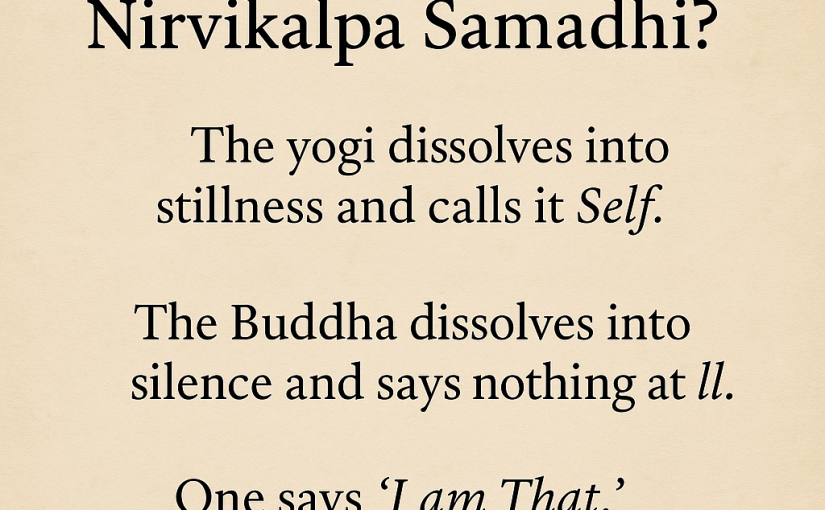
The yogi dissolves into stillness and calls it Self.
The Buddha dissolves into silence and says nothing at all.
One says “I am That.”
The other says “There is no I.”
But both sit in the same unmoving stillness, beyond joy and sorrow, beyond life and death.
Maybe it doesn’t matter what we call it. What matters is living in a way that moves toward that silence, that freedom. Not with force, not with fear, but with surrender, awareness, and love.
To those walking a similar path—between glimpses and grounding, between depth and daily life—this reflection is for you. I haven’t finished the journey. But I’m walking it with eyes open and heart awake.
And in the hush between two breaths, I sense something vast. Not mine. Not even “me.” Just what remains when all else falls away.

 Demystifying Kundalini