Wrathful Buddha, Tara, and the Meditating Buddha: My Profound Meditation Experience at McLeod Ganj Monastery

A Weekend Visit to McLeod Ganj and an Unexpected Meditation Experience

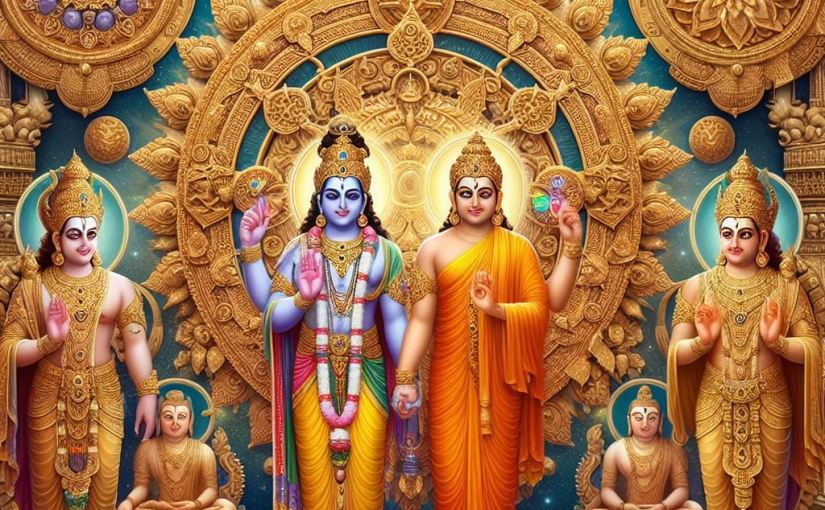
Last weekend, I visited McLeod Ganj using the ropeway (Skyway) from the nearest main city. One of my main purposes was to spend some quiet time meditating in the famous Buddhist monastery there. As I entered the temple and sat for dhyana, I became deeply aware of the arrangement of the sacred statues placed before me. I also noticed that this layout appears to be common in many Tibetan Buddhist temples. There was a beautiful female deity on the right side, a fierce-looking Buddha or wrathful Buddhist figure close to her, and in the center of the front wall sat the largest statue—a serene Buddha in lotus posture absorbed in deep meditation. As my meditation unfolded, I felt that these three figures were not merely independent idols but seemed to contribute differently toward a single meditative journey. Their influence appeared interconnected, each helping a different stage of meditation while ultimately leading toward the same goal.

The Gentle Influence of the Feminine Figure in Deepening Meditation

As I settled into meditation, I first found myself naturally drawn toward the beautiful feminine figure. Simply sitting in her presence seemed to make meditation easier. My mind became softer, more receptive, and more willing to enter silence. The effect was gentle rather than forceful. Because of my long experience with Kundalini Yoga and Tantra, I felt that the feminine presence was helping meditation in a distinctly tantric manner. It seemed to awaken receptivity and inner openness without disturbing the peace of the mind. Whether this was due to my own background or the symbolic nature of the deity itself, I cannot say with certainty, but the experience was unmistakable. The feminine form appeared to prepare the mind for a deeper journey inward.

How the Wrathful Buddha Intensified My Meditation

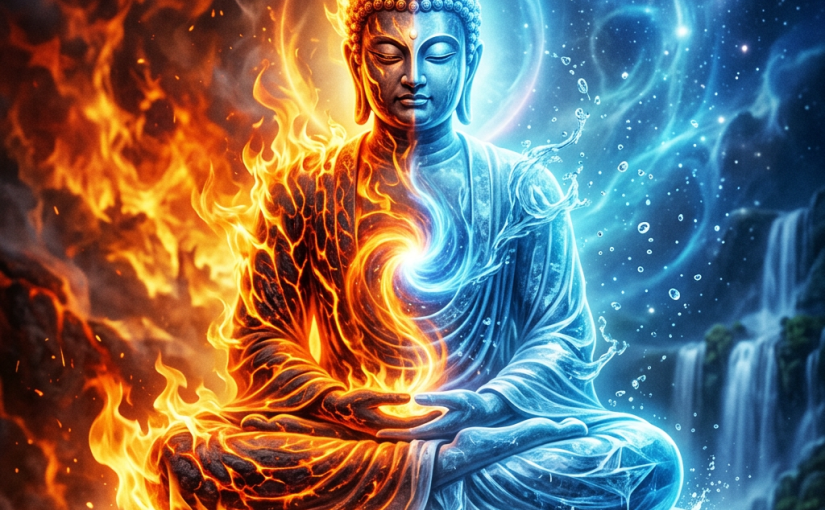
As meditation deepened further, I became increasingly aware of the nearby wrathful Buddha or fierce Buddhist figure. Surprisingly, this statue affected me even more strongly than the others. I felt that it intensified and stabilized my meditation. The expression of the deity appeared full of tremendous energy and tension, and I found that it matched my own internal state remarkably well. During many years of my meditation practice, I have repeatedly observed that my dhyana often begins with rising energy. The movement of prana creates pressure and intensity before eventually settling into effortless stillness. While sitting in the monastery, I felt that the fierce expression of the wrathful Buddha resonated with this energetic phase. My own rising energy and the symbolic energy represented by the statue seemed to reinforce each other. The internal energy became more focused instead of scattered. Rather than creating fear, the wrathful form appeared to help sustain concentration. Because I was passing through an energetic phase of meditation, this figure influenced me more strongly than the peaceful Buddha.

The Peaceful Buddha as the Destination of Meditation

Although the wrathful Buddha influenced me the most during that particular meditation session, the central meditating Buddha had an equally important role. Sitting in perfect lotus posture, radiating complete peace and stillness, the central Buddha seemed to represent the destination toward which the entire meditation was moving. As the energetic phase gradually settled, the peaceful presence of the meditating Buddha introduced qualities of bliss, calmness, spaciousness, and expansion. The experience suggested that energy itself is not the final goal. Instead, energy prepares the mind to enter deeper silence, where peace naturally becomes dominant. The largest Buddha did not appear to stimulate energy but to absorb it into complete equilibrium.

A Possible Interconnection Between the Three Sacred Figures

While reflecting upon the entire experience, I felt that the three statues formed a meaningful progression rather than three unrelated objects of worship. The feminine figure first appeared to open the mind and gently deepen meditation. The wrathful Buddha then seemed to intensify, strengthen, and stabilize the rising energy that accompanies my meditation. Finally, the central meditating Buddha brought that transformed energy into complete peace, bliss, and expanded awareness. Whether this sequence was intentionally designed by the temple architects or simply emerged through my own psychological and spiritual background, I cannot say with certainty. Nevertheless, the experience itself felt remarkably coherent. Each figure appeared to support a different stage of the same meditative journey while pointing toward a common destination.

Understanding the Experience Through Vajrayana Buddhist Symbolism

After reflecting upon this experience, it became clear that Vajrayana Buddhism often presents peaceful and wrathful forms not as contradictory but as complementary expressions of enlightenment. The fierce appearance of wrathful deities does not symbolize ordinary anger. Instead, these forms represent uncompromising wisdom that destroys ignorance, attachment, fear, and ego. I also felt this during my meditation. It seemed to me that the wrathful Buddha was angry at the stuck emotions that give rise to suffering, not at wisdom or humanity. Psychologically, such an image may help practitioners remain steady while encountering powerful inner experiences during meditation. In my own case, the wrathful form appeared to match the intense energetic phase through which my meditation naturally passes. This rising energy destroys the defects of the mind, just like the wrathful Buddha destroys demons. The external symbol and the internal experience seemed to align, making concentration deeper and more stable.

The feminine figure may also be understood through Vajrayana symbolism. Female deities often represent wisdom, compassion, receptivity, and enlightened qualities rather than merely feminine beauty. Since my own spiritual background includes many years of Tantra and Kundalini practice, it is natural that my mind interpreted the feminine image as assisting meditation in a tantric manner. My experience therefore reflects both the symbolic richness of Vajrayana Buddhism and the influence of my own spiritual training.

From Energy to Stillness: A Personal Understanding

Looking back, I feel that my meditation passed through three natural stages. First came openness and receptivity inspired by the feminine figure. Second came transformation through the powerful influence of the wrathful Buddha, whose fierce expression seemed perfectly aligned with the rising energy within me. Third came stillness through the serene meditating Buddha, who represented peace, balance, bliss, and expanded awareness. This progression may simply be described as opening, transformation, and stillness. In terms familiar to my own experience, it also resembles the movement from awakened energy toward effortless awareness. Energy rises, becomes focused, and finally dissolves into silent equanimity.

This understanding also corresponds with an observation I have repeatedly made in my own meditation practice over many years. My meditation usually begins with feminine-inspired energetic activation, pressure, or the upward movement of prana. Only after this energetic phase settles does effortless meditation naturally emerge. Because I happened to be in this activation phase while sitting in the monastery, it is understandable that the wrathful Buddha exerted the strongest influence upon my meditation. Had I already entered deep effortless samadhi before sitting there, perhaps the central meditating Buddha would have become the most powerful influence instead.

Personal Experience and Buddhist Symbolism Can Coexist

One important distinction should be maintained. The experience described here is my own meditative experience. It does not necessarily prove that every visitor to the monastery will experience the statues in the same sequence or that the temple was consciously designed to produce exactly these psychological stages. Different practitioners carry different backgrounds, different methods of meditation, and different states of mind into the temple. Some may be attracted immediately to the peaceful Buddha, others to the feminine deity, and still others to the wrathful form. My own response was undoubtedly influenced by years of Kundalini Yoga, Tantra, and meditation practice.

Nevertheless, what impressed me most was the remarkable harmony between my internal meditation process and the symbolic forms placed before me. The feminine figure gently invited the mind inward. The wrathful Buddha strengthened and stabilized the energetic phase of meditation without creating fear. The central meditating Buddha completed the journey by introducing profound peace, spaciousness, bliss, and equilibrium. Whether viewed spiritually, psychologically, or symbolically, these three sacred forms appeared to work together toward a single purpose—guiding the practitioner from openness through transformation into complete meditative stillness.

Buddhist Dependent Origination, Quantum Darshan and Sharirvigyan Darshan: How a Simple Solar Monk Toy Changed My Way of Contemplation

Sometimes profound philosophical insights come not from large scriptures or scholarly books but from the most ordinary objects. This realization came to me through a small solar-powered Buddhist monk toy. At first glance it appeared to be nothing more than a decorative item whose head nodded and whose hand struck a wooden drum when exposed to light. However, the Chinese words printed on its packaging gradually unfolded into a complete lesson on Buddhist philosophy. While reading every sentence on the box and reflecting upon its meaning, I found striking similarities with my own philosophical explorations, namely Sharirvigyan Darshan and Quantum Darshan. The experience became a meditation in itself and taught me that deep wisdom can hide inside the simplest things.

The package identified the toy as a solar-powered Buddha ornament. It explained that the monk moves only in the presence of light through a tiny solar panel and therefore requires neither batteries nor charging. Initially this appeared to be a simple product description, but on deeper contemplation the mechanism itself became symbolic. The monk remains motionless until suitable conditions are present. As soon as light reaches the solar panel, movement begins naturally. This simple functioning itself became an illustration of the Buddhist doctrine repeatedly printed on the package—that everything arises only when appropriate causes and conditions come together.

The Meaning of Dependent Origination Hidden on the Toy Box

The most important sentence printed on the package stated that everything comes into existence through the coming together of causes and conditions, and that conditions arise and disappear naturally. Another side prominently displayed the Chinese character representing karmic connection, destiny and dependent conditions. The accompanying verse explained that relationships arise, continue and disappear according to conditions and that everything should be accepted as it unfolds naturally. Reading these words, I immediately understood that the central teaching was not fatalism but dependent origination. Nothing exists independently. Every event, every relationship and every experience depends upon innumerable conditions.

This understanding naturally weakens the ego. If every action depends upon countless visible and invisible circumstances, then the feeling that “I alone am the doer” begins to dissolve. The teaching does not deny action. Rather, it shows that action itself emerges from an interconnected network of conditions. This insight immediately resonated with my own philosophical thinking.

My Philosophy Also Resonates with Dependent Origination

As I contemplated these Buddhist teachings, I realized that they closely resemble Sharirvigyan Darshan. According to my understanding, the human body is not governed by a single independent doer. Instead, countless living cells perform their own functions in remarkable coordination. The apparent individual self emerges from this harmonious activity. Therefore, the sense of an isolated doer gradually becomes weaker. The Buddhist teaching that everything arises according to causes and conditions naturally harmonized with this perspective.

I also reflected upon my own writings and philosophical work. Earlier I may have viewed my books primarily as my personal creations, but dependent origination suggested a much broader vision. My philosophy has not arisen solely because of me. It emerged through innumerable conditions. My parents gave me this body and upbringing. Teachers contributed knowledge. Ancient spiritual traditions offered inspiration. My experiences in veterinary service, my observations, my meditation, my studies, modern science, language, readers, publishers, technology and even artificial intelligence all became conditions that helped shape my thinking. My own previous thoughts became conditions for later insights. Thus my work is indeed associated with me, but it cannot honestly be considered the product of an isolated self alone. It is the outcome of countless interconnected causes and conditions.

This realization does not reduce personal effort. Instead, it replaces pride with humility. One may still say that one’s mind and body served as important conditions through which the work appeared, but not that they alone produced it independently.

The Zen Teaching of One Leaf, One World

Another verse printed on the package deeply attracted my attention. It declared that one flower contains one world, one blade of grass contains one heaven, one tree is a Bodhi tree and one leaf is a Tathagata. Traditionally this beautiful Zen expression encourages contemplation that enlightenment is present everywhere and that every ordinary object reflects the entire universe.

While reflecting upon this verse, I found that it beautifully resonated with both Sharirvigyan Darshan and Quantum Darshan. It suggested to me that the principles governing the entire universe may also be reflected within its smallest constituents. Just as a leaf belongs inseparably to the whole tree, every cell belongs inseparably to the body and every atom belongs inseparably to the universe. Although the Zen saying itself is a spiritual metaphor rather than a scientific statement, it became a powerful contemplative bridge connecting ancient wisdom with my own philosophical reflections.

Every quantum interaction occurring anywhere in the cosmos is governed by the same universal laws that operate within a single leaf. The leaf contains atoms, molecules, cells, energy exchange, information flow, self-organization and countless quantum interactions, all functioning according to the same fundamental principles that govern the universe. Beyond this, Quantum Darshan proposes that every gross phenomenon has a corresponding subtle, molecular, atomic, quantum or informational expression. Thus, the organizational principles underlying galaxies, stars, ecosystems, societies and living organisms are reflected in corresponding forms within the leaf. Although the leaf does not physically contain every object in the universe, it embodies the same fundamental laws, interactions, patterns and organizing principles that pervade the cosmos. In this philosophical sense, the leaf is a microcosm of the universe. Therefore, the Zen statement ‘One leaf, one world; one leaf, one Tathāgata’ becomes not merely a poetic metaphor but a profound contemplative insight. Sharirvigyan Darshan extends the same principle to the human body, where every cell reflects the organizational principles of the whole body, while Quantum Darshan extends it further by proposing that the smallest quantum processes mirror the universal order. The whole universe is therefore present in every leaf—not because every physical object literally exists within it, but because every fundamental law, every essential interaction and every organizing principle of the cosmos is continuously expressed within it in subtle forms.

Quantum Darshan and the Role of Circumstances

The Buddhist doctrine of dependent origination also reminded me of Quantum Darshan. In quantum physics, observable outcomes depend upon the complete physical circumstances under which they occur. Although quantum mechanics itself does not state that particles possess or lack personal agency, it does show that outcomes cannot be understood independently of the physical conditions governing the system.

This inspired a philosophical reflection within Quantum Darshan. Quantum particles do not appear as isolated independent doers. Their observable behaviour depends upon the total circumstances, interactions and physical conditions. Likewise, in the gross world, events also arise through interconnected circumstances. Therefore, from the perspective of Quantum Darshan, the universe appears as an interconnected process rather than a collection of isolated independent actors.

This should not be understood as claiming that quantum mechanics scientifically proves the absence of a doer. Rather, it provides an inspiring scientific analogy that helps modern readers contemplate the deeper philosophical principle that events emerge from conditions rather than from isolated independent entities.

Scientific Analogies Make Philosophy Easier to Contemplate

While reflecting further, I realized that scientific foundations often make philosophical ideas easier to understand. Modern readers frequently relate more easily to concepts supported by biology, neuroscience or physics. Scientific observations provide concrete examples that help the mind contemplate abstract philosophical truths.

Science may establish facts such as the coordinated functioning of trillions of cells or the relational nature of quantum systems. Philosophy then extends these observations into broader reflections about human existence, consciousness and the sense of self. Such analogies do not constitute scientific proof of philosophical conclusions, yet they make contemplation more meaningful and accessible. Therefore, expressions such as “is consistent with,” “resonates with,” “is inspired by,” or “offers an analogy” are both intellectually honest and philosophically valuable.

The Solar Monk Became a Silent Teacher

The toy itself also became symbolic. It remains completely motionless in darkness. The moment sufficient light reaches its solar panel, the monk begins nodding and striking the wooden fish naturally without any battery or external command. This simple mechanism silently demonstrates the very doctrine printed on its packaging. Movement does not arise independently. It appears only when suitable conditions are fulfilled. In this way, the toy itself becomes a living illustration of dependent origination.

Lessons I Learnt from an Ordinary Toy Box

By the end of this contemplation, I realized that the Buddhist toy box had quietly taught me many lessons. It showed that everything arises according to causes and conditions. It suggested that the independent ego gradually dissolves when we recognize our dependence upon innumerable circumstances. It reminded me that my own philosophical writings are not solely my personal achievement but the flowering of countless conditions extending across my entire life. It connected naturally with Sharirvigyan Darshan, where coordinated cellular activity gives rise to the apparent individual, and with Quantum Darshan, where interconnected physical circumstances determine observable phenomena. The Zen teaching that one flower contains one world and one leaf contains the Tathagata further inspired contemplation that the whole may be reflected within every part, providing a meaningful philosophical analogy for my own explorations of the relationship between cells, atoms and the universe.

Ultimately, I discovered that profound wisdom does not always arrive through lengthy scriptures or complex philosophical debates. Sometimes it quietly appears on the packaging of a simple solar-powered Buddhist monk. An ordinary object became an extraordinary teacher. What began as curiosity about a decorative toy ended as a deep meditation on dependent origination, humility, interconnectedness, the dissolution of ego and the recognition that everything—including our thoughts, actions, discoveries and philosophies—arises through an immeasurable network of causes and conditions. That single toy box became a reminder that wisdom is available everywhere for those willing to pause, observe and contemplate.

Anattā, Ego, Quantum Darshan and Sharirvigyan Darshan: A Contemporary Scientific Perspective on Buddhist Detachment and Liberation

The Search for the Real Meaning of Anattā

One question continued to arise in my contemplation: What did the Buddha actually mean by anattā (no-self)? Was he denying the existence of everything, or was he pointing to something much more practical? As I reflected on this question, it became increasingly clear that the earliest Buddhist teachings do not declare that nothing exists. Rather, they challenge the assumption that there is a permanent, independent and unchanging entity that can rightly be called “I” or “mine.”

The Buddha analyzed the human being into the five aggregates—body (form), feelings, perceptions, mental formations and consciousness. He encouraged careful observation of each of these. Are they permanent? Are they completely under our control? Can any one of them truly be regarded as “This is mine, this I am, this is my self”? Since every aggregate is constantly changing, arises because of conditions and remains beyond complete personal control, none qualifies as an independent and eternal self. This understanding forms the practical basis of the doctrine of anattā.

Anattā Does Not Mean That Nothing Exists

This reflection also clarified another common misunderstanding. The Buddha did not teach that absolutely nothing exists. Instead, he described reality as a continuously changing and dependently arisen process. Phenomena arise through causes and conditions, remain for some time and eventually cease. What he denied was the existence of an eternal, separate and independently existing soul hidden within these changing processes.

An equally important point is that the Buddha did not explicitly proclaim an indescribable eternal True Self behind the aggregates. The earliest Buddhist teachings neither affirm such a Self nor simply declare that there is no self whatsoever. Instead, the Buddha consistently advised practitioners not to identify any conditioned phenomenon as “This is mine, this I am, this is my self.” His concern was practical rather than speculative. He deliberately refrained from metaphysical assertions that did not contribute directly to liberation.

The Practical Purpose of the Teaching of No-Self

The heart of the teaching is freedom from suffering. According to the Buddha, suffering persists because of attachment to “I” and “mine.” When attachment weakens, pride decreases, fear decreases, possessiveness diminishes and suffering gradually comes to an end. Thus, anattā is best understood as a liberating insight rather than merely a philosophical doctrine. It is a method of transforming one’s relationship with experience.

This understanding also led me to consider an intuitive possibility. Perhaps the Buddha rejected only the ego-bound sense of self because the ultimate reality, if there is one, lies beyond concepts and therefore cannot be adequately described. Such an interpretation has appeared in later philosophical dialogues, particularly in comparisons between Buddhism and Advaita Vedānta. However, if one remains close to the earliest Buddhist texts, it becomes evident that the Buddha himself never explicitly declared the existence of an indescribable eternal Self. Instead, he remained silent on such questions, directing attention toward direct insight into impermanence, dependent origination and the cessation of clinging.

A Philosophical Speculation on Why the Buddha Remained Silent About an Eternal Self

The earliest Buddhist teachings do not affirm the existence of an eternal, unchanging Self behind the five aggregates. Nor do they encourage seekers to search for such a Self. Instead, the Buddha consistently directed attention toward careful observation of body, feelings, perceptions, mental formations and consciousness, showing that each is impermanent, conditioned and therefore not suitable to be regarded as “This is mine, this I am, this is my self.” His purpose was practical: to end suffering by ending attachment.

What follows is my own philosophical speculation rather than a historical claim about early Buddhism.

I speculate that one reason the Buddha did not explicitly speak of an eternal, unchanging Self may have been pedagogical rather than metaphysical. Had he declared that such a Self exists, many people might immediately have tried to imagine it, conceptualize it or claim to possess it. Instead of becoming free from attachment, they might simply have shifted their attachment from the visible world to a subtle idea of the Self. The very teaching intended to liberate could itself have become another object of clinging.

The human mind has a natural tendency to grasp. In the name of realizing the eternal, it often ends up grasping what is temporary. People may mistake the body, the mind, mystical experiences, blissful states, thoughts, beliefs or even refined spiritual experiences for the eternal Self. Thus, the search for the unchanging can paradoxically become another form of attachment to changing phenomena.

From this perspective, the Buddha’s silence acquires a practical significance. Rather than giving the mind another doctrine to believe in, he repeatedly asked practitioners to let go of identification with everything that is impermanent and conditioned. His emphasis remained entirely on direct observation and the cessation of clinging.

My speculation is that when every conditioned form has genuinely ceased to be identified as “I” or “mine,” whatever is ultimately real, if such a reality exists, need not be grasped or declared. It would not appear as another object of knowledge or belief. Rather, it would simply remain of itself when all false identifications have fallen away. In this view, the ultimate cannot be attained by grasping; it reveals itself only when grasping has completely ended.

Whether this speculation is historically correct cannot be established from the earliest Buddhist texts. They neither affirm nor deny such a conclusion. Nevertheless, it offers a possible explanation for why the Buddha consistently avoided metaphysical assertions that might distract practitioners from the practical work of liberation. His teaching remained focused not on winning philosophical debates but on freeing human beings from suffering through the dissolution of attachment.

Seen in this light, the enduring message is profoundly practical: do not become attached even to the idea of the eternal. First become completely free from attachment to everything that changes. If there is an unchanging reality, it does not need to be possessed, imagined or defended. It remains beyond grasping, while all that is false naturally falls away.

My Reflection: Buddhism as the Practical Path of Detachment

This gradually led me to a simple conclusion. The Buddha primarily provided a practical method of detachment. His emphasis was not on constructing an elaborate metaphysical system but on removing attachment to ego. Once clinging disappears, liberation naturally follows according to Buddhist teaching. Whether one answers every metaphysical question becomes secondary compared to the practical transformation of consciousness.

Seen in this light, Buddhism can be understood as a timeless discipline whose primary aim is the dissolution of attachment rather than the establishment of speculative philosophical positions. This practical orientation is one of its greatest strengths.

Sharirvigyan Darshan as a Scientific Contemplation of Non-Ego

As I reflected further, I noticed that my own philosophical work in Sharirvigyan Darshan approaches the same practical goal through a different contemplative method. Instead of beginning with traditional philosophical analysis, it invites continuous observation of the body as a highly coordinated society of innumerable living cells. Every organ, tissue and function emerges through the harmonious activity of countless cellular units without having ego or any attachment. As this perspective deepens, the feeling that a single independent ego is the exclusive doer naturally begins to weaken. The body continues functioning with extraordinary intelligence, yet the sense of isolated personal agency becomes less convincing.

This contemplation is not intended to replace Buddhist insight but to provide an additional framework through which modern minds may cultivate detachment. Biology itself becomes a contemplative teacher.

Quantum Darshan and the Interconnected Nature of Reality

A similar observation arises through Quantum Darshan. Modern scientific understanding repeatedly reveals an interconnected universe governed by relationships, processes and universal principles rather than isolated independent entities. While quantum physics should not be used to claim scientific proof for spiritual doctrines, it can nevertheless serve as an inspiring contemplative model. When reality is viewed as an interconnected unfolding rather than as the activity of completely independent agents having ego or attachment, attachment to the egoic sense of being the sole controller naturally diminishes.

In this way Quantum Darshan offers another modern doorway toward contemplative detachment.

Three Different Approaches Toward the Same Practical Transformation

This comparison suggested an interesting parallel. Buddhism encourages practitioners to observe dependent origination and cease identifying with conditioned phenomena. Sharirvigyan Darshan encourages contemplation of the body’s coordinated cellular intelligence until the independent doer becomes less convincing. Quantum Darshan encourages contemplation of universal interconnectedness until the isolated ego loses its centrality. Although these approaches arise from different intellectual traditions, all three function as contemplative methods that reduce attachment to an independent self.

It would, however, be inappropriate to claim objectively that one approach is superior to another. Such a comparison cannot be established universally because different individuals respond to different contemplative methods. Buddhism has provided a correct practical roadmap for liberation. Different people can devise different ways of walking on that path. In this sense, Buddhism acts as a reference and inspiration for such contemplative philosophies. A more balanced understanding is that Sharirvigyan Darshan and Quantum Darshan provide additional contemplative frameworks expressed through the language of biology and contemporary scientific thought. Some modern readers may find these perspectives especially intuitive while pursuing the same practical goal of reducing egoic attachment.

Ancient Wisdom Expressed Through Contemporary Understanding

This realization gradually shaped the central vision of my philosophical work. Buddhism already provides a timeless practical path toward overcoming attachment through insight into impermanence, dependent origination and no-self. Sharirvigyan Darshan and Quantum Darshan do not seek to replace that path. Rather, they attempt to express the same spirit of contemplative detachment through concepts that resonate with the contemporary scientific mind.

Biology explains the astonishing coordination of countless living cells without any egoistic self. Modern science emphasizes interdependence, process and relational existence. These perspectives can become contemplative tools that help modern individuals understand and internalize ancient spiritual insights while continuing to live fully engaged in family life, professional responsibilities and society. Spiritual understanding need not require withdrawal from worldly life. Instead, scientific contemplation itself can become an aid to inner freedom.

A Contemporary Way of Walking the Ancient Path

This reflection ultimately led me to a position that harmonizes rather than competes with the great spiritual traditions. If Buddhism teaches the destination of liberation and provides the timeless practical discipline of detachment, then Sharirvigyan Darshan and Quantum Darshan may be understood as contemporary interpretative frameworks that illuminate the journey using the language of modern biology and scientific understanding. They do not replace the path established by the Buddha, nor do they claim scientific proof of spiritual truths. Instead, they offer additional contemplative models that many contemporary readers may find accessible while remaining actively engaged in worldly life.

The essence of this vision can therefore be expressed simply: Sharirvigyan Darshan and Quantum Darshan are not intended to replace the great spiritual traditions. They seek to reinterpret the timeless wisdom of detachment through the language of modern biology, scientific understanding and everyday worldly experience, making ancient contemplative insights more accessible to the contemporary mind. In this sense, the enduring spiritual objective remains unchanged—freedom from egoic attachment and the cessation of suffering—while the explanatory language evolves with the intellectual context of each age.

Quantum Darshan, Kundalini Meditation, and My Second Awakening: How a Living Meditation Image Led to Nondual Awareness

From Sharirvigyan Darshan to Quantum Darshan

After my first awakening experience during adolescence, many years passed before I experienced another glimpse of awakening. During those years, my understanding of spirituality gradually matured through contemplation and direct observation.

One of the most important developments was what I later called Sharirvigyan Darshan. Through this contemplation, I began to see the body’s cells not as lifeless components serving a central self, but as equal participants within a larger living system. This simple shift had a profound effect on the mind. The sense of being a separate controller standing above everything else gradually weakened.

Over time, this contemplation naturally expanded beyond the body itself. If body cells could be viewed as equal participants in existence, why stop there? This question eventually led me toward what I later called Quantum Darshan.

Quantum Darshan was never intended as a scientific theory. Its purpose was contemplative rather than scientific. I did not require scientific proof for it to be useful. In spiritual practice, effectiveness is often more important than verification. A contemplative framework only needs enough plausibility for the mind to engage with it deeply.

From ordinary observation and intuitive reasoning, I felt that existence displayed continuity from the smallest to the largest scales. Whether science ultimately agrees or disagrees was secondary. What mattered was that the contemplation reduced separation and expanded awareness.

Why Spiritual Effectiveness Matters More Than Scientific Proof

Many contemplative methods throughout history have operated in this manner. Their value lies not in laboratory confirmation but in their transformative effect upon consciousness.

For me, the practical question became simple.

Does a contemplation reduce separation?

Does it increase mindfulness?

Does it help dissolve judgment?

Does it make awakening more accessible?

If the answer is yes, then the contemplation has value regardless of scientific debates.

This was how I approached Quantum Darshan. The contemplation encouraged a sense of equality throughout existence. Human beings, body cells, thoughts, sensations, objects, and the countless expressions of reality could all be viewed as participating within the same existence.

The contemplation did not attempt to prove anything scientifically. Instead, it served as a practical support for expanding awareness and reducing the sense of isolation.

Nondual Contemplation as a Support for Mindfulness

Over time, I also discovered that nondual contemplation and mindfulness support one another.

During awakening itself, there is no need to think, “I am everything” or “I am everywhere.” The experience speaks for itself. Everything already appears equal and interconnected.

However, ordinary life is different. Mindfulness does not always remain equally strong. Daily activity can weaken it.

Whenever mindfulness diminished, I often found it helpful to contemplate, “Whatever exists, I am already therein.” Such contemplations, helped by the nondual philosophies described above, naturally replenished mindfulness and reduced the sense of separation.

What happens is that clinging to any specific sensation or thought with attachment or aversion produces a block to mindfulness. In my experience, resistance to mindfulness appears to be a natural safety response of both the mind and the body. Judgment tends to pull a person away from the deeper self by creating division, preference, and separation. So, when judgment is applied to one thought, the mind resists all thoughts, thinking that this will further push it away from pure awareness.

Although mindfulness reduces this process of judgment, the mind does not believe it in the beginning. It thinks that if judgment of one thought made it fall down, what will happen if the full mind tends to be judged? It may be that the mind unconsciously fears that if even one judgment is made, hundreds can also be judged. Since the mind is accustomed to maintaining its familiar patterns, it tries to avoid mindfulness in the very beginning.

However, when a person becomes genuinely nonjudgmental toward even a single thought, a small movement toward the fuller self takes place. The mind then experiences a subtle benefit from this reduction in conflict and separation. Motivated by this, it gradually becomes willing to include other thoughts, sensations, and experiences as well. One acceptance encourages another. The field of awareness slowly expands, collecting more and more of what was previously rejected. In this way, mindfulness grows naturally, progressing from acceptance of a single thought toward increasing inclusiveness, fullness, and ultimately the realization of the full self.

Looking back, the trigger for my mindfulness during adolescence appears to have been the mental image of Devrani. For some reason, the mind remained naturally nonjudgmental toward that image. There was neither strong rejection nor deliberate effort to sustain it. Because the image was allowed to remain as it was, without judgment, it gradually encouraged the same nonjudgmental attitude toward other thoughts, sensations, memories, and experiences. In this way, mindfulness continued to grow naturally and eventually culminated in my first awakening experience.

In the case of my second awakening, the trigger was different. There, the central meditation image was that of Dadaguru. Unlike the first case, this image was deliberately nourished through spiritual practice and gradually became vivid, alive, and powerful within awareness. It gathered attention, reduced mental fragmentation, and helped expand mindfulness. Yet, as in the first awakening, the final awakened state itself was not centered on any particular image. The image functioned as a trigger and doorway, but during the awakening experience everything appeared equal within a vast, nonjudgmental, and blissful field of awareness.

Earlier in my adolescence, I practiced nondual contemplation passively and continuously, mainly through studying science deeply enough to generate a reduction in the sense of personal doership and ego. However, the effectiveness of such contemplation increased significantly later through the more active philosophical frameworks of Sharirvigyan Darshan and, subsequently, Quantum Darshan. These frameworks gave practical depth and structure to nondual thinking and helped make mindfulness more stable and sustainable. In my view, the effectiveness of Sharirvigyan Darshan was demonstrated by its role in preparing the ground for my second awakening. The effectiveness of Quantum Darshan itself also appears to be at least partially supported, since both contemplative frameworks seem closely correlated and contributed to the same overall movement toward greater mindfulness, nonduality, and awakening.

In this way, I came to view mindfulness and nondual contemplation not as competing methods but as complementary supports. Nondual contemplation helps establish mindfulness, and mindfulness naturally moves toward awakening.

The Deliberate Cultivation of a Meditation Image

Unlike my first awakening, which arose spontaneously, my second awakening involved deliberate spiritual practice.

This practice centered around a meditation image. Over time, the image became increasingly vivid, alive, and attractive within awareness. Yet even then, the process differed from ordinary concentration techniques. It was more of technical advanced tantric yoa.

But in earlier years before first awakening, I was not merely forcing attention upon a single object. Many images, memories, impressions, and forms continued to exist within awareness. They appeared naturally and often possessed equal brightness.

Among these images, two stood out more strongly than the others. One was associated with Devrani, while the other was associated with Dadaguru. These appeared especially bright and vivid within the mind. Yet even these were not deliberately forced into existence. They simply appeared naturally.

The meditation image that eventually became central was not sustained through strain or effort. It gradually developed through attraction, devotion, and repeated presence. As the image matured, it seemed increasingly alive.

Kundalini and the Living Meditation Image

My understanding eventually became that a Kundalini image is essentially a meditation image strengthened by Kundalini Shakti residing at the base.

As the tantra-yoga assisted meditation image grew stronger, more and more mental energy flowed toward it. This produced an unexpected effect.

Because so much energy was absorbed by the image, less energy remained available for judgment, comparison, analysis, and mental fragmentation.

The mind naturally became quieter.

Mindfulness appeared without deliberate effort.

Nonduality appeared without deliberate effort.

I did not need to continuously repeat philosophical ideas.

The image itself performed much of the work.

Its presence gradually gathered the mind into a more unified condition.

Interestingly, whenever I try to become nondual or mindful, the meditation image naturally expresses itself and lingers in the mind. It often appears without deliberate effort, as if it is closely connected with the movement toward mindfulness itself. From my personal experience, this provides psychological evidence that yoga and mindfulness are not entirely separate processes but may be different expressions of the same underlying movement of consciousness. The meditation image seems to support mindfulness, while mindfulness naturally nourishes the meditation image. As a result, both appear to work together toward greater inclusiveness, reduced judgment, and a deeper awareness of the self. Although their methods may differ, their essential direction and effect often seem to be the same.

How the Second Awakening Emerged

Eventually, this process culminated in a second awakening experience during waking consciousness.

The awakening itself lasted approximately ten seconds, much like the first one.

Before the awakening, the meditation image functioned as a powerful focal point. It gathered attention, energy, and awareness. In this sense, it acted as a doorway.

However, once the awakening actually occurred, something important happened.

The special status of the meditation image disappeared.

Everything became equal.

The image remained present, but it no longer occupied a privileged position.

Thoughts, sensations, memories, objects, inner experiences, and outer experiences all appeared within the same field.

The doorway dissolved into the whole.

The Equality of All Appearances

One of the most remarkable similarities between my two awakening experiences was the complete equality of all appearances.

During awakening, there was no central object.

There was no special image.

There was no preferred experience.

Everything stood on equal ground.

In my first awakening, natural scenes appeared first and human forms appeared later.

In my second awakening, a meditation image served as the trigger.

Yet in both cases, the awakened state itself was characterized by equality.

The trigger and the awakening were not the same thing.

The trigger helped initiate the transition.

The awakening itself transcended the trigger.

Infinite Fullness and Infinite Void

As in my first awakening, the second awakening involved a profound sense of fullness.

This fullness was not created merely by thoughts and sensations.

Instead, awareness seemed connected to an infinite void.

Paradoxically, the void did not feel empty.

It felt limitless.

Because it was limitless, awareness felt completely full.

Thoughts and perceptions appeared like waves moving within an infinite ocean.

The mind contained everything while remaining connected to something beyond all limits.

This produced a state of extraordinary bliss and completeness.

The Common Essence of Both Awakenings

Although the methods differed, the essential nature of both awakenings was remarkably similar.

The first awakening emerged from natural mindfulness, inclusiveness, curiosity, and openness during adolescence.

The second awakening emerged through deliberate practice, Kundalini energy, and a living meditation image.

Yet both culminated in the same fundamental qualities.

Everything became equal.

Judgment disappeared.

Separation weakened.

Mind and world appeared together.

Fullness merged with infinite void.

Bliss became overwhelming.

For a brief period lasting about ten seconds, reality revealed itself as a single, all-inclusive field of awareness.

Looking back, I do not see Sharirvigyan Darshan, Quantum Darshan, mindfulness, nondual contemplation, Kundalini practice, and awakening as separate subjects. They appear as different expressions of the same movement toward greater inclusiveness. As awareness becomes increasingly full, separation decreases. As separation decreases, the infinite becomes more accessible. And when fullness finally extends into the limitless void, awakening reveals itself directly.

Mindfulness, Nonduality, and My First Awakening: How a Full Mind Opened into Infinite Bliss

Mindfulness and Nonduality: Are They Really Different?

For a long time, I felt that Buddhist mindfulness and nondual contemplation were much closer than many people assume. At first glance, they appear different. Nondual teachings often use ideas such as “everything is one” or “I am everywhere.” Mindfulness, on the other hand, appears much simpler. It asks us to observe thoughts, sensations, emotions, and external events without judgment.

Yet when I looked at my own experience, I found that mindfulness itself seemed to contain the seed of nonduality.

In mindfulness, both inner and outer experiences are allowed to appear together. Thoughts, emotions, sensations, sounds, sights, people, objects, and events are all given space within awareness. The mind does not immediately reject one thing and accept another. Judgment gradually weakens because thoughts and objects themselves do not judge. They simply exist.

As more and more experiences are allowed into awareness, the mind becomes increasingly full. In this sense, mindfulness can be understood literally. The mind becomes full of inner and outer conditions together. Nothing is deliberately excluded. Everything is allowed to express itself within awareness.

This naturally creates a sense of equality. Thoughts become equal to sensations. Inner experiences become equal to outer experiences. Objects become equal to feelings. The usual hierarchy created by the mind begins to weaken.

At this stage, nonduality may begin to emerge naturally.

Why I Found Some Nondual Contemplations Artificial

Many nondual teachings encourage contemplation through ideas such as “I am everything” or “I am everywhere.” Such contemplations may be useful in certain stages of practice. They can help establish a nondual orientation within the mind.

However, I personally found that these statements sometimes felt artificial.

During actual awakening experiences, there was no thought repeating, “I am everything.” There was no need to mentally convince myself of anything. The experience itself revealed a state in which everything already appeared equal.

For this reason, I gradually felt that mindfulness seemed more practical and more natural. Instead of forcing a philosophical conclusion, mindfulness simply allows reality to become present. If nonduality is genuine, it can emerge naturally from that openness.

In my own experience, mindfulness appeared closer to awakening than conceptual affirmations. You could add it as:

Looking back, I no longer feel that nondual contemplation and mindfulness are opposed to each other. During awakening itself, there was no need to think, “I am everything” or “I am everywhere.” The experience was direct and self-evident. However, in ordinary life mindfulness does not always remain equally strong. When mindfulness weakens, nondual contemplation can help restore it. I often find that contemplating, “Whatever exists, I am already therein,” naturally replenishes mindfulness and reduces the sense of separation. Earlier, I practiced such contemplations continuously, and their effectiveness increased greatly through Sharirvigyan Darshan and later Quantum Darshan. These contemplative frameworks gave practical depth and logic to nondual thinking, helping the mind become more inclusive, less judgmental, and more mindful. In my experience, nondual contemplation serves as a powerful support for establishing and renewing mindfulness, while mindfulness itself naturally grows toward awakening.

My Natural Mindfulness During Adolescence

Looking back again, I can now see that a natural form of mindfulness developed during my adolescence, especially during my secondary school years.

At that time, I was not consciously pursuing spirituality. I was not practicing nondual philosophy. I was not trying to become enlightened. Nor was I deliberately cultivating or sustaining a meditation image. If a meditation image appeared in the mind, it arose naturally through affection, devotion, or attraction rather than through intentional effort. There was no attempt to force, maintain, or strengthen it. Whatever emerged did so spontaneously, as a natural part of life and experience.

Therefore, instead, many different things gradually became present in my mind. Different friends, teachers, subjects, ideas, books, experiences, and observations all seemed to coexist within awareness. There was curiosity, but there was no particular goal behind it.

Life itself was entering the mind.

Nothing was being deliberately contemplated. Nothing was being forced. The mind simply became increasingly inclusive.

Many different kinds of knowledge and experience accumulated naturally. Looking back, this resembles mindfulness in a broad sense. Awareness was becoming fuller without deliberate effort.

How Fullness Gradually Developed

As this process continued, I noticed that the mind became increasingly spacious and inclusive.

It seemed that mindfulness was not merely paying attention to one thing. Instead, it was allowing more and more of reality to be present simultaneously.

First the mind becomes somewhat full.

Then it becomes more full.

Then even more full.

Everything in nature tends to grow. In a similar way, fullness itself seemed to grow.

The more inclusive awareness became, the less room remained for rigid judgment and separation.

Without realizing it, I was moving toward a completely different state of consciousness.

My First Awakening in a Dream State

Eventually, during adolescence, this process culminated in a brief awakening experience that occurred in a dream state.

The experience lasted only about ten seconds, yet it remains one of the most significant moments of my life.

During those few seconds, something extraordinary happened.

Everything inside and outside appeared equal.

Thoughts and external scenes seemed to exist within the same field.

Judgment disappeared.

The usual sense of separation weakened dramatically.

Most importantly, the mind felt completely full.

This fullness was unlike ordinary mental activity. It was not simply a collection of thoughts and sensations. Instead, it felt as though the mind had become connected to an infinite void.

Infinite Void and Infinite Fullness

Ordinarily, people think of fullness and emptiness as opposites.

However, during that awakening glimpse, they seemed to become one.

The void did not feel empty in the ordinary sense. Instead, it felt limitless.

Because awareness appeared connected to something infinite, the mind simultaneously felt completely full.

Thoughts, sensations, memories, and external scenes appeared within that vastness like waves appearing within an ocean.

The experience did not require any philosophical conclusion.

There was no thought saying:

“I am everything.”

“I am everywhere.”

The understanding was direct rather than conceptual.

Everything simply appeared equal within a limitless field of awareness.

The Absence of Judgment

One of the most striking aspects of the experience was the complete absence of judgment.

Normally, the mind constantly evaluates.

This is good.

That is bad.

This should stay.

That should go.

During the awakening glimpse, this activity vanished.

Objects did not judge.

Sensations did not judge.

Thoughts did not judge.

Everything simply appeared.

This absence of judgment created a profound sense of equality throughout experience.

Inner and outer reality seemed to stand on equal ground.

Human Forms and Natural Scenes

The awakening did not begin through deliberate contemplation of a meditation image.

Natural scenes appeared first.

Later, a few human forms appeared.

Among them were images that resembled a devotee and a goddess-like Devrani figure.

These may have arisen from memory.

However, they did not function as meditation objects.

They were not the cause of awakening.

They simply appeared within the experience like everything else.

Nothing possessed special status.

Everything appeared equally within awareness.

This is important because it distinguished the experience from later meditation practices that involved deliberate concentration upon a meditation image.

Mindfulness as Preparation for Awakening

Looking back, I increasingly felt that mindfulness functions as a preparation for awakening.

As mindfulness deepens, awareness becomes more inclusive.

Judgment weakens.

Rejection weakens.

The mind becomes fuller.

Eventually, fullness may become so complete that it opens into the infinite.

At that point, awakening can arise naturally.

For this reason, mindfulness appears to me not merely as a technique but as a developmental process leading toward deeper states of consciousness.

In this sense, mindfulness may be understood as preparation for awakening, samadhi, and increasingly nondual states of awareness.

A Reflection

My first awakening did not arise from philosophical study. It did not arise from repeating nondual formulas. It did not arise from deliberate meditation upon a particular image.

Instead, it emerged from a gradual expansion of awareness.

Friends, teachers, knowledge, books, lectures, experiences, observations, memories, and life itself became increasingly present within the mind.

The mind became full.

That fullness continued to expand.

Then, for a brief moment lasting about ten seconds, fullness extended into the infinite.

In that moment, everything appeared equal.

Judgment disappeared.

Bliss arose.

The infinite void and infinite fullness became one.

And awakening revealed itself directly.

Did Buddha Enter Nirvikalpa Samadhi? A Seeker’s Honest Reflection

One day, a question naturally arose in me:

Did Gautam Buddha directly enter Nirvikalpa Samadhi while sitting under the Bodhi tree?
Did he attain keval kumbhak—the effortless suspension of breath?
Did he pass through Savikalpa Samadhi, where forms and ideas are still present, before going beyond?

This wasn’t just a curiosity. I asked this from my own lived journey. I’ve touched a deep state of Savikalpa Samadhi—where the sense of “I” dissolved completely, and only pure consciousness remained. It didn’t feel like something I was imagining. It felt absolutely real. Blissful. Expansive. Still, I couldn’t stay in it. I consciously brought myself back—out of fear, maybe, or a sense that the experience was too much to hold. I massaged my forehead and intentionally lowered the energy to the Ajna Chakra, perhaps to stay grounded in worldly life.

I haven’t experienced Nirvikalpa Samadhi yet—the complete absorption beyond all ideas, forms, even bliss. I haven’t reached keval kumbhak permanently either. But I’ve had a glimpse, and that glimpse continues to guide me. So I wanted to understand—what really happened under the Bodhi tree? Did Buddha walk the same path I’ve been walking?

From what I’ve read and understood, Buddha passed through deep meditative states that closely resemble the stages of Samadhi described in the yogic tradition. In Buddhism, these stages are called Jhanas. They begin with focus and joy, move into silence and pure awareness, and go further into formless states—like infinite space, infinite consciousness, and finally, neither perception nor non-perception. These are not imagined states—they are real, lived inner experiences.

In yogic terms, these states are like Savikalpa Samadhi leading into Nirvikalpa. In both systems, the mind becomes still, the ego dissolves, and a pure, unborn awareness remains. Some call this Self. Others, like Buddha, avoided calling it anything at all.

That brings me to a deep doubt that arose within me:

If Buddha denied the idea of a permanent soul or self, then how is Nirvana—which he attained—said to be permanent?

The answer lies in how Buddha approached truth. He didn’t deny the ultimate. He denied that anything we think of as “me” or “mine” is ultimate. He didn’t say there’s nothing beyond—he simply refused to give it a label, refused to trap it in words. Because any word would have become another idea, another attachment. He was silent not because there was nothing, but because what is cannot be spoken.

In that silence, there is no contradiction. Nirvana is not a “thing” that lasts forever. It is the end of all becoming, all clinging, all identification. It’s not the presence of something new—it’s the cessation of all illusion. It’s the stillness when the winds of craving stop blowing.

So is Nirvana the same as Nirvikalpa Samadhi? Maybe not in name, but in essence, they seem to meet. One path says, “I am That”—the timeless Self. The other says, “There is no I”—only the cessation of becoming. But in both, the seeker dissolves. What remains is not “something.” It’s the background silence that was always there.

I know I haven’t reached that silence permanently. I still feel the pull of the world. I still ground myself when energy goes too high. I use some techniques, even earthy ones, to stay balanced. My sadhana isn’t perfect, but it’s deepening. My curiosity is alive. And more importantly, my honesty is alive.

Sometimes I wonder if that early adolescent dream-state I had—which brought more bliss and detachment than anything since—was a preview of what’s to come. Or maybe it was a gift, reminding me what I’m seeking, what I’ve momentarily touched again through tantric sadhana and now through Kriya Yoga.

One thing I’ve learned: the journey is not always upward. Sometimes the energy rises, sometimes it settles. I no longer cling to either. I’ve realized that even bringing the energy down has its own sacredness—its own intelligence.

Here’s a simple reflection that came through this process:

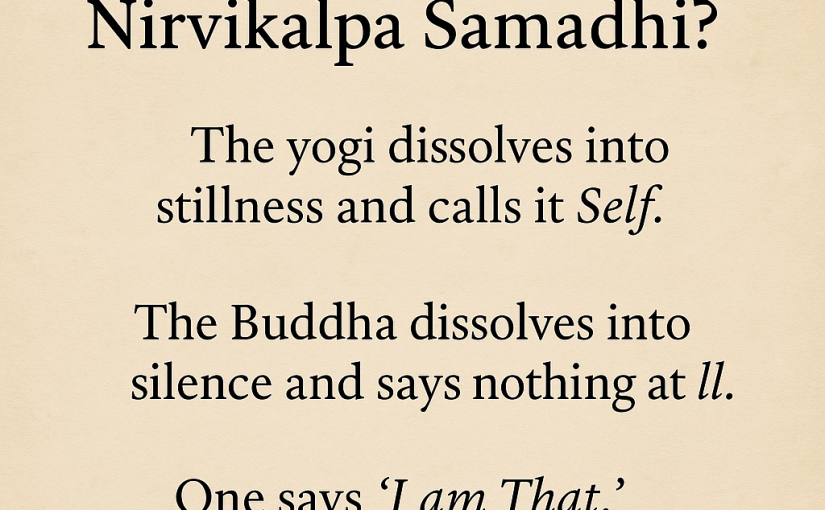
The yogi dissolves into stillness and calls it Self.
The Buddha dissolves into silence and says nothing at all.
One says “I am That.”
The other says “There is no I.”
But both sit in the same unmoving stillness, beyond joy and sorrow, beyond life and death.

Maybe it doesn’t matter what we call it. What matters is living in a way that moves toward that silence, that freedom. Not with force, not with fear, but with surrender, awareness, and love.

To those walking a similar path—between glimpses and grounding, between depth and daily life—this reflection is for you. I haven’t finished the journey. But I’m walking it with eyes open and heart awake.

And in the hush between two breaths, I sense something vast. Not mine. Not even “me.” Just what remains when all else falls away.

Kundalini Yoga is the mother of minimalism

Friends, according to the common popular belief, minimalism is considered synonymous with liberation. This belief is formed by the scriptures. But I think the meaning of the scriptures is something else. If minimalism was the identity of liberation, then all the poor and beggars would be free and supremely knowledgeable. But in reality their condition is the worst. I think the meaning of this statement of the scriptures is that if a person is climbing the ladder of success in yoga practice, then he does not need to run towards materialism more than the minimum requirement. Because his race towards materialism can create obstacles in his yoga practice. Meaning, yoga practice is more important, not minimalism. Yes, if materialism is not creating obstacles in his yoga practice, then there is no harm in materialism. In fact, it is not materialism, but the race towards materialism that creates obstacles. Due to this, the energy that should have been spent in yoga practice is wasted in materialism or in achieving materialism. If someone is getting material happiness and prosperity for free, then it will only save his energy. He can use that saved extra energy in yoga practice. In the scriptures, minimalism like that of the fakirs or sages has been supported so that energy is not wasted by too much physical work and too much physical consumption. On the contrary, some physical labour should also be done and some physical consumption should also be enjoyed. This saves energy. This saved energy can be used in yoga practice. This is the middle path of Buddha. If someone is completely poor, then how will he consume pleasures in moderation in the absence of food and how will he be able to do moderate physical labour? This will certainly not lead to wastage of energy, but it will not save energy either. Similarly, if someone is very rich, then due to carelessness and ego, he will also not do any physical work and along with that he will also consume pleasures excessively. Due to this, his energy will not be saved and the remaining energy will also be wasted in enjoying pleasures. Then how will he do yoga. But if someone, despite being rich, does moderate labour and moderate consumption of pleasures, and does yoga with the energy saved from that, then he will be considered a minimalist or a fakir. Meaning, by referring to minimalism in the scriptures, yoga has been indirectly supported. King Janak was very wealthy, but was still a yogi. Due to this, a minimalist nature developed in him by itself. Actually, the common people of the world have a low intellect, so they understand more about the basic things. People do not easily pay attention to yoga. That is why at many places in the scriptures, minimalism has been described as a synonym for salvation, not yoga. The sages must have been of the opinion that perhaps people will get into the habit of yoga by themselves due to minimalism. This must have happened in many cases, but I see very few such cases. Most people are entangled in minimalism and do not seem to be moving towards yoga. “Neither Maya nor Ram” means not getting enjoyment neither of this and nor of that world, seems to be a saying meant for those people who become minimalists but do not practice yoga. However, the most real and meaningful minimalism is the one that is born out of yoga.

Kundalini Shakti creates the entire universe from darkness

The secret time cycle aka gupta kalchakra seems to me to be a game of the subconscious mind. Information related to each organ of man is hidden in the chakra related to it. These are the information of countless past lives, because the bodies of all living beings, their activities, emotions and chakras associated with them are all almost the same, there may be a difference in quantity or shape. By meditating on the chakras, that information keeps on appearing and disappearing in direct or indirect form. When the gross mind is purified, then man himself turns to Chakrasadhana to purify the subtle mind. Just as the state of the gross mind keeps changing every moment with time, similarly the state of the subtle subconscious mind also keeps changing, because the subtle mind is a reflection of the gross mind, but we cannot see it. That is why it is called Gupta Kalachakra. Meaning that even if the subconscious mind is completely cleaned, there is no guarantee that it will not become dirty again. The practitioner will continue to feel the energy level of all the chakras changing. Nothing can escape the blows of time. Therefore, it is best to accept whatever is there while remaining equanimous and unaffected in every situation. This is vaikalpik kalchakra. This seems to me to be the main objective of Guptakaalchakra Sadhana.

Kundalini Shakti creates the universe, whatever it is said does not mean that it creates physical and gross celestial bodies like planets, stars etc. in space. Rather, it seems to make more sense that it is like the reproductive sexual power that gives birth to a child and creates the entire universe in the form of its body and mind. Although the first statement may also be indirectly true, because what is there in the universe the same is there inside the body, but the second statement appears to be directly, practically and clearly true.

Many people may say that sexual power is for increasing the progeny or lineage, where does Kundalini come from in it. Man can derive any meaning from that power. If we want to know its real purpose then we should see the animals. They do not move according to their thinking or goals but more according to natural inspiration or instinct. The purpose of procreating offsprings is not in their mind regarding sexual intercourse. They are motivated to have sex only to expand their mind which is narrowed in the darkness of ignorance, that too when natural favorable circumstances motivate them for it, even then the desire for this does not arise in them automatically. A buffalo pair will be motivated to do this only when the buffalo is in estrus i.e. in heat which comes for one or two days in a month. Even that heat stops coming in the summer season. Other times, both will not have sexual intercourse even when they are together. But when the buffalo is in estrus, experts believe that the buffalo can travel up to twenty-five kilometers alone in search of the he buffalo, of course she might die on the way. Man is an evolved creature. He knows how to take advantage of natural laws. Tantrayogi is one step further. He lights a small flame in the darkness of the narrowed mind as a meditation image. Then he enhances it so much through sex-assisted yoga that it becomes awakened. This is Kundalini awakening. Now whether you call the mind constricted in the form of meditation picture as Kundalini or the mind constricted in darkness as kundalini. It is the same thing because the same darkness develops through meditation and becomes a meditation picture. The sexual power which gives it the strength to develop, resides in Muladhar i.e. the dark pool or pit or kunda, that is why it is named Kundalini. Meaning, Dhyanachitra got the name Kundalini only when it got the strength of sexual power i.e. semen power. Meaning the word Kundalini itself is tantric. The common man directly interacts with the narrowed mind in darkness or in countless small and sluggish thoughts, due to which that power gets distributed among countless thoughts. Through this he may get worldly expansion or progress, but he gets less benefits of awakening.

When Shakti enters the darkness of the pool of Muladhar, only then the living being gets attracted towards sexual intercourse. A person who always lives in the light of complete knowledge does not feel like having sex. I had a senior foodie and experienced friend who once told me that if I did not eat nonveg, how would I be able to have sex. I could not accept that thing in my mind. Today I am able to understand the Tantra philosophy hidden in his words. Darkness is not created by eating and drinking alone. It is born out of attachment to worldly matters while remaining active. I think the structure of the body is such that as the darkness of the brain or mind increases, the power goes down. Highest or darkest darkness means that Shakti has gathered at Muladhara. It is the blood circulation that naturally keeps gathering downwards. After reaching the perineum, the energy then passes through the back and goes straight to the brain. When power reaches the perineum, it is natural that the sexual organs there will become active. Many exercises, physical activities and Yoga etc. give that power a chance to rise up through back. Many amplifies it at muladhara using Tantrik method and then raise the increased amount, and some even lower it to fall out. Due to the fall of Shakti, Shakti starts accumulating in Muladhara again, which takes more time than before. With good nutrition it accumulates quickly but it can also involve sinful activities. Also, energy is consumed by digestion and assimilation of nutrients causing net loss of life energy. Then it will be like this, running ahead and wide or coiled behind. These simple proverbs have very deep meanings. Chaud or coil means coil of Kundalini serpent. Meaning power sleeps in the form of darkness of sin, although it has been elevated by the power of that darkness itself. But I think that eating and drinking does not cause as much sin as we do through attachment behavior in the world. That is why Shiva, despite looking like a ghost, keeps roaming around looking cheerful, carefree and sinless. But what will happen when a man’s mind or soul becomes so clean that there will be no darkness in it, of course, the power has gone to the Mooladhar. Perhaps then without sex his power would continue to roam like this. He will also have sexual ecstasy and an erection, but he will not be very motivated towards physical intercourse, because he will feel that it is a loss of power, no matter how careful one is. At the time of Shakti in Muladhar, an image of a sensual woman may appear in his mind, and at the time of Shakti in Sahasrara, an image of a Guru or a spiritual person or a loving man may appear in his mind. But he will remain unattached to both and will remain busy in his work, due to which that power will continue to swing in him and he will always remain immersed in bliss.

When the energy goes to the base, there will be a lack of it in the brain, just like when rain water seeps into the ground, the surface pits filled with water will dry up. Due to this, there will definitely be some darkness in the mind, no matter how pure and perfect the person has become. In this corrupt world, no one can be so perfect whose mind is always filled with light. The light in the mind of a common worldly person exists only with the help of energy. Only a very rare saint can be a Sanyasi who has the light without physical energy. Still, complete illumination is possible only in the state of complete liberation, which is not possible while living in the body. How can one remain completely free from vices when associated with a vicious body? How can a person sitting in a bullock cart avoid hiccups? Those who maintain light in their mind without sexual intercourse, have mastered the sattvik techniques other than sexual intercourse, through which the energy of the mooladhara keeps rising up through the back. These are meditation on breath, meditation on body, meditation on present, meditation on chakras with simple or seed mantras, Vipassana, Devpuja etc. For example, meditating on the Bija Mantras on the Chakras opens the life force, opens the breath, increases the consciousness and the brightness of the mind’s thoughts, increases the intellect, and exerts upward contraction force on the Muladhara. Whether the glow is inside or outside the body, it comes with energy only.

Mental darkness is also of two types. One is darkness caused by eating, drinking, physical labour, sleep, rest etc. There is a lot of energy in the body, but it is lacking in the mind, because the consciousness of the mind is suppressed due to violence, intoxication, sleep etc. and the illusion of worldly attachment accompanied afterwards with loneliness. The meaning is clear that when it is not in the brain, then it is concentrated in the realm of Muladhara. There are only two main areas of the body. One is of Sahasrar and the other is of Muladhar. If the energy is not in one realm then it is natural that it will be in another realm. If the coin does not come up with head then only tail will come up, there is no other option. In such a situation, tantric sexual intercourse is beneficial. The second type of darkness is that in which there is lack of energy in the entire body. This is a condition like illness or depression or fatigue or weakness. That’s why one doesn’t feel like having sex. If one does, he may fall ill, because first of all, there is already a lack of energy in the body, and on top of that, one is also wasting energy in sexual intercourse. Everyone knows that water in the rooftop tank of the house helps in completing many tasks of life. But energy is also required to raise the water to the roof and there should also be water in the underground tank. If one runs the pump in a dry tank or at low voltage, the pump will definitely get damaged. By the way, there is also a saintly way of Tantric sexual intercourse, due to which minimum energy is consumed and maximum energy goes upwards. It is most important to have energy in the brain, because it controls the entire body. Even if the energy in the lower chakras, especially the bottom two chakras, is somewhat less, there is not much harm.

Many people can talk about how a thought-like creation is created from void of darkness. Darkness itself means subtle or latent or hidden creation. Darkness is not actually void as is often believed. The real zero for Buddhists means the Supreme God. Only two things are required for creation, darkness and power aka shakti i.e. energy. If there is no energy then darkness will not be able to express itself in the form of creation. It is only to express the darkness in the form of a living soul in the form of creation that it gets a body, which provides energy. It is a different matter whether he will be able to nullify that creation through the practice of Yoga or hide it in the same darkness or even more, through attachment to the world, he will convert himself into even greater darkness, for which he will have to take a new birth and a new body. One will get a new body according to your deeds. If good deeds are done then the human body will be found again which will again give the opportunity to bring the universe to zero. If the karma is bad, then by getting the body of an animal, the burden of darkness will be reduced to some extent but it will not be reduced to zero, because animals cannot do yoga. Like this, I don’t know when one will get the chance again. This is what Vedas say.

Scientists have proved through experiments that the same thing happens in the physical universe also. They found that everywhere in space those fundamental particles or waves are present in the form of quantum fluctuations which constitute the universe. Because they are so subtle and unmanifested, they are felt as darkness as they are not grasped. For example, dark energy, dark matter, all this is darkness. When they get energy from somewhere, their vibration starts increasing due to which the creation of the universe or physical substances starts. For thoughts, this energy is obtained from the body, but for the physical creation, where does it come from? There is no clarity and unanimity regarding this yet. Some say that the gravitational waves etc. which are created due to the collision of celestial bodies like black holes and other movements in space, provide that energy. Where there is more movement in space, more stars have been found to be formed. But it is not known from where the energy came for the first movement of space in the beginning of creation. The scriptures say that the sound of Om came from which the creation of the universe began. The sound of Om ॐ is a wave or movement of space. It is possible that it may have started the process of further movements and constructions. The question of where the energy for the movement in the form of OM sound came from remains unanswered. This is perhaps God’s own unimaginable power, the answer to which cannot be found through science except Yoga. If there is no Shakti, then Shiva will remain dark like a dead body, both inside the individual body and also in the macro body in the form of physical creation.

Kundalini awakens from the Kunda and activates the vaikalpik Kalachakra as Sudarshan Chakra in which sharirvigyan darshan ek adhunik kundalini tantra book helps a lot

It is said that the word Kundalini is not in the scriptures. But the word Kund is there a lot in Shivpuran. In Sanskrit language, a masculine object shaped like an earring or ring is called Kundalin and a feminine object having such shape is called Kundalini. Perhaps the word Kundal is also derived from the word Kund. The relation between the two is clearly visible. The literal meaning of Kund is round pit, and Kundal means round ring. The only difference between the two is that the pit has a bottom surface, but the rings do not, otherwise both are the same. Just as word Harshil is made from Harsh, similarly Kundal can be made from Kund. Harsh means full of joy and Kundal means accompanied with pit. This is because kundal fits properly inside kund. Only any Sanskrit grammar scholar can check this guess of mine, if he is reading this article. Even if a kundal is not formed from the word kund, the snake gets molded into the shape of the coil and hides in the kund i.e. the pit. That is why it is said that the snake has made its kundali. It should not be surprising if the pit in which a snake coils itself and hides is called a kund. In the dark pit of Mooladhar, the widespread power of the mind shrinks and gets hidden in the form of a meditation picture. That is why that power is called Kundalini. It climbs up through all the chakras and spreads in the nadis of the back and brain shaped like a hooded snake. Vishnu installed Shivalinga in the pit. Since it is related to religious faith, not much can be said about it because some staunch Hindus start doubting the fact that the one who calls the stories of the Puranas mythical is a Hindu. Well, in their opinion they are also right, because these stories are not fabricated. Myths are also of two types, one apocryphal or useless type and one based on scientific truth or useful type. The myths of the Puranas are of a different type, meaning that although they may seem like myths, they are completely based on scientific truth. That is why we highlight their scientific truth so that they are not considered fabricated myths and their lost respect can be regained. However, with common worldly thinking, it can be understood that the above Shivalinga worship by Lord Vishnu is similar to the way some skilled Tantra yogis gave Shivdhyan-superimposed sexual power to Muladhar as generated from Yabyum Asana. It is only by Shiva’s meditation on the Linga that it becomes pure and becomes Shivlinga. The method of great and ideal yogis like Dev Vishnu may certainly be advanced and sattvik, but the aim of all is the same, and that is to awaken the Shakti.

Vishnu was trying to worship Shiva with a thousand lotus flowers, that is, he was trying to lift the Shivadhyanachitra from the perineum up to the Sahasrara Chakra through the spine. Shiva hid a flower with his Maya shakti, which means that Vishnu, being fascinated by Shiva’s illusive power, was not able to offer his ego to Shiva. Vishnu searched for that last flower everywhere on earth but could not find it, meaning ego is within, not outside. Even if the entire external creation is offered to Shiva, the offering will still remain incomplete, because the ego residing inside the brain has not been offered. Vishnu then offered his one eye i.e. by awakening the third eye i.e. Ajna Chakra, he brought its power down from the front channel to the Muladhar Chakra. Being completely satisfied with that, Shiva present there climbed up to the Sahasrara Chakra and became fully awakened, that is, being pleased, he presented himself in visual form to Vishnu. The web of ego resides in the form of intelligence, and the symbol of intelligence is the Agyachakra. Meaning, the power of the mind which was trapped in the web of intellectualistic worldliness, got freed and got attached to Shivdhyan Chitra i.e. Kundalini picture, due to which it woke up. Then Shiva gave him Sudarshan Chakra, meaning the Sahasrara Chakra formed after su darshan or good visualisation or Shivadarshan i.e. awakening, is Sudarshan Chakra. Killing evil and demons means eliminating bad thoughts. At many places it is also shown like a rod, which seems to symbolize the Sushumna Nadi.

Shri Krishna had lifted Govardhan Mountain on the Sudarshan Chakra itself, that is, through the awakened Sahasrara Chakra, the form of knowledge, he made the physical world so light, subtle and ethereal that it rose up and came in the middle of the void sky. With this, the cowherds men, i.e. the common worldly people under the influence of senses, were saved from the indiscriminate rain of sorrows, which was being caused by Indra in the form of ego. Cow is called the senses and the one who grazes the cow means an ignorant human being suffering from the influence of senses. This seems to be a similar case of Ravana lifting Mount Kailash on his arms. Sudarshan Chakra moving only at will and coming back on its own after striking and always rotating indicates that it is a divine chakra i.e. Sahasrara Chakra. Its spokes, axles etc. indicate seasons etc. Kalachakra is also compared to this among Buddhists. Even in Kalachakra, there are spokes etc. equal to Sudarshan Chakra which indicate the movement of time, seasons etc. Both contain thunder and electricity. This is the energy flowing in Sushumna and giving instant awakening. Like Sudarshan Chakra, Kalachakra is also associated with Vishnu, Krishna, Shiva etc. Both are described in the Vedas. However, Kalachakra is mainly used among Buddhists.

There are three types of Kalachakra, baahya or external, aantarik or internal and gupta or secret. External macro universe is included in external, internal is micro universe inside the body and secret is included in mysterious liberating sciences like yoga etc. I think that having complete knowledge of one leads to knowledge of all three. For an extroverted person, it is the sadhana of the external Kalachakra. internal for an introvert and Gupt Kalachakra is made for Sanyasin or renunciate type of person. Knowledge and liberation come from all three. Premyogi Vajra’s philosophy of physiological science or sharirvigyan darshan can be called a kind of internal Kalachakra, because it describes the universe inside the body. Kalachakra is a circle in which various deities, symbols and figures are displayed. In fact, there is a world with similar diverse forms in all the three time cycles aka kalchakras. By its sadhana it is natural that Sushumna, Sahasrara and Kundalini etc. get awakened, which then destroy the demons in the form of evil thoughts and nature. In this case also Kalachakra and Sudarshan Chakra are same. It can be said that the Kalachakra is available to a common man, whereas the Kalachakra available to an ideal man like Vishnu has been called Sudarshan Chakra. The common man destroys only his own ignorance whereas Vishnu and his incarnations like Ram, Krishna, Buddha etc. destroy the ignorance of countless devotees. That is why Sudarshan Chakra can be called a special Kalachakra.

In Vamana Purana also this chakra has been called Kalachakra. Its twelve spokes indicate the twelve months and six navels indicate the six seasons. It is also said that the mantra ‘Sahasrat Hum Phat’ is inscribed on its spokes. This sounds like a Buddhist mantra. The Sikhs also used the Chakra as a weapon, which could be used directly or by throwing. At many places it is also said that the center of Sudarshan Chakra is made of Vajra. Vajra is the same spinal cord through which Vajra Shakti passes to Sahasrara. This article will be completely understood after reading the next article because its original story described in Shivpuran will be written in it.

Even in Rigveda, Sudarshan Chakra has been called Kalachakra. Apart from the three Kalachakras, there is also a fourth alternative Kalachakra, in which the mind is not allowed to be affected by the movement of time. This is the chakra of enlightenment and spiritual knowledge. This is Advaita, this is Dvaitadvaita, meaning Advaita is living amidst duality. This is the concept of tantra philosophy called body science philosophy created by Premyogi Vajra. This is Vishnu’s evil destroying Sudarshan Chakra. These are the three previous Kaalchakras, which due to the blows of time are going to put the common man’s mind in duality, ignorance and sorrow and put him in the cycle of birth and death again and again. The benevolent Sudarshan Chakra, the fourth and last one is the alternative Kalachakra, which undoubtedly rotates at the speed of time, but by teaching man to live non-dually in it, gives him happiness, prosperity and liberation. Anyone can have the time cycle that can kill, but only a knowledgeable person like Vishnu can have the one to save. That is achieved when the Sahasrara Chakra is awakened. This time continues like a cycle and never stops. Birth is followed by death, death is followed by birth and then again death. Creation is followed by destruction, destruction is followed by creation and then again destruction. Seasons keep changing in cycles, happiness and sorrow keep coming and going in cycles. We cannot run away from this cycle. The cycle itself cuts the cycle. Varadayi that’s boon providing Sudarshan or Alternative Chakra is the only way to escape. Meaning, keep moving with the cycle but do not let it disturb your non-dual peace. This is the praise and worship of Sudarshan Chakra.

Sudarshan Chakra cut Shishupala’s throat, which means that due to Shishupala’s duplicitous behavior his power did not rise above Vishuddhi Chakra. Because a person speaks with the power of Vishuddhi Chakra of the throat, then the power rising up is stopped by the throat and ends in abusive language, which means the path of power near the throat is cut, which means the throat is cut. Shishupala was abusing Krishna a lot. Kundalini chakras are also called chakras because the level of power on them also keeps changing cyclically. Sometimes the power increases and reaches a peak, which is called awakening of the chakra, and then decreases and reaches a minimum. For example, sometimes the heart’s emotions are in full swing and sometimes it becomes emotionless. After some time, the heart again gets filled with emotions, which sometimes leads to creation of a good poem. This cycle continues. If the Chakra is awakened, it does not mean that it will remain awakened forever. Its power will keep increasing and decreasing. Don’t be afraid of this nor be affected by it. This is the vaikalpik Kalachakra, meaning the Buddhist thinking kalchakra i.e. through truthful imagination or philosophy, we have to eliminate the ill effects of Kalachakra and create positive effects from it. Similarly, Sahasrara Chakra is also sometimes at its peak power. At that time, this can give material prosperity and liberation to deserving person by giving knowledge or boon, and by cursing the sinful person, it can also put him in material loss and bondage. Then the Sahasrara Chakra also occurs at a lower Shakti level, at which time Shri Krishna used to behave like a common man. He behaved like an incarnational man only when the Sahasrara was in a state of extreme power, at which time the Sudarshan Chakra was shown rotating on his finger as an external and physical symbol of the Sahasrara Chakra. Common people cannot feel the subtle Sahasrara Chakra inside the mind or brain. Through awakened Sahasrara Chakra that’s Sudarshan Chakra there is divinity, prophecy and greatness.

Man is born in the external kalchakra and learns a lot by living in it for a long time. This is the time cycle or kalchakra of initial practice. Then, being troubled by the blows of sorrow arising from it, he starts imposing it on the internal kalchakra. Meaning, he starts giving solace to his mind that whatever is there in the vast universe is also there in his own small body. Meaning ‘Yatpinde tat brahmande’. To do this becomes very easy with the book titled “sharirvigyan darshan, ek adhunik Kundalini Tantra, ek yogi ki premkatha”. This gives him a feeling of non-duality due to which he feels some protection from the blows of time. This happens because despite the entire Kalachakra running inside the body, none of its components fall into the bondage of duality. After remaining stable in it for a long time, when he becomes pure enough, then his tendency automatically leans towards the secret time cycle or gupta kalchakra of Yoga Sadhana. While doing yoga and moving forward, he himself turns towards Tantric Kundalini Yoga. Through Tantra Yoga, his Kundalini is awakened in the Sahasrara Chakra, which means he becomes the possessor of the vaikalpik Kalachakra or Sudarshan Chakra. Yet whenever he keeps coming down from this supreme Kalachakra due to lack of energy in Sahasrara, he easily reaches there with a little push of tantric energy.

The infinitely wide external kalchakra becomes smaller and smaller. First it reaches the level of the internal kalchakra. Then it becomes more subtle and limited to seven Kundalini Chakras and becomes the Gupta Kalachakra. It’s called Gupta or secret because not everyone can feel it but only the Kundalini yogis. Then after awakening, it becomes subtle to the level of the point of sahasrar chakra and becomes an vaikalpik Kalachakra. The kalchakra continues from the beginning till the end, but earlier it was the one who puts you in the bondage of ignorance, in the end it becomes the giver of knowledge and liberation. This is a very effective and practical meditation which must be adopted. To put it in the simplest terms, it is like that in between the material worldly life, one should keep experiencing one’s body as well, the paths ahead open up on their own. Yoga is made only to develop its habit. While doing Yogasana, worldly thoughts keep coming due to the activity of Prana and along with this, attention is also focused on the special posture of the body and breath, which means the external Kalachakra keeps getting transformed into the internal Kalachakra.

Kundalini yoga science is the pinnacle of quantum mechanics, space science, cosmology and astronomy-physics

Kundalini awakening proves that the non-existent void does not exist

Friends, I was thinking of transmitting my recently awakened experiences to the scientists, so that they can solve the mystery of the origin of the universe, on which they are badly stuck. But I could not find any comment box on their sites nor did I find any such appeal from their side on Google. After getting the address of one or two, contacted them on Gmail, but did not get any response. If you know any such platform please do share.

Spiritual science and space science are interrelated, and are incomplete without each other. That’s why the science of astrology was also included with Sanatan Vedic philosophy, and it had a special respectable place.

Nihilism is the root of all problems

Nihilism is the biggest duality producing spiritual ignorance. If science had not resorted to nihilism, then nature and humanity would not have been destroyed today. Due to this, there would not have been hue and cry in the form of wars, natural calamities etc. all around today. Then science and spirituality as nonduality would have been progressing together and complete and all-round development of mankind would have been ensured. Buddhism was almost thrown out of ancient India for the same reason, because it resorted to nihilism. Although Buddhists argue a lot that their worship object is not void but conscious Brahman, this is also true, but from the external ethics of Buddhism it appears to be void. Common people only see superficially, they cannot understand the deep things.

It appears that the most anti-zero culture in the world is the Hindu Sanatan culture. In this, along with soil-stone etc. inanimate objects, the dark black sky is also worshipped. For example Shani Dev and Kali Mata.

Origin of the universe and its basic structure based on the experience of awakening

What we think of as void or darkness or blissless sky, and also feel it as our soul, does not feel like that at the time of awakening, that is, it feels like non-zero, light and blissful sky. I am saying non-zero because it looks like the full physical world. The visible physical world and the mental images or thoughts created from it are felt like waves in it. Just like there are waves in the ocean. The same has been described in various theology. So is science ignoring this?

space is soul in its original form

Whole world is virtual and unreal

Original means real, that is, in a viceless form. This was already evident from Einstein’s theory of gravitation, but no one had understood it in this metaphysical form. Einstein was so great but it seems he did not encounter a true awakened person. Lol. Einstein proved that spacetime can be twisted like a three-dimensional sheet, can have holes or pits in it. By the way, what is already like an empty pit, how can another empty pit be made in it. From this, it is clear that space is not empty as the common man thinks. It is empty and not empty at the same time, though it is void in form, it is soul, it is God, it’s supreme soul. Its pit is like a boat making a depression in the water of a pond. The wave also moves in the same way making a depression. Means waves can be formed in space. Then how did it become zero? Many may even say that it is such a void in which falsely assumed virtual waves can be formed. Rishimuni also tells the same experience of the soul. It means that it is not such a wave that can distort the soul in reality. Even the water seems to be distorted by the wave only for a short time, after the wave has passed, its surface also becomes completely flat and as before. The same happens with the air. Then space or sky is even more subtle than them, how can it be distorted. It cannot be perverted even for a short while, because where will it go after being perverted. Because there is sky everywhere. Water and air move to the empty space, but where will the space move? This means that space waves are more virtual than water and air waves. Means the wave does not move anywhere, it only appears. Isn’t it a surprising fact. Amazing zero brother. Probably this is the magic or illusion of God which shows everything even though it is not there.

As classical evidence, the Mahabharata-sized epic Maharāmāyaṇa, aka Yogavasistha, repeatedly and everywhere refers to the soulful void-form sky or space as the Supreme Soul. Everywhere in it the world has been called false and virtual.

If the whole world exists in zero, then it must have the same qualities as the real physical world

Now let us give an edge of logic to the above scientific analysis. All the activities that take place in the physical world take place in the void of space as well, as we said above. This means that the nature of the void must be the same as that of the world. This is possible only if the Sattva guna, Rajo guna and Tamo guna, all these three gunas of nature are present together in that void, because the material world is made of these three gunas, as stated in the scriptures. That’s why that zero soul has been called trigunateet, means outside of three gunas, because having all the three gunas in equal quantity cancel each other’s effect, although all the three are present always. That is why, in spiritual scriptures, God is also called indescribable, that means he has all the three qualities, he doesn’t have them, he has both these things and he doesn’t have both. These qualities cannot be more or less than each other in the void, because with the change of material things with time, the qualities keep becoming more or less, but zero cannot change. This means that the zero soul is present with light in the form of Sattva, activity in the form of Raja (in the form of a virtual wave together with wave’s absence too) and darkness in the form of Tama altogether simultaneously. This all proves the scriptures saying that the all pervading real space that’s supreme soul is conscious though in a far superior way than all the worldly living beings and it’s attainable.

void space also behave like physical substances

However, the only difference is that what void space does everything in virtual form, physical matter does that everything in reality. That’s why called in scriptures that supreme soul is the biggest actor, dramatist and magician. For example, water from sea water bounces out in small pieces to form real drops. But in the ocean of void space, first thing, void cannot jump as a piece, secondly there is no existence of such an empty space, which is not in the form of one continuous void sky. That’s why there is only one way left, that is to make falsehood, that is, to make appearances, that is, to make virtual drops. According to science, we call them the basic particles i.e. Elementary Particles, which keep on popping out of the empty space, that is, they keep on appearing and also keep on merging in it. Just like the drops of water keep coming out of the ocean, and keep merging in it. Then why not accept this experience of self-awakening scientific and correct that the whole universe is a virtual wave inside the soul. The problem is that experience cannot be shown to anyone else and no machine can verify it. It has to be experienced by oneself.

Transformation of Science-era into Yoga-era

It is abundantly written in the scriptures that the world cannot arise out of nothing. From long time ago sages knew from self-experience that this world originated from self-illuminating soul in the form of sky, not from any dark empty space. Many scientific arguments were given for this, which also proved the same. Self-awakened means Kundalini-awakened people also tell the same experience. That soul cannot be grasped by the material senses, but is experienced only as one’s own true nature. That’s why one thing is clear that it can only be guessed by science, but it can be seen only through yoga. Science will calm down after guessing it, and then move towards yoga to experience it. All scientists will become yogis, and the science-age will be transformed into the yoga-yuga.

There is no difference between the outer and inner universe

If the universe of the mind is experienced inside the soul, then the physical universe outside too, because we can know it only in an approximation from the mental universe, never directly and in reality. But this much is certain that the real form of the external universe is also like the mental universe. The only difference is that the outer universe is more stable than the inner universe, that’s why it looks almost the same to everyone for thousands of years, but the mental universe keeps changing every moment with thoughts and experiences.

Many deep mysteries of science can be solved by Kundalini awakening

For example, what is the deepest core of the universe, what is the principle of quantum entanglement, what is an electromagnetic wave and how it moves, vacuum energy, quantum fluctuations, dark energy, big bang, expansion of the universe, black hole, multiverse, parallel universe , Anti Universe, Fourth Dimension, Spacetime Travel, Teleportation, Alien Hunting etc., and many more. Caleb Scharf, an astrophysicist, says that the entire universe may just be a giant alien. For Einstein, time is an illusion. All such thoughts and theories match with the thinking of learned sages and philosophers. That’s why scientists should leave one-sided physical thinking and include yoga and spirituality in their study, only then all the mysteries of the world can be revealed.  Many quantum theories can be understood from yoga science, such as the wave particle dual nature of matter, standing wave, the double slit experiment, the de Broglie principle, the Casimir effect, and many more. The theory of everything for which scientists have been trying for a long time, it seems that yoga can meet it. Some scientists are also moving in spiritually truthful direction, such as Stephen Hawking‘s string theory Robert Lanza‘s Biocentrism Theory, the theory of aliens being hidden in every object, Adam Frank‘s theory considering Earth as a living being, A theory considering Earth as a prison for criminals and Moon as prison monitoring center etc, and many others. Although these are all scientific guesses, like I said above. To prove these, there is a need to take along those people who have directly experienced Kundalini awakening through yoga. Nowadays, the atmosphere of discussion on such inexplicable types of science riddles is heated everywhere. The iron is hot, and scientists should not hesitate to take the hammer. If you also want to contribute in solving these riddles, then do write in the comment box.