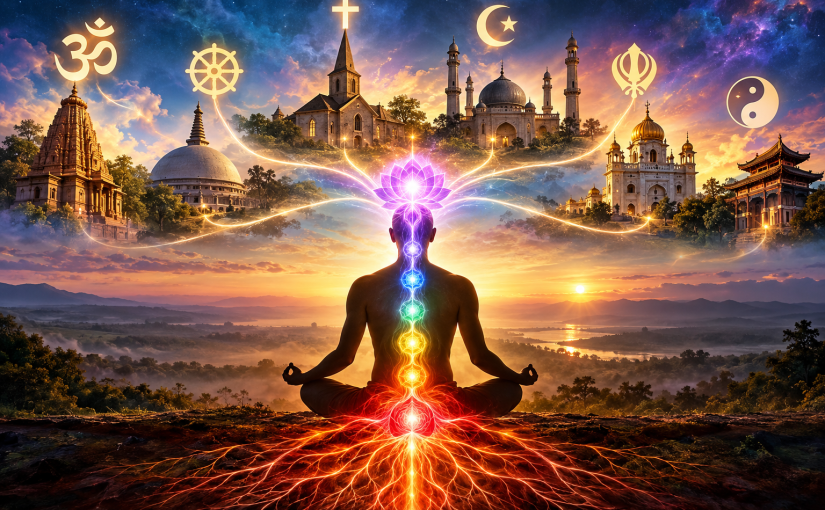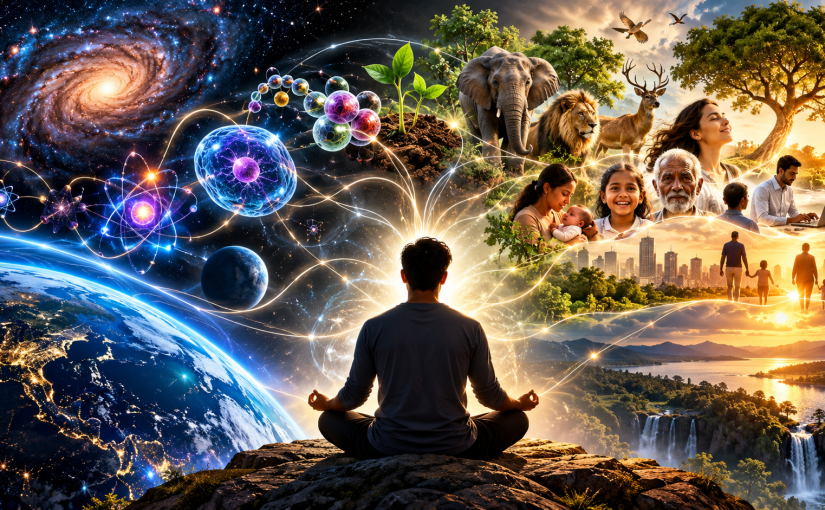
Quantum Verse and Nondual Living: Why Humanity Is Religion, Work Is Worship, Problems Are Teachers, and Household Life Is Sadhana

The Deeper Meaning of My Quantum Verse

In my Quantum Verse, I had written four simple thoughts: no religion is better than humanity, no worship is better than work, no problem is better than a teacher, and no hermit is better than householdship. Earlier, I saw these mainly as principles of life. Recently, through my own experience of working, learning and moving towards awakening and samadhi, I understood a deeper connection between all four. They are not really four unrelated statements. They can be understood as four practical expressions of a nondual way of living, especially when viewed through what I call Sharirvigyan Darshan and Quantum Darshan. Amazingly, I had made it as a spiritual fun for a magazine, but it turned a topmost lesson of my life later on.

No Religion Is Better Than Humanity

For me, humanity is greater than religion because humanity keeps spiritual knowledge connected with actual life. A belief, doctrine or religious practice can remain limited to thought or ritual, but humanity tests what we really understand by how we live and work with other beings. In that sense, humanity itself can become the most practical religion. It also has another important role: it prevents wrong working. When work is done without sensitivity to life and without a nondual understanding, knowledge can become mechanical, ego-driven or harmful. Humanity keeps the action grounded.

No Worship Is Better Than Work

The second statement became much clearer through my own experience. I did not discover that work is automatically worship. Work becomes worship only when it is done with a nondual mindset. Otherwise work can create bad habits, strengthen conditioning and make a person dependent on methods that may not suit the actual structure of the body and mind. This was important in my own journey. I did not stop learning from other people because I disliked teachers or believed that others had nothing to offer. Rather, I found that the people and methods available to me often did not work in the knowledgeable way that I considered necessary according to Sharirvigyan Darshan and Quantum Darshan. If I continued working through unsuitable methods, I could develop wrong habits through the very process of learning. So I felt it was better to learn and work largely by myself. It proved as a boon for me and I could grow as per my own will.

Self-Learning Does Not Mean Rejecting Teachers

My approach was not complete isolation. I took help whenever it was genuinely needed, but I kept it to the minimum necessary. The important point was that I did not want to become dependent on others. I wanted to understand the work directly and discover how it actually functioned through my own observation and experience. This distinction matters to me now: self-learning is not anti-teacher. It means refusing to make the teacher a substitute for one’s own seeing. A teacher can point, explain or correct, but the actual understanding still has to become one’s own.

No Problem Is Better Than a Teacher

This also changes the meaning of the third line. A problem can become a teacher when we do not merely ask someone else to remove it but investigate why it exists, what it is showing and what it requires us to understand. In that sense, the problem itself can expose weaknesses in our knowledge and working. It can teach us more directly than an external explanation because we have to encounter the principle in actual life. This is why I now see the statement not simply as praise of teachers, but as a reminder that learning can come through the very difficulty we are trying to solve.

Nature as the Greatest Teacher

This experience also led to another meaning that arose naturally for me. If nonduality is maintained, nature itself can become the best teacher. Nature does not teach through dependence. It shows processes directly through the body, mind, environment and the relationships between them. When one observes without separating oneself completely from what is being observed, learning becomes more direct. A teacher may explain a principle, but nature continuously demonstrates it. Therefore, the highest form of learning may not always be learning from a person; it may be learning to see what is already happening. Together, nature is nondual and it likes a nondual person, bhola or innocent like shiva.

No Hermit Is Better Than Householdship

The fourth line also becomes deeper in this framework. Household life is not necessarily opposed to spiritual development. It keeps knowledge in contact with work, relationships, responsibility and ordinary human situations. A hermit may reduce external distractions, but household life can test whether nondual understanding actually works in the middle of life. If a truth is valid only in isolation, its practical value remains limited. Householdship therefore becomes a kind of living laboratory where knowledge has to function through action rather than remain an idea.

My Experience of Work and Awakening

My own path gave these statements their present meaning. I began working in my own style because I did not want to acquire unsuitable habits from working methods that did not fit the understanding I had developed through Sharirvigyan Darshan and Quantum Darshan. I still accepted help when necessary, but kept dependence low. I continued this self-directed way of working, and according to my experience it worked: I experienced awakening and movement towards samadhi. That experience made me see that work can truly become worship, but only when the work is performed from nondual understanding. Without that foundation, simply working hard does not make work spiritual.

The Four Statements as One Principle

I now see the four lines as different expressions of one principle. Humanity gives the right relationship with life. Work gives the right relationship with action. Problems give the right relationship with learning. Householdship gives the right relationship with ordinary existence. But all four require the same foundation: nondual understanding. Without that foundation, religion can become dogma, work can become conditioning, teachers can become objects of dependence, and renunciation can become escape. With it, humanity becomes religion, work becomes worship, problems become teachers, nature becomes a source of direct learning, and household life itself can become a field of spiritual practice. This is the deeper meaning that my own experience has recently added to my Quantum Verse.

तुम्हरो भजन राम को पावै

तुम्हरो भजन राम को पावै।
वानर की गति, मनुष्य का ध्यान,
दोनों के संग बने हनुमान।
न केवल वानर, न केवल नर,
दोनों मिलकर हुए एक स्वर।
डाली से डाली, वन से वन,
चलता रहता उसका तन।
टिके रहना रीत नहीं, पर
गति में भी कोई प्रीत नहीं।
फल मिला तो फल ही खाया,
पत्ता मिला तो पत्ता पाया।
कच्चा या फल पका हुआ,
भेद न देखा, काम हुआ।
गले में डाले स्वर्णहार,
क्षण भर पहने वह श्रृंगार।
फिर सहज ही उसको छोड़ दिया,
मन भीतर जैसे मोड़ लिया।
एक डाल छूटी, दूजी थामी,
किसी एक डाल की जगह न मानी।
जितना मिला, उतना ही लिया,
पकड़ा नहीं, आगे हो लिया।
दृष्टि न बांधी एक दिशा में,
देखा जग को हर दिशा में।
क्षण-क्षण बदली उसकी राह,
फिर भी न कहीं जमाई चाह।
यही गति जब मानव धारे,
उसमें जागें विवेक हमारे।
चलना केवल भटकना न हो,
कर्म हो, फिर भी बंधना न हो।
मन जब वस्तुओं में न फंसे,
इच्छा मन को बार-बार न कसे,
जब हाथ करे, पर मन न धरे,
तब अज्ञान को भीतर शक्ति हरे।
बिखरी शक्ति भीतर आए,
ध्यान का दीपक स्वयं जलाए।
जिस छवि को पहले बुलाते थे,
वह मन में स्वयं ही ठहर जाए।
बैठो तो साथ, चलो तो साथ,
जागो तो भी रहे वही बात।
ध्यान न केवल आसन में हो,
जीवन के हर क्षण में हो।
धीरे-धीरे चंचलता थमे,
मन अपने ही केंद्र में जमे।
बाहर गति काम करे,
भीतर चेतना विश्राम धरे।
यहीं समाधि की राह खुलती,
यहीं मन की थकान है ढलती।
जहां न खोज, न कोई काम,
वहीं विश्राम का नाम है राम।
राम केवल नाम नहीं,
भीतर एक धाम कहीं।
जहां चेतना अपने में ठहरे,
बाहर से मानो गूंगे बहरे।
इसीलिए यह वचन महान,
जिसमें छिपा साधना-विज्ञान।
“तुम्हरो भजन राम को पावै,”
हनुमत से राम बन जावै।।
हनुमान गति, हनुमान कर्म,
समर्पण का हनुमान धर्म।
हनुमान शक्ति, पर उसके पार,
कर्म हो पर बिन अहंकार।
यह बात है केवल पढ़ी नहीं,
सोच को लेकर गढ़ी नहीं।
दादागुरु की संगति में रहकर,
वर्षों देखा उनको जीकर।
उनमें गति थी, पकड़ नहीं,
कर्म था, भीतर जकड़ नहीं।
सादगी थी, और गहरा ध्यान,
जीवन में जागा वही विधान।
चाहकर नहीं मैंने अपनाया,
संग ने धीरे-धीरे सिखाया।
जो गुण उनमें सहज समाए,
अनजाने भीतर उतरते जाए।
कर्मयोग ने राह दिखाई,
अद्वैत दृष्टि ने गांठ खुलवाई।
गतिशीलता बनी साधना,
हनुमान की रामाराधना।
सात्त्विक जीवन, सरल विचार,
धीरे-धीरे हल्का भार।
ऊर्जा बाहर कम बिखरी, तो
ध्यान में ही भीतर निखरी।
हनुमान तब अर्थ में आए,
देव नहीं, ये पथ दिखलाए।
वानर ने जो बाहर दिखाई,
शक्ति वही नर-भीतर आई।
वानर पकड़ता, छोड़ देता,
मनुष्य भी बंधन तोड़ देता।
वानर चलता, रुकता नहीं,
मानव भी पहुंचे कहीं से कहीं।
वानर के गुण स्वयं साधना नहीं,
मानव-मन बिन वे अराधना नहीं।
प्रकृति ने जो बाहर दिखाया,
मानव ने उसे भीतर उठाया।
गति से कर्म, कर्म से ध्यान,
ध्यान से होए आत्मज्ञान,
जब सब खोजें शांत हो जाएं,
तब भीतर राम खुद दिख जाएँ।
इसलिए हनुमान से राम तक
अनेक नहीं, एक ही मर्म है।
एक छोर पर जागा कर्म,
दूसरे छोर पर शांत धर्म है।
हनुमान हैं चलती शक्ति,
राम हैं उस शक्ति की मुक्ति।
हनुमत हैं जागृत प्राण,
राम उनका परित्राण।
इसलिए केवल पूजा मत करना,
उनकी गति को जीवन में धरना।
कर्म करो, पर भटको नहीं,
जगत में रहो, पर अटको नहीं।
ऊर्जा को मत व्यर्थ बहाना,
उसे ध्यान में भीतर लाना।
मन को धीरे हल्का करना,
राम को उसके कंधे पे धरना।
तब शायद भेद खुल जाए,
खुद ही कोई गुनगुनाए—
“तुम्हरो भजन राम को पावै,”
हनुमान जियो, राम मिल जावै।
वानर की गति, मनुष्य का ध्यान,
दोनों के संग बने हनुमान।
उससे मन राम में थमे,
जीवन अपने घर में जमे।

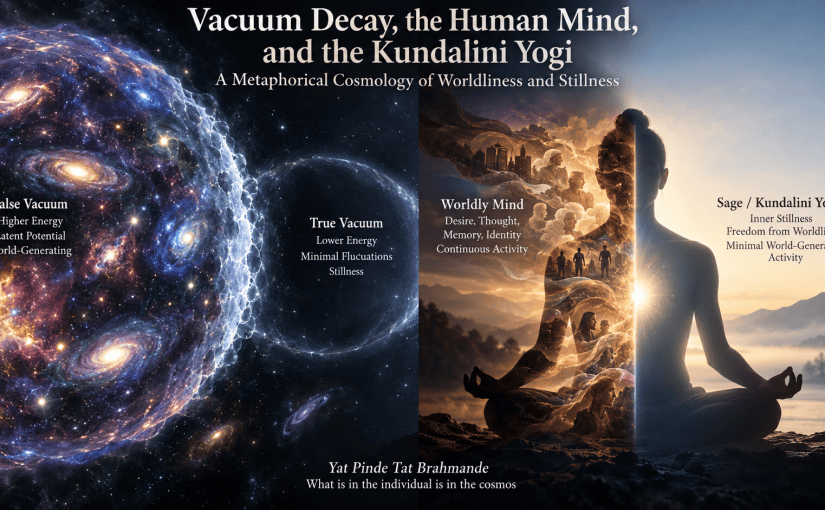
Vacuum Decay, the Human Mind, and the Kundalini Yogi: A Metaphorical Cosmology of Worldliness and Stillness

From the Physical Vacuum to the Inner World

Vacuum decay sounds as if empty space suddenly disappears, but in modern physics a vacuum is not simply empty space. Quantum fields exist throughout space, and what we call particles are excitations of those fields. A vacuum is a particular state of those fields. That state can, in some theories, be a local minimum of potential energy rather than the absolute lowest one. Such a state is called a false vacuum, while the lower-energy state is called the true vacuum. Quantum mechanics allows a metastable false vacuum to tunnel into a lower-energy state. The transition is described through a tunnelling or bounce solution and can produce a bubble of the new vacuum. If the bubble is too small it can collapse, but beyond a critical condition it can expand, potentially approaching the speed of light and replacing the old vacuum. When gravity is included, the situation becomes even more profound because vacuum energy affects spacetime itself. This physical picture led me to see a possible metaphorical correspondence with the human mind.

False Vacuum as Worldly Mind

I began thinking of the false vacuum as similar to the darkness of an ordinary worldly mind. Here darkness does not simply mean evil or absence of knowledge. It means the unseen, unexamined and latent structure through which worldliness is continually generated. The more strongly a person is identified with the world, the greater this darkness appears to be. Beneath conscious thought there are memories, expectations, fears, desires, habits, identity, comparison, social conditioning and countless subtle associations. Much of what maintains our ordinary mental world is therefore not consciously visible. It is already present in a subtle or encoded form, ready to produce further thoughts, emotions, desires and actions. In this sense I see worldliness as a kind of latent world-generating potential.

This also gives a useful metaphorical meaning to the high energy of a false vacuum. In physics, one should not simply say that every high-energy vacuum necessarily has larger quantum fluctuations, because fluctuation behavior depends on the particular fields, masses and couplings. Yet higher-energy field configurations can possess substantial potential for excitation and manifestation. This is the part of the analogy that interests me. The false vacuum is not itself the particles, just as the subtle structure of the mind is not itself every individual thought. Rather, it is the underlying condition from which manifestations can arise. Quantum excitations arise from the field configuration, while thoughts, emotions and worldly responses arise from the latent organization of the mind. Therefore I began to think of the subtle information of worldliness as something like the potential structure hidden within the false vacuum. It is not a literal storage of every object or event, but a hidden capacity from which the manifest world can continually be regenerated.

Quantum Fluctuations and the Mental World

In this metaphor, mental activity can be compared with fluctuations. An ordinary mind continually moves through memory, desire, anticipation, fear, pleasure, pain, identification and planning. One thought produces another, one emotion activates another, and the resulting actions produce fresh impressions. The process therefore becomes self-maintaining: desire produces thought, thought produces action, action produces consequences, and those consequences produce new desire. The worldly mind can thus be imagined metaphorically as a high-activity state with substantial capacity for generating further manifestations. This does not mean that psychological activity is literally caused by quantum fluctuations, nor that the human mind can be physically equated with a cosmological vacuum. The correspondence is structural and phenomenological: hidden potential gives rise to visible manifestations.

The Sage as True Vacuum

A profound transformation appears when an ordinary person becomes a sage, or what I also call a kundalini yogi in this metaphor. The change is not simply that the person has fewer thoughts. It is more radical. The underlying compulsion to continuously construct and maintain a personal worldly cosmos becomes quiet. A deep contemplative state can therefore be imagined as a true vacuum: a state of minimal psychological agitation, minimal compulsive fluctuation and minimal dependence on the continual generation of worldly experience.

This does not necessarily mean that the sage has lost all information. A Buddha can remember people, language and teachings, and a kundalini yogi may still function normally in the world. The deeper change is that information no longer has the same power to generate attachment, identity, craving and psychological continuation. Thus the useful distinction is not information versus no information, but information that actively generates worldliness versus information that remains without compulsive identification. In this sense the true vacuum metaphor represents the lowest world-generating activity rather than literal mental emptiness.

When an Individual Changes State

The transformation of an ordinary householder into a sage can therefore be compared metaphorically with false vacuum becoming true vacuum. The old worldly state is a metastable condition, apparently secure but still carrying the possibility of transition. A brief mystical experience may be like a subcritical bubble: an extraordinary moment appears, but the ordinary mental structure reasserts itself and the experience collapses. A deeper realization may cross a critical threshold. At that point the new state becomes sufficiently stable that the previous organization cannot easily restore itself.

The critical bubble in this analogy is not a physical radius. It represents the depth, stability and integration of realization. Below the threshold, worldliness is stronger than realization; above it, realization becomes strong enough to sustain itself. The “bubble wall” can be understood metaphorically as the resistance between the old and new states: attachment, identity, fear, habit, conditioning and the fear of losing the familiar self. Spiritual practice then becomes a gradual weakening of the barrier between the ordinary worldly state and inner stillness.

From One Mind to Many Minds

The analogy becomes even more interesting when realization spreads. One person’s transformation can affect others through speech, example, teaching and direct influence. A sage may become a source from which other people begin to observe their own minds, question their attachments and discover a quieter state. One transformed mind can therefore influence another, and that mind can influence another, creating a chain of transmission. In this metaphor the sage becomes a nucleation center of a different mental state.

This is where the idea of a critical bubble becomes collective. A person’s realization may remain localized if it does not spread beyond the individual. But if it becomes sufficiently powerful and transmissible, the psychological bubble can expand into a community, a tradition, a civilization and perhaps, over very long periods, a wider transformation of collective consciousness. Figures such as Buddha can be viewed in this philosophical sense as extraordinary examples of a personal realization becoming a lasting field of influence. Krishna can similarly be treated as a theological or archetypal representation of a consciousness that transforms the relationship between action, attachment and liberation. I do not mean that these figures literally altered the quantum vacuum; rather, their significance lies in the ability of a transformed mode of consciousness to propagate through human minds.

Two Different Meanings of Cosmic Destruction

This metaphor also clarifies what it means to say that a sage “destroys the cosmos.” The physical universe is not necessarily destroyed by enlightenment. Stars, planets, bodies and ordinary physical processes can continue. What is diminished is the mentally constructed cosmos: the personal world of “I,” “mine,” desire, fear, comparison, memory, expectation and attachment. In that sense spiritual liberation is not necessarily annihilation of the external universe but cessation of the psychological machinery that continually recreates one’s experienced worldly universe.

The idea can therefore be expressed at three scales. At the level of physics, a metastable vacuum can theoretically transition into a lower-energy vacuum through quantum tunnelling and bubble nucleation. At the level of an individual, a worldly mind can metaphorically transition into profound stillness. At the collective level, a deeply realized person can transmit that transformation to others. The common pattern is a seemingly stable state containing hidden potential for transition, followed by a movement toward a state of lower activity and a possible expansion of the new state.

The Larger Cosmological Question

This metaphor naturally raises a much larger possibility. Perhaps the physical cosmos and the experienced cosmos should be distinguished: one is the universe described by quantum fields and spacetime, while the other is the universe constructed in consciousness through sensation, memory, interpretation, desire and identity. Vacuum decay belongs to the physical description, whereas enlightenment belongs to the phenomenological and spiritual description. There is currently no established scientific evidence that a sage’s mental realization causes physical vacuum decay. That would be a speculative hypothesis, not accepted physics. Yet the structural similarity is striking: a high-potential state, hidden possibilities, manifestation through excitation, a transition to a lower-energy condition and, under certain circumstances, expansion of the new state.

This gives a final way of expressing the whole idea. The false vacuum is not merely “empty space with energy”; metaphorically, it is a latent world-generating condition. The worldly mind is similarly not merely a collection of conscious thoughts; it contains subtle structures capable of continually regenerating its experienced world. The true vacuum, by contrast, represents the deepest stillness, where the compulsive generation of that personal cosmos has greatly diminished. A householder becoming a sage is therefore metaphorically a false vacuum becoming a true vacuum. A temporary realization is a subcritical bubble; a stable realization crosses the critical threshold; and a rare, extraordinarily powerful sage may become a center from which a different mode of consciousness spreads through many minds. In this sense the language of vacuum decay becomes a powerful metaphor for the movement from worldliness to stillness, from latent psychological complexity to liberation, and from the continuous creation of a mental cosmos toward its profound inner dissolution.

It should not be surprising, then, if cosmic vacuum decay has a corresponding reflection in the individual mind, just as other cosmic principles can be reflected in the individual. This is also expressed in the scriptural idea “yat pinde tat brahmande”—what is in the individual is in the cosmos, or what exists in the microcosm is reflected in the macrocosm. From this perspective, the individual is not separate from the larger cosmic process but can be regarded as its smaller reflection. Therefore, studying the individual mind may provide a way to study corresponding principles of cosmology, just as studying cosmological processes may provide metaphors or models for understanding the individual. In this sense, the possibility that a cosmic vacuum transition could have an inner psychological counterpart is not an arbitrary comparison but follows naturally from the microcosm–macrocosm principle. The physical correspondence itself remains a hypothesis rather than established science, but the philosophical method of looking for the same pattern in the individual and the cosmos is ancient.

The Cosmic Apocalypse Reflected Within the Individual

Thus the cosmic apocalypse may have its corresponding reflection within the individual as a mental apocalypse. According to the scriptural vision, God first brought forth the universe and then entered into it in order to experience and sustain it. The Upanishadic idea that the Divine, having created the world, then entered into it expresses this profound principle. If the human being is itself a miniature form of the universe, then the Divine did not merely enter the vast cosmos from outside; it first created a miniature cosmos in the form of the individual and entered that miniature through the individual soul, thereby entering the universe in concentrated form. The human body by itself is inert; it becomes a living centre of perception, thought, action and experience when animated by the soul. In this sense, the individual is a microcosm through which the macrocosm experiences and operates itself. Therefore, if the universe can undergo its own cosmic processes, including a possible transition from one vacuum state to another, a corresponding process may also be contemplated within the individual as a transformation of the mental cosmos. The worldly mind continuously maintains its experienced universe through memory, desire, identity, perception, thought and subtle tendencies; when these world-generating processes become profoundly quiet, that inner cosmos can undergo its own apocalypse—not necessarily the destruction of the physical world, but the dissolution of the mental world through which it is experienced. Thus the individual can be studied as a miniature expression of the cosmos, and the transformation occurring within the individual can offer a way of contemplating corresponding transformations in the larger universe. This remains a metaphysical interpretation rather than an established scientific description of cosmology, but within the scriptural understanding of the microcosm and macrocosm, the correspondence is natural: the Divine enters the cosmos through its living miniature, and the dissolution of the worldly cosmos can therefore be contemplated not only in the vastness of space but also in the deepest stillness of the individual mind.

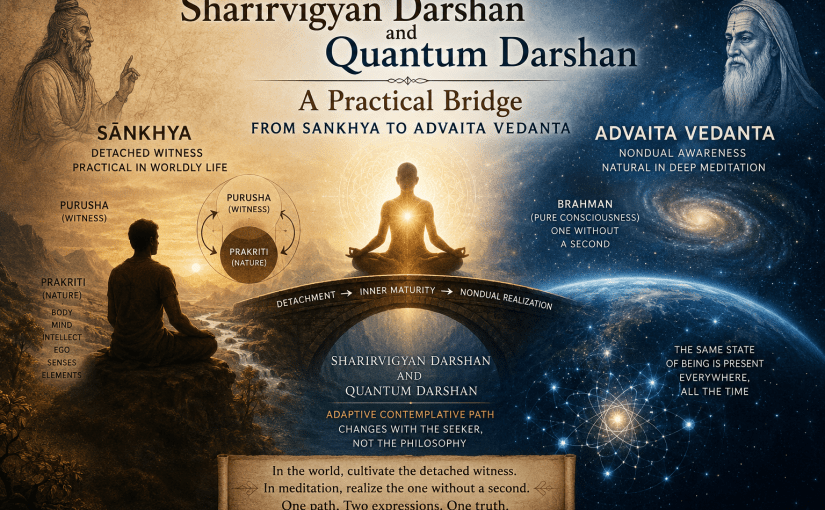
Sharirvigyan Darshan and Quantum Darshan: A Practical Bridge from Sankhya to Advaita Vedanta

Can Ancient Indian Philosophy Become Practical Again? A Personal Search

For many years I lived with a question that slowly became deeper than meditation itself. Ancient Indian philosophy beautifully explains consciousness, liberation and the nature of existence, yet I repeatedly wondered why these teachings often remain difficult for ordinary people to apply in daily life. My own spiritual journey gradually revealed that the answer may not lie in choosing one philosophy over another but in discovering how different philosophies naturally become useful at different stages of inner evolution.

One question especially transformed my contemplation. If pure consciousness is completely detached and inactive, how can the entire universe function with such astonishing intelligence? How can something that never acts still remain connected with every process of creation, every memory of the past and every possibility of the future? Complete non-existence cannot organize anything. Therefore pure existence cannot simply be an absence. It appears to be the silent background that constitutes everything without becoming entangled in anything. This insight slowly made creation appear less like a machine and more like one immense living organism whose countless activities continue while the underlying reality remains untouched.

The Beauty and Limitation of Classical Sankhya

My reflections naturally returned to Sankhya philosophy. Sankhya explains that Purusha is pure witnessing consciousness while Prakriti performs every action. Purusha neither acts nor becomes attached. Prakriti alone evolves into body, mind, intellect, ego, senses and the entire universe. This immediately explains why detachment is possible. Purusha never needed to become detached because it was never attached in the first place.

The more I contemplated this, the more I realized that detachment itself is perhaps the greatest lesson taught by Sankhya. Purusha is detached not because it practices detachment but because detachment is its very nature. Spiritual practice therefore becomes the gradual recognition that body, mind, emotions and actions belong to Prakriti while the witnessing self remains forever untouched.

Yet another question quietly appeared. If Purusha is absolutely inactive, how does Prakriti become so intelligently organized merely by its proximity? This question has inspired many philosophical traditions, including Advaita Vedanta and Kashmir Shaivism, each providing different explanations. Rather than rejecting Sankhya, I began searching for a practical bridge.

The Birth of Sharirvigyan Darshan

During my contemplations I realized that perhaps the easiest teacher already exists inside the human body.

Every cell performs astonishingly intelligent activities. Cells communicate, repair tissues, defend against disease, reproduce, generate energy and maintain life continuously. Yet I do not consciously perform these cellular activities. They continue automatically.

Then a deeper analogy emerged.

Suppose every cell possesses its own witnessing principle just as the human being possesses a witnessing self. The important point is not whether science presently accepts such a hypothesis. The important point is the structure of contemplation.

Just as my self remains detached from my body’s activities and their results, the self of the cell would remain detached from the activities and results of the cell. Neither becomes identical with the body through action.

This is the heart of Sharirvigyan Darshan.

It does not teach that the self of the cell is the cell itself. Nor does it immediately ask the seeker to accept that everything is one consciousness. Instead, it repeatedly invites contemplation of the relationship between self and body.

The cell performs.

The self witnesses.

The body acts.

The self remains detached.

Through this simple contemplation, detachment becomes easier to experience than through abstract metaphysical discussion.

Quantum Darshan Extends the Same Principle

Exactly the same structural principle later appeared in Quantum Darshan.

Only one illustration changes.

Instead of beginning with cells, Quantum Darshan begins with quantum particles.

Again, the philosophy does not claim that the self of a quantum particle is identical with the particle itself. Rather, the same contemplative relationship is extended to a deeper level of nature. Means self of quantum particle is detached from it. The body performs according to its own laws while the witnessing principle remains detached from action and its consequences.

Thus both Sharirvigyan Darshan and Quantum Darshan become beginner-friendly. They do not force the mind to grasp the extremely subtle nondual statement that everything is one. Instead, they first teach the practical experience of witness-consciousness through familiar structures.

Why Direct Advaita Vedanta Was Difficult for Me

My own spiritual journey taught me something very important.

When I first approached nondual Vedanta directly, it was extremely difficult to stabilize in everyday life. The mind found it difficult to understand how becoming and non-becoming could coexist. The statement that everything is one consciousness remained intellectually attractive but practically difficult to maintain while living an active worldly life.

Sankhya-based contemplation proved completely different.

By repeatedly recognizing that body and mind belong to Prakriti while the witnessing self remains detached, I gradually developed stable inner detachment. This was not suppression of worldly life. Rather, it became freedom while living within worldly responsibilities.

Only much later did nondual understanding arise naturally.

My Spiritual Experience Revealed an Unexpected Cycle

One of the most surprising discoveries during my years of Tantra, yoga and meditation was that Sankhya and Vedanta did not appear as rivals. Instead, they seemed to support one another at different stages of consciousness.

While living actively in the world, my attention naturally returned to Sharirvigyan Darshan. The contemplation of the detached self became my greatest support. It helped me perform duties while remaining inwardly free.

Then, after prolonged meditation, Tantra and deep yogic absorption, something changed naturally.

Worldly identification became weaker.

The sense of separation gradually dissolved.

Without forcing any philosophical conclusion, awareness itself began experiencing nonduality. The distinction between myself and everything else became less important than the underlying unity of existence.

Interestingly, at that stage the Sankhya-based contemplation became less necessary because nondual awareness itself had become natural.

However, whenever worldly responsibilities increased again, attention naturally returned to Sharirvigyan Darshan. It again became the practical method through which detachment stabilized until nondual awareness gradually re-emerged.

This cycle repeated many times.

Worldly engagement naturally encouraged Sankhya-like contemplation.

Deep meditation naturally matured into Vedantic realization.

Neither philosophy opposed the other.

Each appeared precisely when needed.

An Adaptive Philosophy Rather Than a Fixed Philosophy

This gradually led me to a new possibility.

Perhaps Sharirvigyan Darshan and Quantum Darshan function as adaptive contemplative systems.

During active worldly life they operate practically like Sankhya by strengthening witness-consciousness and reducing attachment.

During deep meditation, yoga and Tantra they naturally flower into nondual understanding without requiring a separate philosophical conversion. I could easily contemplate that my present state of being is present everywhere at all times because the same universal laws are working everywhere. This became my natural mode of contemplation during the nondual phase, rather than focusing on the distinction between the detached self and its body, which was my primary contemplation during the worldly phase.

The philosophy itself does not change.

Only the seeker’s state of consciousness changes.

When the mind is deeply engaged with worldly activity, attention naturally rests upon the distinction between self and body.

When meditation matures and identification weakens, attention naturally recognizes the underlying unity of existence.

Thus the same contemplative framework serves both stages.

A Humble Proposal for Researchers and Spiritual Seekers

I do not present these reflections as established scientific facts or final philosophical conclusions. They are the outcome of sustained personal contemplation, meditation and practical observation. They invite discussion rather than demand agreement.

If these ideas prove useful, they may offer a practical bridge connecting Sankhya, Yoga, Tantra, Advaita Vedanta, consciousness studies, contemplative psychology and even modern scientific models of biological and quantum organization.

Most importantly, they suggest that perhaps beginners need not begin with the most abstract metaphysical doctrines. They may first learn detachment through direct observation of life itself. As detachment matures, deeper nondual realization may arise naturally rather than intellectually.

My own experience repeatedly followed this path.

Sankhya-like witness consciousness supported me while living in the world.

Deep meditation revealed nonduality.

Returning to the world revived practical witness-consciousness.

Returning inward restored effortless nonduality.

Instead of contradiction, I discovered complementarity.

Instead of choosing between Sankhya and Vedanta, I found that practical detachment and nondual realization can become successive expressions of the same spiritual journey.

Why Sankhya Appears More Practical Before Nondual Realization

From my own experience, Sankhya appears more practical during active worldly life. As long as the mind is deeply engaged with work, relationships and responsibilities, it is easier to cultivate detachment by contemplating that the witnessing self is distinct from the body, mind and actions. In contrast, if one begins directly with the Advaita Vedanta view that Purusha and Prakriti are ultimately one, it can be difficult for many beginners to understand how the same reality can both manifest as the world and yet remain completely detached from it. This subtle paradox may become clear only after deep meditation and inner maturity. My experience has been that Sankhya-based contemplation naturally prepares the mind for this realization. Once detachment becomes stable through practice, nondual awareness arises effortlessly, and the apparent contradiction between distinction and unity gradually dissolves through direct experience rather than intellectual reasoning. This is why Sharirvigyan Darshan and Quantum Darshan are presented not as alternatives to either Sankhya or Advaita Vedanta, but as practical contemplative bridges that guide the seeker from witness-consciousness to nondual realization according to the seeker’s stage of inner development.

Quantum Darshan, Kundalini Meditation, and My Second Awakening: How a Living Meditation Image Led to Nondual Awareness

From Sharirvigyan Darshan to Quantum Darshan

After my first awakening experience during adolescence, many years passed before I experienced another glimpse of awakening. During those years, my understanding of spirituality gradually matured through contemplation and direct observation.

One of the most important developments was what I later called Sharirvigyan Darshan. Through this contemplation, I began to see the body’s cells not as lifeless components serving a central self, but as equal participants within a larger living system. This simple shift had a profound effect on the mind. The sense of being a separate controller standing above everything else gradually weakened.

Over time, this contemplation naturally expanded beyond the body itself. If body cells could be viewed as equal participants in existence, why stop there? This question eventually led me toward what I later called Quantum Darshan.

Quantum Darshan was never intended as a scientific theory. Its purpose was contemplative rather than scientific. I did not require scientific proof for it to be useful. In spiritual practice, effectiveness is often more important than verification. A contemplative framework only needs enough plausibility for the mind to engage with it deeply.

From ordinary observation and intuitive reasoning, I felt that existence displayed continuity from the smallest to the largest scales. Whether science ultimately agrees or disagrees was secondary. What mattered was that the contemplation reduced separation and expanded awareness.

Why Spiritual Effectiveness Matters More Than Scientific Proof

Many contemplative methods throughout history have operated in this manner. Their value lies not in laboratory confirmation but in their transformative effect upon consciousness.

For me, the practical question became simple.

Does a contemplation reduce separation?

Does it increase mindfulness?

Does it help dissolve judgment?

Does it make awakening more accessible?

If the answer is yes, then the contemplation has value regardless of scientific debates.

This was how I approached Quantum Darshan. The contemplation encouraged a sense of equality throughout existence. Human beings, body cells, thoughts, sensations, objects, and the countless expressions of reality could all be viewed as participating within the same existence.

The contemplation did not attempt to prove anything scientifically. Instead, it served as a practical support for expanding awareness and reducing the sense of isolation.

Nondual Contemplation as a Support for Mindfulness

Over time, I also discovered that nondual contemplation and mindfulness support one another.

During awakening itself, there is no need to think, “I am everything” or “I am everywhere.” The experience speaks for itself. Everything already appears equal and interconnected.

However, ordinary life is different. Mindfulness does not always remain equally strong. Daily activity can weaken it.

Whenever mindfulness diminished, I often found it helpful to contemplate, “Whatever exists, I am already therein.” Such contemplations, helped by the nondual philosophies described above, naturally replenished mindfulness and reduced the sense of separation.

What happens is that clinging to any specific sensation or thought with attachment or aversion produces a block to mindfulness. In my experience, resistance to mindfulness appears to be a natural safety response of both the mind and the body. Judgment tends to pull a person away from the deeper self by creating division, preference, and separation. So, when judgment is applied to one thought, the mind resists all thoughts, thinking that this will further push it away from pure awareness.

Although mindfulness reduces this process of judgment, the mind does not believe it in the beginning. It thinks that if judgment of one thought made it fall down, what will happen if the full mind tends to be judged? It may be that the mind unconsciously fears that if even one judgment is made, hundreds can also be judged. Since the mind is accustomed to maintaining its familiar patterns, it tries to avoid mindfulness in the very beginning.

However, when a person becomes genuinely nonjudgmental toward even a single thought, a small movement toward the fuller self takes place. The mind then experiences a subtle benefit from this reduction in conflict and separation. Motivated by this, it gradually becomes willing to include other thoughts, sensations, and experiences as well. One acceptance encourages another. The field of awareness slowly expands, collecting more and more of what was previously rejected. In this way, mindfulness grows naturally, progressing from acceptance of a single thought toward increasing inclusiveness, fullness, and ultimately the realization of the full self.

Looking back, the trigger for my mindfulness during adolescence appears to have been the mental image of Devrani. For some reason, the mind remained naturally nonjudgmental toward that image. There was neither strong rejection nor deliberate effort to sustain it. Because the image was allowed to remain as it was, without judgment, it gradually encouraged the same nonjudgmental attitude toward other thoughts, sensations, memories, and experiences. In this way, mindfulness continued to grow naturally and eventually culminated in my first awakening experience.

In the case of my second awakening, the trigger was different. There, the central meditation image was that of Dadaguru. Unlike the first case, this image was deliberately nourished through spiritual practice and gradually became vivid, alive, and powerful within awareness. It gathered attention, reduced mental fragmentation, and helped expand mindfulness. Yet, as in the first awakening, the final awakened state itself was not centered on any particular image. The image functioned as a trigger and doorway, but during the awakening experience everything appeared equal within a vast, nonjudgmental, and blissful field of awareness.

Earlier in my adolescence, I practiced nondual contemplation passively and continuously, mainly through studying science deeply enough to generate a reduction in the sense of personal doership and ego. However, the effectiveness of such contemplation increased significantly later through the more active philosophical frameworks of Sharirvigyan Darshan and, subsequently, Quantum Darshan. These frameworks gave practical depth and structure to nondual thinking and helped make mindfulness more stable and sustainable. In my view, the effectiveness of Sharirvigyan Darshan was demonstrated by its role in preparing the ground for my second awakening. The effectiveness of Quantum Darshan itself also appears to be at least partially supported, since both contemplative frameworks seem closely correlated and contributed to the same overall movement toward greater mindfulness, nonduality, and awakening.

In this way, I came to view mindfulness and nondual contemplation not as competing methods but as complementary supports. Nondual contemplation helps establish mindfulness, and mindfulness naturally moves toward awakening.

The Deliberate Cultivation of a Meditation Image

Unlike my first awakening, which arose spontaneously, my second awakening involved deliberate spiritual practice.

This practice centered around a meditation image. Over time, the image became increasingly vivid, alive, and attractive within awareness. Yet even then, the process differed from ordinary concentration techniques. It was more of technical advanced tantric yoa.

But in earlier years before first awakening, I was not merely forcing attention upon a single object. Many images, memories, impressions, and forms continued to exist within awareness. They appeared naturally and often possessed equal brightness.

Among these images, two stood out more strongly than the others. One was associated with Devrani, while the other was associated with Dadaguru. These appeared especially bright and vivid within the mind. Yet even these were not deliberately forced into existence. They simply appeared naturally.

The meditation image that eventually became central was not sustained through strain or effort. It gradually developed through attraction, devotion, and repeated presence. As the image matured, it seemed increasingly alive.

Kundalini and the Living Meditation Image

My understanding eventually became that a Kundalini image is essentially a meditation image strengthened by Kundalini Shakti residing at the base.

As the tantra-yoga assisted meditation image grew stronger, more and more mental energy flowed toward it. This produced an unexpected effect.

Because so much energy was absorbed by the image, less energy remained available for judgment, comparison, analysis, and mental fragmentation.

The mind naturally became quieter.

Mindfulness appeared without deliberate effort.

Nonduality appeared without deliberate effort.

I did not need to continuously repeat philosophical ideas.

The image itself performed much of the work.

Its presence gradually gathered the mind into a more unified condition.

Interestingly, whenever I try to become nondual or mindful, the meditation image naturally expresses itself and lingers in the mind. It often appears without deliberate effort, as if it is closely connected with the movement toward mindfulness itself. From my personal experience, this provides psychological evidence that yoga and mindfulness are not entirely separate processes but may be different expressions of the same underlying movement of consciousness. The meditation image seems to support mindfulness, while mindfulness naturally nourishes the meditation image. As a result, both appear to work together toward greater inclusiveness, reduced judgment, and a deeper awareness of the self. Although their methods may differ, their essential direction and effect often seem to be the same.

How the Second Awakening Emerged

Eventually, this process culminated in a second awakening experience during waking consciousness.

The awakening itself lasted approximately ten seconds, much like the first one.

Before the awakening, the meditation image functioned as a powerful focal point. It gathered attention, energy, and awareness. In this sense, it acted as a doorway.

However, once the awakening actually occurred, something important happened.

The special status of the meditation image disappeared.

Everything became equal.

The image remained present, but it no longer occupied a privileged position.

Thoughts, sensations, memories, objects, inner experiences, and outer experiences all appeared within the same field.

The doorway dissolved into the whole.

The Equality of All Appearances

One of the most remarkable similarities between my two awakening experiences was the complete equality of all appearances.

During awakening, there was no central object.

There was no special image.

There was no preferred experience.

Everything stood on equal ground.

In my first awakening, natural scenes appeared first and human forms appeared later.

In my second awakening, a meditation image served as the trigger.

Yet in both cases, the awakened state itself was characterized by equality.

The trigger and the awakening were not the same thing.

The trigger helped initiate the transition.

The awakening itself transcended the trigger.

Infinite Fullness and Infinite Void

As in my first awakening, the second awakening involved a profound sense of fullness.

This fullness was not created merely by thoughts and sensations.

Instead, awareness seemed connected to an infinite void.

Paradoxically, the void did not feel empty.

It felt limitless.

Because it was limitless, awareness felt completely full.

Thoughts and perceptions appeared like waves moving within an infinite ocean.

The mind contained everything while remaining connected to something beyond all limits.

This produced a state of extraordinary bliss and completeness.

The Common Essence of Both Awakenings

Although the methods differed, the essential nature of both awakenings was remarkably similar.

The first awakening emerged from natural mindfulness, inclusiveness, curiosity, and openness during adolescence.

The second awakening emerged through deliberate practice, Kundalini energy, and a living meditation image.

Yet both culminated in the same fundamental qualities.

Everything became equal.

Judgment disappeared.

Separation weakened.

Mind and world appeared together.

Fullness merged with infinite void.

Bliss became overwhelming.

For a brief period lasting about ten seconds, reality revealed itself as a single, all-inclusive field of awareness.

Looking back, I do not see Sharirvigyan Darshan, Quantum Darshan, mindfulness, nondual contemplation, Kundalini practice, and awakening as separate subjects. They appear as different expressions of the same movement toward greater inclusiveness. As awareness becomes increasingly full, separation decreases. As separation decreases, the infinite becomes more accessible. And when fullness finally extends into the limitless void, awakening reveals itself directly.

Mindfulness, Nonduality, and My First Awakening: How a Full Mind Opened into Infinite Bliss

Mindfulness and Nonduality: Are They Really Different?

For a long time, I felt that Buddhist mindfulness and nondual contemplation were much closer than many people assume. At first glance, they appear different. Nondual teachings often use ideas such as “everything is one” or “I am everywhere.” Mindfulness, on the other hand, appears much simpler. It asks us to observe thoughts, sensations, emotions, and external events without judgment.

Yet when I looked at my own experience, I found that mindfulness itself seemed to contain the seed of nonduality.

In mindfulness, both inner and outer experiences are allowed to appear together. Thoughts, emotions, sensations, sounds, sights, people, objects, and events are all given space within awareness. The mind does not immediately reject one thing and accept another. Judgment gradually weakens because thoughts and objects themselves do not judge. They simply exist.

As more and more experiences are allowed into awareness, the mind becomes increasingly full. In this sense, mindfulness can be understood literally. The mind becomes full of inner and outer conditions together. Nothing is deliberately excluded. Everything is allowed to express itself within awareness.

This naturally creates a sense of equality. Thoughts become equal to sensations. Inner experiences become equal to outer experiences. Objects become equal to feelings. The usual hierarchy created by the mind begins to weaken.

At this stage, nonduality may begin to emerge naturally.

Why I Found Some Nondual Contemplations Artificial

Many nondual teachings encourage contemplation through ideas such as “I am everything” or “I am everywhere.” Such contemplations may be useful in certain stages of practice. They can help establish a nondual orientation within the mind.

However, I personally found that these statements sometimes felt artificial.

During actual awakening experiences, there was no thought repeating, “I am everything.” There was no need to mentally convince myself of anything. The experience itself revealed a state in which everything already appeared equal.

For this reason, I gradually felt that mindfulness seemed more practical and more natural. Instead of forcing a philosophical conclusion, mindfulness simply allows reality to become present. If nonduality is genuine, it can emerge naturally from that openness.

In my own experience, mindfulness appeared closer to awakening than conceptual affirmations. You could add it as:

Looking back, I no longer feel that nondual contemplation and mindfulness are opposed to each other. During awakening itself, there was no need to think, “I am everything” or “I am everywhere.” The experience was direct and self-evident. However, in ordinary life mindfulness does not always remain equally strong. When mindfulness weakens, nondual contemplation can help restore it. I often find that contemplating, “Whatever exists, I am already therein,” naturally replenishes mindfulness and reduces the sense of separation. Earlier, I practiced such contemplations continuously, and their effectiveness increased greatly through Sharirvigyan Darshan and later Quantum Darshan. These contemplative frameworks gave practical depth and logic to nondual thinking, helping the mind become more inclusive, less judgmental, and more mindful. In my experience, nondual contemplation serves as a powerful support for establishing and renewing mindfulness, while mindfulness itself naturally grows toward awakening.

My Natural Mindfulness During Adolescence

Looking back again, I can now see that a natural form of mindfulness developed during my adolescence, especially during my secondary school years.

At that time, I was not consciously pursuing spirituality. I was not practicing nondual philosophy. I was not trying to become enlightened. Nor was I deliberately cultivating or sustaining a meditation image. If a meditation image appeared in the mind, it arose naturally through affection, devotion, or attraction rather than through intentional effort. There was no attempt to force, maintain, or strengthen it. Whatever emerged did so spontaneously, as a natural part of life and experience.

Therefore, instead, many different things gradually became present in my mind. Different friends, teachers, subjects, ideas, books, experiences, and observations all seemed to coexist within awareness. There was curiosity, but there was no particular goal behind it.

Life itself was entering the mind.

Nothing was being deliberately contemplated. Nothing was being forced. The mind simply became increasingly inclusive.

Many different kinds of knowledge and experience accumulated naturally. Looking back, this resembles mindfulness in a broad sense. Awareness was becoming fuller without deliberate effort.

How Fullness Gradually Developed

As this process continued, I noticed that the mind became increasingly spacious and inclusive.

It seemed that mindfulness was not merely paying attention to one thing. Instead, it was allowing more and more of reality to be present simultaneously.

First the mind becomes somewhat full.

Then it becomes more full.

Then even more full.

Everything in nature tends to grow. In a similar way, fullness itself seemed to grow.

The more inclusive awareness became, the less room remained for rigid judgment and separation.

Without realizing it, I was moving toward a completely different state of consciousness.

My First Awakening in a Dream State

Eventually, during adolescence, this process culminated in a brief awakening experience that occurred in a dream state.

The experience lasted only about ten seconds, yet it remains one of the most significant moments of my life.

During those few seconds, something extraordinary happened.

Everything inside and outside appeared equal.

Thoughts and external scenes seemed to exist within the same field.

Judgment disappeared.

The usual sense of separation weakened dramatically.

Most importantly, the mind felt completely full.

This fullness was unlike ordinary mental activity. It was not simply a collection of thoughts and sensations. Instead, it felt as though the mind had become connected to an infinite void.

Infinite Void and Infinite Fullness

Ordinarily, people think of fullness and emptiness as opposites.

However, during that awakening glimpse, they seemed to become one.

The void did not feel empty in the ordinary sense. Instead, it felt limitless.

Because awareness appeared connected to something infinite, the mind simultaneously felt completely full.

Thoughts, sensations, memories, and external scenes appeared within that vastness like waves appearing within an ocean.

The experience did not require any philosophical conclusion.

There was no thought saying:

“I am everything.”

“I am everywhere.”

The understanding was direct rather than conceptual.

Everything simply appeared equal within a limitless field of awareness.

The Absence of Judgment

One of the most striking aspects of the experience was the complete absence of judgment.

Normally, the mind constantly evaluates.

This is good.

That is bad.

This should stay.

That should go.

During the awakening glimpse, this activity vanished.

Objects did not judge.

Sensations did not judge.

Thoughts did not judge.

Everything simply appeared.

This absence of judgment created a profound sense of equality throughout experience.

Inner and outer reality seemed to stand on equal ground.

Human Forms and Natural Scenes

The awakening did not begin through deliberate contemplation of a meditation image.

Natural scenes appeared first.

Later, a few human forms appeared.

Among them were images that resembled a devotee and a goddess-like Devrani figure.

These may have arisen from memory.

However, they did not function as meditation objects.

They were not the cause of awakening.

They simply appeared within the experience like everything else.

Nothing possessed special status.

Everything appeared equally within awareness.

This is important because it distinguished the experience from later meditation practices that involved deliberate concentration upon a meditation image.

Mindfulness as Preparation for Awakening

Looking back, I increasingly felt that mindfulness functions as a preparation for awakening.

As mindfulness deepens, awareness becomes more inclusive.

Judgment weakens.

Rejection weakens.

The mind becomes fuller.

Eventually, fullness may become so complete that it opens into the infinite.

At that point, awakening can arise naturally.

For this reason, mindfulness appears to me not merely as a technique but as a developmental process leading toward deeper states of consciousness.

In this sense, mindfulness may be understood as preparation for awakening, samadhi, and increasingly nondual states of awareness.

A Reflection

My first awakening did not arise from philosophical study. It did not arise from repeating nondual formulas. It did not arise from deliberate meditation upon a particular image.

Instead, it emerged from a gradual expansion of awareness.

Friends, teachers, knowledge, books, lectures, experiences, observations, memories, and life itself became increasingly present within the mind.

The mind became full.

That fullness continued to expand.

Then, for a brief moment lasting about ten seconds, fullness extended into the infinite.

In that moment, everything appeared equal.

Judgment disappeared.

Bliss arose.

The infinite void and infinite fullness became one.

And awakening revealed itself directly.

bhayankara rasa in quantum world

In Nātya-Śāstra, Bhayānaka Rasa is not merely “fear” as an emotion felt by the self, but the Rasa that evokes fear in the audience or observer — it is fear-producing, not fear itself.

So, in quantum terms, it’s more like the creation of instability or resonance that induces tension in another system, rather than the contraction of one’s own system (which we earlier associated with Bhaya / Fear).

Bhayānaka Rasa — Fear-Producing / Dread-Creating

Quantum Resonance as Disturbance

In physics, interactions propagate through fields, and a particle or system in an excited or unstable high-energy state can influence nearby particles by inducing oscillations or disturbances through well-defined mechanisms such as electromagnetic coupling, even across a distance. This influence is governed by measurable laws and does not imply emotion or intention. By analogy, in human experience, intense inner states also spread through interaction rather than contact. A person overwhelmed by stress or rage may appear highly charged—his tension visible in the eyes, face, and posture. Without speaking or acting, this state can unsettle those nearby. In Indian aesthetics, the contracted, agitated condition within such a person is termed Bhayānaka Rasa. In observers, the resulting response is bhaya, or fear. Spiritually understood, this comparison is metaphorical: just as physical disturbances propagate through fields by interaction, psychological tension propagates through perception and awareness, without implying that human emotions follow quantum laws.

Quantum Tunneling as Threat Potential

In physics, a particle may sometimes appear in a region where classical reasoning says it should not exist, creating a sense of unpredictability. A similar reaction occurs in the human mind. Fear and horror often arise not from direct harm, but from the sudden appearance of the unknown. When a stranger enters one’s familiar territory from an unseen path or unexpected direction, the mind immediately imagines possible dangers—attack, theft, or loss—before any action has taken place. This anticipatory tension is recognized in Indian aesthetics as bhaya—the felt experience of fear arising from suspense and uncertainty. The source that generates or radiates this tension is termed Bhayānaka, the fear-producing rasa. Spiritually, this distinction reveals a subtle truth: events themselves do not create fear; fear arises when the mind receives and mirrors a Bhayānaka expression and becomes dual like it, projecting potential tragedy into the unknown. A Bhayānaka person is always dual and attached, and he is generally driven by the urge to snatch or take something from the potentially fearful person. A nondual and inwardly free person, who wishes nothing and is detached, has no reason to become Bhayānaka, since he does not want to snatch anything violently; likewise, no one will feel fear toward him, because there is no anticipation of loss through him. Sometimes, however, a nondual person, due to prolonged exposure to the powerful energy of a Bhayānaka person, may begin to turn dual like him and then start feeling bhaya after living for some time in his company. This indicates that nondual contemplation—through quantum darśana or similar insight—needs to be strengthened and accelerated to prevent such influence. It also means that a Bhayānaka person is not necessarily an enemy, but may act as a friend or even a guru, indirectly helping the seeker mature nondual contemplation and grow spiritually through challenge and contrast.

I gained much spiritual growth through this Bhayānaka-produced bhaya challenge. In a way, this challenge has hovered around me since my first breath. It taught me a bhaya-free life of nonduality and detachment instinctively. Many times, seeing my nondual weapon winning, the bhayānaka weapon was upgraded against me, and I again upgraded my defending nondual weapon. Thus, this tug of war always went on—sometimes the defensive nonduality weapon was stronger, and sometimes the attacking duality weapon. Many duality weapons were eventually upgraded into nonduality weapons by coating them with the armor and shield of ‘non’ matter, influenced by the effectiveness of non-duality. Some took a long time, some took less. Ultimately, the nonduality weapon wins, as it is the nearest to truth. Actually, this is the situation for everyone—fear of the environment, fear of animals, fear of elders, fear of teachers, and fear at every step. All of this exists to teach us, inspire us, and help us grow.

Wavefunction Collapse and Observer Effect

In physics, observation collapses many possibilities into a single outcome. A similar process operates in human experience. When uncertainty is present, the mind holds multiple possible futures, but the moment authority, threat, or high stakes enter—like a strict boss assigning one task with warning—those possibilities shrink into a single demanded outcome. Fear arises not from the task itself, but from the sudden narrowing of freedom. However, one can gain unbelievable power from nondual śarīra-vijñāna darśana or quantum darśana to counteract fear and still function fully under the command and rule of law. This is my personal experience, not merely a philosophy. Art and drama use the same principle: by restricting attention and delaying resolution, they generate tension and suspense. Spiritually, fear is understood as the mind’s reaction to constraint, while actually awareness remains untouched by the collapse of possibilities, just as happen in the quantum world.

Quantum Instability / Chaos

In physics, systems that operate at the edge of stability are highly sensitive to small perturbations; even minor disturbances can trigger noticeable changes when balance is fragile, as interactions propagate through fields by well-defined physical mechanisms. A similar pattern appears in human experience. Bhayānaka arises when an event, action, or presence signals potential instability—loss of control, unpredictability, or imbalance—before any actual harm occurs. This signal makes observers alert, anxious, and tense, not because danger is certain, but because uncertainty has been introduced. Fear (bhaya) in others is generated when the mind mirrors this perceived instability, borrowing disturbance through perception rather than through any literal transfer of force. The fear-producing state (Bhayānaka) exists in the source, while fear itself (bhaya) arises only in the observer who allows inner imbalance to form. If this mirroring does not occur, fear is not produced, even in the presence of apparent threat. From a nondual perspective, both the fear-producing and the fearful are understood as transient expressions of the same underlying reality, comparable to temporary oscillations within a single field. When this quantum darśana is stable, distinctions between threatening and threatened dissolve, and fear loses its apparent reality—not through suppression, but through understanding. Simply put, when the targeted person finds himself equally disturbed as the targeting person, he begins to balance himself, as no one wishes to become like someone who intends to harm him.

Bhayānaka Rasa and the Quantum Reflection of Consciousness

Human experience suggests that inner emotional states are often reflected outward, as if the world responds in kind. These patterns are also seen in the quantum world in a similar manner. Bhayankara Rasa or aggression, Fear, calm, or harmony perceived outside—or observed in the quantum world—frequently mirror corresponding movements within consciousness. From this perspective, it appears as though worldly objects and even quantum particles behave analogously to living beings—not literally possessing organs or chakras, but expressing corresponding qualities or tendencies, such as love–hate linked to the heart chakra or interaction and expression linked to the throat chakra. Just as human emotions are connected to subtle centers of awareness, or chakras, one may then ask why it should not be said, analogously, that quantum particles also possess a body and chakras like human beings, or that a quantum particle is, in itself, a complete human being.

Fear, Polarity, and Kundalini Awakening

One may understand this symbolically: a single, unified soul appears to divide into two tendencies—attachment and aversion, attraction and repulsion, plus and minus. In a similar way, pure awareness manifests as particle–antiparticle pairs. The “plus” tendency slightly outweighs the “minus,” allowing the manifested world of humanity to continue and grow, just as matter dominates over antimatter in the observable universe. In this sense, the human being can be seen as a living expression of these polarities, sometimes acting as a particle, sometimes as its opposite. Even people can be categorized as plus, minus, or neutral, depending on which polarity predominates within them or whether both polarities have annihilated each other. After this apparent division, the soul experiences a loss of wholeness and naturally seeks to return to completeness. This movement often takes the form of growing sāttvikatā—an increasing refinement and purity of consciousness through worldliness with nondual awareness—whose extreme culmination is realized through Kundalini awakening and self-realization. actually awareness in spiritual context is always nondual awwareness. Actually, without a nondual attitude, awareness is simply differentiating worldly awareness, not spiritual or true or pure type one. Tantric traditions seek to accelerate this process within a single lifetime by consciously engaging with the so-called “minus” world through pañcamakāras, under discipline, awareness, and proper guidance. Used rightly, these act not as objects of attachment but as a recoil force, like rocket propellant, giving a powerful push toward transcendence. When attachment arises, however, the minus tendency overwhelms the plus, leading not to wholeness but to stagnation, as unresolved urges remain. It is simply a premature or raw wholeness that cannot provide liberation, as one has not yet reached the peak of worldliness through sattvikatā. In a similar way, the outer world does not collapse prematurely, but first reaches a peak stage of evolution, which is analogous to self-realization in the inner world. This stage may be understood symbolically as the enlightenment of Brahmā, after which its liberation occurs through the dissolution of the world, known as pralaya. This represents a mature annihilation of the plus and minus aspects of existence with each other. At the end of the world, one may symbolically imagine antiparticles appearing in balance, allowing particles and antiparticles to combine again and return to a state of initial void of complete pure awareness. Non-tantric spiritual paths also cultivate sāttvikatā, but often more slowly, lacking the intense friction generated by engagement with rājasic and tāmasic forces; thus awakening may unfold gradually, sometimes across many lifetimes. A comparable pattern is seen in physics, where particles and antiparticles are constantly produced together and annihilate each other. Antiparticles are not useless; their presence provides the conditions through which a small excess of particles persists, allowing the physical universe to expand and evolve. Symbolically, the continual creation and dissolution of lower tendencies like bhaya, bhayankara etc.—within oneself or observed in others—serve as a contrast and stimulus for higher growth, suggesting that those who embody negativity are not merely “bad,” but often become the very conditions that inspire others to be good, and the good to become even better. Those deeply attached to lower states may dissolve into repeated up–down cycles, while those inclined toward balance draw inspiration and momentum from this contrast, avoiding annihilation until reaching the peak of awakening and self-realization. In this way, fear (bhaya) and the fear-producing state (Bhayānaka) become meaningful forces within consciousness—not as final truths, but as dynamic tensions that propel awareness toward greater clarity and wholeness.

Bhayānaka Rasa: Surface Disturbance, Inner Stillness

Bhayānaka Rasa refers not to fear felt within oneself, but to the state or expression that produces fear in others. While bhaya is the personal contraction of the mind in response to perceived danger, Bhayānaka is the outward radiance of tension, suspense, or dread. It arises when an event, character, or atmosphere signals instability or threat, making the observer alert and uneasy even before anything harmful occurs. This rasa is widely employed in storytelling, drama, and art, where fear is deliberately evoked through uncertainty and anticipation. Yet from a nondual, quantum-aware perspective, both Bhayānaka and bhaya are understood as surface-level expressions only. Just as oscillations, fluctuations, and interactions continuously appear in the quantum world while the underlying field remains unaffected, outward expressions of fear may arise without disturbing inner stillness. One may therefore express or witness Bhayānaka or Bhaya outwardly—like an actor in a drama—while inwardly remaining calm, centered, and untouched, with disturbance confined only to the surface and not to the core of awareness just like wavy surface of inner calm ocean.

Like other negative worldly emotions, bhayānaka and bhaya tends to attach themselves to the remaining positivity within a person. When one becomes attached to fear or repeatedly identifies with it, this negativity (tāmasikatā) can overpower and even annihilate one’s accumulated sāttvikatā. Such attachment may lead to a kind of premature inner collapse, where growth toward wholeness is arrested. However, through detachment born of quantum darśana—the insight that all such states are transient surface expressions—fear can be neglected rather than resisted. In this detached stance, fear no longer binds; instead, it becomes a source of momentum. The presence of negativity then acts as a contrast that inspires the seeker to strengthen sāttvikatā further and further, until it reaches a level that can no longer be pulled back or annihilated by tāmasikatā. In this way, what once threatened dissolution functions like rocket propellant—providing thrust for irreversible inner ascent rather than drag or backward movement toward destruction.

Nonduality as the End of Fear: Freedom from Bhaya

Simply speaking, the best method to prevent bhaya is freedom from worldly attachments, or in other words, the cultivation of a nondual attitude. Fear exists because of the anticipation of losing something to which one is deeply attached. If there is nothing held tightly, and if everything is already accepted as lost, then there remains no anticipation of loss and, therefore, no bhaya. In this way, fear dissolves naturally. Human beings first become dual, and from this duality arise deep attachments to negativity or darkness, often rooted in unresolved and buried violent tendencies within. When such energy is projected outward, the person embodying it appears bhayānaka to others. This negativity may indeed cause loss or harm to a targeted person. Yet if the target is attached to possessions, identity, or outcomes, fear arises; if the target has already relinquished everything through nonduality-born detachment, fear cannot take hold, because there is nothing left to lose. When the bhayānaka individual sees that his fear-producing power fails against such inner freedom, he gradually loses faith in that weapon. Observing the victory of nondual detachment, he too may be drawn toward freedom, inspired by the one who remained untouched.

Fear, Contraction, and the True Path of Expansion

One who is afraid makes others afraid. It is because his consciousness is contracted. He has not yet experienced the full expansion of consciousness to the ultimate limit of awakening and self-realization. Therefore, he fears that he will have to put in great effort again to expand his consciousness.

But one who has once awakened through self-realization does not worry about this contraction. He has already tasted the fully ripened fruit. Now he moves toward Nirvikalpa Samadhi — beyond words like contraction or expansion of consciousness — into pure void. For him, the journey becomes easier, because worldly expansion of consciousness can no longer lure him back.

The fearful person, however, tries to regain expansion of consciousness through the world. He believes it is possible only through outer means. So he attempts to snatch from others, and as a result, others become afraid of his behavior. Yet this is the wrong way to expand consciousness. Because of the guilt it creates, his consciousness contracts even more.

The correct way of expansion is to avoid harming others, or to cause minimal harm. Then consciousness rises easily and quickly toward awakening. From such a peaceful walker, no one feels fear — even though he may be expanding his consciousness far more than the aggressive walker.

Quantum Analogy of Fear and Cooperation

In quantum physics, when a quantum system collapses from a wave of possibilities into a fixed particle state, it becomes localized and rigid. If such a collapsed entity strongly interacts with other quantum entities, it can disturb their superposition as well. Through forceful interaction, it induces collapse in them. In simple terms, a collapsed quantum state can trigger collapse in nearby systems.

This is similar to fear spreading through interaction. One contracted system creates disturbance, and disturbance reduces coherence. When both systems are collapsed and localized, their behavior becomes more particle-like — rigid, defensive, and limited. In such a condition, the probability of returning to a broad wave-like superposition decreases, because repeated disturbance reinforces localization. In physics, this resembles increasing decoherence.

However, interaction does not always have to be violent or forceful. Quantum systems can also become coherent. When interaction is gentle and aligned, phase relationships synchronize. Instead of forcing collapse, the systems enter cooperative coherence. In such coherence, even a localized state can gradually regain wave-like characteristics through constructive interference.

In this analogy, cooperation corresponds to quantum coherence. Rather than collapsing each other through fear-driven disturbance, systems align and stabilize one another. The result is collective amplification instead of mutual contraction. Expansion then is not achieved by snatching energy, but by resonance.

Thus, in quantum terms, fear behaves like forced measurement causing collapse, while cooperation behaves like phase alignment creating coherence. In coherence, growth becomes shared rather than competitive.

Those who fear themselves make others afraid—
just as disturbed quantum states tend to disturb other quantum states.

When Motion Reveals Nonduality: A Travel Darshan from Sky, Forest, and Ocean

A Journey That Was Not Just Travel

This was a family trip to coastal areas. We went by aeroplane, stayed near the sea, walked among coconut trees, and spent time watching waves. Outwardly, it looked like a normal vacation. Inwardly, something subtle unfolded. Nonduality became more visible — not through meditation, not through effort, but through motion.

I noticed that when the world moved fast, the sense of separation weakened. The faster and more total the movement, the more clearly nonduality revealed itself.

Aeroplane: Nonduality at High Speed

The aeroplane felt special. Not just because it was high, but because it was top in motion. When you sit inside a flying machine, your body is moving but you are not acting. Motion happens through you, not by you. The ground, clouds, distance, time — all flow together. Motionless non-living joins with the in motion living producing nonduality. Human considers motion as sign of life instinctively.

In this state, fixed reference points disappear. The mind cannot hold divisions. Living and non-living begin to mix. Metal, engine, sky, body, breath — everything moves as one system. This mixing itself produced nonduality.

I realized something important: motion is the primary quality of the living world. When non-living objects join a living motion-field, separation collapses. The aeroplane became a form of moving samadhi — a dynamic samadhi. It was not stillness, but total flow.

When I added quantum darshan to this perception — the understanding that at the deepest level there is no real separation between matter and life — nonduality reached near its peak.

Not the absolute peak, because motion still remains. But the highest possible nonduality within movement.

The second amazing movement of the plane is its upward rise, which feels like rising kundalini energy toward sahasrar. Sahasrar symbolically represents nonduality, bliss, and awakening, so this upward motion naturally evokes the same sense of expansion and release.

Coconut Trees: When Matter Looks Back at You

At the coast, coconut trees appeared intensely beautiful. But not because they had some special beauty different from other objects. Their beauty came from recognition.

Their shape is human-like:

  • the crown of leaves like a head
  • the long naked trunk like a body
  • the swaying like dancing
  • the rhythm like laughter and enjoyment

When wind moved them, they looked like they were communicating with each other. A group of coconut trees looked like a group of people talking, laughing, living.

This again was the same mixing of living and non-living worlds. Motion blurred the boundary.

When the thought arose that even at the quantum level they are not different from us, bliss amplified. Perception and understanding aligned. Separation dropped not only visually but ontologically.

It was not that trees became human. It was that human and tree revealed the same pattern of life.

Animal Perception: Entering the Forest Mind

At that moment I understood something else: animals perceive forests differently from humans.

Humans see objects.
Animals see patterns.

Animals read:

  • movement
  • rhythm
  • density
  • silence
  • vibration

To them, a forest is not a collection of things. It is a single living field. Wind, branches, birds, ground — all are messages. Animals are not in the forest. They are the forest sensing itself. Animals do not divide experience into “me” and “forest” just like human do. For them, there is no separate observer standing inside nature. Sensing simply happens as one continuous field of movement, smell, sound, and vibration. When something changes, the whole field responds together. That is why it feels as if the forest itself is sensing — because perception is not localized in a self, but distributed across the living field.

Animals have no benefit of objectify the world. They don’t work blindly nor they need to work so. Lack of hands and brain limits their working ability. So draining energy in objectifying world has no use for them instead it can divert energy from basic need of food and survival. So instinctively they follow sensational patterns to act and react quickly. Together, what’ll they loose natural bliss of nonduality when duality has no major worldly role to play for them. However, little duality is adopted even them as petty worldly roles also demand it but not extreme duality like human.

When I saw trees communicating, I briefly entered this animal mode of perception. But with a difference.

Animals live in nonduality, but they do not attain samadhi.

Why? Because samadhi requires awareness knowing itself. Animals are in the flow, but they do not reflect on the flow. Animals remain continuously in the flow of perception, because their attention is always responding outwardly to the environment. They cannot voluntarily slow the nervous system, pause the breath, or rest awareness in itself. They need to be always alert for survival. Humans, through calm sitting, slow pranayama, or natural stillness like keval kumbhak, can create a pause in the flow. In that pause, awareness reflects on itself. That reflection is samadhi — something animals live but cannot consciously realize. They live unity, but they do not know unity. That’s why it’s described everywhere in scriptures that animals act every way like a human act except only yoga and achieving brahman through it, so one must not waste his life in petty things without practicing yoga.

A constantly active karmayogi lives close to the natural flow of life, somewhat like animals do, where action happens without much inner division. This creates presence, grounding, and a weak sense of separation, but awareness remains outward-moving. However, unlike animals he does it with super intelligence that’s why he gets many benefits in worldly functioning. They realise they are doing karmayoga and instead of continuously being in nonduality flow helplessly like animals, they adopted it intentionally intermittently at will so they realise its real benefits and harness those for their worldly and spiritual development. I think what’s depicted each god and goddess with a companion animal is a metaphor for their nondual lifestyle. For awakening and samadhi to arise, such a person must intentionally rest, slow down, and allow attention to turn back on itself. Without this pause, even pure action cannot become realization. Yet this very life of flowing action becomes a great advantage later, because when the karmayogi finally sits in stillness, reflection happens easily and samadhi comes with less struggle.

Animals live in unity naturally, without thinking about it. Humans lose that unity, but can stop, look, and come back to it consciously. When a human returns to unity with awareness, that is samadhi.

I was perceiving like an animal and knowing it like a human — that knowing turned perception into darshan and amplified bliss.

Ocean: The Living Rhythm of Existence

The ocean felt alive. Not as a belief, but as an experience of resonance.

Waves came forward like a hug.
They went back like stepping away after a kiss — not to increase intimacy, but to prevent too much of it.

The continuous coming and going felt like human life itself:

  • approach and withdrawal
  • effort and rest
  • work and pause
  • earning and returning

The ocean was pure motion. No fixed form, no stable edge, no permanent boundary. My body, breath, and the waves moved together. Again, nonduality appeared through motion.

It was clear that the ocean was not literally hugging me, and trees were not literally dancing. This was not imagination or projection in a pathological sense. It was field perception — where meaning arises from rhythm and unity arises from shared movement.

Bliss did not come from the ocean. It came from dropping the burden of separation.

Motion as the Secret Teacher of Nonduality

Stillness is one door to nonduality. Motion is another — and often a more accessible one for worldly life.

When motion becomes total, separation cannot survive.

When matter moves like life, and life recognizes itself in matter, the world becomes a single body.

This is why:

  • travel opens awareness
  • forests heal
  • oceans calm
  • flight feels liberating

The nervous system relaxes because it stops dividing reality into inside and outside.

A Grounded Darshan for Daily Life

What happened on this journey was not escapism. I did not lose my body. I did not lose my family. I did not leave the world. The experience came, stayed, and left naturally.

This is important.

It shows that nonduality does not require renunciation. It can arise in movement, in travel, in family life, in nature, in ordinary moments.

This is a mature nonduality — one that lives with life, not against it.

Closing Note: A Simple Truth

When motion becomes shared, the boundary between human and world softens, and existence feels like one continuous activity.

This is not philosophy.
This is travel.
This is perception.
This is lived darshan.

And this is how nonduality quietly reveals itself — not in caves, but between waves, trees, clouds, and family laughter.

Chapter 38: Karuṇa Rasa in the Quantum World

Compassion, Sorrow, and Empathy as Cosmic Sensitivity

Karuṇa Rasa, traditionally understood as the rasa of compassion, sorrow, and deep empathy, arises when consciousness becomes sensitive to suffering—both within oneself and in others. It is not mere emotional pain; rather, it is the refined vibration of empathy, born from the recognition that all beings share vulnerability, impermanence, and interconnectedness.

In human experience, Karuṇa manifests as a gentle yet powerful awareness: the capacity to feel another’s pain without resistance, avoidance, or judgment. It is sorrow infused with understanding, and compassion infused with clarity. When viewed through a quantum–cosmic lens, Karuṇa reveals itself not as weakness, but as a high degree of coherence and sensitivity within consciousness itself.

Quantum Entanglement and the Shared Field of Suffering

Compassion as Non-local Resonance

In the quantum world, entangled particles remain instantaneously connected, regardless of physical distance. A change in one is immediately reflected in the other. Karuṇa mirrors this phenomenon at the level of consciousness.

When compassion arises, one being feels the suffering of another without physical contact or personal involvement. The pain is not imagined; it is felt, as if consciousness itself were connected across different forms. Feeling is a deeper form of contact than imagination.

Spiritual parallel: Compassion is the recognition of inseparability. Just as entangled particles behave as a single system, Karuṇa reflects the emotional and existential entanglement of all beings within one field of awareness.

Compassion first requires entanglement. One must become entangled with another to truly develop compassion for them. And nondual wave nature is prerequisite to achieve entanglement. We feel only limited compassion for an unknown person because our waveform isn’t entangled with his waveform.

Pilgrimage Mathas as India’s Ancient Network for Spiritual Unity and Nondual Consciousness

Actually, pilgrimage centers like mathas were created to foster unity among otherwise isolated Indians, who belong to a vast range of cultures and languages. When people from different parts of the nation visited these temples, they experienced their non-dual, wave-like nature there. These waveforms, coming into contact with one another, became beautifully entangled, and from this arose compassion, followed by a sense of unity. However, when we realize the quantum truth that all particles are inherently entangled with one another, compassion naturally expands to include every being in the cosmos.

Compassion, Quantum Entanglement, and Vasudhaiva Kutumbakam: The Science of Feeling One with the World

Fast friends are deeply compassionate toward each other because they are tightly connected. People naturally feel more compassion for those who are closer to them; the greater the closeness, the greater the compassion. When a person becomes mentally disturbed by worldly stress and becomes localized into a particle-like, dual nature—losing their true non-dual, wave nature—they often lose this compassion, even toward those close to them. Similarly, when a quantum wave becomes decohered through interactions with the world and forgets its nondual wave nature, it loses its entanglement with other particles and no longer reflects their states. This shows that wave nature is essential for feeling connected with the cosmos, and this connection gives rise to all higher human qualities. The same truth is expressed in the Vedas as Vasudhaiva Kutumbakam—“the whole earth is one family.”

The Cosmic Screen: How Soul and Quantum Waves Arise from One Universal Background

The unbound nature of the human soul is connected with everything in the cosmos because it is rooted in the same background from which all things appear. Nothing is truly produced; everything is only expressed. One may imagine the cosmic background as a vast theatre screen on which the world is not created but merely shown as if created. In the same way, the wave nature of a quantum particle is connected to everything in nature because it arises from the same background of all physical existence.

Nondual Awareness, Quantum Entanglement, and Compassion: How Shared Wave Nature Creates Human Connection

Just as shared quantum waviness produces quantum entanglement, shared laughter and joy produces friendship and compassion. Wave nature of matter tends to become entangled with other matter. Similarly, the nondual nature of humans tends to feel and show compassion toward all others. For example when I used to be in an awakened nondual state, I could feel even distant happenings in advance, during sleep as realistic dreams or even while awake, reflected as a changed or disturbed mood.

Quantum Duality and Nondual Consciousness: The Forgotten Balance Behind Humanity’s Survival

It looks one of the deepest secrets of quantum science and its relationship with consciousness has been compressed into this short paragraph. The dual nature of the world is the signature of everything in the cosmos—both the unconscious, non-living realm and the conscious, living realm. Wave nature functions like the control unit or brain, while particle nature acts like the working unit or the rest of the body. Both operate together to move creation forward. If there were only wave nature, nothing would ever manifest. If there were only particle nature, the cosmos would become haphazard, uncontrolled, unregulated, and non-functional. Without entanglement, there would be no cosmic regulation; without superposition, there would be no choice; and without interference, there would be no refinement of character. Likewise, in the living human world, if there were only non-duality, no worldly evolution or growth would occur. If there were only duality, there would be overwhelming stress, inefficiency, poor quality of work, chaos, conflict, wars, and all other evils—enough to halt progress or even drive humanity toward extinction. There would be no mutual cooperation and thus no regulation of societies; no thinking beyond fixed parameters and therefore no discoveries or inventions; and no meaningful interaction, so no development of skills. Duality in the mind is like the particle nature of matter, while non-duality is like its wave nature—both must be present for the most balanced and humane outcomes. Just as all interactions in the quantum world arise from particle nature—and every interaction further reinforces particle expression—so too all emotions arise from the duality of the mind, and emotions in turn intensify that duality. The conscious entity that witnesses and feels interactions in the quantum world is called Brahman or the gods, yet it remains unaffected by those interactions. The conscious entity that experiences emotions in the human mind is called the soul, and it is deeply affected by them.
The force that keeps the gods unaffected by quantum interactions is the wave nature of the quantum world itself. It acts as a neutralizer of the disturbances created by interaction, because it is the opposite of particle fixation.
In the same way, the human mind can become god-like by adopting a wave-like, non-dual attitude while moving through particle-like worldly interactions. This is why non-dual traditions such as Sanātana Dharma, Buddhism, and Yoga arose at the very beginning of human civilization: to maintain this essential balance. Today, the non-dual dimension is being eroded, shifting the balance toward disorder, disaster, and a dying planet. The loss of non-duality is reflected in the loss of compassion, and the loss of compassion leads to selfishness, conflict, and war—endangering the entire human race.

The Sacred Lineage of Nondual Wisdom: From Parabrahman to the Sun and Humanity

Sanātana Dharma describes non-dual quantum darśan through an Upadeśa tradition that flows among the devatās and then to human beings. Nārāyaṇa, or Parabrahman, gave this teaching of non-duality to Brahmā; Brahmā passed it to the Sun-god; the Sun passed it to the Prajāpatis; the Prajāpatis passed it to Manu; and from Manu it reached humanity through various sages.

The Sun is the most visible expression of non-dual karma-yoga. It is the greatest worker and benefactor in the visible world. Everything we see on Earth—climate, rain, plants, animals, food, and all basic necessities—is sustained by the Sun, which gives without asking for anything in return. This is the mark of perfect non-duality. It means Sun is the most compassionate one in the entire cosmos. Then why not grow compassion with its worship. That’s why it’s also called as Surya Narayan.

Quantum Tunneling and the Courage of the Heart

Breaking Barriers Through Empathy

Quantum tunneling allows particles to cross energy barriers that classical physics would deem impossible. In the same way, compassion tunnels through psychological, social, and karmic barriers.

Karuṇa enables the heart to reach where logic, self-interest, or circumstance cannot. It allows love and assistance to flow even when obstacles appear overwhelming or insurmountable.

Spiritual insight: True empathy does not negotiate with fear or limitation. Like tunneling, it bypasses resistance and reaches directly into the core of suffering.

Quantum Tunneling of the Heart: How Two Distant Souls Became Entangled Without Physical Contact

Just reflecting on my own experience: sweetheart was a distant thing. There were so many obstructions in the path—obstructions at every step. Still, my wave crossed all obstacles and reached her wave to become entangled with it. Amazing. There was no physical contact in any form, yet the entanglement was so powerful that it defied every kind of physical contact. What is this, if not quantum tunneling? Through that feeling, profound compassion arose for each other.

Superposition and Emotional Wholeness

Holding Pain and Love Simultaneously

A quantum system exists in superposition, holding multiple states at once until observation collapses it into a single outcome. Karuṇa functions similarly within the human heart.

Compassion allows one to hold joy and sorrow, hope and despair, pain and love simultaneously, without collapsing into denial or depression. Rather than rejecting suffering, Karuṇa includes it within a larger field of understanding.

Spiritual parallel: Compassion is emotional superposition—an ability to remain whole while containing contradiction, uncertainty, and vulnerability.

Quantum Compassion: How Emotional Superposition Allows True Healing and Consolation

We often see people holding a double state of mind while consoling someone who is ill: they genuinely feel the person’s pain and suffering, and at the same time they also hold the sense of healing and recovery; if they felt only pain they would collapse into helplessness, and if they felt only optimism their words would sound cold and false, which shows that a kind of superposition is required for true compassion, something that psychology calls empathic attunement with emotional regulation and neuroscience explains through mirror neurons that let us feel another’s pain along with prefrontal circuits that hold a larger, healing perspective; because prolonged illness makes a person habituated to suffering, the patient feels only pain and not the possibility of cure, so a healthy consoler must carry that healing state for him, yet the patient will believe it only when he also feels that his pain is genuinely being shared, otherwise it seems like bluffing or empty formality.

Quantum Decoherence and the Transformation of Pain

From Suffering to Meaningful Action

When a quantum system interacts with its environment, it undergoes decoherence, transforming from pure wave-like potential into measurable outcomes. Likewise, sorrow and empathy, when allowed to interact with lived reality, transform raw pain into understanding, service, and action. Karuṇa does not remain abstract or sentimental. It channels suffering into awareness, and awareness into compassionate engagement with the world.

Think of a crying child. If the child is alone, the crying goes on and on. The pain stays raw and confused. Nothing changes. But when a mother comes, listens, and feels the child’s pain, something different happens. The crying slowly turns into calm, comfort, and maybe even a solution — food, rest, or a hug. Suffering by itself is like noise with no direction. But when someone meets that suffering with compassion, it gets a direction. It turns into understanding and then into action. So Karuṇā (compassion) is not just feeling sad for someone. It is feeling their pain and knowing how to help. That is how pain becomes wisdom, and sorrow becomes love in action. Wisdom in the sense of helping, just as the almighty pure consciousness helps all beings to live.

Compassion Beyond Nirvikalpa

The Voluntary Return to the World

Many realized yogis, having touched or stabilized nirvikalpa samādhi, have consciously abandoned continuous absorption—not out of ignorance, but out of Karuṇa. They willingly re-enter worldly expression to extend helping hands to the deprived and suffering.

This is akin to a quantum wave becoming decohered by the environment and manifesting as a particle. Pure transcendence collapses into form—not as bondage, but as compassionate choice.

Here, compassion becomes the bridge between absolute freedom and relative responsibility.

Karuṇa Rasa — Quantum–Spiritual Synthesis

Karuṇa (Compassion / Sorrow):
Quantum analogy — entanglement, superposition, and decoherence.
Spiritual essence — empathy, deep interconnectedness, egolessness, and the transformation of suffering into understanding and compassionate action.

Closing Reflection

Karuṇa is not sadness—it is sensitivity matured into wisdom. Compassion is not weakness; it is a state of awareness so clear and stable that it can feel the whole universe’s pain without collapsing — and from that clarity, helping naturally flows, just as pure consciousness supports life without effort. Help can arise only when the consoler does not collapse from his infinite natural awareness. If he collapses into the suffering, he becomes frustrated and withdraws, leaving the sufferer alone. Only a stable, spacious awareness can truly hold another’s pain and still offer support.

It means we need both high clarity and non-collapse together. Normally, in ordinary worldly situations, clarity and collapse appear as cause and effect — the more deeply we see pain, the more we tend to collapse into it. But in true compassion, clarity increases without collapse, allowing awareness to remain vast while still fully perceiving suffering. It means superposition must be continued with Karuna.

Karuṇā is a subtle inner discipline that keeps opposing poles together — deep sensitivity to suffering and unbroken inner stability.

Just as quantum systems show hidden unity behind separation, Karuṇā shows love behind suffering and quiet service behind silence.

Quantum Duality and Nondual Consciousness: The Forgotten Balance Behind Humanity’s Survival

One of the deepest secrets of quantum science and its relationship with consciousness can be compressed into a single core insight: the entire cosmos, whether living or non-living, moves through a delicate balance of duality and non-duality. The dual nature of the world is not a mistake or a limitation—it is the very fingerprint of existence. Everything that appears, from atoms to minds, carries both a particle aspect and a wave aspect. This applies equally to unconscious matter and to conscious life.

In this vast design, wave nature functions like a control unit or a brain, while particle nature functions like the working unit or the body. The wave holds possibilities, coherence, and intelligence; the particle executes, interacts, and manifests. Both are required for creation to move forward. If there were only wave nature, nothing would ever be expressed into form. There would be infinite possibility but no world. If there were only particle nature, the cosmos would be chaotic, unregulated, and mechanically driven without inner order, just like a body without a nervous system.

Why Entanglement, Superposition, and Interference Matter

Modern quantum physics has already shown us how this balance operates. Without entanglement, there would be no cosmic regulation, because particles would have no deep relationship with one another. Without superposition, there would be no choice, because systems would be trapped in fixed states rather than holding multiple possibilities. Without interference, there would be no refinement, no pattern formation, and no subtlety of expression. These quantum features are not technical oddities; they are the very language of creativity in nature.

Likewise, in human life, without a non-dual wave-like dimension, the mind becomes trapped in rigid patterns. There is no flexibility, no creativity, no compassion. Without the dual, particle-like dimension, nothing practical could be achieved. Work would not happen, societies would not organize, and no structure could be built. Only when both are present together does meaningful life arise.

Human Mind as Quantum Balance

In the living human world, if there were only non-duality, no worldly evolution or growth would occur. People would remain in abstract peace but would not build, create, or transform the material world. On the other hand, if there were only duality, there would be constant stress, inefficiency, poor quality of work, conflict, and war. History shows that when societies become overly dualistic—focused only on competition, profit, and control—humanity moves toward collapse rather than progress.

Without mutual cooperation there is no regulation of societies. Without thinking beyond fixed parameters there are no discoveries or inventions. Without meaningful interaction there is no development of skill, culture, or wisdom. Duality in the mind works like the particle nature of matter, while non-duality works like its wave nature. Both must coexist for a balanced and humane civilization.

Emotions, Duality, and the Soul

Just as all interactions in the quantum world arise from particle nature, and interactions push systems to express their particle aspect even more, all emotions arise from the duality of the mind. Emotions intensify identification, separation, and attachment. The conscious entity that feels and witnesses interactions in the quantum world is traditionally called Brahman or the gods, and it remains unaffected by those interactions. The conscious entity that experiences emotions in the human mind is called the soul, and it is deeply affected by them.

The reason the gods or Brahman remain untouched is the wave nature of the quantum world itself. Wave nature neutralizes the disturbances created by interaction because it is the opposite of fixation. It holds everything without being trapped by anything. In the same way, a human being can develop a god-like mind by adopting a wave-like, non-dual attitude while moving through particle-like worldly interactions.

Why Ancient Nondual Traditions Were Essential

This is why non-dual traditions such as Sanātana Dharma, Buddhism, and Yoga arose at the very beginning of human civilization. They were not religious inventions; they were technologies of balance. They taught humanity how to remain rooted in wave-like awareness while functioning in a particle-like world. They preserved compassion, coherence, and inner freedom while allowing outer progress. They described quantum darśan in the form of an Upadeśa tradition flowing among the devatās and then from the devatās to human beings. Nārāyaṇa, or Parabrahman, gave this teaching of non-duality to Brahmā; Brahmā gave it to the Sun-god; the Sun gave it to the Prajāpatis; the Prajāpatis gave it to Manu; and from Manu it came to humanity through different sages.

Today, this non-dual dimension is being eroded. Modern civilization is increasingly driven only by particle logic—competition, consumption, and fragmentation. As non-duality disappears, compassion disappears with it. When compassion fades, selfishness rises. When selfishness rises, conflict and war become inevitable. The loss of non-duality is directly reflected in the loss of compassion, and the loss of compassion threatens the survival of the entire human race.

The forgotten truth is simple yet profound: just as the universe requires both waves and particles to exist, humanity requires both non-duality and duality to survive. When this balance is restored, both science and spirituality point to the same future—a coherent, compassionate, and creative civilization grounded in the deepest laws of reality.