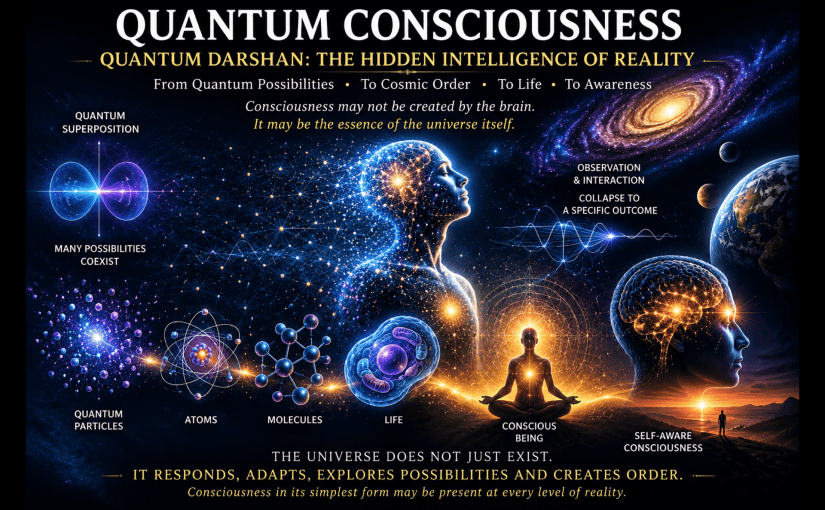
Quantum Consciousness, Quantum Superposition and Quantum Darshan: A New Perspective on the Hidden Intelligence of Reality

Happy International Yoga Day 2026

On this International Yoga Day, as humanity reflects upon consciousness, self-awareness, and inner transformation, it is worth exploring one of the deepest questions in both science and spirituality: What is the true nature of consciousness? The following exploration examines this question through the lens of modern quantum physics, consciousness studies, and a conceptual framework called Quantum Darshan.

Could Quantum Physics Be Pointing Toward a Deeper Principle of Consciousness?

Among the many mysteries revealed by modern quantum physics, few are as astonishing as the phenomenon of quantum superposition. In everyday life, we assume that objects possess definite properties whether anyone observes them or not. Mountains remain mountains, rivers remain rivers, and trees remain trees even when nobody is looking at them. Reality appears fixed, objective, and independent of observation.

Yet the quantum world tells a different story.

According to quantum theory, before measurement occurs, a quantum system is often described not as occupying a single definite state but as existing in multiple possibilities simultaneously. Only when interaction or measurement takes place does one particular outcome become manifest. Physicists continue to debate the exact meaning of this phenomenon, and no universally accepted interpretation has yet emerged.

While reflecting upon this mystery, I was struck by a possibility that may deserve deeper exploration by scientists, philosophers, consciousness researchers, quantum theorists, cognitive scientists, systems theorists, and spiritual thinkers alike.

What if quantum superposition is not merely a mathematical description of probability?

What if it reveals a fundamental principle through which nature continuously explores possibilities before settling upon specific outcomes?

This possibility forms a central insight within Quantum Darshan.

Quantum Superposition and the Selection of Possibilities
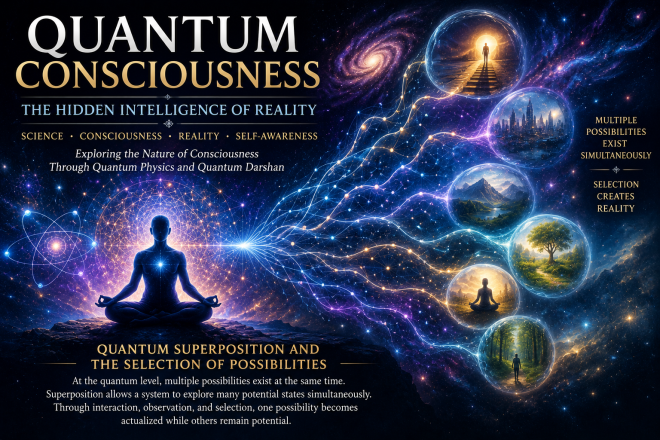
Quantum superposition visualization showing multiple possible states evolving toward a single outcome, illustrating quantum consciousness, quantum mechanics, nature of reality, adaptive processing, and the selection of possibilities in Quantum Darshan.
Quantum superposition suggests that multiple possibilities may coexist before a specific outcome emerges. Quantum Darshan explores whether this process reflects a deeper principle through which nature continuously investigates, adapts to, and selects among potential realities.

To me, quantum superposition appears somewhat analogous to the way multiple thoughts, intentions, possibilities, or potential decisions can coexist in the human mind before a final choice is made. Before a decision emerges, many alternatives remain available. The mind evaluates circumstances, adapts to conditions, and eventually selects a particular course of action.

Likewise, quantum collapse appears analogous to the selection of one possibility from many according to the demands of a given situation.

This does not mean that electrons think, atoms reason, or photons possess human awareness. Such conclusions would go far beyond available evidence.

However, the comparison raises a fascinating question.

If quantum systems continuously respond to surrounding conditions and constraints, could they be participating in an extremely primitive form of intelligent, adaptive, and goal-directed processing?

The significance of this question extends far beyond quantum mechanics itself. It touches the deepest questions concerning the nature of consciousness, intelligence, information, complexity, emergence, self-organization, and reality.

A Radical Yet Simple Interpretation of Consciousness

Quantum Darshan proposes a simple but potentially transformative perspective.

Consciousness, in its broadest sense, may not be limited to self-awareness or subjective experience. Instead, consciousness may be understood as the capacity for intelligent, adaptive, responsive, and goal-oriented processing.

Under this broader definition, human consciousness represents one highly organized expression of a more fundamental principle that may operate throughout nature.

Quantum particles do not possess self-awareness as human beings do. They do not appear to experience emotions, imagination, memory, or reflective thought. Yet they continually interact, respond, adapt, and participate in lawful patterns that contribute to larger forms of organization.

This suggests a continuum rather than a sharp division.

The difference between a quantum particle and a human being may not be the absolute presence or absence of consciousness. Rather, it may be the degree to which conscious processes become integrated, organized, self-referential, and experientially felt.

Solving a Hidden Puzzle of the Universe

One of the greatest mysteries in science is not merely the existence of quantum uncertainty but the emergence of extraordinary order from it.

Individual quantum events often appear unpredictable. Yet the collective behavior of countless particles generates astonishing levels of organization throughout the universe.

Atoms form stable structures.

Molecules assemble into complex systems.

Chemical networks become increasingly sophisticated.

Living cells maintain their integrity.

Biological organisms adapt and evolve.

Ecosystems regulate themselves.

Galaxies organize across immense cosmic scales.

Again and again, nature transforms apparent randomness into meaningful order.

Why?

If reality is fundamentally chaotic, why does it repeatedly produce structure, stability, complexity, adaptation, intelligence, life, and ultimately self-awareness?

Quantum Darshan suggests that beneath apparent randomness may exist a deeper organizing principle that science has not yet fully recognized.

The Missing Link Between Matter and Consciousness

The conventional view often treats matter and consciousness as separate categories.

Matter is considered physical.

Consciousness is considered mental.

Quantum Darshan explores a different possibility.

Perhaps consciousness and matter are not separate substances at all. Perhaps they are different expressions of the same underlying reality operating at different levels of complexity.

At the quantum level this principle may appear as adaptive responsiveness.

At the biological level it may appear as life.

At the neurological level it may appear as awareness.

At the human level it becomes self-conscious experience.

This framework potentially offers a bridge between quantum mechanics, consciousness studies, systems theory, complexity science, information theory, cognitive science, evolutionary biology, philosophy of mind, nondual philosophy, and contemplative traditions.

Consciousness Versus the Feeling of Consciousness

A crucial distinction within Quantum Darshan concerns the difference between consciousness itself and the feeling of consciousness.

The underlying processes of organization, adaptation, responsiveness, and intelligent behavior may exist throughout nature. However, the subjective feeling of being conscious appears only when these processes become sufficiently integrated and complex.

Human beings experience these processes in an extraordinarily organized form. What we call self-awareness emerges when countless layers of information processing become unified within a highly developed nervous system.

The feeling of consciousness is therefore not necessarily identical to the fundamental conscious principle itself.

Rather, it may represent one highly evolved expression of a universal process operating throughout existence.

A Universe That Continuously Explores Possibilities

Viewed in this way, quantum physics may reveal something far more profound than the behavior of subatomic particles.

The universe appears to be continuously responding, adapting, organizing, and exploring possibilities at every level.

What appears as randomness may be only a limited perspective on a deeper order.

What appears as uncertainty may represent the freedom through which nature investigates alternative possibilities before selecting particular outcomes.

What appears as chaos may conceal hidden intelligence operating through countless interactions across the fabric of reality.

This interpretation does not claim final answers. It does not reject science. It does not replace quantum mechanics.

Instead, it invites a broader investigation into whether consciousness, intelligence, self-organization, emergence, adaptation, complexity, and evolution may ultimately arise from a common underlying principle.

The Ancient Roots of Quantum Darshan

One possible indication of primitive adaptive behavior in quantum systems comes from the observer effect. In quantum mechanics, the outcome that becomes manifest depends upon interaction or measurement. Observation does not simply reveal a pre-existing state; it plays a role in determining which possibility emerges from a range of alternatives. While this should not be interpreted as proof of intelligence in the human sense, it does suggest that quantum systems are not completely isolated from their surroundings. Their behavior appears sensitive to external influences and environmental conditions.

From the perspective of Quantum Darshan, this may hint at a primitive form of adaptability operating at the quantum level. Whether this adaptability contributes in any meaningful way to the emergence of larger patterns of order, complexity, and evolution remains unknown. At present, quantum behavior appears mathematically constrained and governed by precise physical laws. Yet it is conceivable that the combined activity of innumerable quantum systems could contribute to the organized structures observed throughout nature. This possibility remains speculative and requires much deeper investigation, but it raises an intriguing question: could the roots of intelligent organization be present, in an extremely simple form, even within the fundamental processes of the quantum world?

For the purposes of Quantum Darshan, such indications do not require the level of proof demanded by science. Science seeks rigorous evidence, mathematical models, predictive power, and experimental verification. Contemplation operates differently. It requires only sufficient logical plausibility for the mind to consider a possibility worthy of sustained reflection. Once a concept becomes contemplatively meaningful, the primary work is no longer performed through analysis or experimentation but through direct observation of one’s own experience.

From this perspective, the observer effect, adaptability to external conditions, and the emergence of order from quantum processes need not be viewed as proofs of consciousness within matter. Rather, they serve as contemplative pointers. They invite the mind to consider the possibility that reality may be more interconnected, responsive, and dynamic than it ordinarily appears. Whether this interpretation is ultimately correct remains an open question. For contemplative practice, however, the value lies not in certainty but in the transformative potential of the inquiry itself.

This forms one of the foundations of Quantum Darshan. By contemplating quantum systems as processes continuously interacting with their surroundings, adapting to conditions, and participating in larger patterns of organization, one gradually begins to see oneself in a similar light. Human beings, too, are dynamic processes embedded within a vast network of relationships and influences. Such contemplation can naturally foster qualities traditionally associated with spiritual development, including detachment, humility, egolessness, acceptance, naturalness, and a deeper sense of connectedness with existence. In Quantum Darshan, awakening is approached not through belief but through sustained contemplation of the same fundamental processes that appear to operate throughout nature, from quantum systems to conscious life itself. In this sense, Quantum Darshan does not propose an entirely new contemplative method. The practice of contemplating nature, natural forces, sacred symbols, deities, and manifestations of existence has been present in Sanatan traditions for thousands of years. Nature worship and idol worship have often functioned not merely as acts of devotion but as contemplative tools through which individuals cultivate humility, surrender, detachment, gratitude, reverence, and a sense of unity with the larger whole. Over centuries, such practices have influenced and transformed the lives of millions of people.

Quantum Darshan does not seek to replace these traditions. Rather, it offers a contemporary contemplative framework for modern minds shaped by science and technology. Where earlier generations contemplated rivers, mountains, the sun, divine forms, and cosmic principles, Quantum Darshan invites contemplation of quantum processes, self-organization, interconnectedness, emergence, and the hidden dynamics of reality revealed by modern physics. The objective remains similar: not the accumulation of beliefs, but the transformation of perception.

Whether quantum systems truly possess any primitive form of intelligence or consciousness remains a question for future inquiry. For contemplative purposes, however, the value lies in the direction toward which the idea points. Just as traditional contemplative symbols helped countless seekers look beyond the confines of the individual ego, Quantum Darshan attempts to provide a modern scientific pointer that may serve a similar function for contemporary readers. Its purpose is not to prove awakening but to encourage the kind of contemplation through which awakening may gradually become possible. From this perspective, Quantum Darshan may not represent an entirely new spiritual path. Quantum systems are present throughout nature and within every physical object. In that sense, contemplating quantum processes everywhere in existence is not fundamentally different from the ancient practice of contemplating nature, sacred forms, or manifestations of the divine. The underlying principle remains similar: directing attention beyond the narrow boundaries of the individual self toward a larger reality.

What changes is not necessarily the object of contemplation but the conceptual framework through which it is viewed. Earlier generations contemplated the same reality through rivers, mountains, the sun, sacred symbols, deities, and cosmic principles. Quantum Darshan invites the modern mind to contemplate that very same reality through quantum systems, interconnectedness, emergence, adaptation, and the hidden processes revealed by contemporary science. The contemplative process remains fundamentally similar; only the language, symbols, and intellectual foundation are updated for an age shaped by scientific understanding. In this sense, Quantum Darshan may be viewed as an ancient contemplative impulse expressed through a modern scientific worldview. Its purpose is not to establish a new doctrine but to provide contemporary seekers with a rational and scientifically inspired basis for contemplation and inner transformation.

In this sense, Quantum Darshan can be viewed as a modern scientific pointer toward an ancient contemplative insight. It does not replace traditional forms of contemplation; rather, it translates a similar impulse into concepts that may feel more accessible and meaningful to readers living in the age of quantum physics and modern science.

A New Direction for Consciousness Research

If this perspective proves even partially correct, its implications could extend across multiple disciplines including quantum physics, quantum biology, neuroscience, philosophy of mind, artificial intelligence, complexity science, systems theory, evolutionary theory, cognitive science, cosmology, metaphysics, spirituality, and consciousness studies.

The deepest significance of quantum uncertainty may not be that reality lacks order.

Rather, it may be that reality possesses the freedom necessary to create order.

The deepest significance of quantum superposition may not be that nature is confused.

Rather, it may be that nature continuously explores possibilities.

The deepest significance of consciousness may not be that it suddenly appears in human brains.

Rather, it may be that consciousness exists as a fundamental organizing principle whose most advanced known expression is the self-aware human mind.

Whether future science ultimately confirms, modifies, or rejects this interpretation remains to be seen.

Yet Quantum Darshan points toward a remarkable possibility: that the universe is not merely a collection of particles moving through empty space, but a continuously evolving reality whose deepest nature may involve intelligence, adaptation, possibility, organization, and consciousness in forms far broader than we have previously imagined.
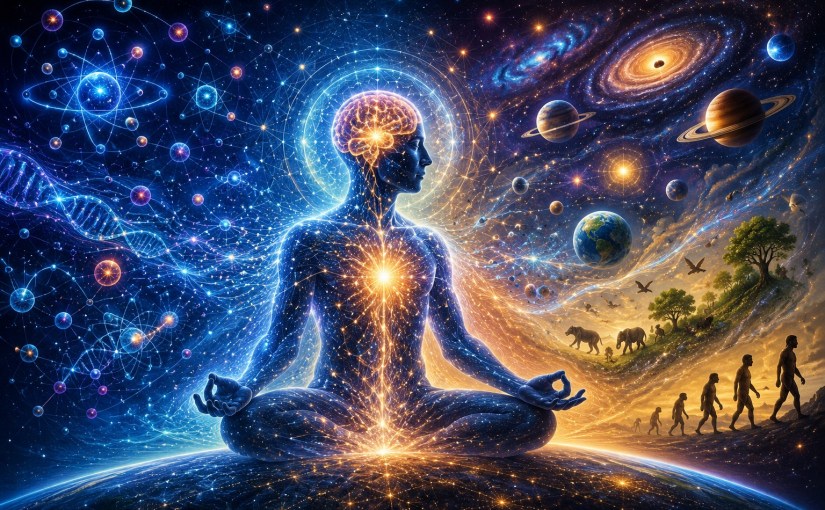
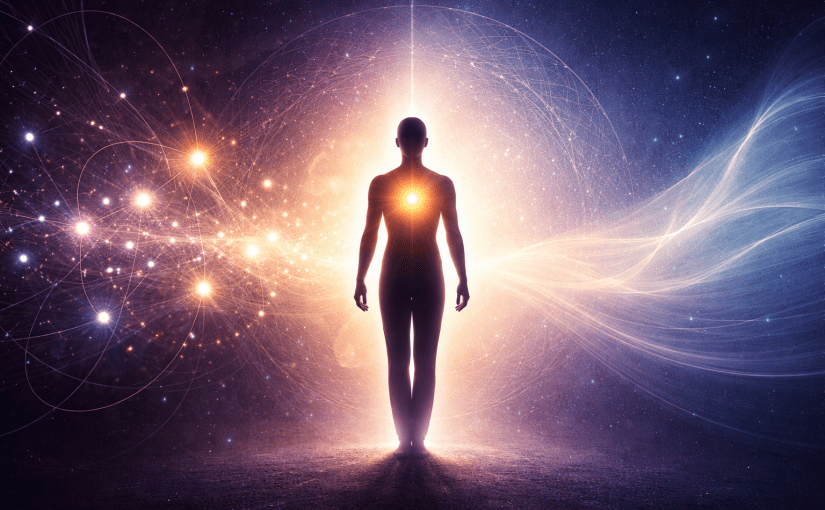
Quantum Darshan: Consciousness, Quantum Reality, and the Ancient Sanatana Vision of a Living Universe

Consciousness, Quantum Reality, and the Search for the Fundamental Nature of Existence

For centuries humanity has struggled with one profound question: What is consciousness? Modern neuroscience attempts to explain it through brain activity, while philosophers continue to debate whether consciousness is merely a by-product of matter or something more fundamental. At the same time, various quantum theories of consciousness suggest that awareness may be linked to the deepest levels of physical reality itself.

This possibility opens a fascinating doorway between modern science and ancient spiritual traditions. For thousands of years, the Sanatana tradition has encouraged reverence toward rivers, mountains, trees, stones, the Sun, the Moon, and other forms of nature. However, these practices are traditionally understood not as worship of inert objects themselves but as contemplation of the divine reality or consciousness believed to pervade all existence. The object serves as a visible symbol of an invisible universal principle.

What makes this noteworthy is that such practices have produced profound spiritual experiences in countless practitioners across generations, including states of inner peace, expanded awareness, nonduality, and awakening. While these outcomes do not constitute scientific proof of quantum-level consciousness, they may be regarded as indirect experiential evidence that consciousness is more fundamental than a mere by-product of biological processes. In this sense, the enduring effectiveness of Sanatana contemplative practices offers a philosophical bridge between modern theories that place consciousness at the foundation of reality and ancient teachings that view the entire universe as permeated by a single underlying existence.

The Concept of Quantum Darshan and Universal Consciousness

Quantum Darshan proposes that consciousness is woven into the very structure of existence. Every quantum particle participates in an underlying field of reality. The emergence of complex organisms does not create consciousness but provides increasingly sophisticated structures through which consciousness can express itself.

From this perspective, the universe may be understood as a continuum of conscious expression. Quantum particles represent the most fundamental level. Biological cells become the first organized expressions. Multicellular organisms demonstrate higher integration. Human beings display self-awareness. Mystical awakening represents perhaps the highest realization of the same underlying principle.

Such a view does not claim that every object experiences consciousness in the same way as a human being. A stone does not possess thoughts, emotions, memories, or self-reflective awareness comparable to those produced by the human brain. However, if consciousness is fundamental to reality, then its presence may extend even to the quantum level from which all forms emerge. In this perspective, inert objects may not consciously feel or recognize their own existence, yet they still participate in the same underlying conscious reality. The difference lies not in the presence or absence of consciousness itself, but in the degree to which it is organized, integrated, felt, and expressed.

In a broader sense, consciousness can be understood as regulated processing and action directed toward a higher developmental tendency or goal. From this perspective, quantum particles and human beings may be viewed as participating in the same fundamental process. Quantum particles continuously process information through their interactions and behave according to laws that contribute to the emergence of larger patterns of organization in nature. Although the universe often appears chaotic and random at the local level, over long periods it repeatedly gives rise to increasing order, complexity, life, and self-awareness. This suggests that there may be a subtle directional tendency inherent in reality, even if it is too faint to be directly observed or measured. The key difference is that quantum particles do not appear to possess subjective experience or the ability to feel these processes, whereas human beings do. This may be because the human brain has evolved a highly complex biological neural network through which pure existence, or Atman, becomes entangled with mental processes and becomes capable of self-awareness, perception, and feeling. Thus, the same underlying reality may be present throughout nature, but conscious experience emerges only when that reality is expressed through sufficiently organized structures such as the human brain.

From quantum particles to atoms, molecules, living cells, complex organisms, and awakened human beings, consciousness remains fundamentally the same underlying principle. Higher levels of organization do not create consciousness but enrich its manifestation, allowing increasingly sophisticated forms of experience, awareness, and self-recognition. Thus, consciousness may be viewed as a continuum extending throughout existence, while the capacity to experience and express it varies according to the complexity of the structure through which it operates.

How Quantum Darshan Connects with Sanatana Philosophy

This perspective creates an intriguing bridge to the ancient Sanatana worldview. The Sanatana tradition has long revered rivers, mountains, trees, stones, the Sun, the Moon, and countless manifestations of nature. To many modern observers this appears to be the worship of inert objects. However, through the lens of Quantum Darshan, a different interpretation becomes possible.

The reverence shown toward natural forms need not imply that a mountain or stone possesses human-like awareness. Rather, it reflects recognition that the same universal reality of consciousness permeates all existence. The worship is not necessarily directed toward the physical object itself but toward the deeper principle expressed through that object.

A river becomes sacred because it participates in the same underlying reality as the worshipper. A mountain becomes worthy of reverence because it is another expression of the universal existence. A tree, a stone, an animal, and a human being differ enormously in complexity and function, yet all may arise from the same foundational reality.

In this interpretation, Sanatana worship becomes an acknowledgment of unity rather than an idolization of matter. The object serves as a visible doorway through which one contemplates the invisible conscious principle underlying all existence.

Consciousness as a Continuum Rather Than a Human Possession

One of the most significant implications of Quantum Darshan is the rejection of the idea that consciousness suddenly appears only when a brain reaches a certain level of complexity. Instead, consciousness exists on a continuum.

At the most fundamental level are quantum entities. Above them emerge atoms and molecules. These organize into living cells. Cells organize into organisms. Organisms develop nervous systems. Human beings develop self-reflective awareness. Spiritual awakening reveals the deeper ground from which all these levels emerge.

In this model, life does not manufacture consciousness. Life becomes a vehicle through which consciousness expresses itself more clearly. Complexity increases the richness of expression, but the underlying reality remains continuous throughout the hierarchy of existence.

Ancient Wisdom and Modern Quantum Thought

The remarkable aspect of this framework is how it allows ancient spiritual insights and modern scientific speculation to engage in meaningful dialogue. Quantum theories of consciousness remain highly speculative and controversial within science. They have not yet established a definitive explanation for awareness. Yet they raise questions that resonate with philosophical and spiritual traditions that have contemplated consciousness for thousands of years.

Many ancient teachings describe the universe as permeated by a single reality. This reality has been expressed through concepts such as Brahman, Shiva-Shakti, universal consciousness, pure existence, or ultimate being. Quantum Darshan does not scientifically prove these teachings. Neither does it replace scientific investigation. Instead, it provides a philosophical framework in which these ancient ideas become intellectually approachable in a modern context.

The possibility emerges that what spiritual traditions discovered through direct inner experience and what science investigates through external observation may ultimately be examining different aspects of the same mystery.

The Meaning of Reverence Toward Nature

Viewed through Quantum Darshan, reverence toward nature acquires deeper significance. The sacredness attributed to rivers, mountains, forests, celestial bodies, and natural forces is not merely cultural symbolism. It becomes recognition that all forms participate in a shared underlying existence.

This perspective naturally encourages ecological respect and humility. If the same foundational reality manifests through every aspect of existence, then exploitation of nature becomes, in a sense, a failure to recognize our own deeper interconnectedness.

A person standing before a river is not simply observing flowing water. A person standing before a mountain is not simply looking at rock. Instead, one is encountering another expression of the same universal reality that gives rise to one’s own existence.

The Continuum from Matter to Awakening

Quantum Darshan suggests a grand continuum extending from quantum particles to awakened consciousness. The smallest entities participate in fundamental reality. Living cells organize that reality into biological systems. Organisms create increasing levels of integration. Human consciousness develops self-awareness. Spiritual realization reveals the universal ground beneath individual identity.

The continuum does not imply that all levels are identical. A human being clearly differs from a stone. Yet the distinction may lie in organization rather than in ultimate essence. Complexity influences expression, but the underlying reality remains shared.

This perspective allows one to understand how traditions that honor natural objects could emerge naturally from a worldview rooted in unity rather than separation.

Science, Philosophy, and the Future of Consciousness Studies

The scientific study of consciousness remains one of humanity’s greatest challenges. Despite tremendous advances in neuroscience, psychology, artificial intelligence, and quantum physics, no universally accepted explanation of consciousness exists. Questions concerning subjective experience, awareness, and the origin of consciousness remain open.

Quantum Darshan enters this discussion not as a completed scientific theory but as a philosophical proposal. It suggests that consciousness may be more fundamental than currently assumed. If future discoveries reveal deeper connections between consciousness and quantum reality, entirely new ways of understanding life, mind, and existence may emerge.

Even if such connections are never scientifically confirmed, the framework remains valuable because it encourages dialogue between scientific inquiry and ancient wisdom traditions. It reminds us that the search for truth need not be divided into opposing camps of science and spirituality.

Conclusion: A Universe United by an Underlying Reality

Quantum Darshan presents a vision of existence in which consciousness is fundamental rather than accidental. Quantum particles participate in the deepest fabric of reality. Living systems organize and amplify this reality. Human beings become capable of recognizing it consciously. Spiritual awakening represents the realization of unity beneath apparent diversity.

Through this lens, the Sanatana reverence for rivers, mountains, trees, stones, the Sun, the Moon, and other natural forms becomes understandable as recognition of a universal conscious principle rather than worship of inert matter. The object itself is not necessarily the focus. The deeper reality present within and through the object becomes the true subject of reverence.

Whether approached through science, philosophy, or direct spiritual experience, the possibility remains profoundly intriguing: that beneath the countless forms of the universe lies a single reality expressing itself in different degrees of organization, complexity, and awareness. Quantum Darshan offers one way of contemplating that possibility, providing a bridge between modern explorations of consciousness and the timeless vision that all existence is ultimately one.

Quantum Duality and Nondual Consciousness: The Forgotten Balance Behind Humanity’s Survival

One of the deepest secrets of quantum science and its relationship with consciousness can be compressed into a single core insight: the entire cosmos, whether living or non-living, moves through a delicate balance of duality and non-duality. The dual nature of the world is not a mistake or a limitation—it is the very fingerprint of existence. Everything that appears, from atoms to minds, carries both a particle aspect and a wave aspect. This applies equally to unconscious matter and to conscious life.

In this vast design, wave nature functions like a control unit or a brain, while particle nature functions like the working unit or the body. The wave holds possibilities, coherence, and intelligence; the particle executes, interacts, and manifests. Both are required for creation to move forward. If there were only wave nature, nothing would ever be expressed into form. There would be infinite possibility but no world. If there were only particle nature, the cosmos would be chaotic, unregulated, and mechanically driven without inner order, just like a body without a nervous system.

Why Entanglement, Superposition, and Interference Matter

Modern quantum physics has already shown us how this balance operates. Without entanglement, there would be no cosmic regulation, because particles would have no deep relationship with one another. Without superposition, there would be no choice, because systems would be trapped in fixed states rather than holding multiple possibilities. Without interference, there would be no refinement, no pattern formation, and no subtlety of expression. These quantum features are not technical oddities; they are the very language of creativity in nature.

Likewise, in human life, without a non-dual wave-like dimension, the mind becomes trapped in rigid patterns. There is no flexibility, no creativity, no compassion. Without the dual, particle-like dimension, nothing practical could be achieved. Work would not happen, societies would not organize, and no structure could be built. Only when both are present together does meaningful life arise.

Human Mind as Quantum Balance

In the living human world, if there were only non-duality, no worldly evolution or growth would occur. People would remain in abstract peace but would not build, create, or transform the material world. On the other hand, if there were only duality, there would be constant stress, inefficiency, poor quality of work, conflict, and war. History shows that when societies become overly dualistic—focused only on competition, profit, and control—humanity moves toward collapse rather than progress.

Without mutual cooperation there is no regulation of societies. Without thinking beyond fixed parameters there are no discoveries or inventions. Without meaningful interaction there is no development of skill, culture, or wisdom. Duality in the mind works like the particle nature of matter, while non-duality works like its wave nature. Both must coexist for a balanced and humane civilization.

Emotions, Duality, and the Soul

Just as all interactions in the quantum world arise from particle nature, and interactions push systems to express their particle aspect even more, all emotions arise from the duality of the mind. Emotions intensify identification, separation, and attachment. The conscious entity that feels and witnesses interactions in the quantum world is traditionally called Brahman or the gods, and it remains unaffected by those interactions. The conscious entity that experiences emotions in the human mind is called the soul, and it is deeply affected by them.

The reason the gods or Brahman remain untouched is the wave nature of the quantum world itself. Wave nature neutralizes the disturbances created by interaction because it is the opposite of fixation. It holds everything without being trapped by anything. In the same way, a human being can develop a god-like mind by adopting a wave-like, non-dual attitude while moving through particle-like worldly interactions.

Why Ancient Nondual Traditions Were Essential

This is why non-dual traditions such as Sanātana Dharma, Buddhism, and Yoga arose at the very beginning of human civilization. They were not religious inventions; they were technologies of balance. They taught humanity how to remain rooted in wave-like awareness while functioning in a particle-like world. They preserved compassion, coherence, and inner freedom while allowing outer progress. They described quantum darśan in the form of an Upadeśa tradition flowing among the devatās and then from the devatās to human beings. Nārāyaṇa, or Parabrahman, gave this teaching of non-duality to Brahmā; Brahmā gave it to the Sun-god; the Sun gave it to the Prajāpatis; the Prajāpatis gave it to Manu; and from Manu it came to humanity through different sages.

Today, this non-dual dimension is being eroded. Modern civilization is increasingly driven only by particle logic—competition, consumption, and fragmentation. As non-duality disappears, compassion disappears with it. When compassion fades, selfishness rises. When selfishness rises, conflict and war become inevitable. The loss of non-duality is directly reflected in the loss of compassion, and the loss of compassion threatens the survival of the entire human race.

The forgotten truth is simple yet profound: just as the universe requires both waves and particles to exist, humanity requires both non-duality and duality to survive. When this balance is restored, both science and spirituality point to the same future—a coherent, compassionate, and creative civilization grounded in the deepest laws of reality.

Chapter 26: The Cosmic Connection: Sāṅkhya and Quantum Physics

The universe begins from a quiet background that holds all possibilities but expresses none. Sāṅkhya calls this Prakṛti, and quantum physics describes it as the undifferentiated quantum field—the vacuum that contains every potential pattern of behaviour. In this original state, nothing is separate. There is no world, no mind, no matter, and no individuality. Only a field of pure potential waiting to move. Alongside this stands Puruṣa, the silent witnessing awareness, comparable to the observer in quantum theory. It does not act, but without it, potentials do not become definite.

When the still Prakṛti undergoes the slightest disturbance, the first form of order appears. This is Mahat or Buddhi. In ancient terms, it is the dawning of cosmic intelligence. In quantum terms, it is the first symmetry-breaking where the basic behaviours of reality appear—attraction, repulsion, oscillation, motion, and balance. This is the beginning of structured behaviour in the universe. Nothing is individual yet, but the field is no longer completely still.

Prakṛti is not a physical point before the Big Bang; it is the totally unmanifest potential where nothing is expressed — no space, no time, no particles, no fields, no laws, no symmetry. When this perfect sameness of guṇas is minutely disturbed, the first expression that appears is Mahat, which is pure cosmic order: the universe’s first structured state, like the perfectly symmetric, massless pre–Higgs early universe where all forces are unified and no individuality exists. Mahat is not particles — it is the first “law-framework” that makes particles possible, just like the unified electroweak field before symmetry breaking. When this initial order further differentiates (Ahaṅkāra), symmetry breaks — exactly like the Higgs field choosing a non-zero value — and now distinct behaviours arise. Actually, with the rapid expansion of the universe after the Big Bang, rapid cooling occurs, and the Higgs field condenses just as water freezes when it becomes cold. Some quantum fields interact strongly with this condensed Higgs field and gain mass (like W and Z bosons), and some remain massless (like the photon). This is the stage where individuality begins. From here, subtle qualities (tanmātras) and then space, forces, energies, and finally particles and matter (mahābhūtas) emerge. In essence: Prakṛti is pure unmanifest potential; Mahat is the first perfectly symmetric order; Ahaṅkāra is the symmetry-breaking that creates separateness; and all matter arises only afterward.

From this early order, a definite identity emerges. This is Ahaṅkāra, the principle that creates “this” and “not this.” Quantum analogies are direct: symmetry breaking, origin of differentiation or duality, wavefunction collapse, decoherence, and the emergence of particles from a spread-out field. Ahaṅkāra is not psychological ego; it is cosmic individuality. It is the moment when a section of the universal field becomes a distinct centre of activity.

Once individuality forms, three streams unfold from Ahaṅkāra. The first is Manas, the coordinating mind. It is not intellect; it is simple internal movement—attention, comparison, and the handling of impressions. This matches quantum oscillations, phase changes, and internal state-shifts. In Sāṅkhya, Manas is the most basic layer of mind—not intellect and not identity—but the simple internal mechanism that receives sensory impressions, shifts attention, compares possibilities, doubts, and coordinates information between the senses and Buddhi. It is fundamentally a movement, a flickering, undecided mental activity. This function matches quantum behavior at the structural level: quantum systems constantly oscillate between possible states, their phases keep changing, and their internal configurations shift rapidly before any measurement stabilizes them. Just as a quantum state exists in superposition, oscillating between alternatives until a collapse fixes it, Manas keeps flickering among impressions without final judgment, leaving decisive understanding to Buddhi. Thus, Manas corresponds to the mind’s continuous, oscillatory, pre-decisional activity, analogous to the quantum field’s continuous state-shifts, fluctuations, and oscillations.

The second stream is the rise of the five Jñānendriyas, the cosmic capacities to receive information: vibration (hearing), force-contact (touch), light-form (sight), bonding-pattern (taste), and density-pattern (smell). These correspond to the five primary types of information present in the quantum world.

In simple quantum terms: hearing is like receiving tiny packets of vibration (phonons) — imagine little ripple-packets that travel through a material and make nearby atoms briefly ring; touch is like feeling invisible pushes and pulls (electromagnetic interactions) — like two magnets sensing a push before they meet; sight is like catching tiny packets of light (photons) that carry color and direction, so when they hit an atom they change its state and deliver a visual signal; taste is like two electron-wave patterns meeting and either harmonizing or clashing — if the electron clouds match in shape and energy they bond (a “pleasant” fit like tasty or sweet dish), if not they repel like repelling bitter poison; and Smell is like tiny quantum particles (molecules) floating around. When they hit another particle, they transfer a little bit of their vibration energy. The receiving particle changes its state because of this small energy transfer. That state-change is the “smell” signal.

The third stream is the rise of the five Karmendriyas, the capacities for action: emission, grasping interaction, motion, release, and replication. An excited electron dropping to a lower level and emitting a photon is like doing work or loosing body-matter and hence getting exhausted by it. Just like the body emits actions outward, the atom releases light outward. An electron absorbing a photon and catching its energy is the quantum version of “grasping” or eating an incoming impulse to grow. A quantum particle tunneling through a barrier is the complex motion or movement exhibited by it. In quantum terms, release is like an atom that briefly holds extra energy and then lets it go as a photon. It is like emission karma. The energy is kept for a moment in an excited state, and when the atom settles back down, the photon escapes into space as its excreta—just as the human system releases what it no longer needs. In the quantum vacuum, energy constantly blossoms into pairs of virtual particles that appear, duplicate themselves for a fleeting moment, and vanish again. This spontaneous sprouting of particle pairs is a far cleaner parallel to replication—something arising from a source, dividing into two, and then returning—mirroring the creative, generative aspect of the Karmendriya. Every physical system from particles to organisms expresses these five modes in some form.

After these capacities arise, the universe expresses five Tanmātras—subtle patterns that underlie all experience. These are not physical; they are the core behavioural signatures of reality: oscillation (śabda), interaction (sparśa), electromagnetic form (rūpa), cohesion (rasa), and density (gandha). In modern understanding, they resemble fundamental field-patterns that guide how matter and energy will behave. They are the bridge between pure subtlety and gross manifestation.

When a child first experiences the world, each sense reveals a subtle behaviour of reality: sound shows that space exists for vibration to travel; touch shows invisible interaction like air, pressure, or warmth; sight shows form, light, and the fire-quality of brightness; taste shows cohesion and blending like water; smell shows density or solidness even before a shape is seen. These five Tanmātras—sound for oscillation, touch for interaction, rupa or form, rasa for cohesion, and smell for density—then generate the five elements: space, air, fire, water, and earth respectively. It means the child understands the character of the five basic elements of outside world by experiencing their five subtle essences, called Tanmātras. In the quantum world the same logic appears in subtler form: oscillation of a quantum field is the proof of space-time itself; interaction among fields is the microscopic version of touch and air; electromagnetic patterns carried by photons create visibility, form, colour, and heat; cohesive forces in atoms and molecules create liquidity and blending; And the subtle drifting of tiny particles here and there gives a clue that, somewhere nearby, their gathering creates a dense form.

When these subtle patterns condense, the physical world appears as the five Mahābhūtas. Space (ākāśa) arises from vibration-patterns; motion or air (vāyu) from interaction-patterns; fire or energy (tejas) from EM-patterns; water or fluidity (apas) from cohesion-patterns; and earth or solidity (pṛthvī) from density-patterns. These five are not metaphors—they are the five classes of physical expression seen everywhere from subatomic behaviour to galaxies. The gross universe is simply the final stage of a flow that began much earlier with pure potential.

A human being grows by repeating the same sequence in miniature. At conception and birth, the individual begins as a packet of pure potential—its own Prakṛti, carrying tendencies, instincts, and latent qualities. When the first internal stirrings of awareness appear, they function as Mahat or Buddhi. As the infant’s consciousness becomes clearer, a sense of “I” forms—Ahaṅkāra. This is the child realising it is separate from the surrounding world. Once individuality is set, Manas begins to operate with simple mental movements, while the five sensing capacities (jñānendriyas) gradually awaken and the five action capacities (karmendriyas) develop through natural growth.

As the newborn senses begin working, the subtle tanmātras are recognised one by one. Through vibration, the child perceives space element in which it travels; through touch, it perceives contact that’s the pure quality of air element as it’s invisible to other senses; through light, it perceives form element; through taste, it perceives bonding or liquidity or water element as everything in mouth become mixed with liquid saliva to be tasted; and through smell, it perceives the nature of solids or earth element because things when dried to solid form start emiting odour. In this way, the gross world is built in the mind through the meeting of inner capacities with outer patterns. The world is not given first; it is assembled through the flow of tattvas. Many people think that the gross world formed first and that the subtle elements emerged from it. This leads to an indirect praising of the gross world, which results in attachment to it. In reality, the reverse is true: the gross emerges from the subtle elements. This understanding leads to an indirect praising of the subtle realm, helping one avoid attachment to the gross world and move toward the subtle realm, whose pinnacle is the soul itself. The subtle realm is the only true realm because it is always present, whether the gross world exists or not. The gross world, however, does not exist when only the subtle realm remains. Even when both appear together, the gross world has no independent identity; its identity lies hidden deep within the subtle realm upon which it is layered. We encounter this subtle realm during deep dhyāna.

Because the universe and the individual follow exactly the same developmental order—from silent potential to ordered vibration, individuality, mind, senses, subtle patterns, and finally the physical world—it becomes clear that they are not two. The human is the cosmos expressing itself on a small scale, and the cosmos is the human writ large. Since the cosmos is directly regulated by the quantum world, this also proves the fundamental sameness between the human being and the quantum entity once again verifying the validity of quantum darshan. This mirroring is the simplest proof of Advaita: one reality flowing through many forms. Quantum theory shows that the observer and the observed arise together; Sāṅkhya shows the same through the tattva sequence. Ishwar of sankhya is the same observer of quantum science causing quantum decoherenc and quantum collapse to build classical world as seen by us in gross form. Both point to a single underlying truth—that the separation between the universe and the individual is only apparent. At the foundation, they arise from the same field and follow the same path of unfoldment.

All bhāvas, emotions, rasas, ṣaḍ-doṣas, and the countless subtle feeling-patterns are not inventions of the human organism. They are primordial forces, woven into the fabric of the cosmos from the very beginning. The human body does not create these states—it merely experiences and expresses the eternal patterns already present in the universal field. What we call “emotion” in a person is only the local manifestation of a cosmic principle. By understanding that all emotions, bhāvas, and inner movements are cosmic patterns rather than personal creations, one can cross the ego barrier more easily. When feelings are seen as impersonal forces passing through the body—not “mine” but expressions of the universe—attachment naturally dissolves. The individual realizes that if the cosmos holds these patterns without suffering or bondage, then there is no need to identify with them or be burdened by them. This shift in perspective brings effortless detachment, clarity, and inner freedom.

In the chapters ahead, we will reveal how these feeling-patterns exist in the quantum substratum, long before any biological or psychological form appears. The structures and behaviours found in the quantum world are the same structures that shape the cosmos at every scale, because the quantum layer is the most fundamental building block of all existence. By understanding the quantum patterns, we understand the cosmic patterns; by understanding the cosmic patterns, we understand ourselves in true way.

First, we will examine human mental functions aka gyanendriyas through the lens of the quantum world—beginning with the Ṣaḍarivarga, then exploring the ashta-bhāvas, and finally the shada-rasas. After this, we will analyse the bodily functions aka karmendriyas of the human organism at the same quantum depth. Earlier in this book, we gave a brief, atomic-level explanation of these processes, but now we will unfold them directly at the level of quantum behaviour one by one in detail, using the electron and other fundamental entities as our reference point.

Keval Kumbhak, Prana–Apana Balance, and the Quantum Nature of Thoughts

There is a certain moment in deep meditation when the breath simply stops.
It is not forced. It is not held. It just… disappears.

This is keval kumbhak — a natural cessation of breath. For me, this happens when the up–down oscillations of pranic energy at a chakra slowly merge into a central still point. The wave’s amplitude reduces and reduces until it reaches zero.

In that zero point, I notice something striking — the mind is gone.
No thoughts, no images, no mental chatter. Just an absolute stillness.

Zero Amplitude – Zero Thoughts

While sitting in that state, it feels as if all mental activity has stopped. But thinking deeper, I realized: maybe the mind has not truly stopped existing. Maybe it is still active somewhere, just not where my awareness is looking.

When the amplitude of the pranic wave is at zero, my attention is also resting in that zero point. Thoughts may still be forming somewhere in the “mind-field”, but in this zone, they are simply not perceptible.

It’s like looking at a large movie screen but focusing on one tiny, blank center spot — all the action at the edges is still playing, but you don’t see it.

Breath Amplitude as the Thought Gateway

As I slowly come out of that deep point and start observing the breath’s movements again, I notice something:

The moment the breath-wave amplitude increases, thoughts start appearing. Small amplitude → few thoughts. Larger amplitude → more thoughts.

It’s as if the breath’s oscillation opens the gate for more of the mind-field to become visible. The breath amplitude acts like the size of a window — the bigger the opening, the more thoughts can pass into perception.

The Quantum Analogy

This reminded me of quantum wave mechanics.

In quantum theory, a particle’s probability of being found at a certain location depends on the amplitude of its wavefunction. Zero amplitude means zero probability — the particle simply won’t be found there. Means, the probability of finding a wavy quantum particle increases in direct proportion to its wave amplitude, with zero amplitude meaning zero probability.

My experience felt similar:

  • Mind = quantum particle
  • Thoughts = particle detections (collapses)
  • Breath/pranic amplitude = probability amplitude for perceiving thoughts

At zero amplitude (in keval kumbhak), the probability of detecting a thought is effectively zero in the zone of observation. When amplitude rises, the probability rises — thoughts appear.

Orch-OR Connection

Orch-OR (Orchestrated Objective Reduction), proposed by Hameroff and Penrose, suggests consciousness arises from quantum collapses in microtubules inside neurons.

In my case, I don’t think those collapses stop entirely in samadhi. Instead:

  • Collapses (thought formations) still happen in the mind-field.
  • But my awareness in deep meditation is focused on the zero-amplitude center, where no thoughts register.
  • When pranic amplitude grows, awareness spreads over a wider zone, catching more of these collapses as thoughts.

It’s a subtle but important difference:
The mind’s activity might still exist in potential form, but in samadhi, I am tuned into a region where it doesn’t show up.

The Practice-Based Side: Prana–Apana Tactics

In truth, this is not just a passive state that “happens” — it can also be reached deliberately through classical yogic techniques.
It involves balancing prana (upward-moving energy) and apana (downward-moving energy) in specific ways:

  • Making one dominant over the other
  • Reversing them — sending physical breath in one direction, mental breath (visualized energy) in the other
  • Colliding them so they meet at a chosen point in the body
  • Merging them completely into a single unified flow

The “mental breath” here is not literal air but the directed pranic flow in awareness. The “physical breath” is the actual inhalation/exhalation movement. These two can be made to work in opposite or complementary ways.

When they fully merge or balance, their oscillations cancel out, creating the still-point — the zero-amplitude zone I described earlier. That is where keval kumbhak naturally occurs, and thought perception drops to zero.

This is why it is hard to explain literally — without direct practice, the idea of “moving physical breath one way and mental breath the other way” sounds abstract. But in practice, it is as real and mechanical as adjusting two water streams so they meet perfectly.

Why This Feels Unique

I have read yoga texts, studied some Kashmir Shaivism, and explored modern quantum-consciousness theories.
Yoga speaks of chitta vritti nirodha (stilling the mind waves).
Kashmir Shaivism says vibration (spanda) never fully stops, but one can rest in the bindu (center).
Science says breath influences brain rhythms.
Orch-OR says quantum collapse underlies awareness.

But I have not come across anyone directly mapping breath/pranic amplitude to the probability of perceiving thoughts, using both lived yogic experience and quantum analogy.

This feels like my personal discovery — a bridge between keval kumbhak and quantum perception theory.

The Simple Takeaway

In keval kumbhak, the mind does not truly vanish — it simply becomes unobservable when awareness rests in the zero-amplitude point of the pranic wave.
As breath amplitude increases, the observable field expands, and thoughts return in proportion to that amplitude.

It is not about stopping the mind entirely; it is about where the lens of awareness is placed.

In the deepest stillness, the movie of the mind is still running somewhere — but I am looking at a blank spot in the center of the screen.

Quantum Collapse and Consciousness: Ancient Wisdom Meets Science

Ancient seers of India declared something deeply mysterious yet simple: “What exists outside in solid, permanent form, exists inside as subtle, transient image.” This is not just poetic philosophy—it may now be echoed in modern quantum physics and brain science. The world we see outside appears fixed, while our thoughts and inner perceptions seem soft and fleeting. Yet both may arise from the same hidden process: quantum collapse. This is where the Orchestrated Objective Reduction (Orch-OR) theory, proposed by physicist Roger Penrose and anesthesiologist Stuart Hameroff, offers a stunning bridge between ancient darshan and modern science.

In the quantum world, particles can exist in many states at once—a situation called superposition. But when they collapse into one state, reality “chooses” an outcome. Penrose believed this collapse is not caused by an observer but by the universe itself—through objective reduction (OR). He theorized that when gravitational effects within spacetime reach a certain threshold, the superposition collapses into a single, irreversible event. This is not just a shift in physics—it might be the spark of a conscious moment.

Hameroff then linked this to the brain, particularly to microtubules, which are tiny cylindrical protein structures inside neurons. These microtubules, made of tubulin proteins, were once thought to be mere skeletons of the cell. But Hameroff noticed their crystalline structure, internal symmetry, and electrical polarity, and proposed that they could support quantum computations.

Now, let’s clarify something important: When we say “quantum computation,” we don’t mean the microtubules are solving algebra or statistics. They aren’t doing math like a calculator. Instead, they are holding patterns of possibilities—like “yes” and “no”, or “apple” vs “orange”, or “fear” vs “love”—in superposition. These potential mental states exist all at once, and then, when a collapse happens inside the microtubules, one option becomes real, and that becomes your conscious moment. It’s like the universe makes a tiny choice through you, within you.

This model offers an answer to something classical neuroscience can’t explain: How do mere firing neurons produce subjective experience—qualia? And why do we have moments of understanding, intuition, or insight that no computer can reproduce? Penrose argued, using Gödel’s theorem, that human insight is non-algorithmic—it can’t be computed by step-by-step logic. Orch-OR proposes that the brain bypasses classical logic using non-computable, quantum-level processes, which might be the very source of consciousness.

But wait—isn’t the brain warm and noisy? How can delicate quantum processes survive in such conditions? This is the biggest challenge. Normally, quantum coherence—the state where particles stay in perfect sync—is destroyed quickly in warm environments due to decoherence. This is like trying to keep a soap bubble alive in a thunderstorm. Yet, surprising examples in nature show it’s possible.

Photosynthesis in plants uses quantum coherence to move energy efficiently. Birds navigate using quantum entanglement in their eyes. Even our sense of smell may involve quantum tunneling. These examples, under the emerging field of quantum biology, show that nature finds ways to protect and use quantum effects even in wet, warm environments—just like the brain.

In microtubules, regions called hydrophobic pockets may shelter tiny quantum states from the noise. These proteins also contain dipoles, which are like tiny bar magnets with a positive and negative end. These dipoles can oscillate—they vibrate or swing back and forth—and may do so coherently, like a choir singing in perfect harmony. This creates a system that can store, process, and collapse information in a quantum way. When these dipole oscillations collapse, they may produce specific conscious outcomes—such as a decision, a thought, a feeling, or a perception.

So, what’s actually being “computed”? Not equations. Not logic gates. But experience itself. The microtubules are theorized to integrate emotions, sensations, perceptions, and thoughts, holding many potential outcomes at once. When collapse happens, only one possibility becomes your actual experience. This is the kind of non-algorithmic computation Penrose speaks of—a moment of meaning rather than mechanical output.

Some critics say that anesthesia can knock out consciousness simply by shutting down classical brain activity. But Hameroff’s insight was that general anesthetics also bind to tubulin in microtubules. That’s key. Consciousness disappears when microtubule function is blocked, not just when neurons stop firing. Still, this is not conclusive, because anesthetics also affect synaptic transmission. It’s hard to isolate which effect is responsible. Yet, the link between tubulin and anesthesia remains one of the strongest clues in favor of Orch-OR.

Another key point: not all decoherence is the same. Depending on where and how the collapse occurs, the output differs—a thought, a decision, a feeling, a dream. So, different forms of decoherence may correspond to different forms of consciousness. And not every collapse needs to involve the whole brain—some may be small, local, producing micro-conscious events. Others might involve large-scale coherence, creating full-blown awareness, like insight, choice, or even spiritual experience.

In the end, this brings us full circle to what the ancient sages said. The outer world is permanent because its quantum states collapse universally and remain fixed. The inner world is subtle and ever-shifting, because its quantum collapses happen inside us, constantly. Yet both arise from the same quantum process. The brain is not just a machine—it may be a sensitive quantum receiver and projector, constantly receiving and collapsing the cosmic possibilities that flow through consciousness.

So, you are not just observing the universe—you are where the universe chooses. Through microtubules, through quantum collapse, through a moment of awareness…
the cosmos becomes aware of itself.

That is why the sages have always said: “Whatever you do, it is not your will—it is God’s will.” This does not mean you are helpless, but that you naturally act according to the situation, like nature itself does. Just as the universe collapses quantum possibilities into the most fitting outcome, you too respond based on the unfolding of circumstances, not from isolated ego. This is not a mystical guess but a pattern seen everywhere—from human consciousness to the workings of body cells, atoms, and even the entire cosmos. Sharirvigyan Darshan presents the same insight, showing that human life, cellular behavior, and cosmic events follow the same fundamental process of synchronized adjustment to nature’s flow. Recognizing this frees you from ego and karma bandhan, because you realize: you are not the isolated doer; you are a participant in the universe’s grand orchestration.

How Quantum Collapse Might Create Consciousness: A Simple Exploration

There’s a growing idea in science that consciousness is not just about brain circuits or chemical reactions, but something far deeper—possibly linked to the quantum fabric of the universe itself. This idea comes mainly from the work of physicist Roger Penrose and anesthesiologist Stuart Hameroff, who together developed what’s known as the Orch-OR theory—short for Orchestrated Objective Reduction.

At its heart, this theory suggests that inside our brain’s microtubules—tiny structures in our neurons—quantum processes are happening. Normally, quantum particles exist in a strange state called superposition, where they hold multiple possibilities at once. For example, a particle might spin both ways at the same time, or be in several places at once. But nature doesn’t allow this to go on forever. At a certain point, the system collapses into one outcome. This is known as quantum collapse.

Penrose believes this collapse isn’t always caused by observation or measurement, like in traditional quantum theory. Instead, he proposes something called Objective Reduction. This means collapse happens because of the way gravity and space-time themselves are structured. Nature can’t keep balancing multiple realities indefinitely, so it chooses one. This is not just a trick of perception—it’s real, irreversible, and fundamental. Once a quantum system collapses, it can’t go back to its previous state. It’s like the universe itself has made a decision.

Hameroff adds a biological layer to this. He suggests that the brain uses microtubules to hold quantum superpositions related to thoughts, decisions, and perceptions. When these superpositions collapse, they produce moments of conscious awareness. Each collapse is like a single frame in the movie of your mind. When these collapses happen in rapid, orchestrated sequences, we experience the flow of thought and the stream of consciousness.

This leads to an interesting question: why do we feel consciousness in the brain but not in rocks, air, or empty space? After all, quantum collapses happen everywhere. The answer lies in orchestration. In nature, collapses are isolated and random—like tiny sparks going off here and there. But in the brain, millions of quantum collapses happen together, in harmony, creating a unified field of awareness. That’s why you experience a rich, conscious inner world while a stone does not.

Some people ask, if this is true, then why can’t we create consciousness artificially? The reason is that computers and AI do not work through orchestrated quantum collapses. They process information step-by-step, running programs and algorithms. Even advanced neural networks simulate thinking but do not collapse quantum possibilities into experience. The human brain, however, might be directly connected to the universe’s mechanism of choosing between potential realities. Consciousness could be part of how the universe works at its core, not just a mechanical process.

Decision-making is a perfect example of this. When we face a dilemma, it feels like we’re holding multiple outcomes in mind at once. But we can’t stay in this state forever. Eventually, a decision happens. According to Penrose, this is exactly what nature does with quantum systems. When the tension becomes too great, a collapse occurs. This is like the mental version of quantum collapse. Your brain may literally hold multiple potential actions in superposition, and when the moment of choice arrives, one outcome is selected. That’s why decisions often feel final and irreversible—it’s like nature locking in one version of events and closing off the others.

This may also explain intuition. Sometimes a solution just pops into your mind without you working through it step-by-step. It could be that your brain was holding several options unconsciously, and then a collapse happened, giving you the answer all at once. Déjà vu might work in a similar way. When a new quantum collapse overlaps with memory patterns from the past, it creates the eerie feeling that you’ve been in this moment before.

Meditation can affect this process too. When you meditate, the mind slows down. This may allow your brain’s superpositions to last a little longer before collapsing. When the collapse finally happens, it could do so in a cleaner, more coherent way, creating deep clarity or moments of timeless awareness. Advanced meditators sometimes describe feeling merged with the cosmos, as if their personal thought patterns dissolve. This could reflect a state where the brain temporarily stops collapsing quantum possibilities into ego-based experiences and instead taps into the universal field of awareness.

Even death may be connected to this process. When the body dies, the brain’s orchestrated collapses stop. But Penrose and Hameroff suggest that the quantum information inside the microtubules might not be lost—it could return to the cosmic field, like a drop of water returning to the ocean. Near-death experiences, where people report feelings of light, unity, and timelessness, might occur when the normal brain filters drop away, allowing pure quantum consciousness to briefly unfold.

Interestingly, these ideas are not entirely new. Ancient philosophies have said similar things for centuries. In Vedanta, it’s taught that Atman, the individual self, is the same as Brahman, the universal consciousness. Orch-OR reflects this by suggesting that consciousness is part of the universe itself, and the brain simply tunes into it. Buddhism teaches that there is no permanent self—only a stream of momentary experiences. Orch-OR echoes this by describing consciousness as a sequence of quantum collapses. Tantra views the world as a cosmic dance of awareness and energy, which aligns with the idea of the universe constantly collapsing possibilities into reality.

Even a single thought or glimpse of awareness might be the result of quantum collapse. When you suddenly think of something or experience a flash of insight, millions of microtubule collapses could be resolving into one conscious moment. In decision-making, this process becomes sharper because you are selecting one path from many, which makes the collapse feel even more final.

One could wonder—if each collapse is irreversible, wouldn’t the brain eventually get filled up or stuck? But this doesn’t happen because the brain is dynamic. It constantly creates new superpositions, new possibilities, and continues the process of collapse. The raw particles don’t get stuck—it’s the patterns and choices that evolve. Memory, learning, and personal growth come from this stream of irreversible experiences, but the mind stays flexible because nature has built-in recycling at the molecular level. Microtubules break down and rebuild all the time, allowing fresh quantum possibilities to emerge.

In simple terms, every thought, decision, intuition, or flash of awareness might be the universe resolving itself into one reality through you. Consciousness isn’t something separate from the cosmos—it’s part of the cosmic process itself, becoming personal in the human mind. Ancient sages hinted at this, and now modern science is beginning to explore it through quantum physics. It’s a humbling and beautiful thought that with every moment of awareness, you are participating in the universe’s ongoing act of creation.

Why Do We Get Stuck? A Quantum Insight Into Depression, Happiness, and Letting Go

In life, we all experience many moods and mind states—joy, sadness, courage, fear, excitement, boredom. These are natural waves of consciousness. But somewhere along the journey, many people make a silent mistake: they get attached to one mental state and start believing it is permanent. This is one of the root causes of suffering.

People fall into depression not just because life is hard, but because they begin to think, “This sadness is final. This is how my life will always be.” Suicidal thoughts often come from this same illusion—the belief that one unbearable feeling is the whole truth of existence, with no possibility of change. People lose happiness not because joy is absent, but because they get trapped in one emotional corner of the mind and forget how naturally shifting life actually is.

This is where Sharirvigyan Darshan, the science of understanding life through the body and the atom, offers a simple but powerful insight.

Look at the quantum world, the very foundation of life. The particles inside every atom—electrons, protons, photons—never cling to one state. They exist inside what physicists call the quantum field, a state where multiple possibilities are always alive at once. The quantum field is like an open playground, where a player can do anything—jump, sit, lie down, roll, squat, walk, run, or stand still. All these actions are present in potential, but the player chooses one depending on the moment. The other actions remain available, silently waiting, not lost. Similarly, in the quantum world, when the right condition appears, one possibility crystallizes into reality, while the others gently step back into the field of maybes.

Now compare this to the human mind. Our consciousness also holds many options. We can think new thoughts, feel new emotions, and take new actions. But we get stuck when we obsessively identify with one mind state, believing, “This is me, and this is final.” This leads to stress, anxiety, depression, and sometimes even the tragic decision to give up on life. But nature itself doesn’t behave this way. Your own body is proof. Right now, trillions of atomic decisions are happening in your cells, constantly shifting, adjusting, and choosing the next best state according to the present moment. Life is not designed to be rigid—it is designed to flow.

So what is the solution? Sharirvigyan Darshan teaches you to remember your atomic roots. Like the quantum field, you too are standing in an open playground of possibilities at every moment. If sadness is present, let it pass through you like a temporary action in the field—but don’t block joy, courage, or peace from blooming next. The universe is constantly shifting between possibilities. Particles don’t get stuck—they shift when needed. Why should you be any different?

This is not just philosophy—it is how reality works. Learning to live like the quantum world means letting go of obsessive clinging to one mental state and allowing life to unfold naturally, just as it was designed to do.