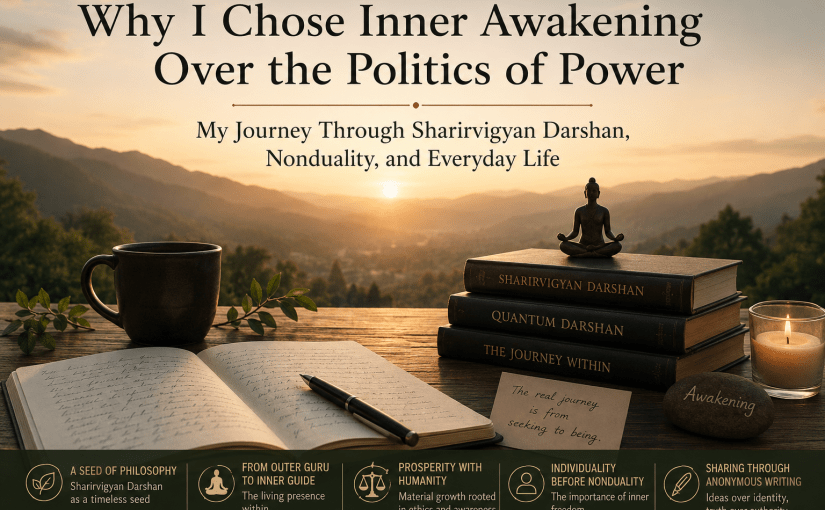
Why I Chose Inner Awakening Over the Politics of Power: My Journey Through Sharirvigyan Darshan, Nonduality, and Everyday Life

Why I Always Remained Away from the Politics of the Crown

Throughout my life, many people have wondered why I always remained away from the politics of the crown. The answer was never that I disliked leadership, authority, prosperity, or responsibility. Neither did I consider worldly success to be inferior to spirituality. My journey simply moved in a different direction.

From the beginning, my interest was less in acquiring power and more in understanding life itself. As years passed, my attention gradually shifted toward the study of consciousness, meditation, and the direct experience of existence. Politics generally demands continuous attention toward public expectations, influence, organization, strategy, competition, and visible achievements. My own mind was increasingly drawn toward contemplation. Both directions require enormous energy, and gradually I realized that my energy was naturally flowing elsewhere.

The Birth of Sharirvigyan Darshan

Nearly three decades ago, an intuitive understanding emerged within me which I later called Sharirvigyan Darshan. It was not a carefully designed philosophical system. I did not sit down with the intention of creating a new philosophy. Rather, it appeared almost like a seed. Looking back today, I feel that the philosophy arose intuitively before I fully understood its future implications.

I intentionally kept it flexible. It was never meant to become another rigid doctrine or sect. It was meant to remain a seed that different individuals could mould according to their own temperament, profession, culture, and circumstances. The philosophy was even published in a university magazine and remained openly available.

Today, after almost thirty years, I find that perhaps I myself have benefited from it the most. Initially this puzzled me. Why had I rarely heard others describe how deeply it had transformed them?

Gradually I understood something important. A philosophy can provide direction, principles, and even practical methods. It cannot live a person’s life on their behalf.

Philosophy Gives Direction, Practice Gives Transformation

Every scripture can offer theory. Some scriptures even provide remarkably practical methods. Yet every individual must eventually walk the path personally.

No philosophy can meditate for us.

No scripture can observe our thoughts for us.

No Guru can permanently replace our own direct experience.

A map shows the destination but never walks the journey.

Perhaps Sharirvigyan Darshan fulfilled exactly this role. It remained a seed. A seed never forces itself to become a tree. The receiver must nourish it through practice, reflection, observation, failures, corrections, and continuous living.

This may explain why millions read great scriptures while relatively few undergo profound transformation. Reading is only the beginning. Living is the real experiment.

Did My Inner Consciousness Become My Guru?

Sometimes I wonder whether I was really the author of Sharirvigyan Darshan. It appeared naturally rather than intellectually.

As years passed, I found myself repeatedly returning to its principles. I walked upon the very path that had emerged through me. This raises an interesting possibility in my own mind.

Perhaps my deeper consciousness first expressed itself through this philosophy and later continued guiding me through it.

During meditation, the living Guru gradually transformed into an inner meditation image. That image was never merely a memory. It functioned like a silent reference point. Whenever confusion appeared, contemplation of that inner presence often brought clarity without deliberate reasoning.

Whether one interprets this as the inner Guru, awakened intuition, deeper consciousness, divine grace, or simply psychological integration is a matter of philosophical language. My experience remains the same. The outer Guru gradually became an inner guide.

Could Everyone Have Benefited?

Sometimes I have wondered what might have happened if many people had sincerely lived according to this philosophy.

The philosophy itself was universal. It was never limited to any religion, caste, nationality, profession, or social group. Its greatest strength was flexibility. The external expression could vary completely from person to person. Only the basic orientation of the mind needed to change.

I cannot claim that everyone would certainly have attained awakening. Every individual grows differently. Yet I genuinely feel that sincere practice could have brought profound spiritual upliftment to many people.

The philosophy never asked anyone to imitate another person. It simply invited a different way of seeing life.

The Difficulty of Modern Spiritual Life

Modern people often expect immediate results.

Even in spirituality, many unconsciously expect the Guru to walk on their behalf. They admire the teacher, attend discourses, collect books, worship photographs, or repeat beautiful words. Yet the real transformation begins only when the seeker personally begins walking.

No Guru can meditate for another person.

No Guru can dissolve another person’s attachments.

The Guru can inspire, guide, encourage, and sometimes accelerate the journey, but the walking always remains personal.

Perhaps that is why I never wanted followers. I wanted fellow travellers.

Prosperity Was Never My Enemy

One misunderstanding that often arises regarding spirituality is that awakening demands rejection of material prosperity.

This was never my understanding.

I never opposed physical prosperity.

I never considered wealth sinful.

I never believed comfort was an obstacle in itself.

Rather, I felt that prosperity should remain rooted in humanity, ethical responsibility, Sharirvigyan Darshan, and the broader insights that later matured into what I call Quantum Darshan.

Material development without humanity eventually creates imbalance. Spirituality without practical responsibility becomes equally incomplete.

The ideal is integration.

Why I Did Not Become Very Prosperous

At the same time, I also recognize another reality in my own life.

As my understanding gradually became more nondual and detached, much of my available energy naturally flowed toward contemplation, meditation, writing, understanding consciousness, fulfilling my professional duties sincerely, and living with greater awareness.

Because of this, I simply did not pursue material opportunities with the same intensity as many enthusiastic material achievers, including many of my own colleagues.

This does not mean I sacrificed prosperity in order to become awakened.

The sequence was almost the opposite.

As nondual understanding matured, attachment to continuously acquiring more naturally weakened. I received enough for a comfortable and dignified life. Beyond that, my deepest satisfaction increasingly came from inner clarity rather than external accumulation.

Looking back, I do not regret the opportunities I missed.

I feel grateful that life provided enough while simultaneously allowing me to pursue what gradually became the highest aim of my life—awakening, self-realization, and living an increasingly nondual lifestyle.

Leadership and Public Expectations

I never contested elections.

Not because I hated the crown.

Not because leadership itself was wrong.

Rather, I sensed that public leadership often carries expectations that did not match my inner direction.

Many people naturally expect leaders to continuously increase visible prosperity, development, and material opportunities. These expectations are understandable because societies need practical progress.

My own vision, however, gradually became broader. I wanted prosperity along with humanity, ethical responsibility, and spiritual insight.

I felt that this vision might not easily fit the expectations commonly placed upon political leadership.

Perhaps there would have been misunderstanding.

Perhaps disappointment.

Perhaps criticism.

My inner calling was quietly moving elsewhere.

The Crowd and Individuality

Another realization gradually emerged.

Coming to the top of a crowd often creates pressure to become what the crowd expects.

Whether in politics, public life, or spirituality, the leader can slowly become shaped by public expectations.

For me, individuality was extremely important.

Not egoistic individuality, but the freedom to observe independently.

I feel that authentic individuality is often the beginning of genuine spiritual inquiry. Before one transcends individuality through nondual realization, one first discovers an authentic individuality capable of independent observation and discrimination.

If that individuality constantly dissolves into public expectations, the inner journey itself may become difficult.

This is why I gradually preferred remaining inwardly free rather than becoming publicly influential.

Sharing Without Preaching

Another insight slowly became clear.

Today’s world is not very receptive to being instructed.

People usually resist being told how to live.

Perhaps the better way is simply to share one’s own experiences, reflections, observations, failures, and discoveries without demanding agreement.

Experience invites exploration.

Preaching often invites resistance.

If someone finds value, they may explore further.

If not, nothing has been imposed.

This approach also protects spiritual freedom.

Why Writing Is Better Than Speaking

Over time I also began feeling that writing is often superior to speaking for sharing spiritual reflections.

A spoken discourse carries the personality, appearance, voice, reputation, and emotional influence of the speaker.

Writing allows ideas to stand independently.

Readers may agree.

Disagree.

Pause.

Return years later.

Or quietly move on.

The text remains patient.

Even better, anonymous writing removes another layer.

People stop asking, “Who wrote this?”

Instead they begin asking, “Is there truth in this?”

That shift is valuable.

Truth should not depend upon the social status, profession, fame, or appearance of the author.

Profession and Spiritual Identity

Anonymous writing is especially meaningful for people whose professions do not outwardly appear spiritual.

A veterinarian, engineer, scientist, administrator, businessman, or government officer may possess genuine contemplative experience.

Yet public identity often creates prejudice.

People may ridicule them by saying they are acting spiritual or merely performing a drama.

The ideas become judged through the profession instead of through their own merit.

Anonymous writing quietly removes this obstacle.

It allows the reflections to breathe freely.

My Way of Sharing Spiritual Knowledge

Looking back today, I feel that my purpose was never to create followers.

Nor was it to establish another sect.

Nor to become famous.

Nor to gather crowds.

If Sharirvigyan Darshan carries any value, it lies in quietly offering a seed.

Every individual remains completely free.

Each person may test it.

Modify it.

Reject it.

Expand it.

Or discover something entirely different.

The real authority is never the writer.

The real authority is direct experience.

Perhaps this is the simplest way to share spirituality in today’s world.

Not through preaching.

Not through argument.

Not through authority.

Not through personality.

But through honest experiences, sincere reflections, and a life quietly lived.

If those reflections help even a few sincere seekers begin their own journey toward awakening, humanity, self-realization, and a nondual way of living, then the seed has already fulfilled its purpose.

Sharirvigyan Darshan and Quantum Darshan: A Practical Bridge from Sankhya to Advaita Vedanta

Can Ancient Indian Philosophy Become Practical Again? A Personal Search

For many years I lived with a question that slowly became deeper than meditation itself. Ancient Indian philosophy beautifully explains consciousness, liberation and the nature of existence, yet I repeatedly wondered why these teachings often remain difficult for ordinary people to apply in daily life. My own spiritual journey gradually revealed that the answer may not lie in choosing one philosophy over another but in discovering how different philosophies naturally become useful at different stages of inner evolution.

One question especially transformed my contemplation. If pure consciousness is completely detached and inactive, how can the entire universe function with such astonishing intelligence? How can something that never acts still remain connected with every process of creation, every memory of the past and every possibility of the future? Complete non-existence cannot organize anything. Therefore pure existence cannot simply be an absence. It appears to be the silent background that constitutes everything without becoming entangled in anything. This insight slowly made creation appear less like a machine and more like one immense living organism whose countless activities continue while the underlying reality remains untouched.

The Beauty and Limitation of Classical Sankhya

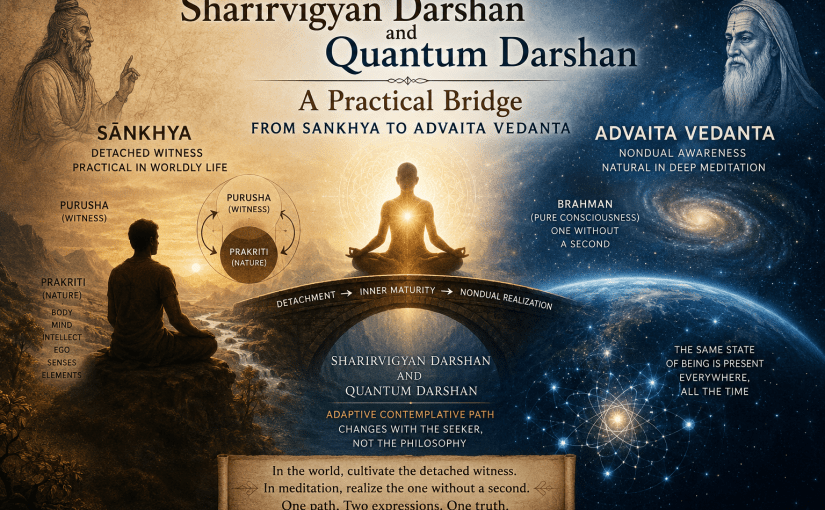
My reflections naturally returned to Sankhya philosophy. Sankhya explains that Purusha is pure witnessing consciousness while Prakriti performs every action. Purusha neither acts nor becomes attached. Prakriti alone evolves into body, mind, intellect, ego, senses and the entire universe. This immediately explains why detachment is possible. Purusha never needed to become detached because it was never attached in the first place.

The more I contemplated this, the more I realized that detachment itself is perhaps the greatest lesson taught by Sankhya. Purusha is detached not because it practices detachment but because detachment is its very nature. Spiritual practice therefore becomes the gradual recognition that body, mind, emotions and actions belong to Prakriti while the witnessing self remains forever untouched.

Yet another question quietly appeared. If Purusha is absolutely inactive, how does Prakriti become so intelligently organized merely by its proximity? This question has inspired many philosophical traditions, including Advaita Vedanta and Kashmir Shaivism, each providing different explanations. Rather than rejecting Sankhya, I began searching for a practical bridge.

The Birth of Sharirvigyan Darshan

During my contemplations I realized that perhaps the easiest teacher already exists inside the human body.

Every cell performs astonishingly intelligent activities. Cells communicate, repair tissues, defend against disease, reproduce, generate energy and maintain life continuously. Yet I do not consciously perform these cellular activities. They continue automatically.

Then a deeper analogy emerged.

Suppose every cell possesses its own witnessing principle just as the human being possesses a witnessing self. The important point is not whether science presently accepts such a hypothesis. The important point is the structure of contemplation.

Just as my self remains detached from my body’s activities and their results, the self of the cell would remain detached from the activities and results of the cell. Neither becomes identical with the body through action.

This is the heart of Sharirvigyan Darshan.

It does not teach that the self of the cell is the cell itself. Nor does it immediately ask the seeker to accept that everything is one consciousness. Instead, it repeatedly invites contemplation of the relationship between self and body.

The cell performs.

The self witnesses.

The body acts.

The self remains detached.

Through this simple contemplation, detachment becomes easier to experience than through abstract metaphysical discussion.

Quantum Darshan Extends the Same Principle

Exactly the same structural principle later appeared in Quantum Darshan.

Only one illustration changes.

Instead of beginning with cells, Quantum Darshan begins with quantum particles.

Again, the philosophy does not claim that the self of a quantum particle is identical with the particle itself. Rather, the same contemplative relationship is extended to a deeper level of nature. Means self of quantum particle is detached from it. The body performs according to its own laws while the witnessing principle remains detached from action and its consequences.

Thus both Sharirvigyan Darshan and Quantum Darshan become beginner-friendly. They do not force the mind to grasp the extremely subtle nondual statement that everything is one. Instead, they first teach the practical experience of witness-consciousness through familiar structures.

Why Direct Advaita Vedanta Was Difficult for Me

My own spiritual journey taught me something very important.

When I first approached nondual Vedanta directly, it was extremely difficult to stabilize in everyday life. The mind found it difficult to understand how becoming and non-becoming could coexist. The statement that everything is one consciousness remained intellectually attractive but practically difficult to maintain while living an active worldly life.

Sankhya-based contemplation proved completely different.

By repeatedly recognizing that body and mind belong to Prakriti while the witnessing self remains detached, I gradually developed stable inner detachment. This was not suppression of worldly life. Rather, it became freedom while living within worldly responsibilities.

Only much later did nondual understanding arise naturally.

My Spiritual Experience Revealed an Unexpected Cycle

One of the most surprising discoveries during my years of Tantra, yoga and meditation was that Sankhya and Vedanta did not appear as rivals. Instead, they seemed to support one another at different stages of consciousness.

While living actively in the world, my attention naturally returned to Sharirvigyan Darshan. The contemplation of the detached self became my greatest support. It helped me perform duties while remaining inwardly free.

Then, after prolonged meditation, Tantra and deep yogic absorption, something changed naturally.

Worldly identification became weaker.

The sense of separation gradually dissolved.

Without forcing any philosophical conclusion, awareness itself began experiencing nonduality. The distinction between myself and everything else became less important than the underlying unity of existence.

Interestingly, at that stage the Sankhya-based contemplation became less necessary because nondual awareness itself had become natural.

However, whenever worldly responsibilities increased again, attention naturally returned to Sharirvigyan Darshan. It again became the practical method through which detachment stabilized until nondual awareness gradually re-emerged.

This cycle repeated many times.

Worldly engagement naturally encouraged Sankhya-like contemplation.

Deep meditation naturally matured into Vedantic realization.

Neither philosophy opposed the other.

Each appeared precisely when needed.

An Adaptive Philosophy Rather Than a Fixed Philosophy

This gradually led me to a new possibility.

Perhaps Sharirvigyan Darshan and Quantum Darshan function as adaptive contemplative systems.

During active worldly life they operate practically like Sankhya by strengthening witness-consciousness and reducing attachment.

During deep meditation, yoga and Tantra they naturally flower into nondual understanding without requiring a separate philosophical conversion. I could easily contemplate that my present state of being is present everywhere at all times because the same universal laws are working everywhere. This became my natural mode of contemplation during the nondual phase, rather than focusing on the distinction between the detached self and its body, which was my primary contemplation during the worldly phase.

The philosophy itself does not change.

Only the seeker’s state of consciousness changes.

When the mind is deeply engaged with worldly activity, attention naturally rests upon the distinction between self and body.

When meditation matures and identification weakens, attention naturally recognizes the underlying unity of existence.

Thus the same contemplative framework serves both stages.

A Humble Proposal for Researchers and Spiritual Seekers

I do not present these reflections as established scientific facts or final philosophical conclusions. They are the outcome of sustained personal contemplation, meditation and practical observation. They invite discussion rather than demand agreement.

If these ideas prove useful, they may offer a practical bridge connecting Sankhya, Yoga, Tantra, Advaita Vedanta, consciousness studies, contemplative psychology and even modern scientific models of biological and quantum organization.

Most importantly, they suggest that perhaps beginners need not begin with the most abstract metaphysical doctrines. They may first learn detachment through direct observation of life itself. As detachment matures, deeper nondual realization may arise naturally rather than intellectually.

My own experience repeatedly followed this path.

Sankhya-like witness consciousness supported me while living in the world.

Deep meditation revealed nonduality.

Returning to the world revived practical witness-consciousness.

Returning inward restored effortless nonduality.

Instead of contradiction, I discovered complementarity.

Instead of choosing between Sankhya and Vedanta, I found that practical detachment and nondual realization can become successive expressions of the same spiritual journey.

Why Sankhya Appears More Practical Before Nondual Realization

From my own experience, Sankhya appears more practical during active worldly life. As long as the mind is deeply engaged with work, relationships and responsibilities, it is easier to cultivate detachment by contemplating that the witnessing self is distinct from the body, mind and actions. In contrast, if one begins directly with the Advaita Vedanta view that Purusha and Prakriti are ultimately one, it can be difficult for many beginners to understand how the same reality can both manifest as the world and yet remain completely detached from it. This subtle paradox may become clear only after deep meditation and inner maturity. My experience has been that Sankhya-based contemplation naturally prepares the mind for this realization. Once detachment becomes stable through practice, nondual awareness arises effortlessly, and the apparent contradiction between distinction and unity gradually dissolves through direct experience rather than intellectual reasoning. This is why Sharirvigyan Darshan and Quantum Darshan are presented not as alternatives to either Sankhya or Advaita Vedanta, but as practical contemplative bridges that guide the seeker from witness-consciousness to nondual realization according to the seeker’s stage of inner development.

Quantum Consciousness, Quantum Superposition and Quantum Darshan: A New Perspective on the Hidden Intelligence of Reality

Happy International Yoga Day 2026

On this International Yoga Day, as humanity reflects upon consciousness, self-awareness, and inner transformation, it is worth exploring one of the deepest questions in both science and spirituality: What is the true nature of consciousness? The following exploration examines this question through the lens of modern quantum physics, consciousness studies, and a conceptual framework called Quantum Darshan.

Could Quantum Physics Be Pointing Toward a Deeper Principle of Consciousness?

Among the many mysteries revealed by modern quantum physics, few are as astonishing as the phenomenon of quantum superposition. In everyday life, we assume that objects possess definite properties whether anyone observes them or not. Mountains remain mountains, rivers remain rivers, and trees remain trees even when nobody is looking at them. Reality appears fixed, objective, and independent of observation.

Yet the quantum world tells a different story.

According to quantum theory, before measurement occurs, a quantum system is often described not as occupying a single definite state but as existing in multiple possibilities simultaneously. Only when interaction or measurement takes place does one particular outcome become manifest. Physicists continue to debate the exact meaning of this phenomenon, and no universally accepted interpretation has yet emerged.

While reflecting upon this mystery, I was struck by a possibility that may deserve deeper exploration by scientists, philosophers, consciousness researchers, quantum theorists, cognitive scientists, systems theorists, and spiritual thinkers alike.

What if quantum superposition is not merely a mathematical description of probability?

What if it reveals a fundamental principle through which nature continuously explores possibilities before settling upon specific outcomes?

This possibility forms a central insight within Quantum Darshan.

Quantum Superposition and the Selection of Possibilities

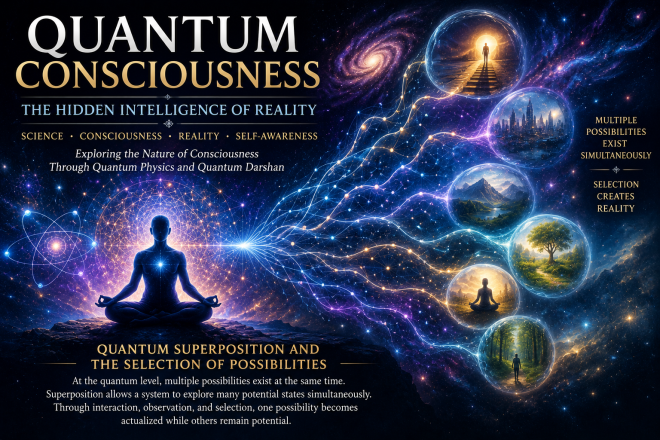
Quantum superposition visualization showing multiple possible states evolving toward a single outcome, illustrating quantum consciousness, quantum mechanics, nature of reality, adaptive processing, and the selection of possibilities in Quantum Darshan.
Quantum superposition suggests that multiple possibilities may coexist before a specific outcome emerges. Quantum Darshan explores whether this process reflects a deeper principle through which nature continuously investigates, adapts to, and selects among potential realities.

To me, quantum superposition appears somewhat analogous to the way multiple thoughts, intentions, possibilities, or potential decisions can coexist in the human mind before a final choice is made. Before a decision emerges, many alternatives remain available. The mind evaluates circumstances, adapts to conditions, and eventually selects a particular course of action.

Likewise, quantum collapse appears analogous to the selection of one possibility from many according to the demands of a given situation.

This does not mean that electrons think, atoms reason, or photons possess human awareness. Such conclusions would go far beyond available evidence.

However, the comparison raises a fascinating question.

If quantum systems continuously respond to surrounding conditions and constraints, could they be participating in an extremely primitive form of intelligent, adaptive, and goal-directed processing?

The significance of this question extends far beyond quantum mechanics itself. It touches the deepest questions concerning the nature of consciousness, intelligence, information, complexity, emergence, self-organization, and reality.

A Radical Yet Simple Interpretation of Consciousness

Quantum Darshan proposes a simple but potentially transformative perspective.

Consciousness, in its broadest sense, may not be limited to self-awareness or subjective experience. Instead, consciousness may be understood as the capacity for intelligent, adaptive, responsive, and goal-oriented processing.

Under this broader definition, human consciousness represents one highly organized expression of a more fundamental principle that may operate throughout nature.

Quantum particles do not possess self-awareness as human beings do. They do not appear to experience emotions, imagination, memory, or reflective thought. Yet they continually interact, respond, adapt, and participate in lawful patterns that contribute to larger forms of organization.

This suggests a continuum rather than a sharp division.

The difference between a quantum particle and a human being may not be the absolute presence or absence of consciousness. Rather, it may be the degree to which conscious processes become integrated, organized, self-referential, and experientially felt.

Solving a Hidden Puzzle of the Universe

One of the greatest mysteries in science is not merely the existence of quantum uncertainty but the emergence of extraordinary order from it.

Individual quantum events often appear unpredictable. Yet the collective behavior of countless particles generates astonishing levels of organization throughout the universe.

Atoms form stable structures.

Molecules assemble into complex systems.

Chemical networks become increasingly sophisticated.

Living cells maintain their integrity.

Biological organisms adapt and evolve.

Ecosystems regulate themselves.

Galaxies organize across immense cosmic scales.

Again and again, nature transforms apparent randomness into meaningful order.

Why?

If reality is fundamentally chaotic, why does it repeatedly produce structure, stability, complexity, adaptation, intelligence, life, and ultimately self-awareness?

Quantum Darshan suggests that beneath apparent randomness may exist a deeper organizing principle that science has not yet fully recognized.

The Missing Link Between Matter and Consciousness

The conventional view often treats matter and consciousness as separate categories.

Matter is considered physical.

Consciousness is considered mental.

Quantum Darshan explores a different possibility.

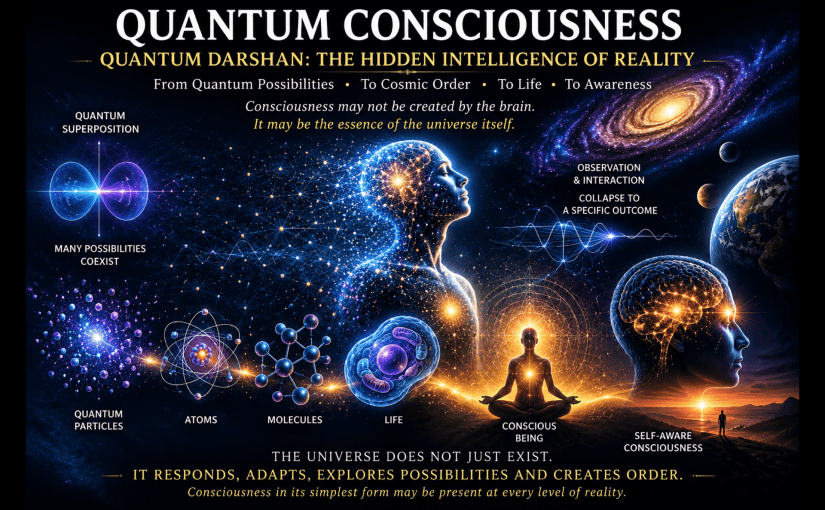
Perhaps consciousness and matter are not separate substances at all. Perhaps they are different expressions of the same underlying reality operating at different levels of complexity.

At the quantum level this principle may appear as adaptive responsiveness.

At the biological level it may appear as life.

At the neurological level it may appear as awareness.

At the human level it becomes self-conscious experience.

This framework potentially offers a bridge between quantum mechanics, consciousness studies, systems theory, complexity science, information theory, cognitive science, evolutionary biology, philosophy of mind, nondual philosophy, and contemplative traditions.

Consciousness Versus the Feeling of Consciousness

A crucial distinction within Quantum Darshan concerns the difference between consciousness itself and the feeling of consciousness.

The underlying processes of organization, adaptation, responsiveness, and intelligent behavior may exist throughout nature. However, the subjective feeling of being conscious appears only when these processes become sufficiently integrated and complex.

Human beings experience these processes in an extraordinarily organized form. What we call self-awareness emerges when countless layers of information processing become unified within a highly developed nervous system.

The feeling of consciousness is therefore not necessarily identical to the fundamental conscious principle itself.

Rather, it may represent one highly evolved expression of a universal process operating throughout existence.

A Universe That Continuously Explores Possibilities

Viewed in this way, quantum physics may reveal something far more profound than the behavior of subatomic particles.

The universe appears to be continuously responding, adapting, organizing, and exploring possibilities at every level.

What appears as randomness may be only a limited perspective on a deeper order.

What appears as uncertainty may represent the freedom through which nature investigates alternative possibilities before selecting particular outcomes.

What appears as chaos may conceal hidden intelligence operating through countless interactions across the fabric of reality.

This interpretation does not claim final answers. It does not reject science. It does not replace quantum mechanics.

Instead, it invites a broader investigation into whether consciousness, intelligence, self-organization, emergence, adaptation, complexity, and evolution may ultimately arise from a common underlying principle.

The Ancient Roots of Quantum Darshan

One possible indication of primitive adaptive behavior in quantum systems comes from the observer effect. In quantum mechanics, the outcome that becomes manifest depends upon interaction or measurement. Observation does not simply reveal a pre-existing state; it plays a role in determining which possibility emerges from a range of alternatives. While this should not be interpreted as proof of intelligence in the human sense, it does suggest that quantum systems are not completely isolated from their surroundings. Their behavior appears sensitive to external influences and environmental conditions.

From the perspective of Quantum Darshan, this may hint at a primitive form of adaptability operating at the quantum level. Whether this adaptability contributes in any meaningful way to the emergence of larger patterns of order, complexity, and evolution remains unknown. At present, quantum behavior appears mathematically constrained and governed by precise physical laws. Yet it is conceivable that the combined activity of innumerable quantum systems could contribute to the organized structures observed throughout nature. This possibility remains speculative and requires much deeper investigation, but it raises an intriguing question: could the roots of intelligent organization be present, in an extremely simple form, even within the fundamental processes of the quantum world?

For the purposes of Quantum Darshan, such indications do not require the level of proof demanded by science. Science seeks rigorous evidence, mathematical models, predictive power, and experimental verification. Contemplation operates differently. It requires only sufficient logical plausibility for the mind to consider a possibility worthy of sustained reflection. Once a concept becomes contemplatively meaningful, the primary work is no longer performed through analysis or experimentation but through direct observation of one’s own experience.

From this perspective, the observer effect, adaptability to external conditions, and the emergence of order from quantum processes need not be viewed as proofs of consciousness within matter. Rather, they serve as contemplative pointers. They invite the mind to consider the possibility that reality may be more interconnected, responsive, and dynamic than it ordinarily appears. Whether this interpretation is ultimately correct remains an open question. For contemplative practice, however, the value lies not in certainty but in the transformative potential of the inquiry itself.

This forms one of the foundations of Quantum Darshan. By contemplating quantum systems as processes continuously interacting with their surroundings, adapting to conditions, and participating in larger patterns of organization, one gradually begins to see oneself in a similar light. Human beings, too, are dynamic processes embedded within a vast network of relationships and influences. Such contemplation can naturally foster qualities traditionally associated with spiritual development, including detachment, humility, egolessness, acceptance, naturalness, and a deeper sense of connectedness with existence. In Quantum Darshan, awakening is approached not through belief but through sustained contemplation of the same fundamental processes that appear to operate throughout nature, from quantum systems to conscious life itself. In this sense, Quantum Darshan does not propose an entirely new contemplative method. The practice of contemplating nature, natural forces, sacred symbols, deities, and manifestations of existence has been present in Sanatan traditions for thousands of years. Nature worship and idol worship have often functioned not merely as acts of devotion but as contemplative tools through which individuals cultivate humility, surrender, detachment, gratitude, reverence, and a sense of unity with the larger whole. Over centuries, such practices have influenced and transformed the lives of millions of people.

Quantum Darshan does not seek to replace these traditions. Rather, it offers a contemporary contemplative framework for modern minds shaped by science and technology. Where earlier generations contemplated rivers, mountains, the sun, divine forms, and cosmic principles, Quantum Darshan invites contemplation of quantum processes, self-organization, interconnectedness, emergence, and the hidden dynamics of reality revealed by modern physics. The objective remains similar: not the accumulation of beliefs, but the transformation of perception.

Whether quantum systems truly possess any primitive form of intelligence or consciousness remains a question for future inquiry. For contemplative purposes, however, the value lies in the direction toward which the idea points. Just as traditional contemplative symbols helped countless seekers look beyond the confines of the individual ego, Quantum Darshan attempts to provide a modern scientific pointer that may serve a similar function for contemporary readers. Its purpose is not to prove awakening but to encourage the kind of contemplation through which awakening may gradually become possible. From this perspective, Quantum Darshan may not represent an entirely new spiritual path. Quantum systems are present throughout nature and within every physical object. In that sense, contemplating quantum processes everywhere in existence is not fundamentally different from the ancient practice of contemplating nature, sacred forms, or manifestations of the divine. The underlying principle remains similar: directing attention beyond the narrow boundaries of the individual self toward a larger reality.

What changes is not necessarily the object of contemplation but the conceptual framework through which it is viewed. Earlier generations contemplated the same reality through rivers, mountains, the sun, sacred symbols, deities, and cosmic principles. Quantum Darshan invites the modern mind to contemplate that very same reality through quantum systems, interconnectedness, emergence, adaptation, and the hidden processes revealed by contemporary science. The contemplative process remains fundamentally similar; only the language, symbols, and intellectual foundation are updated for an age shaped by scientific understanding. In this sense, Quantum Darshan may be viewed as an ancient contemplative impulse expressed through a modern scientific worldview. Its purpose is not to establish a new doctrine but to provide contemporary seekers with a rational and scientifically inspired basis for contemplation and inner transformation.

In this sense, Quantum Darshan can be viewed as a modern scientific pointer toward an ancient contemplative insight. It does not replace traditional forms of contemplation; rather, it translates a similar impulse into concepts that may feel more accessible and meaningful to readers living in the age of quantum physics and modern science.

A New Direction for Consciousness Research

If this perspective proves even partially correct, its implications could extend across multiple disciplines including quantum physics, quantum biology, neuroscience, philosophy of mind, artificial intelligence, complexity science, systems theory, evolutionary theory, cognitive science, cosmology, metaphysics, spirituality, and consciousness studies.

The deepest significance of quantum uncertainty may not be that reality lacks order.

Rather, it may be that reality possesses the freedom necessary to create order.

The deepest significance of quantum superposition may not be that nature is confused.

Rather, it may be that nature continuously explores possibilities.

The deepest significance of consciousness may not be that it suddenly appears in human brains.

Rather, it may be that consciousness exists as a fundamental organizing principle whose most advanced known expression is the self-aware human mind.

Whether future science ultimately confirms, modifies, or rejects this interpretation remains to be seen.

Yet Quantum Darshan points toward a remarkable possibility: that the universe is not merely a collection of particles moving through empty space, but a continuously evolving reality whose deepest nature may involve intelligence, adaptation, possibility, organization, and consciousness in forms far broader than we have previously imagined.