Why Is Kundalini Called Mystical? When Awakening Happens Without Trying

The Continuous Meditation Image and the Movement of Prana

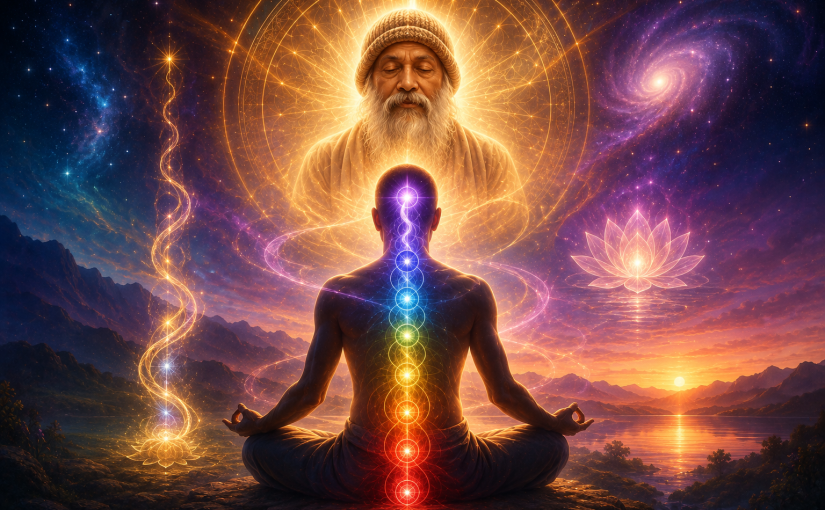
My meditation experience has led me to look at the relationship between prana, kundalini, breathing, nondual contemplation and the inner meditation image in a different way. The most striking feature is the continuous and uniformly shining quality of the meditation image. It does not remain like an ordinary thought or a weak mental picture. At times it becomes so stable, bright and lively that it seems almost like a physical object seen with open eyes. This raises a basic question: what keeps such an inner image continuously alive?

One possible explanation, within the traditional yogic understanding of prana, is that the major support is not ordinary breathing but an upward movement of prana from the muladhara toward the brain. Breathing may still play a role, but it appears to become secondary when sushumna is active. In ordinary functioning, breathing participates in the distribution and movement of prana throughout the body. Exhalation, in particular, seems to be associated in my experience with a downward movement. When this downward movement becomes stronger, the meditation image can become somewhat dimmer, as though some of the energy supporting the image has moved away from the brain.

But when sushumna becomes active and prana is experienced as continuously rising through the spine, the situation seems different. Kundalini energy appears to provide prana to the whole body according to need while its movement is upward through the central pathway, energizing the different chakras and their corresponding functions. It therefore does not seem necessary for this same energy to be repeatedly pushed downward in the way ordinary pranic distribution appears to occur with ordinary breathing. The kundalini energy rising up is giving proportionately equal nourishment to all chakras and their corresponding organs so energy do not need to be moved down frequently from the brain. This may explain why breathing naturally becomes slower or may even pause during deep activation of sushumna.

The experience becomes especially interesting when ordinary breathing cannot slow down. During physical work, stress or other conditions requiring increased respiration, breathing may remain active and its downward effect may still be present. Yet if sushumna is strongly activated and prana is continuously flowing upward, the meditation image may not become significantly dimmer. The downward movement associated with breathing is then apparently unable to overcome the continuous upward supply. The image can remain present, more or less continuously, because it is constantly being supported by the upward current.

From this perspective, a continuously present meditation image could become an experiential indication of an increasingly stable meditative state. If the upward movement through sushumna is sufficiently established, the image may remain continuously present in varying degrees of brightness, approaching what can traditionally be called savikalpa samadhi. This is not meant to establish scientifically that prana literally moves in this way, but to describe the relationship as it is experienced within the yogic framework.

Nondual Contemplation and the Felt Energy Vacuum in the Brain

Another part of the experience has become equally important. Nondual contemplation produces a particular peacefulness and calmness. It is not simply the intellectual acceptance of a philosophical idea. When contemplation becomes deep, ordinary mental activity seems to become quieter, and there is a distinct feeling of spaciousness or even an energy vacuum in the brain.

This felt vacuum may have an important role in the upward movement of kundalini. When ordinary mental activity becomes quiet, there seems to be less energy occupied by scattered thoughts, emotional reactions and ordinary subject-object thinking. The quietness may therefore allow, or in the traditional interpretation even draw, more kundalini energy upward from the base toward the brain.

This seems to explain why a meditation image can become particularly lively during nondual contemplation of sharirvigyan darshan, quantum darshan or another nondual vision. Nondual contemplation first produces the quiet and peaceful condition. That quietness seems to create a receptive space in the brain, after which the upward energetic movement becomes stronger and the established meditation image becomes more vivid.

The process can therefore be understood as a cycle: nondual contemplation produces stillness; stillness allows stronger upward movement; the upward movement makes the inner image brighter and more alive; the bright image stabilizes attention; and stabilized attention further deepens the stillness. The process reinforces itself rather than depending upon deliberate mental effort at every moment.

The term “energy vacuum” is useful for describing the experience, but it should not be mistaken for an established physiological mechanism. What can be directly reported is the felt peacefulness, quietness, spaciousness and associated energetic movement. Whether that experience is ultimately explained through prana, kundalini, neurological activity, attention, interoception, conditioning or a combination of these remains an open question.

Why Does Only One Meditation Image Become So Luminous?

This raises a more difficult question. If nondual contemplation and the upward movement of kundalini increase the energy available in the brain, why does only one preassigned meditation image become continuously bright and lively? Why do other thoughts not become equally vivid?

A possible answer is that the meditation image has become a specially established pathway through long and regular practice. Ordinary thoughts are temporary and associative. One thought produces another, and the mind constantly moves from one subject to another. A deliberately practiced meditation image is different. It is singular, predetermined, repeatedly brought back into awareness and strengthened through thousands of acts of concentration.

Thus, when the mind becomes quiet and more energetic, the established meditation image may be the easiest form through which that intensified activity can express itself. The energy may not literally be restricted to one image; rather, that image may have become the most strongly conditioned and stable representation available.

In this sense, prana may provide the power while meditation provides the channel. Repeated practice may have created a pathway of least resistance. This can explain why a random thought such as what to eat later does not suddenly acquire the same luminosity as the chosen meditation image. The random thought has no comparable stability, repetition or intentional reinforcement.

There is also an important difference in the quality of perception. Ordinary imagination is usually dim, unstable, fragmentary and dependent upon deliberate effort. The meditation image I experience can become continuous, uniformly bright and perceptually alive. It can approach the quality of seeing an object through open physical eyes. This is not simply a matter of imagining the object more clearly. It represents a change from deliberate visualization toward a more spontaneous and self-sustaining inner perception. However at times other images also can intensify like lively physical object but I do not give attention to those and in a way do not like them so energy from them again shifts to meditation image.

The strongest explanation may therefore involve both energy and conditioning. The upward energetic state supplies intensity, while long practice supplies the established form. The image becomes the point where the two meet.

Kundalini and the Long Association with the Meditation Image

There may be an even deeper reason for this special relationship. Kundalini may have become associated with the meditation image itself through the united contemplation of both over a long period of daily practice. The image was not practiced in isolation. It was repeatedly encountered in a meditative state involving concentration, inwardness, nondual contemplation and the experience of an upward kundalini movement through the spine.

If these elements have been repeatedly experienced together, they may eventually become strongly linked. Then, when the image first appears during nondual contemplation, even if only weakly, its appearance may itself become a trigger for the familiar upward movement of kundalini. The image becomes brighter; the upward movement becomes stronger; the stronger movement makes the image more stable; and the stable image draws attention still more completely.

The resulting process can be represented simply as image, upward current, brighter image, stronger concentration, stronger upward current, and still brighter image. The important point is that the image may no longer be merely an object of thought. It may have become a doorway into the entire meditative configuration developed through repeated practice.

This also explains why the experience can be directly felt as a continuity from the base to the image. The movement is not experienced merely as an abstract belief in kundalini. There can be a bodily sense beginning at the muladhara, moving upward through the spinal region and reaching toward the brain or the inner image. From the standpoint of phenomenology, this is a spatially organized experience: the energetic movement seems to have a beginning, a pathway and a point of expression.

It is still important to distinguish direct experience from interpretation. The direct experience is the sensation of an upward movement associated with the meditation image. Calling that movement kundalini, or saying that prana literally travels through a physical channel along the spine, is a traditional interpretation of the experience rather than something established by modern physiology. Keeping this distinction makes the account stronger rather than weaker.

When I enter a familiar place or meet people already associated with my meditation or meditation image, the experience may begin quite distinctly. More often it is better with loving environment that helps get peaceful rest with spine erect and relaxed breath. At first, kundalini seems to rise clearly, felt as a blissful sensation moving upward along the spine—sometimes as one continuous movement and sometimes in stages, almost as if it were passing from one chakra to another. After some time, however, the upward movement may become unnoticeable. An hour or so later, I may no longer consciously feel any movement along the spine, yet the meditation image remains vividly luminous in the brain, accompanied by a deep sense of bliss and peace. Means the kundalini energy prepared the stage for sometime for expression of meditation image there.

The bliss associated with the initial upward surge can resemble sexual pleasure, but it feels different in quality—more refined, diffuse, and inward, as though the familiar sexual sensation has been transformed into a subtler and more pervasive form of bliss. I can describe this as a subjective resemblance to sexual pleasure without claiming that the experience is literally sexual or that a specific physiological process of sexual energy moving upward has been established. But contraction and shrinkage of lower organs with feel of their relief from stress and burden by pushing something up proves this thing experientially.

The Role of the Third Eye and Ajna Chakra

The experience then suggests another component: the role traditionally attributed to the third eye or Ajna chakra. The meditation image does not merely become brighter somewhere vaguely inside the mind. It becomes exceptionally clear and immediate in the region associated in yogic traditions with Ajna.

From this perspective, savikalpa samadhi can be understood as the united contribution of several factors rather than as the result of one factor alone. The regularly practiced meditation image provides the established object. Nondual contemplation produces peacefulness, quietness and a reduction of ordinary mental activity. Kundalini or the upward movement of prana supplies the increasing energetic intensity. Ajna, or the third-eye center in the traditional model, provides the focal center through which the inner object becomes exceptionally clear.

This combination can explain why the image of Dadaguru can become so vivid. It is not merely a picture that has been remembered. It has been practiced repeatedly and associated with the deepest meditative conditions. When nondual contemplation quiets the mind and the upward movement becomes strong, the image can appear almost independently of deliberate effort. At its most developed, it can become continuous, uniformly luminous, stable and lively, with an immediacy approaching physical seeing with open eyes. Even can awaken providing self-realization glimpse in exceptionally favourable environment and heightened energy.

This is where the distinction between ordinary visualization and savikalpa samadhi becomes important. Ordinary visualization still requires the meditator to construct and maintain an image. In the experience being described here, however, the image increasingly seems to maintain itself. Attention no longer has to continuously manufacture it. It becomes a stable inner object around which the mind becomes unified.
This is, in a sense, the special quality of kundalini—the blissful and deeply absorbing state can be achieved deliberately through Tantra, but it can also happen spontaneously. The ordinary meditator may struggle for years, even for a lifetime, simply to maintain a meditation image steadily, let alone reach awakening. What kundalini seems to do spontaneously is therefore not something that can be reproduced so easily by other methods, even when those methods are practiced deliberately and for a very long time.
The difference is important. With ordinary meditation, there can be a continuous struggle to hold the image, bring the wandering mind back, and prevent the visualization from fading. In the experience associated with kundalini, the process can appear to reverse itself: instead of the practitioner constantly maintaining the image, the image seems to become self-sustaining. It shines by itself, attention gathers around it, and the mind enters a state of bliss, peace, and increasing unity without the same continuous effort.
This may be one reason the idea of kundalini appears so extensively in the spiritual literature of the world. Sometimes it is described directly, but much more often it may be expressed indirectly through symbolic stories, verses, sacred figures, ritual practices, images of ascent, inner transformation, divine union, death and rebirth, or the awakening of a hidden power. The language changes from tradition to tradition, and these accounts should not automatically be treated as literal descriptions of the same physiological process. Yet the remarkable persistence of such imagery suggests that human beings have repeatedly tried to describe experiences in which something deeper than deliberate mental effort seems to take over the process of transformation. That is why kundalini is so often termed mystical. But what exactly is mystical about it? If kundalini is understood as a process in which much of the work of awakening can happen spontaneously, without the meditator deliberately producing each stage, then the term seems especially appropriate.

Mystical does not necessarily mean something that has no scientific or physiological basis. It can simply point to something extraordinary that seems to unfold by itself, beyond the ordinary capacity of deliberate effort. A meditator may spend years struggling to maintain concentration, stabilize an inner image, deepen absorption, or transform consciousness. Yet in an experience attributed to kundalini, some of these processes can appear to happen spontaneously, sometimes with remarkable speed and intensity.

What could seem more extraordinary than awakening itself occurring in this way? The remarkable feature is not that kundalini must be a supernatural force, nor that its effects cannot ultimately have physiological or psychological explanations. The mystery lies in the phenomenology: something that normally appears to require enormous effort seems to organize and propel itself from within.

In that sense, kundalini can be called mystical without making an anti-scientific claim. Its mystery is not necessarily that it violates physiology, but that it can produce such profound changes in consciousness with such apparent spontaneity. The experience can feel as though the practitioner is no longer doing the awakening; rather, awakening itself has begun to do the work.

As told above, the term savikalpa remains appropriate within this framework precisely because there is still a particular object. The experience is not completely objectless. There is still the meditation image of Dadaguru, but ordinary mental fluctuation has become greatly reduced and the object has acquired extraordinary clarity and stability.

At the same time, the presence of a bright inner image alone should not automatically be equated with savikalpa samadhi in the classical sense. Traditionally, savikalpa samadhi refers to a deeper transformation in the relationship between awareness, mental activity, and the meditation object.

One can have a bright image of one’s puppy or buffalo or even a beautiful flower or a stone, but how can we call that meditation simply because the image is bright and vivid? There are other qualities of meditation as well, such as nonduality, detachment, bliss, humility, true and selfless love, and the rise of kundalini. These qualities make a meditation image much more spiritually significant. A person who develops such qualities can therefore be considered a better fit for a spiritually oriented meditation image, particularly one associated with a guru, God, or another sacred figure. A Guru, having achieved these qualities through deliberate effort, inspires his followers to cultivate the same qualities in their own lives. Thus, he makes the meditation image further intensify itself in the mind by encouraging the follower to sustain these qualities in daily life. As these qualities are sustained, they further intensify the image, which in turn inspires the follower to embody them even more deeply. This cycle continues, and the image gradually becomes established in the mind, remaining uninterrupted—somewhat like savikalpa samadhi.

Animals or inanimate objects may possess many of these qualities naturally, but they do not possess emotions and cognition in the same way as human beings. In animals, these qualities appear to be largely instinctive or naturally given, whereas in human beings they can be consciously chosen, cultivated, and developed. This gives them greater weight in the context of spiritual practice, because the human being can deliberately direct these qualities toward meditation and awakening. However, as per Patanjali medittion of whatever favourite object can produce samadhi but I think that may take more time than meditation of any spiritual subject. No doubt animals have many spiritual type qualities that is why each god is shown with an animal, so meditation of guru or god with animal seems having synergistic effect. This seems the meaning of god and animal shown together. I also felt this. I largely remain with animals and inside nature during my heightened initial spiritual growth and both awakenings. That’s why most of awakened beings are animal and nature lovers, atleast living in harmonious company with these. Also, animal and nature lovers tend to be more spiritual than others. This is because nonduality is inherent nature of animals and nature. What they do just instinctively to survive, not with any willful dual agenda.

Therefore, the strongest and most accurate statement is that a continuous, luminous image may be an experiential feature associated with a state that resembles or develops toward savikalpa samadhi, rather than by itself proving that the classical state has been attained. The image becomes much more significant when it appears together with the other qualities of meditation—bliss, detachment, nonduality, selfless love, inner stillness, and the spontaneous rise of kundalini.

A Possible Unified Model

Taken together, the experience suggests a unified process. Long practice establishes a particular meditation image as the strongest and easiest inner pathway. Nondual contemplation quiets ordinary thought and creates a profound peacefulness and felt spaciousness in the brain. This quietness appears to make the brain receptive to a stronger upward movement of kundalini from the muladhara through the spine. As that movement reaches the region of the brain and Ajna, the established meditation image becomes increasingly bright, stable and perceptually immediate.

Once the image appears, it may itself reinforce the upward movement because the image has been repeatedly associated with that energetic condition. The process therefore becomes self-reinforcing. A small appearance of the image can initiate a larger upward response; the upward response makes the image brighter; the brighter image holds attention more firmly; and the firmer attention deepens nondual stillness. Breathing may still influence the state, particularly through exhalation and its apparent downward effect, but when sushumna is strongly active, the continuous upward process may become dominant enough that ordinary breathing cannot extinguish the image.

The whole experience can therefore be understood as the convergence of nondual contemplation, kundalini, the practiced meditation image and the Ajna or third-eye focus. None of these elements needs to be considered independently. The meditation image supplies the established form, nonduality provides mental stillness, the upward kundalini experience provides energetic intensity and bliss, and Ajna provides the traditional focal center through which the inner perception becomes exceptionally clear.

The deepest feature of the experience is therefore not simply that an image can be seen in meditation. It is that a particular image, practiced over a long period, can become so deeply associated with stillness and upward energetic movement that it begins to appear with a continuity, uniform brightness and vividness normally associated with direct physical perception. From the yogic perspective, this can be understood as the meeting of prana, kundalini, sushumna and Ajna with a well-established meditation object. From a psychological and neuroscientific perspective, some of the same experience could be approached through learned attention, conditioning, imagery, interoception and changes in ordinary mental activity.

The experience itself, however, remains the starting point. The interpretation can continue to develop without diminishing what was directly observed: the quiet produced by nondual contemplation, the felt movement from the base through the spine, the reduced dependence on ordinary breathing, and above all the transformation of the practiced image of Dadaguru from an ordinary mental representation into a continuous, uniformly shining and unusually lively inner presence.

Why I Chose Inner Awakening Over the Politics of Power: My Journey Through Sharirvigyan Darshan, Nonduality, and Everyday Life

Why I Always Remained Away from the Politics of the Crown

Throughout my life, many people have wondered why I always remained away from the politics of the crown. The answer was never that I disliked leadership, authority, prosperity, or responsibility. Neither did I consider worldly success to be inferior to spirituality. My journey simply moved in a different direction.

From the beginning, my interest was less in acquiring power and more in understanding life itself. As years passed, my attention gradually shifted toward the study of consciousness, meditation, and the direct experience of existence. Politics generally demands continuous attention toward public expectations, influence, organization, strategy, competition, and visible achievements. My own mind was increasingly drawn toward contemplation. Both directions require enormous energy, and gradually I realized that my energy was naturally flowing elsewhere.

The Birth of Sharirvigyan Darshan

Nearly three decades ago, an intuitive understanding emerged within me which I later called Sharirvigyan Darshan. It was not a carefully designed philosophical system. I did not sit down with the intention of creating a new philosophy. Rather, it appeared almost like a seed. Looking back today, I feel that the philosophy arose intuitively before I fully understood its future implications.

I intentionally kept it flexible. It was never meant to become another rigid doctrine or sect. It was meant to remain a seed that different individuals could mould according to their own temperament, profession, culture, and circumstances. The philosophy was even published in a university magazine and remained openly available.

Today, after almost thirty years, I find that perhaps I myself have benefited from it the most. Initially this puzzled me. Why had I rarely heard others describe how deeply it had transformed them?

Gradually I understood something important. A philosophy can provide direction, principles, and even practical methods. It cannot live a person’s life on their behalf.

Philosophy Gives Direction, Practice Gives Transformation

Every scripture can offer theory. Some scriptures even provide remarkably practical methods. Yet every individual must eventually walk the path personally.

No philosophy can meditate for us.

No scripture can observe our thoughts for us.

No Guru can permanently replace our own direct experience.

A map shows the destination but never walks the journey.

Perhaps Sharirvigyan Darshan fulfilled exactly this role. It remained a seed. A seed never forces itself to become a tree. The receiver must nourish it through practice, reflection, observation, failures, corrections, and continuous living.

This may explain why millions read great scriptures while relatively few undergo profound transformation. Reading is only the beginning. Living is the real experiment.

Did My Inner Consciousness Become My Guru?

Sometimes I wonder whether I was really the author of Sharirvigyan Darshan. It appeared naturally rather than intellectually.

As years passed, I found myself repeatedly returning to its principles. I walked upon the very path that had emerged through me. This raises an interesting possibility in my own mind.

Perhaps my deeper consciousness first expressed itself through this philosophy and later continued guiding me through it.

During meditation, the living Guru gradually transformed into an inner meditation image. That image was never merely a memory. It functioned like a silent reference point. Whenever confusion appeared, contemplation of that inner presence often brought clarity without deliberate reasoning.

Whether one interprets this as the inner Guru, awakened intuition, deeper consciousness, divine grace, or simply psychological integration is a matter of philosophical language. My experience remains the same. The outer Guru gradually became an inner guide.

Could Everyone Have Benefited?

Sometimes I have wondered what might have happened if many people had sincerely lived according to this philosophy.

The philosophy itself was universal. It was never limited to any religion, caste, nationality, profession, or social group. Its greatest strength was flexibility. The external expression could vary completely from person to person. Only the basic orientation of the mind needed to change.

I cannot claim that everyone would certainly have attained awakening. Every individual grows differently. Yet I genuinely feel that sincere practice could have brought profound spiritual upliftment to many people.

The philosophy never asked anyone to imitate another person. It simply invited a different way of seeing life.

The Difficulty of Modern Spiritual Life

Modern people often expect immediate results.

Even in spirituality, many unconsciously expect the Guru to walk on their behalf. They admire the teacher, attend discourses, collect books, worship photographs, or repeat beautiful words. Yet the real transformation begins only when the seeker personally begins walking.

No Guru can meditate for another person.

No Guru can dissolve another person’s attachments.

The Guru can inspire, guide, encourage, and sometimes accelerate the journey, but the walking always remains personal.

Perhaps that is why I never wanted followers. I wanted fellow travellers.

Prosperity Was Never My Enemy

One misunderstanding that often arises regarding spirituality is that awakening demands rejection of material prosperity.

This was never my understanding.

I never opposed physical prosperity.

I never considered wealth sinful.

I never believed comfort was an obstacle in itself.

Rather, I felt that prosperity should remain rooted in humanity, ethical responsibility, Sharirvigyan Darshan, and the broader insights that later matured into what I call Quantum Darshan.

Material development without humanity eventually creates imbalance. Spirituality without practical responsibility becomes equally incomplete.

The ideal is integration.

Why I Did Not Become Very Prosperous

At the same time, I also recognize another reality in my own life.

As my understanding gradually became more nondual and detached, much of my available energy naturally flowed toward contemplation, meditation, writing, understanding consciousness, fulfilling my professional duties sincerely, and living with greater awareness.

Because of this, I simply did not pursue material opportunities with the same intensity as many enthusiastic material achievers, including many of my own colleagues.

This does not mean I sacrificed prosperity in order to become awakened.

The sequence was almost the opposite.

As nondual understanding matured, attachment to continuously acquiring more naturally weakened. I received enough for a comfortable and dignified life. Beyond that, my deepest satisfaction increasingly came from inner clarity rather than external accumulation.

Looking back, I do not regret the opportunities I missed.

I feel grateful that life provided enough while simultaneously allowing me to pursue what gradually became the highest aim of my life—awakening, self-realization, and living an increasingly nondual lifestyle.

Leadership and Public Expectations

I never contested elections.

Not because I hated the crown.

Not because leadership itself was wrong.

Rather, I sensed that public leadership often carries expectations that did not match my inner direction.

Many people naturally expect leaders to continuously increase visible prosperity, development, and material opportunities. These expectations are understandable because societies need practical progress.

My own vision, however, gradually became broader. I wanted prosperity along with humanity, ethical responsibility, and spiritual insight.

I felt that this vision might not easily fit the expectations commonly placed upon political leadership.

Perhaps there would have been misunderstanding.

Perhaps disappointment.

Perhaps criticism.

My inner calling was quietly moving elsewhere.

The Crowd and Individuality

Another realization gradually emerged.

Coming to the top of a crowd often creates pressure to become what the crowd expects.

Whether in politics, public life, or spirituality, the leader can slowly become shaped by public expectations.

For me, individuality was extremely important.

Not egoistic individuality, but the freedom to observe independently.

I feel that authentic individuality is often the beginning of genuine spiritual inquiry. Before one transcends individuality through nondual realization, one first discovers an authentic individuality capable of independent observation and discrimination.

If that individuality constantly dissolves into public expectations, the inner journey itself may become difficult.

This is why I gradually preferred remaining inwardly free rather than becoming publicly influential.

Sharing Without Preaching

Another insight slowly became clear.

Today’s world is not very receptive to being instructed.

People usually resist being told how to live.

Perhaps the better way is simply to share one’s own experiences, reflections, observations, failures, and discoveries without demanding agreement.

Experience invites exploration.

Preaching often invites resistance.

If someone finds value, they may explore further.

If not, nothing has been imposed.

This approach also protects spiritual freedom.

Why Writing Is Better Than Speaking

Over time I also began feeling that writing is often superior to speaking for sharing spiritual reflections.

A spoken discourse carries the personality, appearance, voice, reputation, and emotional influence of the speaker.

Writing allows ideas to stand independently.

Readers may agree.

Disagree.

Pause.

Return years later.

Or quietly move on.

The text remains patient.

Even better, anonymous writing removes another layer.

People stop asking, “Who wrote this?”

Instead they begin asking, “Is there truth in this?”

That shift is valuable.

Truth should not depend upon the social status, profession, fame, or appearance of the author.

Profession and Spiritual Identity

Anonymous writing is especially meaningful for people whose professions do not outwardly appear spiritual.

A veterinarian, engineer, scientist, administrator, businessman, or government officer may possess genuine contemplative experience.

Yet public identity often creates prejudice.

People may ridicule them by saying they are acting spiritual or merely performing a drama.

The ideas become judged through the profession instead of through their own merit.

Anonymous writing quietly removes this obstacle.

It allows the reflections to breathe freely.

My Way of Sharing Spiritual Knowledge

Looking back today, I feel that my purpose was never to create followers.

Nor was it to establish another sect.

Nor to become famous.

Nor to gather crowds.

If Sharirvigyan Darshan carries any value, it lies in quietly offering a seed.

Every individual remains completely free.

Each person may test it.

Modify it.

Reject it.

Expand it.

Or discover something entirely different.

The real authority is never the writer.

The real authority is direct experience.

Perhaps this is the simplest way to share spirituality in today’s world.

Not through preaching.

Not through argument.

Not through authority.

Not through personality.

But through honest experiences, sincere reflections, and a life quietly lived.

If those reflections help even a few sincere seekers begin their own journey toward awakening, humanity, self-realization, and a nondual way of living, then the seed has already fulfilled its purpose.

Guru Parva Grace and the Deep Descent into Dhyana

Today is Guru Parva — a day soaked in subtle grace. Perhaps that’s why dhyana came with such ease and depth. Truly, Guru Tattva is omnipresent and omnipotent, guiding from within when outer guidance rests.

I woke around 4:30 a.m., calm and receptive. Instinctively began deep spinal kriya breathing for about twenty minutes. Then I read a few blog posts — words that perhaps tuned my consciousness higher. After that, I shifted into chakra meditation, moving awareness from crown to base, up and down for about twenty minutes. The movement of prana created the right yogic pressure — a preparatory current that automatically launched me into dhyana.

At first, I sat in Padmasana, but it remained a preparatory phase. Then I shifted to Vajrasana, and the change was instant — deep dhyana dawned naturally. Maybe Vajrasana truly suits me best. I laughed inwardly: “So, my name must be Premyogi Vajra.”

What followed was one and a half hours of continuous, breathless dhyana.
In the beginning, energy was high in the upper chakras. The in-breath was imperceptible, and the out-breath only faintly perceptible — as if nature herself was drawing energy downward in a balancing act. Gradually, prana descended through Vishuddhi and Anahata, though not distinctly separated. The awareness of subtle pulsations grew clearer in the lower regions — a breath of energy, not air.

A key realization emerged — never force stillness. Allow the body micro-movements to release strain. When I released effort, breathing softened further, and bliss deepened.

My neck bore much strain, holding the head’s weight. Tilting it slightly left eased the flow; then returning to center or right as needed — a gentle, intelligent cooperation between body and consciousness.

Later, when Vajrasana made the limbs numb, I slowly shifted to Sukhasana. Instead of distraction, dhyana deepened further. Sometimes I lowered the head, sometimes kept it upright or tilted slightly upward. Sometimes back full straight with natural curve, sometimes loosening it little. These spontaneous maneuvers tuned the current like a musician refining his note.

For Ekarnava Dhyana, keeping the head gently dropped with closed eyes gazing upward toward the Ajna Chakra worked best.

When Sukhasana tired, I moved into Siddhasana. Here bliss magnified again — energy dipped lower, steady and full. The ankle pressing Swadhisthana, and the other pressing Muladhara, created a perfect circuit and sensational points to concentrate energy more there. The microcosmic orbit activated naturally, the energy revolving in serenity.

Later, I attempted to lift energy back to Ajna Chakra as an experiment, but it felt stressful. The energy preferred to stay grounded, working in silence. So I let it remain, continuing Ekarnava Dhyana as it was. However, prolonged ekarnava dhyana shifts energy up slowly again. It’s good switch to direct energy rather than directly manipulating.

However, in the lower chakras, dhyana became more witnessing than transcendence — not Nirvikalpa, but a subtle purification. Hidden emotional imprints arose as faint, heartfelt memories — gently surfacing and dissolving. It felt like inner cleansing, a self-healing of the soul.

When calls began coming and bathing time approached, I slowly rose. This time, not with repentance — but with deep satisfaction and fullness.

Perhaps this was the fruit of integrating sitting meditation with working meditation in recent days. I noticed a clear truth:

When dhyana is practiced after days of worldly indulgence, the preparatory phase is longer.
When practiced regularly, with no lingering desires, dhyana launches instantly — like a rocket already fueled by purity.

Today’s experience was not just about time or posture. It was about effortless descent into grace — a reminder that Guru Tattva lives within, guiding from breath to stillness, from effort to surrender.

Moreover, after bathing, I had practiced all the remaining major asanas to rebuild the inner energy for the next meditation session during the day. To avoid too much pressure building up in the head, I slightly turned my hands and feet — especially the front parts of the feet — outward and downward, as if pressing the ground with paws during each pose. This simple adjustment had a wonderful effect. It helped the energy move down and kept me well-grounded, preventing any heaviness or excess pressure in the head.

Climbing the Staircase of Learning: The Real Meaning of “Becoming Zero”

There’s a phrase passed around in spiritual and intellectual circles:
“To truly learn, one must become zero.”
It sounds profound—clean, empty, pure. But is that how learning really works?

Let’s test it against a simple truth.
If someone is standing on the third step of a staircase, can they reach the fourth by first stepping down to ground and then directly jumping to fourth from the ground?
No. That defies both logic and experience. Actually, they will better step up to fourth from the third step.

Learning is not a leap from nothing.
It’s a climb—step by step.
Every insight, every action, every mistake becomes a platform.
We grow because we stood somewhere before, not because we erased the past.


What Does “Becoming Zero” Really Mean?

Many interpret it as letting go of the ego—that voice inside that says, “I know,” or “I did this.”
But let’s look closer.

Ego isn’t a flaw. It’s a tool—part of our human wiring.
It drives us to act, to express, to learn, and to share.
It’s tied to knowledge, action, and even the urge to help others rise.

To dismantle ego entirely is to dismantle the very spark that makes us move.

Even traits often blamed on ego—like boasting or taking pride—can be humanely expressed.

  • A teacher may boast a little to ignite a student’s ambition.
  • A speaker may inflate a story to move hearts.
  • A creator may take pride in their craft to awaken joy in others.

What matters is intention—not suppression.

So “becoming zero” should not mean becoming empty.
It should mean becoming clear—not ego-less, but ego-aware.


The Art of the Humane Ego

The goal isn’t to discard the steps we climbed.
It’s to walk with awareness—step by step—without clinging, without arrogance, and without guilt.

The ego, when kept humanely, becomes a channel—not a chain.
It celebrates, it expresses, it even shines—but it never blinds.

So when someone says, “To learn, become zero,”
perhaps the real meaning is:

“Let your ego serve—not control. Let your pride glow—not explode. Learn not by becoming less, but by becoming more aware of what you already are.”

Kundalini as Lord Vamana pierces Shukracharya’s duality-form eyes

Friends, continuing the previous post, that sacrificial ego that’s king Bali let Vamana come under compulsion, and he also gets apprehension that he may not survive after Kundalini awakening. By the way, the glory has been sung in such a way that King Bali was the biggest donor, who donated three steps of land to Vamana despite knowing his future destruction. Every living being is the supreme donor like King Bali. Knowing that his ego will be destroyed by Kundalini Yoga, his boundless material world will be destroyed, still he does Kundalini Sadhana at some point or the other. When a man is engaged in good deeds like King Bali, then sometimes Lord Vishnu comes to him in the form of a meditation picture to do good to him. He can be a friend, lover, guru or deity in any form. Guru is also considered as the form of God. Anyway, for everyone, their lover is God. For example, suppose a woman enters a man’s life. Men have tens of businesses, and hundreds of relationships. Because of them, innumerable images are formed in his mind. So he takes that woman for granted, and thinks that a woman is nothing in front of his vast material world. He allows her to take up space in his mind, that is, he allows the first step associated with it in the form of her Bhava or existence or Sattva Guna, the second step in the form of her motion or Rajo Guna, and the third step in the form of Darkness or Tamo Guna to fall into his mind-like kingdom. But gradually his love for her grows, and with time she occupies more and more space in his mind. In the end, she spreads throughout his empire, and then awakens and destroys man’s ego as king Bali. The same happens in Kundalini Yoga. This means that there is no difference in essence between yoga and love. King Bali was also doing a great Yagya, which means he was doing a good deed. A man knows that he will become a crazy yogi or crazy lover by falling in the circle of meditation, yet he adopts it and moves forward. Through the awakening, kundalini captured the entire heaven with one step, that is, with Sattvagun. Heaven is dominated by goodness. Because all the three gunas become infinite at the time of Kundalini awakening, that is why it has been said that Kundalini or Vamana has completely permeated all the three worlds. The second step means that the Kundalini picture spread in the whole earth with Rajoguna, because the earth is Rajogunapradhan. With the third step in the form of Tamoguna, the ego and its associated thoughts of karma go into the dark subconscious of the Mooladhara. Since tamoguna is created by killing or destroying someone, it is created by destroying the ego and the mental creation it feeds on. The position of Lord Vishnu as the gatekeeper of Patal Lok or pit abode means that Dhyanachitra keeps on purifying those demons i.e. thoughts buried in the subconscious by letting them go up, i.e. to the brain or heaven, so that everyone becomes gods. At the same time, Vishnuswarupa Dhyanchitra is focused on the Swadhishthana and Muladhara chakras by Kundalini Yoga, so that the demonic emotions that are suppressed in them are exposed and become pure when they comes in contact with it, so that they do not bind the yogi, that is, demons are not able to trouble the deities, because all the deities reside in the body itself. Anyway, Swadhishthan Chakra is called emotional baggage.
Shukra Acharya, the rakshasguru who became Bali’s priest in the yagya, first explains a lot to Bali that he should not trust Vamana because he will snatch everything from him in three steps. But when Bali does not agree, then Shukracharya enters the hole of the conch shell being used to pour out water as a mark of strong will power to donate, but Vaman enters kusha that’s a special grass stick in it and breaks his eye? One more thing, because the conch shell is also on the back of the living being, and like the spinal cord gives it protection, it becomes even more confirmed that the sushumna nadi itself has been called the conch shell. In addition, the shape of the conch is similar to that of a hooded serpent or dragon, which is equated with the spinal cord and the Sushumna located in it. An experienced patriarch never wants to let his host get lost in the wilderness of spirituality, no matter how beneficial it for the host may be. He knows that if the host comes to know the truth, then it will not be easy to cheat him and extract money from him in the name of Yagya etc. rituals. Although rituals are right at their place and are an important ladder for awakening, but who cares about the ladder when the destination is reached. Shukracharya i.e. priest or Guru by pouring out Shukra i.e. semen to block the energy flow of Sushumna is depicted as entering the conch shell. Vaman’s opening it with the Kusha stick is the raising of the Shakti from the Muladhar with the help of the Kundalini Dhyanachitra. It is the line of sensation extending from Muladhara to Sahasrara which is in the spinal cord. It is a thin light streak felt like a broom stick or the stick of kusha grass. This is Sushumna activation or awakening. If the back, especially the spine, is massaged before sexual intercourse, then this sensation line is felt easily and with pleasure. Then the semen power easily rises up, making the sexual intercourse very blissful and spiritual. The pressure of the sexual organs also ends. Man often does this inspired by the greed for Kundalini bliss, that is why the myth says that Vamana did this. Due to this, Shukracharya’s eye bursting means due to the effect of Kundalini, the dual vision of semen power or Shukracharya is destroyed. Shukra means semen in Sanskrit. When the semen power will not flow towards the world full of duality but will flow towards the soul full of non duality, then it is natural that the duality filled vision of semen power will be destroyed. Bali or ego goes to Patala, means after Kundalini awakening man cannot express ego in the form of luminous world because he has experienced the most luminous Kundalini awakening. Therefore, being detached from the gross world, he becomes unmanifested in the form of his subtle body. Moreover, he finds himself too down in front of awakening. This down feeling is depicted as patal or submerged abode. It is like darkness. This is his hellish abode. However, due to the gradual purification of the subtle body, it continues to be purified. It is said as Lord Vishnu guards it as its gatekeeper.

Kundalini Yoga and Sigmund Freud’s psychology say the same thing

From the analysis of some of the recent past posts, it seems that what we consider to be mental illness may actually be symptoms of the mind moving towards awakening, but because of not being able to handle them properly, they become mental illness. I can also prove it from my own experience. At any particular place where I got sexual power, my meditation picture made me top in every field, be it spiritual or physical. But where I didn’t get that, it also made me look like a psychopath. Of course, that sexual force may be imaginary intercourse, even if it is a permanent mental picture of the imaginary sexual partner like a samadhi. Even if of course it is a man instead of a woman. In such a situation, I did not feel any harm in homosexuality. However, it is a different matter and what I feel that Kundalini awakening comes only from man-woman love, because the complete combination of yin and yang can happen only between man and woman. Readers may find this strange.

Sigmund Freud, the great western psychologist, says that there is sexual ecstasy ie orgasm in every part of the body. This has been said in Tantra since a long time ago. That’s why the arrival of Kundalini Shakti on the chakras means to experience sexual ecstasy there. The meaning of Kundalini Yoga is to provide all the chakras turn by turn that sensual or orgasmic sensation by elevating it up from Mooladhara. This orgasmic and blissful sensation is like a super tonic. It enhances and balances all the biological activities of the chakra it reaches. All the organs and biological parts that come under the influence of that chakra, they also get benefited like the chakra itself. Because the whole body is covered in all the seven chakras, therefore the whole body becomes healthy and balanced, diseases stay away from it. In fact, sexual ecstasy of the genitals only works to increase the natural or inherent sex ecstasy of the chakras, as their own ecstatic sex is already inside them. This inner sex drive of theirs is at the base of various biological reactions and processes. The genitals only give it an extra push. Think of it as their own orgasm is like an engine running on its own at idling, and the orgasm of the genitals is like the accelerator pedal of a car. If sexual ecstasy of the genitals was everything, then even a failing heart would have been triggered by it. But this does not happen. It’s like pressing the accelerator pedal won’t start the engine if it is stalled or is stalling due to faulty parts like pistons etc.

At one place, Sigmund Freud takes a slightly different view. He says that sexual power is the biggest, that is, it is the prime motivator, but in our Tantra philosophy it has been said from the beginning that willpower is a bigger motivator than that. If Freud was right, everyone would have been awakened, because everyone has sex. The truth is that even through sexual intercourse, only those people get awakening, who have already made a determination in their mind to attain Guru and awakening through yoga practice and other spiritual methods. Will try to discuss this in detail in a new post.

Kundalini Yoga guides the natural instinct to attain the Self

Many times a man gets so immersed in the mind-kite that he does not even realize that it is connected to his body. Neither the thread nor the one who pulls it is visible, only the kite is visible. Perhaps this is ignorance. In this it seems that the visions of the mind have their own separate existence, and we start fearing them by making them artificial ghosts. By the way, in Kundalini Yoga also the meditation picture is visible, but it is the same singled out, and it is seen in one’s own form and inside his body. Moreover, in most cases it does not have a physical existence or its physical existence is denied. For example, if a deity, an ancestor, a departed or completely separated lover is in the form of a meditation picture, then the intellect of physical reality towards it will not be there by itself. But if the Kundalini picture is in the form of a living lover, guru or other physical object, then one has to maintain non-attachment to its physical form, and treat it non-dual. By the way, such nature and behavior starts being formed by Kundalini Yoga itself. As I told in a previous post, how Kundalini Yoga realizes that Annamaya Kosha, Pranamaya Kosha, Manomaya Kosha, Vigyanmaya Kosha and Anandamaya Kosha are all interconnected. This maintains the belief that the Kundalini picture is within one’s own mind, a part of one’s own composite body, one’s own self, not an external separate physical object. This itself enhances one’s own nature of Non-attachment and nonduality. Because one cannot be attached to himself, nor can one feel duality in himself. No one realizes that he is not one man but a mixture of two men. That man alone has to bear the fruits of his actions, no one else comes. Even if someone keeps on making up in the mirror day and night, he or she does it out of love for someone else or God, not for himself. It is necessary to have two for love. There is no love alone. There is no theoretical difference between attachment and love, there is only a difference of level, behavior and attitude. According to this psychological principle, the soul gets purified itself by considering the Kundalini picture as one’s own self. Meaning that the Kundalini picture is adopted as a support to know your complete self. I think when kundalini meditation reaches a particular critical point, it gives power of existential self expression to soul so much that it is unable to be unexpressed beyond that resulting in to kundalini awakening. Probably, thoughts come in the mind only in the form of a natural effort to know the Self. But the way of understanding and adopting those thoughts is opposite to the correct one. Instead of considering them as our self, we start considering them as external, alien, gross and physical. Due to this, instead of soul getting strength from those thoughts, the confusions of the world keep increasing further and further. Meaning that instead of becoming pure, the soul becomes more and more impure. Perhaps this is the illusion. Kundaliniyoga tries to straighten this method. Due to this, the daily behavior of a man also starts getting transformed positively. The effect of non-attachment and Advaita starts increasing in his life. It is natural that the confusions of his mind start getting resolved. When the mind is healthy, the body also starts to be healthy. Individual health also improves social health. With social health, all the people of the society also feel their good health. In this way, the reform from society to person and from person to society spreads in the whole world like a chain reaction, which is also called era change.

Kundalini Yoga is the only real monotheism, which is the basic essence of all religions and sects of the world

Friends, in the previous post I was talking about the equivalence of Jinn and Kundalini that when the jinn became alive in my Sahasrar chakra and became one with me, that is, when the one who sees that’s me and the jinn who is being seen become inseparable, then that is called Kundalini awakening. This is the definition of samadhi or Kundalini awakening in the scriptures as well. Why don’t we say angel instead of jinn, as it seems more appropriate to me. Because he was not a real jinn but a mirror-reflection of him. Meaning he did not have his own free will, he used to walk in the direction of goodness according to the will of God. The same happens with the angel. Since the jinn has its own independent existence, it can move in any direction. It can be understood in this way that a jinn is a mental picture of a living being or a man wandering in the ways of the hassled up world, just as the memory of a man is settled in the mind. That man may also be in a living state somewhere in the present, or also in the post-death transcendental phantom state or in any other life. This means that whatever desire or action he will do, it will be transmitted to his picture through intuition, telepathy etc., which will definitely disturb the seeker who is holding it in the mind. Also, along with his remembrance, his attachment and bad qualities must also have settled in the mind. Sadhak has to suppress them with his strong will. That is why it is said that one has to work hard to keep the jinn on the right path. But on the contrary, an angel is a mental picture of someone who, if alive, is desireless as a jivanmukta or lively liberated, or if dead, is either fully liberated, or is in a heavenly world. Also, along with his remembrance, the divine qualities of non-attachment etc. also reside in the mind itself. Hence the angel is always neutral and unbiased. That’s why he does not interfere with the sadhna of the seeker and helps in a way in the sadhna. That is why it is said that one should meditate on the Guru or spiritual enlightened or liberated person or deity. Then it is said that an angel is made of light, not of fire like a jinn. In any case, light is more divine, calm, subtle, possessing good qualities, and splendid than fire. A person with spiritual qualities like detachment and non-duality is already subtle, so it is natural that his mental picture will be even more subtle. That is why the angel is called light. On the other hand, jinns are mostly pictures of gaudy and sexy people. That’s why they are more gross, like fire. That’s why sexy people dominate the world more. Where do people who are trapped in the world like the saints who become angels? I had received sage and sexy together, so I did not get bored with sage. Sexy being maintained an attraction towards Sadhu or saint, probably because there was good mutual tuning between Sadhu and Swadhu means saint and sexy. It was like gulping bitter medicine with sugar syrup. That’s why in my mind a jinn, and an angel, both permanently settled together, as I was talking about in the previous post. This could prove to be a good tactic. Jinns are mostly made of sexual fire. When the fire of sex remains buried in the mind for a long time due to a failed love affair, then it becomes a jinn, that is why the jinn are hungry for sex. I think that fire without smoke has been called the sexual sensation of vajra, because it is full of light and heat like fire, and there is no smoke in it. Jing refers to the energy of sexual-sensation. The word genie may have been derived from Jing itself. Both these words belong to the same category. It can have many meanings at once. The jinn has to be made good, but the angel is good by nature. The angel keeps a check on the evil nature of the jinn. There is not much difference between the nature of a good jinn and an angel. A good jinn can be spoiled due to lack of spiritual practice or rituals, but the angel does not get spoiled. The angels also get power from sex, but they take the man towards Kundalini awakening with that power, whereas the jinn mostly lead towards worldliness. Together I was telling how after Kundalini awakening, man’s tendency towards writing increases. Actually writing is also a Kundalini yoga, a witnessing yoga or vipasana. By writing, old things emerge on the surface of the mind with non-attachment and start disappearing blissfully, due to which the conscience becomes clean. The same happens in Kundalini yoga. With the power of Kundalini awakening or Kundalini meditation, picturesquely new and old thoughts emerge in the mind with a sense of witnessing or non-attachment in this same way and disappear soon. As long as the old events are not brought up again in the mind, they remain buried in the same mind, and prevent man from moving forward. I was also telling that the subtle or celestial beings like jinn etc. exist only in the mind and nowhere outside. This means that in reality they are only images means mental pictures of a physical man or woman, but completely different from them. You look at your face in the mirror. You yourself will say that I am not this. The true form of a man is his mind, not his face. Man associates his feelings, his mind, his beliefs, his perceptions with that mental picture created in his mind. That is why it is said that the world looks to us as we want to see it, or as it is our own nature, world has no form of its own. you Meditate on your guru for years, get Kundalini awakening from him, then if you meet him suddenly, he will not even recognize you. You meditated on the outer form of the Guru, not his mind. No one can meditate on someone’s mind, because it is not visible. A young man in my college time wanted a girl very much. When he met her many years later, she refused to even recognize him. He could not bear this grief, and he committed suicide by jumping into the river from the nearby bridge. Although he had attempted suicide in the past too, was depressed, and was under some degree of alcoholism. In fact, under the influence of sexual love, he used to meditate only on the external appearance of the girl, not her mind, that is, her true nature. He had given his form to her picture made in his mind. In a way, he loved himself. In fact everyone loves himself, but he overlays it falsely on someone outside, and gets trapped. Many clever people convince this lie by making sweet things, due to which many times the girlfriend gets caught in their trap. That is why in Patanjali Yoga, the picture of that thing is called the support of meditation, which is meditated in the mind, not the meditation itself. Actually, meditation is always one’s own, not of anyone else, that’s why the mental picture is said to be the support for meditation, not the object of real meditation. That’s why meditation is also called self-research, means again searching self for its buried thought processes. Meditation is called Atman anusandhan or self research, not Kundalini Anusandhan or Jagat means world Anusandhan. Actually kundalini meditation or kundalini awakening is a means of self research, not real self research. You must have also seen in the movie Munnabhai MBBS that the Gandhi who was seen by Munnabhai in his mind used to tell him the same thing that he himself knew. What he himself did not know, even his Gandhi could not tell him. In fact, after reading a book about Gandhi, his mind became like Gandhi, but his mind made him fall into the illusion that Gandhi himself settled inside him. This artificial method is good to meditate on a single, specified and constant mental picture in the morning and evening, and live life happily. Everything done or experienced by meditating being will be considered done and experienced by that picture. Man himself will remain untouched by all things, unattached, like a lotus leaf lying in water. Just like Gandhi was doing everything for Munnabhai, while in fact he was doing everything himself. This is daily Kundalini yoga. This is daily worship. This is the daily morning-evening worship. It is a wonderful spiritual psychology that leads to liberation.

It is a belief in Christianity that the fallen angel carried the human race forward by having sex with women. There are many old paintings or inscriptions in which the demon is shown having sex with a woman. That is why in the olden times, women much beautified did not have much freedom to roam outside in the open. The fallen angel is actually a fallen mind or a fallen Kundalini, because the Kundalini picture is representative of the mind. That Kundalini picture is the angel. Kundalini was once in Sahasrar. She kept falling down because of the man’s wickedness and bad temper, and, piercing all the chakras, fell into the veil of the mooladhara chakra. To rise up again from there, she resorts to sex. There is also confusion among people about the relationship between angels, the eternal angel or archangel, and the Holy Spirit. In fact, all three are essentially the same thing. To explain the same spiritual power or shakti element, it is divided into three elements. The Holy Spirit is considered to be the eternal companion of the Supreme Soul and integral to it, just as sunrey is inseparable from the Sun. The shakti of Shiva is also like this. This means that the eternal shakti is the Holy Spirit. Ordinary angels are said to be temporary and mortal. People also have personal spiritual masters, as I have mentioned about my angel-turned-guru. He can be different for everyone, and remains confined to his disciple. The eternal angels or archangels are our eternal Vedic deities like Ganesha, Durga, Shiva etc. Their forms as meditational mental images continue to take people towards liberation in every age. I think a lot of people keep quarreling among themselves by finding arbitrary differences between them, and are deprived of the real thing.

In a previous post I was also talking about how the contradiction between polytheists and monotheists continues. These ideologies have nothing to do with religion, because they can happen in any religion. Actually it depends on the mental or spiritual level of the person, which ideology he believes. A person can be a monotheist even if he belongs to a polytheistic religion. Similarly, a person may suffer from polytheism i.e. dualism even if he belongs to a monotheistic religion. The real spiritual and scientific ideology is monotheistic. Kundalini yoga is also monotheistic. Kundalini yoga is achieved through concentration. Concentration means concentrated meditation that literally means one thing in front, everything else behind. The only thing that stays in the forefront is Kundalini. Actually no religion is polytheistic, just by delusion it seems. If any religious sect worships Ganapati, it worships only Ganapati and not any other deity. Similarly, if a Shakta sect worships only Durga, how is it polytheistic? Meaning that no religion is polytheistic at the sect level. I had also told in the previous post how the formation of Yinyang alliance by worshiping the deity idols etc. activates the single Kundalini of the mind. Even if one worships a variety of deities, he is not a polytheist, because all form a yin-yang alliance, which only strengthens only the Kundalini and no one else. In contrast, If a person who believes in monotheistic religion does not believe in Kundalini and Yoga, then he is a person full of polytheism or duality. When the only thing in his mind i.e. Kundalini will not be permanently fixed, it is natural that his mind will be lost in the dual world full of diversity. Then how can such a dual person be considered a monotheist. Actually, Kundalini is the only God whom we can worship in the form of meditation. She herself leads one to the Supreme Lord. Directly we can neither see nor feel the formless Brahman, then how can he be worshipped. If one tries to worship, more or less Kundalini starts appearing in the mind to accept that worship, though not as much as Kundalini manifests directly through kundalini meditation. Then why not directly do Kundalini meditation i.e. Kundalini Yoga. If the monotheist worshiping the formless God will forcefully oppose the single Kundalini being born in the mind, then the psychic energy will have no choice but to be exposed as a world full of diversity. Meaning that the mind of a worshiper of Brahma i.e. formless supreme lord will be filled with a world full of duality. Where is he behaving as monotheist then? That is why it is said that what is claimed or seen is not always the same actually, but sometimes quite the opposite. To know the truth one has to do psychological research.

The energy which is inside the body is also outside. Just like outside, inside also, she wants to meet Shiva, so climbs up through man’s back. Although she is avyakt i.e. formless or unexpressed, but to express herself she creates the world of the mind. The Kundalini picture is the most influential part of that mind. Shakti awakens in this form and unites with Shiva. Shakti or energy has no form of its own. It can be experienced only as a sensation. Even among the sensations, the highest sensation is hidden in the mental pictures, among them also in the pictures of the individuals, in them also in the pictures of the familiars, and among them also in the picture of any most preferred guru or god or ancestor. By the way, theoretically, the highest sensation is hidden in the shadow of God, that is, the shakti in the form of the god shadow can be most easily awakened by being most expressed. Dev or god means non-duality, and Devchhaya or god shadow means a pure and permanent picture formed in the mind with the help of non-duality. This shows that the two most important things for awakening are Shakti and Devchaya or god shadow. We can also call Devchaya as Kundalini chitra or picture or in short Kundalini or Holy spirit or Jinn or Angel, as mentioned in the previous post. Outside also, that power or shakti similarly creates various gross worlds. There are also some special areas in that world, such as the country of India, in that too Haridwar or Kashi, or other special and beautiful or spiritual tourist places etc. Shakti is maximally expressed in the form of those special areas. Only then there is more possibility of awakening in such areas. That is why man is engaged in the creation of such beautiful areas, where his mind becomes elated and expresses itself in its ultimate form. The ultimate manifestation of the mind or Kundalini Shakti is called Kundalini awakening. Although nature or collective shakti or energy called samashti shakti is also engaged in the creation of such beautiful areas, but individual energy called vyashti shakti in the form of a living being especially human plays a very important role in accelerating it and putting four moons in it. But nowadays man is obstructing its work by tampering with nature excessively, which is not good for its existence.

The similarity between individual and collective shakti means that by cultivating shakti within the body, one can gain some degree of control over the external gross shakti. For example, imagine that a person is about to suffer an accident under the influence of an external evil force. The man becomes aware of this and becomes extra alert while meditating on the Kundalini. The darkness of his mind is dispelled by the meditation of Kundalini, due to which the darkness of the external shakti is also dispelled to some extent, due to which she makes special efforts to save him even outside, such as finding a safe place or material to escape. It happens only to some extent, so on cannot fully rely on it, but it does help in some way or the other. It can be from a distance or even by prayer, because the shakti is all-pervading. What happens is that the evil or black shakti that has come to kill a person trapped in a calamity can be felt even at a far distant place by a person known to him. If through Kundalini meditation he calms her down inside, then she can become calm for the person in trouble outside too. Perhaps this is the secret of prayer.

The one who has mastered to rotate the shakti in his body according to his will, it seems that he has mastered a lot. Illiterate people used sexual plays for it. Due to this play, feeling of sensational energy in the lower parts of the body made the power of the brain to descend through the front channel to give strength to that energy in lower parts dominated by muladhar chakra, due to which the brain also became lighter, and all the chakras below were also satisfied with the energy. So that the whole body was satisfied. However, they received little and short-term benefits, as they experienced only the dualistic world associated with sensation and not the Kundalini associated with it, as they did not have a single permanent Kundalini picture in their mind. Due to this they felt power in the form of sensation on the organs attached to the muladhar chakra only, but not on the intermediary chakras, such as on Anahata Chakra, Manipura Chakra etc. This was because mostly the Kundalini picture on these intermediary chakras represents the shakti, there is no sensation on them, nor the dual world. The dual world exists only in the mind inside the brain, not on the mind elsewhere in the body. The Kundalini picture itself produces a contraction of the muscle on the chakras, which produces a slight sensation. Kundalini Yogi made this process artificial, scientific and more effective avoiding sexual intercourse as much as possible. He created an artificial sensation by pressing the muladhara chakra with the heel of the foot during Siddhasana or Ardhasiddhasana. Simultaneously he superimposed the kundalini picture over that sensation, so that there would be more attraction for the energy to be drawn, and the energy could be attracted through the kundalini picture even when less sensation was created. Everyone knows about the additionally accompanied liberation benefit that comes from the Kundalini. That is why it is said that by doing yoga the body and mind also remain healthy, and the soul too.

There must also be some permanent base or shelter of shakti. It can be in the form of any art, learning, interest or hobby etc. Likewise the sinc of my shakti is writing and composing poetry. Due to this, my being wasted energy is spent in writing and writing poetry. Once a man harmed me. That instilled in me a mighty zeal to fight with him. Then I decided wisely that there is no gain in fighting, there is only loss. The power or shakti that was born in me, I diverted it towards composing poetry, which made a beautiful poem ready. Meaning that I transformed or directed the power. A similar story comes in Shiv Puran also. When Shiva became very angry with humiliation done by Indra, he was eager to make him ash. Then Brahma and other gods persuaded Shiva with great difficulty. But Shiva’s anger was not subsiding. So the gods took out Shiva’s anger from his forehead and threw it into the ocean, from which a demon named Jalandhar was born. We will reveal the Jalandhar story in the next post. I wish that the power of Ukraine, Russia and NATO would get the same guidance. The Muladhara Chakra is the biggest sink or absorber or attractor of energy. That is why in Kundalini Yoga, the heel is placed on the Muladhara Chakra. In fact, due to the sensation created by the pressure of the heel, the power of the brain is divided equally in all the chakras while descending, but the sensation was created by Muladhara only. It is as if by delivering water from the roof tank to the lowest floor, the water reaches the intermediary floors by itself. If only the middle floor is given water, then the floors below it will be left without water. Through sexual yoga, additional strength or tensionlessness of body and mind is obtained by the additional support of Vajra being received by Muladhara. At the root chakra, the power resides in the most avyakt or unmanifested form, like a veiled darkness. That is why in such a dark mental state, the mind of a man runs towards sex. The place of intercourse is the base chakra. That is why it is said that the original abode of Shakti is Muladhara. Man is mostly at home in an unexpressed or relaxed state. His expression increases when he goes out for business. Kundalini also wants to come out of her home, Muladhara, to manifest in the same way. She resorts to sexual intercourse for maximum expression as quickly as possible. Through sexual intercourse, it directly reaches the Ajna Chakra and Sahasrar Chakra. Otherwise, in a normal worldly manner, it becomes more and more expressed by gradually penetrating all the chakras while climbing up. Of course, it climbs through the back of man, but the power of each chakra of the back continues to seep up to its counterpart main front chakra. She becomes most expressive at Sahasrar. There also on touching the peak of manifestation, she awakens and merges with Shiva. Only man can achieve this ultimate manifestation of shakti. Other beings can express shakti to varying degrees, except for full manifestation. In this way there are countless levels of energy or power or shakti. The lower rung in this evolutionary chain a Jiva or Yoni or organism have, the less is the manifestation of Shakti in it. The ghost spirit also has its own specific energy level, that is why it is also called a living being. Similarly, the energy level of insects is also very low. Although these all lower forms have the same shakti as any human, deity or god or even supreme lord, of course it is not manifested, means it’s in latent or potential form. Meaning that while increasing their expression, they will definitely reach Shiva at some point or the other. That is why it is said that considering everyone equal, one should see his soul in everyone or even everything. A surprising thing that emanates from this thought field is that the inanimate things which we call as nonliving are also living, having least expression of shakti in them. That’s why in Hinduism everything is worshipped, even stone, river, mountain too. Similar nature-worship is recognized in some other cultures of the world, such as in the endangered ancient Celtic culture. Also, that is why Lord Shiva has made the ghosts his own favored ones by giving them equal status to him. This famous quote, ‘Ahimsa Paramo Dharmah’ or ‘nonviolence as the best religion’, is also derived from this principle. Illegal life-violence is not supported in any religion of the world.

Kundalini helped by good company and sanskara or culture or rite or sacrament

Friends, I was talking about sacraments or sanskara in the previous post. The more a person delivers the message of good promise or good deed or good conduct to people, the stronger his sanskar becomes on the mind. For this sanskar building, people write blogs, write articles, promote, organize paid or free camps, organize small and big functions, etc. The more crowd he gets, the more successful he is considered. These activities sometimes cost a lot, sometimes they are done cheaply. Many times it would have been done free of cost by the grace of elders and guru people. In this case, I narrate the incident that happened to me related to awakening. In college time, I got a chance to write an article in a magazine by the grace of the teachers. I wrote two or three articles and gave it away, which fortunately got printed on one page. Those articles were related to general physiological philosophy, humanity, religion, love, patriotism, karma yoga, tantra and poetry. I got a new identity from that. It instilled such a deep impression on my mind that I became very active and started making quadruple progress day and night. I feel that after many years of material development, when that seed of sanskar became a tree full of seeds, only then I got a second glimpse of awakening, due to which the creation of the philosophy of body science was completed in the form of a book, many others too. Many books were written, and Kundalini blog writing was also successful to a great extent. Meaning that first I have lived a lot of books in my practical life, later I have brought that life in the form of books and blogs. Not that I was born, and sat down to write. It is an imitation. Real writing is that in which one sees his life coming down on paper. At that time my sexual hormone levels were very high, as is the case with everyone at that age. But I feel that it was too much in me and spiritually special because of the first glimpse of awakening and activated Kundalini thereby. Perhaps this is the reason why the good sanskar has become so firmly established, which seemed desperate to be associated with me throughout my life. I also feel that after the first glimpse of awakening, my old conflict-like childhood had suddenly collapsed in my mind. It cleared my mind like a child, like a new blackboard without writing. Like a child, my transformation was going on, due to which my mind became very receptive like him. That’s why that auspicious ritual created such a positive and everlasting activity in my mind that it later showed me another glimpse of awakening. That is why it is said that children should be given good values. This makes it clear why a cultured teacher who instills good values in children has been given so much importance in the society. First of all, the first teacher is the mother. The effect of the sacraments given by her is the most stable in mind. That is why it is said, ‘ramante tatra devatah, narayasyatra pujyante, means gods live there, where women are revered. Shivaji Maharaj had started receiving rituals from mother Jijabai right from birth (say that from the womb itself), due to which he could protect Sanatan Dharma from the invading Mughals. The effect of samskaras remains on the mind for many births. I had heard and read a thing long ago. An 80 year old woman from Russia started school. When asked how that study would be useful to her, she replied that it would be useful in her next life. Means she was studying for the next birth. She may not have said this by study, but on the basis of her experience and inference etc., because I feel the theoretical dominance of reincarnation is there in Hindu religion only. A healthy society is built from a healthy mind. Healthy mind is made of healthy habits. Healthy habits are formed by a healthy education system. There is a proverb in Hindi, the mouth of a thorn is sharp from the beginning. This means that the personality of any person is known in his childhood itself. That’s why this proverb also shows the importance of rituals.

The above example also implies that it is not necessary that one should rely only on large and expensive ceremonies for the formation of samskaras. However, there remain the best practices in the society with these. The Sanskrit mantras that are uttered every morning also form the sacraments. The power of those mantras is that they create sanskars by having a deep effect on the subconscious mind. Kundalini power is also derived from Sanskrit mantras because while singing them, the breath becomes long, deep, slow and regular. They are in sync with the breath. Some part of the mantra is sung with a long deep breath going in, and some part with a long deep breath going out. In most of the cases, it is sung only with the exhaled breath. Only the attention is paid to the deep breath going in. By concentrating on the breath, more Kundalini-Advaita benefits are obtained. This makes the ritual stronger. Detached meditation on breath and mantra-words would lead to the emergence of non-duality and witnessing. Speaking Chalisa etc. also provide benefits from this psychological principle. By the way, everyone gets some benefit by singing a song. This is the spiritual psychology of singing. When I used to go to my maternal grandmother’s house in my childhood, my maternal grandfather used to call me and my two almost age maternal uncles again and again and reminded me of many such early morning mantras, which I still remember. Vedic Sanskrit creating a universal generosity that depicts real secularism, I will tell you that in this mantra. Saha navavatu sah nau bhunaktou sah viryam karavavahai, Tejasvinavadhitamstu ma vidvishavahai. It means protect us together, means we all protect each other, we all eat together means no one goes hungry or everyone gets employment, we all use force together means we all help each other. The knowledge acquired by us should be full of light of practicality, that means not just bookish, we should not hate each other. This is a very powerful mantra, and if not more then at least it must be recited every morning. When spoken by singing, it sounds more attractive and effective. In this the word ‘Ma’ is particularly influential. Although its meaning is ‘no’, but it also creates the effect of maan i.e. mother on the mind. Due to this the mind becomes naive and receptive like a child. Therefore, while singing, the word Ma should be given elongation and gravity. The famous Indian slogan, ‘Sabka Saath, Sabka Vikas, Sabka Vishwas’ is also this mantra in simple words. There is no doubt that this is an attempt to inculcate good values in the people of the country, which will surely bear fruit in time. Amazing psychology is hidden in Sanskrit mantras. If these are studied deeply, many mystical powers can be found. Being a Vedic mantra, its Sanskrit grammar and meaning is not very clear. Vedic mantras are like this. There is suspense in them. This is so that, of course, it is not understood in the gross, but with its special pronunciation and word formation, it leaves a deep subtle impression on the mind, which is far more powerful than the gross understanding. There is a lot of power in suspense too. Due to this man makes the horse of thoughts run fast, and can easily achieve many destinations. That’s why movies full of suspense are very popular. The above mentioned articles written by me were also full of suspense, that is why many people got so much power from them as I believe. I got it, but I think there are many others too who read it. Those were having double meaning. Two meanings emerged from them, both material and spiritual, civilized and uncivilized, religious and irreligious, sarcastic and serious, critical and analytical. Sometimes vulgarity was seen in them and sometimes tantric psychology. Such was the tinge of the philosophy of physiology with them that all of these contradictory expressions were also visible in them, and together nothing was visible. Everything seemed like a silent sky. That’s why they appeared to me liked by all kinds of people. Also, there was some virtual thrill in them. I feel that the stories of Puranas are very effective because they are full of suspense and thrill. Why did the movie Bahubali become so popular? There was suspense in it from the beginning, which ended at the end of the second part of the film. Thrill was also very much in it and of a virtual or mythological kind. Similarly, there is another mantra, ‘Karagre vasate lakshmi—-‘ etc. It appears pauranik mantra so having clear grammar. Opposed to it, Vedic mantras are like speaking in tongue, that’s why very powerful. It is said after waking up in the morning and looking at the palm. This reminds physiological philosophy, because it creates the experience of the whole universe in the hand, that is, in the body. Many people blame others for their rude conduct. But in reality the fault lies in the lack of good values in them. It is a different matter that the whole society is responsible to some extent for the lack of good values. For not inculcating good values, sometimes the blame is placed on the parents, sometimes on the teachers and sometimes on the family members, friends, relatives etc. and other close acquaintances. However, man himself is also responsible for his sanskars. It is the sanskars of a man’s past lives that decide what kind of sanskars he will receive. That’s why you must have seen that sometimes a person born in a very bad family also becomes a great Mahatma. Actually he does not get attracted towards bad sanskars in his present life because of good sanskars of previous birth, but he runs towards good sanskars, even if they are outside the family. similarly, a man in a well behaved family can go corrupt. There is a lot of meaning in this small saying, ‘Where there are the seeds of acacia sown, how from there one gets mangoes’.

Importance of Sanskars for Kundalini

Material achievements can be achieved even in a short period of time. But it takes a very long time to attain Kundalini. In most of the cases, even a whole life falls short and it takes many births. Who knows the address of the next birth, where to go, how to go. Therefore, efforts should be made that Kundalini be attained in this one human life. This can be possible only through rituals. If one starts giving him Kundalini rites from birth itself, and this process is continued throughout the life, then only this seems possible to happen. This also happened in the ancient Indian Hindu tradition. This is not a false boast. There used to be a temple at every step. Spiritual festivals and fairs used to take place. Spirituality was associated with every activity. People had faith in astrology. Vedic rituals dominated all around. Varnashrama Dharma ie. scientific division of society existed in its best form. Sixteen sacraments were performed for each person. All this was for Kundalini only. All this is Kundalini science, spiritual psychology. When elders used to impart sanskars, then the impression of their personality became deep on the mind of the children. With this, the child grew up to live two lives together, both his own and that of his ancestor. For example, suppose a person gives Kundalini rites to his grandson. By this a good feeling should be created in the grandson’s mind towards his grandfather. Due to this unknowingly, the grandson starts getting the benefit of the life experiences of the grandfather. Meaning that the grandfather is living second life as a grandson without dying, that is, the age of the grandfather has doubled, and the grandson gets twice the age of the grandfather along with his age. With this, the age of the grandson will be considered as three times, that is, 300 years. Now understand that the grandson has done Kundalini yoga continuously for 300 years. With so much time of meditation, it is very possible that he may get Kundalini awakening. The grandson’s real life is only one hundred years old, but he is getting the benefit of three hundred years due to the rituals. This is the reason why confusion arises in the matter of time counting as described in Hindu scriptures. Somebody’s age is said to be 300, some 500 or some thousands of years. Similarly, some do penance for hundreds of years and some for thousands of years. Actually it is not the actual age or time, but it is the benefit of such age or time being received due to the rituals. In the above example, similarly the grandfather lives two ages together, one for himself and one for his grandson. Even if he dies of old age, he still gets the benefit of both the ages of the previous birth in the next life, because of the sanskars. Sharing life with each other is possible only through sacraments or good company. In Hindu spirituality, the Guru tradition is also meant to increase the sanskaras. If one’s guru tradition is going on from 10 gurus, then the sacramental age of the present guru will be considered as 1000 years. Meaning he will get the benefit of 1000 years long Kundalini Yogasadhana automatically. This will happen because every guru has been giving his whole life to his disciple i.e. future guru in the form of sacraments, so that the sanskars keep on increasing. Similarly, if one’s lineage has been going on for 10 generations, then the sacramental age of the person of his present generation will be considered as 1000 years. The more emotional and loving relationship there is with each other, the more will be the benefit of the sacraments. If a family has been living a spiritual way of life continuously for ten generations, then the member of its present tenth generation will be understood to have been living a spiritual way of life continuously for a thousand years, without dying. This means that the more ancient the way of life or tradition, the more is the force of the sacraments in it. In this sense, the Hindu or Vedic tradition is the most powerful, because it is the oldest. If I am decoding Shiva purana then it may mean that I’m getting the sanskara of its author sage little or more through lineage. Sanskars are hidden in the tradition, so we should not allow the tradition to become extinct. Even if it is to be molded according to the age, then its original form should not be tampered with. The famous Chinese philosopher Confucius says that bring newness in such a way that oldness also survives. A man cut by tradition becomes directionless like a kite cut from a string. However, today we find all ancient traditions strange like the above Vedic tradition or way of life. This is because today they have become distorted, not in their original form. Today it has become a pretense or a sham. Today they do not have power. Today we have become very idealistic, due to which we have forgotten our original culture. It is as if the story goes in the Shiva Purana that Lord Vishnu created Buddhist-Jain type monks with shaved heads in order to misguide the Tripurasars named godly demons. They started preaching their illusory religion by preaching pseudo non-violence etc., things against Shivling, Vedas, Yagyas and animal sacrifices given in them. Due to this, the women became sluts. Due to which everyone became powerless. Those monks used to tie a cloth like mask on the mouth, and walked very slowly, so that no ant etc. creature could be harmed. By leaving Shivling worship, everyone turned away from the tantra. Knowing them to be powerless, the gods, knowing a good chance, got those Tripurasars killed by Shiva. Then those Mundi or shaved people went to Lord Narayan and said that your work is done, now you tell where we should go. Narayan instructed them to go to the desert and said that in Kali Yuga or black age, come out and spread in the world. In today’s Kali Yuga, this seems to be true. I will reveal this story in the next post.

The above points prove that Kundalini without sacraments is rare. There is no need to associate the word auspiciousness with sanskars, because it itself means auspicious sanskars. Special words can be added to describe special rites, such as physical rites, rites of cleanliness, etc. Since Kundalini is got through spiritual rites, therefore, in this Kundalini-related website, the meaning of sanskar will be understood as spiritual rites, which is a type of auspicious rites. Bad or inauspicious has to be associated with word  ‘bad’. It can be understood that Kundalini Yoga or other spiritual activities cannot be done easily by the child, but the sanskar can be instilled in him. No one will even know when this seed of sanskar will become a great tree in due course of time. Sanskar is formed by company or good company. Company itself means good company. That is why good company has great glory in spirituality. With the slightest company, countless people, even other living beings, have crossed the ocean of the universe. The scriptures are full of such examples. For example, a crow used to eat prasad or food offering offered at the temple. Due to the influence of company or sanskar, he became a monk in the next birth and became liberated. Any living being or man became spiritually liberated by staying in the company of a monk’s hut, etc. In Vrindavan garden of Lord Krishna, even the flowers and plants got salvation through the company of Lord Krishna. All this is a miracle of sanskar or company. Everything happens itself without doing anything. Like the sacrament, the meaning of company is also understood here to be auspicious or spiritual company. Basically there is no difference between good company and sanskar.

Kundalini is enhanced with Brahmamuhurta resulting in destruction of ghosts

Happy Guru Nanak Day birthday to all my friends

Moon of Kalratri (dark night) Guru Nanak Dev

Friends, on the occasion of this year’s Guru Nanak Day, I got a chance to go to my Sikh brother cum neighbor’s home place for Prabhat-Feri Katha or morning spiritual touring story. As invited with great love and respect, therefore, with the inspiration of Kundalini, my eyes were opened before four o’clock in the morning. As soon as I got ready and reached the spiritual story session with my wife, so did the Granth Sahib arrived from Gurdwara Sahib. It was as if I had received a special invitation to serve. It was a very emotional and exciting scene. Shabd Kirtan was held from 4.30 am to 5.30 am with melodious music. I liked it. This time was in the middle of the time of Brahmamuhurta, which lasts from about 4 am to 6 pm. It was as if we were doing kirtan all night. This is because of the high spiritual energy of the Brahmamuhurta. That is why this time has been fixed above all for spiritual practice. In Brahmamuhurta, spiritual practice brings Kundalini closer to the zenith. I felt the same way. Light refreshments were also served at the end of Katha-Kirtan. Man learns something every moment. Sikh itself means learning. This proves that this religion is cutting-edge and scientific as well, because nowadays it is the era of learning. Similarly, there is a great importance of service in this religion. Today’s era of consumerism, commercialism and competition is the era of public service. Self-protection is at the core of this religion. This sentiment is also very relevant nowadays, because lies, deceit, and tyranny prevail everywhere. I had heard a lot about Brahmamuhurta, but had not experienced it well myself. The reason people don’t know about its power is because they don’t do spiritual practice in a proper way. Power does not have intelligence. Wisdom is possessed by the soul or Vivek or part of soul differentiating bad from good. If there is guidance of wisdom-intellect to power, then only it does self-welfare, otherwise destruction is also possible through it. For example, Pakistan can be viewed. According to sources, the Pakistani army kills innocent and unarmed people. Many times, this country seems less as a country, and more like a propaganda machine. If the monkey gets a razor, then the result can be anything. Power is a push. If there is already garbage in the mind, then energy will push it, which will spread it further. By this a person will refrain from even waking up in Brahmamuhurta. If there is Kundalini in the mind, then only Kundalini will get the push for development. I have been related to a Hindu family since birth. My grandfather was an eminent Hindu priest. I had worked with him as a disciple for many years. It seems that he had unknowingly become my guru. I found Hinduism and Sikhism to be the same. In both, Dharmadhwaj or religion flag, Granth and Guru are worshiped or respected equally. Actually, all religions are same from inside, some people differentiate these from outside. According to Tantra, Kundalini is the Guru, and the Guru is the Kundalini. Yes, since Sikhism is associated with spiritual warriors, it is natural to have a little more briefness, practicality and fanaticism than traditional Hinduism. But that too is negligible in front of certain religions. Although Sikhism is built on the defensive side, not the aggressive side. If there has ever been an offensive mode, then it has happened only for the defense of itself and Hinduism, otherwise not. I am not taking side of any particular religion here. We respect all religions. I am just clarifying the human truth. With thoughtful analysis and writing, the truth becomes more clear. Some bigotry is there in all religions. Some positive fanaticism is also necessary for religion, but it is much better if it remains within the realm of humanity and socialism, for which Sikhism is often known and accepted. In the Middle Ages, when the Indian subcontinent was in darkness due to jihadi invaders, Guru Nanak Dev emerged like a full moon by the inspiration of God, which transformed the dreadful darkness into pleasant moonlight.

Lord Shiva shines like a full moon in the middle of a night full of ghosts

In a religious ceremony, along with the luminous God, his shadow may also appear dark. Because light and darkness coexist. Darkness should be respected as the ghost of Shiva, because it came with Shiva. There is night with the moon. Don’t be afraid of him. This creates a powerful Advaita, which helps in awakening the Kundalini. Actually these ghosts are responsible for religious animosity, not Shiva. You must have also seen or heard that after becoming very religious, a person became strange. Sometimes a man does wrong things too. I have a relative. He used to have frequent religious discussions with a friend from his village. Seeing them both gathered, the women of the village started talking to each other while making fun of them saying “look, friends, now the discourse of Shrimad Bhagwat Purana is about to begin”. After some time that friend of my relative suddenly committed suicide, which surprised everyone, as he did not show any signs of depression. Too much is forbidden everywhere.  Maybe superficial religiosity acted as a veil, covering up his depression. That imperfect righteousness caused a fake smile on his face. Maybe if he didn’t wear the cloak of unfulfilled spirituality, people would have known the problem responsible for his inner depression, and would have made him aware of it and suggested a solution. Therefore, he would not have taken a fatal step. That’s why it has been said that little knowledge is a dangerous thing. On the contrary, if he had embraced spirituality to the fullest, his depression would have vanished, along with he would have attained Kundalini awakening. The zenith and perfection of righteousness or spirituality lies in Tantric Kundalini Yoga only. Tantric Kundalini Yoga is just a name or symbol or method of a psychological fact. There may be other names, symbols or methods to bring this spiritual and psychological principle to the ground. Why only Hindu, there can be other religions also. It is so, but we do not understand it, do not recognize it. When all religions and life practices would be studied seriously and scientifically, then only the complete picture will be known. Therefore, till the time it is not known, Kundalini Yoga of Hinduism should work. We need pure water to drink, wherever it comes from, or whatever its name is. Tantra had found some solution for this lack of spirituality. It accepted Bhuta Bali as a part of Panchamakara. It is to be noted that there are Panchakakara in Sikhism. These are the five things whose names begin with the letter K, and which a Sikh must carry with him at all times. These are the five thingsKesh or hair, kada or wrist ring, kangha or comb, kachchha or briefs and kataar or dagger. From this it seems that the leftist system was dominated at that time, due to which Panchakakaras came in existence as partial copy of tantric Panchamakaras. Bhutbali, means sacrifice for the ghost. By this the ghosts are satisfied and calm down. Once I got a chance to live in the high Himalayan regions for some time. There, when the deity is called from house to house, animal sacrifices are also offered to him. When asked, the local people told that the sacrifice is not for the deity, but for the attendants of the deity like ministerial staff etc. who came with him. The diet of the deity is sattvik. So those attendants were in a way only Shivaganas or ghosts, and the deities became Shiva. Even today, on the same lines, many smart people get a lot of work done by pleasing the clerical staff of the office, the officers just keep looking. In fact, sacrifices are a storehouse of energy. It also has tamoguna or darkness in it. Due to the entry of energy and tamo guna into the body, the excess satoguna becomes balanced, and a non-duality prevails in the mind. Balance is essential. Although this balancing work gets spoiled due to excessive energy and tamo guna. The body also needs a lot of energy to hold the Advaita spirit. Due to the creation of non-dual spirit, satoguna starts increasing again. To create Satoguna with the help of Tamoguna, this is probably the only divine formula of leftist Shaivas and Tantriks. The Muladhara chakra symbolizes the Tama guna, and the Sahasrara chakra symbolizes the Satoguna. First, the Kundalini is allowed to come to the base through the Tama guna. Then it is raised directly to Sahasrara by Tantric Kundalini Yoga. From that, satoguna increases immediately, though with balance or non-duality. One of the countless benefits of keeping Kundalini in mind with Kundalini Yoga is the benefit of balance of gunas or qualities. Because Kundalini keeps the balance of all the three gunas by moving like a bead of a rosary throughout the body. The whole game is about energy or power. That’s why it is said that Shiva is attained only through Shakti. By the way, there are many other sattvik methods of achieving energy and quality-balance or non-duality, which are described in the countless scriptures. One such modern book is “Sharir Vigyan Darshan~A Modern Kundalini Tantra”. Ghosts become strong and trouble when Shiva is not meditated or worshiped properly. When Advaita Bhava is attached to it, then they calm down and disappear. In fact, they do not disappear but get absorbed in the luminous Shiva. They are false like a shadow. They don’t have real existence. They are illusionary. This means that ghosts teach non-dualism. That’s why they are followers of Shiva, because they want to make everyone non-dual like their lord Shiva. They do not like anything except their lord Shiva. In Shiv Purana, this metaphor has been presented with great amusement through stories. These ghosts are called Wrathful deity in Buddhism, who disturb the seeker during the course of meditation. They are depicted as scary figures.