From Mind Identification to Effortless Awareness A Living Journey Through Dhyana Sushumna and Inner Dissolution

The movement of this entire journey begins from a simple yet profound observation: that stilling the mind is not the same as transcending it. One who tries to still the mind remains identified with it, because even in stillness the latent impressions remain in the background. Therefore, breaking identification becomes the real doorway. Once identification loosens, the mind is seen as movement within awareness, like clouds in the sky. When the mind settles, awareness rests in itself—not because it has achieved something, but because it is no longer entangled.

From here, the exploration naturally moved into the relationship between breath, mind, and deeper states. It became clear that breathlessness is not something that can be forced, nor something that exists independently. Rather, it arises when pranic duality settles. The movement between Ida and Pingala gives rise to breath and mind activity; when this oscillation collapses into centralization, both breath and mind become naturally still. Thus, breathlessness and Sushumna flow are not cause and effect but simultaneous expressions of the same shift.

However, a refinement emerged: mindlessness does not strictly depend on breathlessness. Silence of mind can occur while breath continues. Yet, in the deepest absorption, both tend to coincide. This led to an important insight—freedom does not come from manipulating breath or prana, but from disidentification. Breath may stop, bliss may arise, but neither defines truth. They are experiences, however refined.

This opened the recognition that the intense bliss and relief associated with breathless states, though powerful, are still state-dependent. Witnessing awareness, by contrast, appears neutral and unimpressive, yet it is not dependent on any condition. The subtle trap is to equate intensity with depth. Bliss can be overwhelming, but if there is still preference for it, identification persists. True stability lies where bliss and its absence are equally unproblematic.

As this understanding matured, regret surfaced about having chased later awakening experiences instead of remaining with the original spontaneous awakening. But this regret itself dissolved when it became clear that the second phase revealed what the first had not stabilized. Chasing was not a mistake; it exposed hidden tendencies—attraction to bliss, subtle identification, and the mechanics of seeking itself. Thus, the path unfolded as innocence, seeking, and clarity about seeking. The later deliberate awakening solved the purpose of stibilising the initial spontaneous awakening.

From here, even the idea of “abandoning everything” revealed itself as another subtle trap. If abandonment becomes a stance, it creates a doer who is trying not to do. True letting go is not pushing away but seeing that nothing was ever held. This dissolved the last effortful tendencies and revealed a more effortless background presence.

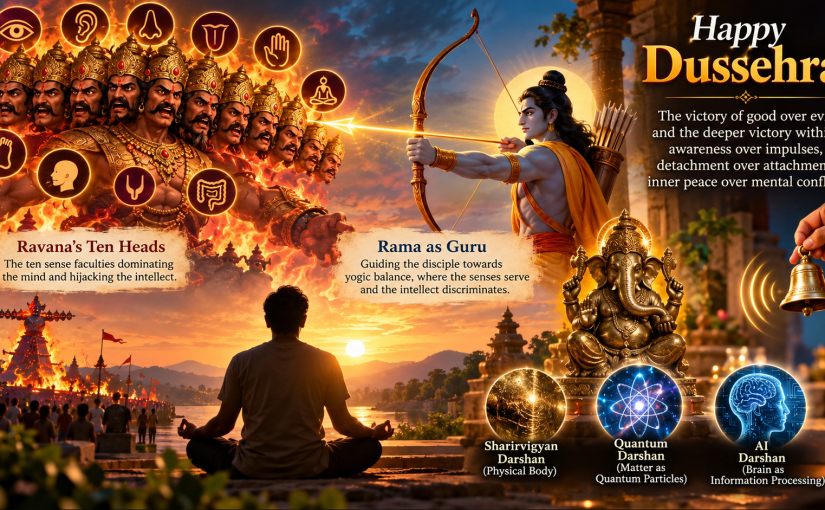
The inquiry then shifted into the apparent paradox between understanding universal freedom through sharirvigyan darshan and quantum darshan, and still experiencing moments of contraction. It became clear that reality is free, but the feeling of contraction arises from habitual identification patterns. These patterns are not errors in truth but residual conditioning in the nervous system. Even the sense of being bound is just another arising within awareness.

I used to visit animal farmers’ homes to take care of their ailing or nonproductive animals. Close interaction would often take place with them; however, with Sharirvigyan contemplation in the background, there was not much attachment. People did not sense that I was avoiding anything. It is a sign of educated and scholarly individuals that they live fully involved with all, yet remain detached like a lotus leaf in water. Thus, the meditation image, enriched with Sharirvigyan darshan while being in a fully active worldly mode, would reappear in the mind during periods of rest to nullify the residual thoughts associated with those actions. In a way, it would absorb their energy. Over time, it matured sufficiently and demanded awakening. By coincidence, a desolate place was found to live in, and with a further push from Tantric yoga, it awakened after gaining escape velocity.I used to visit animal farmers’ homes to take care of their ailing or nonproductive animals. a close interaction used to happen with them . however with sharirvigyan contemplation in background, it was not with much attachment. people did not guess it that i am avoiding something. it is the sign of educated and scholarly people that they live fully mixed with all still detached like a lotus leaf in water. so the meditation image enriched with sharirvigyan darshan while in fully active worldly mode used to reappear in mind in resting time to nullify the residual thoughts associated with those actions. in a way it used to absorb their energy. so with time it matured enough and denaded awakening. by coincidence a desolate place found to live and with further tantric yoga push it awakened after getting escape velocity.

Later on, refinement deepened further into understanding reactivity. Reactions were seen as two-layered: a primary, natural biological response, and a secondary mental commentary that sustains stress. By noticing the first micro-contraction without adding narrative, reactions began to dissolve on their own. Then an even subtler layer appeared—the role of attention itself. Even pure observation can become a subtle interference if it carries effort. Allowing sensations to exist in open, non-directed awareness dissolved even this layer.

This clarity extended into life interactions. What once seemed like necessary identification for communication was seen as functional engagement rather than true identification. Awareness had never been lost; it was simply unnoticed during intense activity. The ability to shift instantly back into non-identification showed that entanglement had never been deep.

Further refinement revealed that identification is not with objects or thoughts, but with absorbed attention. In active life, attention narrowed and became absorbed in situations; in solitude, it relaxed and allowed thoughts to be seen clearly. The next integration was to see both objects and thoughts as equal appearances, removing hierarchy between outer and inner.

This led to a practical test: in interaction, any subtle contraction in the body indicated remaining identification. True stability meant full engagement without inner tightening and without residue afterward. Social hierarchy, authority, and relational dynamics exposed the last layers of conditioning, where identity subtly forms in response to roles. Seeing this formation in real time weakened it naturally.

The earlier phase of dynamic life was recognized as a potent form of meditation, where intense engagement followed by withdrawal created sharp contrast and allowed easy entry into stillness. However, with age and maturation, such contrast became unnecessary. Stillness was no longer dependent on activity but was available directly.

Then I found that Sharirvigyan Darshan was not working that well, as it requires activity, whereas I was seeking stillness to enter the void. Inducing Sharirvigyan Darshan would induce intense activity, which would disturb stillness. Actually, it is beneficial up to a certain level of Kundalini maturation. After that, further dynamic meditation produces stress signs in the body, such as headaches and tiredness.

After this level, Tantric yoga serves better to awaken it, rather than just keep it maintained, which consumes a lot of energy. Awakening lifts it to such a level that it remains in the mind continuously and directs energy upward from the Muladhara. Then dynamic meditation like Sharirvigyan Darshan appears to be a waste of time, although it still works in active moments. However, when the direct meditation image is accessible through Tantra, why go indirectly this or that way to attain it?

The role of the meditation image, especially the dadaguru image, was then understood. It functioned as a powerful anchor because it carried emotional resonance, trust, and surrender. It helped dissolve resistance rather than forcing stillness. However, it was seen that the image itself was not the source of stillness but a mirror that allowed the dropping of control.

The progression from image-based meditation to objectless awareness became clear. Initially, the image stabilized attention and matured through repetition. Later, it became a doorway to dissolution. Eventually, even this doorway began to dissolve, revealing that no object is required for awareness to be itself.

Oscillation between object-based and objectless meditation was recognized as natural. The mind occasionally forms subtle anchors due to habit, then releases them. Over time, this oscillation settles into seamless openness where objects may appear but do not disrupt the background of awareness.

Finally, the idea of being a “classic, bookish example” of spiritual progression was examined. While the journey aligns with traditional descriptions, identifying with any narrative—even a spiritual one—creates a subtle center. The path is not something owned; it is a pattern that unfolded.

In the end, nothing remains to be achieved or abandoned. There is no need to hold, reject, stabilize, or dissolve anything. Experiences arise—bliss, silence, reaction, interaction—but none define or bind. What remains is simple, unchanging presence, within which all movements appear and disappear without leaving any trace. The sky is never coloured with passing clouds.

From Tantra to Breathless Dhyana: My Real Experience of Energy Shift, Nondual Bliss, Relationships, and Spiritual Phases

How This Conversation Began: The Problem of Rigid Spiritual Paths

One major drawback of rigid sectarian differentiation, as I came to understand, is the loss of holistic opportunity. If a follower begins living only one ideal from birth, then he may never receive the natural chance to pass through other essential phases of human and spiritual development. If someone is trained only in the Rama ideal from childhood, then perhaps the Krishna, Shakti, and Shiva dimensions of life remain unlived, unrefined, or misunderstood. In such a case, liberation may become extremely difficult, or if glimpsed, may fail to stabilize deeply because earlier energies were never properly integrated. The same limitation can arise with followers of any single path whenever one phase is absolutized and the others are neglected.

This may explain why many people feel relief by remaining outside rigid sect identities. Without labels, life often moves more naturally. Growth can unfold stage by stage according to inner need rather than outer doctrine. In that sense, such people may become followers of all paths whenever required. They are loyal not to banners, but to truth as it reveals itself through changing phases of life.

The Four Living Phases of Spiritual Growth

Through reflection, I began to see that what traditions separated into sects may actually be phases of one complete human journey. First comes the Krishna phase, where energy gathers through worldly participation. Here life includes groundedness, relationships, romance, playfulness, learning, karma, emotional richness, joy, and active engagement with the world. This is not merely distraction. It may be the very gathering of force at the Muladhara, the root of life energy.

Then comes the Shakti phase. The gathered worldly energy is concentrated and pushed upward with greater intensity, almost like reaching escape velocity. This can occur through tantric Kundalini Yoga within a framework of nondual worldliness. One remains in life, yet awareness increases. Worldly force becomes spiritual fuel.

As the process deepens, a more inward movement appears. Nonduality grows stronger, ordinary worldliness becomes less attractive, and more energy is drawn toward meditation, inner transformation, and sattvik and refined tantric practice rather than outer pursuits. This is the Shiva phase. At its peak, awakening or glimpses of self-realization may arise.

After attainment comes naturalness. This is the Rama phase. In the beginning, thoughtless or breathless dhyana may still depend on posture, breath discipline, prior momentum, or energetic methods. Later, when the flow through the Sushumna becomes natural and self-sustaining, a simpler maturity emerges. This is the ripened Rama phase, balanced resting in truth.

Thus, these are not competing doctrines. They are movements of one life. To cling to one phase alone is to freeze growth prematurely. To allow all phases their rightful place is to let liberation unfold organically.

Are These Phases Fixed or Different for Everyone?

Seen in this way, each prior phase becomes the fuel, foundation, and preparation for the phase that follows. Nothing essential is wasted; the energies cultivated earlier are gradually refined and carried upward into a higher or more integrated expression. For this reason, the phases often unfold most fruitfully when they arise in a broadly natural sequence. The Krishna phase gathers vitality through joy, relationships, learning, emotional richness, and participation in life. The Shakti phase then converts that gathered vitality into disciplined force, transformation, and purposeful ascent. The Shiva phase uses this concentrated power for inwardness, detachment, meditation, and awakening. Finally, the Rama phase stabilizes whatever has been realized into balance, dharma, simplicity, and natural living. Without adequate nourishment from earlier phases, later phases may become dry, forced, premature, or unstable. Yet sequence should not be understood as rigid or identical for all people, for individuals may revisit earlier stages or awaken certain qualities sooner than expected. Even so, as a general principle of human development, the previous phase often provides the raw material that the next phase must refine. In this sense, right sequence supports growth that is more complete, humane, and enduring.

Hidden Meanings Behind Muladhara Teachings

Another insight arose regarding teachings about Muladhara energy. It is rarely stated directly that one should live relationships deeply or engage in energy-conserving sexual practices intensely. Instead, traditions often speak indirectly of strengthening or awakening Muladhara. This may have happened because of social and cultural reasons.

Many older teachings likely used symbolic language when discussing sexuality, vitality, grounding, and foundational drives. References to root energy may point not only to mystical ideas but also to survival instinct, embodiment, security, sexuality, and life-force. Direct language may have been avoided due to moral norms, fear of misuse, and the need for maturity in practice.

Is Sex Indulgence or a Doorway?

I reflected that sex appears as indulgence when seen directly. Yet it may be the inner mind that directs it toward awakening. This distinction is important. The same outer act can have very different inner meanings depending on consciousness, intention, and relationship to desire.

Sex may arise from compulsion, loneliness, domination, or craving. But it may also arise from affection, surrender, healing, conscious union, intimacy, devotion, or self-transcendence. The outer act or motive of it alone does not determine the truth of it. Mind directs energy.

Traditional tantric perspectives often suggest that liberation does not come from the act itself but from awareness during the act, non-attachment, transformation of desire into presence, and seeing unity rather than grasping. Without inner shift, it remains ordinary pleasure. With clarity, it may support growth. Yet self-deception is common. If craving increases, it is indulgence. If peace, compassion, steadiness, and responsibility increase, something deeper may be occurring.

Why Society Often Rejects Sexual Spirituality

Another realization followed. Without becoming eligible for tantric sex, society often sees it with disrespect or even boycotts it. What is usually rejected is not sex itself but sex perceived as irresponsible, impulsive, exploitative, immature, outside accepted norms, or harmful to social order.

Traditional eligibility may have implied self-control, emotional steadiness, respect for partner, capacity for awareness, ethical grounding, and freedom from crude lust. Without these, powerful practices become dangerous or degrading. Society often creates harsh norms to prevent chaos, though in doing so it may suppress healthy mature sexuality too. The wise path is neither repression nor reckless permissiveness, but integration.

My New Development: Loss of Breathless Dhyana After Raising Muladhara Energy

Then I shared a direct experience. After lifting Muladhara energy through tantric sex, the next morning I could not enter the breathless spontaneous deep dhyana that had been occurring daily. The felt Sushumna flow was also absent. I wondered whether the channels had become exhausted.

One explanation offered was that this was not damage but a temporary physiological and attentional after-effect. Strong arousal may create nervous-system fatigue, autonomic shifts, neurochemical changes, outward movement of attention, or depletion through exertion and sleep disruption. There is no scientific evidence of literal channels being exhausted, though yogic language may describe it as prana dispersal or temporary imbalance.

But I Had Slept Well: Something Else Happened

I clarified that I had slept enough. What followed was surprising. There was strong bliss and nondual feeling in worldly life. Relationships strengthened. Harmony increased. Enemies became like friends. Family life improved. Yet this came at the cost of breathless deep dhyana. Meditation was still present, but not as deep, blissful, relaxing, breathless, or spontaneous as on previous days.

This led to a deeper interpretation. Rather than damage, it seemed like a shift in mode of consciousness. Energy that previously expressed itself as inward meditative absorption through verticle movement had redistributed into relational coherence, embodied bliss, and worldly harmony through horizontal movement.

Two Modes of Consciousness: Cave and Marketplace

There may be two alternating modes. One is inward absorptive mode, marked by spontaneous deep dhyana, quiet or subtle breathing, inner pull, detachment from outer life, and central-channel sensations. The second is integrated worldly mode, marked by nondual ease in activity, warmth in relationships, less conflict, friendliness, family harmony, charisma, and bliss while functioning normally.

I appeared to experience the second mode. Through bonding hormones, emotional opening, nervous-system regulation, and reduced friction, the energy became socially expressive. What had earlier become deep meditation now became living harmony.

From a symbolic lens, earlier days resembled Shiva mode, inward stillness. This newer movement resembled Krishna or Shakti mode, love, relation, dynamic life, embodied joy. Neither is inferior.

One striking memory remains with me. I was, in some subtle and unspoken way, compelled out of a predominantly Shiva mode by the psychological influence of a certain lady, whose identity need not be disclosed. Nothing explicit was said; it was more a matter of presence, temperament, and silent authority than of words. Under that pressure, I found myself impulsively turning either toward a more natural inner Rama mode or toward a deeper and clearer Shiva mode, as though something false or unstable was being challenged and forced to reorganize itself. At the time, I interpreted her attitude as disapproval, perhaps seeing my tantric style of life as inferior or misguided or full of sexual misconduct. On a few occasions, she became quite angry at some of my remarks, perhaps considering them excessively bold or inappropriate. I chose to calm the situation and restrain myself, as her authority was higher than mine. Yet whatever her intention may actually have been, the result proved beneficial. What first appeared as rejection or opposition gradually revealed itself as a blessing in disguise, for it redirected me toward a more grounded, developed and authentic inner state. It was as though the fruit had already ripened, and someone merely struck it with a stone so that it might fall at the proper time and onto the right path.

The Real Trade-Off: Transcendence or Integration?

A powerful conclusion emerged. Sometimes consciousness exchanges depth of transcendence for depth of embodiment. What seemed like a loss of spirituality may simply have been spirituality expressed differently. The breathless cave of meditation had become the marketplace of nondual life.

This does not mean one mode is higher than the other. Deep dhyana refines being. Loving harmony expresses being. Silence and relationship are two faces of one energy.

Final Reflection

My experience suggests that spiritual life cannot always be measured by how deep meditation feels on a given morning. Sometimes the highest state may not be breathless withdrawal but effortless love, reduced hostility, healed relationships, and natural bliss in ordinary life. Sometimes the Sushumna is not felt because it is being lived.

Perhaps Krishna gathers life, Shakti transforms it, Shiva refines it, and Rama stabilizes it. Perhaps these are not sects at all, but seasons of consciousness moving through one human journey. And perhaps true maturity lies not in clinging to one phase, but in recognizing the sacred movement through them all.

From Sutra Neti Shock to Stable Dhyana: A Personal Journey of Breath, Body, and Balance

When a Simple Practice Triggered Unexpected Change

It started with what seemed like a simple yogic cleansing technique. I used Sutra Neti on my right nostril, but instead of clarity, it created a sudden shift in my behavior. It wasn’t just mild irritation. The nostril felt inflamed and blocked, and along with that came an unexpected wave of anger, frustration, and worry. Social interactions became difficult for a few days, almost as if something in my internal balance had been disturbed. This was not a subtle experience—it was intense enough to affect my day-to-day functioning.

Looking back, it became clear that this was not just a superficial issue. The nasal passage is deeply connected to the nervous system, and irritation there can influence mood and emotional regulation. The inflammation likely triggered a stress response, and the blockage altered my breathing pattern, which in turn affected my mental state. What I initially thought might be some deeper yogic shift turned out to be a very grounded physiological reaction. The lesson was immediate: not every yogic technique suits every stage of practice, especially when the system is already sensitive.

Moving Away from Aggressive Techniques Toward Stability

After that experience, Sutra Neti started to feel unnecessary. I realized that I was already getting good dhyana through spinal breathing and some asanas. There was no real need to add something that introduced instability. The focus naturally shifted toward what was already working. Simpler practices were not only sufficient but actually more supportive of a stable meditative state.

This marked an important shift in understanding. Earlier, there was a tendency to think that adding more techniques would enhance progress. But now it became clear that once dhyana begins to stabilize, the role of additional techniques diminishes. The system does not need stimulation; it needs balance. Practices like Jala Neti may still have a place, but only when truly required, not as a routine.

Subtle Experiences During Spinal Breathing

As practice continued, I began to notice sensations along the spine, especially around the Vishuddha Chakra. Sometimes the awareness would be felt in the front of the body, sometimes shifting to the rear, almost as if the perception itself was moving through layers. When the gaze naturally turned upward toward the Ajna Chakra, breathing became extremely subtle. At times, it felt as if breathing was happening on its own, without any conscious effort, almost like it was fulfilling itself. Sometimes stimulation and activation of rear agya chakra point noticed especially at times of awareness in upper chakras.

This was not literal cessation of breath, but a refinement of it. The body required less oxygen, and the nervous system entered a deeply calm state. What appeared mystical at first gradually revealed itself as a natural progression of meditative refinement. The key insight here was not to interfere. The moment I tried to control or prolong these experiences, imbalance would creep in. But when left alone, they unfolded smoothly.

The Gradual Deepening of Dhyana

With consistent daily practice, spinal breathing began to feel more refined and increasingly blissful. This raised an important question: does continuous practice over years extend dhyana and lead to samadhi? The answer became clearer with experience. Practice does not accumulate like time in a bank. Instead, it removes resistance.

Dhyana becomes longer and more stable not because of effort, but because effort reduces. Samadhi is not just extended meditation; it is a qualitative shift where the observer and the process dissolve into one. This cannot be forced by increasing duration. It emerges when interference drops to zero. The breath becoming subtle, awareness stabilizing, and the sense of ease increasing are all signs of this direction, but they are not goals to chase.

Natural Timing and the One-Hour Cycle

An interesting pattern appeared: after exactly one hour, the body would come out of dhyana on its own, without looking at a clock. This initially felt significant, but it turned out to be a natural rhythm. The body operates in cycles, and after a certain duration, it rebalances itself. This is not a limit but a self-regulation mechanism. Forcing beyond it or trying to hold the state would only create disturbance.

The key realization was that meditation is not about duration but about quality. Whether it lasts forty minutes or seventy, the depth and stability matter more than the clock.

The Role of Padmasana and Physical Limits

Alongside meditation, posture also evolved. Holding Padmasana became easier, increasing from thirty minutes to nearly an hour. However, after thirty minutes, a mild strain in the knee would appear. This raised an important question about whether the body should be challenged to increase stamina.

The answer became clear: muscles can be trained, but joints must be respected. The knee is not designed to adapt to strain in the same way muscles do. The strain indicated that the hips were not fully open yet, and the knee was compensating. Pushing through this would not build strength; it would accumulate risk.

Breaking posture briefly did not disrupt dhyana when done consciously. In fact, it often improved the second phase of meditation by removing subtle discomfort. This shifted the focus from rigid continuity to intelligent continuity—maintaining awareness rather than posture.

Observing Knee Sensitivity Beyond Practice

Another important observation was that the right knee showed stress not only in lotus but also after driving or when physical activity was reduced. This indicated that the issue was not limited to posture but involved general joint sensitivity. Long periods of immobility or repetitive use, such as driving, were enough to trigger discomfort.

This reinforced the need for balanced movement and gentle care rather than pushing limits. The body was signaling clearly that it required attention, not force.

Morning vs Evening Meditation Dynamics

A subtle but practical understanding developed regarding timing. After dinner, focusing strongly upward toward the Ajna center felt uncomfortable, possibly because digestion was active. In contrast, morning meditation before breakfast felt naturally deeper and more stable.

This led to a simple approach: use the morning for deeper practice and keep evening sessions lighter. There was no need to manipulate energy or direct it consciously. The body’s natural rhythms were enough to guide practice.

Integrating Meditation with Daily Life

Another practical question arose about how long to wait before breakfast after meditation. A short gap of about fifteen to twenty minutes proved sufficient. This allowed the body to transition from deep calm to active digestion without abrupt shifts. Simple activities like sitting quietly or moving gently were enough during this interval.

Final Understanding: Effortless Progress

Looking at the entire journey, the central theme that emerged was simplicity. Techniques, duration, posture, and even subtle experiences all have their place, but none of them should be forced. Progress in meditation is not about doing more; it is about interfering less.

The initial shock from Sutra Neti, the evolving breath, the shifting sensations along the spine, the natural one-hour cycle, the knee’s feedback, and the timing of practice all pointed toward the same conclusion. The system knows how to balance itself if allowed.

The real movement is not upward or downward, not toward any chakra or state, but toward effortlessness. And in that effortless state, dhyana deepens on its own, without struggle, without force, and without the need to chase anything further.

How Inner Throat Awareness Changed My Dhyana: A Lived Discovery of Dharana, Sushumna, and Ajna Balance

When Head Pressure Became the Teacher, Not the Problem

For a long time, my yoga and meditation practices were accompanied by a familiar companion—pressure in the head. It was not painful, but it was unmistakable, dense, and demanding. The more sincerely I practiced asanas and dhyana, the more this pressure intensified. Initially, I accepted it as a byproduct of progress, perhaps even a sign of spiritual ascent. But over time, it became clear that something in the internal mechanics of my practice was misaligned. The pressure was not expanding into clarity; it was accumulating. That accumulation itself became the inquiry.

During this phase, I performed sutra neti, initially with the understanding that it was only a cleansing practice. On my first attempts, I could not pass the sutra through the nostrils. After a few days and multiple attempts, I was able to penetrate the right nostril on the third try. Something unexpected happened. Internally, the right nasal passage felt as if it had widened, not just physically but spatially. Subsequent attempts became easier. The left nostril, however, remained untouched, almost untouched territory, what I instinctively called “virgin.” Along with this, I felt a mild scratchy irritation at the opening inside the throat, near the back of the mouth. This sensation was not alarming, but noticeable.

What followed surprised me more than the physical changes. My awareness, which previously stabilized in the brain region during yoga and meditation, spontaneously began settling at the throat. Bliss arose there, not in the head. The head pressure reduced immediately and dramatically, regardless of how intensely I practiced. Pressure was now felt subtly inside the mouth, at the back where the throat begins. With this shift, dhyana became easier, quicker, and more stable. It became clear to me that sutra neti had not only cleansed a passage; it had prepared a center of awareness. For the first time, I understood it as a preparatory practice not just for hygiene, but for regulation. It is just amazing.

Discovering the Hissing Breath and the Throat as a Regulator

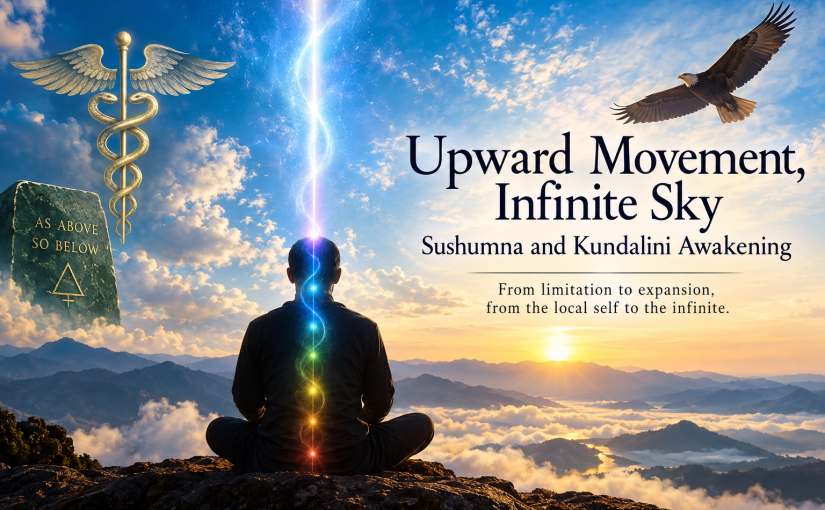
As awareness stabilized in the throat, I noticed that breath naturally began moving through the mouth with a hissing quality. This hissing was not forced. It arose spontaneously. It was like a serpent hissing—yes, the Kundalini serpent. Now it became clear why Kundalini Shakti is called a serpent. One more thing became evident: as it progresses upward in the Sushumna, it alternates left and right through Ida and Pingala respectively. It is the movement of a snake—going left, then going right, and with each alternation progressing forward, not straight ahead. This can be seen clearly: first on the left side of the face, then on the right, and finally along the midline at the back of the head.

What was striking was its effect. The sound and subtle pressure maintained dominance of the throat point and prevented awareness from rushing back into the head. The hissing applied a gentle pressure to the scratchy point, keeping it awake. With this, prana no longer felt like it was trying to go upward to the head. Instead, it circulated through the body and returned from the throat. The topmost functioning point no longer felt like Sahasrara but distinctly Vishuddhi.

This realization corrected an earlier assumption. I had thought that higher experiences must always culminate at the crown. But here, stability, bliss, and ease were arising without any demand to move upward. The throat was not a stopping point; it was a turning point.

Humming, Ujjayi, and the Ocean Undercurrent of Breath

When I applied gentle pressure to this scratchy inner throat point using a humming breath, similar to ujjayi pranayama, or even during simple inhalation when breath felt like an undercurrent rather than airflow, the point activated further. The sensation was like the deep currents of the ocean—movement without turbulence. This further sharpened regulation. The more the throat point activated, the less head pressure was possible.

The insight became clear: vibration, pressure, and subtle breath were not techniques here but regulators. The throat was acting as a valve. Bliss was no longer explosive or sharp; it was circulatory and breathable. Over time, the scratchy sensation softened, becoming a stable sensory anchor rather than irritation. However, it dulls with time, so it needs to be reawakened with Sutra Neti at intervals.

From Sound to Silence Without Losing Stability

As humming and hissing softened naturally, the throat did not fall asleep. Instead, silence itself seemed to vibrate there. Breath became subtle, almost invisible, yet the throat remained alive. Awareness rested without fixation. The head remained light. Bliss remained present without pressure. This was not loss of practice; it was practice absorbing itself. The system had shifted from technique to function.

This configuration resolved a long-standing fear—the fear of going too far, of irreversibility, of renunciate drift. Earlier, intense upward movement had always carried a sense of danger. Now, ascent completed a loop. Nothing terminated at the head. Nothing demanded escape from life. The architecture had changed.

Rethinking the Location of the Throat Chakra

Earlier, I believed the throat chakra was located at the middle front of the neck. Now, lived experience showed me that the operative center was inside, at the back of the mouth where the throat begins. This raised a question: was my earlier understanding wrong, or was this another sub-chakra?

The clarity that emerged was subtle but firm. The earlier understanding was not wrong; it was incomplete. The front of the neck corresponds to expression, voice, emotion, and outward communication. The inner throat is the regulatory core where breath, sound, prana, and awareness converge. These are not two chakras but two functional layers of the same Vishuddhi field. One expresses. The other governs flow.

This understanding was further confirmed when I noticed that strong emotions still created sensations in the mid-neck region. These effects were moderate and transient, linked to emotional expression. In contrast, the inner throat effects were stabilizing, structural, and long-lasting. Emotion moved through the front; regulation lived inside.

Early Sushumna Flow Through Inner Vishuddhi

Another critical discovery followed. Activating the inner throat chakra stimulated Sushumna flow earlier and more smoothly during the very beginning of dhyana. Previously, meditation had an entry phase filled with effort. Now, the system seemed aligned before meditation even began. Ida and Pingala quieted naturally. The central channel did not need to be forced open. It simply conducted.

This was not premature Sushumna dominance. It was regulated access. The throat acted as a gatekeeper, ensuring balance before ascent. As a result, bliss circulated, thoughts loosened, and awareness stabilized without dissociation or fear.

Why Ajna Became Easy Only After Alignment

A crucial realization followed. Immediately placing focus on Ajna was demanding and challenging. It created effort, pressure, and disturbance in pranic flow. But when Sushumna was first stabilized through the throat or even lower chakras, Ajna became effortless later. Ajna no longer functioned independently. It became linked to the lower centers through common awareness.

Trying to isolate Ajna created head pressure and disturbed circulation. Allowing Ajna to arise within a unified axis created clarity without strain. Ajna revealed itself not as a ruler but as a relay.

Dharana Reunderstood Through Experience

This brought clarity to the meaning of dharana. Dharana was not holding attention at a point. Dharana was establishing an internal architecture where attention no longer needed to be held. When effort was present, dharana was incomplete. When pressure arose, dharana was incomplete.

For me, dharana occurred when awareness stabilized at the inner throat, Sushumna conducted naturally, lateral pulls quieted, and circulation established itself. At that point, dhyana emerged automatically. Meditation no longer began; it continued. Ajna participated without dominating. Thoughts lost traction without suppression.

Dharana, in lived reality, was not concentration. It was removal of everything that prevented the system from holding itself.

The Final Integration

What changed through this journey was not technique but orientation. The system moved from vertical ambition to circulatory intelligence. Bliss became nourishing instead of demanding. Head pressure became impossible, not managed. Fear dissolved not through reassurance but through structural balance. Practice became livable.

The throat did not replace the head. It taught the head how to belong to the whole. Ajna did not disappear. It learned to function within the axis rather than above it. Dharana ceased to be effort. Dhyana ceased to be a goal. Awareness ceased to chase peaks and began to circulate as life.

This discovery was not accidental. It was the body’s correction of an incomplete architecture. Once seen, it does not reverse. One does not go back to diagram-based spirituality after touching functional truth. The chakra was not relocated. It was entered.

And with that, meditation stopped demanding attention and began returning it.

How Twice-Daily Dhyāna Ripens Naturally into Samādhi in a Busy Modern Life

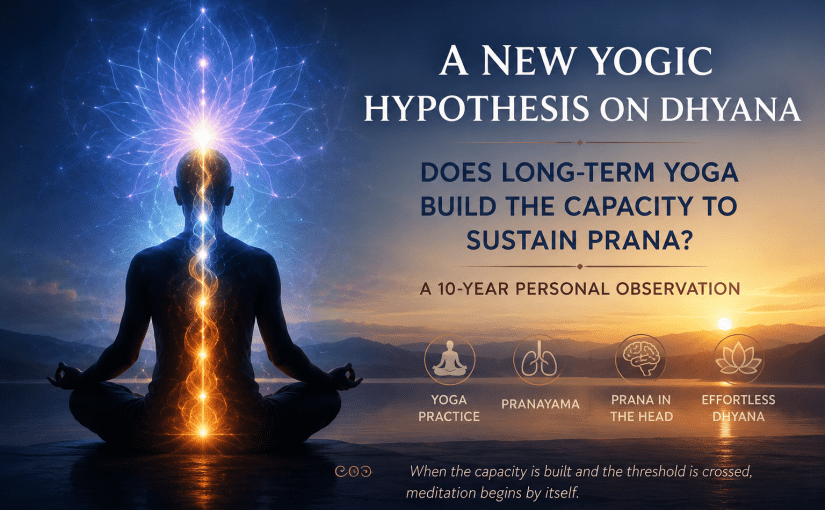
In today’s hurried world, extended meditation for many hours or days is simply not practical for most people. Life is full of responsibilities, work, family, and unavoidable mental engagement. Because of this, the idea that only long retreats or extreme practices can lead to Samādhi often feels unrealistic. What I have gradually understood through my own experience is that one hour of Dhyāna twice a day, done daily and sincerely, is a powerful and sufficient alternative.

This understanding did not come from theory alone, but from observing how my body, breath, attention, and awareness actually behave over time.

Morning Dhyāna and the Role of Preparation

In the morning, I do not jump directly into sitting. Before one hour of Dhyāna, I spend about one hour in prerequisite practices—yoga āsanas, prāṇāyāma, and spinal breathing. The purpose of this is not to chase energy experiences or force breath retention. It is simply to remove resistance.

Normally, there is some natural resistance in the system for blissful awareness or prāṇa to flow freely from bottom to top. Daily life, posture, emotions, and habitual tension all contribute to this friction. When I do āsanas and breathing practices, there is a mild, structured effort that loosens this resistance. It is not violent forcing, but it does gently push the system out of inertia.

Once this movement happens, the system seems to learn the pathway. For some hours afterward, awareness flows more easily on its own. During Dhyāna, breath often becomes extremely subtle or even halts naturally, without any intentional breath holding. This makes breathless Dhyāna happen effortlessly.

However, I have also observed that this “habit” of easy flow does not last forever. After daily activities or after about 24 hours, resistance slowly returns. This is not failure or regression—it is simply natural entropy. That is why refreshing the system every morning with yoga and prāṇāyāma is helpful. Just like bathing or brushing teeth, it is daily hygiene for awareness.

Over time, as practice matures, dependence on preparation may reduce by itself, but there is no need to force that conclusion.

Empty Stomach vs Light Food

I also noticed something subtle but important. Sometimes, when I meditate after eating fruit or a light meal, Dhyāna does not deepen as much. Other times, surprisingly, a light meal actually matures Dhyāna.

The reason became clear: digestion pulls attention and energy downward. On days when awareness is already very sharp or over-concentrated in the head, a light meal helps redistribute energy and soften excess intensity. On other days, especially when clarity is needed, an empty stomach allows awareness to gather more cleanly.

So food is not an enemy or a rule—it is a fine adjustment knob. The important thing is that I still sit for the full one hour regardless of depth or outcome.

Fixed One-Hour Sitting: The Real Training

Sitting for one full hour whether Dhyāna matures or not turned out to be crucial. This habit trains something deeper than concentration—it trains non-dependence on experience.

Some days Dhyāna deepens quickly. Some days it feels flat, dull, or neutral. Still, I sit. This teaches the system to stay without bargaining, without checking results. That kind of staying is what allows deeper states to appear naturally later.

Not every sitting is meant to be deep. Some sittings are meant to remove the need for depth.

Evening Dhyāna Before Sleep

In the evening, I again sit for one hour just before bed. This sitting has a different role. It is not for sharp clarity or effortful depth. It is for dissolution.

If sleep comes during evening sitting, that is not failure. It means the nervous system feels safe enough to let go. Awareness hovers at the edge of sleep, effort drops, and many subtle shifts happen below memory. Sometimes Dhyāna matures quietly; sometimes sleep takes over. Both outcomes are correct.

Morning practice gathers.
Evening practice dissolves.

Together, they bracket the entire day so that nothing accumulates.

Chakra Contemplation Without Forcing Breath

In Dhyāna itself, I found that chakra contemplation from top to bottom works best for me. This is not intense visualization and not breath control. It is simple contemplation—allowing awareness to rest at each level.

Because there is no forced breath retention, respiration sometimes halts on its own. This happens not by intention but because attention becomes continuous and relaxed. Breathlessness appears as a by-product, not a goal. This spontaneous breath-hold is transient and accompanied with blissful constriction on contemplated chakr.

Over time, the sense of moving through individual chakras sometimes disappears. Instead, all chakras feel connected like a single vertical string, with awareness resting on the whole axis at once rather than on a single point. This is a sign of integration, not a new technique.

Inclusion of Ajñā Chakra

When Ajñā is gently included—eyes closed, gaze naturally upward without strain—along with awareness of the whole vertical axis, or any specific activated chakra, Dhyāna often becomes thoughtless, breathless, and quietly blissful. Ajñā here is not a peak or target, but a stabilizer. Agya chakra is the real site of these spiritual qualities.

Nothing is forced. There is no staring, no tightening, no effort to hold the state. That is why it feels safe and complete.

Throat (Neck) Area Prominence

Recently, I noticed that prāṇa sometimes seems to rest more around the neck or throat area, with a blissful and breathless quality. This is not something I try to create. It appears naturally as tension releases at that junction between head, chest, and breath.

The important thing is not to cling to this sensation or localize attention there. It should be included but not emphasized. Over-attention can subtly stall integration.

Why This Practice Can Ripen into Samādhi

Through all of this, one understanding became clear:
Samādhi does not come from chasing depth or extending duration. It comes from familiarity and non-preference.

By sitting twice daily:

  • whether deep or shallow
  • whether alert or sleepy
  • whether blissful or neutral

awareness slowly learns to rest without conditions.

Extended hours of meditation may force surrender, but daily repetition teaches surrender. Teaching lasts longer.

In a modern life, one hour in the morning (with preparation) and one hour in the evening (with surrender) is not a compromise. It is a realistic, intelligent, and complete path.

Final Understanding

  • Preparation removes resistance; it does not push prāṇa.
  • Breathlessness in Dhyāna is natural when effort drops.
  • States come and go; the habit of sitting remains.
  • Integration matters more than intensity.
  • Samādhi will not announce itself—it will be recognized later, quietly.

The most important thing I have learned is this:

Use effort where effort belongs, and stop effort where it must end.

From there, practice ripens on its own.

Chapter 29: Quantum Darśan — When the Restless Vacuum Becomes the Universe and the Mind

1. Nothingness Is Never Truly Empty

We often imagine the universe beginning from absolute nothingness. But in science, “nothing” is never truly nothing. Even when space seems blank and silent, it silently vibrates with subtle energy, just like a quiet room that still contains faint echoes, hums, and air movement if we listen closely.

In physics, this restless background is called the vacuum. It is not dead space but a dynamic field filled with tiny fluctuations. Nature does not allow perfect stillness.

Just like a calm ocean that always hides currents beneath its surface, the cosmic vacuum is a sea of invisible ripples. This restlessness is the root of creation.

2. The Vacuum as a Restless Ocean of Possibilities

Even when the ocean looks calm, beneath it are vibrations, pressures, and flows. Similarly, empty space is never truly empty—it is saturated with quantum fluctuations, gentle energetic waves that appear and disappear.

Nature forbids absolute zero movement. Just as the ocean can never freeze completely still, the vacuum cannot reach zero energy. This impossibility is not a flaw; it is the creative power of existence.

These vibrations are the seeds of galaxies, just as subtle thoughts are seeds of personality.

3. How Energy Hides Inside the Vacuum

Now imagine pushing a beach ball underwater. The harder you try to hold it still, the more energy it stores. The moment you release it, it explodes upward. Trying to force perfect stillness creates hidden energy.

The same happens in the vacuum. When space is pushed toward perfect equilibrium, it stores tension inside itself. This hidden tension is called vacuum energy.

Sometimes the vacuum holds so much suppressed energy that it becomes unstable. This unstable condition is called a false vacuum, similar to supercooled water that remains liquid below freezing temperature but holds immense latent energy, waiting to release the moment it is disturbed.

This false vacuum is the root of cosmic inflation.

4. The Sudden Birth of Inflation

When the false vacuum could no longer sustain its unstable stillness, it snapped into a more natural and stable state—just as supercooled water instantly freezes when triggered.

This cosmic “snap” released the stored tension in an explosive expansion of space itself. Like a balloon that suddenly finds a weak spot and expands violently in one direction, the universe expanded unimaginably fast.

This era is known as cosmic inflation.

5. When Tiny Ripples Become the Architecture of Creation

Before inflation, the vacuum contained tiny quantum ripples, quiet and harmless like small waves on a still lake. But the hurricane of inflation stretched those ripples into giant waves. These waves carried different energies in different regions, becoming the blueprint of the universe.

Just as waves crashing on a shoreline sculpt beaches and carve patterns in sand, the stretched fluctuations shaped the large-scale structure of the cosmos. When inflation ended and space cooled, these amplified ripples condensed into matter, stars, galaxies, and clusters. Galaxies are, therefore, frozen echoes of the universe’s earliest vibrations.

6. The Vacuum as the Womb of Matter and Mind

If the universe can create everything from a restless vacuum, then nothing about us—neither the body nor the mind—is separate from the cosmos.

Just as galaxies existed as hidden ripples inside the dark vacuum of the early universe, our thoughts, emotions, and personality patterns exist as subtle vibrations in consciousness before they take visible form.

The “empty” vacuum is a womb, not a void. Likewise, the silent mind in yoga is not dead space but pregnant with awareness. The potential for life, thought, identity, and creativity rests in an unseen background, just as the galaxy rests in the vacuum before appearing.

7. Yogic Analogy: The Mind as a False Vacuum

In human life, our mind is never truly empty, just like the cosmic vacuum is never still. It is quantum reality. Even when we sit silently, there are subtle thoughts and impressions (saṁskāras) vibrating beneath awareness like tiny ripples.

When we force absolute thoughtlessness, we create more inner resistance—just as forcing vacuum stillness stores energy. A meditator who tries too hard to be “calm” builds hidden stress, like the universe storing energy in its false vacuum. Just as the false vacuum of the early universe suddenly released its trapped energy and burst into cosmic inflation, the human mind can also explode into giant waves of disturbance when one enters deep meditation incorrectly or forcefully. If subtle inner impressions are suppressed rather than gently observed, they accumulate tension the way vacuum energy builds up in an unstable state, and when this tension finally releases, it may erupt as emotional breakdown, hallucination, confusion, ego-inflation, or even madness. Proper dhyāna does not push the mind into silence by force; it allows the mind to settle naturally into stillness. This is why Yogic texts emphasize correct practice, clear awareness, and the guidance of a knowledgeable teacher, so that suppressed thoughts do not become cosmic-scale “mental inflation” inside the practitioner. True meditation is a relaxed descent into natural clarity, not a violent attempt to shut down the mind.

A person who suppresses emotions may appear peaceful but is inwardly packed with unprocessed impulses, just like supercooled water that looks quiet but holds explosive potential. When the mind can no longer sustain this artificial silence, it either breaks down or breaks through—snapping into deeper relaxation, tears, creativity, or insight. This moment mirrors the false vacuum collapsing into the true vacuum, triggering cosmic inflation.

However, this inner “inflation” of the mind can become controlled, creative, and deeply transformative when it unfolds correctly through proper guidance and authentic practice. Just as cosmic inflation did not destroy the universe but shaped galaxies when its energy settled naturally, meditation can expand our inner impressions into wisdom, clarity, and creativity when the mind is not forced into silence but gently allowed to open. When thoughts are released consciously instead of being suppressed, they do not explode as madness; they blossom into insight. Proper dhyāna amplifies the mind’s subtle currents in a harmonious way, turning unconscious material into awareness, confusion into understanding, and latent potential into higher intelligence. In this way, deep meditation becomes not a breakdown, but a breakthrough—an orderly expansion of consciousness that reshapes one’s inner world just as the universe evolved through cosmic inflation into magnificent structure.

This natural control of the mind arises through non-dual darśanas such as Śarīra-Vijñāna Darśan and Quantum Darśan, where the mind is not treated as a personal burden but recognized as a universal activity present in every quantum expression of existence. When our thoughts are accepted as part of the same fluctuation that exists everywhere in the cosmos, they are no longer suppressed or resisted; they gently release themselves into the inner “true vacuum” of awareness, little by little, without shock or force. In such non-dual vision, mental energy settles gradually, just as the universe relaxed out of inflation into stable structure. But when many thoughts are continuously suppressed through forced meditation or rigid control, their load keeps increasing like a building false vacuum, storing more and more tension until it bursts unpredictably as emotional breakdown, fear, ego-madness, or psychological collapse. This is the fundamental danger of suppression—its energy does not disappear; it accumulates. It is just like controlled energy release from aviation fuel that allows an airplane to fly steadily, whereas sudden, uncontrolled release of the same fuel causes explosion, fire, and destruction. In the same way, a mind guided by non-dual understanding evolves creatively, while a suppressed mind can erupt destructively.

Thus, just as the cosmic vacuum released its energy gradually to form stars and worlds, our emotional and psychological energy can also transform into clarity, awareness, and wisdom when it is allowed to release naturally instead of being forced down. When thoughts are accepted and observed without judgment, they dissolve into understanding the way cosmic tension dissolved into creation. But when the same inner energy is violently suppressed in the name of silence or control, it does not disappear—it becomes unstable, storing pressure like a false vacuum that can collapse without warning. Forced suppression may look peaceful on the surface, yet it hides dangerous intensity underneath, waiting to erupt as breakdown, confusion, fear, or madness. In the same way that gentle energy release builds galaxies while an uncontrolled explosion destroys, a relaxed, non-dual approach to the mind creates inner evolution, while forceful suppression risks psychological disaster. True meditation does not choke the mind; it liberates it.

8. The Subconscious and the Cosmic Blueprint

The tiny subconscious ripples within us, magnified during intense yoga, meditation, or life experiences, later shape our personality—similar to how quantum ripples stretched by inflation shaped galaxies.

Just as deep yoga expands old impressions and stabilizes them into clarity, the universe stretched fluctuations into cosmic structure and stabilized them into matter. Galaxies are the frozen patterns of primordial fluctuations; our personality and behavior are the frozen results of our subconscious vibrations.

Both journeys—the cosmic and the psychological—begin from restless “nothingness” that must release itself through creative expansion rather than forced silence.

9. Quantum Darśan — Consciousness as the Ground of All

The vacuum that generates the cosmos is not a dead backdrop; it is the field within which all possibilities exist, waiting to manifest. Yoga calls this ground Brahman, the silent witness behind all movement.

Quantum physics and yogic wisdom meet on the same foundation: everything in existence is a single reality expressing itself in different forms. What we call the universe is consciousness first becoming energy, that energy condensing into matter, and matter eventually organizing itself into life, brain, and mind. As awareness grows, the mind begins to recognize its source, and experience returns back into consciousness again. In this way, the same fundamental stillness expresses as vacuum, becomes the universe, evolves into living beings, and finally reflects back as thought and awareness. All forms are simply different stages of one reality unfolding and returning to itself.

Final Realization

Real stillness is not forced emptiness but natural settling.
The universe expanded to relieve its tension; awareness expands in meditation to relieve psychological tension. Creation—cosmic or personal—arises not from dead emptiness but from a fertile depth of subtle vibrations.

One-Line Essence

The cosmos and the mind both emerge from a restless emptiness that naturally transforms into creative expansion.

When Darkness Turns Peaceful: The Quiet Maturity of Dhyāna

Today, I felt the Kundalini stationed at the navel chakra. I rose a little late, around 6 a.m., and practiced spinal breathing, my Guru-given poses and pranayama, along with some self-devised postures and a top-to-bottom chakra meditation—without holding the breath as daily routine. Soon, enough yogic pressure built up to launch dhyāna.

I sat in vajrāsana, keeping my eyes turned upward toward the eyebrow center, and even beyond—straight up toward the unlimited height of Ekārṇava. The breath gradually became regular and calm, though not completely suspended as on previous days.

The śūnya dhyāna was deep, with occasional flashes of my Guru Nārāyaṇa’s image—alive and radiant. Guru Tattva is not actually outside but within. When one turns inward, it naturally emerges from inside. It is the intermittently appearing image in the mind during dhyāna that keeps the mind from wandering—by focusing it upon itself until it finally dissolves into Brahman. In a way, it acts like a cargo vehicle of the mental world, carrying awareness directly toward Brahman.

That is why many religions give prime importance to the Guru. They design their lifestyles to encourage introversion and dhyāna, allowing a stable Guru-image to form within the mind itself. However, for this process to become truly effective, there must be a suitable person embodying divine qualities—only then can he or she become a true Guru. In the absence of such a living master, divine idols may serve as substitutes, though they cannot compare to a living Guru, who is like an animated idol of God, and therefore far more transformative.

The Guru principle is revered in every sect and religion, but it seems that Sikhism understands the essence of Guru Tattva most profoundly.

I felt that just as Kundalini energy nourishes the chakras within the body, it also nourishes the chakras beyond the body, extending infinitely into śūnya. The same Kundalini that maintains physical vitality also helps transcend the body, merging into the endless expanse of Ekārṇava śūnya.

Today, I gave priority to the nourishment of śūnya rather than to any specific chakra. Still, the intermediate chakras seemed to receive their share of energy naturally whenever it was directed upward toward Brahman. I could sense the energy supporting the area behind the navel chakra along the spine, while the other chakras felt calm and balanced—not blissfully inflamed like the navel center.

Yesterday, my energy had settled at the Anāhata chakra. It had descended gradually—from Sahasrāra downward—each day resting at the next lower chakra. A day earlier, I had also conserved Mūlādhāra energy, which perhaps rose swiftly to the navel. This rapid movement might be due to the role of descending energy; although all energies rise from Mūlādhāra, the descending current seems to return from Sahasrāra like the monsoon rains returning from the mountains. When the forward and returning monsoons (the western disturbance rains) meet over an area, they bring catastrophic rainfall. Similarly, when descending and ascending energies meet at a chakra, they cause its profound activation, often producing a mental upheaval that can be difficult to control at times although quantum darshan helps in it.

In any case, śūnya dhyāna was peaceful. Later, I tried focusing directly on the navel chakra to give it an extra boost. The breath then turned irregular, as if adjusting itself to channel energy into the navel center. When I shifted my focus back to the Ājñā chakra, the breath again became calm. After a few such cycles, I gently ended my dhyāna and stood up to begin my morning routine.

There comes a time in meditation when bliss fades, and only silent awareness remains. I am experiencing this now—no bliss, but a completely still and neutral space. I can’t even call it darkness, because darkness usually frightens or repels one; yet I feel the exact opposite. I find perfect peace there, a deep relief from the agitation of breathing. At first, this may seem like something is lost—but in truth, it marks the maturity of dhyāna.

Earlier, the mind sought experiences—light, warmth, or waves of joy. Darkness felt empty and unsettling. But when the storms of breath and thought finally rest, perception changes. The same darkness no longer threatens; it simply is. Nothing outside has changed—only the seer has.

This is the quiet flowering of awareness: peace without excitement, clarity without effort. Even without inner light or sensation, a subtle luminosity begins to shine—the light of knowing itself.

When this awareness deepens, life feels transparent and gentle. Speech, work, and movement unfold within the same still space that once appeared only in meditation. There is no need to hold awareness—it holds itself. I am still waiting for that stage to blossom within me.

In this simplicity lies the true radiance of dhyāna: not a blaze of visions, but a calm seeing that never leaves, even in the heart of darkness.

Awareness at the Anahata Chakra – Healing Through the Goddess Within

I began my yoga practice at 5 a.m. today. The air was still, mind silent, and body ready. After spinal breathing, I moved through guru-given yoga and my own selected set, including chakra meditation from top to bottom — without holding breath. These days I avoid breath-holding to prevent excess head pressure. Yet I’ve realized there’s no real need to fear it; the head has an incredible capacity to bear and balance the force of prana.

Once, during a dream-state gastric uprising, I experienced immense head pressure, momentary choking, and a transient rise in blood pressure — but the body adjusted beautifully. It reminded me that a well-practiced body knows how to balance itself. So, my preparatory yogic routine continued for about an hour and a half — enough to create the internal yogic pressure required for launching into dhyana.

I know this yogic pressure is temporary. It gradually dissolves into the luminosity of dhyana, just like gas slowly burning out from an LPG cylinder. And when that inner fuel finishes, the practitioner naturally returns from dhyana — first through strong internal contractions from lower to upper area of body backside as to facilitate the movement of energy in the three main spinal channels, followed by the gradual deepening of breath. When the breath returns to normal, the eyes open by themselves. The same happened today.

During dhyana, Vajrasana again gave an excellent starting response. Subtle breathing began automatically at the Ajna Chakra and continued for quite long. Yet all along, I felt a kind of sexually blissful senation at the Anahata Chakra. I was including this bliss within my Ajna-to-Muladhara meditation line, so both centers — Ajna and Anahata — were simultaneously satisfied. No other centres seemed power hungry. Later, I shifted my dhyana solely to Anahata. The awareness deepened there, but the main purpose of dhyana — the realization of Shunya (void) — was not completely fulfilled there. So, I again combined both Ajna and Anahata awareness together.

I recall a Kriya Yoga expert once said that “spinal meditation alone can’t grant liberation.” He emphasized that Ajna Chakra meditation includes the whole spinal system. Today, I understood his point deeply — indeed, every chakra of the backbone is reflected within Ajna. Yet, even knowing this, my sensational awareness remained localized at the rear Anahata Chakra, unwilling to move elsewhere, although breathing awareness was on agya chakra.

Yesterday my focus was at Vishuddhi Chakra, where I had a throat infection. That infection cleared today, but the infection and along with it the energy had descended to the chest. This shows how sensitively these inner sensations mirror physical conditions — a subtle diagnostic test and often a healing mechanism. Still, medicines nowadays help more directly, supporting this inner process. In ancient times, diagnosis and healing through awareness given the form of the Goddess held prime importance, as there were not so many worldly facilities available.

As I visualized the Goddess at the Anahata, the rising sexual bliss from the Muladhara seemed to empower Her presence. I could faintly see Her fighting demons — symbolic of microorganisms — within my chest. It felt as if the Anahata Chakra itself had become a Lingam, the real blissful lingam now manifesting only there.

After about thirty minutes, when my legs cramped, I slowly shifted to Sukhasana, minimizing body movement while keeping awareness rooted at Ajna to avoid breaking dhyana. I then sat for another hour, not breaking earlier feeling that Shakti was healing my heart center and its connected tissues.

Towards the end, a magnificent experience unfolded — a clear perception of Shunya, more radiant than yesterday. It felt as though I was seeing the infinite sky directly above, though my head was hardly tilted upward.

Reflections:
The heart center feels open today — calm, luminous, and healing. The Shakti there is gentle yet profound. Awareness no longer seems confined to a point but spread like the sky itself. Every breath now feels like a hymn in the temple of the heart. Moreover, I was quite busy intellectually yesterday, so it seems that heavy intellectual work facilitates dhyana; however, it can also take a toll on the body’s health.

The Fiery Grace of the Goddess Within

A Morning of Dhyana and the Awakening of the Red Shakti

In spiritual practice, every dawn brings a new mystery. Sometimes the journey unfolds gently — like a soft sunrise — and sometimes it roars like a divine storm within. This morning’s sadhana revealed one such fierce and purifying play of Shakti — a meeting with the Red Goddess who dwells in the Vishuddhi Chakra, cleansing and transforming with fiery grace.

The Dawn of Practice

Today, I rose early at 4:30 a.m., drawn by the quiet pull of dawn. My sadhana began with spinal kriya breathing, followed by Guru-given light postures and pranayama. Then came chakra meditation — top to down — and finally, a few self-learned postures that felt natural in the moment.
By around 6 a.m., the body was prepared, the breath steady, and the awareness ready for dhyana.

Breath at the Ajna — The Seat of Silent Fire

I sat first in Vajrasana. The breath gradually calmed and anchored itself at the Ajna Chakra, mostly at its back side though still connected to the front. The sensation there was unique — a broad, dull, yet blissful inflammation, carrying a subtle sexual tone.

It felt as though that area alone was breathing, consuming the prana, while the rest of the body remained still and breathless. With each inward pulse, it seemed to feed on the breath, performing some mysterious, vital work known only to itself.

My face had turned slightly upward, and the neck tilted back just enough to make my inner gaze face infinite space above. Though the tilt wasn’t physically great, the awareness itself had turned upward in surrender to infinity.
The mind was silent. The dhyana deepened.

The Shift and the Hunger of Vishuddhi

After some time, I brought my head slightly down, eyes closed, gaze fixed in a gentle squint at the eyebrow centre. The meditative current continued unbroken. I occasionally scanned all chakras — each felt fresh and content — all except the Ajna, which alone still hungered for breath.

I let it feed as it wished until, after a while, awareness shifted to the throat region, where the oral and nasal passages meet the back wall. That area, too, began consuming breath, drawing pranic nourishment like a thirsty desert drinking rain.

Then the current descended into the Vishuddhi Chakra. There, the energy found the greatest hunger — something was out of order. The Shakti refused to move further; she had work to do there. She lingered — healing, transforming, purifying.

The Vision of the Red Goddess

As the process intensified, the sexual-type bliss grew stronger. Suddenly, a vivid image of the Goddess appeared within the throat region — fierce and radiant.
She wore red garments, her many hands adorned with red bangles, worn along most of the length of her forearms, clashing and ringing as she struck at tiny rascals — perhaps microorganisms — symbols of impurities. Her lion roared beside her, aiding her divine battle.

Her face was fearsome, glowing with red anger, lips painted crimson, thirsting to devour the darkness. Her long, dishevelled hair flew in all directions as she fought relentlessly. Her terrifying feminine roar in high pitch was heart shaking.

Then the sexual energy from the Muladhara rose to support her — surging upward, fueling her divine rage and purpose. The scene grew ever more intense — the Shakti rising, transforming, conquering.

When I visualized the same Goddess at the Muladhara, she rose in even greater ferocity, bursting upward through the spine. The body, caught in this inner battle, grew exhausted. Dhyana slowly came to its natural end.

A Symbolic Offering

As the awareness returned outward, I found myself instinctively walking to the chemist’s shop and buying Betadine gargle — as if to offer a worldly weapon to the Goddess, aiding her fight within me.
Perhaps she was cleansing not only the spiritual but also the physical battlefield.

Thus ended today’s dhyana — a fierce yet purifying encounter with the Red Goddess of the Throat, the living embodiment of transformation and sacred fire.
Each such meditation reveals that the Divine Feminine is not distant or abstract — she is alive within, tirelessly healing, balancing, and guiding the evolution of consciousness.

Guru Parva Grace and the Deep Descent into Dhyana

Today is Guru Parva — a day soaked in subtle grace. Perhaps that’s why dhyana came with such ease and depth. Truly, Guru Tattva is omnipresent and omnipotent, guiding from within when outer guidance rests.

I woke around 4:30 a.m., calm and receptive. Instinctively began deep spinal kriya breathing for about twenty minutes. Then I read a few blog posts — words that perhaps tuned my consciousness higher. After that, I shifted into chakra meditation, moving awareness from crown to base, up and down for about twenty minutes. The movement of prana created the right yogic pressure — a preparatory current that automatically launched me into dhyana.

At first, I sat in Padmasana, but it remained a preparatory phase. Then I shifted to Vajrasana, and the change was instant — deep dhyana dawned naturally. Maybe Vajrasana truly suits me best. I laughed inwardly: “So, my name must be Premyogi Vajra.”

What followed was one and a half hours of continuous, breathless dhyana.
In the beginning, energy was high in the upper chakras. The in-breath was imperceptible, and the out-breath only faintly perceptible — as if nature herself was drawing energy downward in a balancing act. Gradually, prana descended through Vishuddhi and Anahata, though not distinctly separated. The awareness of subtle pulsations grew clearer in the lower regions — a breath of energy, not air.

A key realization emerged — never force stillness. Allow the body micro-movements to release strain. When I released effort, breathing softened further, and bliss deepened.

My neck bore much strain, holding the head’s weight. Tilting it slightly left eased the flow; then returning to center or right as needed — a gentle, intelligent cooperation between body and consciousness.

Later, when Vajrasana made the limbs numb, I slowly shifted to Sukhasana. Instead of distraction, dhyana deepened further. Sometimes I lowered the head, sometimes kept it upright or tilted slightly upward. Sometimes back full straight with natural curve, sometimes loosening it little. These spontaneous maneuvers tuned the current like a musician refining his note.

For Ekarnava Dhyana, keeping the head gently dropped with closed eyes gazing upward toward the Ajna Chakra worked best.

When Sukhasana tired, I moved into Siddhasana. Here bliss magnified again — energy dipped lower, steady and full. The ankle pressing Swadhisthana, and the other pressing Muladhara, created a perfect circuit and sensational points to concentrate energy more there. The microcosmic orbit activated naturally, the energy revolving in serenity.

Later, I attempted to lift energy back to Ajna Chakra as an experiment, but it felt stressful. The energy preferred to stay grounded, working in silence. So I let it remain, continuing Ekarnava Dhyana as it was. However, prolonged ekarnava dhyana shifts energy up slowly again. It’s good switch to direct energy rather than directly manipulating.

However, in the lower chakras, dhyana became more witnessing than transcendence — not Nirvikalpa, but a subtle purification. Hidden emotional imprints arose as faint, heartfelt memories — gently surfacing and dissolving. It felt like inner cleansing, a self-healing of the soul.

When calls began coming and bathing time approached, I slowly rose. This time, not with repentance — but with deep satisfaction and fullness.

Perhaps this was the fruit of integrating sitting meditation with working meditation in recent days. I noticed a clear truth:

When dhyana is practiced after days of worldly indulgence, the preparatory phase is longer.
When practiced regularly, with no lingering desires, dhyana launches instantly — like a rocket already fueled by purity.

Today’s experience was not just about time or posture. It was about effortless descent into grace — a reminder that Guru Tattva lives within, guiding from breath to stillness, from effort to surrender.

Moreover, after bathing, I had practiced all the remaining major asanas to rebuild the inner energy for the next meditation session during the day. To avoid too much pressure building up in the head, I slightly turned my hands and feet — especially the front parts of the feet — outward and downward, as if pressing the ground with paws during each pose. This simple adjustment had a wonderful effect. It helped the energy move down and kept me well-grounded, preventing any heaviness or excess pressure in the head.