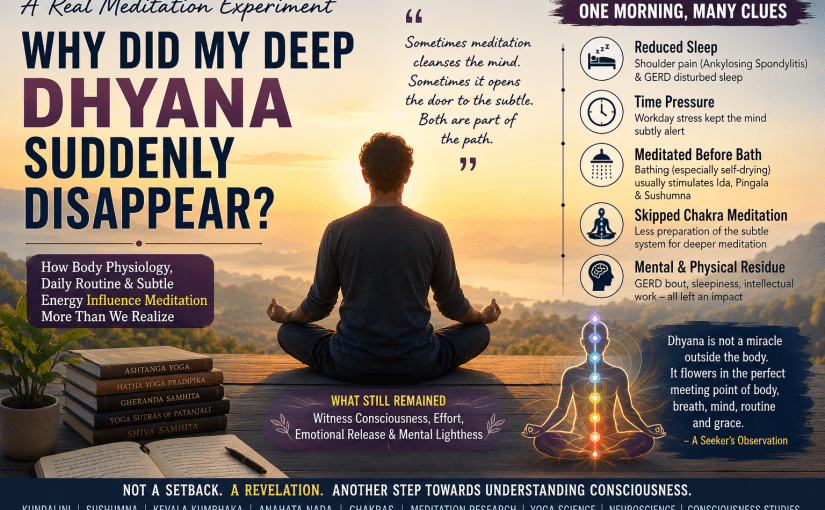
Why Did My Deep Dhyana Suddenly Disappear? A Real Meditation Experiment Reveals the Hidden Role of Body Physiology, Sushumna, Kevala Kumbhaka and Consciousness

Daily Yoga May Establish Dhyana, but Daily Dhyana Also Needs Daily Preparation

For a long time I have felt that just as all the limbs of Ashtanga Yoga practiced over years ultimately culminate in dhyana, the same principle seems to apply every single day. Even after meditation becomes established, daily practice of yoga asanas, pranayama, spinal breathing, ethical living, mental preparation and inward turning appears necessary to recreate the inner environment in which deep meditation naturally blossoms. It does not appear to be a one-time achievement after which preparation becomes unnecessary. Every day seems to be a fresh laboratory.

One Morning That Changed My Understanding of Meditation

One morning I woke at about 3 a.m. As usual, I first did a little intellectual work. This has become part of my routine because it removes the heaviness of sleep and helps me become mentally alert before yoga. After that I completed my full yoga practice and then sat for meditation for nearly one hour.

What happened surprised me.

Normally I become aware of what I describe as sushumna flow. Sometimes spontaneous kevala kumbhaka develops naturally. At times subtle inner sound, anahata nada, also becomes noticeable. On this particular day none of these familiar experiences appeared.

Instead, there were continuous thoughts, emotions and mental disturbances. The mind repeatedly tried to identify with them. My effort throughout the hour was simply to witness them. The witnessing itself was not effortless. Again and again the mind was pulled towards identification, and again and again I deliberately returned to the position of the witness.

Yet something important happened. Although the subtle yogic experiences were absent, the meditation removed a considerable amount of mental garbage. Many hateful emotions, emotional burdens and other disturbing impressions became lighter. I finished meditation feeling mentally cleaner and more peaceful.

This raised an important question in my mind. Why did this happen today?

Witnessing Without Sushumna Was Still Meaningful

One insight gradually became clear. A meditation session should perhaps not be judged only by whether sushumna flow, anahata nada or spontaneous kevala kumbhaka occurs. Witness consciousness itself has tremendous value. Sometimes meditation may function more as purification of the mind than as an experience of subtle energy.

The effort required to maintain witnessing also suggested that this particular meditation resembled dharana more than effortless dhyana. Nevertheless, repeatedly returning to witnessing instead of becoming lost in thoughts still appeared to strengthen non-identification with the mind.

Why Did the Subtle Yogic Experiences Not Appear?

The first possibility that came to my mind was my usual intellectual work before yoga. However, I realized that I perform this light intellectual work almost every day precisely to remove sleep inertia, and on most days it does not interfere with meditation. Therefore it probably was not the primary reason.

Another important difference immediately became obvious. Normally after yoga I take a bath before sitting for meditation. This particular day I sat for meditation before bathing.

Over many months I have repeatedly observed that bathing itself seems to stimulate ida, pingala and especially sushumna in a very noticeable manner. Surprisingly, this stimulation appears strongest during the natural self-drying phase when the body dries by itself without vigorous towel wiping. Since I skipped this sequence before meditation, perhaps one important preparatory step was missing.

Missing Chakra Meditation May Have Changed the Outcome

Another significant difference also occurred. Usually I perform chakra meditation sequentially, concentrating one by one on each chakra before deeper meditation. On this day I omitted that part because sufficient time was not available.

My own experience suggests that sequential chakra meditation prepares the entire subtle system for deeper meditation. Whether one interprets this as increased concentration, improved inward attention or activation of subtle energetic processes, it consistently seems to make meditation deeper for me. Omitting this step may therefore have reduced the likelihood of experiencing the upward movement that I normally associate with sushumna and spontaneous kevala kumbhaka.

Time Pressure May Quietly Affect Meditation

There was still another difference. It was a working day.

Because office duties were waiting, I constantly knew that time was limited. Even if this awareness remained in the background, time pressure itself may have prevented complete relaxation. I have often noticed that on holidays, when there is no urgency, meditation naturally becomes deeper and subtle yogic experiences appear more readily.

Perhaps the subconscious awareness that meditation must finish within a certain time quietly altered the entire mental atmosphere.

GERD and Ankylosing Spondylitis Added More Variables

The previous day I had also experienced a bout of GERD. Such episodes often disturb sleep and influence the overall condition of the body. In addition, for several days I had been suffering from left shoulder pain due to ankylosing spondylitis. This pain had repeatedly interrupted my sleep.

Poor sleep itself can influence alertness, emotional stability, breathing patterns and the balance between relaxation and wakefulness. Looking back, I realized that shoulder pain, reduced sleep, the recent GERD episode and mild sleepiness could all have been acting together.

A New Possibility Emerged

Gradually another thought emerged.

Perhaps sushumna flow, spontaneous kevala kumbhaka and similar deep meditation experiences are not isolated miracles that appear independently of the body. Perhaps they are strongly influenced by the total physiological and psychological condition of the practitioner.

This does not necessarily reduce their spiritual significance. Instead, it may reveal that consciousness, body physiology, breathing, emotions, attention and subtle yogic processes are deeply interconnected.

The body may not create consciousness itself, yet it may greatly influence the conditions under which particular meditative experiences become accessible.

One Obstacle May Not Matter, But Many Together Might

While reflecting on the entire morning, another pattern appeared.

Perhaps sushumna can tolerate one or two minor disturbances. On many occasions slight deviations from routine have not prevented deeper meditation. However, this day several changes occurred simultaneously.

I had reduced sleep because of shoulder pain. There had been a GERD episode the previous day. I felt some sleepiness. Time pressure existed because of office work. I meditated before bathing instead of after. I omitted my usual chakra meditation.

None of these factors alone may have been sufficient. Together, however, they may have changed the internal conditions enough that meditation expressed itself differently. Instead of subtle energetic phenomena, it focused on emotional purification and witness consciousness.

Dhyana Appears Closely Connected with Body Physiology

This experience led me towards an important working hypothesis.

Perhaps dhyana is not a supernatural event occurring independently of bodily conditions. It appears deeply influenced by body physiology, nervous system balance, sleep quality, pain, digestion, breathing, emotional state, preparation and daily routine.

Classical yoga itself may indirectly support this possibility because it begins not with meditation but with preparation. Ethical discipline, posture, breath regulation, withdrawal of the senses and concentration all precede effortless meditation. This sequence itself suggests that body and mind prepare the ground upon which deeper consciousness flowers.

Modern neuroscience also increasingly recognizes that sleep, autonomic nervous system activity, inflammation, chronic pain, breathing and emotional regulation all influence attention and meditation. My own experience seems to point in a similar direction.

A Personal Meditation Experiment Rather Than a Final Conclusion

I do not present these observations as established scientific facts. They are simply careful observations arising from one meditation session viewed in the context of many previous sessions.

The next step is obvious. I intend to return to my normal routine consisting of yoga, chakra meditation, bathing and then meditation while observing whether sushumna, spontaneous kevala kumbhaka and anahata nada again become more frequent. Repeated observation over many days will be far more meaningful than conclusions drawn from a single experience.

A Small Observation That May Interest Researchers of Consciousness

This entire experience has left me with a simple but fascinating possibility.

Meditation may not fail simply because extraordinary experiences are absent. Sometimes its purpose may quietly shift from mystical absorption to purification of the mind. On other days deeper energetic experiences may naturally arise again. The quality of meditation may therefore depend not only upon practice itself but also upon the constantly changing interaction between body physiology, sleep, pain, digestion, breathing, emotions, preparation, attention and consciousness.

If this understanding continues to be supported by future observations, it may provide an interesting meeting point between classical yoga, kundalini practice, meditation research, neuroscience, philosophy of consciousness and modern physiology. Rather than viewing spirituality and physiology as opposing explanations, they may represent two complementary perspectives describing different aspects of the same living process.
Deep Meditation, Dream Symbolism, Compassion, and the Question of Nadi Potential: Reflections from a Morning Yoga Session

A Song, a Rainy Mood, and the Fire Within

The old song “Rimjhim Gire Saawan, Sulag Sulag Jaaye Man, Phir Aaj Is Mausam Mein Lagi Kaisi Ye Agan” became an unexpected starting point for reflection. The song speaks of a paradox: rain falls outside, bringing coolness to the world, yet an inner fire burns in the heart. This contrast between outer calm and inner intensity became a fitting backdrop for a morning meditation experience that unfolded in several unexpected stages.

Early Morning Practice and an Unusual Meditation Session

The day began at around 3 a.m. with some work on a book manuscript. Afterward, fatigue and sleepiness were present, yet yoga practice was undertaken. The nadis appeared to open well, but deep spinal breathing pranayama did not flow as smoothly as usual. There was a sense that the head already carried some pressure or fullness, making deep practice difficult. Instead of forcing pranayama, attention shifted toward dhyana.

During meditation, awareness seemed to move around Vishuddha and Anahata. At times the breath appeared to originate from the throat region, and at other times from the heart region. Subtle upward sensations were felt in the spine. Anahata nada heard subtly like Shiva’s damru beating. Although not fully. Thoughts slowed considerably but did not completely stop. The breath became subtle but did not cease. Relaxation emerged, though not in its fullest form. Sleepiness repeatedly appeared, and maintaining an erect spine required effort. Even so, the meditation continued for approximately one hour.

The Dream After Meditation

After the sitting session, there was a short period of lying down on the floor for relaxation. During this brief sleep, a vivid and pleasant dream arose.

In the dream, there was a bike and a large old monumental structure. Inside the structure, professional colleagues were attending a meeting with a senior authority figure. Standing somewhat outside the gathering, fragments of conversation could be heard. There was a feeling of having missed some important practical knowledge or understanding. At the same time, there was neither humiliation nor defeat. Alongside mild concern existed a sense of self-respect and confidence.

Music began playing from the bike on its own. Thinking that a wiring problem existed, attempts were made to inspect the dashboard and trace the source. While moving around the base of the monument, a locked cabinet containing old mystical tools appeared. Some interaction took place with this cabinet before it was closed again. The music continued to create concern because it might be heard by those attending the meeting. Eventually the music stopped. A pleasant female colleague then appeared, smiling and approachable, and conversation followed regarding the bike and the location of the meeting. Soon afterward, sleep ended.

Psychological Meaning of the Dream

The dream appeared to reflect several layers of personal psychology. The monumental building resembled a symbol of accumulated knowledge, institutional authority, tradition, or practical wisdom. Being near but not fully inside the meeting suggested a subtle awareness that there are always areas of practical understanding still left to learn, regardless of spiritual progress. Or it may be indicator of detachment from knowledge wealth gained in the brain.

The bike symbolized movement through life. It was functioning but behaving in an unusual way. This reflected the meditation session itself, where practice was progressing yet not exactly according to expectation. Thoughts had slowed but not disappeared. Breath had become subtle but not silent. Some pressure and uncertainty remained.

The music represented autonomous activity of the mind. It resembled thoughts, memories, emotions, creativity, and subconscious processes that continue functioning without deliberate control. The dream was especially interesting because the music did not stop through a clear conscious solution. Instead, some intuitive handling seemed to resolve the issue. This suggested that not all inner adjustments occur through intellectual understanding. Sometimes change happens through intuitive engagement, and only later does one recognize that something has shifted.

The old cabinet containing mystical tools symbolized accumulated inner resources, previous experiences, spiritual knowledge, and latent capacities developed over years of practice and even knowledge inside ancient and mystical spiritual texts. The smiling female colleague represented a helpful, relational, intuitive aspect of the psyche. Her appearance after the music stopped suggested that once mental noise settled, a more harmonious and integrated quality emerged.

Compassion Instead of Emotional Turbulence

Upon waking, powerful emotions arose. At first these appeared to resemble an emotional storm. On closer observation, however, they were not turbulent emotions. They were not fear, anxiety, sadness, or excitement. Instead, they carried the flavor of deep compassion and tenderness felt directly within the heart.

This distinction proved important. There is a difference between emotional disturbance and heart-centered feeling. The experience did not seem to be pulling attention away from meditation. Rather, it appeared to express a different mode of consciousness.

One possibility considered was that emotions represent intermediary stages before entering the void. In earlier experiences, awareness sometimes moved directly into a silent witness state where emotions were absent. On this occasion, however, awareness seemed to travel through more human and relational layers before reaching stillness. Through that route, compassion surfaced.

This led to the insight that there may be different expressions of spiritual depth. One form appears as detached stillness, witness-consciousness, and emptiness. Another appears as tenderness, compassion, interconnectedness, and warmth of heart. Neither necessarily excludes the other.

Deep Spinal Breathing Returns but Dhyana Does Not

A particularly interesting development occurred after waking. Deep spinal breathing pranayama, which had earlier been difficult, now became easy and natural. Yet despite this improvement, dhyana could not be re-established in the same way.

It means a transformation process had started in the brain, so it drew energy from the Muladhara Chakra through spinal breathing. In the beginning, spinal breathing was not happening properly because the transformation process and energy movement were somewhat hindered by worldly tiredness, sleepiness, and other factors. During the one-hour dhyana session, the process gradually continued, allowing the energy to move and support the ongoing transformation.

An important question arises. If pranayama was flowing better, why did meditation not deepen during dhyana?

One possibility was that subtle anticipation of office responsibilities had already begun influencing the mind. Even without conscious worry, awareness may have carried a faint orientation toward the upcoming workday. Such subtle readiness for action can be enough to prevent deeper absorption.

Another possibility was that the earlier meditation had already completed a certain cycle. The one-hour session may have utilized the momentum generated through yoga and pranayama. What remained afterward was not depletion but integration.

The Question of Nadi Potential

This led to reflection on what might be called nadi potential. It seemed as though the energetic momentum developed through yoga had been released or expressed during the one-hour meditation session. Afterward, a new cycle of potential would need to be generated.

This observation raised another question: if such potential is not real, why does dhyana often last for a particular period before naturally changing?

Several perspectives emerged. Traditional yoga would describe dhyana as influenced by prana, nadis, samskaras, and bodily condition. Psychology would describe it in terms of attention, mental fatigue, emotion, and cognitive processing. Both perspectives acknowledge that meditative states often arise when multiple factors align and change when those factors shift.

The experience of the morning suggested that meditation may not operate through a simple mechanical reservoir of energy. Yet it often depends on a temporary alignment of attention, physiology, emotional state, and what yogic language calls prana. When that alignment changes, the quality of meditation changes as well.

A Morning That Chose the Heart Over the Void

Looking back, the entire sequence appears coherent. An old song about inner fire arose as a theme. Early morning book work was followed by yoga and meditation. Awareness moved around the regions traditionally associated with communication and the heart. A symbolic dream unfolded involving knowledge, authority, hidden tools, music, intuition, and relationships. Compassion emerged upon waking. Deep spinal breathing improved. Yet the detached stillness of dhyana did not immediately return.

Rather than indicating failure, the experience may represent a different mode of inner development. Instead of moving directly into emptiness, consciousness traveled through meaning, feeling, memory, and relationship. The result was not agitation but compassion. The morning seemed to suggest that spiritual practice does not always move toward the void through the same doorway. Sometimes it passes first through the heart.

Guru Parva Grace and the Deep Descent into Dhyana

Today is Guru Parva — a day soaked in subtle grace. Perhaps that’s why dhyana came with such ease and depth. Truly, Guru Tattva is omnipresent and omnipotent, guiding from within when outer guidance rests.

I woke around 4:30 a.m., calm and receptive. Instinctively began deep spinal kriya breathing for about twenty minutes. Then I read a few blog posts — words that perhaps tuned my consciousness higher. After that, I shifted into chakra meditation, moving awareness from crown to base, up and down for about twenty minutes. The movement of prana created the right yogic pressure — a preparatory current that automatically launched me into dhyana.

At first, I sat in Padmasana, but it remained a preparatory phase. Then I shifted to Vajrasana, and the change was instant — deep dhyana dawned naturally. Maybe Vajrasana truly suits me best. I laughed inwardly: “So, my name must be Premyogi Vajra.”

What followed was one and a half hours of continuous, breathless dhyana.
In the beginning, energy was high in the upper chakras. The in-breath was imperceptible, and the out-breath only faintly perceptible — as if nature herself was drawing energy downward in a balancing act. Gradually, prana descended through Vishuddhi and Anahata, though not distinctly separated. The awareness of subtle pulsations grew clearer in the lower regions — a breath of energy, not air.

A key realization emerged — never force stillness. Allow the body micro-movements to release strain. When I released effort, breathing softened further, and bliss deepened.

My neck bore much strain, holding the head’s weight. Tilting it slightly left eased the flow; then returning to center or right as needed — a gentle, intelligent cooperation between body and consciousness.

Later, when Vajrasana made the limbs numb, I slowly shifted to Sukhasana. Instead of distraction, dhyana deepened further. Sometimes I lowered the head, sometimes kept it upright or tilted slightly upward. Sometimes back full straight with natural curve, sometimes loosening it little. These spontaneous maneuvers tuned the current like a musician refining his note.

For Ekarnava Dhyana, keeping the head gently dropped with closed eyes gazing upward toward the Ajna Chakra worked best.

When Sukhasana tired, I moved into Siddhasana. Here bliss magnified again — energy dipped lower, steady and full. The ankle pressing Swadhisthana, and the other pressing Muladhara, created a perfect circuit and sensational points to concentrate energy more there. The microcosmic orbit activated naturally, the energy revolving in serenity.

Later, I attempted to lift energy back to Ajna Chakra as an experiment, but it felt stressful. The energy preferred to stay grounded, working in silence. So I let it remain, continuing Ekarnava Dhyana as it was. However, prolonged ekarnava dhyana shifts energy up slowly again. It’s good switch to direct energy rather than directly manipulating.

However, in the lower chakras, dhyana became more witnessing than transcendence — not Nirvikalpa, but a subtle purification. Hidden emotional imprints arose as faint, heartfelt memories — gently surfacing and dissolving. It felt like inner cleansing, a self-healing of the soul.

When calls began coming and bathing time approached, I slowly rose. This time, not with repentance — but with deep satisfaction and fullness.

Perhaps this was the fruit of integrating sitting meditation with working meditation in recent days. I noticed a clear truth:

When dhyana is practiced after days of worldly indulgence, the preparatory phase is longer.
When practiced regularly, with no lingering desires, dhyana launches instantly — like a rocket already fueled by purity.

Today’s experience was not just about time or posture. It was about effortless descent into grace — a reminder that Guru Tattva lives within, guiding from breath to stillness, from effort to surrender.

Moreover, after bathing, I had practiced all the remaining major asanas to rebuild the inner energy for the next meditation session during the day. To avoid too much pressure building up in the head, I slightly turned my hands and feet — especially the front parts of the feet — outward and downward, as if pressing the ground with paws during each pose. This simple adjustment had a wonderful effect. It helped the energy move down and kept me well-grounded, preventing any heaviness or excess pressure in the head.