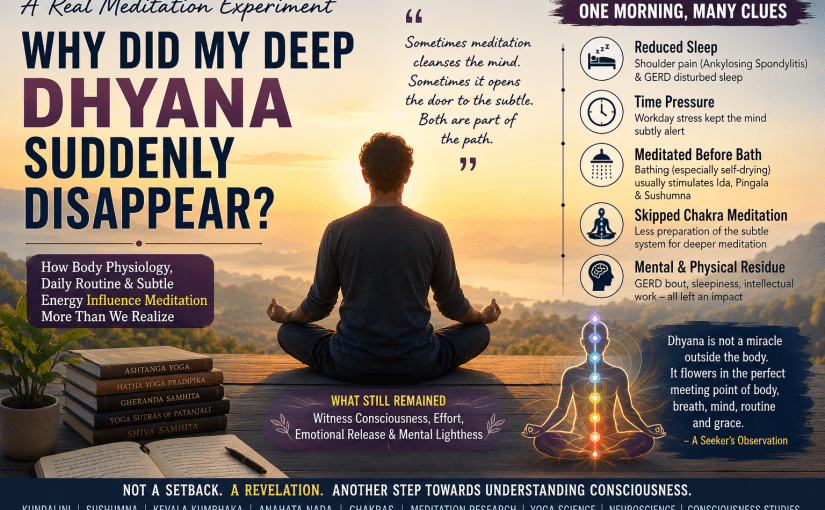
Why Did My Deep Dhyana Suddenly Disappear? A Real Meditation Experiment Reveals the Hidden Role of Body Physiology, Sushumna, Kevala Kumbhaka and Consciousness

Daily Yoga May Establish Dhyana, but Daily Dhyana Also Needs Daily Preparation

For a long time I have felt that just as all the limbs of Ashtanga Yoga practiced over years ultimately culminate in dhyana, the same principle seems to apply every single day. Even after meditation becomes established, daily practice of yoga asanas, pranayama, spinal breathing, ethical living, mental preparation and inward turning appears necessary to recreate the inner environment in which deep meditation naturally blossoms. It does not appear to be a one-time achievement after which preparation becomes unnecessary. Every day seems to be a fresh laboratory.

One Morning That Changed My Understanding of Meditation

One morning I woke at about 3 a.m. As usual, I first did a little intellectual work. This has become part of my routine because it removes the heaviness of sleep and helps me become mentally alert before yoga. After that I completed my full yoga practice and then sat for meditation for nearly one hour.

What happened surprised me.

Normally I become aware of what I describe as sushumna flow. Sometimes spontaneous kevala kumbhaka develops naturally. At times subtle inner sound, anahata nada, also becomes noticeable. On this particular day none of these familiar experiences appeared.

Instead, there were continuous thoughts, emotions and mental disturbances. The mind repeatedly tried to identify with them. My effort throughout the hour was simply to witness them. The witnessing itself was not effortless. Again and again the mind was pulled towards identification, and again and again I deliberately returned to the position of the witness.

Yet something important happened. Although the subtle yogic experiences were absent, the meditation removed a considerable amount of mental garbage. Many hateful emotions, emotional burdens and other disturbing impressions became lighter. I finished meditation feeling mentally cleaner and more peaceful.

This raised an important question in my mind. Why did this happen today?

Witnessing Without Sushumna Was Still Meaningful

One insight gradually became clear. A meditation session should perhaps not be judged only by whether sushumna flow, anahata nada or spontaneous kevala kumbhaka occurs. Witness consciousness itself has tremendous value. Sometimes meditation may function more as purification of the mind than as an experience of subtle energy.

The effort required to maintain witnessing also suggested that this particular meditation resembled dharana more than effortless dhyana. Nevertheless, repeatedly returning to witnessing instead of becoming lost in thoughts still appeared to strengthen non-identification with the mind.

Why Did the Subtle Yogic Experiences Not Appear?

The first possibility that came to my mind was my usual intellectual work before yoga. However, I realized that I perform this light intellectual work almost every day precisely to remove sleep inertia, and on most days it does not interfere with meditation. Therefore it probably was not the primary reason.

Another important difference immediately became obvious. Normally after yoga I take a bath before sitting for meditation. This particular day I sat for meditation before bathing.

Over many months I have repeatedly observed that bathing itself seems to stimulate ida, pingala and especially sushumna in a very noticeable manner. Surprisingly, this stimulation appears strongest during the natural self-drying phase when the body dries by itself without vigorous towel wiping. Since I skipped this sequence before meditation, perhaps one important preparatory step was missing.

Missing Chakra Meditation May Have Changed the Outcome

Another significant difference also occurred. Usually I perform chakra meditation sequentially, concentrating one by one on each chakra before deeper meditation. On this day I omitted that part because sufficient time was not available.

My own experience suggests that sequential chakra meditation prepares the entire subtle system for deeper meditation. Whether one interprets this as increased concentration, improved inward attention or activation of subtle energetic processes, it consistently seems to make meditation deeper for me. Omitting this step may therefore have reduced the likelihood of experiencing the upward movement that I normally associate with sushumna and spontaneous kevala kumbhaka.

Time Pressure May Quietly Affect Meditation

There was still another difference. It was a working day.

Because office duties were waiting, I constantly knew that time was limited. Even if this awareness remained in the background, time pressure itself may have prevented complete relaxation. I have often noticed that on holidays, when there is no urgency, meditation naturally becomes deeper and subtle yogic experiences appear more readily.

Perhaps the subconscious awareness that meditation must finish within a certain time quietly altered the entire mental atmosphere.

GERD and Ankylosing Spondylitis Added More Variables

The previous day I had also experienced a bout of GERD. Such episodes often disturb sleep and influence the overall condition of the body. In addition, for several days I had been suffering from left shoulder pain due to ankylosing spondylitis. This pain had repeatedly interrupted my sleep.

Poor sleep itself can influence alertness, emotional stability, breathing patterns and the balance between relaxation and wakefulness. Looking back, I realized that shoulder pain, reduced sleep, the recent GERD episode and mild sleepiness could all have been acting together.

A New Possibility Emerged

Gradually another thought emerged.

Perhaps sushumna flow, spontaneous kevala kumbhaka and similar deep meditation experiences are not isolated miracles that appear independently of the body. Perhaps they are strongly influenced by the total physiological and psychological condition of the practitioner.

This does not necessarily reduce their spiritual significance. Instead, it may reveal that consciousness, body physiology, breathing, emotions, attention and subtle yogic processes are deeply interconnected.

The body may not create consciousness itself, yet it may greatly influence the conditions under which particular meditative experiences become accessible.

One Obstacle May Not Matter, But Many Together Might

While reflecting on the entire morning, another pattern appeared.

Perhaps sushumna can tolerate one or two minor disturbances. On many occasions slight deviations from routine have not prevented deeper meditation. However, this day several changes occurred simultaneously.

I had reduced sleep because of shoulder pain. There had been a GERD episode the previous day. I felt some sleepiness. Time pressure existed because of office work. I meditated before bathing instead of after. I omitted my usual chakra meditation.

None of these factors alone may have been sufficient. Together, however, they may have changed the internal conditions enough that meditation expressed itself differently. Instead of subtle energetic phenomena, it focused on emotional purification and witness consciousness.

Dhyana Appears Closely Connected with Body Physiology

This experience led me towards an important working hypothesis.

Perhaps dhyana is not a supernatural event occurring independently of bodily conditions. It appears deeply influenced by body physiology, nervous system balance, sleep quality, pain, digestion, breathing, emotional state, preparation and daily routine.

Classical yoga itself may indirectly support this possibility because it begins not with meditation but with preparation. Ethical discipline, posture, breath regulation, withdrawal of the senses and concentration all precede effortless meditation. This sequence itself suggests that body and mind prepare the ground upon which deeper consciousness flowers.

Modern neuroscience also increasingly recognizes that sleep, autonomic nervous system activity, inflammation, chronic pain, breathing and emotional regulation all influence attention and meditation. My own experience seems to point in a similar direction.

A Personal Meditation Experiment Rather Than a Final Conclusion

I do not present these observations as established scientific facts. They are simply careful observations arising from one meditation session viewed in the context of many previous sessions.

The next step is obvious. I intend to return to my normal routine consisting of yoga, chakra meditation, bathing and then meditation while observing whether sushumna, spontaneous kevala kumbhaka and anahata nada again become more frequent. Repeated observation over many days will be far more meaningful than conclusions drawn from a single experience.

A Small Observation That May Interest Researchers of Consciousness

This entire experience has left me with a simple but fascinating possibility.

Meditation may not fail simply because extraordinary experiences are absent. Sometimes its purpose may quietly shift from mystical absorption to purification of the mind. On other days deeper energetic experiences may naturally arise again. The quality of meditation may therefore depend not only upon practice itself but also upon the constantly changing interaction between body physiology, sleep, pain, digestion, breathing, emotions, preparation, attention and consciousness.

If this understanding continues to be supported by future observations, it may provide an interesting meeting point between classical yoga, kundalini practice, meditation research, neuroscience, philosophy of consciousness and modern physiology. Rather than viewing spirituality and physiology as opposing explanations, they may represent two complementary perspectives describing different aspects of the same living process.
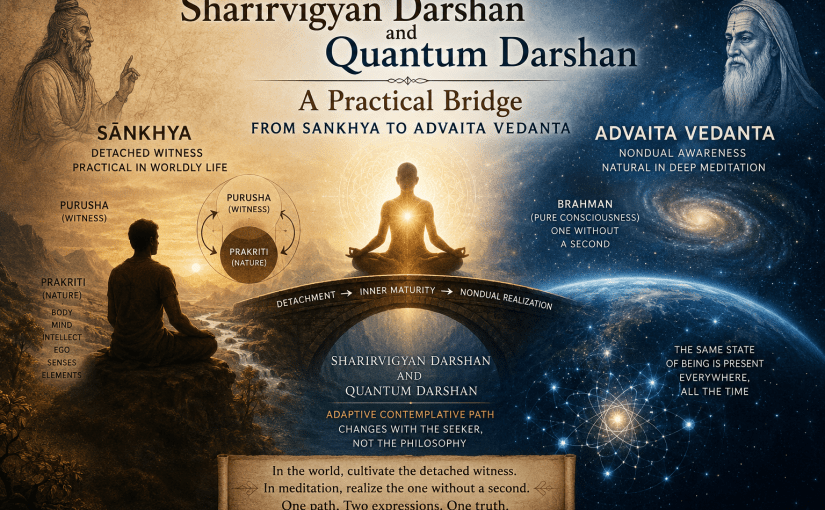
Sharirvigyan Darshan and Quantum Darshan: A Practical Bridge from Sankhya to Advaita Vedanta

Can Ancient Indian Philosophy Become Practical Again? A Personal Search

For many years I lived with a question that slowly became deeper than meditation itself. Ancient Indian philosophy beautifully explains consciousness, liberation and the nature of existence, yet I repeatedly wondered why these teachings often remain difficult for ordinary people to apply in daily life. My own spiritual journey gradually revealed that the answer may not lie in choosing one philosophy over another but in discovering how different philosophies naturally become useful at different stages of inner evolution.

One question especially transformed my contemplation. If pure consciousness is completely detached and inactive, how can the entire universe function with such astonishing intelligence? How can something that never acts still remain connected with every process of creation, every memory of the past and every possibility of the future? Complete non-existence cannot organize anything. Therefore pure existence cannot simply be an absence. It appears to be the silent background that constitutes everything without becoming entangled in anything. This insight slowly made creation appear less like a machine and more like one immense living organism whose countless activities continue while the underlying reality remains untouched.

The Beauty and Limitation of Classical Sankhya

My reflections naturally returned to Sankhya philosophy. Sankhya explains that Purusha is pure witnessing consciousness while Prakriti performs every action. Purusha neither acts nor becomes attached. Prakriti alone evolves into body, mind, intellect, ego, senses and the entire universe. This immediately explains why detachment is possible. Purusha never needed to become detached because it was never attached in the first place.

The more I contemplated this, the more I realized that detachment itself is perhaps the greatest lesson taught by Sankhya. Purusha is detached not because it practices detachment but because detachment is its very nature. Spiritual practice therefore becomes the gradual recognition that body, mind, emotions and actions belong to Prakriti while the witnessing self remains forever untouched.

Yet another question quietly appeared. If Purusha is absolutely inactive, how does Prakriti become so intelligently organized merely by its proximity? This question has inspired many philosophical traditions, including Advaita Vedanta and Kashmir Shaivism, each providing different explanations. Rather than rejecting Sankhya, I began searching for a practical bridge.

The Birth of Sharirvigyan Darshan

During my contemplations I realized that perhaps the easiest teacher already exists inside the human body.

Every cell performs astonishingly intelligent activities. Cells communicate, repair tissues, defend against disease, reproduce, generate energy and maintain life continuously. Yet I do not consciously perform these cellular activities. They continue automatically.

Then a deeper analogy emerged.

Suppose every cell possesses its own witnessing principle just as the human being possesses a witnessing self. The important point is not whether science presently accepts such a hypothesis. The important point is the structure of contemplation.

Just as my self remains detached from my body’s activities and their results, the self of the cell would remain detached from the activities and results of the cell. Neither becomes identical with the body through action.

This is the heart of Sharirvigyan Darshan.

It does not teach that the self of the cell is the cell itself. Nor does it immediately ask the seeker to accept that everything is one consciousness. Instead, it repeatedly invites contemplation of the relationship between self and body.

The cell performs.

The self witnesses.

The body acts.

The self remains detached.

Through this simple contemplation, detachment becomes easier to experience than through abstract metaphysical discussion.

Quantum Darshan Extends the Same Principle

Exactly the same structural principle later appeared in Quantum Darshan.

Only one illustration changes.

Instead of beginning with cells, Quantum Darshan begins with quantum particles.

Again, the philosophy does not claim that the self of a quantum particle is identical with the particle itself. Rather, the same contemplative relationship is extended to a deeper level of nature. Means self of quantum particle is detached from it. The body performs according to its own laws while the witnessing principle remains detached from action and its consequences.

Thus both Sharirvigyan Darshan and Quantum Darshan become beginner-friendly. They do not force the mind to grasp the extremely subtle nondual statement that everything is one. Instead, they first teach the practical experience of witness-consciousness through familiar structures.

Why Direct Advaita Vedanta Was Difficult for Me

My own spiritual journey taught me something very important.

When I first approached nondual Vedanta directly, it was extremely difficult to stabilize in everyday life. The mind found it difficult to understand how becoming and non-becoming could coexist. The statement that everything is one consciousness remained intellectually attractive but practically difficult to maintain while living an active worldly life.

Sankhya-based contemplation proved completely different.

By repeatedly recognizing that body and mind belong to Prakriti while the witnessing self remains detached, I gradually developed stable inner detachment. This was not suppression of worldly life. Rather, it became freedom while living within worldly responsibilities.

Only much later did nondual understanding arise naturally.

My Spiritual Experience Revealed an Unexpected Cycle

One of the most surprising discoveries during my years of Tantra, yoga and meditation was that Sankhya and Vedanta did not appear as rivals. Instead, they seemed to support one another at different stages of consciousness.

While living actively in the world, my attention naturally returned to Sharirvigyan Darshan. The contemplation of the detached self became my greatest support. It helped me perform duties while remaining inwardly free.

Then, after prolonged meditation, Tantra and deep yogic absorption, something changed naturally.

Worldly identification became weaker.

The sense of separation gradually dissolved.

Without forcing any philosophical conclusion, awareness itself began experiencing nonduality. The distinction between myself and everything else became less important than the underlying unity of existence.

Interestingly, at that stage the Sankhya-based contemplation became less necessary because nondual awareness itself had become natural.

However, whenever worldly responsibilities increased again, attention naturally returned to Sharirvigyan Darshan. It again became the practical method through which detachment stabilized until nondual awareness gradually re-emerged.

This cycle repeated many times.

Worldly engagement naturally encouraged Sankhya-like contemplation.

Deep meditation naturally matured into Vedantic realization.

Neither philosophy opposed the other.

Each appeared precisely when needed.

An Adaptive Philosophy Rather Than a Fixed Philosophy

This gradually led me to a new possibility.

Perhaps Sharirvigyan Darshan and Quantum Darshan function as adaptive contemplative systems.

During active worldly life they operate practically like Sankhya by strengthening witness-consciousness and reducing attachment.

During deep meditation, yoga and Tantra they naturally flower into nondual understanding without requiring a separate philosophical conversion. I could easily contemplate that my present state of being is present everywhere at all times because the same universal laws are working everywhere. This became my natural mode of contemplation during the nondual phase, rather than focusing on the distinction between the detached self and its body, which was my primary contemplation during the worldly phase.

The philosophy itself does not change.

Only the seeker’s state of consciousness changes.

When the mind is deeply engaged with worldly activity, attention naturally rests upon the distinction between self and body.

When meditation matures and identification weakens, attention naturally recognizes the underlying unity of existence.

Thus the same contemplative framework serves both stages.

A Humble Proposal for Researchers and Spiritual Seekers

I do not present these reflections as established scientific facts or final philosophical conclusions. They are the outcome of sustained personal contemplation, meditation and practical observation. They invite discussion rather than demand agreement.

If these ideas prove useful, they may offer a practical bridge connecting Sankhya, Yoga, Tantra, Advaita Vedanta, consciousness studies, contemplative psychology and even modern scientific models of biological and quantum organization.

Most importantly, they suggest that perhaps beginners need not begin with the most abstract metaphysical doctrines. They may first learn detachment through direct observation of life itself. As detachment matures, deeper nondual realization may arise naturally rather than intellectually.

My own experience repeatedly followed this path.

Sankhya-like witness consciousness supported me while living in the world.

Deep meditation revealed nonduality.

Returning to the world revived practical witness-consciousness.

Returning inward restored effortless nonduality.

Instead of contradiction, I discovered complementarity.

Instead of choosing between Sankhya and Vedanta, I found that practical detachment and nondual realization can become successive expressions of the same spiritual journey.

Why Sankhya Appears More Practical Before Nondual Realization

From my own experience, Sankhya appears more practical during active worldly life. As long as the mind is deeply engaged with work, relationships and responsibilities, it is easier to cultivate detachment by contemplating that the witnessing self is distinct from the body, mind and actions. In contrast, if one begins directly with the Advaita Vedanta view that Purusha and Prakriti are ultimately one, it can be difficult for many beginners to understand how the same reality can both manifest as the world and yet remain completely detached from it. This subtle paradox may become clear only after deep meditation and inner maturity. My experience has been that Sankhya-based contemplation naturally prepares the mind for this realization. Once detachment becomes stable through practice, nondual awareness arises effortlessly, and the apparent contradiction between distinction and unity gradually dissolves through direct experience rather than intellectual reasoning. This is why Sharirvigyan Darshan and Quantum Darshan are presented not as alternatives to either Sankhya or Advaita Vedanta, but as practical contemplative bridges that guide the seeker from witness-consciousness to nondual realization according to the seeker’s stage of inner development.