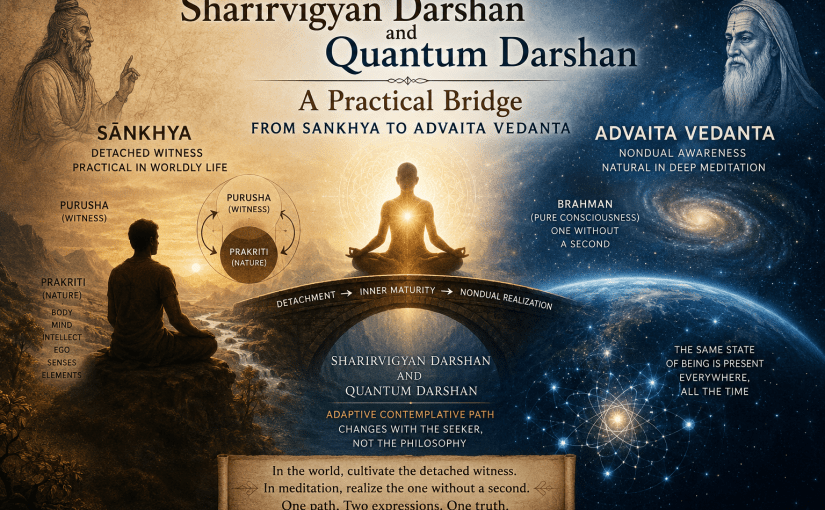
Can Ancient Indian Philosophy Become Practical Again? A Personal Search
For many years I lived with a question that slowly became deeper than meditation itself. Ancient Indian philosophy beautifully explains consciousness, liberation and the nature of existence, yet I repeatedly wondered why these teachings often remain difficult for ordinary people to apply in daily life. My own spiritual journey gradually revealed that the answer may not lie in choosing one philosophy over another but in discovering how different philosophies naturally become useful at different stages of inner evolution.
One question especially transformed my contemplation. If pure consciousness is completely detached and inactive, how can the entire universe function with such astonishing intelligence? How can something that never acts still remain connected with every process of creation, every memory of the past and every possibility of the future? Complete non-existence cannot organize anything. Therefore pure existence cannot simply be an absence. It appears to be the silent background that constitutes everything without becoming entangled in anything. This insight slowly made creation appear less like a machine and more like one immense living organism whose countless activities continue while the underlying reality remains untouched.
The Beauty and Limitation of Classical Sankhya
My reflections naturally returned to Sankhya philosophy. Sankhya explains that Purusha is pure witnessing consciousness while Prakriti performs every action. Purusha neither acts nor becomes attached. Prakriti alone evolves into body, mind, intellect, ego, senses and the entire universe. This immediately explains why detachment is possible. Purusha never needed to become detached because it was never attached in the first place.
The more I contemplated this, the more I realized that detachment itself is perhaps the greatest lesson taught by Sankhya. Purusha is detached not because it practices detachment but because detachment is its very nature. Spiritual practice therefore becomes the gradual recognition that body, mind, emotions and actions belong to Prakriti while the witnessing self remains forever untouched.
Yet another question quietly appeared. If Purusha is absolutely inactive, how does Prakriti become so intelligently organized merely by its proximity? This question has inspired many philosophical traditions, including Advaita Vedanta and Kashmir Shaivism, each providing different explanations. Rather than rejecting Sankhya, I began searching for a practical bridge.
The Birth of Sharirvigyan Darshan
During my contemplations I realized that perhaps the easiest teacher already exists inside the human body.
Every cell performs astonishingly intelligent activities. Cells communicate, repair tissues, defend against disease, reproduce, generate energy and maintain life continuously. Yet I do not consciously perform these cellular activities. They continue automatically.
Then a deeper analogy emerged.
Suppose every cell possesses its own witnessing principle just as the human being possesses a witnessing self. The important point is not whether science presently accepts such a hypothesis. The important point is the structure of contemplation.
Just as my self remains detached from my body’s activities and their results, the self of the cell would remain detached from the activities and results of the cell. Neither becomes identical with the body through action.
This is the heart of Sharirvigyan Darshan.
It does not teach that the self of the cell is the cell itself. Nor does it immediately ask the seeker to accept that everything is one consciousness. Instead, it repeatedly invites contemplation of the relationship between self and body.
The cell performs.
The self witnesses.
The body acts.
The self remains detached.
Through this simple contemplation, detachment becomes easier to experience than through abstract metaphysical discussion.
Quantum Darshan Extends the Same Principle
Exactly the same structural principle later appeared in Quantum Darshan.
Only one illustration changes.
Instead of beginning with cells, Quantum Darshan begins with quantum particles.
Again, the philosophy does not claim that the self of a quantum particle is identical with the particle itself. Rather, the same contemplative relationship is extended to a deeper level of nature. Means self of quantum particle is detached from it. The body performs according to its own laws while the witnessing principle remains detached from action and its consequences.
Thus both Sharirvigyan Darshan and Quantum Darshan become beginner-friendly. They do not force the mind to grasp the extremely subtle nondual statement that everything is one. Instead, they first teach the practical experience of witness-consciousness through familiar structures.
Why Direct Advaita Vedanta Was Difficult for Me
My own spiritual journey taught me something very important.
When I first approached nondual Vedanta directly, it was extremely difficult to stabilize in everyday life. The mind found it difficult to understand how becoming and non-becoming could coexist. The statement that everything is one consciousness remained intellectually attractive but practically difficult to maintain while living an active worldly life.
Sankhya-based contemplation proved completely different.
By repeatedly recognizing that body and mind belong to Prakriti while the witnessing self remains detached, I gradually developed stable inner detachment. This was not suppression of worldly life. Rather, it became freedom while living within worldly responsibilities.
Only much later did nondual understanding arise naturally.
My Spiritual Experience Revealed an Unexpected Cycle
One of the most surprising discoveries during my years of Tantra, yoga and meditation was that Sankhya and Vedanta did not appear as rivals. Instead, they seemed to support one another at different stages of consciousness.
While living actively in the world, my attention naturally returned to Sharirvigyan Darshan. The contemplation of the detached self became my greatest support. It helped me perform duties while remaining inwardly free.
Then, after prolonged meditation, Tantra and deep yogic absorption, something changed naturally.
Worldly identification became weaker.
The sense of separation gradually dissolved.
Without forcing any philosophical conclusion, awareness itself began experiencing nonduality. The distinction between myself and everything else became less important than the underlying unity of existence.
Interestingly, at that stage the Sankhya-based contemplation became less necessary because nondual awareness itself had become natural.
However, whenever worldly responsibilities increased again, attention naturally returned to Sharirvigyan Darshan. It again became the practical method through which detachment stabilized until nondual awareness gradually re-emerged.
This cycle repeated many times.
Worldly engagement naturally encouraged Sankhya-like contemplation.
Deep meditation naturally matured into Vedantic realization.
Neither philosophy opposed the other.
Each appeared precisely when needed.
An Adaptive Philosophy Rather Than a Fixed Philosophy
This gradually led me to a new possibility.
Perhaps Sharirvigyan Darshan and Quantum Darshan function as adaptive contemplative systems.
During active worldly life they operate practically like Sankhya by strengthening witness-consciousness and reducing attachment.
During deep meditation, yoga and Tantra they naturally flower into nondual understanding without requiring a separate philosophical conversion. I could easily contemplate that my present state of being is present everywhere at all times because the same universal laws are working everywhere. This became my natural mode of contemplation during the nondual phase, rather than focusing on the distinction between the detached self and its body, which was my primary contemplation during the worldly phase.
The philosophy itself does not change.
Only the seeker’s state of consciousness changes.
When the mind is deeply engaged with worldly activity, attention naturally rests upon the distinction between self and body.
When meditation matures and identification weakens, attention naturally recognizes the underlying unity of existence.
Thus the same contemplative framework serves both stages.
A Humble Proposal for Researchers and Spiritual Seekers
I do not present these reflections as established scientific facts or final philosophical conclusions. They are the outcome of sustained personal contemplation, meditation and practical observation. They invite discussion rather than demand agreement.
If these ideas prove useful, they may offer a practical bridge connecting Sankhya, Yoga, Tantra, Advaita Vedanta, consciousness studies, contemplative psychology and even modern scientific models of biological and quantum organization.
Most importantly, they suggest that perhaps beginners need not begin with the most abstract metaphysical doctrines. They may first learn detachment through direct observation of life itself. As detachment matures, deeper nondual realization may arise naturally rather than intellectually.
My own experience repeatedly followed this path.
Sankhya-like witness consciousness supported me while living in the world.
Deep meditation revealed nonduality.
Returning to the world revived practical witness-consciousness.
Returning inward restored effortless nonduality.
Instead of contradiction, I discovered complementarity.
Instead of choosing between Sankhya and Vedanta, I found that practical detachment and nondual realization can become successive expressions of the same spiritual journey.
Why Sankhya Appears More Practical Before Nondual Realization
From my own experience, Sankhya appears more practical during active worldly life. As long as the mind is deeply engaged with work, relationships and responsibilities, it is easier to cultivate detachment by contemplating that the witnessing self is distinct from the body, mind and actions. In contrast, if one begins directly with the Advaita Vedanta view that Purusha and Prakriti are ultimately one, it can be difficult for many beginners to understand how the same reality can both manifest as the world and yet remain completely detached from it. This subtle paradox may become clear only after deep meditation and inner maturity. My experience has been that Sankhya-based contemplation naturally prepares the mind for this realization. Once detachment becomes stable through practice, nondual awareness arises effortlessly, and the apparent contradiction between distinction and unity gradually dissolves through direct experience rather than intellectual reasoning. This is why Sharirvigyan Darshan and Quantum Darshan are presented not as alternatives to either Sankhya or Advaita Vedanta, but as practical contemplative bridges that guide the seeker from witness-consciousness to nondual realization according to the seeker’s stage of inner development.
Discover more from Demystifying Kundalini
Subscribe to get the latest posts sent to your email.


