Daily Yoga May Establish Dhyana, but Daily Dhyana Also Needs Daily Preparation
For a long time I have felt that just as all the limbs of Ashtanga Yoga practiced over years ultimately culminate in dhyana, the same principle seems to apply every single day. Even after meditation becomes established, daily practice of yoga asanas, pranayama, spinal breathing, ethical living, mental preparation and inward turning appears necessary to recreate the inner environment in which deep meditation naturally blossoms. It does not appear to be a one-time achievement after which preparation becomes unnecessary. Every day seems to be a fresh laboratory.
One Morning That Changed My Understanding of Meditation
One morning I woke at about 3 a.m. As usual, I first did a little intellectual work. This has become part of my routine because it removes the heaviness of sleep and helps me become mentally alert before yoga. After that I completed my full yoga practice and then sat for meditation for nearly one hour.
What happened surprised me.
Normally I become aware of what I describe as sushumna flow. Sometimes spontaneous kevala kumbhaka develops naturally. At times subtle inner sound, anahata nada, also becomes noticeable. On this particular day none of these familiar experiences appeared.
Instead, there were continuous thoughts, emotions and mental disturbances. The mind repeatedly tried to identify with them. My effort throughout the hour was simply to witness them. The witnessing itself was not effortless. Again and again the mind was pulled towards identification, and again and again I deliberately returned to the position of the witness.
Yet something important happened. Although the subtle yogic experiences were absent, the meditation removed a considerable amount of mental garbage. Many hateful emotions, emotional burdens and other disturbing impressions became lighter. I finished meditation feeling mentally cleaner and more peaceful.
This raised an important question in my mind. Why did this happen today?
Witnessing Without Sushumna Was Still Meaningful
One insight gradually became clear. A meditation session should perhaps not be judged only by whether sushumna flow, anahata nada or spontaneous kevala kumbhaka occurs. Witness consciousness itself has tremendous value. Sometimes meditation may function more as purification of the mind than as an experience of subtle energy.
The effort required to maintain witnessing also suggested that this particular meditation resembled dharana more than effortless dhyana. Nevertheless, repeatedly returning to witnessing instead of becoming lost in thoughts still appeared to strengthen non-identification with the mind.
Why Did the Subtle Yogic Experiences Not Appear?
The first possibility that came to my mind was my usual intellectual work before yoga. However, I realized that I perform this light intellectual work almost every day precisely to remove sleep inertia, and on most days it does not interfere with meditation. Therefore it probably was not the primary reason.
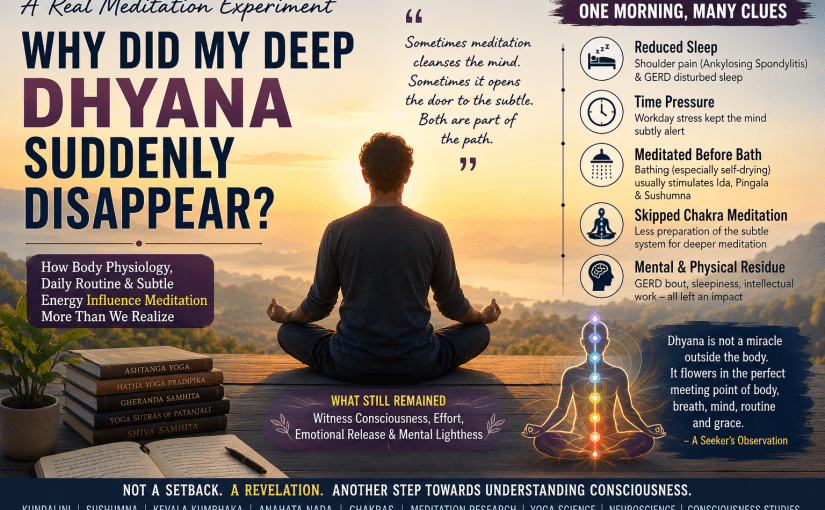
Another important difference immediately became obvious. Normally after yoga I take a bath before sitting for meditation. This particular day I sat for meditation before bathing.
Over many months I have repeatedly observed that bathing itself seems to stimulate ida, pingala and especially sushumna in a very noticeable manner. Surprisingly, this stimulation appears strongest during the natural self-drying phase when the body dries by itself without vigorous towel wiping. Since I skipped this sequence before meditation, perhaps one important preparatory step was missing.
Missing Chakra Meditation May Have Changed the Outcome
Another significant difference also occurred. Usually I perform chakra meditation sequentially, concentrating one by one on each chakra before deeper meditation. On this day I omitted that part because sufficient time was not available.
My own experience suggests that sequential chakra meditation prepares the entire subtle system for deeper meditation. Whether one interprets this as increased concentration, improved inward attention or activation of subtle energetic processes, it consistently seems to make meditation deeper for me. Omitting this step may therefore have reduced the likelihood of experiencing the upward movement that I normally associate with sushumna and spontaneous kevala kumbhaka.
Time Pressure May Quietly Affect Meditation
There was still another difference. It was a working day.
Because office duties were waiting, I constantly knew that time was limited. Even if this awareness remained in the background, time pressure itself may have prevented complete relaxation. I have often noticed that on holidays, when there is no urgency, meditation naturally becomes deeper and subtle yogic experiences appear more readily.
Perhaps the subconscious awareness that meditation must finish within a certain time quietly altered the entire mental atmosphere.
GERD and Ankylosing Spondylitis Added More Variables
The previous day I had also experienced a bout of GERD. Such episodes often disturb sleep and influence the overall condition of the body. In addition, for several days I had been suffering from left shoulder pain due to ankylosing spondylitis. This pain had repeatedly interrupted my sleep.
Poor sleep itself can influence alertness, emotional stability, breathing patterns and the balance between relaxation and wakefulness. Looking back, I realized that shoulder pain, reduced sleep, the recent GERD episode and mild sleepiness could all have been acting together.
A New Possibility Emerged
Gradually another thought emerged.
Perhaps sushumna flow, spontaneous kevala kumbhaka and similar deep meditation experiences are not isolated miracles that appear independently of the body. Perhaps they are strongly influenced by the total physiological and psychological condition of the practitioner.
This does not necessarily reduce their spiritual significance. Instead, it may reveal that consciousness, body physiology, breathing, emotions, attention and subtle yogic processes are deeply interconnected.
The body may not create consciousness itself, yet it may greatly influence the conditions under which particular meditative experiences become accessible.
One Obstacle May Not Matter, But Many Together Might
While reflecting on the entire morning, another pattern appeared.
Perhaps sushumna can tolerate one or two minor disturbances. On many occasions slight deviations from routine have not prevented deeper meditation. However, this day several changes occurred simultaneously.
I had reduced sleep because of shoulder pain. There had been a GERD episode the previous day. I felt some sleepiness. Time pressure existed because of office work. I meditated before bathing instead of after. I omitted my usual chakra meditation.
None of these factors alone may have been sufficient. Together, however, they may have changed the internal conditions enough that meditation expressed itself differently. Instead of subtle energetic phenomena, it focused on emotional purification and witness consciousness.
Dhyana Appears Closely Connected with Body Physiology
This experience led me towards an important working hypothesis.
Perhaps dhyana is not a supernatural event occurring independently of bodily conditions. It appears deeply influenced by body physiology, nervous system balance, sleep quality, pain, digestion, breathing, emotional state, preparation and daily routine.
Classical yoga itself may indirectly support this possibility because it begins not with meditation but with preparation. Ethical discipline, posture, breath regulation, withdrawal of the senses and concentration all precede effortless meditation. This sequence itself suggests that body and mind prepare the ground upon which deeper consciousness flowers.
Modern neuroscience also increasingly recognizes that sleep, autonomic nervous system activity, inflammation, chronic pain, breathing and emotional regulation all influence attention and meditation. My own experience seems to point in a similar direction.
A Personal Meditation Experiment Rather Than a Final Conclusion
I do not present these observations as established scientific facts. They are simply careful observations arising from one meditation session viewed in the context of many previous sessions.
The next step is obvious. I intend to return to my normal routine consisting of yoga, chakra meditation, bathing and then meditation while observing whether sushumna, spontaneous kevala kumbhaka and anahata nada again become more frequent. Repeated observation over many days will be far more meaningful than conclusions drawn from a single experience.
A Small Observation That May Interest Researchers of Consciousness
This entire experience has left me with a simple but fascinating possibility.
Meditation may not fail simply because extraordinary experiences are absent. Sometimes its purpose may quietly shift from mystical absorption to purification of the mind. On other days deeper energetic experiences may naturally arise again. The quality of meditation may therefore depend not only upon practice itself but also upon the constantly changing interaction between body physiology, sleep, pain, digestion, breathing, emotions, preparation, attention and consciousness.
If this understanding continues to be supported by future observations, it may provide an interesting meeting point between classical yoga, kundalini practice, meditation research, neuroscience, philosophy of consciousness and modern physiology. Rather than viewing spirituality and physiology as opposing explanations, they may represent two complementary perspectives describing different aspects of the same living process.

