Can Deep Meditation Replace Sleep? My Real-Life Experience of Sushumna Flow, Ajna Chakra Recharge and Mental Refreshment

There are some experiences in meditation that are difficult to explain unless they happen repeatedly. They are not conclusions drawn from books but observations made quietly over time. Recently I had one such experience that made me think deeply about the relationship between meditation, sleep, awareness and inner energy.

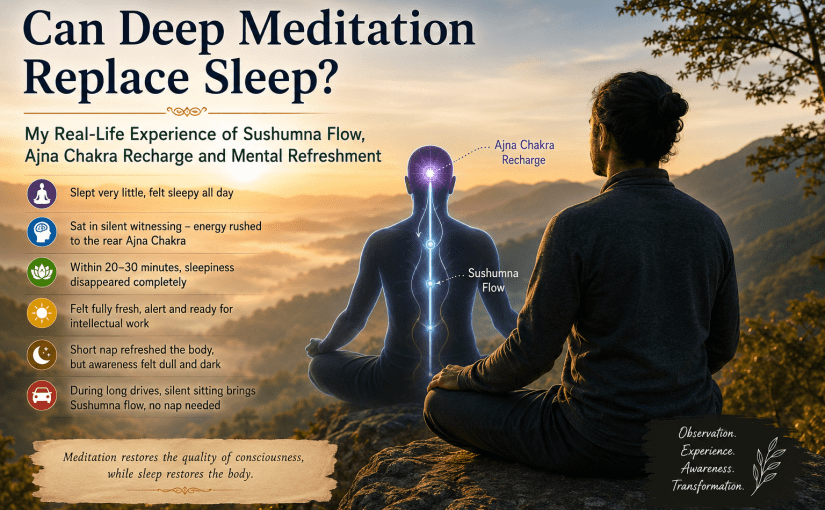
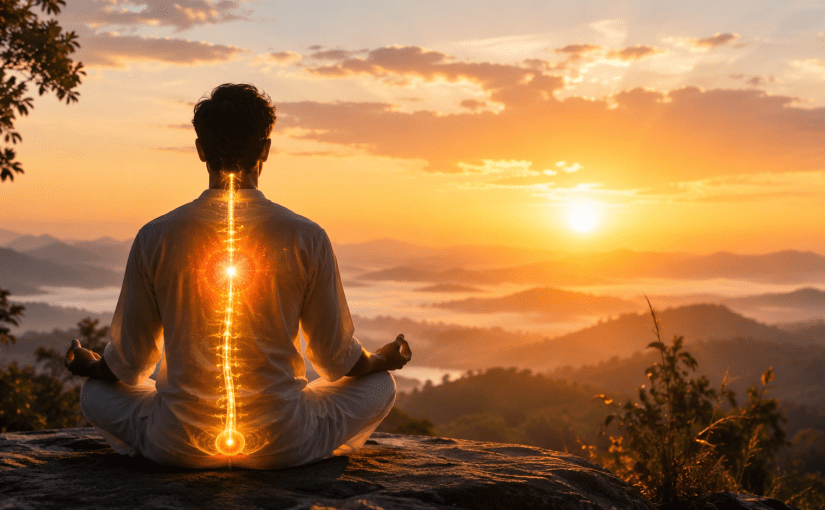
One night I slept very little. The next day I remained sleepy almost throughout the day. Normally such sleep deprivation reduces concentration, mental sharpness and enthusiasm for work. However, whenever I sat quietly for meditation without making any effort, something remarkable happened. As soon as the mind became peaceful and settled into simple witnessing, I repeatedly felt a strong movement of energy towards the rear region of the Ajna Chakra. It did not feel imaginary. It was as if the back portion of the brain was being recharged from within.

Within about thirty minutes the sleepiness disappeared completely. Instead of feeling dull after a sleepless night, I became mentally fresh, alert and ready for intellectual work. It felt almost as though a new day had just begun. This happened more than once during the day and naturally raised a question in my mind. If meditation can refresh the brain so completely, is ordinary sleep always necessary? Can Sushumna flow and Ajna Chakra recharge become an alternative to sleep?

This question deserves careful thinking because the experience itself was genuine. Deep meditation seemed to restore mental clarity in a way that ordinary relaxation never could. During meditation my awareness became clean, bright and steady. There was no heaviness, no mental fog and no struggle to remain awake. The state felt more than ordinary wakefulness. It carried a quality of heightened self-awareness that is difficult to describe in words.

From the yogic point of view, such an experience can be understood as prana gradually withdrawing from scattered mental activity and becoming concentrated in the central channel. Many traditions describe that when prana begins to move through Sushumna, the mind naturally becomes quiet, inner awareness brightens and much less energy is wasted through constant thinking and sensory activity. The practitioner often feels inwardly nourished, refreshed and mentally light. My experience appeared to fit this description remarkably well.

At the same time, modern neuroscience also offers useful insight. Deep meditation activates relaxation mechanisms within the nervous system, reduces unnecessary mental activity and can restore attention after fatigue. This may explain why meditation can remove the feeling of sleepiness and greatly improve mental performance. However, science also reminds us that sleep performs important biological functions such as memory consolidation, tissue repair, hormonal regulation, immune support and the clearance of metabolic waste from the brain. Therefore, meditation and sleep may overlap in some benefits while still serving different purposes.

As I continued observing this phenomenon, another experience taught me an equally valuable lesson. After several cycles of becoming refreshed through meditation, I decided to lie down in Tribhangmurari Asana for further meditation. My intention was not to sleep but simply to continue witnessing in a relaxed posture. However, despite my efforts, I drifted into a short nap. After some time rising stomach acid woke me because of my tendency towards acid reflux.

The result surprised me even more than the earlier meditation. Physically I felt refreshed after the short sleep, but mentally I did not experience the same crystal-clear awareness that meditation had produced. Instead, I felt somewhat dull, dark and heavy. The body seemed rested, but the luminous self-awareness that had accompanied meditation was missing.

This comparison became very meaningful. Meditation had produced extraordinary clarity of consciousness, whereas the interrupted nap restored the body but not the same quality of awareness. It appeared that the two experiences were serving different functions.

One possible explanation is that deep meditation maintained a continuous stream of awareness while energy remained concentrated inwardly. The short sleep interrupted that continuity. On waking suddenly because of acid reflux, I may also have experienced ordinary sleep inertia, the temporary grogginess that often follows abrupt awakening from deeper stages of sleep. This could explain why I felt physically refreshed yet mentally less clear.

From the yogic perspective, another possibility is that meditation had organized the flow of prana in a stable manner, while unconscious sleep temporarily dissolved that organized state. Whatever the exact explanation may be, the contrast between the two states was unmistakable. Meditation refreshed consciousness itself, whereas the nap refreshed the body but not the same level of awareness.

Naturally I felt a little disappointed. I had hoped that meditation would continue providing complete refreshment without any need for sleep. I wanted sleepless meditative renewal to continue indefinitely. Yet the involuntary nap suggested that although the mind had repeatedly become fresh through meditation, the body still carried a physiological need for sleep after the previous night’s deprivation.

This realization itself became another lesson. Perhaps advanced meditation should not be judged by whether it eliminates sleep altogether. Many classical yogic traditions describe great practitioners gradually requiring less sleep, but they also suggest that this happens naturally rather than through deliberate effort. Reduced sleep is presented as a consequence of transformation, not as a goal to be forced. Chasing sleeplessness may therefore become a distraction from the deeper purpose of meditation, which is the refinement of awareness itself.

Another observation from daily life strengthened my understanding further. During long-distance driving, if I begin feeling sleepy, I never continue driving carelessly. Instead, I safely park the car at the roadside and sit quietly. I do not force concentration or repeat anything mentally. I simply remain silent, witnessing the inner play of consciousness.

Almost every time, after about twenty minutes, the same inward movement appears. The feeling of Sushumna becoming active and the rear Ajna region receiving energy gradually develops. The drowsiness disappears without taking a nap. I become mentally fresh once again, almost as if I have just started the day. The difference in alertness is remarkable and consistent enough that I have observed it repeatedly.

Even so, this experience should be understood carefully. Feeling mentally refreshed does not necessarily mean that all the biological consequences of insufficient sleep have disappeared. Meditation may restore subjective alertness very effectively while the body may still require proper sleep later. Therefore, the safest practice is exactly what I follow during driving: stop immediately when drowsiness appears, rest or meditate only after parking safely, and continue driving only when genuine alertness has returned. Meditation should never become an excuse to ignore serious sleep deprivation.

Looking back over these experiences, one distinction has become increasingly clear to me. Meditation and sleep are not identical. Meditation appears to restore the quality of consciousness, bringing exceptional clarity, stable awareness and renewed mental energy. Sleep, on the other hand, appears to restore many deeper physiological functions that meditation may not completely replace. The fact that my body eventually entered sleep despite repeated meditative refreshment suggests that both forms of restoration have their own place.

Perhaps the more important discovery is not whether meditation can eliminate sleep, but why meditation can produce a quality of awareness that even sleep does not always provide. The clean, luminous and deeply present state experienced after silent witnessing feels fundamentally different from ordinary wakefulness and also different from the refreshed feeling after a short nap. It is this difference that deserves continued observation.

For now, I do not see these experiences as final conclusions. They are simply careful observations from personal practice. They encourage humility rather than certainty. They also remind me that genuine meditation is not merely relaxation. When the mind becomes still and awareness settles naturally within itself, something profound seems to happen. Whether one describes it as Sushumna flow, Ajna Chakra activation, refined nervous system function or a combination of all these possibilities, the result is a state of extraordinary mental freshness that is difficult to compare with ordinary rest.

My journey continues with the same attitude that produced these observations in the first place: to witness carefully, avoid exaggerated conclusions, respect both ancient yogic wisdom and modern scientific understanding, and allow direct experience to remain the primary teacher. If meditation eventually reduces the need for sleep naturally, that will simply be another observation. But the greatest gift already received is not reduced sleep. It is the discovery that a silent mind can awaken a level of clarity, freshness and self-awareness that transforms the quality of consciousness itself.

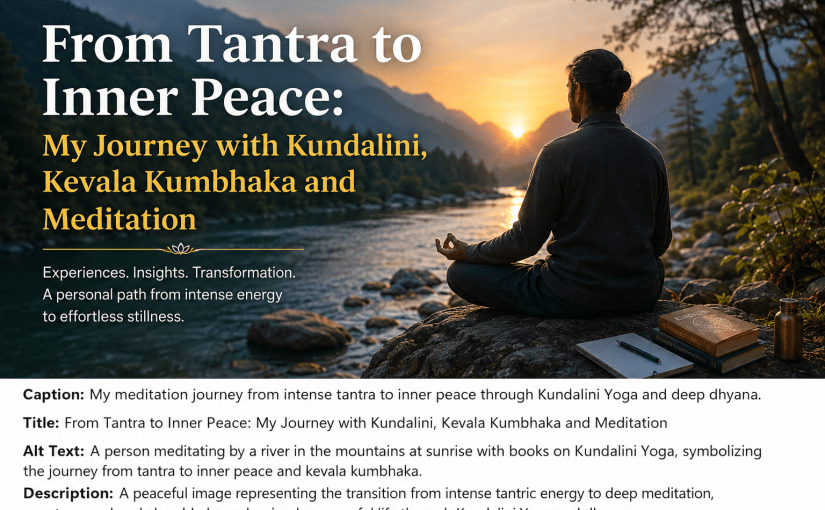
Kundalini Yoga, Tantra, Kevala Kumbhaka and the Shift from Energy to Inner Peace: My Personal Meditation Experience

A New Phase Began with a Different Kind of Meditation Experience

Today I noticed something new in my meditation. After receiving a tantric energetic boost, I could clearly feel the flow through the sushumna. Along with it, anahata nada, the inner unstruck sound, became noticeable. However, one thing was different from many earlier experiences. Although the energy was active, the inner void lacked its usual clarity and depth. Sometimes the void was present but appeared dull and not very deep. At other times it almost disappeared, and my attention remained mainly occupied with the energetic flow and the inner sound. These two conditions kept alternating during the meditation.

This made me wonder whether energetic activity and deep meditation always develop together. The observation that emerged was that they may not. Sometimes energy becomes very active while the depth of meditation remains ordinary. At other times, profound silence appears with very little energetic activity. This particular meditation seemed to emphasize energetic activation rather than complete absorption into silence.

Extremely Subtle Breathing and the Appearance of Internal Humming

During the meditation my breathing gradually became extremely subtle. It almost seemed to happen by itself. The sensation appeared mainly around the throat and at times near the heart while the feeling of sushumna flow continued. Along with this, a continuous internal humming became noticeable.

The interesting part was that this humming resembled breathing in and breathing out, but it was entirely internal. It did not match the timing of my physical inhalation and exhalation. The physical breath and the internal humming appeared to function independently. I had first noticed this phenomenon during the previous day’s calm sitting, and it continued into today’s meditation as well.

One useful insight was that such inner sounds are described in yogic traditions as forms of nada, although their exact physiological basis cannot be established scientifically. Rather than chasing the sound or trying to increase it, it seemed wiser to simply allow it to remain in the background while awareness rested naturally.

The Feeling of Suffocation and What Happened Next

After nearly forty minutes of meditation, a slight feeling of suffocation gradually developed. Instead of trying to maintain the subtle breathing, I simply allowed natural breathing to return. As soon as normal breathing resumed, the discomfort disappeared completely.

What surprised me most was that the meditation did not end. Instead, the void became deeper and much clearer. This was an important observation. It suggested that deeper meditation was not dependent upon maintaining extremely subtle breathing. In fact, allowing the body to breathe naturally seemed to support rather than interrupt the meditation.

The suffocation did not appear to be related to the internal humming. The humming itself remained pleasant and satisfying. It appeared only during calm sitting with naturally slow breathing and focused meditation. The temporary urge to breathe seemed to be a separate bodily event rather than a consequence of the internal sound.

This also reinforced an important practical lesson. Whenever the body naturally asks for a fuller breath, it is wise to allow it immediately. Deep meditation does not require suppressing the body’s normal respiratory needs.

A Repeating Pattern in My Meditation

Looking back over many meditation sessions, I noticed a pattern that seems to repeat itself. For several days, tantric energetic phenomena become dominant. During these days I experience stronger energetic movement, clearer sushumna flow and more noticeable internal humming. Then, after this energetic phase settles, meditation naturally transforms into high-quality dhyana characterized by effortless stillness and natural breathlessness.

This sequence has repeated often enough that I have started recognizing it. However, one useful insight is not to expect this pattern during every practice. Meditation unfolds differently on different days, and expectations themselves can interfere with natural awareness. It is better simply to observe what happens without trying to reproduce previous experiences.

From Years of Tantra to the Emergence of Kevala Kumbhaka

For many years my life was dominated by intense tantric energy. Those years contained powerful energetic experiences and formed an important part of my spiritual journey.

Later my external circumstances gradually changed. My work responsibilities increased considerably. Living conditions shifted to a colder hilly environment where survival, routine and professional responsibilities naturally demanded greater attention. At the same time, my spiritual practice also changed. Instead of intense tantric methods, I increasingly practiced simpler Kundalini Yoga and meditation.

After these changes, something unexpected happened. Natural kevala kumbhaka began appearing spontaneously. It was not deliberately produced. Rather, it arose on its own after the energetic dominance had gradually settled.

Although it is impossible to prove that one directly caused the other, it seemed quite possible that these environmental and practical changes altered the conditions under which meditation unfolded. The observation that stood out was not that energy disappeared completely, but that awareness became quieter and meditation more effortless.

Peaceful Kundalini Yoga Versus Energetic Tantra

Another realization became increasingly clear. If tantra is set aside for some time, sincere Kundalini Yoga combined with deep meditation and supported by yogic cleansing creates remarkably peaceful days.

The result is not excitement or indulgence. Instead, ordinary daily life itself becomes peaceful. The mind remains calmer. Routine work feels lighter. Awareness carries over into daily living. This quiet contentment appears to become more valuable than extraordinary meditative experiences themselves.

Many contemplative traditions emphasize that the real value of meditation is not measured by dramatic inner experiences but by how peacefully one lives ordinary life. Looking at my own experience, this observation seems increasingly true.

How My Relationship with the World Changed

One interesting difference between my earlier tantric years and my present meditation became obvious.

During the years dominated by tantra, I experienced bliss, detachment and nondual awareness, yet worldly life remained attractive. I happily enjoyed cinema, television, travelling, comfortable living and many ordinary luxuries. Surprisingly, these enjoyments existed alongside spiritual practice without creating inner conflict. Looking back, this appears to be one remarkable quality of tantra.

The present phase feels different. Deep and quiet meditation naturally reduces attraction towards luxurious living and interactive worldly indulgence. The mind simply does not run toward such activities as before. This is not forced renunciation. Rather, the attraction itself gradually becomes weaker.

This difference resembles descriptions found in various contemplative traditions. Some emphasize remaining fully engaged with life while maintaining awareness. Others naturally lead practitioners toward simplicity because inner contentment itself becomes increasingly satisfying.

Neither approach necessarily appears superior. They simply represent different expressions of spiritual life.

Family Life Requires a Different Understanding

This observation also raised an important practical question. Family members and friends often need external satisfaction. They enjoy movies, outings, celebrations, travel and shared experiences. Relationships are nourished through these activities.

Meditation may reduce one’s own desire for such pleasures, but relationships still require participation.

One helpful understanding emerged from reflecting upon this. There is a difference between seeking enjoyment for oneself and participating lovingly for the happiness of others. Even if one personally feels complete in silence, joining family activities can become an expression of affection rather than personal craving.

The motivation changes. Earlier the activity itself may have been the source of enjoyment. Later the joy comes from sharing life with loved ones, even when the activity itself no longer carries the same attraction.

This allows inner peace and family life to coexist harmoniously instead of opposing each other.

The Continuing Journey

Looking at the entire sequence, my meditation appears to move through different phases. Strong tantric energy may dominate for several days with noticeable sushumna flow, subtle breathing and internal humming. Gradually this settles into deeper and clearer meditation where awareness becomes effortless and breathing naturally becomes extremely subtle. If the body asks for fuller breathing, allowing it naturally does not disturb meditation. Instead, clarity may actually increase.

Years of intense tantra gradually gave way to simpler Kundalini Yoga because of changes in work, environment and lifestyle. Unexpectedly, spontaneous kevala kumbhaka appeared after this transition. More importantly, the emphasis shifted from extraordinary energetic experiences to quiet inner peace that naturally continues throughout ordinary daily life.

Yet this quieter life also presents a new challenge. Family and society continue to value shared worldly experiences. Rather than rejecting them, it seems wiser to participate with love while remaining inwardly peaceful. In this way meditation does not become an escape from life but a way of living life with greater balance.

Perhaps the most valuable lesson from this entire journey is that spiritual growth does not always move in one direction. At one stage energy dominates. At another stage silence becomes more important. Sometimes meditation expresses itself through powerful inner experiences, and at other times through ordinary peace. Both phases may have their own place. The real measure of progress may not be the intensity of inner phenomena but the quiet stability, clarity and compassion that naturally begin to shape everyday life.

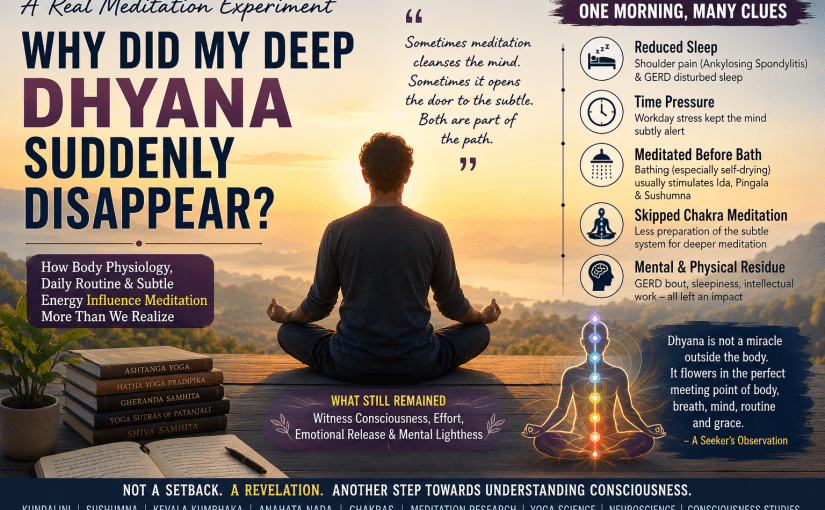
Why Did My Deep Dhyana Suddenly Disappear? A Real Meditation Experiment Reveals the Hidden Role of Body Physiology, Sushumna, Kevala Kumbhaka and Consciousness

Daily Yoga May Establish Dhyana, but Daily Dhyana Also Needs Daily Preparation

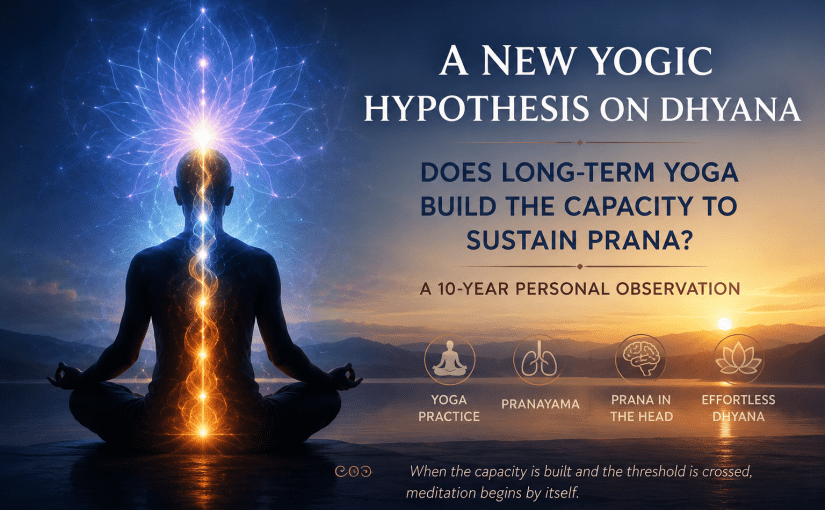
For a long time I have felt that just as all the limbs of Ashtanga Yoga practiced over years ultimately culminate in dhyana, the same principle seems to apply every single day. Even after meditation becomes established, daily practice of yoga asanas, pranayama, spinal breathing, ethical living, mental preparation and inward turning appears necessary to recreate the inner environment in which deep meditation naturally blossoms. It does not appear to be a one-time achievement after which preparation becomes unnecessary. Every day seems to be a fresh laboratory.

One Morning That Changed My Understanding of Meditation

One morning I woke at about 3 a.m. As usual, I first did a little intellectual work. This has become part of my routine because it removes the heaviness of sleep and helps me become mentally alert before yoga. After that I completed my full yoga practice and then sat for meditation for nearly one hour.

What happened surprised me.

Normally I become aware of what I describe as sushumna flow. Sometimes spontaneous kevala kumbhaka develops naturally. At times subtle inner sound, anahata nada, also becomes noticeable. On this particular day none of these familiar experiences appeared.

Instead, there were continuous thoughts, emotions and mental disturbances. The mind repeatedly tried to identify with them. My effort throughout the hour was simply to witness them. The witnessing itself was not effortless. Again and again the mind was pulled towards identification, and again and again I deliberately returned to the position of the witness.

Yet something important happened. Although the subtle yogic experiences were absent, the meditation removed a considerable amount of mental garbage. Many hateful emotions, emotional burdens and other disturbing impressions became lighter. I finished meditation feeling mentally cleaner and more peaceful.

This raised an important question in my mind. Why did this happen today?

Witnessing Without Sushumna Was Still Meaningful

One insight gradually became clear. A meditation session should perhaps not be judged only by whether sushumna flow, anahata nada or spontaneous kevala kumbhaka occurs. Witness consciousness itself has tremendous value. Sometimes meditation may function more as purification of the mind than as an experience of subtle energy.

The effort required to maintain witnessing also suggested that this particular meditation resembled dharana more than effortless dhyana. Nevertheless, repeatedly returning to witnessing instead of becoming lost in thoughts still appeared to strengthen non-identification with the mind.

Why Did the Subtle Yogic Experiences Not Appear?

The first possibility that came to my mind was my usual intellectual work before yoga. However, I realized that I perform this light intellectual work almost every day precisely to remove sleep inertia, and on most days it does not interfere with meditation. Therefore it probably was not the primary reason.

Another important difference immediately became obvious. Normally after yoga I take a bath before sitting for meditation. This particular day I sat for meditation before bathing.

Over many months I have repeatedly observed that bathing itself seems to stimulate ida, pingala and especially sushumna in a very noticeable manner. Surprisingly, this stimulation appears strongest during the natural self-drying phase when the body dries by itself without vigorous towel wiping. Since I skipped this sequence before meditation, perhaps one important preparatory step was missing.

Missing Chakra Meditation May Have Changed the Outcome

Another significant difference also occurred. Usually I perform chakra meditation sequentially, concentrating one by one on each chakra before deeper meditation. On this day I omitted that part because sufficient time was not available.

My own experience suggests that sequential chakra meditation prepares the entire subtle system for deeper meditation. Whether one interprets this as increased concentration, improved inward attention or activation of subtle energetic processes, it consistently seems to make meditation deeper for me. Omitting this step may therefore have reduced the likelihood of experiencing the upward movement that I normally associate with sushumna and spontaneous kevala kumbhaka.

Time Pressure May Quietly Affect Meditation

There was still another difference. It was a working day.

Because office duties were waiting, I constantly knew that time was limited. Even if this awareness remained in the background, time pressure itself may have prevented complete relaxation. I have often noticed that on holidays, when there is no urgency, meditation naturally becomes deeper and subtle yogic experiences appear more readily.

Perhaps the subconscious awareness that meditation must finish within a certain time quietly altered the entire mental atmosphere.

GERD and Ankylosing Spondylitis Added More Variables

The previous day I had also experienced a bout of GERD. Such episodes often disturb sleep and influence the overall condition of the body. In addition, for several days I had been suffering from left shoulder pain due to ankylosing spondylitis. This pain had repeatedly interrupted my sleep.

Poor sleep itself can influence alertness, emotional stability, breathing patterns and the balance between relaxation and wakefulness. Looking back, I realized that shoulder pain, reduced sleep, the recent GERD episode and mild sleepiness could all have been acting together.

A New Possibility Emerged

Gradually another thought emerged.

Perhaps sushumna flow, spontaneous kevala kumbhaka and similar deep meditation experiences are not isolated miracles that appear independently of the body. Perhaps they are strongly influenced by the total physiological and psychological condition of the practitioner.

This does not necessarily reduce their spiritual significance. Instead, it may reveal that consciousness, body physiology, breathing, emotions, attention and subtle yogic processes are deeply interconnected.

The body may not create consciousness itself, yet it may greatly influence the conditions under which particular meditative experiences become accessible.

One Obstacle May Not Matter, But Many Together Might

While reflecting on the entire morning, another pattern appeared.

Perhaps sushumna can tolerate one or two minor disturbances. On many occasions slight deviations from routine have not prevented deeper meditation. However, this day several changes occurred simultaneously.

I had reduced sleep because of shoulder pain. There had been a GERD episode the previous day. I felt some sleepiness. Time pressure existed because of office work. I meditated before bathing instead of after. I omitted my usual chakra meditation.

None of these factors alone may have been sufficient. Together, however, they may have changed the internal conditions enough that meditation expressed itself differently. Instead of subtle energetic phenomena, it focused on emotional purification and witness consciousness.

Dhyana Appears Closely Connected with Body Physiology

This experience led me towards an important working hypothesis.

Perhaps dhyana is not a supernatural event occurring independently of bodily conditions. It appears deeply influenced by body physiology, nervous system balance, sleep quality, pain, digestion, breathing, emotional state, preparation and daily routine.

Classical yoga itself may indirectly support this possibility because it begins not with meditation but with preparation. Ethical discipline, posture, breath regulation, withdrawal of the senses and concentration all precede effortless meditation. This sequence itself suggests that body and mind prepare the ground upon which deeper consciousness flowers.

Modern neuroscience also increasingly recognizes that sleep, autonomic nervous system activity, inflammation, chronic pain, breathing and emotional regulation all influence attention and meditation. My own experience seems to point in a similar direction.

A Personal Meditation Experiment Rather Than a Final Conclusion

I do not present these observations as established scientific facts. They are simply careful observations arising from one meditation session viewed in the context of many previous sessions.

The next step is obvious. I intend to return to my normal routine consisting of yoga, chakra meditation, bathing and then meditation while observing whether sushumna, spontaneous kevala kumbhaka and anahata nada again become more frequent. Repeated observation over many days will be far more meaningful than conclusions drawn from a single experience.

A Small Observation That May Interest Researchers of Consciousness

This entire experience has left me with a simple but fascinating possibility.

Meditation may not fail simply because extraordinary experiences are absent. Sometimes its purpose may quietly shift from mystical absorption to purification of the mind. On other days deeper energetic experiences may naturally arise again. The quality of meditation may therefore depend not only upon practice itself but also upon the constantly changing interaction between body physiology, sleep, pain, digestion, breathing, emotions, preparation, attention and consciousness.

If this understanding continues to be supported by future observations, it may provide an interesting meeting point between classical yoga, kundalini practice, meditation research, neuroscience, philosophy of consciousness and modern physiology. Rather than viewing spirituality and physiology as opposing explanations, they may represent two complementary perspectives describing different aspects of the same living process.

Deep Meditation, Dream Symbolism, Compassion, and the Question of Nadi Potential: Reflections from a Morning Yoga Session

A Song, a Rainy Mood, and the Fire Within

The old song “Rimjhim Gire Saawan, Sulag Sulag Jaaye Man, Phir Aaj Is Mausam Mein Lagi Kaisi Ye Agan” became an unexpected starting point for reflection. The song speaks of a paradox: rain falls outside, bringing coolness to the world, yet an inner fire burns in the heart. This contrast between outer calm and inner intensity became a fitting backdrop for a morning meditation experience that unfolded in several unexpected stages.

Early Morning Practice and an Unusual Meditation Session

The day began at around 3 a.m. with some work on a book manuscript. Afterward, fatigue and sleepiness were present, yet yoga practice was undertaken. The nadis appeared to open well, but deep spinal breathing pranayama did not flow as smoothly as usual. There was a sense that the head already carried some pressure or fullness, making deep practice difficult. Instead of forcing pranayama, attention shifted toward dhyana.

During meditation, awareness seemed to move around Vishuddha and Anahata. At times the breath appeared to originate from the throat region, and at other times from the heart region. Subtle upward sensations were felt in the spine. Anahata nada heard subtly like Shiva’s damru beating. Although not fully. Thoughts slowed considerably but did not completely stop. The breath became subtle but did not cease. Relaxation emerged, though not in its fullest form. Sleepiness repeatedly appeared, and maintaining an erect spine required effort. Even so, the meditation continued for approximately one hour.

The Dream After Meditation

After the sitting session, there was a short period of lying down on the floor for relaxation. During this brief sleep, a vivid and pleasant dream arose.

In the dream, there was a bike and a large old monumental structure. Inside the structure, professional colleagues were attending a meeting with a senior authority figure. Standing somewhat outside the gathering, fragments of conversation could be heard. There was a feeling of having missed some important practical knowledge or understanding. At the same time, there was neither humiliation nor defeat. Alongside mild concern existed a sense of self-respect and confidence.

Music began playing from the bike on its own. Thinking that a wiring problem existed, attempts were made to inspect the dashboard and trace the source. While moving around the base of the monument, a locked cabinet containing old mystical tools appeared. Some interaction took place with this cabinet before it was closed again. The music continued to create concern because it might be heard by those attending the meeting. Eventually the music stopped. A pleasant female colleague then appeared, smiling and approachable, and conversation followed regarding the bike and the location of the meeting. Soon afterward, sleep ended.

Psychological Meaning of the Dream

The dream appeared to reflect several layers of personal psychology. The monumental building resembled a symbol of accumulated knowledge, institutional authority, tradition, or practical wisdom. Being near but not fully inside the meeting suggested a subtle awareness that there are always areas of practical understanding still left to learn, regardless of spiritual progress. Or it may be indicator of detachment from knowledge wealth gained in the brain.

The bike symbolized movement through life. It was functioning but behaving in an unusual way. This reflected the meditation session itself, where practice was progressing yet not exactly according to expectation. Thoughts had slowed but not disappeared. Breath had become subtle but not silent. Some pressure and uncertainty remained.

The music represented autonomous activity of the mind. It resembled thoughts, memories, emotions, creativity, and subconscious processes that continue functioning without deliberate control. The dream was especially interesting because the music did not stop through a clear conscious solution. Instead, some intuitive handling seemed to resolve the issue. This suggested that not all inner adjustments occur through intellectual understanding. Sometimes change happens through intuitive engagement, and only later does one recognize that something has shifted.

The old cabinet containing mystical tools symbolized accumulated inner resources, previous experiences, spiritual knowledge, and latent capacities developed over years of practice and even knowledge inside ancient and mystical spiritual texts. The smiling female colleague represented a helpful, relational, intuitive aspect of the psyche. Her appearance after the music stopped suggested that once mental noise settled, a more harmonious and integrated quality emerged.

Compassion Instead of Emotional Turbulence

Upon waking, powerful emotions arose. At first these appeared to resemble an emotional storm. On closer observation, however, they were not turbulent emotions. They were not fear, anxiety, sadness, or excitement. Instead, they carried the flavor of deep compassion and tenderness felt directly within the heart.

This distinction proved important. There is a difference between emotional disturbance and heart-centered feeling. The experience did not seem to be pulling attention away from meditation. Rather, it appeared to express a different mode of consciousness.

One possibility considered was that emotions represent intermediary stages before entering the void. In earlier experiences, awareness sometimes moved directly into a silent witness state where emotions were absent. On this occasion, however, awareness seemed to travel through more human and relational layers before reaching stillness. Through that route, compassion surfaced.

This led to the insight that there may be different expressions of spiritual depth. One form appears as detached stillness, witness-consciousness, and emptiness. Another appears as tenderness, compassion, interconnectedness, and warmth of heart. Neither necessarily excludes the other.

Deep Spinal Breathing Returns but Dhyana Does Not

A particularly interesting development occurred after waking. Deep spinal breathing pranayama, which had earlier been difficult, now became easy and natural. Yet despite this improvement, dhyana could not be re-established in the same way.

It means a transformation process had started in the brain, so it drew energy from the Muladhara Chakra through spinal breathing. In the beginning, spinal breathing was not happening properly because the transformation process and energy movement were somewhat hindered by worldly tiredness, sleepiness, and other factors. During the one-hour dhyana session, the process gradually continued, allowing the energy to move and support the ongoing transformation.

An important question arises. If pranayama was flowing better, why did meditation not deepen during dhyana?

One possibility was that subtle anticipation of office responsibilities had already begun influencing the mind. Even without conscious worry, awareness may have carried a faint orientation toward the upcoming workday. Such subtle readiness for action can be enough to prevent deeper absorption.

Another possibility was that the earlier meditation had already completed a certain cycle. The one-hour session may have utilized the momentum generated through yoga and pranayama. What remained afterward was not depletion but integration.

The Question of Nadi Potential

This led to reflection on what might be called nadi potential. It seemed as though the energetic momentum developed through yoga had been released or expressed during the one-hour meditation session. Afterward, a new cycle of potential would need to be generated.

This observation raised another question: if such potential is not real, why does dhyana often last for a particular period before naturally changing?

Several perspectives emerged. Traditional yoga would describe dhyana as influenced by prana, nadis, samskaras, and bodily condition. Psychology would describe it in terms of attention, mental fatigue, emotion, and cognitive processing. Both perspectives acknowledge that meditative states often arise when multiple factors align and change when those factors shift.

The experience of the morning suggested that meditation may not operate through a simple mechanical reservoir of energy. Yet it often depends on a temporary alignment of attention, physiology, emotional state, and what yogic language calls prana. When that alignment changes, the quality of meditation changes as well.

A Morning That Chose the Heart Over the Void

Looking back, the entire sequence appears coherent. An old song about inner fire arose as a theme. Early morning book work was followed by yoga and meditation. Awareness moved around the regions traditionally associated with communication and the heart. A symbolic dream unfolded involving knowledge, authority, hidden tools, music, intuition, and relationships. Compassion emerged upon waking. Deep spinal breathing improved. Yet the detached stillness of dhyana did not immediately return.

Rather than indicating failure, the experience may represent a different mode of inner development. Instead of moving directly into emptiness, consciousness traveled through meaning, feeling, memory, and relationship. The result was not agitation but compassion. The morning seemed to suggest that spiritual practice does not always move toward the void through the same doorway. Sometimes it passes first through the heart.

Why Kundalini and Saṁskāras Do Not Operate in Animals the Way They Do in Humans

Saṁskāras can be understood as symbolic markings impressed upon a human being through consciously designed spiritual ceremonies. These are not casual social events; they are grand, emotionally charged occasions in which relatives, friends, elders, and the wider community gather with a single individual as the focal point. The person receiving the saṁskāra becomes the center of collective attention, intention, and emotion. This focused convergence is not accidental—it is deliberately structured to imprint deep emotional and psychological tendencies that shape the individual for life.

Such ceremonies generate powerful emotions within the recipient because humans are uniquely responsive to meaning, symbolism, and shared attention. When hundreds of minds momentarily align around one person with reverence, expectation, and intention, the effect is far stronger than ordinary cooperation or social interaction. Worldly cooperation is usually task-oriented and fragmented; saṁskāras, by contrast, are designed exclusively for emotional and inner imprinting. One individual becomes the sole beneficiary of the collective emotional field, making the imprint unusually strong and persistent.

Metaphorically, this process resembles quantum entanglement—not as a literal physical mechanism, but as a structural analogy. In quantum systems, particles that interact within a coherent environment exhibit correlated behavior even after separation. Similarly, during a saṁskāra, many minds temporarily converge within a highly focused symbolic space. The emotions, values, and intentions do not merely add up linearly; they become coherent. Once imprinted, these emotional correlations persist long after the ceremony ends, influencing the individual’s inner responses independent of physical proximity. This comparison does not claim scientific equivalence; it simply highlights a parallel principle: intense interaction under conditions of focus, coherence, and meaning creates unusually stable imprints.

Across a human lifetime, there are traditionally sixteen saṁskāras, each corresponding to key transitions—birth, learning, maturity, responsibility, and death. Together, they refine emotional depth, psychological structure, and spiritual receptivity. These imprints form a subtle emotional architecture within which higher processes, including Kundalini awakening, can later unfold. Saṁskāras are not merely cultural customs; they are intentional emotional technologies.

Not every individual absorbs these imprints equally. Certain emotionally receptive people resonate more deeply than others. Their sensitivity allows emotions to adhere more strongly, creating bonds that often appear as love or devotion. This love is not merely relational or outward-facing; when it matures and turns inward, it becomes transformative. In yogic and tantric understanding, this inward-turning love can later express itself as Kundalini movement. What begins as emotional bonding gradually converts into inner energy. In this way, bhāva (emotion) evolves into bhakti (love or devotion), and bhakti further condenses into śakti (inner power).

This progression is logical within its own framework. Focused collective attention produces strong emotional imprinting; individual sensitivity determines depth of absorption; deep emotional imprinting gives rise to love; and inward-directed love becomes spiritual energy. Psychology explains the imprinting, neuroplasticity explains the durability, and spiritual traditions describe the energetic flowering.

Animals, however, do not participate in this process in the same way. They do not receive saṁskāras—not because life or awareness is absent in them, but because the necessary emotional and neurological infrastructure is undeveloped. Animals do have emotions, but these are largely immediate, survival-oriented, and unlayered. They lack the capacity to absorb, integrate, and symbolize the collective emotions of many minds simultaneously. Their brains are not designed to hold complex symbolic meaning, long-term emotional imprinting, or ritualized identity formation.

Moreover, animals are not placed at the center of intentional emotional convergence. No ceremony is designed to imprint values, identity, or transcendental orientation upon them. Without repeated, structured emotional imprinting across life stages, there is no stable inner architecture for love to refine itself inwardly and no latent reservoir from which Kundalini can later rise.

Thus, Kundalini and saṁskāras are not absent in animals due to inferiority, but due to difference in design. Human life is uniquely structured for emotional accumulation, symbolic meaning, and inward transformation. Saṁskāras provide the emotional soil, love becomes the living current, and Kundalini is the flowering that appears when conditions mature. Animals live in harmony with nature, but humans alone are given the tools to consciously transcend it.

When Darkness Turns Peaceful: The Quiet Maturity of Dhyāna

Today, I felt the Kundalini stationed at the navel chakra. I rose a little late, around 6 a.m., and practiced spinal breathing, my Guru-given poses and pranayama, along with some self-devised postures and a top-to-bottom chakra meditation—without holding the breath as daily routine. Soon, enough yogic pressure built up to launch dhyāna.

I sat in vajrāsana, keeping my eyes turned upward toward the eyebrow center, and even beyond—straight up toward the unlimited height of Ekārṇava. The breath gradually became regular and calm, though not completely suspended as on previous days.

The śūnya dhyāna was deep, with occasional flashes of my Guru Nārāyaṇa’s image—alive and radiant. Guru Tattva is not actually outside but within. When one turns inward, it naturally emerges from inside. It is the intermittently appearing image in the mind during dhyāna that keeps the mind from wandering—by focusing it upon itself until it finally dissolves into Brahman. In a way, it acts like a cargo vehicle of the mental world, carrying awareness directly toward Brahman.

That is why many religions give prime importance to the Guru. They design their lifestyles to encourage introversion and dhyāna, allowing a stable Guru-image to form within the mind itself. However, for this process to become truly effective, there must be a suitable person embodying divine qualities—only then can he or she become a true Guru. In the absence of such a living master, divine idols may serve as substitutes, though they cannot compare to a living Guru, who is like an animated idol of God, and therefore far more transformative.

The Guru principle is revered in every sect and religion, but it seems that Sikhism understands the essence of Guru Tattva most profoundly.

I felt that just as Kundalini energy nourishes the chakras within the body, it also nourishes the chakras beyond the body, extending infinitely into śūnya. The same Kundalini that maintains physical vitality also helps transcend the body, merging into the endless expanse of Ekārṇava śūnya.

Today, I gave priority to the nourishment of śūnya rather than to any specific chakra. Still, the intermediate chakras seemed to receive their share of energy naturally whenever it was directed upward toward Brahman. I could sense the energy supporting the area behind the navel chakra along the spine, while the other chakras felt calm and balanced—not blissfully inflamed like the navel center.

Yesterday, my energy had settled at the Anāhata chakra. It had descended gradually—from Sahasrāra downward—each day resting at the next lower chakra. A day earlier, I had also conserved Mūlādhāra energy, which perhaps rose swiftly to the navel. This rapid movement might be due to the role of descending energy; although all energies rise from Mūlādhāra, the descending current seems to return from Sahasrāra like the monsoon rains returning from the mountains. When the forward and returning monsoons (the western disturbance rains) meet over an area, they bring catastrophic rainfall. Similarly, when descending and ascending energies meet at a chakra, they cause its profound activation, often producing a mental upheaval that can be difficult to control at times although quantum darshan helps in it.

In any case, śūnya dhyāna was peaceful. Later, I tried focusing directly on the navel chakra to give it an extra boost. The breath then turned irregular, as if adjusting itself to channel energy into the navel center. When I shifted my focus back to the Ājñā chakra, the breath again became calm. After a few such cycles, I gently ended my dhyāna and stood up to begin my morning routine.

There comes a time in meditation when bliss fades, and only silent awareness remains. I am experiencing this now—no bliss, but a completely still and neutral space. I can’t even call it darkness, because darkness usually frightens or repels one; yet I feel the exact opposite. I find perfect peace there, a deep relief from the agitation of breathing. At first, this may seem like something is lost—but in truth, it marks the maturity of dhyāna.

Earlier, the mind sought experiences—light, warmth, or waves of joy. Darkness felt empty and unsettling. But when the storms of breath and thought finally rest, perception changes. The same darkness no longer threatens; it simply is. Nothing outside has changed—only the seer has.

This is the quiet flowering of awareness: peace without excitement, clarity without effort. Even without inner light or sensation, a subtle luminosity begins to shine—the light of knowing itself.

When this awareness deepens, life feels transparent and gentle. Speech, work, and movement unfold within the same still space that once appeared only in meditation. There is no need to hold awareness—it holds itself. I am still waiting for that stage to blossom within me.

In this simplicity lies the true radiance of dhyāna: not a blaze of visions, but a calm seeing that never leaves, even in the heart of darkness.

The Fiery Grace of the Goddess Within

A Morning of Dhyana and the Awakening of the Red Shakti

In spiritual practice, every dawn brings a new mystery. Sometimes the journey unfolds gently — like a soft sunrise — and sometimes it roars like a divine storm within. This morning’s sadhana revealed one such fierce and purifying play of Shakti — a meeting with the Red Goddess who dwells in the Vishuddhi Chakra, cleansing and transforming with fiery grace.

The Dawn of Practice

Today, I rose early at 4:30 a.m., drawn by the quiet pull of dawn. My sadhana began with spinal kriya breathing, followed by Guru-given light postures and pranayama. Then came chakra meditation — top to down — and finally, a few self-learned postures that felt natural in the moment.
By around 6 a.m., the body was prepared, the breath steady, and the awareness ready for dhyana.

Breath at the Ajna — The Seat of Silent Fire

I sat first in Vajrasana. The breath gradually calmed and anchored itself at the Ajna Chakra, mostly at its back side though still connected to the front. The sensation there was unique — a broad, dull, yet blissful inflammation, carrying a subtle sexual tone.

It felt as though that area alone was breathing, consuming the prana, while the rest of the body remained still and breathless. With each inward pulse, it seemed to feed on the breath, performing some mysterious, vital work known only to itself.

My face had turned slightly upward, and the neck tilted back just enough to make my inner gaze face infinite space above. Though the tilt wasn’t physically great, the awareness itself had turned upward in surrender to infinity.
The mind was silent. The dhyana deepened.

The Shift and the Hunger of Vishuddhi

After some time, I brought my head slightly down, eyes closed, gaze fixed in a gentle squint at the eyebrow centre. The meditative current continued unbroken. I occasionally scanned all chakras — each felt fresh and content — all except the Ajna, which alone still hungered for breath.

I let it feed as it wished until, after a while, awareness shifted to the throat region, where the oral and nasal passages meet the back wall. That area, too, began consuming breath, drawing pranic nourishment like a thirsty desert drinking rain.

Then the current descended into the Vishuddhi Chakra. There, the energy found the greatest hunger — something was out of order. The Shakti refused to move further; she had work to do there. She lingered — healing, transforming, purifying.

The Vision of the Red Goddess

As the process intensified, the sexual-type bliss grew stronger. Suddenly, a vivid image of the Goddess appeared within the throat region — fierce and radiant.
She wore red garments, her many hands adorned with red bangles, worn along most of the length of her forearms, clashing and ringing as she struck at tiny rascals — perhaps microorganisms — symbols of impurities. Her lion roared beside her, aiding her divine battle.

Her face was fearsome, glowing with red anger, lips painted crimson, thirsting to devour the darkness. Her long, dishevelled hair flew in all directions as she fought relentlessly. Her terrifying feminine roar in high pitch was heart shaking.

Then the sexual energy from the Muladhara rose to support her — surging upward, fueling her divine rage and purpose. The scene grew ever more intense — the Shakti rising, transforming, conquering.

When I visualized the same Goddess at the Muladhara, she rose in even greater ferocity, bursting upward through the spine. The body, caught in this inner battle, grew exhausted. Dhyana slowly came to its natural end.

A Symbolic Offering

As the awareness returned outward, I found myself instinctively walking to the chemist’s shop and buying Betadine gargle — as if to offer a worldly weapon to the Goddess, aiding her fight within me.
Perhaps she was cleansing not only the spiritual but also the physical battlefield.

Thus ended today’s dhyana — a fierce yet purifying encounter with the Red Goddess of the Throat, the living embodiment of transformation and sacred fire.
Each such meditation reveals that the Divine Feminine is not distant or abstract — she is alive within, tirelessly healing, balancing, and guiding the evolution of consciousness.

A New Beginning: Exploring Kundalini Through Storytelling

Hi friends,

For a long time, Demystifying Kundalini has been a space for deep insights, serious reflections, and explorations into the mysteries of consciousness. Through direct experiences, analysis, and discussion, we have climbed a peak of understanding—where knowledge has sharpened like a mountain summit.

But what happens after reaching a peak? A true seeker knows that the journey doesn’t end there. The next phase is just as crucial: the slow descent, the gathering of energy, and the preparation for the next ascent.

Now, instead of only discussing Kundalini in its abstract and conceptual form, it’s time to experience it through storytelling—a medium that can convey depth, emotion, and transformation in a way pure intellectual discussion cannot.

Introducing ‘A Cosmic Transfer Order’

This is the first chapter of a new allegorical story series on Demystifying Kundalini, blending elements of science fiction with profound spiritual insights. It follows a protagonist—who is none other than myself—on an unexpected interplanetary journey. But beneath this cosmic adventure lies something deeper: the exploration of Kundalini, consciousness, and the process of awakening.

Just as Kundalini rises and falls in waves, this story mirrors the practical journey of energy management—diving down, consolidating, and preparing for the next transcendental leap.

I invite you to immerse yourself in this journey, not just as a reader, but as a participant in the unfolding of energy, awareness, and transformation.

Let’s begin.

Part 1: Departure from Earth and Settling on the Moon

A Cosmic Transfer Order

It was an ordinary morning on Earth—until the message arrived.

Dr. Aryan Verma, a veterinarian with a calm demeanor and an inquisitive mind, was sipping his usual cup of masala chai when his holo-screen blinked with an urgent notification. The government seal flashed momentarily before a deep robotic voice announced:

“Dr. Aryan Verma, your interplanetary transfer order has been approved. Report to the Lunar Immigration Terminal within 30 days. You are now assigned as the chief veterinarian of Chandravaanshi Lunar Colony.”

Aryan stared at the screen, his mind racing.

“The Moon? Why me?”

He had expected his next assignment to be in some remote biosphere on Earth, tending to genetically modified cattle or hybrid species designed for extreme climates. But the Moon? That was something else entirely.

His wife, Meera, looked up from across the dining table, sensing his hesitation.

“What is it?” she asked, placing her cup down.

Aryan turned the screen toward her. She read the notification twice before meeting his gaze. There was a flicker of worry in her eyes, but also an unspoken excitement.

Their son, Ansh, a 13-year-old obsessed with interstellar travel, practically jumped out of his chair.

“Are we seriously moving to the Moon? That’s so cool! My friends are going to be so jealous.”

His daughter, Avni, a third-year computer science student, was more skeptical.

“The Moon? But I just started working on an AI project with my team! What about my studies?”

Aryan exhaled deeply. The decision wasn’t in his hands anymore. The transfer order wasn’t a request—it was a directive. A high-paying, once-in-a-lifetime government opportunity, but also a drastic uprooting of their Earthly life.

Still, a subtle pull stirred within him—an unexplained inner knowing that this move was not just about a career shift but something much greater.

Meera saw the shift in his expression and gently asked, “Are you ready for this?”

Aryan didn’t answer immediately. He looked past the transparent walls of their apartment, where the artificial sky of the domed megacity shimmered above.

For years, he had worked on Earth, but something in him had always sought more—a deeper meaning beyond the routines of life. Could this be the universe’s way of pushing him toward it?

His heart steadied. A new world awaited.

He turned back to his family and smiled.

“Let’s go to the Moon.”

The Call to Adventure Begins

With only a month to prepare, the Verma family began the chaotic yet exhilarating process of selling assets, saying goodbye, and getting interstellar clearance. Ansh couldn’t stop talking about zero gravity, while Avni still wrestled with doubts about her future.

For Aryan, a sense of destiny loomed in the air.

Little did he know, this journey wasn’t just about relocating to another planet—it was about unlocking the mysteries of the cosmos and the vast universe within himself.

His real awakening had just begun.