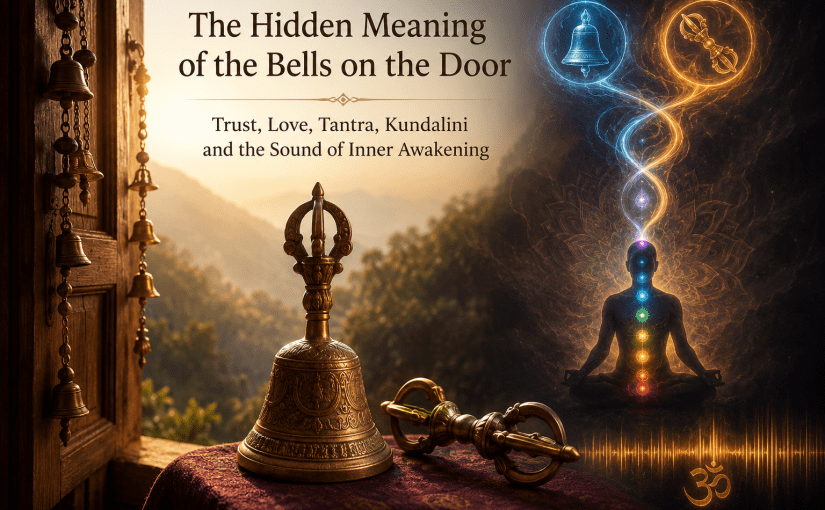
The Hidden Meaning of the Bells on the Door: Trust, Love, Tantra, Kundalini, and the Sound of Inner Awakening

A Simple Act of Hospitality That Revealed an Entire Spiritual Journey

Some experiences enter our lives quietly, almost unnoticed, yet within a few hours they begin revealing meanings far deeper than the event itself. They remind us that life often speaks through ordinary objects long before we understand its language. One such experience has remained with me ever since.

My old friend recently accommodated me in a room whose doorway was beautifully decorated with hanging bells. The room appeared to contain valuable belongings, yet he welcomed me with complete openness, leaving no trace of suspicion or hesitation. His gesture was not merely one of hospitality. It was an expression of trust. At that moment I simply appreciated his warmth, but within hours something extraordinary happened. The room remained the same, the bells remained the same, and the host remained the same. Only my perception changed. Suddenly, everything around me began revealing another dimension. What had seemed like a pleasant memory quietly transformed into a living lesson in Tantra, Kundalini, and consciousness.

The Greatest Treasure Was Never Inside the Room

Most people would naturally think that the valuables inside the room were its expensive possessions. Today I see the situation very differently. Whether costly objects were actually present or not has become almost irrelevant. The greatest wealth in that room was not material. It was the priceless trust with which another human being opened the door of both his room and his heart. Material possessions may have a market value, but trust has no price. The willingness to leave another person alone among one’s belongings without fear is itself a priceless gift. That invisible treasure remained with me long after I had forgotten every physical detail of the room.

The Bells Could Tell Many Different Stories

Those small bells hanging on the doorway gradually became the center of my contemplation. At first they appeared to be nothing more than attractive decorations. Then my mind smiled at another possibility. One could humorously imagine them as the simplest security system ever invented. Every time the guest entered or left the room, the bells faithfully announced his movements. If the guest quietly decided to leave carrying expensive belongings inside his bag, the bells would probably reveal the secret before anyone else could. The thought itself was amusing, but it lasted only for a moment because another interpretation appeared almost immediately.

Perhaps those bells had nothing to do with suspicion at all. Perhaps they simply informed the host that his guest had awakened, stepped outside, or returned safely. Every gentle chime gave him another opportunity to ask whether I had eaten, whether I needed tea, whether I was comfortable, or whether anything else could make my stay more pleasant. The same bells that one person might interpret as surveillance could equally be understood as expressions of care. The object never changes. Consciousness changes. A suspicious mind discovers suspicion. A humorous mind discovers comedy. A loving mind discovers affection. A spiritual seeker discovers symbols.

When Decorative Bells Became the Ghanta

Within only a few hours another realization unfolded. Those bells were no longer merely decorative ornaments hanging from a doorway. They had become the Ghanta of Tantra. The moment Ghanta appeared within my contemplation, another symbol naturally emerged beside it—the Vajra. Suddenly the memory of that room connected itself with my own spiritual journey. What had begun as ordinary hospitality quietly transformed into a profound tantric metaphor.

Trust, Love, and Surrender Form the First Tantric Union

As I reflected more deeply, I realized that no authentic tantric journey begins merely with physical union. Before the body can unite meaningfully, something much deeper must unite first. Trust opens the first door. Love opens the second. Surrender opens the third. Only when trust becomes complete, love becomes unconditional, and surrender becomes effortless does the true tantric pair begin to emerge. It is this invisible union that prepares the ground for authentic tantric meditation. Without these foundations, outer union remains only physical. With them, the same union gradually becomes spiritual.

When Vajra Meets the Bell

The symbolism now became remarkably clear to me. The receptive Bell remains silent by itself. The phallic Vajra, representing the masculine principle, likewise remains silent alone. Only in their symbolic union does the Bell begin to ring. Only when Vajra and Bell unite does resonance begin. Yet this ringing is not immediate. Just as genuine spiritual awakening cannot be forced, neither does the symbolic bell begin ringing at the very first meeting. It is prolonged practice, deepening trust, maturing love, complete surrender, disciplined meditation, and inner purification that gradually awaken the resonance. The true ringing does not arise from metal striking metal. It arises from consciousness entering its own deeper dimensions.

The Ringing That Cannot Be Heard by the Ears

The longer I contemplated this symbolism, the more clearly I understood that the ringing of the Bell was never merely an external sound. It represented the subtle inner resonance that gradually becomes perceptible during sustained tantric and yogic practice. This is the beginning of the unstruck sound, the Anāhata Nāda. It is not produced by external impact but arises spontaneously within consciousness itself. As this subtle current deepens, the practitioner gradually becomes aware of an entirely different dimension of meditation.

The Awakening of Kundalini

In my own experience, sacred sexual union became the doorway through which this inner journey began. It was never merely an act of physical intimacy. It became the catalyst for awakening. Through prolonged tantric practice, the symbolic union of Vajra and Bell gradually expressed itself as an inner current flowing through the Sushumnā Nāḍī. As this subtle flow strengthened, Kundalini awakened. With that awakening came the direct recognition of the Self. For me, self-realization was not the conclusion of the journey but the beginning of a far greater one.

Beyond Self-Realization

The journey did not end with Kundalini awakening. Continued practice under the necessary inner conditions gradually revealed deeper stages of yogic experience. The natural suspension of breath known as Kevala Kumbhaka emerged spontaneously rather than through force. As meditation matured further, consciousness appeared to move beyond even this into a state that I can only describe as the profound silence traditionally associated with Nirvikalpa Samadhi. The experience was extremely brief, occurring only a few times, and so subtle that I still remain uncertain whether it was truly Nirvikalpa Samadhi or only a fleeting glimpse of that state. Whatever it was, it left a deep and lasting impression on my spiritual journey. These stages unfolded as living experiences rather than philosophical concepts. They taught me that the path of Tantra extends far beyond its outer forms. What begins as love and surrender gradually becomes meditation. Meditation becomes awakening. Awakening becomes silence. Silence finally becomes the direct experience of limitless consciousness.

The Hidden Meaning of the Bells

Today, whenever I remember those bells, I no longer see only decorations hanging from a doorway. I see trust becoming love, love becoming surrender, surrender becoming tantric meditation, meditation becoming the symbolic union of Vajra and Bell, that union gradually giving birth to the subtle resonance of the Anāhata Nāda, the current ascending through the Sushumnā, Kundalini awakening into Self-realization, and the continuing journey toward Kevala Kumbhaka and Nirvikalpa Samadhi. Yet none of these deeper meanings erase the outer event. The room was still a room. The host was still a gracious host. The bells were still ordinary bells. They simply became mirrors reflecting increasingly deeper layers of consciousness.

Perhaps this is how hidden meanings always reveal themselves. Life first offers us an experience. Understanding follows. A simple act of hospitality becomes a lesson in trust. Trust blossoms into love. Love matures into surrender. Surrender opens the gateway to Tantra. Tantra awakens meditation. Meditation gives voice to the silent Bell. The Bell begins to ring within. The ringing becomes the subtle current of the Sushumnā. The current awakens Kundalini. Kundalini reveals the Self. Continued practice carries consciousness beyond breath into Kevala Kumbhaka and ultimately into Nirvikalpa Samadhi. The bells hanging on that doorway have long since fallen silent in the outer world, yet within me their resonance continues even today, reminding me that the deepest spiritual teachings often arrive disguised as the simplest moments of ordinary life.
Kundalini Yoga, Tantra, Kevala Kumbhaka and the Shift from Energy to Inner Peace: My Personal Meditation Experience

A New Phase Began with a Different Kind of Meditation Experience

Today I noticed something new in my meditation. After receiving a tantric energetic boost, I could clearly feel the flow through the sushumna. Along with it, anahata nada, the inner unstruck sound, became noticeable. However, one thing was different from many earlier experiences. Although the energy was active, the inner void lacked its usual clarity and depth. Sometimes the void was present but appeared dull and not very deep. At other times it almost disappeared, and my attention remained mainly occupied with the energetic flow and the inner sound. These two conditions kept alternating during the meditation.

This made me wonder whether energetic activity and deep meditation always develop together. The observation that emerged was that they may not. Sometimes energy becomes very active while the depth of meditation remains ordinary. At other times, profound silence appears with very little energetic activity. This particular meditation seemed to emphasize energetic activation rather than complete absorption into silence.

Extremely Subtle Breathing and the Appearance of Internal Humming

During the meditation my breathing gradually became extremely subtle. It almost seemed to happen by itself. The sensation appeared mainly around the throat and at times near the heart while the feeling of sushumna flow continued. Along with this, a continuous internal humming became noticeable.

The interesting part was that this humming resembled breathing in and breathing out, but it was entirely internal. It did not match the timing of my physical inhalation and exhalation. The physical breath and the internal humming appeared to function independently. I had first noticed this phenomenon during the previous day’s calm sitting, and it continued into today’s meditation as well.

One useful insight was that such inner sounds are described in yogic traditions as forms of nada, although their exact physiological basis cannot be established scientifically. Rather than chasing the sound or trying to increase it, it seemed wiser to simply allow it to remain in the background while awareness rested naturally.

The Feeling of Suffocation and What Happened Next

After nearly forty minutes of meditation, a slight feeling of suffocation gradually developed. Instead of trying to maintain the subtle breathing, I simply allowed natural breathing to return. As soon as normal breathing resumed, the discomfort disappeared completely.

What surprised me most was that the meditation did not end. Instead, the void became deeper and much clearer. This was an important observation. It suggested that deeper meditation was not dependent upon maintaining extremely subtle breathing. In fact, allowing the body to breathe naturally seemed to support rather than interrupt the meditation.

The suffocation did not appear to be related to the internal humming. The humming itself remained pleasant and satisfying. It appeared only during calm sitting with naturally slow breathing and focused meditation. The temporary urge to breathe seemed to be a separate bodily event rather than a consequence of the internal sound.

This also reinforced an important practical lesson. Whenever the body naturally asks for a fuller breath, it is wise to allow it immediately. Deep meditation does not require suppressing the body’s normal respiratory needs.

A Repeating Pattern in My Meditation

Looking back over many meditation sessions, I noticed a pattern that seems to repeat itself. For several days, tantric energetic phenomena become dominant. During these days I experience stronger energetic movement, clearer sushumna flow and more noticeable internal humming. Then, after this energetic phase settles, meditation naturally transforms into high-quality dhyana characterized by effortless stillness and natural breathlessness.

This sequence has repeated often enough that I have started recognizing it. However, one useful insight is not to expect this pattern during every practice. Meditation unfolds differently on different days, and expectations themselves can interfere with natural awareness. It is better simply to observe what happens without trying to reproduce previous experiences.

From Years of Tantra to the Emergence of Kevala Kumbhaka

For many years my life was dominated by intense tantric energy. Those years contained powerful energetic experiences and formed an important part of my spiritual journey.

Later my external circumstances gradually changed. My work responsibilities increased considerably. Living conditions shifted to a colder hilly environment where survival, routine and professional responsibilities naturally demanded greater attention. At the same time, my spiritual practice also changed. Instead of intense tantric methods, I increasingly practiced simpler Kundalini Yoga and meditation.

After these changes, something unexpected happened. Natural kevala kumbhaka began appearing spontaneously. It was not deliberately produced. Rather, it arose on its own after the energetic dominance had gradually settled.

Although it is impossible to prove that one directly caused the other, it seemed quite possible that these environmental and practical changes altered the conditions under which meditation unfolded. The observation that stood out was not that energy disappeared completely, but that awareness became quieter and meditation more effortless.

Peaceful Kundalini Yoga Versus Energetic Tantra

Another realization became increasingly clear. If tantra is set aside for some time, sincere Kundalini Yoga combined with deep meditation and supported by yogic cleansing creates remarkably peaceful days.

The result is not excitement or indulgence. Instead, ordinary daily life itself becomes peaceful. The mind remains calmer. Routine work feels lighter. Awareness carries over into daily living. This quiet contentment appears to become more valuable than extraordinary meditative experiences themselves.

Many contemplative traditions emphasize that the real value of meditation is not measured by dramatic inner experiences but by how peacefully one lives ordinary life. Looking at my own experience, this observation seems increasingly true.

How My Relationship with the World Changed

One interesting difference between my earlier tantric years and my present meditation became obvious.

During the years dominated by tantra, I experienced bliss, detachment and nondual awareness, yet worldly life remained attractive. I happily enjoyed cinema, television, travelling, comfortable living and many ordinary luxuries. Surprisingly, these enjoyments existed alongside spiritual practice without creating inner conflict. Looking back, this appears to be one remarkable quality of tantra.

The present phase feels different. Deep and quiet meditation naturally reduces attraction towards luxurious living and interactive worldly indulgence. The mind simply does not run toward such activities as before. This is not forced renunciation. Rather, the attraction itself gradually becomes weaker.

This difference resembles descriptions found in various contemplative traditions. Some emphasize remaining fully engaged with life while maintaining awareness. Others naturally lead practitioners toward simplicity because inner contentment itself becomes increasingly satisfying.

Neither approach necessarily appears superior. They simply represent different expressions of spiritual life.

Family Life Requires a Different Understanding

This observation also raised an important practical question. Family members and friends often need external satisfaction. They enjoy movies, outings, celebrations, travel and shared experiences. Relationships are nourished through these activities.

Meditation may reduce one’s own desire for such pleasures, but relationships still require participation.

One helpful understanding emerged from reflecting upon this. There is a difference between seeking enjoyment for oneself and participating lovingly for the happiness of others. Even if one personally feels complete in silence, joining family activities can become an expression of affection rather than personal craving.

The motivation changes. Earlier the activity itself may have been the source of enjoyment. Later the joy comes from sharing life with loved ones, even when the activity itself no longer carries the same attraction.

This allows inner peace and family life to coexist harmoniously instead of opposing each other.

The Continuing Journey

Looking at the entire sequence, my meditation appears to move through different phases. Strong tantric energy may dominate for several days with noticeable sushumna flow, subtle breathing and internal humming. Gradually this settles into deeper and clearer meditation where awareness becomes effortless and breathing naturally becomes extremely subtle. If the body asks for fuller breathing, allowing it naturally does not disturb meditation. Instead, clarity may actually increase.

Years of intense tantra gradually gave way to simpler Kundalini Yoga because of changes in work, environment and lifestyle. Unexpectedly, spontaneous kevala kumbhaka appeared after this transition. More importantly, the emphasis shifted from extraordinary energetic experiences to quiet inner peace that naturally continues throughout ordinary daily life.

Yet this quieter life also presents a new challenge. Family and society continue to value shared worldly experiences. Rather than rejecting them, it seems wiser to participate with love while remaining inwardly peaceful. In this way meditation does not become an escape from life but a way of living life with greater balance.

Perhaps the most valuable lesson from this entire journey is that spiritual growth does not always move in one direction. At one stage energy dominates. At another stage silence becomes more important. Sometimes meditation expresses itself through powerful inner experiences, and at other times through ordinary peace. Both phases may have their own place. The real measure of progress may not be the intensity of inner phenomena but the quiet stability, clarity and compassion that naturally begin to shape everyday life.