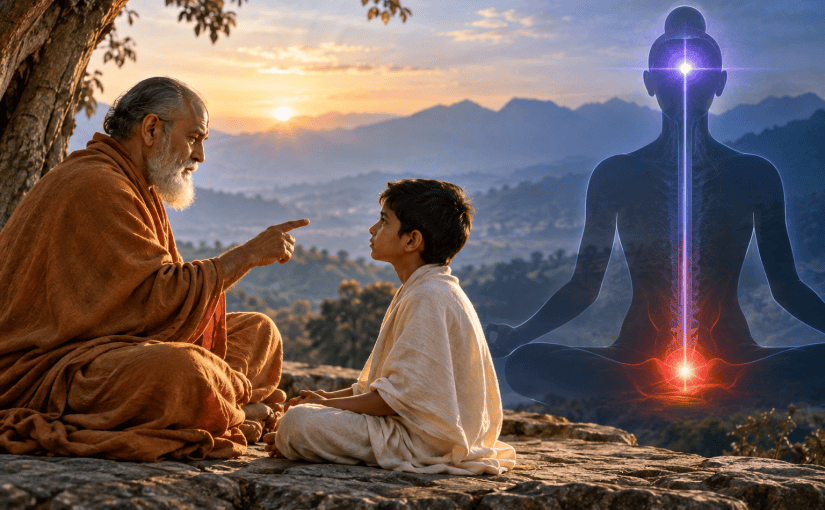
Hanuman Ansh: The Hidden Spiritual Symbolism Behind Neem Karoli Baba’s Miracles

Watching Hanuman Ansh Through a Spiritual Lens

Friends, I went today to the theatre to see the blockbuster movie Hanuman Ansh. The emotions in the movie are powerful, but what interested me even more was how many of the apparently miraculous events can also be understood as symbolic expressions of inner spiritual experiences. I do not feel that every event has to be forced into either a literal miracle or a fictional story. Some may have been experienced as extraordinary events, while at the same time carrying a deeper psychological and yogic meaning.

One scene that particularly affected me was the freedom fighter eating halwa-puri. On the surface it is only a simple meal, but emotionally it becomes almost an ultimate expression of hunger and satiety. Hunger is one of the most basic limitations of the body, and the satisfaction that comes from food can communicate relief, dignity and joy without requiring elaborate words. The simplicity of the scene is precisely what gives it such emotional strength.

Baba Standing in Cold Water and the Symbolism of Kundalini

Another scene showed Baba standing in water and remaining in samadhi for an extended period. My own feeling while watching it was that the cold water could symbolically represent a powerful stimulus to the body, with the resulting inward movement being portrayed through yogic language as energy rising from Muladhara through Sushumna. In the traditional Kundalini understanding, the awakening and upward movement of Shakti is associated with the transformation of consciousness and deeper states of meditation.

Of course, this should be understood as a yogic interpretation rather than as an established physiological explanation. Cold water produces strong bodily and autonomic responses, whereas science has not demonstrated that such responses are literally Kundalini moving through Sushumna. Still, as a symbolic reading of the scene, the connection is meaningful: the body is exposed to an intense experience while awareness appears to become increasingly inward and absorbed.

The Prison Lock as Liberation From Limited Identification

The events that appear miraculous in Baba’s life can similarly be understood as symbolic. When the prison lock opens by itself and Baba wanders outside, I see something more than simply a miraculous opening of a physical lock. The prison can represent the limited identification of consciousness with the body, personality and circumstances. The opening of the lock can therefore symbolize the breaking of that limitation.

Baba walking out of the prison becomes an image of consciousness moving beyond confinement into something much vaster. If this is connected with samadhi, the symbolism becomes even deeper: the body may remain in the world, but awareness is no longer experienced as confined to the ordinary boundaries of individual identity. The movement is from prison, to locked identity, to the opening of the lock, to freedom and finally to the vastness of existence.

The Serpents Around Baba and Awakened Kundalini Shakti

I also remembered the account in which a devotee saw Neem Karoli Baba covered with hooded snakes while he was in samadhi. To me, this too can be understood as a powerful representation of awakened Kundalini Shakti. The serpent is one of the oldest symbols associated with Kundalini in Indian yoga. Therefore, seeing serpents surrounding a yogi absorbed in samadhi can naturally be interpreted as the devotee perceiving the immense Shakti associated with his spiritual state.

We cannot know from such an account whether actual snakes were physically present, whether the devotee experienced a visionary perception, or whether the experience was influenced by familiar spiritual symbolism. But the symbolic meaning remains striking: serpent, Kundalini Shakti, awakening, ascent of consciousness and samadhi all come together in a single image.

The Train That Would Not Move and the Power of Guilt

Another event has an equally interesting psychological interpretation. Baba was pushed out of a train, but afterward the train would not start. This can be seen symbolically as the train of life itself stopping after an innocent person has been wronged. The person may have thought that he had simply removed an unwanted passenger, but suddenly the entire movement of the train comes to a halt.

It resembles the way guilt can stop the inner movement of a person. An innocent person is hurt, conscience becomes disturbed, guilt arises, and the normal momentum of life is interrupted until there is recognition and remorse. In this sense, what we reject or hurt outwardly can become an obstruction within ourselves. The story is therefore not merely about punishment; it can also represent the power of innocence, compassion and spiritual presence to interrupt the unconscious momentum of the ego.

Miracles, Telepathy and the Traditional Yogic View of Siddhis

There may also be other events in Baba’s life that appear telepathic or clairvoyant. I do not think we should automatically dismiss such accounts. In the traditional yogic framework, extraordinary perceptions and abilities, called siddhis, are described as possibilities arising from profound concentration and samadhi. Patanjali’s Yoga Sutras, particularly the Vibhuti Pada, discusses such capacities.

At the same time, not being disproved is not the same as being scientifically established. Modern science has not established telepathy, teleportation or clairvoyance as reliable supernatural abilities, and individual stories can have different explanations. So I would leave the question open rather than making an absolute claim. A spiritual account may be interpreted literally by a devotee, symbolically by a contemplative, psychologically by a modern reader, or perhaps, in some cases, as an extraordinary phenomenon that we do not yet understand.

The important point in yoga is also that siddhis are not themselves liberation. Even when such abilities arise, attachment to them can become another distraction from samadhi and realization. The purpose of spiritual practice remains freedom, not the acquisition of extraordinary powers.

The Child Who Wanted to Reach God

Perhaps the most touching part for me is the story of how Baba’s spiritual search was inspired in childhood. When people told him that his deceased mother had gone to God, he apparently took the statement with the directness of a child. If his mother had gone to God, then he too wanted to go there. This desire became strong enough that he eventually left home in search of yoga and the means of reaching that state.

There is something profound in this simplicity. He did not begin with complicated theories about chakras, Kundalini or enlightenment. He began with longing: if there is a place called God, I want to reach it. From that simple question came the search for yoga, renunciation, spiritual practice and eventually samadhi. It reminds me that the deepest spiritual journey may begin not with philosophy but with an intense longing to know what lies beyond ordinary existence. I still remember my childhood, when my family tried to console me after my elder sister was gone, telling me that she had gone to God. As a child, I accepted those words with a simple heart, imagining that she had only gone somewhere beyond my reach.

The Essence of Tantra in a Few Words

Another thing that struck me was the simplicity of the instruction given to the child Baba by his guru: to leave dhyana at the Ajna chakra and place it at the Muladhara chakra. The deeper implication is that this can establish strong dhyana at the Ajna chakra by itself, without continuously forcing attention there. To me, this is perhaps one of the most basic and complete essences of Tantra expressed in an extraordinarily few words. The teaching does not need a long philosophical explanation; a simple direction contains an entire method, which the practitioner can discover through practice. Teaching Tantra in such simple and little words is itself amazing.

The Psychology of the Bahelia Scene

One scene is particularly profound from a psychological and spiritual point of view. A Bahelia, meaning a bird-catcher or fowler, is shown catching birds and imprisoning them. When Baba asks him why he does this, the Bahelia gives a surprisingly philosophical answer. He says, in effect, that just as nature has imprisoned human beings and entangled them in troubles, he is simply doing the same to the birds. It also helps him earn bread and butter for his children.

This is remarkable because the Bahelia does not even believe in God. Yet, at some deeper level, he feels that something is trapping human beings and making them suffer. Since he sees himself as a victim of this mysterious force, he feels justified in reproducing the same pattern with the birds—imprisoning them because he himself feels imprisoned.

Baba then completely changes his perspective. Instead of allowing him to blame God or nature for his suffering, Baba points him toward his own actions. Baba asks him why he had beaten his wife when she was pregnant. The implication is profound: it is not God or nature that is arbitrarily entangling a person; one’s own actions can become the very cause of one’s bondage and suffering.

The Bahelia had been looking outward for the cause of his troubles. Baba makes him look inward. What he experienced as an external force imprisoning him could actually be the consequence of his own actions. Thus, the scene transforms the idea of “I am being imprisoned by nature” into “I may be bound by what I myself have done.”

The psychological transformation that follows is equally beautiful. When Baba reveals details of the Bahelia’s past that he could not ordinarily have known, his disbelief begins to break down. He develops faith in Baba and eventually becomes one of his principal devotees.

The scene therefore works on a very subtle psychological level. Baba does not simply tell the Bahelia to believe in God. He first breaks his habit of projecting the cause of his suffering onto the outside world and brings his attention back to his own life and actions. That inward turning becomes the beginning of his transformation.

The symbolism is especially powerful: the bird-catcher himself feels caught. He imprisons birds because he feels imprisoned by life. Baba shows him that the real trap may not be nature at all—it may be the bondage created by one’s own actions.Seeing the

The Symbolism of the Germinating Seeds

Another beautiful incident occurs when Baba’s wife becomes annoyed by his long periods away from home, absorbed in deep dhyana and samadhi, and by his apparent lack of attention to family life. She asks him what he actually gains from spending so much time in meditation and samadhi.

Baba does not answer her verbally. Instead, he extends his tongue, places a few grains of seeds on it, and, within moments, they germinate and grow into tiny seedlings or plants. His answer is symbolic rather than literal: this is what he gains through such intense spiritual practice—extraordinarily rapid spiritual development.

The symbolism is simple yet profound. Under ordinary conditions, a seed takes time to germinate, grow, and eventually become a plant. In the same way, an ordinary human life may involve a gradual process of inner development through experience, relationships, worldly responsibilities, and spiritual practice. But Baba’s life of exceptionally intense meditation and samadhi is portrayed as accelerating that process dramatically—as though a seed that normally takes a long time to become a plant could mature in moments.

Thus, without explaining anything in words, Baba gives his wife a visual answer: the time spent in deep meditation is not simply time taken away from life; for him, it is a means of accelerating the growth of consciousness.

Miracles as a Language of Inner Experience

After watching Hanuman Ansh, I therefore feel that the miraculous stories surrounding Baba can be approached on several levels at once. The chana-puri scene expresses the bodily movement from hunger to satiety; the cold water and samadhi can suggest the inward movement of energy; the opening prison can symbolize liberation from limited identification; the serpents can represent awakened Kundalini Shakti; the stopped train can represent conscience and guilt interrupting the momentum of life; and the accounts of telepathic or clairvoyant perception can be considered in the context of the traditional yogic descriptions of siddhis, while leaving their literal interpretation open.

For me, this makes the story more meaningful rather than less miraculous. What appears outwardly as a miracle may also be a language through which an inner spiritual event is being communicated. The physical story, the devotional interpretation, the symbolic meaning, the psychology of consciousness and the possibility of extraordinary yogic experience do not necessarily have to cancel one another. They can exist together, allowing us to watch the life of a yogi not merely as a collection of miraculous incidents, but as a possible symbolic map of the movement from bodily limitation toward freedom, expanded awareness and the divine.
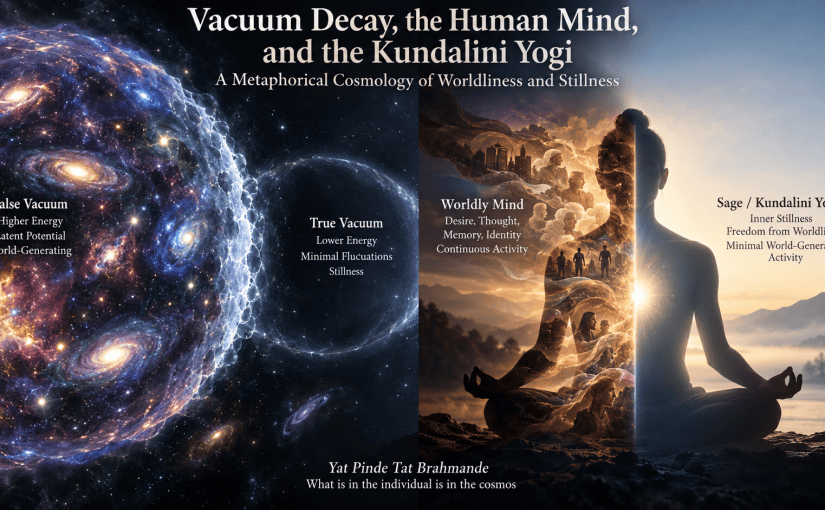
Vacuum Decay, the Human Mind, and the Kundalini Yogi: A Metaphorical Cosmology of Worldliness and Stillness

From the Physical Vacuum to the Inner World

Vacuum decay sounds as if empty space suddenly disappears, but in modern physics a vacuum is not simply empty space. Quantum fields exist throughout space, and what we call particles are excitations of those fields. A vacuum is a particular state of those fields. That state can, in some theories, be a local minimum of potential energy rather than the absolute lowest one. Such a state is called a false vacuum, while the lower-energy state is called the true vacuum. Quantum mechanics allows a metastable false vacuum to tunnel into a lower-energy state. The transition is described through a tunnelling or bounce solution and can produce a bubble of the new vacuum. If the bubble is too small it can collapse, but beyond a critical condition it can expand, potentially approaching the speed of light and replacing the old vacuum. When gravity is included, the situation becomes even more profound because vacuum energy affects spacetime itself. This physical picture led me to see a possible metaphorical correspondence with the human mind.

False Vacuum as Worldly Mind

I began thinking of the false vacuum as similar to the darkness of an ordinary worldly mind. Here darkness does not simply mean evil or absence of knowledge. It means the unseen, unexamined and latent structure through which worldliness is continually generated. The more strongly a person is identified with the world, the greater this darkness appears to be. Beneath conscious thought there are memories, expectations, fears, desires, habits, identity, comparison, social conditioning and countless subtle associations. Much of what maintains our ordinary mental world is therefore not consciously visible. It is already present in a subtle or encoded form, ready to produce further thoughts, emotions, desires and actions. In this sense I see worldliness as a kind of latent world-generating potential.

This also gives a useful metaphorical meaning to the high energy of a false vacuum. In physics, one should not simply say that every high-energy vacuum necessarily has larger quantum fluctuations, because fluctuation behavior depends on the particular fields, masses and couplings. Yet higher-energy field configurations can possess substantial potential for excitation and manifestation. This is the part of the analogy that interests me. The false vacuum is not itself the particles, just as the subtle structure of the mind is not itself every individual thought. Rather, it is the underlying condition from which manifestations can arise. Quantum excitations arise from the field configuration, while thoughts, emotions and worldly responses arise from the latent organization of the mind. Therefore I began to think of the subtle information of worldliness as something like the potential structure hidden within the false vacuum. It is not a literal storage of every object or event, but a hidden capacity from which the manifest world can continually be regenerated.

Quantum Fluctuations and the Mental World

In this metaphor, mental activity can be compared with fluctuations. An ordinary mind continually moves through memory, desire, anticipation, fear, pleasure, pain, identification and planning. One thought produces another, one emotion activates another, and the resulting actions produce fresh impressions. The process therefore becomes self-maintaining: desire produces thought, thought produces action, action produces consequences, and those consequences produce new desire. The worldly mind can thus be imagined metaphorically as a high-activity state with substantial capacity for generating further manifestations. This does not mean that psychological activity is literally caused by quantum fluctuations, nor that the human mind can be physically equated with a cosmological vacuum. The correspondence is structural and phenomenological: hidden potential gives rise to visible manifestations.

The Sage as True Vacuum

A profound transformation appears when an ordinary person becomes a sage, or what I also call a kundalini yogi in this metaphor. The change is not simply that the person has fewer thoughts. It is more radical. The underlying compulsion to continuously construct and maintain a personal worldly cosmos becomes quiet. A deep contemplative state can therefore be imagined as a true vacuum: a state of minimal psychological agitation, minimal compulsive fluctuation and minimal dependence on the continual generation of worldly experience.

This does not necessarily mean that the sage has lost all information. A Buddha can remember people, language and teachings, and a kundalini yogi may still function normally in the world. The deeper change is that information no longer has the same power to generate attachment, identity, craving and psychological continuation. Thus the useful distinction is not information versus no information, but information that actively generates worldliness versus information that remains without compulsive identification. In this sense the true vacuum metaphor represents the lowest world-generating activity rather than literal mental emptiness.

When an Individual Changes State

The transformation of an ordinary householder into a sage can therefore be compared metaphorically with false vacuum becoming true vacuum. The old worldly state is a metastable condition, apparently secure but still carrying the possibility of transition. A brief mystical experience may be like a subcritical bubble: an extraordinary moment appears, but the ordinary mental structure reasserts itself and the experience collapses. A deeper realization may cross a critical threshold. At that point the new state becomes sufficiently stable that the previous organization cannot easily restore itself.

The critical bubble in this analogy is not a physical radius. It represents the depth, stability and integration of realization. Below the threshold, worldliness is stronger than realization; above it, realization becomes strong enough to sustain itself. The “bubble wall” can be understood metaphorically as the resistance between the old and new states: attachment, identity, fear, habit, conditioning and the fear of losing the familiar self. Spiritual practice then becomes a gradual weakening of the barrier between the ordinary worldly state and inner stillness.

From One Mind to Many Minds

The analogy becomes even more interesting when realization spreads. One person’s transformation can affect others through speech, example, teaching and direct influence. A sage may become a source from which other people begin to observe their own minds, question their attachments and discover a quieter state. One transformed mind can therefore influence another, and that mind can influence another, creating a chain of transmission. In this metaphor the sage becomes a nucleation center of a different mental state.

This is where the idea of a critical bubble becomes collective. A person’s realization may remain localized if it does not spread beyond the individual. But if it becomes sufficiently powerful and transmissible, the psychological bubble can expand into a community, a tradition, a civilization and perhaps, over very long periods, a wider transformation of collective consciousness. Figures such as Buddha can be viewed in this philosophical sense as extraordinary examples of a personal realization becoming a lasting field of influence. Krishna can similarly be treated as a theological or archetypal representation of a consciousness that transforms the relationship between action, attachment and liberation. I do not mean that these figures literally altered the quantum vacuum; rather, their significance lies in the ability of a transformed mode of consciousness to propagate through human minds.

Two Different Meanings of Cosmic Destruction

This metaphor also clarifies what it means to say that a sage “destroys the cosmos.” The physical universe is not necessarily destroyed by enlightenment. Stars, planets, bodies and ordinary physical processes can continue. What is diminished is the mentally constructed cosmos: the personal world of “I,” “mine,” desire, fear, comparison, memory, expectation and attachment. In that sense spiritual liberation is not necessarily annihilation of the external universe but cessation of the psychological machinery that continually recreates one’s experienced worldly universe.

The idea can therefore be expressed at three scales. At the level of physics, a metastable vacuum can theoretically transition into a lower-energy vacuum through quantum tunnelling and bubble nucleation. At the level of an individual, a worldly mind can metaphorically transition into profound stillness. At the collective level, a deeply realized person can transmit that transformation to others. The common pattern is a seemingly stable state containing hidden potential for transition, followed by a movement toward a state of lower activity and a possible expansion of the new state.

The Larger Cosmological Question

This metaphor naturally raises a much larger possibility. Perhaps the physical cosmos and the experienced cosmos should be distinguished: one is the universe described by quantum fields and spacetime, while the other is the universe constructed in consciousness through sensation, memory, interpretation, desire and identity. Vacuum decay belongs to the physical description, whereas enlightenment belongs to the phenomenological and spiritual description. There is currently no established scientific evidence that a sage’s mental realization causes physical vacuum decay. That would be a speculative hypothesis, not accepted physics. Yet the structural similarity is striking: a high-potential state, hidden possibilities, manifestation through excitation, a transition to a lower-energy condition and, under certain circumstances, expansion of the new state.

This gives a final way of expressing the whole idea. The false vacuum is not merely “empty space with energy”; metaphorically, it is a latent world-generating condition. The worldly mind is similarly not merely a collection of conscious thoughts; it contains subtle structures capable of continually regenerating its experienced world. The true vacuum, by contrast, represents the deepest stillness, where the compulsive generation of that personal cosmos has greatly diminished. A householder becoming a sage is therefore metaphorically a false vacuum becoming a true vacuum. A temporary realization is a subcritical bubble; a stable realization crosses the critical threshold; and a rare, extraordinarily powerful sage may become a center from which a different mode of consciousness spreads through many minds. In this sense the language of vacuum decay becomes a powerful metaphor for the movement from worldliness to stillness, from latent psychological complexity to liberation, and from the continuous creation of a mental cosmos toward its profound inner dissolution.

It should not be surprising, then, if cosmic vacuum decay has a corresponding reflection in the individual mind, just as other cosmic principles can be reflected in the individual. This is also expressed in the scriptural idea “yat pinde tat brahmande”—what is in the individual is in the cosmos, or what exists in the microcosm is reflected in the macrocosm. From this perspective, the individual is not separate from the larger cosmic process but can be regarded as its smaller reflection. Therefore, studying the individual mind may provide a way to study corresponding principles of cosmology, just as studying cosmological processes may provide metaphors or models for understanding the individual. In this sense, the possibility that a cosmic vacuum transition could have an inner psychological counterpart is not an arbitrary comparison but follows naturally from the microcosm–macrocosm principle. The physical correspondence itself remains a hypothesis rather than established science, but the philosophical method of looking for the same pattern in the individual and the cosmos is ancient.

The Cosmic Apocalypse Reflected Within the Individual

Thus the cosmic apocalypse may have its corresponding reflection within the individual as a mental apocalypse. According to the scriptural vision, God first brought forth the universe and then entered into it in order to experience and sustain it. The Upanishadic idea that the Divine, having created the world, then entered into it expresses this profound principle. If the human being is itself a miniature form of the universe, then the Divine did not merely enter the vast cosmos from outside; it first created a miniature cosmos in the form of the individual and entered that miniature through the individual soul, thereby entering the universe in concentrated form. The human body by itself is inert; it becomes a living centre of perception, thought, action and experience when animated by the soul. In this sense, the individual is a microcosm through which the macrocosm experiences and operates itself. Therefore, if the universe can undergo its own cosmic processes, including a possible transition from one vacuum state to another, a corresponding process may also be contemplated within the individual as a transformation of the mental cosmos. The worldly mind continuously maintains its experienced universe through memory, desire, identity, perception, thought and subtle tendencies; when these world-generating processes become profoundly quiet, that inner cosmos can undergo its own apocalypse—not necessarily the destruction of the physical world, but the dissolution of the mental world through which it is experienced. Thus the individual can be studied as a miniature expression of the cosmos, and the transformation occurring within the individual can offer a way of contemplating corresponding transformations in the larger universe. This remains a metaphysical interpretation rather than an established scientific description of cosmology, but within the scriptural understanding of the microcosm and macrocosm, the correspondence is natural: the Divine enters the cosmos through its living miniature, and the dissolution of the worldly cosmos can therefore be contemplated not only in the vastness of space but also in the deepest stillness of the individual mind.

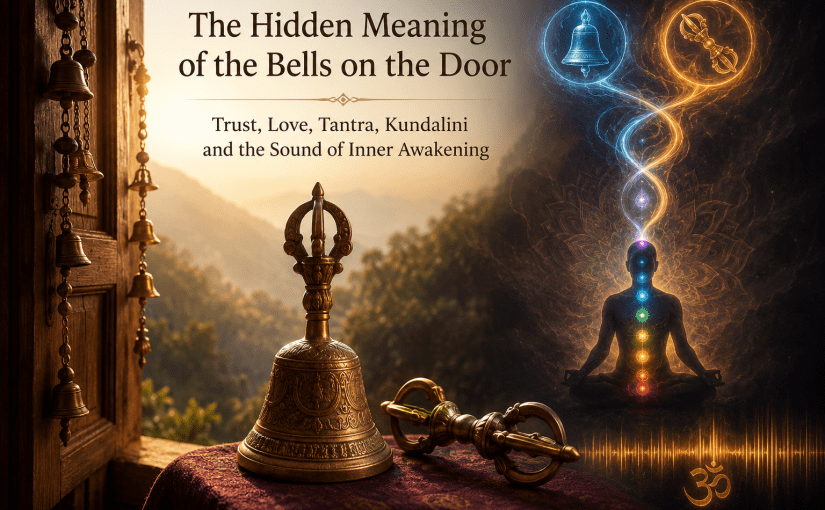
The Hidden Meaning of the Bells on the Door: Trust, Love, Tantra, Kundalini, and the Sound of Inner Awakening

A Simple Act of Hospitality That Revealed an Entire Spiritual Journey

Some experiences enter our lives quietly, almost unnoticed, yet within a few hours they begin revealing meanings far deeper than the event itself. They remind us that life often speaks through ordinary objects long before we understand its language. One such experience has remained with me ever since.

My old friend recently accommodated me in a room whose doorway was beautifully decorated with hanging bells. The room appeared to contain valuable belongings, yet he welcomed me with complete openness, leaving no trace of suspicion or hesitation. His gesture was not merely one of hospitality. It was an expression of trust. At that moment I simply appreciated his warmth, but within hours something extraordinary happened. The room remained the same, the bells remained the same, and the host remained the same. Only my perception changed. Suddenly, everything around me began revealing another dimension. What had seemed like a pleasant memory quietly transformed into a living lesson in Tantra, Kundalini, and consciousness.

The Greatest Treasure Was Never Inside the Room

Most people would naturally think that the valuables inside the room were its expensive possessions. Today I see the situation very differently. Whether costly objects were actually present or not has become almost irrelevant. The greatest wealth in that room was not material. It was the priceless trust with which another human being opened the door of both his room and his heart. Material possessions may have a market value, but trust has no price. The willingness to leave another person alone among one’s belongings without fear is itself a priceless gift. That invisible treasure remained with me long after I had forgotten every physical detail of the room.

The Bells Could Tell Many Different Stories

Those small bells hanging on the doorway gradually became the center of my contemplation. At first they appeared to be nothing more than attractive decorations. Then my mind smiled at another possibility. One could humorously imagine them as the simplest security system ever invented. Every time the guest entered or left the room, the bells faithfully announced his movements. If the guest quietly decided to leave carrying expensive belongings inside his bag, the bells would probably reveal the secret before anyone else could. The thought itself was amusing, but it lasted only for a moment because another interpretation appeared almost immediately.

Perhaps those bells had nothing to do with suspicion at all. Perhaps they simply informed the host that his guest had awakened, stepped outside, or returned safely. Every gentle chime gave him another opportunity to ask whether I had eaten, whether I needed tea, whether I was comfortable, or whether anything else could make my stay more pleasant. The same bells that one person might interpret as surveillance could equally be understood as expressions of care. The object never changes. Consciousness changes. A suspicious mind discovers suspicion. A humorous mind discovers comedy. A loving mind discovers affection. A spiritual seeker discovers symbols.

When Decorative Bells Became the Ghanta

Within only a few hours another realization unfolded. Those bells were no longer merely decorative ornaments hanging from a doorway. They had become the Ghanta of Tantra. The moment Ghanta appeared within my contemplation, another symbol naturally emerged beside it—the Vajra. Suddenly the memory of that room connected itself with my own spiritual journey. What had begun as ordinary hospitality quietly transformed into a profound tantric metaphor.

Trust, Love, and Surrender Form the First Tantric Union

As I reflected more deeply, I realized that no authentic tantric journey begins merely with physical union. Before the body can unite meaningfully, something much deeper must unite first. Trust opens the first door. Love opens the second. Surrender opens the third. Only when trust becomes complete, love becomes unconditional, and surrender becomes effortless does the true tantric pair begin to emerge. It is this invisible union that prepares the ground for authentic tantric meditation. Without these foundations, outer union remains only physical. With them, the same union gradually becomes spiritual.

When Vajra Meets the Bell

The symbolism now became remarkably clear to me. The receptive Bell remains silent by itself. The phallic Vajra, representing the masculine principle, likewise remains silent alone. Only in their symbolic union does the Bell begin to ring. Only when Vajra and Bell unite does resonance begin. Yet this ringing is not immediate. Just as genuine spiritual awakening cannot be forced, neither does the symbolic bell begin ringing at the very first meeting. It is prolonged practice, deepening trust, maturing love, complete surrender, disciplined meditation, and inner purification that gradually awaken the resonance. The true ringing does not arise from metal striking metal. It arises from consciousness entering its own deeper dimensions.

The Ringing That Cannot Be Heard by the Ears

The longer I contemplated this symbolism, the more clearly I understood that the ringing of the Bell was never merely an external sound. It represented the subtle inner resonance that gradually becomes perceptible during sustained tantric and yogic practice. This is the beginning of the unstruck sound, the Anāhata Nāda. It is not produced by external impact but arises spontaneously within consciousness itself. As this subtle current deepens, the practitioner gradually becomes aware of an entirely different dimension of meditation.

The Awakening of Kundalini

In my own experience, sacred sexual union became the doorway through which this inner journey began. It was never merely an act of physical intimacy. It became the catalyst for awakening. Through prolonged tantric practice, the symbolic union of Vajra and Bell gradually expressed itself as an inner current flowing through the Sushumnā Nāḍī. As this subtle flow strengthened, Kundalini awakened. With that awakening came the direct recognition of the Self. For me, self-realization was not the conclusion of the journey but the beginning of a far greater one.

Beyond Self-Realization

The journey did not end with Kundalini awakening. Continued practice under the necessary inner conditions gradually revealed deeper stages of yogic experience. The natural suspension of breath known as Kevala Kumbhaka emerged spontaneously rather than through force. As meditation matured further, consciousness appeared to move beyond even this into a state that I can only describe as the profound silence traditionally associated with Nirvikalpa Samadhi. The experience was extremely brief, occurring only a few times, and so subtle that I still remain uncertain whether it was truly Nirvikalpa Samadhi or only a fleeting glimpse of that state. Whatever it was, it left a deep and lasting impression on my spiritual journey. These stages unfolded as living experiences rather than philosophical concepts. They taught me that the path of Tantra extends far beyond its outer forms. What begins as love and surrender gradually becomes meditation. Meditation becomes awakening. Awakening becomes silence. Silence finally becomes the direct experience of limitless consciousness.

The Hidden Meaning of the Bells

Today, whenever I remember those bells, I no longer see only decorations hanging from a doorway. I see trust becoming love, love becoming surrender, surrender becoming tantric meditation, meditation becoming the symbolic union of Vajra and Bell, that union gradually giving birth to the subtle resonance of the Anāhata Nāda, the current ascending through the Sushumnā, Kundalini awakening into Self-realization, and the continuing journey toward Kevala Kumbhaka and Nirvikalpa Samadhi. Yet none of these deeper meanings erase the outer event. The room was still a room. The host was still a gracious host. The bells were still ordinary bells. They simply became mirrors reflecting increasingly deeper layers of consciousness.

Perhaps this is how hidden meanings always reveal themselves. Life first offers us an experience. Understanding follows. A simple act of hospitality becomes a lesson in trust. Trust blossoms into love. Love matures into surrender. Surrender opens the gateway to Tantra. Tantra awakens meditation. Meditation gives voice to the silent Bell. The Bell begins to ring within. The ringing becomes the subtle current of the Sushumnā. The current awakens Kundalini. Kundalini reveals the Self. Continued practice carries consciousness beyond breath into Kevala Kumbhaka and ultimately into Nirvikalpa Samadhi. The bells hanging on that doorway have long since fallen silent in the outer world, yet within me their resonance continues even today, reminding me that the deepest spiritual teachings often arrive disguised as the simplest moments of ordinary life.

Orch-OR Theory, Quantum Darshan, and the Quantum Foundations of Consciousness: A Personal Exploration

Orch-OR Theory, Quantum Darshan, and the Quantum Foundations of Consciousness: A Personal Exploration

From Awakening Experiences to Quantum Consciousness

For many years, I have been interested in the question of consciousness. Like countless seekers, philosophers, scientists, and mystics before me, I have wondered what consciousness really is and where it originates. My own journey has not been limited to intellectual inquiry. It has been shaped by direct experiences during spiritual practice, particularly experiences of nonduality and awakening glimpses that profoundly altered the way I perceive reality.

These experiences gradually led me toward a view that I call Quantum Darshan. In its broadest sense, Quantum Darshan proposes that consciousness is not merely a product of the human brain. Rather, consciousness is a fundamental aspect of reality itself. Human beings express it in a highly organized form, but the same underlying principle may be present throughout nature.

During my reflections, I often noticed an interesting parallel. Human consciousness continuously processes information, responds to circumstances, and acts toward various outcomes. Surprisingly, when one observes nature at the quantum level, a somewhat similar pattern appears. Quantum particles process information through interactions, respond to their surroundings, and participate in processes that eventually contribute to increasingly complex structures and forms.

At first glance this may appear entirely mechanical. Yet when viewed from a broader perspective, creation itself unfolds in a remarkably ordered sequence. Stars form, elements emerge, planets arise, life develops, biological complexity increases, intelligence appears, and eventually conscious beings begin questioning the nature of existence itself. This naturally raises an intriguing question. If reality is completely directionless, why does creation repeatedly generate increasing levels of organization and complexity?

Quantum Darshan does not claim that nature follows a predetermined script or that every event serves a clearly defined cosmic purpose. Rather, it suggests that there may be subtle tendencies toward organization and development embedded within reality itself. Such tendencies may be too faint to observe directly. They may remain hidden beneath the apparent randomness of nature. Yet despite enormous complexity and apparent chaos, order repeatedly emerges.

Consciousness Beyond Human Thought

An important clarification is necessary. Quantum Darshan does not suggest that every object thinks like a human being. A stone does not possess memories, emotions, desires, language, imagination, or self-reflective awareness. These qualities require highly organized biological structures such as brains and nervous systems.

However, the absence of human-like thinking does not necessarily imply the complete absence of consciousness. The idea proposed by Quantum Darshan is that consciousness exists in different degrees and expressions depending upon organization and complexity. Human consciousness represents one highly developed form. Simpler systems may express only primitive forms of information processing and interaction.

However, development seems to occur mainly in the individualized feeling of consciousness, not in consciousness itself. Consciousness, as I understand it, is orderly and complex processing directed toward developmental goals. Such processing can exist in quantum realms as well as in physical and biological realms at any level, whether atomic, molecular, cellular, that may be even more than what’s within the brain of living beings. However, this processing is felt only in the brains of living beings. The degree of this feeling appears to develop gradually, from single-celled organisms to human beings through countless forms of life. For simplicity, let us consider goal-oriented intelligent processing itself as consciousness. In that sense, consciousness is everywhere. The feeling of consciousness, however, begins only when, at a certain level of biological development, pure awareness, Atman, or pure existence starts becoming entangled with this processing and begins to experience it within itself. Many times this feeling of processing itself is called consciousness, but for the sake of clarity I divide it into feeling consciousness and non-feeling consciousness. Non-feeling consciousness is present everywhere as intelligent goal-directed processing, whereas feeling consciousness emerges only at a particular stage of biological evolution and development.

From this perspective, consciousness is not something that suddenly appears when matter reaches a particular level of complexity. Instead, complexity may provide increasingly sophisticated ways for an underlying conscious principle to feel and express itself.

The Search for Scientific Support

While developing these ideas, I naturally became interested in scientific theories that attempt to connect consciousness with quantum physics. Among all such proposals, one theory stands out as particularly significant: the Orchestrated Objective Reduction Theory, commonly known as Orch-OR.

Developed by Roger Penrose and Stuart Hameroff, Orch-OR proposes that consciousness is not generated solely through classical neural computation. Instead, quantum processes occurring within microscopic cellular structures called microtubules may contribute directly to conscious experience.

This theory is important because it challenges the traditional materialistic assumption that consciousness is merely a by-product of complex brain activity. Instead, it introduces quantum reality into the discussion of consciousness.

Of course, Orch-OR does not claim that every quantum particle possesses consciousness. Nor does it directly support all aspects of Quantum Darshan. Nevertheless, it represents a major shift in scientific thinking because it acknowledges that consciousness may be connected to deeper quantum processes rather than emerging exclusively from conventional computation.

Quantum Superposition and Human Thought

One of the most fascinating parallels emerges when we compare quantum processes with ordinary mental activity.

In a simple conceptual sense, quantum superposition resembles the way the human mind can hold multiple possibilities simultaneously. Before making a decision, various thoughts, options, ideas, and alternatives may coexist within awareness. Nothing has yet been selected.

Quantum collapse appears somewhat similar to the role of intellect or discrimination. Eventually a decision is made. One possibility becomes actualized while the others remain unrealized.

This comparison should not be interpreted as a literal scientific equivalence. Human thinking and quantum mechanics operate in very different domains. Nevertheless, the analogy helps illustrate a common pattern: multiple possibilities existing prior to the emergence of a single outcome.

The human mind moves from potentiality to actuality. Quantum systems appear to do something conceptually similar when a definite state emerges from a range of possibilities.

Where Orch-OR and Quantum Darshan Meet

The most interesting insight arises when comparing the foundational assumptions of Orch-OR Theory and Quantum Darshan.

Both says that quantum superposition is a type of thought and quantum collapse is decision making.

Both perspectives begin with the recognition that quantum reality may be relevant to understanding consciousness. Both move beyond strict materialism. Both acknowledge that reality may involve processes that cannot be fully explained through classical mechanisms alone.

The major difference concerns scope.

Orch-OR applies these ideas specifically to the human brain. According to the theory, quantum events occurring within microtubules contribute to conscious experience. Consciousness remains associated with biological systems possessing the required structures.

Quantum Darshan extends the same basic principle much further. It proposes that the relationship between potentiality, information processing, interaction, and actualization exists throughout nature. The processes observed in the human brain may represent a highly organized expression of principles already operating at the quantum level.

In this view, human consciousness is not completely separate from the rest of reality. Rather, it is an advanced manifestation of patterns already present throughout the universe. In a way brain is just feeling what’s already present everywhere.

Thus, one could say that Orch-OR applies the quantum-consciousness relationship to the human brain, whereas Quantum Darshan extends that relationship to every quantum particle and every level of existence.

Consciousness, Creation, and the Future of Inquiry

The question of consciousness remains one of the greatest mysteries facing humanity. Despite remarkable advances in neuroscience, physics, psychology, and artificial intelligence, no universally accepted explanation currently exists.

Ancient mystics approached the problem differently. Through direct realization, many claimed to discover consciousness as the fundamental reality underlying existence. Traditions across the world described reality using concepts such as Shiva and Shakti, Purusha and Prakriti, or the interplay between awareness and manifestation. They often emphasized that consciousness cannot be fully understood through concepts alone. Direct experience is essential.

Modern science follows a different path, relying upon observation, experimentation, mathematics, and empirical verification. Yet surprisingly, certain scientific developments appear to be moving toward questions that ancient contemplative traditions explored long ago.

Orch-OR Theory represents one such development. Whether ultimately confirmed or rejected, it demonstrates a willingness within science to investigate consciousness beyond conventional materialistic assumptions.

Quantum Darshan attempts to continue that exploration by asking a broader question. If quantum processes contribute to consciousness in the human brain, could similar principles operate throughout nature in simpler forms? Could consciousness be a fundamental feature of reality rather than a late evolutionary accident?

At present, these questions remain open. Definitive scientific proof does not yet exist. Nevertheless, the dialogue between quantum physics, consciousness studies, neuroscience, philosophy, and spiritual inquiry continues to grow.

My own experiences, reflections, and observations have led me to view consciousness not as an isolated phenomenon confined to the human brain, but as something woven deeply into the fabric of existence itself. Whether future science ultimately validates or challenges this perspective, the search itself remains one of humanity’s most profound adventures.

The journey toward understanding consciousness is far from complete. Yet theories such as Orch-OR and perspectives such as Quantum Darshan invite us to consider a possibility that was once dismissed by both science and philosophy: that mind and matter may be far more deeply interconnected than we ever imagined, and that the mystery of consciousness may ultimately reveal something fundamental about the nature of reality itself.

Nonduality on the Street: What Dogs Quietly Teach Us About Being Whole

Nonduality and Animal Behaviour: Understanding How Dogs Perceive Reality

Most conflicts between humans and animals do not arise because animals are violent or humans are weak. They arise because humans forget how animals perceive reality. Dogs, especially street dogs, do not respond to our words, beliefs, professions, or intentions in the way we imagine. They respond to state. They sense whether a being standing before them is internally divided or internally whole. This difference alone often decides whether a dog barks, chases, attacks, ignores, or quietly settles.

A dog does not encounter us as a psychological story. It encounters posture, breath, facial tension, rhythm of movement, and the invisible but very real coherence or incoherence of the nervous system. When a human lives in inner division—fear mixed with courage, friendliness mixed with suspicion, dominance mixed with anxiety—the body leaks signals. These signals create edges, and edges invite testing. Barking, circling, and chasing are not moral judgments; they are responses to fragmentation. When a human is internally unified, however, something entirely different is perceived. The body moves as one piece. The breath flows evenly. The face carries no agenda. To a dog, such a human does not appear as another competing individual. He appears as part of the environment.

Nonduality and the “Mountain Effect”: Why Coherence Dissolves Conflict

This is why the metaphor of “being one with the mountain” is not poetic exaggeration. When a person is inwardly undivided, the animal nervous system reads scale, not size. The human feels large, not because of muscle or dominance, but because there is no resistance to push against. Animals do not fight mountains, rivers, or weather. They adapt to them. In the same way, a coherent human presence often dissolves confrontation before it begins. The dog does not submit; it disengages. Dogs primarily challenge what they perceive as a threat to their territory. A nondual being makes the least claim on resources and shows minimal territorial behavior, which dogs instinctively respond to positively. In practical life, one must of course keep possessions in order to live, but inwardly one remains nondual—akin to being possessionless. A mountain may hold countless forms of natural wealth, yet inwardly it is almost possessionless. Actually, all healthy animals instinctively appreciate nonduality, because they are closest to it—though compulsively rather than by conscious choice.

How Dogs Read the Human Face and Body

Dogs are highly sensitive face readers, but not in the emotional sense humans assume. They read movement, contrast, breath, and eye tension. Wide eyes, exposed sclera, projecting chin, forward breath, and sudden motion activate reflexive circuits, especially in abnormal or stressed dogs. A relaxed, upright head with the chin slightly tucked—not collapsed—soft eyes that are neither staring nor fearful, and a neutral, peripheral gaze communicate something very specific: awareness without challenge. This posture is not submission; it is protection without aggression. Children, especially, must be taught this, because most bites occur when fear and excitement amplify facial signals.

Limits of Nonduality: Rabies, Extreme Stress, and Reflex Behaviour

It is important to understand that nonduality is not a magic shield. It works well with normal, socially regulated dogs, particularly when encounters are individual and calm. It does not reliably work with rabid dogs, severely injured animals, starving animals, or highly aroused packs. Rabies damages inhibition. In such cases, subtle presence gives way to raw reflex. Calm behaviour reduces reactions as long as perception is intact. When perception collapses as in rabies, severe pain or hunger, reaction runs on reflex. Sometimes instinctive actions—creating distance, increasing physical silhouette, using barriers—can pause an attack, as in the experience of lifting a large boulder overhead during a rabid assault.The dog probably sensed my body as being huge, with my face partially shielded by it. This is why the technique of increasing apparent body size—such as holding a stick or a bag wide in front with both hands or becoming tall lifting both hands up—sometimes works. However, these actions should be done softly and calmly, with a nondual attitude and without fear, in a defensive—not attacking—sense. One should never attack, because we can almost never overpower a beast. That pause may save seconds. But only medicine saves lives. Washing wounds thoroughly and seeking vaccination and immunoglobulin is not optional. There is no spiritual immunity to rabies, and pretending otherwise costs lives.

Essential Safety Education for Children Around Dogs

Children should also be clearly advised never to pelt stones or sticks at dogs, never to pass close to a sleeping dog, and never to stare continuously into a dog’s eyes, as this is read as a challenge. Children can easily underestimate the strength of small-looking dogs, so they should be made aware that even smaller dogs possess hidden, inherent strength and can cause serious injury. They should not rush or run suddenly, because dogs often interpret such movement as an act of theft or escape. Instead, one should calmly walk back in a slow, reverse motion without turning the back, keeping the dog in peripheral view. Even while increasing distance, it is safer to remain partially oriented toward the dog, gazing sideways rather than fully away, because dogs sometimes approach silently from behind and may bite without barking. Facing the dog inhibits this and often repels further approach. Most importantly, children should avoid displaying fear, as dogs read facial expressions in a very direct, gross manner. These behaviors should not be acted or pretended; they must be genuine, because dogs can easily sense the difference between performance and real inner state. nearby elder people should be called for help, never to walk alone in dog prone areas. If an attack occurs despite all precautions, becoming passive by curling the body inward and protecting the head and neck does not usually encourage further aggression. Most dogs attack in response to movement, noise, and interaction, not from an intent to continue harm indefinitely. When these signals suddenly disappear, the feedback loop sustaining the attack often collapses, leading the dog to disengage once arousal drops. This approach does not guarantee safety in every situation—especially in cases involving packs, rabies, or extreme predatory states—but it can significantly reduce the severity of injury by protecting vital areas. Passivity here is not surrender, but the withdrawal of signals that fuel aggression, buying critical time until the animal disengages or help arrives.

Personal Experiences of Nonduality and Aggressive Dogs

Once, while I was in a state of full nonduality arising from śarīra-vijñāna darśana, I approached the door of a stranger’s house. Suddenly, a dog jumped toward me with intense anger—barking fiercely, teeth fully exposed in a way that felt genuinely dangerous. I remained standing as I was, without reacting outwardly, and slowly called the owner in a calm voice. The dog stopped right near my feet and began wagging its tail. In a similar incident some years earlier, within three years of my dream-state awakening, a dog tethered by a chain at a house broke free and charged toward me with comparable aggression, yet again stopped near my feet in the same manner. I had gone there to treat that dog and had treated him earlier as well, so perhaps some remembrance existed. More recently, during a phase of what I call quantum-darśana nonduality, I encountered a stray dog at a shopkeeper’s house. It jumped toward me with an intensity of aggression that is difficult to describe fully. I raised my hands calmly and, with a gentle smile, spoke softly—playing lightly, saying that I meant no harm, asking it to calm down. The dog stopped near my feet, allowed me to touch its body affectionately, and then walked away peacefully, sniffing the grass with curiosity. I do not know whether the dogs were responding with amazement to a sensed state of nonduality, or whether nonduality itself prevented the bites. Perhaps both explanations are partially true.

Pack Dynamics: Why Groups Behave Differently

Pack dynamics reveal another layer of reality. A single dog reads a human. A pack reads itself. Once arousal crosses a threshold, individual awareness collapses into collective rhythm. Even calm dogs may act against their own earlier disposition. This is why packs often target crowds rather than solitary, coherent individuals. Chaos mirrors chaos. Coherence has nowhere to land in noise. Leadership in packs functions only while the pack remains socially regulated. A socially intelligent leader can anchor calm and prevent escalation—but only before ignition. Once panic spreads, hierarchy dissolves and physics replaces psychology. This is true for dogs and humans alike.

Street Dog Leadership and Shared Territory: A Real Example

A lived street example illustrates this more clearly than theory. A patwari—a revenue employee—used to attend early-morning yoga classes at a temple. A stray pup settled with him first, drawn by routine, calmness, and predictability. The dog was physically cared for by his family and became part of that household’s daily management. Much later, another person entered the same street. Normally, a street dog would respond to a late entrant with suspicion, barking, or chase. Instead, the dog responded with amazement and closeness, without anger or testing. This was not because of association alone. It was because the newcomer did not enter as an intruder but as coherence. There was no territorial counter-pressure, no dominance, no fear. The dog sensed no edge.

Over time, two bonds coexisted naturally. One bond was logistical—food, shelter, routine, survival. The other was orientational—calm presence, non-interference, inward settlement. Dogs are capable of this maturity. They can eat in one place and orient emotionally to another. They attach inwardly not to who gives the most, but to who disturbs them the least. That is why some attachments feel quiet and deep rather than clingy or possessive.

In a later incident, when a territorial dog beneath a car triggered an alarm and other dogs began assembling, the street dog positioned itself near the coherent human, growled without charging, and faced the others. It did not bark hysterically. It did not attack. It held space. That single act communicated affiliation, legitimacy, and controlled authority. The pack dispersed—not out of submission, but because the situation was re-evaluated and arousal dropped below ignition threshold. In pack situations, dog-to-dog signals override human presence. Calm human behavior matters because it allows such leadership to function rather than amplifying chaos. A similar neighbourhood experience happened to me when I was at the peak of nonduality. The dog used to look at me with a sense of closeness mixed with amazement.

What Dogs Ultimately Teach About Nonduality

All of this carries an important lesson for children and society. Animals are not enemies. They do not understand our words, arguments, or moral self-images. They understand whether we are at war inside or at peace. Teaching children not to scream, stare, run suddenly, or invade animal space is not fear-based education; it is intelligence-based education. Most bites are preventable when perception replaces panic.

Dogs do not practice nonduality consciously. They never left it. They live without inner conflict. Humans leave that ground through excessive thought and return to it through coherence. When humans return, animals respond naturally—not as disciples, but as mirrors. Life stops pushing back, and the mind stops splitting. In that sense, dogs encourage nonduality not by instruction, but by rewarding wholeness with peace.

Conclusion: Nonduality as Practical Wisdom

Nonduality, then, is not a belief system. It is a way of being that reduces friction with life itself—including animals. Wisdom lies in holding presence, science, safety, and compassion together. Presence prevents many conflicts. Medicine saves lives. Education saves society.

Animals do not understand what we say.
They understand whether we are whole.

Chapter 22 – Superposition and Collapse: The Dance of Choice and Becoming

Creation is not a frozen script, but a living play of possibilities. At the quantum level, reality does not exist as fixed entities waiting to be discovered—it exists as superpositions, states of “may be,” “could be,” “shall be.” A particle before observation is not one thing or another; it is many things at once, carrying the fragrance of infinite futures. But when collapse happens—when an act of choice arises out of the silent field—one possibility is plucked from the garden of infinity and becomes the reality of this moment. Thus, superposition is the womb of creation, and collapse is its birth.

Imagine a child standing in front of a shelf of storybooks at night. Before choosing, every book is a possible story for the night — all the adventures, mysteries, and fantasies are equally open. It’s like a whole library of possible nights even though the child will read only one. But the moment the child picks a book, that story becomes the night’s reality, and all the other stories fade back into the shelf. This is exactly how superposition and collapse work: many possibilities exist at first, and one becomes real when the choice is made.

The sages of India intuited this mystery long before the equations of quantum mechanics. In the Upanishads, Brahman is described as “neither this nor that, yet also this and that”—a description that mirrors the quantum superposition. It is the realm where all attributes are held simultaneously, but none is bound. Collapse then is like the act of Ishvara Sankalpa—the divine will choosing to manifest a particular form from the unbounded potential of Brahman. Every event, every form, every particle we see is thus a frozen decision within this eternal game of becoming. That is why the Upanishads declare eko’ham bahu syām—“I am One, and I shall become many”—the divine will at the beginning of creation. Why not see this cosmic will as the very first collapse of pure potential into actuality, taking the form of fundamental fields and particles with specific properties such as form, charge, position, spin, and momentum?

Superposition: The Silent Ocean of Possibility

Imagine standing at the ocean early in the morning. The water is very calm, but that calmness is full of hidden possibilities—waves could rise in any direction at any moment. This is like superposition, where many outcomes exist together before anything is measured. In this “possibility state,” an electron is not spinning clockwise or counterclockwise—it is in a special quantum state that contains both possibilities at once, just like the calm sea contains all the potential waves before any one wave actually forms. Nothing is fixed yet; everything is only potential, waiting for one specific outcome to appear when observed.

In Sankhya, Prakriti before disturbance is completely calm — the three gunas are balanced, nothing has taken form, and nothing has begun. It is a state of pure potential. This is just like superposition in quantum physics, where all possibilities exist together but none is chosen yet. It’s called Prakriti in samyavastha or equilibrium. Prakriti waits for the presence of Purusha before anything moves or evolves. In the same way, a quantum state waits for measurement or interaction before one outcome becomes real. The moment Purusha’s attention falls on Prakriti is like the moment of collapse in quantum mechanics — the instant where potential becomes creation, and one definite reality appears. It’s called kshobha or disturbance in Prakriti. Why not call underlying fields as prakriti in samyavastha and particles born from them as kshobha in prakriti.

Prakriti is like sugar syrup. Within it, the sugar particle in it represents sattva; its dispersed presence throughout the syrup represents rajo guna through constant but unnoticeable movement; and its dissolution, where the particle no longer exists in solid form, represents tamo guna or destruction of particle form. Means in mool prakriti, all the three gunas remain in unchanging amount equally dispersed everywhere. It’s samyavastha. But when sugar particle is separated back from syrup through crystallization etc., then sattva guna varies at different locations as sugar particle has more concentrated sattva than rest of the sugar syrup. Similarly rajoguna also varies as sugar particles shows more concentrated motion than rest of the sugar solution on heating. With this tamoguna also varies for destruction or dissolution back of sugar particles contains more concentrated tamoguna or destruction than the uniform tamoguna in rest of the sugar syrup. If we replace the sugar particle with a quantum particle, the sugar syrup becomes the quantum field. The formation of a particle then expresses sattva as form, rajo guna as motion, and tamo guna as the particle’s eventual changing form, destruction or dissolution back into the field. It proves the same quantum fields were experienced by ancient sages with inner eyes which scientists are discovering as quantum fields through physical experiments. Brahma can be called as cosmic quantum field and soul as individualised quantum field as it has individual’s hidden impressions made from its countless lifetimes. Soul reborns again and again from this individualised quantum field. Liberation is like dissolving of even this field back into pure void space that’s nothing at all and is the background of grand quantum field aka prakriti. It’s only practically possible through nirvikalp samadhi, the top achievement of yoga.

There must exist a grand, all-encompassing quantum field from which every known quantum field arises. Science has not yet detected it, but logic strongly points toward its existence, because everything in nature moves toward unification. Just as diverse particles emerge from individual fields, all fields themselves must emerge from a deeper, singular foundation. In philosophical terms, this is the modern reflection of Prakriti—one source field from which all forms arise and into which they dissolve. Although string theory and few other scientific theories are speculating it.

Collapse: The Birth of Form

Collapse is not destruction; it is birth. When superposition resolves, a particular outcome is chosen and becomes the world. It is like the sculptor striking a block of marble: infinite shapes are hidden within, but one form emerges. Collapse is the act of manifestation, the narrowing of infinity into one thread of reality.

The Nyaya Darshana speaks of pramana, valid means of knowledge, where perception crystallizes the uncertain into the certain. Collapse is a cosmic pramana—it validates one outcome as the “real.” But this validation does not cancel the unseen others; they remain as shadows, as unseen branches in the cosmic tree, perhaps flowering in parallel universes.

Thus, every collapse is like an act of cosmic decision-making. The world is not predetermined; it is continuously deciding itself into being.

Choice as the Engine of Creation

Why is collapse so central to creation? Because collapse is the very engine of becoming. Without collapse, everything would remain an undifferentiated soup of potentials—silent, formless, directionless. Superposition is the clay, but collapse is the potter’s hand.

The Yoga Darshana explains creation as a process of sankalpa-shakti, the power of intention, arising from consciousness. The yogi is taught that by stilling the modifications of mind (chitta vritti nirodha), one returns to the ocean of possibility; but by focusing thought and intention, one collapses possibility into reality. In this sense, collapse is not only physical but also experiential. Each thought we entertain collapses infinite ideas into one lived reality.

In human life, collapse appears as choice. At every moment, we hover in superposition: Shall I act or refrain? Shall I love or withdraw? Shall I see the divine in the other, or reduce them to an object? Each decision collapses countless options into one stream of destiny. Thus, collapse is the bridge between freedom and form.

Quantum Collapse and Indian Metaphysics

In Vedanta, the play of Maya is described as veiling (avarana) and projection (vikṣepa). Superposition mirrors the veiling: the true state of things remains hidden, undefined, unmanifest. Superposition also veils the self luminous soul when it’s ready to collapse. Actually soul doesn’t collapse and can never collapse as it has nothing inside. It is perfect zero. It’s a perfect void. When soul of Brahma takes the form of prakriti, then it becomes full of all potentials. Although basic supreme soul remains fully void as such always. It means the soul of Brahma needs to become veiled to entertain the Collapse. Veiled means there is everything or every outcome in prakriti or bound soul in hidden or veiled or potential form without anything yet expressed through collapse. Collapse mirrors projection: a specific form is projected into consciousness of Brahma or human whatever level. What is hidden becomes revealed, what is possible becomes actual. The cycle repeats endlessly, each collapse weaving the fabric of the manifest.

The Bhagavad Gita proclaims: “I am the gambling of the gambler, the chance among things.” This chance, this sudden crystallization of one possibility among many, is none other than collapse. It shows that creation is not mechanical necessity alone—it is also play (lila), spontaneity, surprise. The universe evolves not by rigid design, but by the freedom of collapse.

Collapse as Sacred Fire

Consider collapse as Agni, the sacred fire. In the Vedic sacrifice, offerings are placed into fire, and fire transforms them into smoke and flame that rise to the heavens. In the same way, the infinite offerings of potential are cast into the fire of collapse. From that fire arises one reality, glowing with form and direction. Every collapse is thus a yajna, a cosmic sacrifice where possibilities are consumed to give birth to actuality.

This yajna continues ceaselessly: electrons choosing orbits, galaxies forming shapes, cells dividing, humans making decisions. All are flames of the same sacred fire.

The Pulse of Becoming

Superposition and collapse together form the pulse of becoming—the systole and diastole of the cosmic heart. Superposition is expansion into infinity, collapse is contraction into form. Together they beat, again and again, generating time, space, and history.

The Kashmir Shaiva philosophers described creation as the pulsation (spanda) of Shiva’s consciousness—an eternal throb between stillness and manifestation. Modern physics echoes this ancient intuition: reality is not a frozen block but a dynamic dance of probabilities collapsing into certainties.

Collapse and Evolution of Complexity

Each collapse does not occur in isolation; it feeds into the next. A particle’s collapse shapes its neighbor’s potential, like ripples overlapping in a pond. Over time, these ripples build into patterns, and patterns into structures. From hydrogen atoms to stars, from DNA to consciousness, the universe evolves because collapses accumulate into order.

In this sense, collapse is not merely local but evolutionary. The cosmos learns from each decision. Diversity emerges because collapses never follow a single path but branch into endless variations. Unity emerges because all collapses occur within the same underlying field. Creation is thus diversity in unity, and unity in diversity.

Collapse as the Mirror of the Self

Collapse is not just a physical event—it mirrors the movement of the Self. The Self is simply that which chooses, that which says, “I am this.” Means it ignores all of its hidden potentials and selects only a single outcome to identify with. In deep meditation, when thoughts fade, we rest in a state like superposition—pure being, without any identity. But the moment a thought appears, a collapse happens: the mind claims, “I am this body, this person, this story.” In this way, life becomes a continuous series of collapses happening on the still, silent ocean of superposition.

The Advaita Vedanta reminds us that behind all collapses, the Witness remains untouched—the pure consciousness that neither chooses nor becomes, but allows all choices and becomings to appear. To know that Witness is liberation, the transcendence of collapse itself. Probably it is this very same detachment and non-duality by whatever means, out of which quantum darshan can be a good one.

Quantum Collapse: The Engine of Creation

If we look at the grand picture, superposition provides the infinite palette, collapse paints the stroke. Together, they are the engine of creation. Without superposition, no possibility; without collapse, no actuality. Creation is thus not a single event but a continuous unfolding, driven by the rhythm of superposition and collapse.

This engine powers not only physics but life, mind, and spirit. Every breath is a collapse of air into lungs, every word a collapse of thought into sound, every act a collapse of freedom into destiny. The universe is not a machine, but a living story—authored moment by moment by the choices of collapse.

Copenhagen interpretation says the collapse is real and that no outcome is determined in advance—and many experiments support this. I also appreciate pilot-wave theory, where a particle is guided by a wave. It fits experimental results quite well. However, it claims that every outcome is already determined, which aligns with Indian philosophy that says everything is predetermined—even the movement of a leaf—and that humans are merely puppets.

If we think logically, when the probability distribution already tells us where a particle is most likely to be found, then perhaps the exact position is also predetermined; we simply do not know it yet.

Many-worlds theory is philosophically remarkable as well. In it, there is no collapse of superposition into a single outcome. Instead, every outcome manifests in parallel worlds. This resembles the human mind: one person may perceive a tree as tall, another as short; one may see it as more green, another as less green. A single object gives rise to multiple subjective outcomes. Many-worlds, in a sense, implies many minds—because the world is nowhere but within the mind.

Yet, among all interpretations, the Copenhagen interpretation—superposition and collapse—fits experimental observations most directly. That seems to be how nature operates everywhere. It is a kind of Darwinian quantum evolution: the peak of the amplitude is the most likely outcome, and nature consistently evolves toward it.

De Broglie was right: everything has a wave nature, whether electron, photon, atom, molecule, mountain, planet, or galaxy. Development occurs through survival of the fittest, and the “fittest” option is simply the option with the highest amplitude. This reveals a deep non-duality, where everything—physical or mental—operates through similar underlying patterns.

At the foundation of reality lies the pure quantum world, an impersonal field that performs the entire cosmic play without any capacity to feel. It creates, transforms, and dissolves everything effortlessly, yet it remains completely non-experiential, untouched by emotion or awareness. From this arises the quantum-human, a subtler layer where feeling and experience do appear, but with complete detachment and nondual clarity. The quantum-human experiences all sensations, thoughts, and perceptions generated by brain-wave dynamics, yet never mistakes them as “mine,” and therefore remains inwardly free. The mistake happens at the level of the macro-human soul, the ego-sense, which identifies with these brain-wave activities and assumes, “These thoughts are mine, these feelings are mine, this world is mine.” This misidentification creates duality, attachment, and ignorance. The quantum-human represents the middle path—a state in which a social human aka macro human being can still feel, relate, think, and live, but without falling into attachment and ignorance. Unlike the purely non-feeling quantum world, which no embodied person can emulate while living, the quantum-human offers a balanced model: fully feeling, fully aware, yet inwardly liberated. This is the practical ideal that Quantum Darshan points toward—living in society while maintaining the detachment and freedom that arise from understanding the deepest quantum game.

In nutshell, the main point of the story is that mystics discovered the ultimate truth and perfect peace by practicing seeing everything in the world as equal to themselves this way or that way that I also feel—meaning the inner working of everything is similar to that of a human being. Experience has already revealed this, and science will also reveal it fully one day. The division between living and non-living is superficial; at a deeper level, the functioning of all things is astonishingly similar. Call it the collapse of potential thoughts into specific thought or thoughts into a decision or something else—experience can never be denied simply because science has not yet fully explained it. Experience reigns higher than science. First comes experience; science only later affirms it so that even laypeople and non-believers can understand and believe it.

Conclusion

Superposition is the silence of infinite potential; collapse is the voice that speaks one possibility into being. Together, they form the essence of creation: freedom held in balance, then released into form. The Indian darshanas recognized this in their own tongues: as Purusha’s glance upon Prakriti, as the projection of Maya, as the pulse of spanda, as the divine will of Ishvara. Modern physics recognizes it as the quantum wave collapsing into measurement. Both are describing the same mystery: reality is not found—it is chosen, moment by moment.

Creation, then, is not behind us as a past event, but within us as an ongoing act. With every collapse, the universe is reborn.

Enhancing Dhyana through Yogic Cleansing Techniques

Recently, I noticed that after performing rubber neti, a distinct sensation persisted along my left nostril passage. When I sat down for dhyana and focused on this sensation, my breath felt partially suspended, and I could observe subtle internal responses. I had also done vastra dhauti, and together these practices led me into a wonderful state of kevala kumbhaka during dhyana. This shows that such cleansing techniques truly support meditation. This heightened sensitivity is likely connected to the internal awareness cultivated through yoga and pranayama practices.

Later, during Vastra Dhauti, I ingested a full-length gauze bandage of about one and a half feet, though I captured its end carefully with my hand to ensure safety. Unlike earlier experiences where I felt resistance from the lower esophageal sphincter, this time it came out easily when I pulled it. I reflected on why the sphincter’s grip was different this time. Physiologically, sphincter tone naturally varies due to factors like relaxation, digestion, hydration, and nervous system state. From a yogic perspective, classical texts describe the resistance as the body’s natural “gate” holding impurities, which can reduce as the body becomes cleansed and the channels more open.

I also considered recent influences on my internal state. About fifteen hours earlier, I had consumed a beverage containing a small percentage of green tea along with herbal components. That night, I experienced strong GERD with momentary suffocation during sleep. The combination of caffeine, catechins, and acidic foods like sour lassi and curry likely contributed to LES relaxation, increased stomach acid, and heightened sensitivity to reflux. Even sleeping with my head elevated 20–25% did not fully prevent the episode, highlighting that LES tone, residual acid, and heightened internal awareness can overpower positional benefits.

This experience reinforced my observation that prana-raising yoga can heighten sensitivity to GERD. Pranayama, Kundalini, and other prana-focused practices modulate the autonomic nervous system — often increasing vagal tone and at times sympathetic activity. These shifts can contribute to transient relaxations of the lower esophageal sphincter and, combined with heightened interoceptive awareness from yoga, may make sensations such as reflux more noticeable. Even a standard wait period of three to three and a half hours after meals does not always prevent reflux for someone with heightened sensitivity. That is why, in Yoga, cleansing techniques such as Vaman and Dhauti are prescribed — they help purify the digestive tract and may indirectly support functions like those of the LES.

I have clearly found that Keval Kumbhak Dhyana helps reduce GERD and gastritis. When I lie down to sleep in a bad mood, feeling bored or stressfully tired, acid often rises, burning my esophagus and throat, and even eroding my teeth. But when I sit for Keval Kumbhak Dhyana, I become cool and refreshed. After such practice, I notice that during subsequent evening or night sleep, acid reflux does not occur. This clearly proves that deep dhyana reduces stress and promotes healthy forward gut motility. I also feel an increase in appetite after dhyana. It means that easy and calm yoga, without strenuous or rapid energy shifts, is better in this condition.

GERD is primarily caused by transient lower esophageal sphincter relaxations (TLESRs), which are neurogenic reflexes mediated through the vagus nerve in the parasympathetic system. Excess vagal activation, often triggered by gastric distension or autonomic shifts, is what induces these relaxations. Constant sympathetic dominance by itself does not usually cause GERD, but it can impair esophageal clearance, slow digestion, and heighten stress-related sensitivity to symptoms, making reflux episodes feel worse. Thus, it is the dynamic shifts and imbalances between parasympathetic and sympathetic activity—rather than a single constant state—that underlie both the occurrence of reflux and the way it is perceived. So, it’s really over-activation or imbalance (too much of either, or rapid shifts between the two) that creates the problem — not their normal physiological levels. In yoga, however, the deliberate play of the sympathetic and parasympathetic nervous systems may often cause surges in either and rapid shifts between both states, which explains why heightened awareness of reflux can occur during intense prana-raising practices. However in yoga, both mechanisms can play a role — sometimes it’s just heightened awareness of normal reflux, and sometimes the practice itself can physiologically trigger reflux through vagal reflexes, abdominal pressure, or autonomic shifts.

I also explored alternatives to reduce such effects while retaining benefits. Non-caffeinated or decaffeinated green tea provides the antioxidants and catechins of green tea without stimulating the nervous system or relaxing the sphincter excessively. Choosing decaf blends or herbal infusions allows for the health benefits without aggravating GERD, making them more compatible with yogic cleansing practices.

Finally, I considered a safety protocol for Vastra Dhauti after reflux-prone days: waiting 24 hours after acidic or caffeinated foods, checking stomach comfort, ensuring well-lubricated gauze, maintaining upright posture, breathing calmly, observing LES response, and monitoring for soreness or burning afterward. This cautious approach, combined with attention to diet, posture, and timing of prana-raising practices, helps sustain the benefits of yogic cleansing while minimizing discomfort or risk.

The Dual Nature of the Soul: A Reflection of Matter’s Duality

In this regard, I find the dual nature of matter or particle very interesting. When we look at the finite particle nature, the infinite wave nature abolishes. It seems as if infinite space gets localized at a point space. When we observe its wave nature, the particle nature collapses. It means we cannot observe both natures together. These are completely contrasting to each other, and yet, they are two aspects of the same reality. This mysterious behavior is not just a property of physical matter but hints at something deeper, something metaphysical.

A similar phenomenon seems to happen with the soul or consciousness. When we observe the particle-like world inside the soul deeply with attachment, its infinite nature collapses into a localized experience. Our awareness shrinks down to the level of the senses, the ego, and the personal story. We get entangled in the world, and the vastness of consciousness becomes hidden.

On the other hand, when we try to see the infinite sky-like nature of the soul through yoga, meditation, or inner stillness, the localized experience collapses. The senses become secondary, the ego fades, and the experience of the infinite opens up again. It seems that we cannot observe both natures together deeply with attachment because both are completely opposite to each other. This is exactly why the seers have been saying since ages that the world and God cannot be enjoyed together. We have to leave one to get the other. It is the dual nature of the soul, just like the dual nature of matter. The way of seeing determines what reveals itself.

If we assume the particle to be the worldly experience, and the wave to be the pure soul, the analogy becomes clear. The particle is the personal story, the wave is the infinite being. If one has not dissolved all sanskaric imprints in this lifetime through yoga, meditation, or inner purification, then these impressions remain buried as encoded memories on the soul even after death. The soul continues to observe or experience these localized imprints, because the attachments and tendencies are not dissolved.

According to this understanding, it becomes natural to conclude that the soul will not experience its limitless self-nature in such a state. Its infiniteness will be veiled, although it will still be the same pure space as the soul itself. The difference is only in the covering, the veiling caused by impressions.

In this way, space or sky becomes of two types:

  1. One is the unveiled pure space, where the consciousness is free and expansive.
  2. The other is the veiled impure space, where consciousness is dimmed and clouded by sanskaric burdens.

Although both are having consciousness, the extent differs like sky and earth. That veiled space is called jada (inert or unconscious) by common people, although it is not fully jada, but having a very faint consciousness, varying according to the burden of imprints.

This understanding reveals a deep truth: the dual nature of soul is not different from the dual nature of matter. It is the same space, the same consciousness, but the way of seeing changes everything.

Individual Soul as Space — Ripples, Prana, and Cosmic Memory

I’ve been deeply fascinated by the idea that the information of a lifetime doesn’t just vanish after death. Instead, it remains as imprints — subtle and stable — like ripples frozen in space. These ripples, I feel, are what the Yogic tradition calls the Sukshma Sharira, the subtle body. Even Patanjali’s definition of Yoga as Chitta Vritti Nirodha — the cessation of the mind’s modifications — is essentially about dissolving these exact ripples. Once they dissolve, the space-like soul becomes fully pure again — free, mindless, and liberated. These ripples are what cover the natural infinity, knowledge, and bliss that is the nature of the soul. The more ripples there are, the more limited and distorted the experience becomes. Interestingly, I’m seeing scientists talk similarly about the physical universe — how ripples in space-time, like gravitational waves, store information and preserve memory of cosmic events. The parallel feels profound.

I asked myself — can this insight be translated into something structured and communicable? A diagram perhaps? And yes, the core idea is that in both ancient yogic philosophy and modern physics, ripples hold memory. In the human soul, they’re subtle thoughts and impressions. In the cosmos, they’re gravitational or quantum ripples. When they’re stilled, either through deep meditation or natural cosmic stillness, what remains is pure being.

Then came a deeper insight. Just like the human soul stores the mental formations in its subtle layers and carries them forward, could the universe itself — after its death — retain its memory in the form of stable gravitational waves? Could these waves be like the soul’s sanskaras? This would mean that the universe, too, is reborn with characteristics similar to what it previously held — just as a human being is reborn with a tendency pattern from earlier lives. It seemed clearer now: both the human and the cosmos are memory-bearing entities. In humans, that memory is preserved in the subtle pranic structure. In the cosmos, that memory is stored in the fabric of space-time itself.

But the pattern doesn’t stop there. Just as the human soul is sustained by prana — the subtle life force — even after death, that prana does not perish. It stays in an unmanifest form, sustaining the subtle impressions or ripples. So, shouldn’t cosmic prana also survive after the death of the universe? It makes sense to think that the pranic energy of the cosmos — perhaps what science refers to as dark energy or vacuum energy — doesn’t disappear. Instead, it sustains the subtle ripples in the vastness of space. The same mechanism seems to repeat: subtle energy sustains subtle form, whether in the microcosm of a soul or the macrocosm of a universe.

This led to a bigger question — if the human soul can be liberated by dissolving its ripples, what about the cosmic soul? Can Brahma — the creator — be liberated? And if yes, does that liberation happen after many cycles of creation and destruction as the scriptures say? The answer in traditional cosmology is yes. Even Brahma, after living a span of unimaginable length and creating countless universes, ultimately merges into Brahman — the absolute. Just like the individual soul, Brahma too is not absolutely free until the very last ripple is stilled — when even the desire to create dissolves. This is the true Mahapralaya — the final dissolution, not just of matter and space, but of all mental intention, even divine ones.

This brings up an essential doubt. If Brahma — the cosmic mind — is liberated, then how can a new universe emerge again? Isn’t the story over? But the scriptures and philosophies say that the play is beginningless and endless. Even after the dissolution, the potential remains in Brahman. A new Brahma arises — not from karmic bondage, but spontaneously — from the freedom of infinite stillness. It’s a divine pulse, a self-expression, not a necessity. In the same way that waves naturally arise from still water without any karma, a new cosmos arises from the infinite potential of Brahman.

This aligns with some scientific models too. Quantum field theory tells us that the vacuum is never empty — it always retains the potential for particles, energy, even new universes to emerge. Some cosmologists believe that universes are cyclic — they collapse, leave an imprint, and then arise again. So the philosophical and scientific views seem to be converging on this one mysterious truth: nothing ever truly begins, and nothing ever truly ends.

And then came perhaps the most integrated insight of all. If the human soul is carrying ripples, and the universe is carrying ripples, then maybe the soul isn’t just a “drop of consciousness” — maybe it’s a space unto itself. A localized field. An individual bubble of space-time carrying its own gravitational ripples (samskaras), sustained by its own dark energy (subtle prana). This would mean that the individual soul is nothing fundamentally different from the cosmic soul — just a localized, individualized expression. It’s the same ocean appearing as a unique wave. The same infinite field, just folded into a personal experience. The Sukshma Sharira becomes a field space — full of memory (ripples), energy (prana), and consciousness (Atman) — just like the universe.

This realization made everything fit. In science, the holographic principle tells us that each part of space contains the whole. In Vedanta, Atman is Brahman — the soul is not different from the whole. The soul becomes bounded not because it is lesser, but because it identifies with its ripples. And liberation — for both the Jiva and Brahma — is the return to boundary-less awareness. The field collapses into itself. No more ripples, no more time, no more cycles. Just the infinite, again.

And yet — from that infinite, new ripples arise. A new soul, a new Brahma, a new universe. The play never ends.

Chapter 2: What Is the Holographic Principle?

Dear reader, let’s now gently step ahead from where we paused earlier. We had seen a deep and beautiful idea — that the entire universe might be a reflection of our own body. That what seems outside us might actually be connected to us more deeply than we imagine.

Now, we go one step further.

Have you ever seen a hologram? Maybe on a sticker or a card? It looks 3D, as if the image has depth and shape. But when you touch it, it’s flat. If you break off even a small piece, it still shows the whole image, though smaller. How can that be?

It’s because a hologram is made in a very special way. Every part contains the pattern of the whole. It’s like magic, but it’s actually science. This is called the holographic principle.

Now, scientists began to notice something strange while studying black holes. A black hole is a place in space where gravity is so strong that nothing, not even light, can escape. But then they asked: if something falls into a black hole, where does its information go? Is it lost forever?

Surprisingly, they found that all the information about what falls in could still be stored on the surface of the black hole. Not inside it — but on the outer layer. Like how a 3D image can be stored in a 2D hologram.

That led to a big idea: maybe the entire universe works like this. Maybe everything we see in three dimensions is actually coming from a two-dimensional surface that we can’t directly see.

Now, let’s make it simpler. Imagine you are looking at a movie on a screen. The movie has people, buildings, mountains. It looks 3D. But the screen is flat. The depth is just an illusion. In the same way, what we see as solid space around us may also be a kind of illusion — a very detailed and real-looking one.

And this is not just about the outer world. Your own brain also works like this.

Your eyes see flat images. The surface of your eye (the retina) is flat. But somehow, your brain creates the feeling of depth. You see things as near and far. You see 3D. But inside the brain, it’s just patterns of electrical signals. The 3D world you experience is created inside your mind. It is a kind of hologram too.

So both outside and inside — the world and your mind — may be working like projectors, creating a 3D picture from a 2D base.

This idea also matches what ancient Indian wisdom said. The sages said the world is Maya — not exactly false, but like a dream or illusion. It feels real, but its base is something else. Just like in a dream, you walk, talk, feel, and meet people — but when you wake up, you see it was all happening inside your mind.

Even your body follows this hologram idea.

Your body has about 37 trillion cells. Each cell may look different — some are skin cells, some are liver cells, some are brain cells. But almost every cell has the same DNA — the full code for your entire body. Every part carries the whole.

Go even deeper. At the level of atoms, everything is made of the same building blocks. Whether it’s a human body, a rock, a tree, or a star — all are made of atoms. And atoms are mostly empty space, with just energy and patterns. So how does something as empty as an atom become something as alive as you?

It’s a mystery. But it shows that form and life arise from patterns — just like a hologram.

You begin to see now — the walls between you and the world start to blur. You’re not just a small person in a big universe. You are part of the universe, and the universe is part of you.

That’s why when you truly understand this, ego begins to melt. Not because someone told you to be humble, but because you actually see there is no real separation.

Even your dreams show this. In a dream, your body sleeps still, but your mind creates whole worlds. You see, hear, touch, and feel. It’s all inside you. If that’s possible in dreams, maybe our waking life also has a dream-like structure.

Scientists now say the brain can build the feeling of space and time just from signals. That means the space around you might not be exactly “out there.” It might be something your mind is drawing — like a canvas.

And what if the universe is doing the same?

So both the world and your experience of it may be coming from encoded patterns — from something deeper, beyond what we normally see. This is what the holographic principle hints at.

Now, just a small note here: scientists haven’t yet proven that black holes really store information like a hologram. But many strong theories and equations suggest this is true. For example, famous physicists like Stephen Hawking and Leonard Susskind found that the information inside a black hole might actually live on its outer surface — not deep inside. This means the black hole may act like a flat screen showing a 3D world, much like a hologram. While we can’t test this directly yet (since we can’t go near a black hole), the idea matches well with both modern physics and ancient spiritual wisdom. So, it is a very strong possibility, though still being explored.

And here is the spiritual wonder: when you really get this, something beautiful happens.

You begin to feel at peace. You stop fighting the world so much. You stop feeling so alone. You realize everyone and everything is connected — not in some vague way, but in a real, scientific, spiritual way.

You are not a tiny drop in a vast sea. You are the sea appearing as a drop.

And this understanding is not just for scientists or saints. It is for anyone who has the courage to look carefully, honestly, and lovingly into their own experience.

This is the heart of Sharirvigyan Darshan. It tells us that the human body is not separate from the universe, but a mirror of it. A reflection of the whole. A living, breathing hologram.

As we end this chapter, a quiet question appears in the mind:

If both your body and the world are patterns… If both are reflections of something deeper… Then who or what is watching all this?

What is the light behind the hologram?

Let’s go there, together, in Chapter 3.