An Unusual Meeting Between Worldly Life and Spiritual Practice
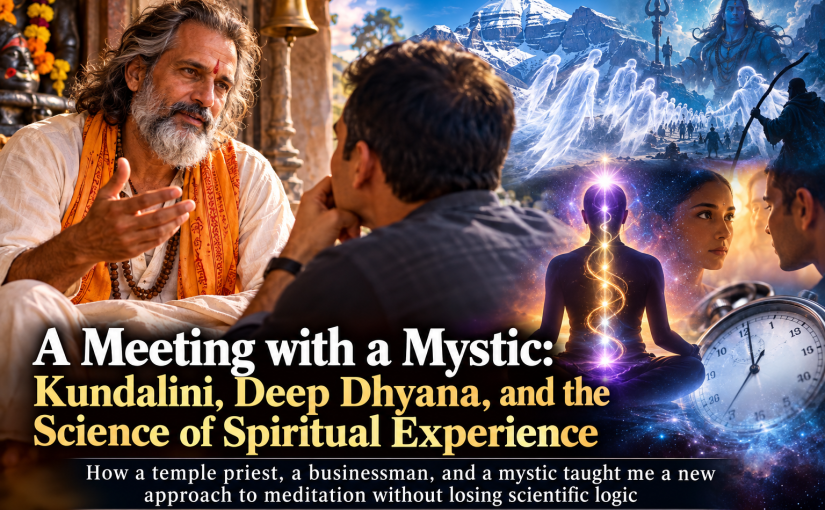
A few days ago, I met a strange and interesting personality who seemed to belong to both the worldly and spiritual worlds without being completely identified with either. His face, eyes, hair, and business-minded approach sometimes reminded me of a modern Western man, while his devotion to God gave him the appearance of a sage. People in his area called him a pujari, or temple priest. His companion also told me that he had obtained advanced qualifications in Sanskrit, including Shastri and Acharya degrees, from well-known institutions in places such as Kashi. This made me even more interested in interviewing him and exploring his understanding of spirituality, meditation, and the unusual experiences he described.
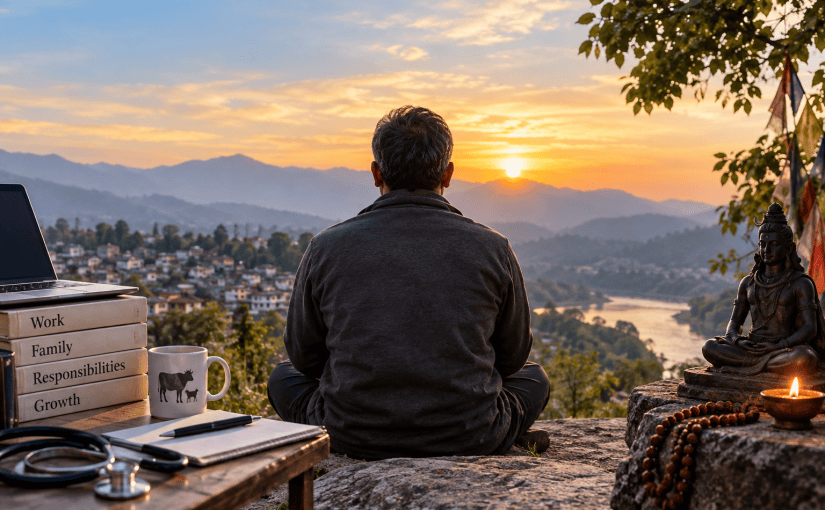
He had spent years in the transport business before leaving it and returning to his native village. He then served as a full-time priest in a small nearby temple for about six years. He told me that he had experienced real poverty there, yet found great spiritual satisfaction. Small village temples often receive little support from trusts or corporations and depend mainly on occasional donations from devotees. Despite these difficulties, he appeared to have found something meaningful in temple life.
He had not completely abandoned his former occupation. His son had taken over the transport business, and he occasionally visited to guide him before returning to the temple. He seemed to move between the two environments, taking refuge in spiritual practice when business became chaotic and returning to worldly responsibilities when needed. This reminded me of karma yoga, in which one participates in practical life without allowing its pressures to dominate one’s inner world.
Scientific Scepticism and Extraordinary Spiritual Claims
I noticed a certain gravity in his eyes. He appeared contemplative but remained alert to practical matters and external circumstances. Someone accompanying him told me that he could predict the future like an astrologer and even tell when a person was going to die.
I refused to accept miracles without evidence. He reportedly once told a sick woman that she would die soon, and she died the following morning. I found the claim difficult to accept as proof of supernatural knowledge. Perhaps he had intuitively noticed signs of approaching death, perhaps the prediction was a coincidence, or perhaps successful predictions were remembered more clearly than unsuccessful ones. Without knowing the circumstances and his record of predictions, no firm conclusion was possible.
When I pressed my tongue between my teeth and laughed with my mouth wide open, my expression indirectly conveyed my disbelief and astonishment at his claims. He immediately understood my reaction and said that he had stopped making such predictions because people might interpret them as black magic or tantra. His quick response impressed me. It suggested that he was observant of human behaviour, although such social intelligence could not establish the truth of his claims. However, I strongly oppose predicting someone’s death, as such a prediction can create intense psychological fear and distress. A person may begin to believe that death is inevitable at a predetermined time, potentially affecting their mental state and quality of life. Spirituality should offer people understanding, peace, and courage rather than fear of an uncertain future.
He also described seeing the spirits of people approaching death travelling towards Kailash. According to him, he had once visited Kailash in this way and seen spirits jumping across distances of enormous size while a force resembling a man with a stick chased them from behind. He claimed that he could visit any spiritual abode and speak with any god at will. These accounts were extraordinary, but I could not verify them. They might have represented vivid inner experiences, religious imagery, dreams, or interpretations shaped by his beliefs. Their sincerity and factual accuracy were separate questions. However, virtual external visual and other sensory experiences can be overlaid on inner spiritual experiences when one is open eyed.
I had similarly experienced a departed soul communicating with me. It was like an unexpressed self, containing all its sanskaras hidden within it, like a sky without any distinction between mouth, ears, face, or body. Yet I recognised it fully, even more deeply than I would recognise a living person. It felt as if my soul was directly connected to that soul and a mutual conversation was taking place between us, without the involvement of the senses or the ordinary mind, although the experience was much more effective than any communication that could have occurred through the senses and mind. It was a dream visitation, and my eyes were closed. There may be a scientifically understandable way to investigate this experience because I am clearly distinguishing the feeling of communication from actual verbal conversation. It felt as though one soul was directly experiencing another, although no physical words were spoken. words were also soul-like. Perhaps the mystic was trying to convey something similar, but our short conversation did not give us enough time to explore it. Others might interpret his account conceptually, as if he were describing events in the physical world. I now feel that I should meet him again and investigate these experiences more deeply, with an open mind and without abandoning scientific reasoning.
Kundalini Awakening, Bodily Sensations, and Deep Meditation
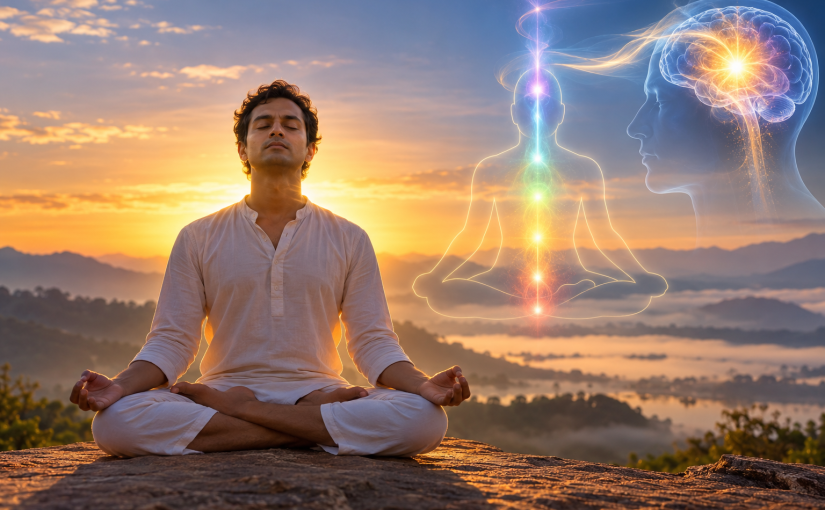
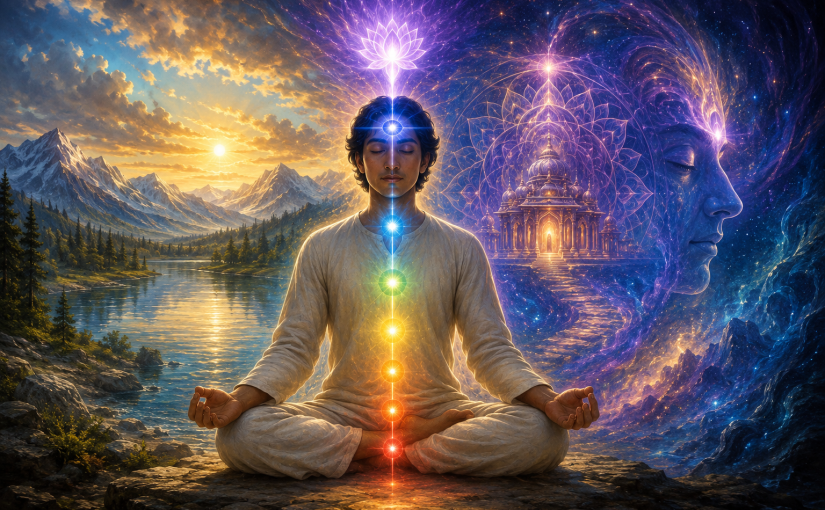
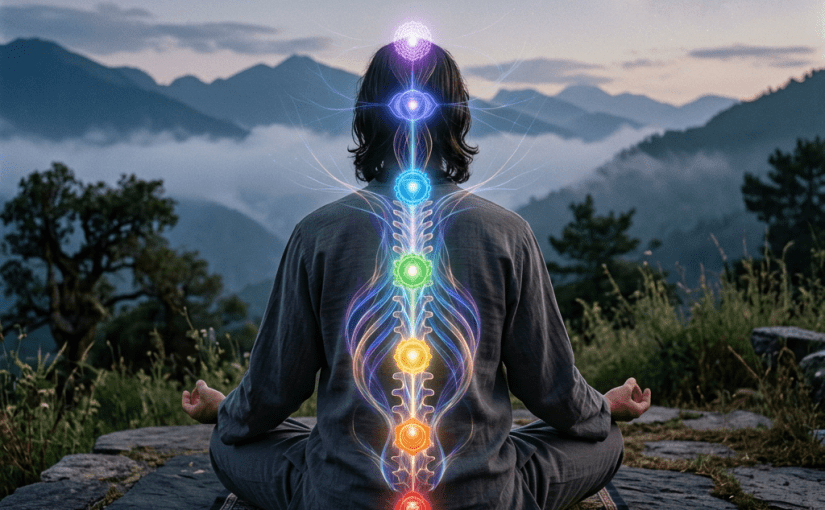
Our conversation became more interesting when we began discussing meditation. I told him that I accepted scientific explanations and did not believe extraordinary claims merely because someone made them. I explained that my own interest centred on Kundalini rising through the back and awakening at the Sahasrara, the crown chakra. He then suggested that what he described was essentially the same phenomenon.
He meant to say that supernatural things are not separate from Kundalini reaching Sahasrara or awakening. What he was describing, which looked supernatural, was just a manifestation of the same logical phenomenon of Kundalini ascent from Muladhara and awakening at Sahasrara. Both are the same thing. It means these manifestations may happen or may not, but awakening is logical and attainable through effort. We can say that other powers are like top-ups, not essential for dhyana and merging into the pure Self. As per Patanjali yogasutra, these top-ups can also act as distractions and prevent one from merging with the pure Self. For scholarly purposes, these things certainly need to be discussed with him. His acceptance of this connection gave me some hint of his genuineness; otherwise, one could completely glamourise these things as special and different.
I began questioning him through logic rather than accepting his explanation. He told me that he sometimes experienced rash-like sensations on his skin and a cap-like sensation at the centre of his head, which reminded him of the traditional depiction of the Buddha. Such sensations can have different physical or perceptual explanations, and they do not independently establish chakra awakening. Nevertheless, his account suggested that he had paid close attention to unusual bodily experiences during spiritual practice.
I told him that my deepest dhyana sessions sometimes lasted about two hours. He replied that he could meditate for six hours while feeling that only ten minutes had passed. When I mentioned that my knees became sore during long sessions, he advised that short dhyana of ten minutes could be better. I objected that ten minutes seemed too short. He quickly clarified that ten minutes was only the intention: one might enter meditation aiming for ten minutes, remain absorbed for half an hour, and feel that only ten minutes had passed.
His responses were quick, practical, and adapted to my objections. I wondered whether he was trying to establish his spiritual authority, but I also sensed that he might have genuine experience of prolonged meditation. He said that six-hour sessions had caused bodily aches. This was a useful reminder that prolonged sitting can strain the body and that meditation need not be measured by the length of a session.
When I asked whether he had experienced complete awakening or self-realization that lasted only about ten seconds, he answered that it had lasted a very long time. I questioned this because my own most intense awakening-related experience had been brief and energetically powerful. I had assumed that the body could not tolerate such intensity for long. He replied that he knew from his own experience.
I later considered another interpretation: perhaps he had experienced a brief glimpse of awakening followed by prolonged Nirvikalpa-like absorption. His regular, full-time practice might have enabled him to remain in deep dhyana for longer than I usually did. This remained a possibility rather than a confirmed explanation. A brief experience of insight, prolonged meditative absorption, and lasting self-realization are different phenomena and should not be confused. The duration of meditation alone cannot establish the depth of realization.
The Meditation Technique That Changed My Next Session
Although our conversation lasted no more than twenty minutes, I received several practical suggestions. The next day, I applied one of them. He had advised me to observe breathing quickly and establish dhyana without hoping or planning for a long sitting. The aim was to enter meditation as naturally and quickly as possible by observing the breath, its bodily sensations, and the movements it produced throughout the body.
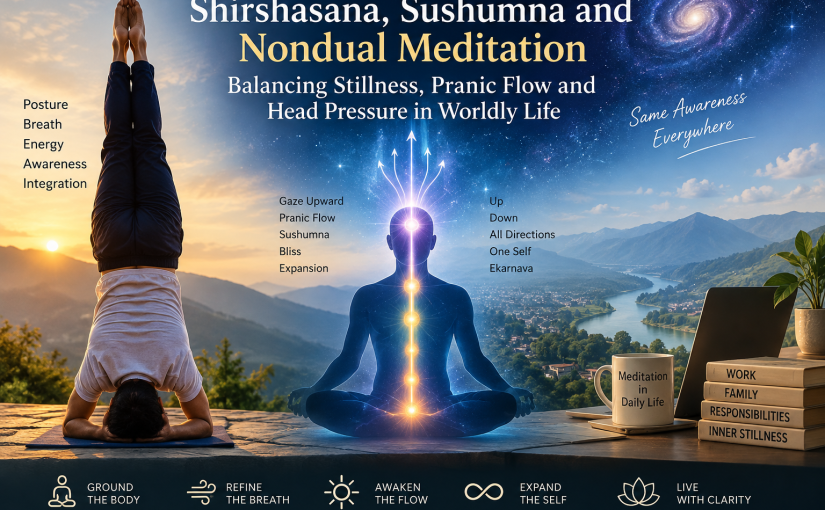
He had also suggested scanning the whole body from top to bottom within a single field of awareness. On very next day morning, I followed this approach. After preparatory yoga for about an hour’s duration to open the energy chanels, I sat for dhyana. I relaxed my body and started observing it along with breath. Within two or three minutes, I entered deep dhyana. My breathing became almost silent. As the body became more settled and the agitation of prana diminished, I continued scanning the body from top to bottom and then directed my attention towards the Ajna chakra, the centre associated with the space between the eyebrows.
My meditation then deepened into the void I call ekarnava, an experience of vast inner emptiness. When my knee began to hurt, I opened my eyes and checked my watch. Thirty minutes had passed, although it had felt like only ten. This closely resembled the altered sense of time the mystic had described.
The experience did not prove his claims about spirits, divine realms, or supernatural prediction. It did, however, give me a practical method worth exploring. Whole-body awareness, natural observation of breathing, and the reduction of effort seemed to help me enter deep dhyana quickly. The change in my perception of time was also consistent with what can happen during sustained concentration. I did not need to force my breathing, hold it, or attempt to produce a particular state.
I was careful not to treat this single session as proof that the method would always produce the same result. Nor did I regard knee pain as an obstacle that must be overcome at any cost. Meditation should respect the body’s limits, and posture changes or shorter sessions may be wiser than prolonged static sitting.
A Tantric Mystic and the Limits of Spiritual Interpretation
The man also described meeting a Buddhist-like mystic woman who proposed an unusual meditation exercise. She said that she would keep her eyes open and look at him, and he should look back with open eyes to enter deep dhyana. He told me that he could not meditate deeply with his eyes open, so he closed them.
Open-eye meditation is practised in several Buddhist traditions, including Zen and Tibetan Buddhism. Depending on the method, it can involve a relaxed gaze or sustained attention to an object or person. Closing the eyes, by contrast, often makes inward attention easier by reducing visual stimulation. Neither method is universally superior.
I felt that the man was aligned with Tantra in some way, even he told he had once lived like an Aghori tantric also, yet he also appeared practical and fully human. His business experience, devotion, bodily sensations, long meditation sessions, and unusual spiritual beliefs did not fit neatly into the image of a conventional ascetic. However, these characteristics alone could not establish his spiritual lineage or prove that he had attained enlightenment.
Perhaps he had genuine contemplative experience and interpreted it through a religious framework. Perhaps he was also highly skilled at reading people and responding to their objections. It was possible that he exaggerated some experiences, but I had no conclusive evidence that he was deliberately deceiving me. The sensible approach was to remain curious without accepting every claim.
He also told me that he could establish dhyana for a long time while standing. I tried this myself and found that keeping every part of the body, from head to toe, in constant and equal awareness helped me maintain the state. It felt as if thoughts continued to emerge while I witnessed them, and my mind kept clearing, leaving me immediately refreshed after intense mental tiredness. It was not like Nirvikalpa Dhyana, but rather prolonged witnessing that might gradually merge into Nirvikalpa Dhyana. However, I ended the standing practice before that could happen because someone who had been waiting to meet me arrived.
What This Meeting Taught Me About Science, Spirituality, and Self-Realization
The most valuable part of this encounter was the discovery that a person can offer practical knowledge even when some of his explanations remain doubtful. I initially rejected his supernatural claims, yet I continued listening when he discussed meditation. The following day, I tested his advice and experienced a useful change in my practice.
This distinction matters in contemplative psychology and the scientific study of consciousness. A person’s interpretation of an experience may be mistaken even when the experience itself is sincere and meaningful. Conversely, impressive spiritual language, a grave expression, or prolonged meditation does not by itself prove self-realization. More reliable understanding requires careful observation, logical questioning, openness to correction, and a willingness to distinguish personal experience from objective evidence.
My meeting with this mystic also challenged the idea that worldly intelligence and spiritual practice must oppose each other. He could guide a transport business, return to temple life, and find relief from commercial pressures through meditation and devotion. His life suggested that participation in the world and inward contemplation can coexist.
The greatest lesson was simple: we can learn from people without accepting everything they believe. Genuine curiosity does not require blind faith, and scientific scepticism does not require closing the door to experience. When we meet someone with friendliness, listen carefully, ask logical questions, and test what can reasonably be tested, even a brief conversation may offer something valuable.
I cannot verify the mystic’s claims about Kailash, spirits, or divine communication. But I can report what happened when I applied his advice about dhyana. That distinction allows me to preserve both intellectual honesty and the willingness to learn. Perhaps the real value of the encounter was not discovering a person who possessed extraordinary powers, but discovering a practical insight into meditation through an unexpected source.