How Worship of Different Gods Can Purify Different Emotions and Prepare the Mind for Nondual Meditation and Kundalini Yoga

Happy Krishna Janmashtami Festival to All

Different Gods as Different Doors of Emotional Surrender

I have been looking at worship of gods and goddesses in a somewhat different way. I do not see all idols only as objects to whom one offers flowers, prayers and devotion. I also see them as different symbolic forms through which different kinds of emotions can be surrendered. The human shape, face and familiar stories of a deity make this easier for the mind. An emotion is otherwise invisible and difficult to hand over to something abstract, but when I stand before a recognizable divine form, I can consciously place a particular class of emotions, memories and experiences before that form. The idol therefore becomes a practical meeting point between my personal emotional life and a larger spiritual symbol.

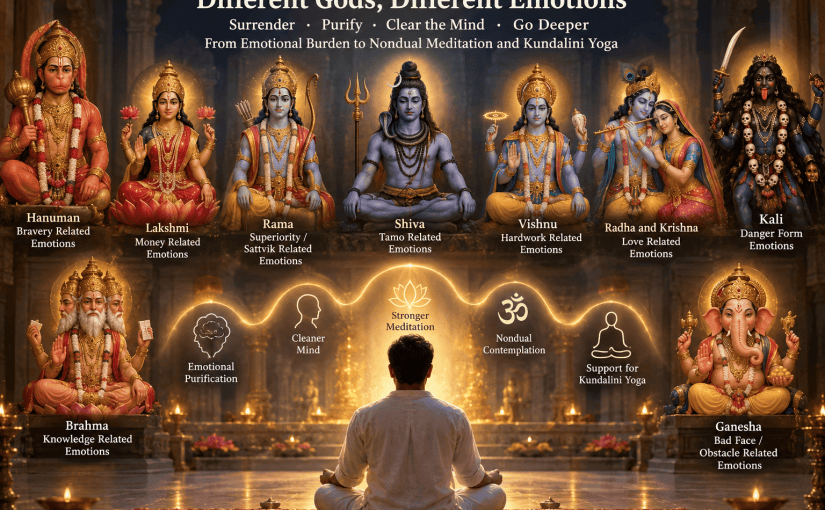
My experience with Hanuman made this especially clear to me. I stood in front of Hanuman and surrendered all kinds of emotions and incidents connected with bravery. I did not surrender only the idea of courage. I surrendered the emotional burden associated with being brave, the memories of situations in which bravery had been expressed, and the feelings that had gathered around those experiences. After doing this I felt quite relieved and disburdened. This was important because it showed me that surrender does not necessarily mean destroying a quality. I was not trying to lose courage or become weak. I was trying to release my attachment to carrying all the psychological material connected with courage.

This idea then became broader. Hanuman can be one form for one class of emotional material, but other gods and goddesses can serve as suitable forms for other classes. In this way, worship need not be psychologically identical every time. The particular deity gives the mind a particular symbolic direction.

Lakshmi, Rama, Shiva and Vishnu as Different Emotional Purifiers

For me, Lakshmi can become a focus for purification of money-related emotions. Money carries many kinds of psychological material: greed, fear, insecurity, pride, attraction, competition, status-consciousness and anxiety about losing what one has. Instead of allowing all these feelings to remain mixed together inside the mind, I can bring them before Lakshmi and surrender them. The purpose is not to reject money or prosperity. It is to reduce the emotional burden and attachment surrounding them so that money can remain a practical part of life without becoming an excessive psychological identity.

Rama can similarly become a focus for emotions connected with superiority, righteousness and even sattvik identity. This is important because not every difficult emotion is obviously negative. A person can become proud of being good, pure, disciplined, spiritual or morally superior. Even sattvik qualities can therefore become material for ego. By surrendering these emotions before Rama, I can retain the quality of righteousness without carrying the feeling that I am superior because of it.

Shiva, in my framework, can become a focus for tamasic emotions and heavier inner tendencies. This includes dullness, darkness, destructive impulses, heaviness and other forms of emotional material that may be difficult to approach directly. Instead of constantly fighting such tendencies mentally, I can place them before Shiva as a symbolic act of surrender and purification.

Vishnu can represent another kind of emotional burden, especially that connected with hard work, preservation, responsibility and the effort required to continue one’s worldly duties. Work itself is not the problem, just as courage itself is not the problem. The burden may come from attachment to achievement, pressure, exhaustion, pride in one’s effort or the feeling that everything depends personally on me. Surrendering this material can allow work to continue while reducing the psychological weight carried with it.

Radha and Krishna, Kali, Brahma and Ganesha

Radha and Krishna can serve as a focus for love-related emotions. Love can be beautiful, but it can also become attachment, longing, possessiveness, jealousy, fear of separation, emotional dependence and repeated mental involvement with another person. By bringing these emotions before Radha and Krishna, the aim can be to purify the emotional intensity without rejecting love itself. Love may remain, but the clinging around love can become lighter.

Kali provides a particularly powerful symbolic form for emotions connected with danger, fear, threat and intense vulnerability. When the mind carries danger-related emotions, it can remain prepared for something bad even when no immediate danger exists. Bringing such emotions before Kali can create a strong symbolic act in which fear and the feeling of threat are consciously surrendered. The terrifying form itself can make this surrender psychologically meaningful because it does not require fear to be hidden or softened before approaching the symbol.

Brahma can become a focus for knowledge-related emotions. Knowledge is valuable, yet knowledge can also create pride, intellectual superiority, attachment to being right, the need to display understanding and an identity built around knowing. Surrendering knowledge-related emotions before Brahma does not mean rejecting knowledge. It means trying to separate knowledge from the ego that can grow around knowledge.

Ganesha can become useful for another category of emotions, including feelings connected with one’s appearance, obstacles, embarrassment, unfavorable self-image or the sense that one’s face or body has something wrong with it. A form that itself differs from ordinary human appearance can become a particularly meaningful symbol here. Instead of remaining ashamed of an appearance-related feeling or repeatedly fighting it, I can bring it into the presence of Ganesha and surrender the emotional burden attached to it.

There can naturally be many more such associations. The list does not have to end with the major deities. Different forms, stories and qualities can provide different symbolic containers for different emotional burdens. What matters is the relationship between the deity and the emotional material being surrendered.

Worship as Emotional Purification Rather Than Mere Ritual

In this understanding, idol worship becomes a practical method of emotional purification. Different gods do not necessarily have to be understood as mechanically removing different emotions from the mind. Rather, the traditional qualities and forms associated with them help the mind organize and surrender different kinds of psychological material. One form may naturally draw courage-related emotions, another wealth-related emotions, another love, another fear, another knowledge, another ego connected with virtue, another heaviness and so on.

The physical idol itself is only the outer support. The deeper process happens in the mind. I stand before the form, recognize what I have been carrying, consciously offer it, and allow myself not to hold it so tightly. The emotional burden may then become weaker. Repeated practice can make this process more familiar. The emotions do not necessarily vanish permanently, and there is no requirement that the mind become emotionless. What changes is the amount of unnecessary attachment, repetition and identification surrounding them.

This is why I find the word purification useful. A purified mind does not mean a blank mind or a mind incapable of strong feeling. It means a mind in which emotions can arise without every emotion becoming another object of possession, struggle or identity. Courage can remain courage without becoming a burden. Knowledge can remain knowledge without becoming superiority. Love can remain love without becoming excessive attachment. Money can remain useful without becoming the center of psychological security. Hard work can continue without carrying endless pressure. Spirituality itself can remain without creating the feeling of being better than others.

From Emotional Clearing to Nondual Contemplation

Once emotional burdens have been eased, I can see how the mind may become more suitable for meditation. A mind constantly occupied by unresolved memories, fears, pride, attachment, achievement and personal stories has less attention available for subtle contemplation. When some of this material is surrendered, the mind can feel quieter and less crowded.

This gives a natural place to the nondual practices that I follow, including what I call sharirvig darshan and quantum darshan. These forms of contemplation require a different quality of attention from ordinary emotional thinking. The less the mind is pulled around by personal emotional material, the easier it may become to stay with a subtle idea, observation or contemplative image. In this sense, devotional worship and nondual meditation do not have to be competing paths. Worship can prepare the emotional ground on which deeper contemplation becomes easier.

The idol also has another role here. The physical form provides a stable image for the mind. By repeatedly looking at the face, posture and overall form of the deity, the image may gradually become established inwardly. With concentration, the physical idol is no longer the only place in which the form exists for the practitioner. The image can become increasingly available in meditation. Emotional surrender may make this easier because a less burdened mind is less easily distracted.

Thus there can be a practical progression: emotion is recognized, emotion is surrendered, emotional burden becomes lighter, the mind becomes cleaner, attention becomes steadier, the meditation image becomes stronger, and deeper contemplation becomes possible.

How This May Support Kundalini Yoga

I therefore see worship of gods and goddesses as potentially supportive of Kundalini yoga. I do not mean that worship automatically raises Kundalini or that a particular idol mechanically produces a particular energetic effect. The connection is more practical and experiential. Kundalini-oriented meditation requires sustained attention, inner stability and the ability to remain with subtle bodily and mental experiences. Emotional turbulence can make this difficult. Emotional purification may therefore help prepare the mind for the practice.

When different emotional burdens are consciously surrendered through different divine forms, the mind may become less entangled in its own history. This does not mean abandoning ordinary life. In fact, the qualities represented by the deities can remain fully available. Hanuman can represent courage, Vishnu work and preservation, Lakshmi prosperity, Rama righteous conduct, Shiva the transformation of heavy tendencies, Radha and Krishna love, Kali confrontation with danger, Brahma knowledge and Ganesha the overcoming of obstacles and difficult self-image. The goal is not to get rid of these qualities but to reduce the emotional ownership and burden associated with them.

This also connects with ego. A positive quality can become a source of bondage when it turns into identity. “I am brave,” “I am knowledgeable,” “I am spiritual,” “I am righteous,” “I am successful,” or “I am the one who works hardest” can all become heavy identities. Surrender allows the quality to remain while softening the claim of ownership around it. The person can still be brave when bravery is needed, work when work is needed, love when love is present and use knowledge when knowledge is useful, without constantly carrying the psychological demand to prove that identity.

The Spiritual Symbol and the Quantum Idea

I also connect this understanding with the physical nature of idols. An idol is made of matter, just as the human body and the rest of the physical world are made of matter. From a philosophical point of view, this can be contemplated as part of a common physical reality. I sometimes use the language of quantum particles to think about this deeper commonality. The human form of the deity then becomes a practical appearance through which consciousness relates to something that, in a deeper philosophical view, is not fundamentally separate from the rest of existence.

At the same time, I find it important to distinguish my contemplative interpretation from a scientific claim. It is reasonable to say that physical idols consist of ordinary matter and ultimately of physical constituents described by physics. It is not an established scientific fact that particular gods or specific emotions are literally particular quantum particles. The quantum language can therefore be kept as a philosophical or meditative way of understanding unity and interconnectedness rather than presented as proof of a specific religious interpretation.

This distinction does not reduce the value of the experience. The practical effect can still be meaningful. A symbol can change the way the mind relates to an emotion without requiring a scientific theory to validate every aspect of the symbol. The relief I experienced before Hanuman is a direct example. I surrendered my bravery-related emotions and incidents and felt lighter afterward. That experience itself is the foundation of my understanding.

However, as per Quantum Darshan every emotion resides in quantum particle. It is other thing they are not aware of them, leave alone attachement to these. That is why ancient saying god resides in every particle. They even not knowing quantum science knew its spiritual essence it seems. So it is like technique to become detached with all emotions by surrendering them to quantum particles. Different outer forms like different masks applied to them.

All emotions are basically in nature and we have only learnt these from there. Idol worship is like returning that all emotional burden back to nature that have been obtained from it.

Many Divine Forms, One Movement Toward Inner Freedom

Seen as a whole, my understanding of god worship is therefore not about choosing one deity as the only correct emotional purifier. Different forms can provide different doors into the same larger process. Lakshmi can help me examine money-related attachment. Rama can help me soften superiority and even pride in sattvik qualities. Shiva can help me surrender heavy and tamasic tendencies. Vishnu can receive the burdens attached to work and responsibility. Radha and Krishna can receive love-related attachment. Kali can receive fear and danger-related emotions. Brahma can receive knowledge-related pride. Ganesha can receive emotions connected with obstacles and unfavorable self-image. Hanuman can receive bravery-related experiences and the burden of identifying too strongly with courage. Many other deity forms can naturally occupy similar roles according to their qualities and according to the particular emotional material of the practitioner.

The deeper movement is the same: what has been psychologically carried as “mine” can be consciously surrendered. When this is repeated, the mind may become cleaner and less burdened. A cleaner mind may contemplate nonduality more easily. A steadier mind may develop meditation imagery more strongly. Deeper meditation may then provide a better foundation for Kundalini-oriented practice.

For me, this makes idol worship far more than an external religious activity. It can become a practical psychology of surrender. The idol gives a face to the abstract, the deity gives a symbolic direction to the emotion, surrender reduces the burden of personal ownership, and the resulting lightness can prepare the mind for deeper contemplation. I do not have to destroy my emotions, nor do I have to destroy the qualities associated with them. I can allow courage, love, knowledge, work, prosperity, righteousness and strength to remain while surrendering the unnecessary psychological weight around them.

My experience before Hanuman gave me the clearest starting point for this understanding. I stood before the image, gave away the emotions and incidents connected with bravery, and felt relief and disburdenment. From there I began to see a larger possibility: perhaps every divine form can become a doorway for surrendering a different emotional burden. Through many such doors, the mind can gradually become lighter. And when the mind becomes lighter, it may become more capable of the stillness, imagery, nondual contemplation and subtle awareness through which my meditation and Kundalini practice can continue to deepen.

Janamejaya’s Sarpa Yajna: Are Serpents Really a Symbol of Kundalini Power?

The stories of the Puranas do not merely describe events; they can also be read as symbols of consciousness, the inner life of human beings, and spiritual practice. From this perspective, Janamejaya’s Sarpa Yajna becomes a particularly fascinating story. Traditionally, the episode appears as a vast sacrifice performed for the destruction of serpents, but if the serpent is understood as a symbol of the power within us that governs both the body and consciousness, several aspects of the story begin to take on an entirely different meaning. It is not necessary to claim that this was the historical or original meaning of the Purana. Rather, when the story is read from this perspective, certain spiritual संकेत contained within it may become visible.

When the Serpents Fall into the Fire

In Janamejaya’s Sarpa Yajna, serpents were being drawn down one after another from above and falling into the sacrificial fire, where they were consumed. If this scene is viewed by taking the serpent as a symbol of Kundalini power, it becomes a deeply meaningful image. A power that possesses the potential to rise upward is being repeatedly drawn downward and destroyed in the same fire.

From a yogic perspective, the region of Manipura is associated with digestion, fire, sustenance, and various fundamental processes of the body. In this context, the Sarpa Yajna can be understood as a metaphor for a state in which most of a person’s life-force is continually spent on food, digestion, sensual enjoyment, security, accumulation, and the maintenance of the body. The power is present within, but its direction remains predominantly downward and outward.

A person eats, digests, maintains the body, fulfills desires, and invests energy in the material necessities of life. There is nothing inherently wrong with this—it is necessary for the body. The problem arises when the entire life-force becomes confined to this cycle and the person forgets that this very same power can also become a means for the upward development of consciousness.

From this perspective, the continuous falling of serpents into the fire can symbolize the depletion of an inner potential in which the power exists, but is being used only for lower-level processes of life.

Why Do the Serpents Need to Be Saved?

The appeal to stop the Sarpa Yajna also becomes significant from this symbolic perspective. If the serpent is viewed merely as a creature, then this is simply an episode in the story. But if the serpent is understood as a symbol of Kundalini power, the message changes.

Power does not need to be destroyed.

The real question is: In which direction is that power flowing?

The same life-force within a human being keeps the body alive, digests food, activates the senses, generates desire, and provides the capacity to act in the world. But through spiritual practice, that very power can also move toward subtler levels of consciousness. Therefore, the problem is not the power itself, but the lack of understanding of how it is being used and where it is directed.

If the serpents were completely destroyed, then symbolically it would mean that the very fundamental power capable of transforming consciousness had been eliminated from within the human being. Instead of destroying the power, it is necessary to understand its nature.

Parikshit, Takshaka, and Another Meaning of the Serpent

When this symbolism is connected with the story of Parikshit, the perspective becomes even more interesting.

Parikshit dies after being bitten by the serpent Takshaka. In the traditional story, this is the consequence of a curse. Parikshit had insulted a meditating sage by placing a dead serpent around his neck, and this incident ultimately led to the curse that he would die from a serpent’s bite. But if the episode is read symbolically, the image of the dead serpent can also suggest something different.

The dead serpent lying around the neck of the meditating sage may be understood as a symbol of a power whose outward movement has become still. The serpent’s ordinary activity has ceased; it appears motionless and inactive. But has the power really disappeared? Or has it merely withdrawn from its ordinary expression and entered a subtler state?

This is where the possibility of discovering a spiritual meaning in the story begins to emerge.

While listening to the Bhagavata story during the final days of his life, Parikshit moves toward the end of his earthly existence. Ultimately, his life comes to an end in the form of Takshaka, the serpent. If this death is not read merely as physical death but symbolically as the ending of the old ego-centered personality, then Takshaka ceases to be merely a destructive serpent. He can also become a symbol of the transformative power that brings the limitations of the old personality to an end.

Here, “death” need not mean the end of the body. It can be understood as the ending of the ego-centered identity through which a person confines himself.

The story says that Takshaka assumed a subtle form, concealed himself within a bunch of flowers brought for worship, and eventually reached Parikshit. If this episode is read from the perspective of yogic symbolism, this detail becomes extremely interesting. In the yogic tradition, the Sahasrara chakra is regarded as a lotus with a thousand petals, and it is at the Sahasrara that the highest awakening of consciousness is described. In the Indian spiritual tradition, the lotus has not merely been a flower but has also been a symbol of the blossoming of consciousness. Therefore, Takshaka’s arrival while concealed within a bunch of flowers can, from this perspective, be understood as a subtle indication—as though the serpent in the form of Kundalini is making its final journey toward the lotus of the Sahasrara.

If Takshaka is regarded as a symbol of Kundalini power, then Parikshit’s death from Takshaka’s bite need not be understood merely as physical death. It can also be viewed as the ending of the old body-based ego and limited personality, after which a higher state of consciousness emerges. In this sense, the “death” in the story may symbolically also be an “awakening”—an awakening in which the seeker moves beyond his limited ego-identity and recognizes a more expansive nature of consciousness.

Takshaka, then, is no longer merely a poisonous serpent that brings death; he can become a symbol of the very Kundalini power that reaches the Sahasrara and brings the seeker’s old identity to an end. From this perspective, Parikshit’s death may actually represent the death of the person who considered himself to be merely the body and the ego, while hidden behind it is the birth of a new consciousness.

What Was Janamejaya’s Mistake?

It is here that Janamejaya’s Sarpa Yajna becomes a profoundly psychological symbol.

The simple equation before Janamejaya was: a serpent caused my father’s death, therefore the serpents must be destroyed.

But at the symbolic level, this can represent a common psychological mistake. When a power within us brings about transformation and our old identity begins to break down as a result, the ego may begin to regard that very power as its enemy.

The process of liberation can sometimes appear like death from the outside.

Old desires change. Old identities weaken. The influence of former attachments diminishes. The ideas we have constructed about ourselves begin to break apart. For the ego, all of this may feel like some kind of ending.

At such a moment, a person may begin fighting against the very power that is bringing about the transformation.

Symbolically, Janamejaya’s Sarpa Yajna can therefore be seen as an image of this mentality—he wants to destroy the very power that could lead toward liberation because he mistakes it for the cause of death.

The Serpent Is Power, Not an Enemy

From this perspective, perhaps the most important message of the story is that destroying the serpent is not the solution.

The serpent can be a symbol of power.

The same power flows downward and sustains the body and its fundamental life processes, while that very power, through spiritual practice, can rise upward and become a means of transforming consciousness.

Therefore, spiritual practice is not a war against the body. Nor is its purpose to destroy the body or escape from material life. Its purpose is to understand that the power active within the body is not meant only for physical existence.

If all energy continues to be spent on hunger, digestion, sensual pleasure, fear, security, accumulation, and survival, then very little energy and attention may remain for the higher dimensions of consciousness. But when that same life-force becomes more balanced and aware and turns inward, a person may begin to perceive his own existence from an entirely different level.

Here, the concept of Kundalini can be understood not merely as some mysterious energy, but also as a symbol of the inherent transformative potential within a human being.

The Deepest Message of the Sarpa Yajna

When Janamejaya’s story is read from this perspective, the Sarpa Yajna is no longer merely a story about the destruction of serpents. It can become a symbol of a conflict taking place within the human being.

On one side is the life-force that keeps the body alive and enables a person to remain active in the world.

On the other is the potential of consciousness to give that same power an upward direction.

If a person spends his power solely on material necessities, his life continues, but the development of his consciousness may remain limited. If he understands that power and gives it a more upward direction through spiritual practice, awareness, and inwardness, that same life-force can become an instrument of inner transformation.

Thus, in this symbolic interpretation, Janamejaya’s Sarpa Yajna gives us a message not about destroying power, but about understanding it.

The serpent does not need to be killed; the nature of the serpent needs to be understood.

Power itself is not the problem. The problem is that human beings often fail to recognize their own power and continue to use it without understanding its direction.

The same power flowing downward sustains the body.

The same power rising upward can transform consciousness.

And perhaps this is why the serpent has remained such an important symbol in Indian spirituality—it is not merely a symbol of fear, poison, or death, but also of hidden power, transformation, and the possibility of awakening consciousness.

Thus, when read symbolically, Janamejaya’s Sarpa Yajna may point toward a profound psychological mistake: the very power that a person regards as the cause of his bondage may also be the means through which he becomes free.

An Evening Conversation on Faith, Spirits and Yoga

A few days ago, while on my evening walk after an early dinner, I stopped at a fellow’s shop to sit for a while. His neighbour, who runs a gosadan (cow shelter), and known to me since few months had recently broken his arm when a herd of cattle rushed toward the gate, breaking it while he was leaning on it. I had come there to offer sympathy and a helping hand, but he was not there at that moment. A few months earlier, his 14‑year‑old son had passed away from a rare disease.

I had often noticed a mysterious dark mixed glow in this man’s eyes. Despite his suffering, he is a devout follower of Lord Shiva and every year he, along with his entire team, arranges food (langar) for pilgrims during the month‑long Manimahesh Yatra in the hills.

While sitting there, I said to the shopkeeper that perhaps the neighbour was under bad stars or some evil influence and that he might visit a nearby city yoga guru to remove this effect. The shopkeeper immediately denied the efficacy of yoga for removing evil spirits.

I told him, “I have myself evaded such a spirit.”
He asked, “How?”

I explained: “Whenever that spirit tries to come in my dream, my guru appears there and tells it to leave me and come to him. I simply put my dhyana on my guru and pray for the peace and liberation of that spirit. It is not evil, but who would want to frequently encounter something paranormal?”

Hearing this, he softened a little.
Then he asked, “Who is your guru?”

I replied, “It should not be told to anyone.”
He asked again, “But it must have some form?”

I said, “Yes. Sometimes my guru appears as my Dadaji, sometimes as Shiva, and sometimes as Narayana, depending on the situation.”

Hearing this, and being himself a member of the Manimahesh team, he began speaking as if he knew more. He said, “Shiva cannot be worshipped. Shiva is Mahakaal. He doesn’t save, he destroys as per one’s Karma. One can become Shiva but can’t worship him. One has to become Shiva to gain benefit.”

I wondered silently: How can one become one’s favourite deity without first admiring, honouring, and worshipping it?

Then he added, “Only a Satguru can save from evil spirits, not others.”

Again, I reflected: He first opposed yoga but now he praises the Satguru — and a Satguru becomes functional only through yoga and dhyana.

That small conversation once again highlighted for me the importance of open discussion to grow and to deepen understanding.

Human problems also activate Kundalini

What are the human problems

Problems of people that are superficial or unreal, and which do not harm themselves or others, are called humanitarian problems. For example, one realizes the problem of breaking up of a relationship. Although the reality is that his love affair had never started. Premyogi vajra had a similar surprising feeling, which helped him to experience momentary self-awakening.

We take another example of fasting. That sounds like a problem to us, but in reality it is not. Along with body and mind, fasting also provides energy to the Kundalini.

The problem for humanity is also a human problem

Spiritual activities like chanting, penance, yoga etc. are good examples of this. To bear the problem for the country, society, human religion, family etc. is a human problem. The more people become benefitted from goodness, purity and intensity of the problem, the better will be its humanity.

What happens with human problem

A man with a human problem starts loving humanity . He starts loving all humans. The image of a special human being (Guru, Friend, Dev etc.) starts residing in his mind. With time, that image becomes a Kundalini. The same happened with Premyogi vajra. Due to his hyperactivity running under the influence of physiology philosophy, the image of that spiritual old man was confirmed in his mind .

How Kundalini develops due to human problem

When Kundalini becomes very strong in one’s mind, then there comes a time when he breaks due to a double burden of work and Kundalini. In such a situation, as soon as any major problem comes in his way, he surrenders completely to Kundalini, and becomes dependent on Kundalini. With this, his Kundalini becomes active.

How then activated Kundalini is awakened

After the Kundalini becomes active in a problem-filled man, his mental depression decreases, and his pleasure/bliss increases. This increases his faith in Kundalini, and he feels that it is his Kundalini that protects him from all problems. Then he starts studying and practicing the yoga type literature. This keeps his knowledge and practice related to yoga moving forward. Eventually, his Kundalini is awakened.

How Premyogi Vajra got the escape velocity for his Kundalini from his problem

Premyogi vajra was broken, physically as well as mentally, by the human problems being received under the influence of physiology philosophy, various human activities and the burden of non-duality/Kundalini all together. His memory was also reduced significantly. Although his mind had felt an increase in joy/bliss and peace. Then he got the opportunity to live in a picturesque place with family in peace that was too far away from his home. He bought a state-of-the-art and very expensive vehicle to travel from home to there. He did not get a driver seat comfort in that. He was very sorry, but what had to happen, that had been done. In order to handle himself, he started  meditating his kundalini while completely surrendering himself fully in front of her. With this, his Kundalini started glowing, and his anxiety almost ended. Convinced of this, he started learning and practicing yoga with the help of e-books, paper books, internet and friends. Due to this, his Kundalini became very strong in a year. In the last one month of his that practice, she awoke when he took the help of sexual yoga. After that he got used to his car, and came to know that his car’s comfort was more than that of other vehicles. This means that his problem was not real, but it was unreal, which was born in him to awaken his Kundalini.

Surrender to kundalini is the surrender to God

The real problem should be after a lot of efforts for success

If the problem is faced only after few attempts, then the man’s faith remains on the physical world, and he does not surrender fully to the Kundalini. But when the man realizes the loss even after making a lot of efforts, his faith in the vulgar and diversified world is lost, and he completely kneels in front of the Kundalini {a single mental image} to get prana-juice or life-juice without much physical efforts. It is theorized that the problems that occur after a lot of efforts are virtual or positive, not real or negative.

This kundalini inducing problem {so called emotional and psychological trauma} can be better defined as positive and temporary loss of faith in the physical world

This kundalini inducing problem is defined as emotional and psychological trauma by so many. Although it is not trauma actually for trauma carries one down, not uplifts up to kundalini heights. Actually it should be called as positive and temporary loss of faith in the physical world, which propels one towards the mental world of kundalini.

According to Tantra, Kundalini is easily attained only by filling the mind with physical worldliness.

A man should experience every sphere of life {as Premyogi vajra had experienced}; otherwise, his mind will remain in the physical world out of longing for it. He must also be sufficiently rich {as was Premyogi Vajra}; otherwise, he will remain worried about earning, so that his mind will not be removed from the physical world. It is a straightforward matter that the person whose mind is filled with positive, karmic and human colours of the physical world, gets the opportunity to rise above the world easily.

Enlightenment by Kundalini’s dissolution

Doing Yoga-Sadhana/yoga, there comes a time when Kundalini starts dissolving in the soul. Then the person’s trust moves away from the Kundalini and focuses on the soul. Only then, he gets glimpse enlightenment. The same happened with Premyogi vajra, which he has described in detail in his book “Physiology Philosophy – A Modern Kundalini Tantra (A Yogi’s Love Story)” in Hindi and in the book “Love story of a Yogi- what Patanjali says” in English.

कृपया इस पोस्ट को हिंदी में पढ़ने के लिए इस लिंक पर क्लिक करें (मानवतापूर्ण समस्याएँ भी कुण्डलिनी को क्रियाशील करती हैं )