Happy Krishna Janmashtami Festival to All
Different Gods as Different Doors of Emotional Surrender
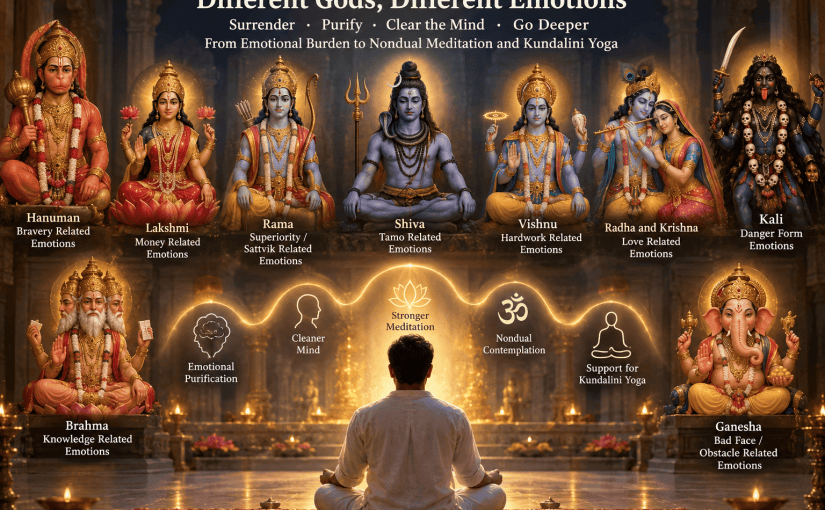
I have been looking at worship of gods and goddesses in a somewhat different way. I do not see all idols only as objects to whom one offers flowers, prayers and devotion. I also see them as different symbolic forms through which different kinds of emotions can be surrendered. The human shape, face and familiar stories of a deity make this easier for the mind. An emotion is otherwise invisible and difficult to hand over to something abstract, but when I stand before a recognizable divine form, I can consciously place a particular class of emotions, memories and experiences before that form. The idol therefore becomes a practical meeting point between my personal emotional life and a larger spiritual symbol.
My experience with Hanuman made this especially clear to me. I stood in front of Hanuman and surrendered all kinds of emotions and incidents connected with bravery. I did not surrender only the idea of courage. I surrendered the emotional burden associated with being brave, the memories of situations in which bravery had been expressed, and the feelings that had gathered around those experiences. After doing this I felt quite relieved and disburdened. This was important because it showed me that surrender does not necessarily mean destroying a quality. I was not trying to lose courage or become weak. I was trying to release my attachment to carrying all the psychological material connected with courage.
This idea then became broader. Hanuman can be one form for one class of emotional material, but other gods and goddesses can serve as suitable forms for other classes. In this way, worship need not be psychologically identical every time. The particular deity gives the mind a particular symbolic direction.
Lakshmi, Rama, Shiva and Vishnu as Different Emotional Purifiers
For me, Lakshmi can become a focus for purification of money-related emotions. Money carries many kinds of psychological material: greed, fear, insecurity, pride, attraction, competition, status-consciousness and anxiety about losing what one has. Instead of allowing all these feelings to remain mixed together inside the mind, I can bring them before Lakshmi and surrender them. The purpose is not to reject money or prosperity. It is to reduce the emotional burden and attachment surrounding them so that money can remain a practical part of life without becoming an excessive psychological identity.
Rama can similarly become a focus for emotions connected with superiority, righteousness and even sattvik identity. This is important because not every difficult emotion is obviously negative. A person can become proud of being good, pure, disciplined, spiritual or morally superior. Even sattvik qualities can therefore become material for ego. By surrendering these emotions before Rama, I can retain the quality of righteousness without carrying the feeling that I am superior because of it.
Shiva, in my framework, can become a focus for tamasic emotions and heavier inner tendencies. This includes dullness, darkness, destructive impulses, heaviness and other forms of emotional material that may be difficult to approach directly. Instead of constantly fighting such tendencies mentally, I can place them before Shiva as a symbolic act of surrender and purification.
Vishnu can represent another kind of emotional burden, especially that connected with hard work, preservation, responsibility and the effort required to continue one’s worldly duties. Work itself is not the problem, just as courage itself is not the problem. The burden may come from attachment to achievement, pressure, exhaustion, pride in one’s effort or the feeling that everything depends personally on me. Surrendering this material can allow work to continue while reducing the psychological weight carried with it.
Radha and Krishna, Kali, Brahma and Ganesha
Radha and Krishna can serve as a focus for love-related emotions. Love can be beautiful, but it can also become attachment, longing, possessiveness, jealousy, fear of separation, emotional dependence and repeated mental involvement with another person. By bringing these emotions before Radha and Krishna, the aim can be to purify the emotional intensity without rejecting love itself. Love may remain, but the clinging around love can become lighter.
Kali provides a particularly powerful symbolic form for emotions connected with danger, fear, threat and intense vulnerability. When the mind carries danger-related emotions, it can remain prepared for something bad even when no immediate danger exists. Bringing such emotions before Kali can create a strong symbolic act in which fear and the feeling of threat are consciously surrendered. The terrifying form itself can make this surrender psychologically meaningful because it does not require fear to be hidden or softened before approaching the symbol.
Brahma can become a focus for knowledge-related emotions. Knowledge is valuable, yet knowledge can also create pride, intellectual superiority, attachment to being right, the need to display understanding and an identity built around knowing. Surrendering knowledge-related emotions before Brahma does not mean rejecting knowledge. It means trying to separate knowledge from the ego that can grow around knowledge.
Ganesha can become useful for another category of emotions, including feelings connected with one’s appearance, obstacles, embarrassment, unfavorable self-image or the sense that one’s face or body has something wrong with it. A form that itself differs from ordinary human appearance can become a particularly meaningful symbol here. Instead of remaining ashamed of an appearance-related feeling or repeatedly fighting it, I can bring it into the presence of Ganesha and surrender the emotional burden attached to it.
There can naturally be many more such associations. The list does not have to end with the major deities. Different forms, stories and qualities can provide different symbolic containers for different emotional burdens. What matters is the relationship between the deity and the emotional material being surrendered.
Worship as Emotional Purification Rather Than Mere Ritual
In this understanding, idol worship becomes a practical method of emotional purification. Different gods do not necessarily have to be understood as mechanically removing different emotions from the mind. Rather, the traditional qualities and forms associated with them help the mind organize and surrender different kinds of psychological material. One form may naturally draw courage-related emotions, another wealth-related emotions, another love, another fear, another knowledge, another ego connected with virtue, another heaviness and so on.
The physical idol itself is only the outer support. The deeper process happens in the mind. I stand before the form, recognize what I have been carrying, consciously offer it, and allow myself not to hold it so tightly. The emotional burden may then become weaker. Repeated practice can make this process more familiar. The emotions do not necessarily vanish permanently, and there is no requirement that the mind become emotionless. What changes is the amount of unnecessary attachment, repetition and identification surrounding them.
This is why I find the word purification useful. A purified mind does not mean a blank mind or a mind incapable of strong feeling. It means a mind in which emotions can arise without every emotion becoming another object of possession, struggle or identity. Courage can remain courage without becoming a burden. Knowledge can remain knowledge without becoming superiority. Love can remain love without becoming excessive attachment. Money can remain useful without becoming the center of psychological security. Hard work can continue without carrying endless pressure. Spirituality itself can remain without creating the feeling of being better than others.
From Emotional Clearing to Nondual Contemplation
Once emotional burdens have been eased, I can see how the mind may become more suitable for meditation. A mind constantly occupied by unresolved memories, fears, pride, attachment, achievement and personal stories has less attention available for subtle contemplation. When some of this material is surrendered, the mind can feel quieter and less crowded.
This gives a natural place to the nondual practices that I follow, including what I call sharirvig darshan and quantum darshan. These forms of contemplation require a different quality of attention from ordinary emotional thinking. The less the mind is pulled around by personal emotional material, the easier it may become to stay with a subtle idea, observation or contemplative image. In this sense, devotional worship and nondual meditation do not have to be competing paths. Worship can prepare the emotional ground on which deeper contemplation becomes easier.
The idol also has another role here. The physical form provides a stable image for the mind. By repeatedly looking at the face, posture and overall form of the deity, the image may gradually become established inwardly. With concentration, the physical idol is no longer the only place in which the form exists for the practitioner. The image can become increasingly available in meditation. Emotional surrender may make this easier because a less burdened mind is less easily distracted.
Thus there can be a practical progression: emotion is recognized, emotion is surrendered, emotional burden becomes lighter, the mind becomes cleaner, attention becomes steadier, the meditation image becomes stronger, and deeper contemplation becomes possible.
How This May Support Kundalini Yoga
I therefore see worship of gods and goddesses as potentially supportive of Kundalini yoga. I do not mean that worship automatically raises Kundalini or that a particular idol mechanically produces a particular energetic effect. The connection is more practical and experiential. Kundalini-oriented meditation requires sustained attention, inner stability and the ability to remain with subtle bodily and mental experiences. Emotional turbulence can make this difficult. Emotional purification may therefore help prepare the mind for the practice.
When different emotional burdens are consciously surrendered through different divine forms, the mind may become less entangled in its own history. This does not mean abandoning ordinary life. In fact, the qualities represented by the deities can remain fully available. Hanuman can represent courage, Vishnu work and preservation, Lakshmi prosperity, Rama righteous conduct, Shiva the transformation of heavy tendencies, Radha and Krishna love, Kali confrontation with danger, Brahma knowledge and Ganesha the overcoming of obstacles and difficult self-image. The goal is not to get rid of these qualities but to reduce the emotional ownership and burden associated with them.
This also connects with ego. A positive quality can become a source of bondage when it turns into identity. “I am brave,” “I am knowledgeable,” “I am spiritual,” “I am righteous,” “I am successful,” or “I am the one who works hardest” can all become heavy identities. Surrender allows the quality to remain while softening the claim of ownership around it. The person can still be brave when bravery is needed, work when work is needed, love when love is present and use knowledge when knowledge is useful, without constantly carrying the psychological demand to prove that identity.
The Spiritual Symbol and the Quantum Idea
I also connect this understanding with the physical nature of idols. An idol is made of matter, just as the human body and the rest of the physical world are made of matter. From a philosophical point of view, this can be contemplated as part of a common physical reality. I sometimes use the language of quantum particles to think about this deeper commonality. The human form of the deity then becomes a practical appearance through which consciousness relates to something that, in a deeper philosophical view, is not fundamentally separate from the rest of existence.
At the same time, I find it important to distinguish my contemplative interpretation from a scientific claim. It is reasonable to say that physical idols consist of ordinary matter and ultimately of physical constituents described by physics. It is not an established scientific fact that particular gods or specific emotions are literally particular quantum particles. The quantum language can therefore be kept as a philosophical or meditative way of understanding unity and interconnectedness rather than presented as proof of a specific religious interpretation.
This distinction does not reduce the value of the experience. The practical effect can still be meaningful. A symbol can change the way the mind relates to an emotion without requiring a scientific theory to validate every aspect of the symbol. The relief I experienced before Hanuman is a direct example. I surrendered my bravery-related emotions and incidents and felt lighter afterward. That experience itself is the foundation of my understanding.
However, as per Quantum Darshan every emotion resides in quantum particle. It is other thing they are not aware of them, leave alone attachement to these. That is why ancient saying god resides in every particle. They even not knowing quantum science knew its spiritual essence it seems. So it is like technique to become detached with all emotions by surrendering them to quantum particles. Different outer forms like different masks applied to them.
All emotions are basically in nature and we have only learnt these from there. Idol worship is like returning that all emotional burden back to nature that have been obtained from it.
Many Divine Forms, One Movement Toward Inner Freedom
Seen as a whole, my understanding of god worship is therefore not about choosing one deity as the only correct emotional purifier. Different forms can provide different doors into the same larger process. Lakshmi can help me examine money-related attachment. Rama can help me soften superiority and even pride in sattvik qualities. Shiva can help me surrender heavy and tamasic tendencies. Vishnu can receive the burdens attached to work and responsibility. Radha and Krishna can receive love-related attachment. Kali can receive fear and danger-related emotions. Brahma can receive knowledge-related pride. Ganesha can receive emotions connected with obstacles and unfavorable self-image. Hanuman can receive bravery-related experiences and the burden of identifying too strongly with courage. Many other deity forms can naturally occupy similar roles according to their qualities and according to the particular emotional material of the practitioner.
The deeper movement is the same: what has been psychologically carried as “mine” can be consciously surrendered. When this is repeated, the mind may become cleaner and less burdened. A cleaner mind may contemplate nonduality more easily. A steadier mind may develop meditation imagery more strongly. Deeper meditation may then provide a better foundation for Kundalini-oriented practice.
For me, this makes idol worship far more than an external religious activity. It can become a practical psychology of surrender. The idol gives a face to the abstract, the deity gives a symbolic direction to the emotion, surrender reduces the burden of personal ownership, and the resulting lightness can prepare the mind for deeper contemplation. I do not have to destroy my emotions, nor do I have to destroy the qualities associated with them. I can allow courage, love, knowledge, work, prosperity, righteousness and strength to remain while surrendering the unnecessary psychological weight around them.
My experience before Hanuman gave me the clearest starting point for this understanding. I stood before the image, gave away the emotions and incidents connected with bravery, and felt relief and disburdenment. From there I began to see a larger possibility: perhaps every divine form can become a doorway for surrendering a different emotional burden. Through many such doors, the mind can gradually become lighter. And when the mind becomes lighter, it may become more capable of the stillness, imagery, nondual contemplation and subtle awareness through which my meditation and Kundalini practice can continue to deepen.


