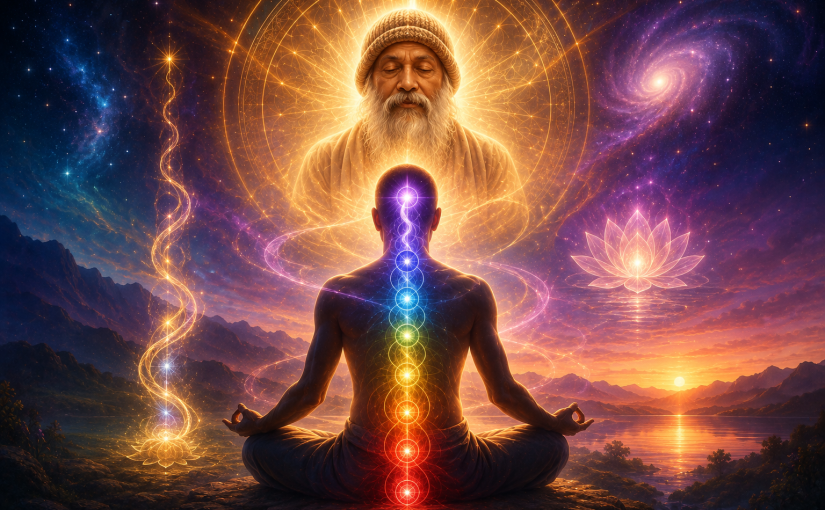
The Continuous Meditation Image and the Movement of Prana
My meditation experience has led me to look at the relationship between prana, kundalini, breathing, nondual contemplation and the inner meditation image in a different way. The most striking feature is the continuous and uniformly shining quality of the meditation image. It does not remain like an ordinary thought or a weak mental picture. At times it becomes so stable, bright and lively that it seems almost like a physical object seen with open eyes. This raises a basic question: what keeps such an inner image continuously alive?
One possible explanation, within the traditional yogic understanding of prana, is that the major support is not ordinary breathing but an upward movement of prana from the muladhara toward the brain. Breathing may still play a role, but it appears to become secondary when sushumna is active. In ordinary functioning, breathing participates in the distribution and movement of prana throughout the body. Exhalation, in particular, seems to be associated in my experience with a downward movement. When this downward movement becomes stronger, the meditation image can become somewhat dimmer, as though some of the energy supporting the image has moved away from the brain.
But when sushumna becomes active and prana is experienced as continuously rising through the spine, the situation seems different. Kundalini energy appears to provide prana to the whole body according to need while its movement is upward through the central pathway, energizing the different chakras and their corresponding functions. It therefore does not seem necessary for this same energy to be repeatedly pushed downward in the way ordinary pranic distribution appears to occur with ordinary breathing. The kundalini energy rising up is giving proportionately equal nourishment to all chakras and their corresponding organs so energy do not need to be moved down frequently from the brain. This may explain why breathing naturally becomes slower or may even pause during deep activation of sushumna.
The experience becomes especially interesting when ordinary breathing cannot slow down. During physical work, stress or other conditions requiring increased respiration, breathing may remain active and its downward effect may still be present. Yet if sushumna is strongly activated and prana is continuously flowing upward, the meditation image may not become significantly dimmer. The downward movement associated with breathing is then apparently unable to overcome the continuous upward supply. The image can remain present, more or less continuously, because it is constantly being supported by the upward current.
From this perspective, a continuously present meditation image could become an experiential indication of an increasingly stable meditative state. If the upward movement through sushumna is sufficiently established, the image may remain continuously present in varying degrees of brightness, approaching what can traditionally be called savikalpa samadhi. This is not meant to establish scientifically that prana literally moves in this way, but to describe the relationship as it is experienced within the yogic framework.
Nondual Contemplation and the Felt Energy Vacuum in the Brain
Another part of the experience has become equally important. Nondual contemplation produces a particular peacefulness and calmness. It is not simply the intellectual acceptance of a philosophical idea. When contemplation becomes deep, ordinary mental activity seems to become quieter, and there is a distinct feeling of spaciousness or even an energy vacuum in the brain.
This felt vacuum may have an important role in the upward movement of kundalini. When ordinary mental activity becomes quiet, there seems to be less energy occupied by scattered thoughts, emotional reactions and ordinary subject-object thinking. The quietness may therefore allow, or in the traditional interpretation even draw, more kundalini energy upward from the base toward the brain.
This seems to explain why a meditation image can become particularly lively during nondual contemplation of sharirvigyan darshan, quantum darshan or another nondual vision. Nondual contemplation first produces the quiet and peaceful condition. That quietness seems to create a receptive space in the brain, after which the upward energetic movement becomes stronger and the established meditation image becomes more vivid.
The process can therefore be understood as a cycle: nondual contemplation produces stillness; stillness allows stronger upward movement; the upward movement makes the inner image brighter and more alive; the bright image stabilizes attention; and stabilized attention further deepens the stillness. The process reinforces itself rather than depending upon deliberate mental effort at every moment.
The term “energy vacuum” is useful for describing the experience, but it should not be mistaken for an established physiological mechanism. What can be directly reported is the felt peacefulness, quietness, spaciousness and associated energetic movement. Whether that experience is ultimately explained through prana, kundalini, neurological activity, attention, interoception, conditioning or a combination of these remains an open question.
Why Does Only One Meditation Image Become So Luminous?
This raises a more difficult question. If nondual contemplation and the upward movement of kundalini increase the energy available in the brain, why does only one preassigned meditation image become continuously bright and lively? Why do other thoughts not become equally vivid?
A possible answer is that the meditation image has become a specially established pathway through long and regular practice. Ordinary thoughts are temporary and associative. One thought produces another, and the mind constantly moves from one subject to another. A deliberately practiced meditation image is different. It is singular, predetermined, repeatedly brought back into awareness and strengthened through thousands of acts of concentration.
Thus, when the mind becomes quiet and more energetic, the established meditation image may be the easiest form through which that intensified activity can express itself. The energy may not literally be restricted to one image; rather, that image may have become the most strongly conditioned and stable representation available.
In this sense, prana may provide the power while meditation provides the channel. Repeated practice may have created a pathway of least resistance. This can explain why a random thought such as what to eat later does not suddenly acquire the same luminosity as the chosen meditation image. The random thought has no comparable stability, repetition or intentional reinforcement.
There is also an important difference in the quality of perception. Ordinary imagination is usually dim, unstable, fragmentary and dependent upon deliberate effort. The meditation image I experience can become continuous, uniformly bright and perceptually alive. It can approach the quality of seeing an object through open physical eyes. This is not simply a matter of imagining the object more clearly. It represents a change from deliberate visualization toward a more spontaneous and self-sustaining inner perception. However at times other images also can intensify like lively physical object but I do not give attention to those and in a way do not like them so energy from them again shifts to meditation image.
The strongest explanation may therefore involve both energy and conditioning. The upward energetic state supplies intensity, while long practice supplies the established form. The image becomes the point where the two meet.
Kundalini and the Long Association with the Meditation Image
There may be an even deeper reason for this special relationship. Kundalini may have become associated with the meditation image itself through the united contemplation of both over a long period of daily practice. The image was not practiced in isolation. It was repeatedly encountered in a meditative state involving concentration, inwardness, nondual contemplation and the experience of an upward kundalini movement through the spine.
If these elements have been repeatedly experienced together, they may eventually become strongly linked. Then, when the image first appears during nondual contemplation, even if only weakly, its appearance may itself become a trigger for the familiar upward movement of kundalini. The image becomes brighter; the upward movement becomes stronger; the stronger movement makes the image more stable; and the stable image draws attention still more completely.
The resulting process can be represented simply as image, upward current, brighter image, stronger concentration, stronger upward current, and still brighter image. The important point is that the image may no longer be merely an object of thought. It may have become a doorway into the entire meditative configuration developed through repeated practice.
This also explains why the experience can be directly felt as a continuity from the base to the image. The movement is not experienced merely as an abstract belief in kundalini. There can be a bodily sense beginning at the muladhara, moving upward through the spinal region and reaching toward the brain or the inner image. From the standpoint of phenomenology, this is a spatially organized experience: the energetic movement seems to have a beginning, a pathway and a point of expression.
It is still important to distinguish direct experience from interpretation. The direct experience is the sensation of an upward movement associated with the meditation image. Calling that movement kundalini, or saying that prana literally travels through a physical channel along the spine, is a traditional interpretation of the experience rather than something established by modern physiology. Keeping this distinction makes the account stronger rather than weaker.
When I enter a familiar place or meet people already associated with my meditation or meditation image, the experience may begin quite distinctly. More often it is better with loving environment that helps get peaceful rest with spine erect and relaxed breath. At first, kundalini seems to rise clearly, felt as a blissful sensation moving upward along the spine—sometimes as one continuous movement and sometimes in stages, almost as if it were passing from one chakra to another. After some time, however, the upward movement may become unnoticeable. An hour or so later, I may no longer consciously feel any movement along the spine, yet the meditation image remains vividly luminous in the brain, accompanied by a deep sense of bliss and peace. Means the kundalini energy prepared the stage for sometime for expression of meditation image there.
The bliss associated with the initial upward surge can resemble sexual pleasure, but it feels different in quality—more refined, diffuse, and inward, as though the familiar sexual sensation has been transformed into a subtler and more pervasive form of bliss. I can describe this as a subjective resemblance to sexual pleasure without claiming that the experience is literally sexual or that a specific physiological process of sexual energy moving upward has been established. But contraction and shrinkage of lower organs with feel of their relief from stress and burden by pushing something up proves this thing experientially.
The Role of the Third Eye and Ajna Chakra
The experience then suggests another component: the role traditionally attributed to the third eye or Ajna chakra. The meditation image does not merely become brighter somewhere vaguely inside the mind. It becomes exceptionally clear and immediate in the region associated in yogic traditions with Ajna.
From this perspective, savikalpa samadhi can be understood as the united contribution of several factors rather than as the result of one factor alone. The regularly practiced meditation image provides the established object. Nondual contemplation produces peacefulness, quietness and a reduction of ordinary mental activity. Kundalini or the upward movement of prana supplies the increasing energetic intensity. Ajna, or the third-eye center in the traditional model, provides the focal center through which the inner object becomes exceptionally clear.
This combination can explain why the image of Dadaguru can become so vivid. It is not merely a picture that has been remembered. It has been practiced repeatedly and associated with the deepest meditative conditions. When nondual contemplation quiets the mind and the upward movement becomes strong, the image can appear almost independently of deliberate effort. At its most developed, it can become continuous, uniformly luminous, stable and lively, with an immediacy approaching physical seeing with open eyes. Even can awaken providing self-realization glimpse in exceptionally favourable environment and heightened energy.
This is where the distinction between ordinary visualization and savikalpa samadhi becomes important. Ordinary visualization still requires the meditator to construct and maintain an image. In the experience being described here, however, the image increasingly seems to maintain itself. Attention no longer has to continuously manufacture it. It becomes a stable inner object around which the mind becomes unified.
This is, in a sense, the special quality of kundalini—the blissful and deeply absorbing state can be achieved deliberately through Tantra, but it can also happen spontaneously. The ordinary meditator may struggle for years, even for a lifetime, simply to maintain a meditation image steadily, let alone reach awakening. What kundalini seems to do spontaneously is therefore not something that can be reproduced so easily by other methods, even when those methods are practiced deliberately and for a very long time.
The difference is important. With ordinary meditation, there can be a continuous struggle to hold the image, bring the wandering mind back, and prevent the visualization from fading. In the experience associated with kundalini, the process can appear to reverse itself: instead of the practitioner constantly maintaining the image, the image seems to become self-sustaining. It shines by itself, attention gathers around it, and the mind enters a state of bliss, peace, and increasing unity without the same continuous effort.
This may be one reason the idea of kundalini appears so extensively in the spiritual literature of the world. Sometimes it is described directly, but much more often it may be expressed indirectly through symbolic stories, verses, sacred figures, ritual practices, images of ascent, inner transformation, divine union, death and rebirth, or the awakening of a hidden power. The language changes from tradition to tradition, and these accounts should not automatically be treated as literal descriptions of the same physiological process. Yet the remarkable persistence of such imagery suggests that human beings have repeatedly tried to describe experiences in which something deeper than deliberate mental effort seems to take over the process of transformation. That is why kundalini is so often termed mystical. But what exactly is mystical about it? If kundalini is understood as a process in which much of the work of awakening can happen spontaneously, without the meditator deliberately producing each stage, then the term seems especially appropriate.
Mystical does not necessarily mean something that has no scientific or physiological basis. It can simply point to something extraordinary that seems to unfold by itself, beyond the ordinary capacity of deliberate effort. A meditator may spend years struggling to maintain concentration, stabilize an inner image, deepen absorption, or transform consciousness. Yet in an experience attributed to kundalini, some of these processes can appear to happen spontaneously, sometimes with remarkable speed and intensity.
What could seem more extraordinary than awakening itself occurring in this way? The remarkable feature is not that kundalini must be a supernatural force, nor that its effects cannot ultimately have physiological or psychological explanations. The mystery lies in the phenomenology: something that normally appears to require enormous effort seems to organize and propel itself from within.
In that sense, kundalini can be called mystical without making an anti-scientific claim. Its mystery is not necessarily that it violates physiology, but that it can produce such profound changes in consciousness with such apparent spontaneity. The experience can feel as though the practitioner is no longer doing the awakening; rather, awakening itself has begun to do the work.
As told above, the term savikalpa remains appropriate within this framework precisely because there is still a particular object. The experience is not completely objectless. There is still the meditation image of Dadaguru, but ordinary mental fluctuation has become greatly reduced and the object has acquired extraordinary clarity and stability.
At the same time, the presence of a bright inner image alone should not automatically be equated with savikalpa samadhi in the classical sense. Traditionally, savikalpa samadhi refers to a deeper transformation in the relationship between awareness, mental activity, and the meditation object.
One can have a bright image of one’s puppy or buffalo or even a beautiful flower or a stone, but how can we call that meditation simply because the image is bright and vivid? There are other qualities of meditation as well, such as nonduality, detachment, bliss, humility, true and selfless love, and the rise of kundalini. These qualities make a meditation image much more spiritually significant. A person who develops such qualities can therefore be considered a better fit for a spiritually oriented meditation image, particularly one associated with a guru, God, or another sacred figure. A Guru, having achieved these qualities through deliberate effort, inspires his followers to cultivate the same qualities in their own lives. Thus, he makes the meditation image further intensify itself in the mind by encouraging the follower to sustain these qualities in daily life. As these qualities are sustained, they further intensify the image, which in turn inspires the follower to embody them even more deeply. This cycle continues, and the image gradually becomes established in the mind, remaining uninterrupted—somewhat like savikalpa samadhi.
Animals or inanimate objects may possess many of these qualities naturally, but they do not possess emotions and cognition in the same way as human beings. In animals, these qualities appear to be largely instinctive or naturally given, whereas in human beings they can be consciously chosen, cultivated, and developed. This gives them greater weight in the context of spiritual practice, because the human being can deliberately direct these qualities toward meditation and awakening. However, as per Patanjali medittion of whatever favourite object can produce samadhi but I think that may take more time than meditation of any spiritual subject. No doubt animals have many spiritual type qualities that is why each god is shown with an animal, so meditation of guru or god with animal seems having synergistic effect. This seems the meaning of god and animal shown together. I also felt this. I largely remain with animals and inside nature during my heightened initial spiritual growth and both awakenings. That’s why most of awakened beings are animal and nature lovers, atleast living in harmonious company with these. Also, animal and nature lovers tend to be more spiritual than others. This is because nonduality is inherent nature of animals and nature. What they do just instinctively to survive, not with any willful dual agenda.
Therefore, the strongest and most accurate statement is that a continuous, luminous image may be an experiential feature associated with a state that resembles or develops toward savikalpa samadhi, rather than by itself proving that the classical state has been attained. The image becomes much more significant when it appears together with the other qualities of meditation—bliss, detachment, nonduality, selfless love, inner stillness, and the spontaneous rise of kundalini.
A Possible Unified Model
Taken together, the experience suggests a unified process. Long practice establishes a particular meditation image as the strongest and easiest inner pathway. Nondual contemplation quiets ordinary thought and creates a profound peacefulness and felt spaciousness in the brain. This quietness appears to make the brain receptive to a stronger upward movement of kundalini from the muladhara through the spine. As that movement reaches the region of the brain and Ajna, the established meditation image becomes increasingly bright, stable and perceptually immediate.
Once the image appears, it may itself reinforce the upward movement because the image has been repeatedly associated with that energetic condition. The process therefore becomes self-reinforcing. A small appearance of the image can initiate a larger upward response; the upward response makes the image brighter; the brighter image holds attention more firmly; and the firmer attention deepens nondual stillness. Breathing may still influence the state, particularly through exhalation and its apparent downward effect, but when sushumna is strongly active, the continuous upward process may become dominant enough that ordinary breathing cannot extinguish the image.
The whole experience can therefore be understood as the convergence of nondual contemplation, kundalini, the practiced meditation image and the Ajna or third-eye focus. None of these elements needs to be considered independently. The meditation image supplies the established form, nonduality provides mental stillness, the upward kundalini experience provides energetic intensity and bliss, and Ajna provides the traditional focal center through which the inner perception becomes exceptionally clear.
The deepest feature of the experience is therefore not simply that an image can be seen in meditation. It is that a particular image, practiced over a long period, can become so deeply associated with stillness and upward energetic movement that it begins to appear with a continuity, uniform brightness and vividness normally associated with direct physical perception. From the yogic perspective, this can be understood as the meeting of prana, kundalini, sushumna and Ajna with a well-established meditation object. From a psychological and neuroscientific perspective, some of the same experience could be approached through learned attention, conditioning, imagery, interoception and changes in ordinary mental activity.
The experience itself, however, remains the starting point. The interpretation can continue to develop without diminishing what was directly observed: the quiet produced by nondual contemplation, the felt movement from the base through the spine, the reduced dependence on ordinary breathing, and above all the transformation of the practiced image of Dadaguru from an ordinary mental representation into a continuous, uniformly shining and unusually lively inner presence.


