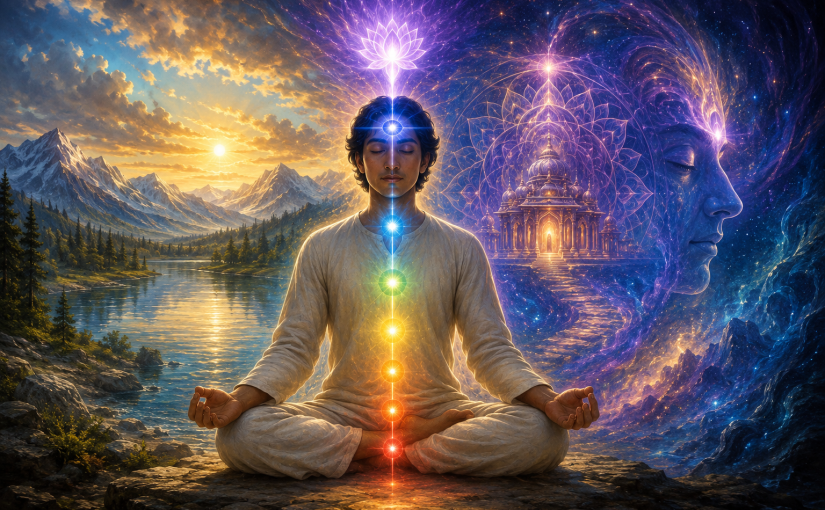
The Experience That Led to the Question of the Third Eye
My understanding of the third eye did not begin with the idea of a mystical organ somewhere inside the head. It emerged from observing something much simpler: the difference between sensory experience and purely mental experience, and the remarkable change that can occur when the breath spontaneously pauses. This observation also connects with the larger exploration of sex, breath suspension, kundalini and samadhi, but the present question is much more specific. It concerns what happens to the brightness and continuity of experience when sensory input is present or absent, and why certain states are traditionally associated with the third eye or ajna chakra.
One of the first things I noticed was that there can be a remarkably uniform brightness in ordinary sensory experience even while the breath is running normally. If I look at beautiful scenery, for example, the visual experience remains continuously bright. The breath is moving in and out, yet the scenery does not seem to become darker with every outbreath. The sensory system is continuously receiving information from the external scene, and this continued sensory input appears to keep the corresponding mental formation uniformly alive and bright. The mental image is therefore constantly supplemented by perception itself.
But when the breath spontaneously pauses while looking at beautiful scenery, the experience can become much stronger. The scenery may suddenly feel extraordinarily vivid, stable and blissful. I have referred to this as “breathholding beauty.” The point is not that physically holding the breath creates beauty, but that when the breath naturally pauses, the already beautiful sensory experience can become unusually intense and experiential. The temporary absence of ordinary respiratory movement seems to allow the experience to become more continuous and concentrated.
This observation becomes even more interesting when there is no external sensory object.
Why Pure Thought Reveals the Effect More Clearly
During purely mental thought, when there is no sensory involvement, the darkening effect associated with outbreath becomes more obvious. A thought or mental image has no external sensory stream continuously supplying it with information. There is nothing like the visual scene before the eyes that keeps refreshing the mental formation. The thought therefore has to sustain itself internally, and fluctuations associated with respiration can become more noticeable.
In this sense, sensory experience may conceal something that becomes obvious in purely mental experience. When looking at a scene, the senses continually supplement the mental image. During a thought without sensory involvement, that supplementation is absent. The changing respiratory rhythm can therefore appear more directly related to the changing brightness or stability of the mental formation.
This should be understood as a phenomenological observation rather than an established physiological law. I am describing how the experience appears and the model that arises from it, not claiming that science has established that every exhalation literally darkens a thought. The distinction between experience and its proposed mechanism is important.
Spontaneous Breath Suspension and Uniformly Bright Thought
During energetic ascent, when the breath pauses spontaneously, something different can happen. A mental formation that would ordinarily fluctuate can remain uniformly bright. It can acquire a continuity similar to that of sensory experience, or even to directly seeing something with the eyes open.
This is significant because there may be no external sensory input providing the image. Yet the mental image can remain vivid, stable and continuously present. In the experience, it is as though prana is now doing what sensory input ordinarily does: sustaining the mental formation and keeping it continuously bright.
This gives a possible experiential explanation for why such states can feel like seeing rather than merely thinking. An ordinary thought is something I can know, imagine or construct mentally, but an intensely bright inner formation can have a different quality. It can feel directly experienced, almost as though something is actually being seen. The eyes can remain closed, and yet the experience can have a perceptual intensity comparable to seeing with open eyes.
This is the point at which the traditional idea of the third eye becomes especially interesting.
The Third Eye as Inner Seeing
The third eye does not necessarily have to mean another physical eye or an additional anatomical sensory organ. From this perspective, it can describe the emergence of a mode of inner perception in which prana sustains a mental formation with a continuity and brightness that ordinarily come through sensory input.
Normally, the physical eyes see an external object because sensory information is continuously reaching the brain and contributing to the perceptual experience. In the state I am describing, an internally generated mental image can acquire a similar continuity without depending upon an external sensory object. The experience can therefore resemble direct perception even though the physical eyes remain closed.
This also gives a deeper meaning to the word “awakening.” When a person wakes from ordinary sleep, the physical eyes open and the external world becomes visible. There is a transition from an inward, dreamlike or unconscious condition to a state in which the world is directly perceived. In a somewhat analogous sense, the third eye can be understood as an inner awakening: the physical eyes remain closed, but an internal world becomes directly and intensely perceptible.
The mechanism or process through which this inner “waking up” is experienced can therefore be called the opening or functioning of the third eye. The third eye is not necessarily a separate organ; it is the name given to the capacity for this intensified inner seeing.
Why Ajna Is Called the Third-Eye Chakra
At ajna, there can still be something that resembles an object of perception. There is inner brightness, inner seeing of medtation image, and an experience that can feel almost like direct perception through the senses. This is why ajna is specifically described as the location of the third eye.
The important feature is not merely brightness. Brightness alone would not explain the expression “eye.” The defining feature is the experiential quality of seeing. Something appears before awareness in a way that can resemble an object of perception. It may be an image, a form, a scene or another mental formation, but it is experienced with a directness that goes beyond ordinary intellectual thought.
This experience is also not necessarily mystical. In a broader sense, everyone may have the third eye open to some extent at different times. Human beings constantly experience mental images, thoughts and inner representations without having corresponding physical objects immediately before the senses. Every mental thought therefore has something of the nature of a third eye: it creates an internally experienced object or representation.
The difference is one of degree and intensity. The more a person is intellectually self-contained and inwardly engaged without unnecessary dependence on sensory and worldly stimulation, the more developed this capacity for inner seeing may be. A person who can remain inwardly occupied does not need constant external sensory stimulation to maintain mental activity. In this broad sense, the third eye is not an extraordinary possession belonging only to mystics. It is a capacity already present in ordinary consciousness.
From Ordinary Thought to a Fully Open Third Eye
Every mental thought can therefore be regarded as a very simple form of third-eye functioning. When I think about something that is not physically present, there can still be an internal representation of it. I may see a place in my mind, remember a person’s face, imagine an object or construct an entire scene without looking at anything externally.
Ordinary thought, however, usually does not have the same intensity as external sensory perception. I know that I am imagining it. Its brightness, stability and immediacy are generally weaker than the direct perception of an object before the physical senses.
The third eye can therefore be understood as a continuum rather than an all-or-nothing event. At one end there is ordinary mental imagery and thought. At a stronger level, inner imagery becomes increasingly vivid and independent of sensory support. At the highest level of this particular function, an inner thought or image can become as strong, stable and directly experiential as external sensory perception. In that sense, the third eye is fully open when inner seeing reaches the intensity of actual sensory seeing.
This also explains why third-eye experiences do not have to be dramatic visions. The essential characteristic is the quality of perception. A mental formation may become exceptionally clear without necessarily producing a supernatural event. What changes is the degree to which the inner formation is experienced as something directly seen.
My Experiences of Awakening and the Third Eye
My own experiences make the distinction between third-eye functioning and complete awakening particularly important. I experienced this inner seeing during both of my awakening experiences that were accompanied by self-realisation, and I experienced it for a third time during the temple imagery described earlier. But the third experience was different because the awakening was incomplete, or perhaps more accurately, it was a simple awakening without full self-realisation.
This suggests that the third eye may be closely synonymous with awakening, but the two cannot be treated as completely identical. The third-eye function can occur without complete awakening or self-realisation. There can be inner seeing, extraordinary brightness and a feeling of having awakened internally without the complete transformation associated with self-realisation. However it looks true that the way to full awakening is through third eye. It is like saying that door to awakening of meditation image is lively meditation image itself. When through prolonged and constant meditation it crosses certain threshhold of liveliness it becomes full awakening.
In my experience, the awakenings accompanied by self-realisation occurred at the level of sahasrara. The simple awakening associated mainly with the temple imagery was experienced around ajna, or did not fully express itself in sahasrara. This distinction helps explain why ajna and sahasrara can both be associated with extraordinary inner brightness while still representing different levels or qualities of experience. So third eye opening seems synonym to savikalpa samadhi.
Ajna, Sahasrara and the Difference Between Seeing and Realisation
At ajna, there can still be something resembling an object of perception. There is a seer and something that appears to be seen. The inner experience can be remarkably vivid, but it retains the character of seeing. This is precisely why ajna is associated with the third eye.
At sahasrara, however, the experience can move beyond inner perception. There can be full awakening together with self-realisation and complete nonduality. The issue is no longer simply whether a mental formation is bright enough to resemble sensory perception. The deeper transformation is that the distinction between the observer and the observed can itself disappear.
Therefore, sahasrara should not simply be understood as an even brighter version of ajna. Ajna represents the emergence or intensification of inner seeing; sahasrara, in the experience of full awakening, represents going beyond the separation between seer and seen. There can still be extraordinary brightness, but brightness is no longer the essential point. Self-realisation and nonduality become the defining features.
This also explains why I experienced third-eye-like inner perception during experiences that differed in their degree of awakening. The inner seeing could appear without complete self-realisation. The third eye, therefore, seems to be closely related to awakening because awakening makes inner perception exceptionally direct, but full awakening with self-realisation is something further.
Awakening as an Inner Opening of the Eyes
The word “awakening” itself now becomes particularly suggestive. When a person wakes from sleep, the physical eyes open and the external world becomes visible. The act of waking therefore naturally becomes associated with seeing. In the inner experience, something similar may happen while the physical eyes remain closed.
The difference is that instead of waking into the external sensory world, consciousness seems to wake into an internal world. The mental formations that previously existed only as thoughts or images can become directly perceptible, intensely bright and stable. It is as though the inner eye has opened while the physical eyes have remained closed.
This may be why the language of the third eye and awakening fits the experience so naturally. The physical eye sees objects after waking into the external world; the third eye sees the mental world after an inward awakening. The comparison is not intended to establish that a literal hidden eye exists. It describes the similarity in the experiential quality of becoming awake and seeing.
Thus, the internal mechanism or process that provides this experience of “waking up” can be called the third eye. It is the transition from ordinary mental representation toward direct inner perception.
The Continuum From Thought to Third Eye to Self-Realisation
The whole observation can therefore be seen as a continuum. Ordinary thought already contains a rudimentary form of inner seeing because a mental formation can be experienced without a corresponding external object. Sensory perception is normally stronger because continuous sensory input keeps the mental representation uniformly alive. Pure thought reveals respiratory fluctuations more clearly because there is no sensory supplementation. During spontaneous breath suspension while its work taken up by kundalini, an internally generated formation can become uniformly bright and stable. When this inner brightness becomes strong enough to resemble direct sensory perception, the experience can be described as a fully open third eye.
At ajna, this inner seeing can become particularly prominent, which explains its traditional association with the third eye. It can occur without full mystical awakening and may exist in lesser degrees in ordinary people. In my own experience, however, it became especially clear during awakening experiences. The temple imagery represented a simpler or incomplete awakening mainly associated with ajna, while the experiences accompanied by self-realisation reached sahasrara.
At sahasrara, the process goes beyond seeing. Full awakening with self-realisation and nonduality is not merely the perfecting of mental brightness. It is a change in the relationship between consciousness, the observer and the perceived world.
The third eye, then, may be understood not as a mysterious physical organ but as a name for the awakening of inner perception. Its ordinary form may already exist in every thought and mental image. Its stronger form appears when inner formations become independent of continuous sensory support and acquire exceptional brightness and stability. Its fullest perceptual expression resembles direct sensory seeing with the physical eyes closed. And when awakening proceeds beyond perception into self-realisation and complete nonduality, the experience reaches a different dimension associated, in this framework, with sahasrara.
This makes the traditional expression “opening of the third eye” less mysterious. It can be understood as an awakening of the capacity to see inwardly, first in ordinary mental forms, then with increasing brightness and directness, and finally with an intensity that can resemble external perception itself. The remarkable point is that the physical eyes need not open for this inner seeing to begin. In fact, the paradox is precisely that one can feel as though one has awakened and begun to see while the physical eyes remain closed. However both eyes are not fully equal. Outside is outside, and inside is inside. Therefore, difference is jenuine, still many things are in common.


