A New Insight During Deep Dhyana
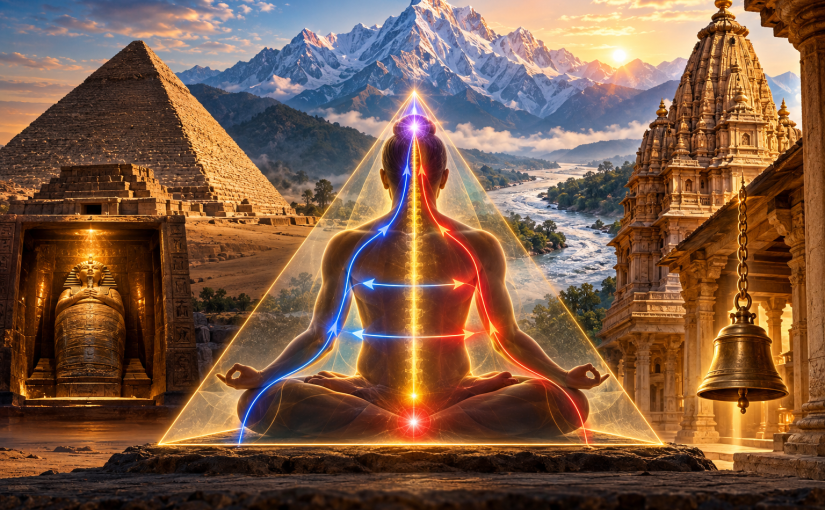
During deep dhyana, I experienced an interesting insight connecting the shape of a yogi sitting in Padmasana with the structure of temples and pyramids. The seated body has a broadly conical form, with a wide base tapering towards the head. The crown represents the highest point, which I associate with Sahasrara, the chakra symbolizing the connection between earthly existence and heavenly transcendence. This resemblance led me to contemplate the possible relationship between human anatomy, sacred architecture, Kundalini awakening, and ancient beliefs about life after death. What emerged was a geometric model connecting the body, the movement of prana, and the symbolic meaning of structures built for spiritual purposes.
The Three-Dimensional Pyramid and the Human Body
The pyramid in my contemplative model represents the human body sitting in Padmasana, viewed as a three-dimensional structure rather than a flat shape. The backbone forms the main posterior axis, representing Sushumna, the central channel of traditional yogic anatomy. It extends upward from the base of the seated body towards Sahasrara, represented by the pyramid’s apex. Two slanting lateral planes extend from the central spinal axis towards the left and right sides of the body, corresponding symbolically to Ida and Pingala. The planes are widest at the base, encompassing the legs and lower trunk, and progressively narrow as they rise, following the decreasing width of the body towards the shoulders, neck, and head. In this way, the three-dimensional pyramid reflects the body’s changing width from its broad lower region to its narrow upper region. The arms extend laterally near the shoulders, while the outward-slanting planes can be contemplated in relation to the throat, ears, and eyes. The two lateral planes connect through the front plane, across which I perceive energy moving in a straight path from left to right. Above these converging regions, Sahasrara remains the solitary apex, symbolizing the culmination of the upward movement towards transcendence.
The two lateral planes, the central axis, and the connecting front plane form the main elements of this model. The front plane connects the left and right sides, while the slanting planes represent their relationship with the central spinal axis. The model therefore combines the body’s overall shape with a representation of the perceived movement of energy within it.
The Movement of Prana Between Ida and Pingala
Sometimes during ascent of energy, I experience energy oscillating between Ida and Pingala in a pattern resembling the geometry of a pyramid. I perceive energy moving from the left slanting plane towards the right, with both sides emerging from the central spinal axis. Across the front of the body, this movement follows a straight path from left to right. I associate this direct connection with the pyramid’s straight front plane, which differs from its two slanting lateral planes. I have also experienced a sensation associated with the left-slanting plane around the heart.
The most significant part of this experience occurs when I contemplate the entire body icluding appandages in this pyramidal arrangement. I feel that energy from different parts of the body converges towards the central spinal axis, which I associate with Sushumna. Rather than concentrating on an isolated chakra or body part, I maintain awareness of the whole body as one integrated structure. The legs, arms, sensory regions, lateral planes, and central axis become parts of a unified mental image. In my experience, the oscillation between Ida and Pingala and the convergence of awareness towards Sushumna become complementary aspects of the same contemplative process. The upward extension of the central axis towards Sahasrara represents its culmination. This is my interpretation of the sensations experienced during dhyana, rather than a claim that the subtle channels follow these exact geometric paths as physical structures.
Temples and Pyramids as Symbols of Transcendence
The resemblance between the meditating body, temple architecture, and pyramids raises an interesting philosophical question. Could similar geometric forms serve as symbols of the relationship between earthly existence and transcendence? In my interpretation, the broad base represents grounded physical existence, while the tapering summit represents the upward movement of consciousness towards Sahasrara.
The temple’s rising superstructure can thus be contemplated as resembling a yogi sitting in meditation, with the uppermost point representing the crown. The pyramid offers a similar geometric image. Its broad foundation and narrowing summit can be interpreted as representing the journey from embodied existence towards a higher state of awareness. This does not establish that the builders of these structures intended precisely this meaning, but it offers a way to explore their forms through the perspective of yogic contemplation.
Pyramids are also popularly associated with extraterrestrial civilizations. I have considered whether the extraterrestrial world, understood in my philosophical framework as a world beyond ordinary earthly existence, might be associated with transcendence. However, a connection between pyramids and extraterrestrial civilizations has not been established by reliable scientific evidence. My central interest is the symbolic resemblance between these structures and the meditating body, rather than a claim about their builders.
The Temple Bell, Tantric Union and Kundalini Energy
Another insight emerged from contemplating the bell hanging inside a temple. In tantric symbolism, the bell can be associated with the union of masculine and feminine principles. In my interpretation, this union represents the joining of complementary energies at the base, where Kundalini is traditionally symbolized as a dormant serpent. The bell’s sound becomes a symbol of the energy expressed through this union.
The metal chain connecting the bell with the upper structure offers another element of the model. I interpret the chain as representing Sushumna, linking the lower part of the temple with its highest point. The bell represents union and the arising of sound, the chain represents the central pathway, and the summit represents Sahasrara, associated with spiritual awakening and wisdom. Together, these elements create a symbolic sequence connecting tantric union, sound, the upward pathway, and transcendence.
Sitting inside a dome-shaped or pyramid-like temple may also encourage peace and contemplation. The architecture, the sound of bells, devotional associations, and the quiet atmosphere can help direct attention inward. When the entire structure is contemplated as a representation of the meditating body, its different elements become parts of one integrated image of the inner yogic journey. The proposed movement of Kundalini through the chain is symbolic, not an established physical mechanism, but the practice of focused contemplation may help settle the mind.
The Ganga, Egyptian Mummies and Liberation After Death
This insight led me to compare Hindu funerary traditions with ancient Egyptian practices. In Hindu belief, immersing the ashes or bones of the deceased in the Ganga is associated with spiritual merit and the person’s destiny after death. I contemplated the Ganga as a symbol of the flow of Sushumna towards liberation. Through this symbolic relationship, the remains of the deceased become connected with a sacred process representing release from earthly existence. In this interpretation, the river serves not merely as a physical destination for the remains but also as a spiritual symbol.
I then considered whether the preservation of Egyptian mummies inside pyramids might express a comparable hope. If the pyramid resembles a yogi sitting in meditation, with its apex representing Sahasrara, could the preserved body inside it be understood as maintaining a symbolic connection with spiritual ascent? Perhaps the Egyptians regarded the continued preservation of the body as important for the deceased person’s continued existence in the afterlife. This possibility is worth exploring, although the specific connection with dhyana energy and Sahasrara is my hypothesis, not an established explanation of Egyptian beliefs.
Ancient Egyptians had their own religious understanding of bodily preservation, resurrection, and life after death. Hindu funerary traditions developed within their own religious and philosophical settings. Whether the two traditions borrowed ideas from each other would require historical evidence. Nevertheless, the comparison raises an important question: could different civilizations have used different physical symbols to express a similar hope for existence beyond earthly life? In one tradition, the remains are entrusted to a sacred river; in the other, the body is preserved within a monumental structure.
The difference between the Egyptian and Indian traditions may be related to their different natural surroundings. India has the Ganga, a sacred river that flows from the Himalayan region, whose majestic mountain landscape can itself be contemplated as resembling a meditating yogi. In this symbolic interpretation, the Ganga represents a natural flow of spiritual energy from the heights towards the plains. Ancient Egyptians, lacking a comparable river originating from such a mountainous landscape, may have created an artificial symbolic resemblance through the pyramid, whose broad base narrows towards the apex like a meditating yogi rising towards transcendence. This is a possible interpretation of the two traditions rather than an established historical explanation.I see a possible symbolic parallel between these practices, although their historical origins and meanings must be examined separately.
One Geometry, Many Spiritual Symbols
The insight that emerged during my deep dhyana brings together the human body, temple architecture, pyramids, sacred rivers, funerary practices, and the symbolism of Kundalini. The pyramid provides a geometric model for the meditating body. The backbone represents the central axis of Sushumna, the two lateral planes represent Ida and Pingala, and the front plane represents the direct connection between the two sides. The oscillation of prana between the lateral pathways and the convergence of awareness towards the central axis form the experiential core of this model. Sahasrara, represented by the apex, symbolizes the culmination of the upward movement towards transcendence.
The temple bell adds the symbolism of tantric union and sound, while its chain represents the connection between the lower structure and the summit. The Ganga and Egyptian pyramids extend the contemplation towards the question of liberation after death, suggesting how physical forms and rituals may become symbols of spiritual hope.
These parallels do not prove that all the traditions share a common historical origin or that their symbolic relationships describe a measurable flow of spiritual energy. They offer a way to explore how geometry, ritual, architecture, and meditation can express humanity’s enduring search for transcendence. The central insight is that the external form of a sacred structure can be contemplated as a representation of the inner yogic journey, from the integration of bodily awareness and complementary energies to the stillness and wisdom symbolized by Sahasrara.
Discover more from Demystifying Kundalini
Subscribe to get the latest posts sent to your email.


