Pyramids, Temple Architecture and Kundalini: Exploring the Hidden Geometry of Spiritual Awakening

A New Insight During Deep Dhyana

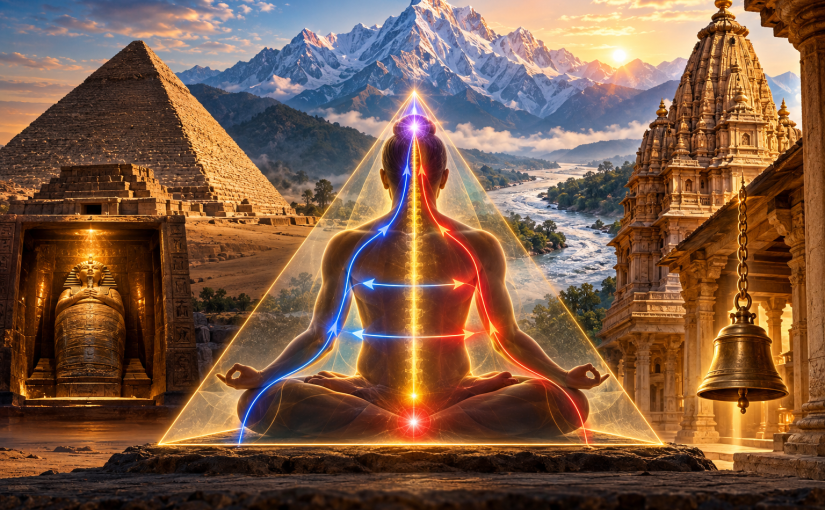
During deep dhyana, I experienced an interesting insight connecting the shape of a yogi sitting in Padmasana with the structure of temples and pyramids. The seated body has a broadly conical form, with a wide base tapering towards the head. The crown represents the highest point, which I associate with Sahasrara, the chakra symbolizing the connection between earthly existence and heavenly transcendence. This resemblance led me to contemplate the possible relationship between human anatomy, sacred architecture, Kundalini awakening, and ancient beliefs about life after death. What emerged was a geometric model connecting the body, the movement of prana, and the symbolic meaning of structures built for spiritual purposes.

The Three-Dimensional Pyramid and the Human Body

The pyramid in my contemplative model represents the human body sitting in Padmasana, viewed as a three-dimensional structure rather than a flat shape. The backbone forms the main posterior axis, representing Sushumna, the central channel of traditional yogic anatomy. It extends upward from the base of the seated body towards Sahasrara, represented by the pyramid’s apex. Two slanting lateral planes extend from the central spinal axis towards the left and right sides of the body, corresponding symbolically to Ida and Pingala. The planes are widest at the base, encompassing the legs and lower trunk, and progressively narrow as they rise, following the decreasing width of the body towards the shoulders, neck, and head. In this way, the three-dimensional pyramid reflects the body’s changing width from its broad lower region to its narrow upper region. The arms extend laterally near the shoulders, while the outward-slanting planes can be contemplated in relation to the throat, ears, and eyes. The two lateral planes connect through the front plane, across which I perceive energy moving in a straight path from left to right. Above these converging regions, Sahasrara remains the solitary apex, symbolizing the culmination of the upward movement towards transcendence.

The two lateral planes, the central axis, and the connecting front plane form the main elements of this model. The front plane connects the left and right sides, while the slanting planes represent their relationship with the central spinal axis. The model therefore combines the body’s overall shape with a representation of the perceived movement of energy within it.

The Movement of Prana Between Ida and Pingala

Sometimes during ascent of energy, I experience energy oscillating between Ida and Pingala in a pattern resembling the geometry of a pyramid. I perceive energy moving from the left slanting plane towards the right, with both sides emerging from the central spinal axis. Across the front of the body, this movement follows a straight path from left to right. I associate this direct connection with the pyramid’s straight front plane, which differs from its two slanting lateral planes. I have also experienced a sensation associated with the left-slanting plane around the heart.

The most significant part of this experience occurs when I contemplate the entire body icluding appandages in this pyramidal arrangement. I feel that energy from different parts of the body converges towards the central spinal axis, which I associate with Sushumna. Rather than concentrating on an isolated chakra or body part, I maintain awareness of the whole body as one integrated structure. The legs, arms, sensory regions, lateral planes, and central axis become parts of a unified mental image. In my experience, the oscillation between Ida and Pingala and the convergence of awareness towards Sushumna become complementary aspects of the same contemplative process. The upward extension of the central axis towards Sahasrara represents its culmination. This is my interpretation of the sensations experienced during dhyana, rather than a claim that the subtle channels follow these exact geometric paths as physical structures.

Temples and Pyramids as Symbols of Transcendence

The resemblance between the meditating body, temple architecture, and pyramids raises an interesting philosophical question. Could similar geometric forms serve as symbols of the relationship between earthly existence and transcendence? In my interpretation, the broad base represents grounded physical existence, while the tapering summit represents the upward movement of consciousness towards Sahasrara.

The temple’s rising superstructure can thus be contemplated as resembling a yogi sitting in meditation, with the uppermost point representing the crown. The pyramid offers a similar geometric image. Its broad foundation and narrowing summit can be interpreted as representing the journey from embodied existence towards a higher state of awareness. This does not establish that the builders of these structures intended precisely this meaning, but it offers a way to explore their forms through the perspective of yogic contemplation.

Pyramids are also popularly associated with extraterrestrial civilizations. I have considered whether the extraterrestrial world, understood in my philosophical framework as a world beyond ordinary earthly existence, might be associated with transcendence. However, a connection between pyramids and extraterrestrial civilizations has not been established by reliable scientific evidence. My central interest is the symbolic resemblance between these structures and the meditating body, rather than a claim about their builders.

The Temple Bell, Tantric Union and Kundalini Energy

Another insight emerged from contemplating the bell hanging inside a temple. In tantric symbolism, the bell can be associated with the union of masculine and feminine principles. In my interpretation, this union represents the joining of complementary energies at the base, where Kundalini is traditionally symbolized as a dormant serpent. The bell’s sound becomes a symbol of the energy expressed through this union.

The metal chain connecting the bell with the upper structure offers another element of the model. I interpret the chain as representing Sushumna, linking the lower part of the temple with its highest point. The bell represents union and the arising of sound, the chain represents the central pathway, and the summit represents Sahasrara, associated with spiritual awakening and wisdom. Together, these elements create a symbolic sequence connecting tantric union, sound, the upward pathway, and transcendence.

Sitting inside a dome-shaped or pyramid-like temple may also encourage peace and contemplation. The architecture, the sound of bells, devotional associations, and the quiet atmosphere can help direct attention inward. When the entire structure is contemplated as a representation of the meditating body, its different elements become parts of one integrated image of the inner yogic journey. The proposed movement of Kundalini through the chain is symbolic, not an established physical mechanism, but the practice of focused contemplation may help settle the mind.

The Ganga, Egyptian Mummies and Liberation After Death

This insight led me to compare Hindu funerary traditions with ancient Egyptian practices. In Hindu belief, immersing the ashes or bones of the deceased in the Ganga is associated with spiritual merit and the person’s destiny after death. I contemplated the Ganga as a symbol of the flow of Sushumna towards liberation. Through this symbolic relationship, the remains of the deceased become connected with a sacred process representing release from earthly existence. In this interpretation, the river serves not merely as a physical destination for the remains but also as a spiritual symbol.

I then considered whether the preservation of Egyptian mummies inside pyramids might express a comparable hope. If the pyramid resembles a yogi sitting in meditation, with its apex representing Sahasrara, could the preserved body inside it be understood as maintaining a symbolic connection with spiritual ascent? Perhaps the Egyptians regarded the continued preservation of the body as important for the deceased person’s continued existence in the afterlife. This possibility is worth exploring, although the specific connection with dhyana energy and Sahasrara is my hypothesis, not an established explanation of Egyptian beliefs.

Ancient Egyptians had their own religious understanding of bodily preservation, resurrection, and life after death. Hindu funerary traditions developed within their own religious and philosophical settings. Whether the two traditions borrowed ideas from each other would require historical evidence. Nevertheless, the comparison raises an important question: could different civilizations have used different physical symbols to express a similar hope for existence beyond earthly life? In one tradition, the remains are entrusted to a sacred river; in the other, the body is preserved within a monumental structure.

The difference between the Egyptian and Indian traditions may be related to their different natural surroundings. India has the Ganga, a sacred river that flows from the Himalayan region, whose majestic mountain landscape can itself be contemplated as resembling a meditating yogi. In this symbolic interpretation, the Ganga represents a natural flow of spiritual energy from the heights towards the plains. Ancient Egyptians, lacking a comparable river originating from such a mountainous landscape, may have created an artificial symbolic resemblance through the pyramid, whose broad base narrows towards the apex like a meditating yogi rising towards transcendence. This is a possible interpretation of the two traditions rather than an established historical explanation.I see a possible symbolic parallel between these practices, although their historical origins and meanings must be examined separately.

One Geometry, Many Spiritual Symbols

The insight that emerged during my deep dhyana brings together the human body, temple architecture, pyramids, sacred rivers, funerary practices, and the symbolism of Kundalini. The pyramid provides a geometric model for the meditating body. The backbone represents the central axis of Sushumna, the two lateral planes represent Ida and Pingala, and the front plane represents the direct connection between the two sides. The oscillation of prana between the lateral pathways and the convergence of awareness towards the central axis form the experiential core of this model. Sahasrara, represented by the apex, symbolizes the culmination of the upward movement towards transcendence.

The temple bell adds the symbolism of tantric union and sound, while its chain represents the connection between the lower structure and the summit. The Ganga and Egyptian pyramids extend the contemplation towards the question of liberation after death, suggesting how physical forms and rituals may become symbols of spiritual hope.

These parallels do not prove that all the traditions share a common historical origin or that their symbolic relationships describe a measurable flow of spiritual energy. They offer a way to explore how geometry, ritual, architecture, and meditation can express humanity’s enduring search for transcendence. The central insight is that the external form of a sacred structure can be contemplated as a representation of the inner yogic journey, from the integration of bodily awareness and complementary energies to the stillness and wisdom symbolized by Sahasrara.
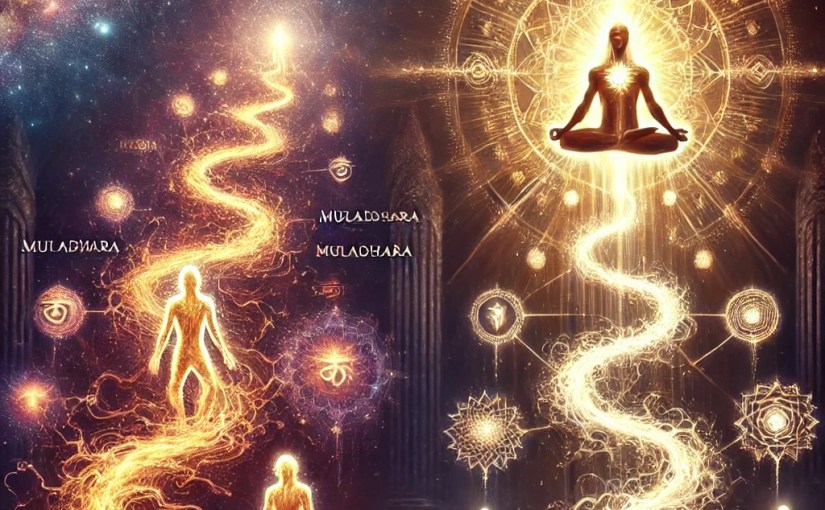
Kundalini as the Inner Ganga: A New Perspective on Ego, Nonduality and Inner Purification

The Inner Ganga: A Personal Experience of Kundalini Purification

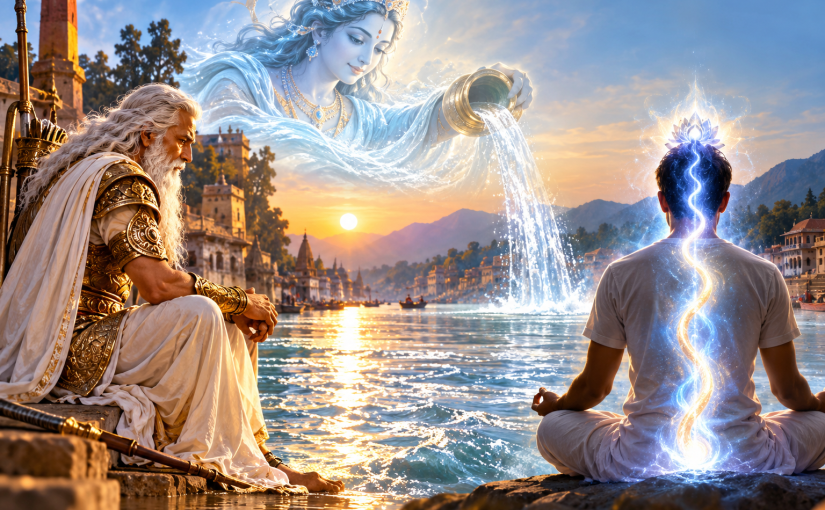
I have noticed something interesting in my own meditation. After periods of heavy worldly involvement, when the mind becomes disturbed by emotions, attachments and conflicting thoughts, I sit silently and experience a flow rising through my back towards my brain. As this flow develops, the emotions gradually settle, the mind becomes calm, and I feel fresh again, almost as if I have bathed in the holy Ganga. This experience has led me to understand Kundalini as an inner Ganga, a current of spiritual purification that helps restore mental clarity after the disturbances of worldly life.

The Ganga is traditionally regarded as a purifier in Sanatana Dharma. My experience suggests a possible inner meaning of this symbolism. Just as bathing in the river represents purification, the flow experienced during meditation seems to wash away the emotional burden accumulated through worldly involvement. I do not mean that every thought or emotion disappears permanently. Rather, the mind appears to recover its balance through a process that can be repeated whenever necessary.

Kundalini, Ego and the Cycle of Worldly Involvement

Spiritual teachings often describe ego as an obstacle to enlightenment because it strengthens attachment, duality and the sense of being an independent doer. However, worldly life inevitably involves decisions, relationships, responsibilities and personal actions. These activities can disturb the mind even when a person sincerely follows a spiritual path.

My experience suggests that spiritual development may not require complete withdrawal from worldly life. Instead, it may involve a recurring cycle of worldly participation, mental disturbance, silent meditation, inner purification and renewed freshness. After recovering through meditation, one can return to worldly responsibilities with greater clarity. In this way, spiritual practice becomes a continuing process rather than an attempt to maintain a permanently undisturbed condition.

Why Tantric Practitioners May Appear Egoistic Yet Remain Detached

This perspective also offers a possible explanation for the apparently contradictory behaviour of some tantric practitioners and mystics. They may confidently claim that they can accomplish certain things, express anger, quarrel, abuse or curse others, and sometimes bless them. Outwardly, such behaviour may appear egoistic and dualistic, even though the practitioners may understand themselves to be established in nonduality.

Perhaps the important distinction is between the functional expression of individuality and attachment to the ego. A person can exercise strong will, make decisions and express a forceful personality without necessarily identifying completely with the individual self. In Indian philosophy, this distinction can be related to ahamkara, the ego-making function that gives rise to the sense of individuality and personal agency.

Tantric practice, sustained contemplation of nonduality and powerful determination may help some practitioners maintain detachment while participating intensely in worldly life. If their inner awareness remains stable, outward involvement need not automatically imply complete inward attachment. However, this is a possible interpretation, not proof that every forceful or abusive practitioner is enlightened. Anger, pride and the desire for control can also arise from ordinary psychological conditioning. Claims of spiritual attainment must therefore be distinguished from evidence of it.

The Inner Ganga as a Possible Explanation for Nondual Living

My interpretation is that Kundalini may function like an inner Ganga, repeatedly restoring the mind after it becomes disturbed by ego, duality, attachment and worldly indulgence. A practitioner who experiences this process strongly may find it easier to recover inner balance without avoiding every situation that produces emotional disturbance.

The analogy also suggests why spiritual purification need not be understood as a single, final event. Just as people bathe in the Ganga repeatedly, the mind may require repeated periods of silence and meditation. Worldly experiences leave impressions, meditation helps settle them, and the person returns to activity with renewed freshness. The process may continue throughout life.

This could provide a useful way to think about the relationship between Kundalini, emotional regulation, meditation, nondual awareness and detachment. The inner Ganga represents continuity amid changing mental conditions. It is not necessary to interpret every worldly emotion as spiritual failure if one can recognise the disturbance, return to silence and gradually recover one’s balance.

Bhishma Pitamaha Returning to the River Ganga When Worldly Burdens Disturb the Mind

Bhishma Pitamaha’s deep connection with the Ganga offers an interesting parallel to this understanding. Whenever he became emotionally disturbed by the burdens, conflicts and worldly affairs of life, he would seek the peace of the Ganga, his mother. This can be understood symbolically as the return of a person immersed in worldly responsibilities to a source of inner purification. Just as Bhishma repeatedly returned to the physical Ganga, a spiritual practitioner may return to the inner Ganga of Kundalini through silent meditation whenever worldly involvement disturbs the mind. Both images suggest that spiritual strength does not necessarily require escaping worldly duties. It may instead involve repeatedly returning to a source of peace, clarity and detachment amid life’s struggles.

A Spiritual Hypothesis for Further Exploration

The sensation of energy rising through the back towards the brain is part of my personal meditative experience. Kundalini traditions associate such experiences with spiritual transformation, while psychology offers another possible perspective: silent meditation can help regulate emotional arousal, reduce mental overactivity and restore a sense of clarity. The precise cause of the rising sensation cannot be established from subjective experience alone. Nor is it scientifically established that tantric practitioners possess greater Kundalini energy or that this energy guarantees nondual awareness.

Nevertheless, the experience raises an interesting question for spiritual philosophy and the study of meditation: can sustained inner practice help a person participate more fully in worldly life while becoming less psychologically bound by its changing emotions?

The central insight is that nonduality need not necessarily mean the absence of worldly activity, just as detachment need not mean the suppression of individuality. A person may continue to act, feel and respond while repeatedly returning to inner stillness. In this understanding, Kundalini as the inner Ganga becomes a metaphor for the ongoing purification that may support a life of action, awareness and detachment.

Direct vs. Refined Energy Ascent: The Science of Tantra-Kriya Transformation

Perhaps what I had been thinking of as my Kundalini awakening experience till today was actually the experience of enlightenment or Savikalpa Samadhi, because in it there was a complete experience of the soul along with complete Advaita bliss. Meaning, it felt like I have attained perfection, that is, I have attained the ultimate achievement, that is, I have united with the Supreme Being. Kundalini awakening is perhaps that state when the raw or formless energy of the Muladhara transforms into a meditative picture. Of course, this state is similar to enlightenment and reaches there after developing. Therefore, it can also be called immature or light level enlightenment. The formless Kundalini Shakti can also be called dormant power. When it gets refined and takes the form of a stable meditative picture, then it can also be called the awakening of the Shakti. By the way, the difference in all these spiritual states is only of intensity, basically the nature of all is the same. Therefore, there is not much difference in changing their names among themselves.

One of the most fascinating aspects of energy awakening is the transformation of raw sexual energy into higher spiritual awareness. But how does this process actually happen? And is it necessary to refine the energy before lifting it, or can raw energy be pulled directly into Sahasrara for transformation?

In my experience, both approaches work, but they have different effects. Let’s explore both paths in depth.

1. Directly Lifting Raw Energy to Sahasrara

Some traditions emphasize pulling energy straight from the base (Muladhara) up the Sushumna to Sahasrara without any pre-conditioning. This method can lead to instant awakening experiences, but it also has potential risks.

What Happens When Raw Energy is Pulled Up?

✔ If the person is already spiritually mature, the energy self-organizes in Sahasrara, automatically transforming into a meditation image, bliss, or pure formless awareness. But the person doesn’t believe fully that meditation image played an important role in ascent of energy and resulting awakening. It’s so because during his glimpse awakening moments, that image didn’t enter his awareness because initially it was not superimposed on energy in lower chakras. This may produce his hesitation to fully surrender to it and take its help in further spiritual progress. Just opposite happens if one transforms raw energy of muladhar and swadhishthan region into meditation image before its upward ascent. It’s better and economic to process food in the beginning before its transport.✔ If the ascent is not controlled, the energy may manifest as:

Intense head pressure or discomfort.

Chaotic visions or light phenomena.

Temporary disorientation or imbalance.

Energy draining back down quickly without full absorption. But if meditation image is already live at muladhar then awakening will most probably accompany it. Then the meditation image always appear in mind as indicator of any lurking energy phenomenon. Means, one can recognise energy play with this tag easily.

Formless or empty energy can make a person fall into bad habits, but the energy that is fixed or stabilized in the form of a meditation image will remain stuck in it, how will it be able to go out. Understand it like this that when a sadhak is engrossed in meditation of Guru or God, then he will not have any attention left to spend on bad things. On the contrary, if the energy is not fixed in any uplifting meditation, then it will definitely get stuck in the meditation of bad or dualistic or worldly things because the nature of mental energy is to create meditation or contemplation, meaning it gets spent by contemplation only.

✔ In some cases, instead of stabilizing as a meditation image, the energy might dissolve into a formless ecstatic state—powerful, but harder to sustain. Because there is no meditation picture to remember it or to maintain its awareness through Vipassana. Understand it like this, Awakening is suddenly attained but what will happen next. The seeker can suddenly fall into the world full of unconscious tendencies. This can give him a tremendous shock of consciousness change, which can be frightening. It can cause many types of mental disorders or diseases. That is why it is said that there is no knowledge without a Guru. Perhaps the Guru himself makes the meditation picture or gets it made by someone else like a lover or a deity. If even then the disciple is unable to make a meditation picture, then he protects him from the mental fluctuations that occur during and after awakening.

2. Refining Energy Before Lifting: A More Controlled Process

In contrast, refining the energy before lifting it ensures that the ascent is smooth, stable, and directed. Stable or sthir means that this meditation keeps on being remembered again and again along with the meditation of the meditation picture. Smooth means that the meditation should be continuous with the meditation of the picture. It should not happen that by chance the energy starts flowing on its own and then we sit idle. Because we will not know how to make it rise again. Even if we try with bandh etc., it will be a mechanical pull. There will be less consciousness in it. There will also be less joy. Because we will experience only sensations, not any meditation picture. Due to this, it will also get less loving social recognition. Due to this, we will not be able to do sadhana with much enthusiasm. Due to the absence of love force with mechanical force, that force will also be very less. Guided means that by meditating on the meditation image on the Ajna Chakra, we can automatically draw the energy there, we do not need to concentrate on the energy. Similarly, by meditating on any chakra with a meditation picture, we can collect energy there. Refinement of energy is often done by superimposing a meditation image onto the energy while it is still in the lower chakras.

How Does Refinement Work?

✔ Step 1: Generating Raw Energy at the Base

This is traditionally done through Tantric Maithuna, controlled arousal, or internal energy cultivation.

Raw energy is powerful, but in its unrefined state, it is downward-flowing (Apana). Because only raw or unrefined sensations are felt in the sexual organs located below. Opposite to it, meditation image has natural instinct to rise up always because the brain is the main organ for image making. With itself image also lifts energy up. Means, the image becomes an efficient energy carrier.

✔ Step 2: Stabilizing with a Meditation Image

Instead of allowing the energy to remain chaotic, a deity, Guru, Self-image, or void is superimposed onto it.

This anchors the energy and prevents loss through dissipation.

✔ Step 3: Lifting the Energy through Kriya Breath

Once the raw energy is colored by a spiritual focus, it is guided upward using Kriya breathing (spinal breathing, Ujjayi, or inner suction).

Now, the energy doesn’t just rise—it carries the meditation image with it.

✔ Step 4: Transformation in Sahasrara

When this refined energy reaches Sahasrara, the meditation image fully blossoms into a living, conscious experience.

The energy doesn’t scatter chaotically but stabilizes as pure bliss, awareness, and spiritual realization. The meditation picture serves to keep it tied.

Which Approach is Better?

Both direct lifting and refined lifting can lead to awakening, but their effects differ:

✔ For advanced practitioners, raw energy may self-organize in Sahasrara, making direct lifting possible. ✔ For most people, refining first ensures a structured and predictable transformation.

My own energy ascent experience around my awakening glimpses 

My first awakening glimpse was there by lifting up of raw energy because I had not refined it to meditation image on lower chakras through structured meditation. That’s why no image came as a central anchor for my awareness during that glimpse. Instead all objects felt during awakening were equal to each other. As I can remember, no human face came to awareness. Afterwards images of guru and virtual consort used to appear in awareness during ordinary living giving me nonduality, bliss and peace but I couldn’t accept any of them as my meditation image. I used to see them as some errors in my brain chemistry. So occassionally trying to getting rid of them instead of incorporating them with my life for spiritual progress. That’s why I have gone littlebit unsocial type mainly in the eyesight of some over extrovert people. However, later I got and started accepting them that fuelled my skyrocket progress. Upto the time of structured meditation for my second awakening I had become enough mature and I refined the energy on the base itself since the beginning. That resulted in my awakening initiated by my guru as my meditation image. This altogether destroyed all the above drawbacks of my previous awakening.

Beyond the Ascent: Sustaining the Awakened State

One major challenge in both approaches is keeping the awakened state stable in daily life.

✔ If refinement was done early, the meditation image remains accessible even after practice. ✔ If raw energy was lifted chaotically, it may fade quickly, requiring constant practice to regain. ✔ A mix of both methods may be the most practical—generating energy through Tantra, refining it, and then lifting it through Kriya.

Final Thoughts: The Most Practical Path

From my experience, the most realistic and sustainable approach is:

✔ Use Tantra to generate energy at the base. ✔ Superimpose a meditation image for refinement. ✔ Lift it gradually through Kriya breathwork. ✔ Anchor it in Sahasrara as a living awareness. ✔ Let it circulate in daily life through subtle breath awareness.

This method avoids the dangers of uncontrolled raw energy ascent while still allowing the full power of awakening to unfold.

Ultimately, the goal is not just to awaken energy but to integrate it permanently into consciousness.

Prana: The Hidden Connection Between Body, Mind, and Experience

Millions of salutations to Adi Tantra Yogi Shiva on the occasion of his sacred Shivratri festival, may he continue to bless us all.

One simple yet profound realization changed how I see prana. When we feel pain in the foot, why do we experience it in the foot itself and not in the brain, where it is actually processed?

Nerves only send signals to the brain. If the brain were the sole center of experience, pain should be felt in the brain, not at the point of injury. Yet, it doesn’t work that way. This means something beyond just nerve signals is connecting consciousness to the body—something that allows experience to be localized at the exact place of sensation. This invisible connection is prana.

Prana: More Than Just Energy—It Localizes Consciousness

If prana were just physical energy, it wouldn’t explain why different parts of the body hold different experiences. Love is felt in the chest, fear in the stomach, sexual pleasure in the lower body. Prana acts like a network flowing through non physical experiential channels or nadis that binds consciousness to different locations in the body, making sensations real and localized.

This made me rethink prana—not just as life force but as the very mechanism that determines where we experience life. Prana is not just movement of energy; it is the movement of experience itself.

Tantra Yoga: Shifting Experience from Body to Mind

This understanding connects directly to my Tantra Yoga practice. In Tantra, sexual energy is not suppressed—it is shifted. Normally, pleasure is felt in the lower body because prana is concentrated there. But through specific techniques, this energy can be moved upwards to the brain.

When prana moves, the location of conscious experience moves with it.

  • The same energy that once felt like raw pleasure transforms into mental clarity, bliss, and stability.
  • Instead of being outwardly stimulating, it becomes inwardly illuminating.

I’ve experienced this shift, but not yet to a state where it remains stable. The connection is clear, but true mastery—where prana stays effortlessly in higher awareness—is something I still seek.

Health Aspects: Can This Practice Cause Issues?

While moving energy upward can bring profound mental clarity and deep meditation, forcing the process unnaturally can create imbalances. Some possible issues include:

  • Head Pressure or Mental Fatigue: If too much prana is held in the brain without grounding, it can create discomfort or detachment from daily life.
  • Lack of Interest in Worldly Activities: A rapid shift of prana to the higher centers can reduce attachment to physical experiences, making normal activities feel empty.
  • Physical Imbalance: Moving prana upward without proper grounding can sometimes lead to nervous system issues, digestive problems, or sexual dysfunction.

Balancing Energy for a Healthy Experience

I’ve realized that prana must be guided, not forced. When the shift happens naturally, it leads to clarity without imbalance. I consciously use grounding techniques when needed, ensuring that I stay connected to both higher awareness and practical life.

What This Means for Spiritual Growth

This insight opened a new perspective for me:

  • Prana is not just sustaining the body—it is directing consciousness itself.
  • Where prana flows, experience follows.
  • If we can control prana, we can control not just energy, but where and how we experience reality.

I’ve seen glimpses of this transformation, but I am still refining the practice. My goal is to make this shift natural and effortless—not just something I touch occasionally, but a state I can rest in permanently. At the same time, I’m careful to balance this journey with health and well-being, so the experience remains both profound and sustainable.

Kundalini Yoga keeps a person swinging between wakefulness and dreams

Friends, an idle mind is really the devil’s workshop. That is why I keep doing something or the other all the time. If I don’t see anything to do, I start writing. My son works awake so that he can have good dreams. Wow, he considers the world of wakefulness to be fake and the world of dreams to be real. I was shocked to hear this. A new thought arose. All the sages and Vedas and Puranas also say the same thing. They say that a life full of detachment and non-duality is the real one. Such is the life in dreams as well. In that, happiness and sorrow, all feel almost the same. Everything is in the form of experience. Pure experience. All experiences are in the form of happiness. If a lion runs from behind, even though you are afraid, you don’t feel afraid. If someone starts fighting, even though you are angry, you don’t get angry. If you fall from a mountain, even though you are in pain, you don’t feel sad. Even if you get a kingdom, even though you are happy, you don’t feel happy. Meaning, uniform happiness is everywhere, but not the polluted happiness of materialism. It is a happiness in the form of a subtle experience. The physical gross world pollutes the subtle experience of happiness and sorrow. Happiness increases due to the gross world, but it also increases sorrow. The higher the ball goes, the lower it falls. Happiness is the soul’s own form. But the world subjugates it and creates waves in that uniform spiritual happiness. Then, with time, in the absence of the gross world, that wave is destroyed. Due to this, of course, a person reaches the uniform or waveless spiritual happiness again, but in that state, darkness in the form of sorrow is felt. This appears to be due to illusion. Actually, it is not so. It is like after moving around in a circular motion around your body, everything around you feels as if it is rotating for a while. This is also called dizziness. This is why the word illusion has been used for ignorance.

While living in the world, no one can escape from illusion. Yes, it can definitely be reduced. Perhaps that is why people leave the world and become sadhus and sanyasis, so that the world cannot create illusion. But the disadvantage of this is that it does not lead to self-development. Because the world is necessary for this. The world can also be called a necessary evil in this case. That is why it is considered appropriate for those who have attained self-awakening to take sanyaas. It means that they have reached the peak of self-development, and there is no need for them to get entangled in the world. Actually, there is a need. But only to keep the body alive, because until the age determined by the previous deeds is not completed, the sanskars related to the prarabdha karma will keep troubling. Yes, this will not create sanskars for the next birth.

Dreams also produce a wave in self-happiness, but not as much as the awakened state. That is why when that wave disappears in the dream, the illusion is also not as much as in the awakened state. Some illusion is there. That is why it is said in the scriptures that the world is like a dream, and it should be considered as a dream only. In reality, it is so because the physical world does not enter the mind. We are only feeling its subtle picture, as we do in dreams. But considering it gross and physical creates all the mess. Man considers it gross and physical only in the greed of a wave of happiness, so that he can get more pleasure from the wave. At that time he does not realize the sorrow that comes with it in the long run. Actually, the big wave is called the gross world and the small wave is called the subtle world. While watching a movie, nothing gross happens but many people become too attached to it. Meaning, they get too immersed in it. And create a wave of happiness to the fullest from it. Due to this, the scenes shown on the screen, despite being subtle, become gross for them. That is why, many times, when such and such scenes come, they create a ruckus and vandalism in the theater. Many people, despite being in the gross world, do not get attached to it. They remain absolutely calm no matter what happens. Meaning, it does not create huge or rapid waves in their mind. For them, even the gross world is as subtle as a dream. Due to this they remain the same in happiness and sorrow. But the same thing is that for self awakening, strong mental waves like that of physically awakened state are also necessary.

This world is like a river flowing in both directions. That is why it is not understood properly. It lifts some people up and takes some people down. It can be said that the worldliness full of attachment should be pacified with non-dualistic philosophies like Sharirvigyan Darshan. This will give self awakening and also will not create illusion. Kundalini Yoga can give this benefit that the power to hold the picture of Samadhi felt during the non-dualistic feeling will increase and along with this, due to the energy in the brain, one will be able to do the feeling of Sharirvigyan Darshan well along with worldliness. Because every chakra is connected to some kind of worldliness, so at the time of every kind of work, some chakra or the other will become active. Meaning, the effect of power will increase to that chakra. Due to this, the feeling of Sharirvigyan Darshan along with that work will become easy, because all work is done with power. That extra power may seem trivial to us, but it is very useful. With the daily practice of Kundalini Yoga, the channels to all the chakras will remain open. When energy reaches the chakras, some energy will also reach the chakras of the brain, because all the chakras are interconnected. And it is from the brain that feelings arise, whether dualistic or non-dual.

In between, with the feeling of physiology, a person should continuously oscillate between the waking state and the dream state.
This will give you the benefits of both. Both the awakened and the dream state. The benefits of the awakened state include the benefits of material worldliness along with Kundalini awakening and the benefits of the dream state include the benefits of sannyasa. Meaning that the awakened state changes into the dream state with Kundalini yoga. However, the dream state also changes into the awakened state because of it. When there is fatigue in the body, that is, incapacity, that is, lack of strength, then the person is in a state similar to that of intoxication or dream. When he gets strength from Kundalini yoga, he again becomes like an awakened person in the worldly life. Of course, later, being troubled by it, he again changes his physically awakened state into a dream state with the feeling of physiology philosophy, and minimizes his illusion. At that time, he has the power. That state is not like that of intoxication or sleep, in which there is no strength. Therefore, his extra power is transformed into a mental picture of samadhi. Meaning that he enters samadhi with that extra power.

When one feels his present state in the body, the breath comes out of the stomach rapidly, especially if there is a lot of pressure in the brain. Due to this, the energy descending from the front channel makes the brain feel lighter. I feel that this energy going down turns back from the Muladhara and ascends to the brain again through the spinal cord. This means that a closed circuit loop of energy is formed. Surprisingly, this energy going up does not increase the pressure in the brain but makes it lighter. Anyway, the pressure should increase due to lack of energy. Perhaps the back part of the brain helps more in creating emotions, or it is the main controller of the entire brain. That is why the energy received by its back part from the spinal cord is more effective. It may also be that the energy pushed down is not full of oxygen. While passing down through the heart chakra, it becomes full of oxygen, gets purified and ascends up from the back. Perhaps that is why it is said that the energy should keep moving in the microcosmic orbit loop. If there is lethargy or low pressure in the brain, then deep breath is taken in. Due to this, the energy ascends up and makes the brain powerful. This means that if there is no energy in the brain, then how will it descend down. That is why at that time the emphasis is on lifting it from the bottom to the top. It happens on its own. Meaning, just as the gross physical body remains in balance, similarly it also makes the mind in the same way, if it is meditated upon properly.

Kundalini awakening is also like physical awakening. It can also be called the peak point of the physical awakened state. Because in this, the subconscious mind also awakens along with the conscious mind. Meaning that for Kundalini awakening, one has to be more awakened than the awakened state. This can happen only from the awakened state, not from the dream state. However, it can be achieved by saving the energy by converting the awakened state into a dream state. Meaning that dream state also have a contribution in this. But that dream state is not a dream state of powerlessness or laziness or compulsion, but a dream state that has been achieved deliberately. With that extra energy, the mental picture of the form of a Guru, God etc. is meditated upon. With practice, that meditation increases so much that that mental picture awakens. Although usually the mental picture is in the dream state, but at the time of Kundalini awakening it comes into the awakened state. It means that the mental wave that creates that picture becomes so strong that it crosses the limits of the dream state and enters the realm of the awakened state. The power that awakens it is so great that it also awakens the subconscious mind i.e. the soul with it. That is why everything seems non-dual i.e. one i.e. one’s own form because then the earlier sleeping dark soul becomes as bright as the awakened Kundalini picture by waking it up.

Actually, it is the soul that is awakened. The mental meditation picture is only a medium to awaken it. Because the Kundalini picture is a mental wave, which is already a form of an awakened state. Of course that wave is so light that it comes in the realm of the dream state. Still a wave is a wave. The mental waves of the dream state and the awakened state are the same thing, there is only a difference of intensity in them, nothing else. The light is the same, it does not change if it is reduced. What I mean to say is that the meditation picture was not asleep that it would wake up. The sleeping soul is connected to the subconscious mind which wakes up with the help of meditation picture. The meditation picture works to send power to the brain. When that power reaches above a certain limit, it wakes up the subconscious mind. We call this Kundalini awakening.

It is the soul that is asleep, and which wakes up at the time of Kundalini awakening. In reality, his illusion of being in deep sleep is dispelled, because it is only due to the illusion that he appears to be asleep. Of course, after experiencing a few moments of Kundalini awakening, the person goes back to sleep, but that deep sleep is not as effective as it was before because now he has known the truth. The subconscious mind of a man becomes like a burnt seed which does not have the power to give birth to a new life or birth. It is burnt by the light of the soul. Like a burnt seed, it exists but cannot give a new birth. Then it is said that the deeds that will be done after Kundalini awakening will create the subconscious mind to give results. But when the subconscious mind itself is burnt, then how can new deeds be added to it. When the basis of the existence of the subconscious mind is destroyed, then how will a new one be created. But then how will the fruits of the new deeds be obtained. Then a self-awakened man can do any sinful act without any fear. So in answer to this it is said that due to the absence of the subconscious mind, there is no attachment towards the deeds and their results. What attachment can light have towards light? Darkness has attachment towards light only. He keeps flowing with time. If he commits sinful deeds due to ignorance or compulsion, he gets its fruits quickly and in a mild form because his attachment was also mild. Even if he does not get the fruits in that life, he gets free by handing them over to nature. Now it is nature’s will to decide to whom it gives its fruits. Perhaps that is why it is said that the whole universe or the whole society has to suffer the consequences of the deeds done by great men. There are many such examples of the founders and preachers of religions, and great or world leaders. Why many religions are thirsty for each other’s blood till date, this can also be linked to this. All these experiences and thoughts are from the scriptures, which we are analyzing here as scientifically as possible. When the soul becomes illuminated or luminous, then every object or thought wave or the whole world will look like oneself because all things are luminous. What is the difference between light and light? This light is much above ordinary light, meaning it is the light of consciousness.

Kundalini Shakti is pulled up by breathing and gazing at Agya Chakra

I was reading the original sentences of some great Yogis filled with their experiences. Actually they used to keep them secret in diaries. These diaries used to reach their relatives only after their death. It is better not to reveal the names of great Yogis. Because otherwise, one can be accused of disrespect. They are revered by countless people. The feelings of those people can also be hurt. The staunch supporters of great people can get angry with the review of their statements etc. Similarly, no one wants to hear anything bitter about his culture, religion, nature etc., even if it is the truth. The writer needs to be very careful. Controversial issues should be said in gestures only. This kills the snake and the stick also does not break.

The main points that I came to know were the following. The breath stopped, the breath went inside, the breath started going in reverse direction, and there was a heaviness in the brain, the breath went inside the Sushumna. These can also be called the keywords of yoga. You can make as many Kriya yoga exercises from this as you want. But they are of little use. Because Pranayama is basically the same, which works. This is the reverse breathing or the breathing inside. In my opinion, this is what is called the breathing inside or the stopping of the breath. Actually, the breath of a living being cannot stop. It is possible that by practising reverse breathing, such a situation comes that the breath becomes so slow and light that it cannot be felt. But this can happen only with reverse breathing, not with straight breathing. It is with reverse breathing that the mind stops. Because the mind considers straight breathing as breath. Reverse breathing is not breath at all for it. This goes on like a chain reaction. When the mind stops, the breath will become even slower. Of course, the reverse will continue. With the mind stopping, a stage will come when the breath will become almost unnoticed. It will not be an exaggeration to call such a state the realization of the soul or the Brahma or very near to it. Pranayam is not just breathing, but breathing in the right manner is Pranayam. While inhaling, the energy should be felt rising through the back, and while exhaling, it should be felt going down. This happens on its own, because while inhaling from the stomach, the energy rises from the Mooladhar and reaches the pit of the Manipur Chakra. Then from there it rises upwards with pulling the chest and back upwards. As soon as the back and chest are pulled upwards, the energy of the spine is also pulled upwards by itself. By casting a little glance upwards between the eyebrows, it gets pushed even more upwards. And the energy gets aligned straight in the Sushumna line, from the muladhar Chakra to the agya Chakra. Sometimes it comes to the Agya Chakra through the Sahasrar, and sometimes it bypasses the Sahasrar and goes straight to the Agya Chakra.

The words of old Yogis like “pulling the breath, the breath went up to the head”, eye went up (means upward gazing of agya chakra), tongue went up (means tongue’s back touched back palate) etc. show that Pranayam is a science of pulling, not of relaxation. Of course, when the head becomes very heavy or the head starts aching, then do not pull like this. When the head becomes light, then start pulling again. I myself have felt that after this heaviness of the mind, a very creative, emotional, practical and divine power comes. All human and divine qualities come automatically. The feeling of detachment and non-duality arises automatically. It seems that nature is helping everywhere like a servant. Yogis also say the same. But what I say clearly, and what Yogis have been shying away from saying, is that this is only the sexual power, nothing else. This sexual power rises only with the Pranayam done correctly. If sexual intercourse is done correctly, then artificial Pranayam is dwarfed in front of it. Of course, only the combination of both can provide complete and permanent benefits. Although complete benefits can be obtained even by just Pranayama. But it may take more time for the practice to mature. We have been habituated to straight breathing since many births. That is why it is not so easy to form the habit of reverse breathing. Reverse breathing means that the focus is not on the inflow of air, but on the rise and fall of energy in the back. The descent of energy will be considered automatically, when the back will descend on its own while exhaling and will become relaxed. It is called reverse breathing because in this, when the energy is rising up in the body, at that time the breath or air is going down in the body. And when the energy is descending in the body, at that time the air in the body is rising up to come out.

The energy is pulled more only when you breathe from both the stomach and the chest. Of course, it should be done very slowly. A good Pranayama may take up to 1 minute. For example, first stop for a while when the belly area becomes full of air. Then apply the second level of pull by raising the chest. Then pause for a while and the pull of the third level is felt by looking upwards at the Agya Chakra. There is a feeling of touch an upward gushing like gharrrrr and the heaviness of the brain increasing with it. After this heaviness, new and old thoughts surge in the soul like air bubbles in the air. There is a great pleasure. Yogis have written it like this, bada maza aaya, maza bhayo etc.

There is a water wheel to draw water from the well. A bucket is tied to a rope. That rope rests on a pulley. The other end of the rope is in the hands of a man. When the man pulls the rope, the bucket end of the rope goes up and also lifts the bucket filled with water from the well up. When the man loosens the rope, the bucket end of the rope goes down into the well and takes the empty bucket inside the well. Breath also works like this rope and Kundalini Shakti works like a bucket. When breath is inhaled, meaning the breath string is pulled long, then with its force the Kundalini Shakti rises up in the well of the back and pours the water in the form of shakti into the brain. When breath is exhaled, meaning the breath string is loosened and made short, then the empty Kundalini Shakti descends down the back. It then fills itself with water in the form of power in the Muladhara Chakra, and again rises up in the next breath. In this way, this manual pump of breath keeps working for the entire life. That is why breath is often compared to a string, Mooladhar to a well or a pit and Shakti to water.

This sexual power remains confined to the lower parts of the body for reproduction and remains constricted. It is said that the Kundalini Shakti is wrapped in three coils around the Shivling. That is why a snake is shown wrapped around the Shivling. All these things are interconnected. But in the real Shivling, when this Shakti-form serpent rises up to form a hood over the Shivling, then only one coil remains below. Meaning, there is so much of it in the Mooladhar. Kundalini is such a power that it cannot be destroyed in a living being. If it’s finished then creation will also be threatened to be finished as there will be no sexual desire. If all the coils open, it means that the power is about to end. But the presence of one coil always shows that the Kundalini power of Muladhara is unlimited. It means that it can continuously straighten up and keep climbing upwards. But even then a large part of it will remain contracted in Muladhara. All this cannot be merely symbolic. If it were so, then the Vam Marg tantra would not have existed. But the basic tantra is this same. All the other tantras are based on it. But it seems that all of them are engaged in rejecting their own origin.

Kundalini yoga teaches the art of dying

Friends, there is a famous saying that by practicing continuously, even a fool becomes wise and skilled. All people are fools when it comes to attaining salvation. So, can salvation be attained effortlessly by practicing Kundalini yoga continuously? Let us analyze it in this post.

I was reading the introduction to Purana Purush. It was written in it that how did a householder yogi, known to the author, die? At the last moment, he had focused his life exactly in the middle of the eyebrows. Due to this, there was a strong vibration there. Then he breathed his last there. It was believed that he was liberated. That same Agya Chakra has been called Ram Dwara. In common parlance, the death that people used to mention at Ramdwara was the Agya Chakra itself.

Now the question is that at the last moment, when all the senses become devoid of knowledge, how can one focus the life of the body on the Agya Chakra? I think this happened on its own, through lifelong practice. Science also shows that the blood circulation of the body keeps on shifting from non-essential organs to essential organs. Then this should happen even without yoga. It does happen. Whether one does yoga or not, blood circulation gives importance to the brain. Agya Chakra is one of the main parts of the brain, and is the most effective point in the path of the main nerve of the body. But such vibration is not seen in everyone. It is seen only in Yogis. It seems that blood circulation is automatically controlled by itself. There is no need to be aware or experienced about it. But to make Nadi Sanchar more effective, one has to be aware of it. Meaning, one has to experience it. Although Nadi Sanchar keeps happening at the basic level even without experience. It is due to it that the body remains active. But to raise it to the level of providing liberation, its experience has to be increased. Blood circulation cannot do all the work. It certainly supplies all the necessary substances to the cells for their work, but it is the nerve circulation that motivates the cells to work by using them. Perhaps this nadi circulation is called Prana. If we place material for building a house in front of a person, he will not immediately start building the house. He will have to be motivated to work using that material. This motivating work is done through nadi circulation. You all know that for liberation, it is necessary for all the thoughts suppressed in the mind to manifest in the soul. This is what happens in the witness state. That is why there is a feeling of liberation from it. We certainly experience all the previous suppressed thoughts in the soul in the witness state, but the new thoughts that are suppressed after that are enough to put us in bondage. At the time of death, because all the senses become inactive, the new world cannot be experienced, meaning new thoughts cannot be formed and suppressed in the mind. In such a situation, if all the old suppressed thoughts are experienced in the soul even once due to the great circulation of Prana in the brain, then there should be no doubt about liberation. It is written in the scriptures that if the name of God is taken or he is remembered at the time of death, then one attains salvation. It is also written in many places that this can be done only if there is a lifelong practice. This practice points towards Kundalini Yoga practice. Because the common practice will not be useful at that time. That is because all the senses will be almost dead. How can anything be thought through them. Those almost dead inner senses can come to life only if a strong wave of life force shakes them. Right now because the blood circulation would have shifted from the external senses like eyes, ears etc. to the internal senses like mind and intellect. That blood circulation will also not be so much that it can provide sufficient nutrition to the nervous system there. In such a situation, only the strong wave of life force rising from the Mooladhara can make it active.

Then it is said that whatever a man thinks about in his last moments, he becomes that in his next life. Jad Bharat thought about a deer, so he became a deer. Perhaps this thinking is solitary thinking which happens due to lack of prana. Attachment or credit intelligence remains towards only one mental picture. That is why one gets the same kind of birth. But due to the powerful vibration of prana coming from the Mooladhar, all the mental pictures are felt together and become calm in the soul. Then there is no attachment to any particular picture. This gives liberation. Either do not get attached to anyone or do it with everyone. The result of both is the same, detachment. Either do not remember anyone at the time of death, or remember everyone. The thing is the same. But this does not happen because the ordinary prana will make you remember someone or the other. The kundalini power flowing in the Sushumna is so powerful that it makes you experience everything together. Perhaps this is its basic principle.

But death does not always come so comfortably that it gives the thoughts a chance to merge with the soul. Premature death occurs suddenly. In today’s modern, mechanical, polluted, war-ridden and disease-ridden era, it occurs more often. Earlier it was considered very inauspicious and an obstacle to salvation. It was even believed that the soul would wander without a body for a long time. That is why it was said that one should always be spiritually prepared for death so that even if untimely death comes, one can still get salvation. Such preparation can be done only by daily Kundalini Yoga practice.

When I had corona, I used to feel the transmission of prana through my back, which was probably to fight the disease. In those days I was not even able to do Kundali Yoga. Thoughts were emerging very peacefully and merging into the soul. Perhaps it happens that when the practice of yoga is missed, the accustomed body tries to do that yoga on its own. Perhaps this is why pranayama and yoga are considered liberating. Countless yogis have tested it for centuries.

Kundalini Shakti never sleeps

The Shakti in the body does all the work while remaining hidden. It digests food, makes the heart beat, and does countless other small and big functions of the body. She can’t be sleeping. If she had slept, how could she have done so much work? Perhaps we call it sleeping because even when a man’s body is in deep sleep, it continues to do innumerable tasks of life, otherwise would he not have died? It doesn’t do just one thing, just generate conscious thoughts. Similarly, sleeping Shakti means that all the functions of the body are being carried out by it, but awakened thoughts are not being generated. This can be called a semi-dormant state because ordinary or vague thoughts are still arising. Light thoughts come to a person even during sleep in the form of dreams. To awaken Shakti means to bring it into its most expressed form and that is Kundalini awakening. Just as there can be countless levels of awakening of a man, but the real awakening is the one in which he is most expressed, which is Kundalini awakening. Other states can also be called sleep. It is mentioned many times in the scriptures that this world is like a dream. The ordinary life we are living is just a dream, meaning we are asleep. Real awakening is the state of Kundalini awakening. Below Sahasrara, there are all the pits, Mooladhar is the biggest pit. Because a little amount of energy leaks from other pits to Sahasrara, there is no complete darkness there. But when Kundalini is present in Mooladhara, it is most dark, because it is the farthest from Sahasrara. This movement of energy is of special importance in human being, because he walks while standing, and special strength is required to deliver blood high up to the brain. When there is a contraction of the muscles due to Shakti reaching the chakra through yoga or physical activity, then the consumption of nutrients increases there, which automatically increases the blood circulation there. That is why it is said that Shakti controls blood circulation. However, it appears directly controlling the speed of contraction and relaxation of muscles, thereby controlling blood circulation indirectly. This does not often appears happening in animals because their backs are straight. Because monkeys, langurs, chimpanzees etc. also become quite upright, that is why they are also playful so that the Shakti keeps flowing and the blood circulation continues smoothly in the whole body.

According to physiology, not only nerve fibers control the body, but biochemicals called hormones also control them and the organs also have their own local control. But the nerves keep the entire body functioning smoothly. It has never been heard that in such and such a yogi, some organs were cured by Nadi Chalana, but there was no effect on other organs, especially the organs controlled by hormones. From this it also seems that nerve fibers are not called nadis. It is said that electrical energy flows in the nerve fibers and life energy or Shakti flows in the nadis. However, when there is movement in the chakras, the hormone producing cells will also become active and the local systems will also become active.

There are many similarities between Shakti and energy, but both are different. Energy is inanimate, whereas Shakti is conscious due to the presence of Shiva with it. Energy can be present in any inanimate thing or machine etc., but Shakti can be present only in a conscious being. The sex-based energy rising from the perineum through Kundalini Yoga is called Shakti because it feels like bliss of samadhi. In simple words, this strengthens the Samadhi picture or Kundalini picture. And in simple words it leads towards God. Because it provides energy to the brain, the energy suppressed in the subconscious mind gets destroyed by coming out or getting expressed. Although this also happens through physical activity, Shakti there also travels through the same path. Meaning that due to physical movement, Shakti keeps gathering on the perineum and keeps rising up through the back. That is why Kundalini Yoga is very beneficial for physically hard working people also.

Kundalini Yoga powered Ganges flow irrigates the chakras in the form of Shivlinga

Famous legend of Atri-Anasuya

The story of Anasuya comes in Shivpuran. Anasuya means one who does not criticize or condemn anyone. Once there was a great famine. There was shortage of water everywhere. People and animals started dying due to thirst. Saints cannot see the sufferings of the world. Therefore, Sage Atri started doing penance for water. His disciples also left him. Only Anasuya continued to serve her husband and worshiped the Shivling everyday. One day Atri asked for water. Anasuya took the kamandal that’s sacred handheld pitcher and started searching for water. On the way she met Ganga. Ganga was pleased with Anasuya’s devotion to her husband. Anasuya asked for water from Ganga. Ganga asked her to dig a pit. That pit became filled with water. Anasuya went away with water. He gave water to Atri. Atri said that it was not like everyday drinking water. Anasuya told the whole story. She took Atri to that pit. Both of them took bath in it and drank it. All the people were satisfied with that. When Ganga started leaving, Anasuya prayed to her to stay there forever. Ganga in return demanded from her the fruit of her one year’s husband’s service and worship of Shiva. Ganga said that she likes husband service the most. When Anasuya gave it, Ganga settled there. Along with this, Shiva also sat there forever in the form of Atrishwar Linga.

the explanation for mythological story

Atri is a living soul. Atri literally means devoid of all three qualities or gunas. Only the soul is like this. Anasuya is intelligence or intellect. Intelligence does not condemn anyone, because it wants everyone to get its work done. Only a useless mind condemns. Intelligence is like a devoted wife to her husband as soul. She serves the living being soul in every way, along with worshiping Lord Shiva. An idle mind does nothing. Actually work is done by intellect, and work itself has been called worship. Work is the worship of Shivling because the world is made up of a combination of Purush meaning Shiva and Prakriti meaning Shakti. The body itself is that drought-stricken country. All the cells of the body are its people and creatures. They were thirsty means deprived of water in the form of energy. Energy flows like water. Intellect used to provide the soul in the form of Rishi Atri with enough energy or simple water for living. But the whole body country could not survive well with it. That’s why sage does penance i.e. Kundalini Yogasadhana for extra energy. One day, on asking for Shakti-jal by Rishi-jiva, Anasuya-buddhi started wandering all over the body in search of it. By the grace of Shivling, she felt the sexual based Kundalini Shakti i.e. Ganga around Muladhar. She inspired the prana of the body i.e. the workers of Dahdesh or body-country to make a pit there i.e. to press Muladhara with the heel in Siddhasana or to make a sensory pit in the front Manipur Chakra by yogasanas, massages etc. It seems to me that this pit is the deep pit above the base of the back or the hip bone prominence. At the time of massage, by pressing hard with the base of the straight palm and slowly sliding upwards, a sharp and blissful sensation is felt, which starts climbing upwards in the spinal cord. It seems to be directly related to the real or textual Mooladhara, because Mooladhara is also often referred to as the pit. Massage should not be done in the spine with the force of fingers, because there can be a fear of damage like injury to the delicate bone. Divine water was filled there, which means there was a feeling of blissful energy. She fed that water to the sage means the soul felt that sensation. The soul found it different and divine from other days because sexual pleasure was also mixed in it. Both of them took bath in it, which means that it climbed up from the coccyx to the brain, due to which both of them got refreshed along with the whole body. Both the intellect and the soul reside in the brain and are connected to each other, so they feel everything together. It can also be taken in another way that a tantric couple is consuming energy together in Yabyum posture. All living beings were satisfied after drinking water, which means all the cells of the body were refreshed and recharged with energy. Ganga liked Anasuya’s chastity. Surely she must have taken hes test, only then came to know. Nowadays there are many examiners of the religion of chastity. For women going to office or work, various men peeping at them and talking to them with love-filled obscenities, being in the mood to misbehave with them, etc. is their test. There will be no exam while sitting inside the house. The meaning is clear that stay with everyone but serve your husband only. Ganga asked Anasuya for a year’s good deeds in exchange for permanently settling there, which means that Sushumna can be permanently awakened by one year’s Tantric Yogasadhana and Shivling worship. There the Atriswar Linga was also established permanently. To me it seems to be the awakened Muladhar Chakra. Chakras are in the form of lingas, because the same sensation as linga-based is experienced there. Twelve Jyotirlingas are twelve chakras only. The light is created there by the shining of the meditation picture. That meditation picture can be the form of Shiva, Guru, lover etc. According to Shivpuran, there are many lingas and upalingas, but these twelve Jyotirlingas are the main ones. Other lingas are called sub or upa lingas only, not Jyotirlingas, because the brightness of the Kundalini picture is felt only on the chakras. By the way, every cell of the body can be called a linga, because they become active only when Ganges water in the form of energy falls on them. As far as the Kundalini Shakti in the form of Ganga reaches to bathe, there is linga’s presence. Anyway, cerebrospinal fluid flows in the spinal cord, which is just like water. Many scientists claim that energy flows in the same way as the flow of a fluid. Although at the time of Sushumna awakening, energy flows in the form of sensationally bright line. It is possible that flow can occur in both ways, especially in the common and simple energy flow, the contribution of fluid flow is more. From this story it seems that any sage discovered Kundalini Shakti and realized it, which he told in the form of a myth rather than telling it directly.

Kundalini Yoga is important for environmental protection

When Arjun was doing penance to Lord Shiva for the Pashupat weapon, a demon named Mook sent by Duryodhana came there in the form of a pig. He was going through the same route where Arjun was, breaking the peaks of the mountains, uprooting many trees and shouting various types of meaningless words. Seeing him, Arjun started remembering Shiva. Shiva came in the form of Bhilraj or jungle tribe’s king to kill him. That boar between Arjuna and Shiva looked like a wonderful peak. Both of them fired arrows together. Lord Shiva’s arrow entered the tail, came out of its mouth and soon disappeared into the earth. Arjun’s arrow (probably after entering the mouth) came out of its tail and fell on the ground in the side. The pig fell down dead at that very moment.

Explanation of the above myth

Duryodhana means ego makes Arjun’s Karmayogi soul do so much work that his Ida and Pingala nadis become active, meaning Arjun’s body itself becomes like a pig. The mooladhara itself is its tail. Ida and Pingala are the two sharp teeth on its sides. The diverse thoughts of the wandering mind in the duality-forest are its face. Only the wandering mind can break the mountains, not the body. The Mook name is Hindi word for dumb. Because the wandering mind never tells a man that he is his enemy and has come to fight with him, but keeps on attacking by deceit, that is why it is called dumb demon. Just as the mind feels like a mountain between the soul and the Supreme Soul, similarly it was feeling like a pig. Due to the alternate activation of Ida and Pingala nadis, a person becomes so active as if he is ready to break a mountain. When Ida is activated, he does the work of the world in a frenzy, and when Pingala is activated, he falls asleep. After waking up from sleep and so getting refreshed, again starts running to do sinful deeds like looting and hunting. He oscillates between this duality of darkness and light, and does not see the equanimity or non-duality of the sushumna nadi between them. The color of the Indian wild boar is also a mixture of black and brown, indicating the duality. Filled with stupidity like an animal, he keeps on doing bad and environmental-killing work. Nowadays man is like this. There is no brake on activity. He is hitting his head everywhere like a blind man. Hollowing out the ground. The forests are being destroyed. After polluting the air, land and water, he is roaming in it with joy and fun. All these are characteristics of a pig. Shiva inserted an arrow through its tail, which means Shiva caused activation of the sushumna channel through mooladhara. Actually, this is what happens by meditating and worshiping Shivalinga. That arrow came out of his mouth i.e. Sahasrar Chakra and merged into the body through the front channel called as getting lost in the earth.
Arjun was anyway meditating and worshiping Shivalinga. It is natural that his Sushumna became active. This Brahmashir arrow emerges out of the Brahmarandhra. The whole body of the pig is the face. It can also be understood that the arrow turned down and merged into the agya chakra. From there it reaches the mouth, through the secretions of the palate. There that secretion goes into the land, that is, the stomach, and there it is spent or merged in the form of energy in digesting food. Just as food is made in the soil, similarly it is made in the stomach too, of course in the form of light and broken micro pieces to be absorbed by the body.
By touching the tongue with the palate, Arjun brought down the energy of the brain through the front channel. Due to this, that previously ascended power went back to Muladhar down. That which is meditated by Arjuna by his will inside the brain, is the arrow released by Arjuna. It comes from top to bottom through the front channel. Suppose that Shaktibaan or energy arrow reached the Muladhar and came out and fell on the ground in the lateral part. But how did it fall out? There is a possibility that Shakti fell out in the form of semen. But why did Arjun have to run out to get it. By the way, great things are done with the power of semen, big industries and businesses run, and material prosperity spreads all around. Perhaps Arjun ran here and there to collect them, calling them his own. There is also a possibility that Shakti came in the form of semen to the Vajra tip, which Arjuna tried to pull back up through the yoga. But how did it fall to the ground? It may have fallen in the vagina, which is being pulled back through Vajroli Mudra. But Shivganas should not have objected in this, because it is a personal matter. Shivgan said that the pig was killed by Shiva’s arrow and it is the arrow of Shiva that fell to the ground. In fact, due to the effect of Shivlingam, the power of Mooladhar itself was going up to Sahasrar and then turning and coming down through the front channel. Arjuna thought that he created that power by meditating in his mind, but in reality he was able to meditate in the mind only by the power of the Shakti coming up from Muladhara, not by his self-power or will. With the awakening of Muladhara Chakra, Sushumna was activated, due to which Ida and Pingala became like inactive. Means the pig in the form of ignorance had died and also the mischief caused by ignorance alongwith. Arjuna leaving the shelter of Shivling forced to do so by his ego or not giving credit to Shivling for killing the ignorance form pig is his fighting with Shiva form Bhilraj. In the end, he has to understand the greatness of Shivling through his defeat by Bhilraj. The Shaktibaan that fell on the side of Arjuna could be in any form of food, grass, flower etc., which he had grown by walking with his legs. Energy descends mainly from the mooladhara to the legs. And Muladhar got power from Shivling. That’s why Shivgan was asserting his rights on them. The animals, birds and insects that eat food grains, grass, leaves, flowers etc. are Shivagana, who are dependent on the cooperation of man for their life.
Arjuna said that the arrow was painted with back lines and his name was inscribed on it. We can call the lines the ridges of the ribs situated transversely on the front channel, which are at its beginning. We can say that the name is engraved in the form of heart chakra, because in it the whole attitude of a man, meaning his identity, is hidden. Arrogant man would have fought only with God, to collect his wealth. God keeps on punishing him for that selfishness. This is the fight between Shiva and Arjuna which reaches to the wrestling match. Then a time comes when man rubs his head in the temple of God to fulfill his selfishness. This is the same part of the story, in which Arjuna grabs Shiva by his feet and tries to throw him around, but at the same time, pleased with his feet being held, Shiva reverts to his real form and gives him the Pashupat weapon as a boon. It is like when a man goes to the temple of God with any sense and attains good wisdom, and unknowingly obtains the boon of being saved from calamity. Pashupat Astra means Shiva had explained to him through the above incident that only Mooladhar can control Shakti well, not Sahasrara or brain. With this understanding, he calmed the irritation of the brain caused by the Brahmastra shot by Ashwatthama.
This phenomenon can be understood more clearly in the following way. Arjuna fought with Shiva in the form of Bhil for many years, first with arrows and then with wrestling. Actually such a war can happen only between ego and truth, because two persons cannot fight continuously for years. Ego first spends all the equipments and all the prosperity of its life in denying the God. God destroys them one by one so that man can improve. Of course he destroys them in his mind in the form of boredom with them, not in the outer physical form. In the end, when nothing is left, man fights with the Lord with the help of the memories and desires of those material achievements within him, that means he maintains his existence separate from the divine. If any member of the family leaves the house, he will go after fighting, not by hugging with love. Sanskrit word Vasna seems to be derived from the Punjabi word vashana or vice versa, which means smell. All the joy is in the smell. When there is no sense of smell due to cold etc., then food does not taste tasty at all. You must have noticed that sometimes an old memory comes to mind with great pleasure. It seems that the pleasure which might not have occurred even at the time of that actual physical event, comes in a very vague memory. This is the lust or smell of that event. It is just like the fragrance of a perfume. Perhaps this is the most subtle form of the world which is also called Tanmatra. If such smells of past events or the past world are coming, then understand that the Yogi is situated at a high stage of spiritual practice and his worldly waste is getting purified and merging into the soul. Soon he may even get a glimpse of awakening. When the last weapon of Vasana is destroyed, then one starts drowning in darkness, which is also called the Dark Night of the Soul. Then he goes to the temple of Lord Shiva to defeat him, which means he grabs Shiva’s feet to throw him away. It is like a man going to a temple to seek material prosperity. Then God becomes pleased and reveals His true form before him, due to which he accepts defeat at that very moment. The darkness of ego cannot stand in front of the light of God. Maybe this is awakening.