Kundalini Awakening, Sexual Energy and Samadhi: How Sexual Release May Lead to Thoughtless Awareness

The Peak of Orgasm and the Possibility of a Samadhi-Like State

The question that led this exploration was simple but profound: what is the scientific basis of the samadhi-like feeling that can arise at the peak of orgasm and immediately after sexual release? My experience suggests that the answer may lie in what happens to the whole body-mind system at the height of sexual excitation. During sexual activity, the body becomes intensely activated, and at release there is an abrupt transition. I began to consider whether the enormous excitation accumulated during the sexual act could support a short period of breathlessness or respiratory suspension after release. In the language of yoga, I understand this accumulated intensity as prana. I am not claiming that prana has been physically measured as a stored substance or that it literally substitutes for oxygen. I am describing what the experience feels like and exploring its possible meaning. The important point is that the body can remain intensely awake even when ordinary breathing becomes temporarily very quiet or appears to stop.

Sexual Energy, Breath and the Upward Movement of Prana

At sexual release, the pranic flow is experienced as a voluminous, unidirectional movement from muladhara toward sahasrara. Ordinary breathing, in my understanding, creates an oscillation of prana, moving it up and down with inhalation and exhalation. Such oscillation does not seem suited to the state produced at the peak of release, where the movement is experienced as one powerful upward surge. Therefore, breathing seems to pause until the entire wave of sensual joy or pranic intensity has passed upward through the central axis. This is why the temporary suspension of breath becomes significant in the experience. The essential phenomenon is not simply breathlessness. It is the combination of respiratory stillness with complete wakefulness while the rising energy seems to move toward sahasrara. Probably, the rising Prana keep wakefulness maintained in absence of breathing. It means not only breath or oxygen but prana is also needed for life. Prana can compensate for breath to some extent. I do not mean that science has established that prana physically travels through the spine in this way. The traditional yogic model provides the language with which I understand the experience, while physiology can investigate its observable correlates.

Why Sexual Experience Can Resemble Concentrative Meditation

This led me to another possibility. Sexual activity may contain an involuntary form of concentration. During intense sexual excitation, attention becomes increasingly absorbed in a narrow field of bodily sensation and pleasure. Competing thoughts can diminish, ordinary self-monitoring can weaken, judgement weaken, nonduality arises, and the whole organism becomes organized around one highly intense process. Meditation usually approaches absorption from the quiet side: stillness leads to concentration and concentration can lead to absorption. Sexual excitation approaches it from the opposite direction: intense excitation progressively concentrates consciousness until release is followed by stillness. Thus the common factor may not be sexuality itself but concentration. In this sense, sexual orgasm may sometimes function as a naturally occurring, physiologically driven concentration process. This does not prove that orgasm is samadhi, but it raises the possibility that different routes can converge on similar features of consciousness.

Ordinary Sexual Energy and the Meditatively Prepared System

I then considered what might happen when the person is already practicing meditation. In ordinary life, sexual energy may be experienced as dispersing into different parts of the body and through different side channels. But if someone has been meditating regularly with awareness stabilized at ajna and sahasrara, the entire system may already have a strong attentional orientation toward the upper axis. In the traditional model, daily yogasana also prepares the body-mind for meditation. It steadies the body, reduces restlessness, develops bodily awareness and makes sustained attention easier. It also propels prana upward to top chakras through spinal axis. Yogic tradition further understands asana as helping keep the pranic channels or nadis open and reducing obstruction to prana. Therefore, when a powerful sexual release occurs in a meditatively trained person, the experience may be very different from that of an ordinarily active person. The same or a broadly comparable energetic surge may be expressed differently because the receiving system has changed. The energy may be experienced as moving more directly toward sahasrara, while the breath becomes extremely subtle or temporarily suspended. Breathing stops more than ordinary person as now prana is to be lifted to the top. I would not claim scientifically that breathing physically interferes with prana or that daily asana has been proven to open literal energy channels. These are parts of the yogic explanatory and experiential framework. The more cautious scientific question is whether training attention and regulating the body changes how an intense sexual or autonomic event is experienced. This is experiential science. If we keep searching physical science in it, much of availale time for genuine experience to be got is reduced.

Savikalpa and Nirvikalpa-Like Expression of the Same Surge

An important distinction emerged from my own experiences. I do not think the same amount of energy necessarily produces the same state of consciousness in every person. The energetic surge may be similar, perhaps with some difference in intensity, while the body-mind system expressing it can be very different. Earlier in life, I was ordinarily peaceful and calm but my mind was active and strongly oriented toward nonduality. I was not trying to stop thoughts through meditation at the particular time of the experience. When the powerful ascending experience occurred, I experienced a glimpse of self-realization together with what I call savikalpa samadhi. At its peak there were what appeared to be thoughts, but on closer examination they did not feel like ordinary thoughts. They were more like waves appearing within a background of self-awareness. They did not fade and return in the ordinary way. They remained constantly and uniformly bright along with the background of self-awareness. Although pure background self-awareness as in nirvikalp samadhi is indescribable, it also felt bright with waves. Everything uniformly bright and nondual. This is why I describe the experience as thoughts without thoughts.

It may also be that sudden release and gush of upward energy as mainly in younghood produces high energy awakening linked to savikalp samadhi and slow, steady and stable flow of energy as in maturity produce more of nirvikalp samadhi.

Breath Suspension and the Brightness of Mental Waves

There was another striking feature. Ordinarily, I experience the in-breath as brightening a thought and the out-breath as dimming it. In that sense, ordinary mental content seems to oscillate with breathing. During the peak experience, however, the breath paused. The normal cycle of brightening and dimming therefore seemed to pause as well. The mental waves did not disappear, but remained uniformly bright for the whole experience, which lasted around ten seconds. The mind had not become empty. Rather, its ordinary thought process had changed into something more like luminous waves in self-awareness. This is why I distinguish this from simple thoughtlessness. The awareness remained awake, but what ordinarily appeared as thought no longer behaved like ordinary thought. It was as though thoughts remained without the usual process of thinking them and as if thoughts and thought-experincer both had become one.

Why the Same Energy May Produce Different States at Different Stages of Life

This led to a further hypothesis. Producing or sustaining these highly differentiated, luminous waves in awareness seems, from my experience, to require tremendous energy. I say this from direct experience, not from any measurement of metabolic or pranic energy. Others may not experience the process in the same way. The important point is that the subjective intensity of energy and the way the body-mind expresses it need not be identical for everyone. In younger and more active life, the mind may have enough cognitive momentum to express an intense ascending event through vivid nondual thoughts, insights or imagery. The result can therefore be savikalpa-like. Later, with maturation, prolonged meditation and a naturally quieter mind, there may be much less mental activity available to produce those waves. Increased workload and exhaustion may also reduce the amount of cognitive activity, although exhaustion alone should not be confused with samadhi because ordinary exhaustion produces dullness or sleepiness rather than necessarily heightened awareness.

Thus the model is not simply that more energy produces nirvikalpa and less energy produces savikalpa. It is that a similar rising gush of energy can encounter a different body-mind system and therefore be expressed differently. Earlier, strong energy met a peaceful but active nondual mind and produced luminous waves within self-awareness. Later, strong energy met a quieter mind with fewer thoughts and possibly reduced cognitive reserve, and the same kind of ascending event tended to produce more nirvikalpa-like states. The difference may therefore lie not only in the magnitude of the energy but in the condition of the system receiving and expressing it. What could be the way of expressing of that upsurging prana energy other than thoughtlessness with wakefulness if it can neither form thought waves due to system-exhaustion nor ordinary thoughts due to paused breath? It may also be that energy gush is reduced in intensity by body itself if system is not capable of tolerating it as body is intelligent. So with this reduced gush only nirvikalpa can be experienced not high energy savikalpa with self realisation.

A Spontaneous Energy Experience in Half Sleep

Another experience helped clarify this distinction. On one occasion, in a half-awake and half-asleep state, I felt a rising, shining and blissful streak of energy moving through the spine. I had deliberately preparing the mind through meditation, yogasana, breathing techniques or sexual activity but with little pause or hesitation on those days. During its ascent, I suspect there may also have been a temporary pause in breathing lasting roughly ten to fifteen seconds. The temple imagery that was present in the mind remained continuously bright like directly seeing with open eyes during this period. Yet the experience did not produce the same direct recognition of background self-awareness that I had experienced during the earlier fully awake event.

This suggested to me that the intensity of the energetic sensation itself is not necessarily the measure of the depth of the consciousness that accompanies it. The half-sleep experience had a much more conspicuous luminous energetic streak, whereas in the earlier daytime experience, when self-realization was glimpsed, the actual movement of energy through the spine was almost unnoticed. In other words, the energy can be highly perceptible without producing the deepest transformation of awareness, while a subtler energetic movement can accompany a much greater recognition of self-awareness.

The Metaphor of Friction, Heat and Light

I have used the word friction to describe the possibility that when the rising energy encounters resistance, its movement becomes more perceptible as brightness, heat or a streak-like sensation. By friction I primarily mean a metaphor, although whether something corresponding to it may actually exist remains unknown. May be just like electrons passing through heating coil colliding with its particles due to obstructed path produce heat and light, same may be true in spine too atleast psychologically. I do not claim that there is a scientifically established physical friction inside the spine producing the experienced light. There may be physiological processes involving interoception, autonomic activity, sensory integration or altered brain processing that contribute to such sensations. But the traditional language of blocked or unobstructed prana provides another way of describing the same experience. In one case, the movement may be felt as a dramatic streak because the process is perceptually prominent; in another, the movement may be almost unnoticed while its effect on consciousness is profound. Therefore, a spectacular energetic sensation should not automatically be taken as a higher state.

From Savikalpa-Like Experience Toward Nirvikalpa-Like Absorption

The earlier experience was important precisely because the mind was not trying to become thoughtless. I was living with a peaceful, calm and active nondual orientation, and in that condition the peak experience gave me a glimpse of self-realization along with the intense energetic event. The luminous waves that remained in awareness showed me, experientially, a distinction between awareness and what appears within awareness. However it was not coceptual or visible much, may be it produced its effect on succeeding lifestyle, behaviour and attitude silently. Afterward, it became easier to settle into thoughtlessness. In this sense, the initial savikalpa-like glimpse may have been necessary for me however it may not be necessary for all. I needed the peak of worldliness itself to recognize what I experienced as kundalini awakening together with a glimpse of self-realization. Once that distinction had been directly felt, stillness became easier to recognize and enter.

Later, when thoughts were naturally fewer and the mind had matured through continued practice, the ascending energy and accompanying breath suspension tended to produce more nirvikalpa-like states. The ordinary thought-producing mechanism was already quieter. With suspended breathing there was no familiar respiratory oscillation to brighten and dim mental content so no ordinary thoughts as those are nothing else but mixture of bright and dark spots, and there was not the same amount of cognitive activity available to create the earlier luminous waves. Therefore, the system seemed to have fewer ways of expressing the ascending intensity through differentiated thought. What remained was thoughtlessness together with full wakefulness.

A Possible Understanding of Tantra

This entire sequence makes me wonder whether something like this may help explain why Tantra arose. If ordinary sexual energy is experienced as dispersed through the body, while a meditatively prepared system can gather and direct the experience toward a single upper axis, sexual release becomes more than ordinary pleasure. The enormous concentration already present in sexual excitation may become a vehicle for attention and absorption. Tantra may therefore be understood, at least as one hypothesis, as an attempt not to suppress sexual energy but to use its extraordinary intensity as a means of transforming consciousness. Meditation prepares the receiving system; sexual excitation supplies an unusually powerful concentration-producing event; release creates a sudden transition toward stillness; and the resulting state may differ according to how prepared and quiet the mind already is.

What Science Can and Cannot Yet Say

The scientific investigation should not begin by assuming that prana, nadis, ajna, sahasrara and sushumna are established anatomical structures. They belong to a traditional yogic map and to the language through which these experiences are interpreted. At the same time, science does not have to dismiss the experiences simply because their traditional explanation has not been established. The experiences themselves can be investigated through respiration, autonomic activity, cardiovascular changes, brain activity, interoception, attention, imagery, self-processing and subjective reports.

The central phenomenon I am interested in is therefore not simply orgasm, breathlessness or an unusual light in the spine. It is the possibility that an intense ascending experience can temporarily alter respiratory rhythm and ordinary thought while preserving or even intensifying wakeful self-awareness. In one state, the remaining cognitive activity may appear as luminous waves within self-awareness, producing a savikalpa-like experience. In another, when the mind has become sufficiently quiet, the same or a comparable energetic event may be expressed primarily as thoughtlessness with full wakefulness, producing a nirvikalpa-like experience.

This leaves an open scientific question rather than a finished conclusion: perhaps different routes—meditation, sexual excitation and spontaneous internal experiences—can produce different physiological pathways that nevertheless converge on some common organization of consciousness. My own experiences suggest that the crucial variable may not be the amount of energy alone, but the condition of the body-mind system through which that energy is expressed. The spectacular rising streak, the breath pause, the luminous thought-waves, the recognition of self-awareness and the later thoughtless absorption may be related phenomena, but they are not necessarily the same phenomenon. Understanding how they interact may provide a more precise bridge between the ancient language of kundalini and samadhi and the modern scientific study of altered states of consciousness.

Sex, Samadhi and Sharirvigyan Darshan: From Orgasmic Silence to Nirvikalpa Samadhi

Why Osho’s Observation About Sex and Samadhi Feels Experientially True

Osho’s statement that sex can give a glimpse of samadhi begins to look much more meaningful when it is examined as an experience rather than as an idea. At the peak of sexual climax, there can be a brief interruption of ordinary thinking. The mind, which is usually filled with thoughts, images, expectations, memories and self-consciousness, can suddenly become completely quiet. For a moment, there may be no ordinary mental activity at all. In that limited sense, the experience can resemble a glimpse of samadhi. It does not necessarily mean that orgasm itself is samadhi, but it can reveal something important: when ordinary thought stops, consciousness can have a very different quality.

This distinction becomes especially important when comparing the experience with the different forms of samadhi described in yoga. There is a kind of high-energy awakening in which sexual or tantric energy becomes intense, consciousness expands, self-realisation appears, and there is a powerful sense of awakening or transcendence. Such an experience can resemble what I call savikalpa samadhi. At its peak, there may be a glimpse of energetic awakening, as I experienced. There is still something happening that can be experienced. There is still a subtle quality of consciousness, a sense of witnessing, bliss, expansion, energy or self-awareness. The mind may be extraordinarily quiet, but there is still some content to the experience.

What I am discussing here, however, is something different. I am referring to nirvikalpa samadhi, understood as the void in which even the ordinary structure of experience disappears. This is far more difficult to recognise. It is not simply a state in which there are few thoughts. Having few thoughts by itself can just as easily be a sign of dullness or mental inactivity. Nor is it merely extraordinary pleasure, bliss, energy, extreme wakefulness, extreme mental activity, trance, or even a sense of witnessing. It points toward a state in which the usual distinction between experiencer and experience is no longer available in the ordinary way. There is a complete absence of thought, yet it is not a state of mental blankness or inactivity. On the contrary, there is an unmistakable fullness of wakefulness—as though the mind is completely alive and fully active, yet without thought. There is no particular thing being experienced, no separate experiencer standing apart from it, and nothing to grasp or describe. It is simply this.

The difficulty is that we normally recognise consciousness through its contents. Here, the contents are absent, but consciousness is not. It is fully awake without being occupied by anything.

Why Nirvikalpa Samadhi Is So Difficult to Recognise

Nirvikalpa samadhi has a paradoxical quality that makes it especially difficult to describe. In one sense, it can resemble sleep because there is no ordinary memory of what happened during the interval. Yet it is not the same as unconscious sleep. In sleep, we ordinarily say that we were unconscious and later woke up. In deep samadhi, the question becomes much more subtle because the mental machinery that ordinarily produces experience, observation and memory may itself have become inactive.

This creates an extraordinary paradox. There may be no experience available afterward that can be described in the ordinary sense, and yet the person may know that something fundamentally different happened. There may be no ordinary content to remember, yet there may be a profound recognition of the transition and of the difference between that state and ordinary unconsciousness. It is therefore not quite accurate simply to say, “I experienced nothing.” A more careful description would be that there was no experiencable object there in the ordinary sense, yet the state did not feel equivalent to ordinary sleep.

This is also why nirvikalpa samadhi can be difficult to recognise the first time. Someone who has never gone deeply into meditation may experience a brief absence of thought and assume that they have fallen asleep, become exhausted, fainted, or simply lost a part of the experience. I had a similar thought when I first experienced keval kumbhak. I initially assumed that I had become tired and simply gone blank, but I soon realised that it was something entirely different.

Someone who has already experienced deep meditation has a useful inner reference point. They can compare the new experience with what they have already known in meditation and recognise the difference more easily.

That is why a person with genuine experience of deep samadhi may be better able to recognise a samadhi-like glimpse during another extreme state of consciousness. Someone like Osho, who spoke from a background of deep meditation, could potentially distinguish between ordinary pleasure, excitement, blankness, unconsciousness and a genuine cessation of mental activity. He could point toward something that most people otherwise struggle even to imagine.

The Difference Between the Orgasmic Glimpse and Nirvikalpa Samadhi

The most accurate way to understand the sexual experience is therefore not to say that orgasm is nirvikalpa samadhi. Rather, the sexual climax may sometimes provide a brief glimpse of the cessation of ordinary mental activity. It can show, in a form that is immediately accessible to human experience, what happens when thought suddenly stops.

There is an important difference between the event itself and what follows. The sexual climax can be very brief, whereas meditative samadhi may continue for a prolonged period. The climax may therefore act more like a doorway or a glimpse, while meditation allows the deeper state to be entered and observed more fully. In this view, the most interesting evidence is not merely the thoughtless moment at orgasm but what happens immediately afterward.

In my experience, the sequence matters enormously. If the body and mind are brought into a calm, wakeful state and the sexual peak is followed immediately by sitting quietly in meditation, the subsequent meditation can become remarkably effortless. One does not have to struggle to establish concentration in the usual way. Instead, the mind can settle almost immediately, and the person may enter a deep meditative state for a long period. Kevala kumbhaka, or a naturally breathless state, can arise without deliberate forcing. Meditation may remain deep for an hour or even two hours.

This is very different from simply becoming sleepy after sex. If one becomes exhausted, lies down and falls asleep, there is no opportunity to investigate the transition. The entire process has moved into ordinary unconsciousness. The possibility of observing whether the orgasmic glimpse can open into a deeper meditative absorption is simply lost.

Wakefulness, Calmness and the Quality of Sexual Experience

This makes the quality of the sexual experience extremely important. It is not simply a question of stronger stimulation or greater excitement. In fact, excessive excitement may interfere with the very phenomenon being investigated. When the sexual act becomes overly intense, agitated or forceful, attention can become scattered and the body can become exhausted. After discharge, the person may quickly become sleepy and fall into ordinary unconsciousness.

The experience seems more interesting when it takes place in full wakefulness and alertness, rather than late at night when the body is already tired and the mind is naturally approaching sleep. A calm and relaxed sexual experience may preserve a much clearer quality of awareness. There may be no need to force anything. The act can feel gentle, quiet and almost automatic, as though the body itself is carrying out its own natural process.

This is an important distinction between intensity and clarity. A more powerful experience is not necessarily a more useful one for investigating consciousness. What matters is whether awareness remains awake while effort, psychological interference and unnecessary excitement decrease. The ideal described here is not an act dominated by force or shock, but something calm enough that it almost seems as though “the body is doing itself.”

That quality is especially important if the intention is to observe what happens immediately after climax. If one remains awake, quiet and physically settled, the moment can become an object of careful inner observation. If one becomes drowsy and falls asleep, there is no such observation. The opportunity has passed.

The Importance of Sitting Immediately in Meditation

There is therefore a very practical point in this whole observation. If the aim is to investigate whether the brief thoughtless state at climax can lead naturally into deeper meditation, one needs to remain still afterward. Sitting calmly in a stable posture such as padmasana gives the body an appropriate environment in which to settle.

The sequence is then very different from simply returning to ordinary life. Sexual climax may be followed by a brief cessation of thought. If, at that precise time, one gets up, starts working, begins talking or becomes occupied with external activity, the mind soon becomes active again. The same thing happens if one simply goes to sleep. In either case, the meditative possibility is interrupted.

By contrast, sitting immediately in meditation allows the transient opening to be explored instead of being wasted. The sequence becomes sexual climax, brief thoughtless or void-like glimpse, immediate stillness, effortless settling, natural kevala kumbhaka or breathlessness, and prolonged meditation. The sexual experience may be only the beginning of the transition, while the subsequent meditation provides the real opportunity to investigate what has happened.

This also explains why the condition of wakefulness is so important. One needs enough alertness to recognise the transition and remain still without disturbing it. The body may have completed its physiological activity, but the mind has not yet returned fully to its ordinary pattern. That narrow interval may be especially interesting for someone who already knows deep meditation.

How Prior Meditation Changes Recognition

This brings me back to the most important distinction. Someone who has never experienced deep samadhi may not know what to look for. But someone who has already entered prolonged meditative absorption can compare the quality of one state with another.

This does not mean that every orgasmic climax is samadhi, nor that every moment of blankness is nirvikalpa. It means that prior meditation provides a phenomenological reference. The person has already experienced what deep absorption feels like, has already encountered kevala kumbhaka, has already seen how ordinary thought can disappear, and has already become familiar with the difference between deep meditation, sleep, excitement and unconsciousness.

Therefore, if a brief state during orgasm appears strangely familiar and is followed immediately by effortless deep meditation, the person is in a better position to notice the relationship. The strongest part of the observation is arguably not the claim that climax itself is nirvikalpa, but that the climax may create a brief opening followed by a state in which meditation suddenly becomes effortless.

Sharirvigyan Darshan Makes the Philosophy Practical

This is where Sharirvigyan Darshan becomes especially lively. The philosophy does not have to remain a system of abstract ideas. It can become a way of observing the body directly.

When two bodies meet sexually, instead of thinking only in terms of two personalities, two desires or two psychological identities, one can observe the meeting of two living bodily systems. There are sensations, breath, rhythm, muscular movements, nervous responses and countless cellular processes taking place continuously. The body is performing its own functions without needing the conceptual mind to supervise every detail.

During sex, the body is naturally fully activated, with all its systems and cells intensely engaged in the process. Yet the cells themselves are mindless. Their intense activity is not accompanied by excitement, anxiety, resistance, or psychological disturbance. Their mindlessness can therefore be understood not as unconsciousness or ignorance, but as a kind of inherent calmness—a “calm-mindedness” in which there is no separate mind to become disturbed. If they had a mind with attachment, as a living being does, they would also have an unconscious mind. But they never had such a mind; so from where could ignorance arise? Ignorance is only an after-effect of attachment. Since there was never attachment in the first place, there is no ignorance either. Their mindlessness is therefore not ignorance or unconsciousness; it is simply the absence of a mind that could become attached and disturbed. Observing this can help the human mind remain calm even while the body is intensely activated.

If the body’s cells can be intensely active without any mental disturbance, then why should the observing mind necessarily become disturbed merely because the body is highly activated? The activity of the body and its cells can continue fully while the observing mind remains calm. This is where Sharirvigyan Darshan becomes practical rather than theoretical: it allows one to see intense bodily activity without adding unnecessary mental excitement to it.

The idea of the karmayogi cell becomes especially relevant here. A cell does not think, “I am performing an action for myself.” It simply performs its function. It works without the egoic story that usually surrounds human action. Applying this way of seeing to the larger body can create a similar attitude: allow the body to function rather than constantly trying to impose an idea of what it should do.

The result is not indifference but observation. There can still be intense bodily experience, but the mental attitude becomes cooler and more spacious. The sexual event is no longer viewed merely as a pursuit of pleasure. It becomes an opportunity to observe the body, the mind, the cessation of thought and the transition from activity into stillness.

From Sexual Experience to Meditative Investigation

Seen in this way, the entire subject becomes less about sex itself and more about the nature of consciousness. Sexual climax happens to provide an unusually sharp and accessible moment in which ordinary thought can suddenly disappear. Meditation provides the environment in which that disappearance can be investigated more deeply.

The essential sequence is therefore not simply sex followed by pleasure. It is wakeful awareness, calmness, minimal force, natural bodily action, a brief cessation of ordinary thought, immediate stillness, and meditation. The more excited and exhausted the body becomes, the more difficult it may be to observe the transition clearly. The calmer and more alert the person remains, the more interesting the observation becomes.

This also gives a more careful interpretation of Osho’s teaching. He may have been pointing out that an ordinary human experience already contains a tiny hint of a profound truth. At climax, there can be a moment in which the mind stops its usual commentary. That moment can serve as an experiential clue. A person who has not meditated may simply enjoy it and forget it. A meditator may recognise that something significant has happened. A person deeply familiar with samadhi may be able to compare that moment with states already known through meditation.

The deepest insight, however, is not to confuse the glimpse with the destination. A sexual climax with calm, peaceful, and spontaneous sexual release may offer a temporary interruption of thought. Savikalpa samadhi may involve profound absorption in which some subtle awareness or content remains. Nirvikalpa samadhi, as understood here, points toward an even more radical void in which the ordinary structure of experiencer and experience disappears. The sexual moment may therefore provide a doorway, while prolonged meditation reveals what happens beyond that doorway.

A Living Experiment in Consciousness

What began as a statement about Osho and sex therefore becomes a much broader investigation of consciousness. Sex can sometimes reveal a sudden cessation of ordinary thought. Deep meditation can reveal that stillness more deliberately. Prior experience of samadhi can provide the reference necessary to distinguish it from sleep or simple exhaustion. Remaining awake and sitting in meditation immediately afterward can reveal whether the temporary opening naturally facilitates deeper absorption.

For me, this is where Sharirvigyan Darshan becomes remarkably alive. It takes philosophy out of books and places it inside direct observation of the living body. The body is not treated as an obstacle to spiritual experience but as a field in which consciousness, energy, sensation, breath and action can be observed without unnecessary interference.

The most intriguing possibility is therefore not that sex itself is samadhi, but that certain qualities of sexual experience may expose a doorway that meditation can explore more deeply. When excitement becomes calm, force becomes effortless action, thought becomes silent and the body seems to perform itself, an unusual threshold may appear. If one remains awake rather than becoming unconscious, sits quietly rather than returning immediately to activity, and allows meditation to continue without force, that threshold may become the beginning of a much deeper investigation.

Perhaps this is why the connection between sex and samadhi can be meaningful without reducing samadhi to sex. The sexual experience may provide a glimpse. Meditation provides continuity. Prior experience provides recognition. And Sharirvigyan Darshan provides a practical way of observing the entire process with coolness, wakefulness and minimal interference. What begins as an ordinary bodily event can then become a living experiment in the mystery of thoughtlessness, awareness, void and samadhi.

Kundalini, Tantra and Alchemy: The Hidden Parallel Between the Emerald Tablet and the Birth of Kartikeya

The Common Pattern of Alchemy, Tantra and Kundalini

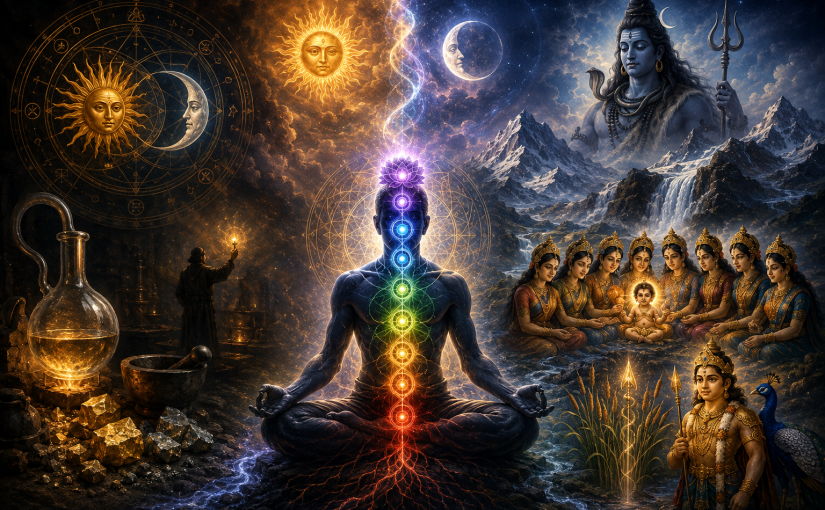
A striking correspondence appears when the symbolism of the Emerald Tablet, tantric ideas of kundalini, and the traditional narratives of Kartikeya’s birth are examined together. This does not mean that the Emerald Tablet is literally a tantric text, that Kartikeya’s story was deliberately written as a chakra diagram, or that the two traditions necessarily influenced one another. Their histories are distinct. The important observation is structural: each can be read as describing a concentrated generative potential that is produced through complementary principles, carried by an intermediary force, progressively nourished or refined, and ultimately transformed into a higher or perfected state.

The Emerald Tablet is a short Hermetic text rather than a complete description of the whole alchemical process. Its central teaching begins with a unified principle, the “One Thing,” from which multiplicity arises. It describes the Sun as Father and the Moon as Mother, followed by the statement that the wind carries the generated principle in its womb and that the Earth nourishes it. The text then speaks of separating the subtle from the gross, ascending from earth toward heaven and bringing the powers of above and below together. Later alchemical traditions developed such imagery into the Magnum Opus, the great work of purification, separation, transformation and reunion, culminating symbolically in perfected matter, the Philosopher’s Stone and the transmutation of base metal into gold.

The phrase concerning the wind is especially important. The wind is not presented merely as something that transports an object; it carries the principle “in its womb.” The imagery therefore combines movement with containment and gestation. In a comparative yogic reading, this is reminiscent of prāṇa or vāyu: not simply physical air, but the vital movement associated with breath and subtle activity. The parallel should not be turned into the claim that the author of the Emerald Tablet was describing Indian prāṇāyāma. The historical evidence does not establish that. The meaningful comparison is functional: an already generated potential requires a medium through which it can be carried, developed and transformed. Similarly, earth symbolizes the Muladhara Chakra because it provides the constant foundation and nourishment necessary for its growth and ascent. Earth, or grounding, is also symbolically associated with the Muladhara in Tantra. This does not mean that the earth described in the Emerald Tablet refers specifically to the Muladhara Chakra; rather, the symbolic parallel between the two is clear.

The Tantric Parallel

Tantric and yogic traditions provide a different vocabulary for a similar transformational pattern. Kundalini is traditionally described as a latent power that can be awakened and directed through the subtle body, particularly through Suṣumṇā, the central channel. The chakra systems vary between traditions, and the familiar seven-chakra model is not universal across all historical yoga, but the later widely known model presents successive centers from the base of the subtle axis toward the crown. Within this framework, the process is not simply transportation from one point to another. Each stage can be understood as a transformation of the original potential.

This is why the correspondence becomes more precise when the chakras are regarded as stages of refinement rather than as seven physical containers. The generative potential associated symbolically with the lower center is progressively transformed as it passes through successive levels. Prāṇa provides the mediating movement, while Suṣumṇā represents the central route of ascent. The culmination is associated with the highest state of consciousness, traditionally symbolized by Sahasrāra. This should not be confused with a claim that chakras or Suṣumṇā are physical anatomical structures. They belong to a traditional subtle-body model and can be studied scientifically as a phenomenological and contemplative system without being presented as established anatomy.

The role of breathing must likewise be stated precisely. Yogic breathing practices regulate breath and prāṇic activity, but kundalini awakening is not traditionally reduced to mechanically pushing an energy upward by respiration alone. Different traditions combine breath regulation with concentration, meditation, purification, bodily locks and other practices. Thus the useful analogy with the Emerald Tablet is not “air physically carries semen through seven organs,” but rather that a concentrated potential is mediated and transformed through a regulated vital process.

The Birth of Kartikeya

The Kartikeya birth narratives provide a striking mythological parallel. There is no single uniform version: the Rāmāyaṇa, Mahābhārata and Purāṇic traditions arrange the roles of Śiva, Agni, Gaṅgā, the Kṛttikās, Svāhā and the reeds differently. Yet several versions share the central idea that an extraordinary generative power associated with Śiva cannot proceed through ordinary reproduction. It must be transferred, contained, carried and developed through several intermediary stages before Kartikeya is born.

The seven Kṛttikās are traditionally maternal figures who nourish Kartikeya and are associated with the Pleiades. The identification of these seven mothers with the seven chakras is not an explicit statement of the ancient myth and should therefore be treated as an esoteric interpretation, not a historical fact. Nevertheless, the symbolic correspondence is unusually coherent. If the seven Kṛttikās are interpreted as seven successive centers or stages, their nursing represents the nourishment and maturation of an already generated potential. The original essence is not merely transported unchanged; it is developed through successive levels until it can manifest in a new form.

This gives the Kṛttikās a particularly interesting symbolic relation to the chakras. The chakras, in this interpretation, are not merely passages. They are stages of gestation and refinement. What begins as a concentrated generative potential at the lower level is progressively transformed into increasingly subtle expression. The “nursing” of the seven mothers therefore becomes a mythic image of progressive development.

Himalaya, Gaṅgā and Suṣumṇā

The later stages of the Kartikeya narrative can also be read through a yogic symbolic framework. The Himalaya may be interpreted as an image of the great spinal axis, the mountain being the archetypal vertical structure of Indian sacred geography. Gaṅgā, which carries the developing essence in relevant versions of the story, can then be compared symbolically with Suṣumṇā, the central current of the subtle body. The comparison is not that the myth literally defines Gaṅgā as Suṣumṇā; it is that both function within their respective symbolic systems as a central route through which something transformative is carried.

The reeds at the final stage can similarly be read as an image of the place of culmination, corresponding symbolically to the highest region of the subtle ascent and, in a later tantric vocabulary, to Sahasrāra. Again, the reeds do not historically have to mean Sahasrāra for the comparison to be meaningful. The sequence itself is what matters: origin, transmission, sevenfold nourishment, central passage, culmination and birth.

Kartikeya’s birth can consequently be interpreted as the birth of an awakened principle. The significance is not ordinary biological reproduction but transformation: a powerful potential that begins in an unmanifest or unstable state passes through containment, nourishment and refinement until it emerges as a qualitatively different being. This is closely analogous to the alchemical movement from crude matter toward gold.

The Meaning of the Generative Essence

The sexual terminology in these traditions should therefore be understood primarily as symbolic language for concentrated generative potential. Where Kartikeya traditions speak of Śiva’s semen or reproductive essence, it is unnecessary—and scientifically unjustified—to claim that physical semen literally travels upward through the spine and becomes kundalini. The stronger interpretation is that reproductive substance represents concentrated creative potential: something capable of generating new life and therefore an effective symbol for energy that is retained, transformed and redirected toward another form of manifestation.

The same principle helps clarify the Father and Mother of the Emerald Tablet. They need not signify ordinary biological parents. They can represent complementary principles, such as active and receptive, conscious and transformative, or solar and lunar aspects. Their conjunction generates the potential; the wind carries it; the Earth nourishes it; and the process of separation (from worldly lust) and refinement (with help of meditation image constantly in mind) brings it toward perfection.

Thus the central subject is not sexual activity but generation, retention, mediation, refinement and rebirth.

The Alchemical and Yogic Meaning of Transmutation

This also explains why the alchemical transformation of base metal into gold is such a powerful parallel. Taken literally, historical alchemy sought material transformation and the Philosopher’s Stone. Taken symbolically, the same language describes the movement from the crude to the perfected, the impure to the purified, and the divided to the unified. Gold becomes an image of completion and incorruptibility.

In the tantric interpretation, the corresponding transformation is from an unawakened or conditioned human state into awakened consciousness. In the Kartikeya myth, an extraordinary generative power passes through a process of transmission and nourishment before becoming Kartikeya. In alchemy, the raw material becomes gold. The outward symbols differ, but the underlying narrative is similar: potential is not merely released; it is transformed.

This distinction is important. Kundalini should not simply be equated with semen, the Philosopher’s Stone should not simply be equated with Sahasrāra, and Kartikeya should not simply be equated with awakened consciousness, and Kritika not to be equated with an anatomically located chakra. The deeper correspondence is between processes rather than objects.

The Most Precise Comparative Model

The three systems can therefore be placed beside one another in a single sequence. In the Emerald Tablet, the One expresses itself through complementary Father and Mother principles; a generative essence arises; the wind carries it in its womb; the Earth nourishes it; the subtle is separated from the gross; ascent and descent bring higher and lower powers together; and perfection is achieved. In the tantric model, latent potential is awakened; prāṇa mediates its movement; successive chakras refine it; Suṣumṇā provides the central route; and the culmination is awakening. In the Kartikeya narratives, Śiva’s extraordinary generative power is transferred, contained, nourished through the Kṛttikās in relevant versions, associated with the mountain and Gaṅgā, and finally manifested as Kartikeya.

The common structure can therefore be expressed without forcing one tradition into another: unity or concentrated potential → complementary principles → generation → carrying medium → nourishment and progressive refinement → central ascent or transformation → culmination → emergence of a perfected state.

This is stronger than the simple assertion that “alchemy is Tantra” because it does not depend on proving an uncertain historical connection. It identifies a functional similarity in the way different traditions represent transformation.

A Scientific Boundary

A scientifically responsible interpretation must also distinguish experience from physical mechanism. Modern research can investigate breathing, meditation, attention, autonomic regulation, sensory changes, altered states of consciousness and the subjective experiences practitioners associate with kundalini. It cannot presently establish chakras as physical organs, Suṣumṇā as an anatomical channel, or the literal conversion of semen into an independently measurable substance called kundalini. The traditional subtle-body system is therefore best treated as a religious, contemplative and phenomenological model unless specific claims acquire independent empirical evidence.

That limitation does not make the model meaningless. A disciplined spiritual tradition can contain repeatable practices, defined procedures, recognizable stages and recurring experiences without being identical to modern physical science. What may legitimately be called experiential knowledge is knowledge obtained through structured practice and observation of experience. Whether such knowledge qualifies as “science” in the strict modern sense is a separate question requiring reproducibility, operational definitions and independent measurement.

The Full Meaning of the Parallel

The most compelling insight is therefore not that an ancient alchemist secretly knew the chakra system or that an Indian myth secretly describes modern physiology. It is that three very different symbolic traditions repeatedly use the same broad image of transformation. Something primordial or generative is concentrated; complementary principles participate in its formation; a medium carries it; successive stages nourish and refine it; the transformed potential moves toward a higher condition; and something new is born.

In the Emerald Tablet, the result is expressed through alchemical perfection and gold. In Tantra, it is expressed through the awakening and ascent of kundalini toward higher consciousness. In the Kartikeya narrative, it appears as the extraordinary birth of a divine being after a prolonged process of transmission, nourishment and maturation. The correspondence is therefore best understood neither as proof of identity nor as a coincidence to be dismissed, but as a meaningful comparative pattern: what is latent can be retained, carried, refined and transformed until it emerges as a higher state of being.

That is the deepest point at which the alchemical, tantric and Kartikeya narratives meet. Their languages differ, their histories differ, and their literal claims must remain distinct, but their central transformational imagination is remarkably close: the crude becoming refined, the latent becoming manifest, the divided becoming integrated, and the ordinary becoming awakened.

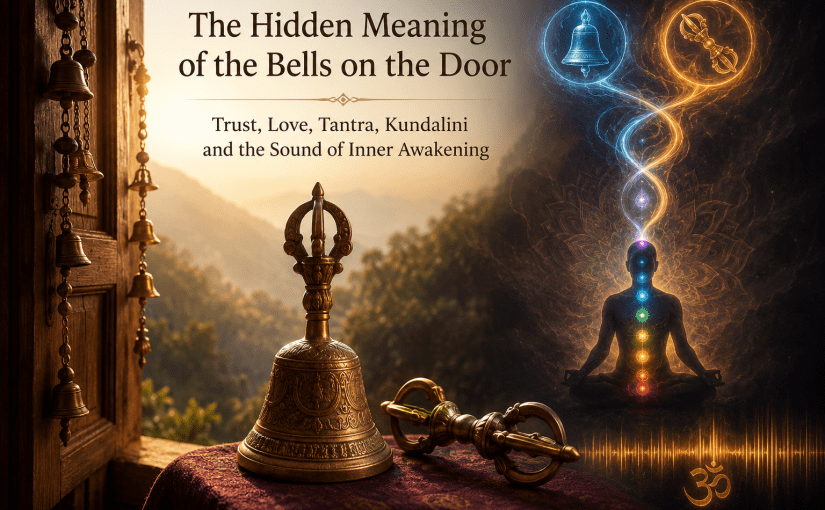
The Hidden Meaning of the Bells on the Door: Trust, Love, Tantra, Kundalini, and the Sound of Inner Awakening

A Simple Act of Hospitality That Revealed an Entire Spiritual Journey

Some experiences enter our lives quietly, almost unnoticed, yet within a few hours they begin revealing meanings far deeper than the event itself. They remind us that life often speaks through ordinary objects long before we understand its language. One such experience has remained with me ever since.

My old friend recently accommodated me in a room whose doorway was beautifully decorated with hanging bells. The room appeared to contain valuable belongings, yet he welcomed me with complete openness, leaving no trace of suspicion or hesitation. His gesture was not merely one of hospitality. It was an expression of trust. At that moment I simply appreciated his warmth, but within hours something extraordinary happened. The room remained the same, the bells remained the same, and the host remained the same. Only my perception changed. Suddenly, everything around me began revealing another dimension. What had seemed like a pleasant memory quietly transformed into a living lesson in Tantra, Kundalini, and consciousness.

The Greatest Treasure Was Never Inside the Room

Most people would naturally think that the valuables inside the room were its expensive possessions. Today I see the situation very differently. Whether costly objects were actually present or not has become almost irrelevant. The greatest wealth in that room was not material. It was the priceless trust with which another human being opened the door of both his room and his heart. Material possessions may have a market value, but trust has no price. The willingness to leave another person alone among one’s belongings without fear is itself a priceless gift. That invisible treasure remained with me long after I had forgotten every physical detail of the room.

The Bells Could Tell Many Different Stories

Those small bells hanging on the doorway gradually became the center of my contemplation. At first they appeared to be nothing more than attractive decorations. Then my mind smiled at another possibility. One could humorously imagine them as the simplest security system ever invented. Every time the guest entered or left the room, the bells faithfully announced his movements. If the guest quietly decided to leave carrying expensive belongings inside his bag, the bells would probably reveal the secret before anyone else could. The thought itself was amusing, but it lasted only for a moment because another interpretation appeared almost immediately.

Perhaps those bells had nothing to do with suspicion at all. Perhaps they simply informed the host that his guest had awakened, stepped outside, or returned safely. Every gentle chime gave him another opportunity to ask whether I had eaten, whether I needed tea, whether I was comfortable, or whether anything else could make my stay more pleasant. The same bells that one person might interpret as surveillance could equally be understood as expressions of care. The object never changes. Consciousness changes. A suspicious mind discovers suspicion. A humorous mind discovers comedy. A loving mind discovers affection. A spiritual seeker discovers symbols.

When Decorative Bells Became the Ghanta

Within only a few hours another realization unfolded. Those bells were no longer merely decorative ornaments hanging from a doorway. They had become the Ghanta of Tantra. The moment Ghanta appeared within my contemplation, another symbol naturally emerged beside it—the Vajra. Suddenly the memory of that room connected itself with my own spiritual journey. What had begun as ordinary hospitality quietly transformed into a profound tantric metaphor.

Trust, Love, and Surrender Form the First Tantric Union

As I reflected more deeply, I realized that no authentic tantric journey begins merely with physical union. Before the body can unite meaningfully, something much deeper must unite first. Trust opens the first door. Love opens the second. Surrender opens the third. Only when trust becomes complete, love becomes unconditional, and surrender becomes effortless does the true tantric pair begin to emerge. It is this invisible union that prepares the ground for authentic tantric meditation. Without these foundations, outer union remains only physical. With them, the same union gradually becomes spiritual.

When Vajra Meets the Bell

The symbolism now became remarkably clear to me. The receptive Bell remains silent by itself. The phallic Vajra, representing the masculine principle, likewise remains silent alone. Only in their symbolic union does the Bell begin to ring. Only when Vajra and Bell unite does resonance begin. Yet this ringing is not immediate. Just as genuine spiritual awakening cannot be forced, neither does the symbolic bell begin ringing at the very first meeting. It is prolonged practice, deepening trust, maturing love, complete surrender, disciplined meditation, and inner purification that gradually awaken the resonance. The true ringing does not arise from metal striking metal. It arises from consciousness entering its own deeper dimensions.

The Ringing That Cannot Be Heard by the Ears

The longer I contemplated this symbolism, the more clearly I understood that the ringing of the Bell was never merely an external sound. It represented the subtle inner resonance that gradually becomes perceptible during sustained tantric and yogic practice. This is the beginning of the unstruck sound, the Anāhata Nāda. It is not produced by external impact but arises spontaneously within consciousness itself. As this subtle current deepens, the practitioner gradually becomes aware of an entirely different dimension of meditation.

The Awakening of Kundalini

In my own experience, sacred sexual union became the doorway through which this inner journey began. It was never merely an act of physical intimacy. It became the catalyst for awakening. Through prolonged tantric practice, the symbolic union of Vajra and Bell gradually expressed itself as an inner current flowing through the Sushumnā Nāḍī. As this subtle flow strengthened, Kundalini awakened. With that awakening came the direct recognition of the Self. For me, self-realization was not the conclusion of the journey but the beginning of a far greater one.

Beyond Self-Realization

The journey did not end with Kundalini awakening. Continued practice under the necessary inner conditions gradually revealed deeper stages of yogic experience. The natural suspension of breath known as Kevala Kumbhaka emerged spontaneously rather than through force. As meditation matured further, consciousness appeared to move beyond even this into a state that I can only describe as the profound silence traditionally associated with Nirvikalpa Samadhi. The experience was extremely brief, occurring only a few times, and so subtle that I still remain uncertain whether it was truly Nirvikalpa Samadhi or only a fleeting glimpse of that state. Whatever it was, it left a deep and lasting impression on my spiritual journey. These stages unfolded as living experiences rather than philosophical concepts. They taught me that the path of Tantra extends far beyond its outer forms. What begins as love and surrender gradually becomes meditation. Meditation becomes awakening. Awakening becomes silence. Silence finally becomes the direct experience of limitless consciousness.

The Hidden Meaning of the Bells

Today, whenever I remember those bells, I no longer see only decorations hanging from a doorway. I see trust becoming love, love becoming surrender, surrender becoming tantric meditation, meditation becoming the symbolic union of Vajra and Bell, that union gradually giving birth to the subtle resonance of the Anāhata Nāda, the current ascending through the Sushumnā, Kundalini awakening into Self-realization, and the continuing journey toward Kevala Kumbhaka and Nirvikalpa Samadhi. Yet none of these deeper meanings erase the outer event. The room was still a room. The host was still a gracious host. The bells were still ordinary bells. They simply became mirrors reflecting increasingly deeper layers of consciousness.

Perhaps this is how hidden meanings always reveal themselves. Life first offers us an experience. Understanding follows. A simple act of hospitality becomes a lesson in trust. Trust blossoms into love. Love matures into surrender. Surrender opens the gateway to Tantra. Tantra awakens meditation. Meditation gives voice to the silent Bell. The Bell begins to ring within. The ringing becomes the subtle current of the Sushumnā. The current awakens Kundalini. Kundalini reveals the Self. Continued practice carries consciousness beyond breath into Kevala Kumbhaka and ultimately into Nirvikalpa Samadhi. The bells hanging on that doorway have long since fallen silent in the outer world, yet within me their resonance continues even today, reminding me that the deepest spiritual teachings often arrive disguised as the simplest moments of ordinary life.

Destruction, Creativity, Sexual Energy, and the Possibility of a Spiritual Explosion

Human life appears to move continuously between destruction and creation. Whenever energy is spent through violence, aggression, domination, excessive consumption, or any activity that destroys life or harmony, a subtle imbalance is created within consciousness. Nature seems unwilling to leave this imbalance incomplete. Deep within the human psyche arises an unconscious urge to compensate for what has been destroyed. This compensation generally takes the form of creativity. The mind begins searching for some way to recreate, rebuild, nourish, or regenerate life. If refined forms of creativity are available, the same energy may flow into art, music, invention, social service, philosophy, spirituality, or constructive work. However, if higher creative channels are absent or underdeveloped, the balancing movement often takes the form of sexuality, because sexuality itself is deeply connected with biological creation and regeneration.

This may explain why many human beings unconsciously move toward sexual activity after periods of aggression, emotional disturbance, intoxication, stress, conflict, or intense sensory indulgence. Something within seeks balance. When life has been consumed, harmed, or psychologically disturbed, nature silently pushes the individual toward creation again. In ordinary people this creative balancing frequently manifests through reproduction, because reproduction is the most direct and instinctive method by which nature restores life. In this way population growth is not always the result of conscious intention alone. Much of it may emerge from unconscious energetic compensation taking place continuously within humanity.

Sexuality therefore cannot be understood merely as physical desire. Hidden within sexual energy is the same creative force that can generate life itself. The energy capable of producing a child is also capable of producing poetry, philosophy, scientific innovation, artistic depth, emotional sensitivity, compassion, meditation, and spiritual transformation. Ancient yogic and tantric traditions often viewed sexual energy not as something sinful but as one of the densest and most powerful forms of life-force within the human system. According to these perspectives, the problem is not energy itself but unconsciousness regarding its direction and use. When this energy is discharged mechanically and repeatedly without awareness, it remains confined to biological reproduction and temporary pleasure. However, when the same energy is consciously observed, retained, refined, and redirected, it can begin transforming the mind and expanding consciousness.

This is where the deeper principle behind Tantric sexual yoga emerges. In ordinary sexuality the creative force moves outward toward physical reproduction, whereas in Tantric transformation the same force gradually begins moving inward and upward toward psychological, intellectual, and spiritual development. The creative pressure that would otherwise express itself through population growth starts expressing itself through heightened awareness, meditation, subtle perception, artistic creativity, emotional refinement, and inner bliss. Instead of creating bodies alone, the individual begins creating consciousness within himself. The energy that once sought release through instinct slowly becomes fuel for awakening.

As this transformation deepens, a person may naturally become more intuitive, contemplative, creative, and socially aware. The mind becomes less compulsive because the energy is no longer escaping unconsciously. Instead, it begins nourishing higher centers of intelligence and perception. Many spiritual seekers throughout history may have unknowingly experienced this shift when they discovered that desire itself could become a doorway to awareness if approached consciously rather than mechanically. The same force that binds a person to instinct can also liberate him when transformed through observation and meditation.

Modern civilization possesses enormous energy but very little understanding regarding its refinement. Humanity today lives under continuous stimulation, consumption, aggression, emotional tension, and sensory overload. Because constructive channels for transforming these energies are often weak, much of the accumulated force repeatedly falls back into unconscious biological patterns. This contributes not only to psychological unrest but also to endless cycles of craving, exhaustion, and imbalance. Suppression does not solve the problem because suppressed energy eventually returns in distorted forms. Blind indulgence also fails because indulgence temporarily releases pressure without transforming consciousness. True transformation requires awareness. It requires understanding how destructive and sexual energies can be refined into creativity, intelligence, compassion, and spiritual depth.

If humanity ever learns this art collectively, society could witness a completely different kind of explosion. Instead of merely a population explosion driven by unconscious compensation, there could emerge a creative and spiritual explosion driven by transformed consciousness. The same energies that presently fuel violence, obsession, addiction, and endless craving could begin expressing themselves through science, philosophy, healing, ecological restoration, meditation, artistic excellence, and deeper human understanding. Such a civilization would not reject human instincts, nor would it worship them blindly. It would refine them. The aim would not be suppression of energy but elevation of energy.

Perhaps this is one of the hidden evolutionary possibilities within human existence. Destructive energy and sexual energy may not ultimately be enemies of spirituality. They may simply be raw forms of life-force waiting to be understood. When unconscious, the same energy becomes violence, compulsion, and restless desire. When partially conscious, it becomes creativity, romance, and emotional expression. When fully conscious, it becomes meditation, illumination, and awakening. The fire remains the same, but its direction changes. One direction burns life in unconscious repetition, while the other illuminates consciousness and transforms human existence itself.

Destructive and creative energies enrich each other through a feedback loop. If destructive energy is violent and without awareness, the creative energy that forms in response will also be blind. Then, in turn, the next phase of destructive energy becomes blind again, and the cycle continues as a self-sustaining loop. However, if at any point—whether in the destructive phase or the creative phase—awareness combined with humanity is introduced, the loop reverses direction, and both phases begin to infuse awareness into each other. The so-called destructive phase may itself be misunderstood in many human situations. What appears outwardly as destruction is often not absolute destruction in the deeper sense, because humane qualities, empathy, social conditioning, emotional intelligence, fear, morality, and subtle compassion continuously dilute the raw destructive impulse. In most civilized individuals the destructive tendency rarely reaches its pure form. It remains moderated, symbolic, theatrical, or psychological rather than totally annihilative. The person may outwardly display aggression, domination, harshness, competitiveness, hunting instinct, consumption, or power assertion, yet internally a hidden layer of humanity keeps softening the impulse before it becomes fully destructive.

In that sense much of human aggression is not complete destruction but a drama of power expression. The individual unconsciously wishes to feel strength, expansion, intensity, importance, or energetic release rather than actual annihilation of life. The destructive appearance therefore becomes partially symbolic. One may engage in arguments, competition, dominance, excessive consumption, risky behavior, violent entertainment, or even non-vegetarian food habits not necessarily from deep cruelty but from an unconscious need to experience vitality, power, grounding, excitement, or energetic expansion. The humane core within most people prevents the impulse from becoming fully demonic or purely destructive.

Because the destructive element remains incomplete and diluted by human sensitivity, the balancing movement toward creativity also becomes subtler. The person may not feel overwhelming guilt or violent compensation, but rather a gentle movement toward affection, sexuality, bonding, creativity, emotional intimacy, or spiritual seeking. Nature appears to continuously maintain equilibrium even within these softened human dramas. The apparent destruction and the subsequent creativity together become part of a larger energetic rhythm rather than a battle between absolute good and evil.

This also explains why many people who outwardly appear aggressive, dominating, or intensely worldly may simultaneously possess deep emotional softness, artistic sensitivity, protectiveness toward family, compassion toward children, attraction toward spirituality, or longing for peace. The same person may participate in harsh worldly activities yet seek meditation, love, devotion, beauty, or transcendence afterward. Human consciousness is rarely one-dimensional. The humane element continuously interferes with pure destruction and slowly redirects energy toward preservation and creation.

Thus the so-called destructive phase in ordinary human life may often be more accurately understood as compressed life-force seeking expression through intensity rather than true destruction. It is frequently an energetic performance of power rather than an authentic desire to eliminate existence. Since the underlying life-force itself is creative by nature, even its distorted or aggressive expressions eventually bend back toward creation, bonding, sexuality, art, spirituality, or consciousness expansion. The movement toward creativity therefore is not merely compensation for destruction but the natural tendency of life-force to return toward harmony after temporary imbalance or energetic dramatization.

From this perspective, even human violence in its milder civilized forms may secretly contain an incomplete search for vitality, grounding, and self-expansion. When awareness grows, the individual gradually realizes that genuine power does not arise from domination or symbolic destruction but from conscious transformation of energy itself. Then the drama of power slowly dissolves, and creativity becomes direct, effortless, and conscious rather than compensatory.

In this understanding, creativity becomes the true balancing principle of nature. Whenever destruction increases, pressure for creation also increases. Whenever awareness enters this creative process, evolution accelerates beyond biology. Humanity then begins producing not only more bodies, but also more consciousness.

From Dynamic Engagement to Effortless Stillness: The Evolution of Inner Practice

There was an earlier phase in life when dynamic engagement itself functioned as a powerful form of meditation. Activity was not a distraction; rather, it was an integral part of the process. Intense involvement in worldly tasks—meeting people, solving problems, moving through responsibilities—would naturally be followed by withdrawal into rest. This alternation between engagement and withdrawal created a sharp inner contrast, and that contrast made entry into stillness almost effortless.

The mind, having exhausted itself in activity, would drop easily into silence.

In those days, this rhythm was not only effective but deeply transformative. It provided a natural doorway into meditative absorption. The world and withdrawal were not opposites but complementary forces, each enhancing the other.

It was during this phase that I would frequently visit the homes of animal farmers, tending to their sick or nonproductive animals. These visits brought me into close human contact. Conversations unfolded, relationships formed, and outwardly I appeared fully immersed in the flow of life.

Yet inwardly, something entirely different was happening.

Sharirvigyan Darshan remained active in the background, quietly shaping perception. It did not interfere with action, nor did it create visible detachment. People never sensed that anything was being avoided or withheld. I lived among them as one of them—engaged, responsive, and natural.

And yet, there was no deep attachment.

This subtle inner state resembled the classical image of a lotus leaf resting on water—completely surrounded, yet untouched. It is perhaps one of the signs of a refined inner discipline: to remain fully integrated into life while inwardly free from its binding impressions.

During moments of rest, the meditation image—strengthened through Sharirvigyan Darshan—would spontaneously arise. It required no effort. It simply appeared, as if it had become the natural resting position of the mind. The impressions gathered during daily activity would dissolve in its presence. Residual thoughts lost their charge, absorbed effortlessly into this inner image.

Over time, this process matured.

The meditation image was no longer something cultivated—it became self-sustaining. It began to carry an inherent pull toward awakening, as if the system itself was preparing for a deeper shift.

When Stillness Becomes Primary

However, with age and inner maturation, a subtle but decisive shift occurred.

The earlier dependence on contrast—activity followed by withdrawal—began to fade. Stillness no longer required the exhaustion of activity to reveal itself. It became directly accessible, independent of outer engagement. Silence was no longer the result of effort; it became the underlying state.

And with this shift, the limitations of Sharirvigyan Darshan started to become apparent.

This method, by its very nature, is rooted in dynamic engagement. It requires movement, interaction, and a certain level of outward activity to function effectively. But now, the inner requirement had changed. The movement toward the void demanded stillness, not stimulation.

Whenever Sharirvigyan Darshan was intentionally induced, it would generate a certain intensity—an activation of the system that, at this stage, felt counterproductive. Instead of aiding entry into stillness, it disturbed it.

This marked an important realization:

What is beneficial at one stage of Kundalini maturation can become a hindrance at another.

Dynamic meditation, which once served as a powerful tool, now began to produce subtle stress signals in the body—head pressure, fatigue, and a sense of unnecessary exertion. It was not that the method had lost its validity, but rather that its role had been fulfilled.

The Shift Toward Direct Awakening

Beyond this stage, a different approach became more appropriate.

Instead of maintaining the state through repeated dynamic engagement—which required continuous energy expenditure—there arose a need for direct awakening. This is where Tantric yoga played a crucial role.

Rather than building the state again and again, Tantra worked by lifting the system to a level where the meditative presence remained continuously available. The meditation image, once cultivated through effort, became spontaneously present in the mind. Energy began to move upward naturally from the Muladhara, without deliberate stimulation.

This marked a fundamental shift—from effort to continuity.

In comparison, returning to dynamic methods like Sharirvigyan Darshan began to feel indirect and unnecessary. While it still retained utility during active phases of life, its central role diminished.

A simple clarity emerged:

If the meditation image is directly accessible, why take a longer, indirect route to reach it?

Maturation, Solitude, and the Final Push

As this inner readiness deepened, external circumstances aligned in an unexpected way. A desolate place became available—a space of physical isolation that perfectly matched the inner movement toward stillness.

In that environment, the process accelerated.

With the additional push of Tantric yoga, the accumulated momentum reached a critical threshold. What had been gradually maturing beneath the surface crossed into a new phase. It felt like achieving escape velocity—moving beyond the gravitational pull of previous patterns and limitations.

The awakening that followed was not a sudden creation, but the natural flowering of a long-prepared ground.

All the earlier phases—dynamic engagement, detached participation, spontaneous absorption, and eventual stillness—had played their role. Nothing was wasted. Each stage was necessary, but none was final.

A Natural Progression, Not a Contradiction

Seen in totality, this journey is not a rejection of earlier methods but their fulfillment.

Dynamic meditation leads to stillness. Stillness matures into direct presence. Direct presence seeks stabilization through awakening.

What once required effort becomes effortless.
What once depended on contrast becomes self-existent.
What once was practiced becomes natural.

And in that naturalness, the path dissolves into its own destination.

The Necessity of Physical Yoga After Inner Stillness

However, an important practical question naturally arises: if dynamic spiritual practices reduce and one remains mostly established in inner stillness, then how will the body remain healthy? Earlier, active forms of meditation and outward engagement indirectly kept the body energized and functional. Dynamic practices such as Sharirvigyan Darshan involved movement, interaction, stimulation, and continuous participation in life, which naturally maintained physical vitality alongside spiritual growth. But once consciousness matures into effortless stillness, the tendency toward physical inactivity can gradually increase.

At this stage, physical yoga is no longer required primarily as a means to attain meditation; rather, it becomes necessary for maintaining the biological and energetic balance of the body itself. The body follows its own natural laws. Muscles, joints, circulation, lungs, digestion, glands, and the nervous system all require movement and activation to remain healthy. Without sufficient physical activity, even a deeply peaceful meditative life can slowly produce stiffness, fatigue, poor circulation, heaviness, or loss of vitality in the body.

Therefore, after a certain level of Kundalini maturation, spiritual stillness alone is not enough for complete balance. Conscious bodily practices become important—not to create meditation, but to support the physical structure through which consciousness continues to function. Stretching, spinal movement, walking, breathwork, grounding activities, and light physical yoga help maintain harmony between inner silence and bodily health.

At this mature stage, a clear distinction naturally appears. Meditation stabilizes consciousness, while physical yoga stabilizes the body. Earlier, both functions were mixed together within dynamic spiritual practice. Later, they separate into their own respective roles. Stillness may become effortless and continuously accessible, but the body continues to require care, movement, circulation, and grounding. In this way, physical yoga evolves from being merely a spiritual technique into a practical science of maintaining health, balance, and energetic stability while living in an awakened or inwardly silent state.

Chapter 15 – The Energy of Creation

This chapter reveals the ultimate secret of the cosmos—a profound unification of the atom and the human being, both in the tangible world and in the realm of consciousness, ultimately demystifying Tantra. Here, the nucleus represents the core energy, like the Muladhara, while the electron shells correspond to the chakras, each level guiding the flow of energy and awareness. The dance of electrons mirrors the currents of prana, and the architecture of atoms reflects the structured ascent of consciousness. It is a journey where physics and spirituality converge, where the smallest particle and the vastness of human awareness are one, and where the mysteries of the universe unfold within and around us.

In the last chapter, we explored how mass gives weight and stability to the universe—how it anchors stars, planets, and even our own bodies, providing shape to creation. But mass alone is not enough. A stone may have weight, yet without energy it cannot move, shine, or evolve. The universe would be a silent sculpture, heavy but lifeless.

To bring that sculpture alive, nature needs another ingredient—energy.
If mass is the body of creation, then energy is its breath. Mass gives form, while energy gives play. Together, they weave the dynamic universe where stars burn, rivers flow, and life blossoms.

At the most fundamental level, everything is a play of energy. In the quantum world, particles are not fixed lumps of matter; they are waves of energy that rise, fall, and occupy specific levels inside an atom. In a similar way—though more metaphorical than scientific—human breath or prana is described in yogic traditions as rising, falling, and focusing on specific chakras. These levels decide the structure of reality itself—how atoms are built, how molecules form, how light interacts, and even how life becomes possible. In a similar metaphorical sense, the focus of a people’s breath or prana on different chakras is said to shape how they interact with the world—spiritually, intellectually, emotionally, playfully, lovingly, or even ignorantly. Imagine energy levels like the rungs of a ladder. A particle can occupy a lower rung or jump to a higher one, but it cannot linger in between. Each rung represents a discrete possibility offered by nature. The particle’s wavefunction assigns probabilities to each rung, often peaking near certain favored levels. When a quantum measurement occurs—or even when the particle interacts with its environment—it collapses to one of these rungs. If we clarify it further, An atom has fixed energy rungs where its electron can exist. Before any measurement or interaction, the electron is not tied to one rung but spreads out as a probability wave across several of the allowed rungs, depending on how it was excited. When collapse happens, this wave no longer stays spread out—the electron is found on one definite rung chosen from those present in the wavefunction. Electron transitions between energy rungs usually occur by absorbing or emitting photons, but can also happen through collisions, heat, or external fields. In every case, the interaction first collapses the wavefunction onto a definite rung and then shifts the electron to a new level uniquely determined by the energy gap. If the electron absorbs a single photon of known energy, the outcome is no longer a choice among many rungs—the fixed photon energy matches only one gap, so the electron must land on that specific rung. In very strong light, an electron can absorb multiple photons simultaneously, and because different combinations of the same fixed photon energy can match different energy gaps, several higher rungs may become possible, with wavefunction amplitudes weighting the probabilities and collapse determining which one is realized. This collapse is not a conscious choice, but an ego-less, natural selection dictated by probability and interaction. While a single event may seem insignificant, the collective activity of countless quantum particles accumulates and propagates, giving rise to the stability of matter, the formation of structures, and, ultimately, the grand architecture of the cosmos. Each tiny probabilistic selection—these primordial, nature-made choices—adds its thread to the vast cosmic tapestry. One should not call quantum particles or these events “experience-less” or “non-conscious,” for they occur within the all-pervading pure awareness, which is the form of endless experience and consciousness.

Similarly, chakras can be seen as the rungs of a ladder along the backbone. Energy is experienced most distinctly at the chakras, not in between them. The breath or prana may focus on a particular chakra depending on the body’s need to cope with the present environmental circumstances. This is a type of environmental interaction. This is somewhat like the quantum collapse of a particle, which interacts with its environment and chooses an outcome that best fits the situation—allowing not only itself to grow, but also to let all grow.

The Cosmic Blueprint in Energy Choices

Let us again take the atom as an example. Electrons around the nucleus do not roam aimlessly—they occupy specific energy shells. When an electron jumps from one shell to another within the same atom, it changes the atom’s behavior—how it reacts, absorbs light, or bonds—without changing the element itself. Hydrogen, with its single electron, is the simplest example: its electron in different shells clearly alters its properties. In multi-electron atoms, electrons in various shells can also shift, especially the outer (valence) electrons, affecting chemical behavior in more subtle ways. On the other hand, creating a completely new element requires adding more electrons along with additional protons, producing atoms like carbon, oxygen, gold, or uranium, each with distinct properties.

A similar principle is described in yogic science. Energy shifts between chakras may alter a person’s behavior for a time—spiritually, emotionally, or intellectually—yet the deeper personality remains unchanged. Only when greater energy is added through practices such as Kundalini Yoga, pranayama, asanas, or tantra can the subconscious impressions be dissolved or transformed, changing the personality. If the vacant space so generated is filled with a meditation image and awakened, it can lead quickly to self-realization, thus opening the hidden channel of energy fully and transforming one entirely. This is like adding protons and electrons to create a new element: the very structure changes.

Just as an atom finds stability when its positive protons and negative electrons are balanced, human consciousness finds harmony when the root (muladhara) and crown (sahasrara) energies are balanced. If energy gathers too much at the crown, one may feel ungrounded; if it sinks into the root, one may feel heavy and depressed. But when balanced, consciousness becomes steady, expansive, and capable of true transformation. Adding electrons and protons is like adding quantum energies of opposite natures: proton-energy is heavy and grounding, while electron-energy is light and liberating.

When an atom has more electrons than protons, it becomes a negatively charged ion, having captured extra electrons from its surroundings. When it has fewer electrons than protons, it becomes a positively charged ion, having released electrons to the environment. In nature, these exchanges balance themselves, forming bonds that stabilize matter. Similarly, in human beings, one who has more energy at the sahasrara than at the muladhara is naturally drawn to someone whose energy is stronger at the muladhara, and vice versa. This complementary balance or opposite pull is like a lame person riding on the shoulders of a blind man—together they benefit and move forward. Just as atoms bond by sharing electrons, human beings form relationships by sharing their energies, creating harmony and growth for both.

An electron rests in its ground state, stable and content at the lowest orbital, until a spark of energy lifts it to higher realms—yet it soon returns, releasing its borrowed light. So too, human energy dwells naturally at the muladhara, the root of stability, unless awakened by the fire of yoga, pranayama, or tantra or even healthy relationships. When charged with such force, it rises through the chakras, unveiling hidden awareness; but without sustained energy, it drifts back to its base. Thus, the dance of electrons mirrors the dance of prana—the journey between rest and awakening, between grounding and transcendence.

The attractive pull of the proton may be seen as Pingala, and the attractive pull of the electron as Ida channel. When both are in balance, the personality of the human-form atom remains steady and harmonious. If the electron pull dominates, the personality becomes floating and expansive, drawing others toward it to form bonds as most of the ordinary people are resting in muladhara, much like positively charged ions attracted towards the negatively charged ions to complete themselves. If the proton pull dominates, the personality turns ego-centered and heavy, weighed down by over-worldliness, and thus seeks a strong companion bond to supply the needed electron pull of expansivensess. In this way, the balance of Ida and Pingala mirrors the balance of charges in an atom, shaping both stability and relationships.

Neutrons, acting as the Sushumna of the atom, prevent protons from repelling each other that can lead to nuclear burst by producing the strong nuclear force that holds them together against their electrostatic repulsion. In the same way, Sushumna keeps a check on Pingala by attracting its energy and channeling it toward Ida for balance, while also taxing a little bit of its energy for the growth of awareness and stability. Metaphorically, neutrons thus indirectly help to push the electrostatic energy of protons toward electrons to maintain harmony, while consuming a part of it themselves—absorbing some binding energy—to keep the atom stable and even evolving through processes like nuclear fusion. This resembles the kundalini awakening in humans, where a fully new and improved personality appears—just as with nuclear fusion a new, larger, or more powerful atom can emerge with more number of protons, neutrones, electrons and orbitals. When Pingala is brought under control, Ida too becomes balanced, for both are relative and run on each other’s power. In this balanced state, protons do not fly away and electrons remain steady in their orbitals. It is like awakening would be impossible without Sushumna, just as stable fusion in stars would be impossible without neutrons holding nuclei together.

The nucleus of the human-form atom is the Muladhara, the powerhouse of energy that sustains all activity. Electrons circling around it represent thoughts and subtle energy, moving through various orbitals akin to the chakras. The higher orbitals correspond to higher chakras, culminating in the Sahasrara—the point of expansive consciousness. Nuclear fusion can be seen as the awakening of this system: an outburst of energy from the Muladhara surges upward through the chakras, activating them fully and giving birth to improved consciousness, where the new atom formed has larger flows of Ida, Pingala, and Sushumna, and a greater number of outer chakras, symbolizing expanded consciousness. Just as fusion releases immense energy by merging nuclei, kundalini awakening channels the latent potential of the Muladhara to the Sahasrara through the merging of Shiva and Shakti, producing a transformed, expansive, and enlightened state, with the chakras aligned and pointing toward the full expansion of consciousness. Even though both nuclei (or both Muladharas in a Tantric pair) are essentially of the same “type” or nature, for the purpose of attraction, union, and merging, they are treated as opposites as Shiva and Shakti—like complementary polarities that allow energy flow and unification. The legendary Brahmastra, fired by yogis such as Guru Putra Ashvatthama, can be seen as a similar awakening, but applied in the worldly domain—harnessing the same primal energy for external effect rather than inner transformation. Or it may be that the sages knew this psychological secret, reflected also in the physical material world, and expressed it both literally and philosophically through spiritual-metaphoric stories.

Electrons do not move gradually between orbits—they leap suddenly when enough energy is absorbed. In yoga, too, states such as dhyana and samadhi unfold in sudden leaps, not in slow crawling. This explains why enlightenment often feels like an instantaneous shift, even though the preparation may take years. You can determine the probability of an awakening occurring—how likely it is under certain conditions—but you can never predict the exact moment it will happen, just as in quantum mechanics where you know the probabilities of outcomes but not the precise result of a single event. The silent jump of an electron to a higher orbit can be likened to dhyana ripening gradually through repeated inner leaps between chakras—peaceful, steady, and gradually transformative. In contrast, the great surge of nuclear fusion resembles the moment when awareness itself flashes: the energy of the self previously bound and sleeping in muladhara suddenly leaps into pure, boundless consciousness, joining the endless expanse of full potential. In that momentary blaze, the atom also experiences boundless bliss and light, before stabilizing into a new, transformed, and evolved state—just as an awakened yogi shines with renewed being. It is exactly like Tantric Yoga, where the Muladharas of two loving partners merge, releasing an explosive surge of energy that rises from the base upward, piercing all the chakras, until it expands into the boundless infinity of the Sahasrara. Two nuclei merge to maximum extent but a small portion still remains unmerged that is converted to large amount of energy spreading upward. Similarly, both muladharas of a tantric couple share their energies with each other akin to merging as much as possible, but still some energy remains unmerged. Probably this extra energy left after merging manifests as awakening. In this sense, what tantra calls detachment can be seen as this unmerged residue of energy—preventing the partners’ energies from clinging completely, and instead redirecting the unified current upward for the awakening of the meditation image and self-realization. Just as in fusion, the unmerged part becomes the source of tremendous release, so too in tantra it is the subtle detachment that transforms love into awakening. Just as nuclear fusion requires intense heat to occur, tantric kundalini awakening too needs the inner heat generated by worldly activities, loving relationships, and the contemplation of non-dual philosophy such as Sharirvigyan Darshan.

People often perceive forbidden relationships as more thrilling because they are often formed in broad awareness of daytime, unlike genuine family bonds that society sometimes associates with duty or constraints, and often reserved for the ignorance-filled dark of the night when one is fully tired and exhausted due to roaming blindly and wildly amidst the so called job-jungle throughout the daytime for so called important livelihood activities, as if it is the least important work in the world so far. Even then it works fine more or less. What good not to expect if it is done in full awareness. Moreover, if family relationships were valued and nurtured openly in the light of day—with clarity, respect, and mutual understanding—there would be little attraction toward what is considered illegal. Just as nuclear fusion happens in broad daylight inside the sun—with full awareness, without secrecy, without being forbidden—resulting in the enhanced light of awareness, so too can lawful, harmonious bonds generate true fulfillment when embraced openly. Clinging to the external form of a partner without understanding the sameness of energetic essence in every human being is also a reason for attraction toward relationships outside the family. When Tantra shows its effect, this fact is properly understood and truly believed. Needless to say, I have seen near perfectly matching pairs go astray by not recognizing this deeper energetic essence and by being superficially swayed by egoistic patterns.

On the other hand, in the psychological fission, it is as if the neutron—the awakened sushumna of a potential partner—strikes the muladhara, the nucleus of the possible lover, and breaks it open into two. One half is the bunch of ego, while the other half is like the pure soul, suddenly lightened by shedding the burden of impressions. The energy that was once bound tightly within egoistic thoughts is now released and becomes available for awakening. Just as in nuclear fission the mass of the resulting nuclei is slightly less than that of the original, with the difference emerging as an immense burst of energy, so too the breaking of the ego releases a vast inner power. The mass of egoistic patterns shed is transformed into this energy. This surge of liberated energy flows upward, igniting awareness and transforming consciousness. Such a shift cannot occur through an ordinary bond; it can only be catalyzed by the presence of a partner whose sushumna is awakened, carrying the force to dissolve ego and redirect the released energy toward spiritual awakening. Just as nuclear fission does not require extremely high temperatures to occur, in the same way this indirect tantra does not demand the intense heat of passionate worldliness, unlike the fusion-form direct tantra described above. Can we, by extending this analogy, also discover a method of cold fusion—one that could solve the world’s energy needs forever? If nuclear fusion is the fiery union of energies and fission the breaking apart of burdens, perhaps the hidden key to cold fusion lies in the same mystery that tantra reveals—that energy, when rightly aligned, can be released without fire, silently transforming both the yogi and the world. But the problem with fission is the production of toxic radiation—just like the toxic thoughts that arise when love-filled relationships are made for breaking instead of union. If this is resolved, the energy problem is solved.

Moreover, this is not mere theory—by the grace of my guru and God, I have personally experienced both of these phenomena, receiving awakening glimpses through both fusion-like union and fission-like breaking apart.

Seeing the grand similarity between the atom and the body, it is not hard to believe that an atom can be understood as a complete human body in itself, just as these flowing chapters of Quantam Darshan have been asserting since the very beginning.

Repeating further, energy levels are like the blueprint of all diversity. Electrons can only exist in certain allowed energy levels around an atom’s nucleus, and these positions determine the atom’s behavior—how it bonds, reacts, or inter acts with other atoms. This arrangement shapes the molecules that form, deciding whether they become water, sugar, or DNA.

An atom’s energy levels can be imagined as the floors of a building, with electrons as tenants who can only occupy these designated floors. Lower floors fill up first, following specific rules, while the outermost floor—the valence level—holds the electrons that interact with the outside world and determine how the atom bonds or reacts. The energy gaps between floors act like elevator heights: small gaps allow electrons to move easily, while large gaps require precise energy input, such as from photons. Altogether, the number of floors, the arrangement of tenants, and the spacing between floors form a blueprint that dictates where electrons can be, how they can move, and ultimately how the atom behaves and interacts chemically.

On a much larger scale, the life of a star is determined by the nuclei of its atoms—the number of protons and neutrons—which dictate the nuclear fusion reactions in its core and whether the star burns steadily like our Sun or ends violently as a supernova.

In the heart of every star, life is sustained by hydrostatic balance—the delicate equality between the inward pull of gravity and the outward push of nuclear fusion. If fusion pressure runs ahead, the star swells outward until cooling slows the reactions and balance returns; if gravity takes the lead, contraction heats the core until fusion strengthens again. This harmony allows stars to shine for billions of years, but when their core fills with nuclei such as iron, which cannot yield net energy by fusion, no outward push remains to resist collapse. Gravity then crushes the core, sometimes into a neutron star, sometimes into a black hole, or in rare majesty, releasing all stored energy in a supernova explosion. So too in the inner cosmos: the body endures as long as prana, the fuel of life, sustains the balance between the contracting pull of ego and the radiant expansion of awareness. If awareness expands without grounding, the mind scatters; if ego contracts too tightly, consciousness suffocates into bondage. But in perfect equilibrium arises a steady luminosity—egoless quantum darshan, the inner sun burning without exhaustion. And when prana is finally exhausted at life’s end, the soul too meets its destiny: if awareness bursts free of ego’s last grip, liberation shines like a supernova, scattering individuality into the vastness; but if egoic gravity still outweighs, the soul collapses inward, bound like a neutron star or lost in the depths of a black hole—its journey continuing until balance is rediscovered.

Moreover, electrons and their energy levels play only an indirect role in this, influencing how radiation moves through the star. Without these energy levels setting the rules for electrons, nothing would take shape: no chemistry, no molecules, no planets, and no living beings to notice it.

The Drama of Quantum Jumps

Bringing the story to the fore again, you may have heard of the term “quantum jump.” It is not just a metaphor—it is a real event. When an electron absorbs or emits energy, it does not glide smoothly but suddenly leaps from one energy level to another. This jump is accompanied by light—what we call photons. And these photons are the messengers of creation, carrying information and energy across the universe.

Every ray of sunlight, every twinkle of a star, and every color in a rainbow arises from electrons making quantum transitions between energy levels. In stars and atoms, multiple energy levels exist, and the timing and path of each transition are probabilistic, giving photons a spectrum of colors and intensities—a whisper of the quantum world. In contrast, engineered systems like LED bulbs force electrons to drop across a single fixed energy gap, producing light of a steady wavelength and color. Whether probabilistic or fixed, each photon is still born from the same quantum rules, linking the microscopic choices of particles to the vast tapestry of creation.

Energy Levels and the Symphony of Life

If spin brought individuality and momentum brought direction, then energy levels bring structure. Consider the orchestra of life. Proteins fold into shapes, DNA forms a double helix, water forms crystals of ice—all because electrons collapse into specific energy levels, giving atoms predictable bonds and patterns.

Had these collapses gone differently, perhaps the chemistry of life would not exist. Imagine a universe where electrons never settled into stable shells—there would be no stable atoms, only chaos. Imagine a universe where energy gaps were wider or narrower—water might not exist, oxygen might not bind, and life as we know it could not breathe. Even sunlight would fail to power biology, because the energy of its photons would not match the molecular energy gaps needed for processes like photosynthesis or vision.

Thus, energy levels are not random—they are the stage upon which life performs.

Chakras as Quantum Energy Levels of Consciousness

If we dwell on the chakra–energy level analogy again, we find that in both the quantum world and the human subtle body, energy shows a natural tendency to move in waves. Just as quantum energy in bound systems oscillates as standing waves with crests and troughs, fitting only discrete levels, while free waves spread continuously yet obey the same quantum laws, Kundalini energy too bound in muladhar-sahasrar axis undulates like standing wave from left to right and back, as if sahasrar and muladhar are its two nodes where wave returns back and forth in a closed loop, energizing the chakras as it rises from Mooladhara to Sahasrara and back again going repeating the pendulum like movements. Movement of both is snake-like. It appears snake like when different chakras act as different nodes. standing wave from one node to next node is one loop or half of the full curvature of snake, the second standing wave from next to further next chakra is second loop or second half of snake’s full one curvature and likewise. It is just intertwined play of ida nd pingla. Similarly, serpent nature of standing electron wave is more visible in p-wave, when two loops of stnding waves join together. Though Kundalini is one serpent power, it expresses itself through two oscillating currents—Ida and Pingala—which spiral around the central Sushumna like twin serpents around a staff, much like the caduceus symbol. Each chakra can be seen as a different energy level, much like the quantized states of an atom, where energy is not continuous but arranged in distinct steps that require a “jump” for transition. Just as electron-energy manifests as different characters of the atom at different levels, prana-energy manifests as different characters of the human being at different chakras. In physics, energy levels are measured in electron volts, and the electron’s presence within each level forms a standing wave enveloping nucleus—a probability pattern revealing where it is most likely to exist. In yoga, these same principles appear as vibrational centers of prana and consciousness. Means any centre from muladhar to sahasrar may be activated as per probability wave distribution and favoring the points where amplitude of oscillations is high. Both show the same profound truth: energy moves in oscillations, rising and falling, before settling into harmonious unity of sushumna as collapsed particle.

It is truly experiential. When the brain is tired from work, it actually receives energy from the base in a wave-like fashion. Sometimes this energy moves alternately along the left and right sides, directly merging at the Ajna Chakra and energizing it. At other times, it rises only up to the Heart Chakra and merges there. There is no fixed rule that it must always ascend step by step through each chakra from bottom to top, although mostly it tends to do so.

A Universe Sculpted by Choices

Think of the entire cosmos as a vast painting. Spin provides the brush strokes, momentum provides the direction, but energy levels provide the colors. Each collapse decides which hue appears, how bright it is, and how it blends with others. Together, they form the masterpiece of stars, galaxies, and living beings.

The amazing part is that all this structure comes from simple binary choices at the quantum level—this energy rung or that one, up or down, here or there. Multiply these micro-choices over cosmic time, and you get the grand, diversified creation we live in.

Quantum Collapse – The Engine of Creation

At this point, we can see a deeper pattern. Spin, momentum, position, and energy levels are all qualities waiting to be decided. But nothing is determined until a collapse occurs. Quantum collapse is like the beating heart of the cosmos. It pumps out choices, moment by moment, and each choice builds on the last, driving forward the story of creation.

If there were no collapse, the universe would remain a haze of probabilities, a dream never waking. But collapse turns possibility into reality. It is the engine of creation, transforming silence into song, emptiness into form, and potential into life.

So when you feel the warmth of sunlight, sip a glass of water, or look at the colors of a flower—remember that all of it is born from the humble but profound act of quantum collapse at the level of energy. Without those invisible decisions, the visible world would never exist.

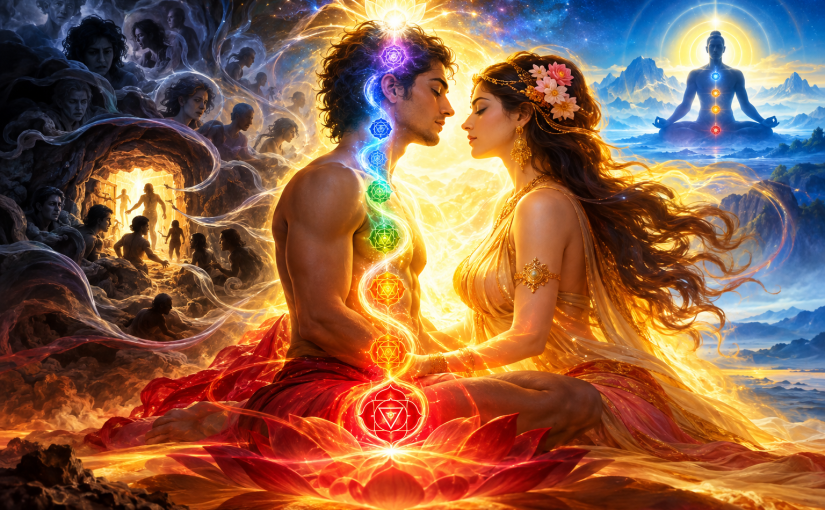
My Journey Through Sharirvigyan Darshan, Tantric Kundalini, and Self-Realization

Friends, this is one of my favorite posts, deeply experiential in nature and reflective of my lifetime spiritual journey. Ever since I began exploring meditation, I noticed a subtle yet profound distinction between thought-based contemplation and the deeper, formless stillness of awareness. Raman Maharshi often said it is better to engage in neti-neti or non-dual contemplation, yet I realized that these experiences — as blissful as they were — were still transient. Nirvikalpa samadhi, on the other hand, creates chidakash or ekarnava, a stillness that abides for longer periods, whereas contemplation alone only gives fleeting glimpses.

Eventually, I understood that to sustain even the transient experiences of ekarnava, one has to embrace breathlessness. Before I experienced keval kumbhak, even after Kundalini awakening, self-realization, and non-dual awareness through sharirvigyan darshan, I could not fully comprehend thoughtless awareness. Yet I had immense bliss, rest, satisfaction, and a feeling of completeness — all connected to subtle thought. I realized that bliss and non-duality connected with thought could not reach the final state of fully thoughtlessness.

This led me to a subtle but important insight: after self-realization and Kundalini awakening, and even sharirvigyan darshan, one can attempt to reach breath stillness more quickly, because the ego is already weakened and the body-prana system more prepared. In the same way, Ramana Maharshi had cautioned against forceful breath control without inner maturity. He emphasized that natural keval kumbhak arises only when the mind and ego are ready. Forceful suppression might temporarily quiet thoughts, but it does not destroy the ego and can create strain or attachment.

In my observation, thought stillness slows the breath but does not stop it sufficiently or for long periods, whereas breath stillness immediately calms the mind and lasts longer. This is because thought is like waves on the lake’s surface — you can quiet them, but the lake still moves underneath. Breath, however, is like the spring feeding the lake: if the source of movement stops, the surface cannot ripple. This shows why prana stillness (keval kumbhak) is far more decisive for sustained thoughtless awareness.

Ramana Maharshi often said, “Mind and breath arise from the same source. To still one is to still the other.” Ego is the hidden source of both. When the ego weakens, prana settles naturally; when prana is still, the mind has no fuel for thought. In deep states, breath is the shadow of the ego. This simply means that in ordinary, laborious worldly activities, breath reflects not only the ego but also the need for oxygen. During deep meditation without ego, the breath itself fades, and awareness abides in pure stillness — the chidakash or ekarnava.

I noticed subtle variations in breath depending on ego orientation. Unequal inspiration and expiration reveal ego tendencies:

  • Longer inspiration reflects inward, self-centered attention.
  • Longer expiration reflects outward, world-centered attention.

This aligns with the ida–pingala–sushumna play in yogic physiology:

  • Ida (left, inward) → longer inhalation → self-absorption.
  • Pingala (right, outward) → longer exhalation → outer engagement.
  • Balance in breath → equilibrium between ida and pingala → sushumna activation → mind quiets → doorway to sustained stillness. That is why it is said that when breath flows equally through the left and right nostrils, dhyana becomes fixed quickly. This is because equal inhalation and exhalation balance each other, leading to a natural stillness of breath.
  • The up-and-down movements of the breath reflect both the vertical and left-right movements of Ida and Pingala: up for the left, down for the right. Actually, Ida Nadi feels more inclined toward inhalation or upward breath movement, while Pingala feels more inclined toward exhalation or downward breath movement.It is amazing. The left nostril activating Ida does create a subtle left-side dominance in energy, and right nostril activating Pingala creates right-side dominance.

Even a single complete breath moves awareness up and down: inhalation lifts consciousness inward or upward, exhalation spreads it outward or downward. Prolonged breathing keeps awareness oscillating. Only when prana rests in sushumna, in natural breathlessness, does awareness remain steady. Sushumna means that the breath is neither moving up nor down, but stays in the center; it is neither in the left nor the right, but centrally aligned—this corresponds to the breathless state, or Kevala Kumbhaka. Breathing through the left nostril brings the sensation of the breath moving through the left side of the body and more upward, and breathing through the right nostril brings the sensation of the breath passing through the right side and more downward. When there is no breathing, it is self understood that the breath is flowing neither through the left nor the right nostril, neither upward nor downward. When there is no left-right sensation, it is self-evident that the breath is central, along the midline of the body or through the backbone. The sensation also confirms this. Along with it, when there is no up-down movement in the breathless state, the breath is understood to be in the central line, precisely at the midpoint of that line. “No up-down movement” does not imply prana is physically fixed at the midpoint; it means prana is static along the central channel. Feeling it at the midpoint is a perceptual focus, not a literal physical location. It is amazing psychology and terminology, sometimes confusing too. At first, I used to think of Sushumna as a special type of heavenly breath, never imagining a breathless state for a living being, but my experience now shows otherwise. This is why destroying ego, reducing breath oscillations, and balancing breath are crucial. Ego is notorious in producing duality. Yet, with sharirvigyan darshan, the ego feels hurt — the body is revealed as a non-dual, ego-less and detached living system, not as “me,” and that hurt is purification, loosening the ego’s grip.

In a nutshell, Keval Kumbhak (breath stillness) and Sushumna breathing are synonymous. Both are highly praised in the scriptures and regarded as the direct doorway to liberation as well as the source of supernatural powers. Yet, liberation itself is the supreme power — beyond all others. Strictly speaking, Sushumna breathing (when ida and pingla flows are equal) prepares the ground and naturally matures into Keval Kumbhak, so the two are inseparably linked stages rather than exactly the same.

When breath flows equally through both nostrils, it shows that Idā and Piṅgalā are balanced and prāṇa is entering the Sushumnā, creating the right state for meditation; when this deepens, the breath may stop on its own without effort—this is Keval Kumbhak, the natural peak of Sushumnā flow where prāṇa is fully absorbed and the yogi rests in stillness.

The insight of sharirvigyan darshan was a turning point for me. I realized why I was drawn toward Tantric Kundalini Yoga after practising it consistently: in Tantra, contemplation or thinking, beautification, care, respect, and love toward the body are of prime importance—just as in Sharirvigyan Darshan—thus both complementing each other at both the physical and spiritual levels, leading to progressive development. It is another amazement. The cells of the body live without claiming doership of work or enjoyment, so why should I? This shook the ego profoundly, and freed prana or energy for meditation. Sharirvigyan darshan gave me a contemplative base — a rational, embodied insight — while Tantric Kundalini Yoga liberated my world-entangled energy, allowing me to offer it to the meditation image. This image, nourished by freed prana, awakened and became alive before me, not just a mental visualization. That living image led to glimpse of self-realization.

The sequence of my journey — Darshan → Energy Release → Image Awakening → Realization — mirrors the Tantric map of jñāna-śakti (knowledge), icchā-śakti (will), kriyā-śakti (action), and śakti (energy/awakening):

  1. Sharirvigyan darshan gave me knowledge.
  2. My choice to pursue Tantric Kundalini Yoga provided will. Although it originated itself through practice of sharirvigyan darshan. It is the most amazing part. In majority of scriptures, will is forced that seldom succeeds.
  3. The practice itself — offering energy to the meditation image — was action.
  4. The awakened image and glimpse of Self-realization was the manifested energy, śakti.

This phenomenon is interpreted differently in various traditions:

  • Tantra sees the image awakening as divine Shakti appearing in form, a sacred manifestation.
  • Advaita Vedānta regards it as a transitional phenomenon; the image is only a springboard — awareness turning inward leads to direct realization.
  • Yoga Sutras classify this as savitarka samadhi, where meditation on form (image) is energized and luminous, leading toward nirvitarka (formless stillness).

Had I pursued Tantric Kundalini Yoga alone, without sharirvigyan darshan, I could still have achieved realization with great difficulty and after prolonged practice, even getting none because favourable conditions do not sustain for long. Even after getting plainly, I would have missed the extraordinary bliss, creativity, and worldly play that arose naturally when freed energy flowed into the meditation image during normal worldly activities. This illustrates the difference between the nivṛtti-mārga (ascetic vertical path) and pravṛtti-mārga (world-affirming spiral path) of Tantra:

  • Nivṛtti: rapid, inward ascent, ego dissolves quickly, but world’s richness may feel muted. But failing it, one may feel astrayed forever.
  • Pravṛtti: spiral, celebratory ascent, energy sanctifies worldly life while also piercing into realization — what I experienced.

In my path, Sharirvigyan Darshan provided a non-dual type of insight, while Tantric Kundalini Yoga freed the energy bound to latent thoughts and impressions. This happened through two processes: carrying the non-duality of Sharirvigyan Darshan to its peak, and knocking out hidden mental activities. In this way, the last drop of available energy was extracted, with which the meditation image became alive by itself—just like drinking that very energy, similar to Goddess Kali drinking the bowl of blood—leading to glimpse of Self-realization. The world itself became part of the practice, joyous and meaningful, not something to escape. My experience beautifully combined both liberation and enjoyment, embodying the Tantric principle of bhoga-apavarga-samyoga — the union of divine enjoyment and liberation.

This journey shows that self-realization, energy mastery, and meditation image awakening can converge naturally when knowledge, will, and action align, and when the ego loosens its grip. Breath stillness (keval kumbhak) and mind stillness become inevitable outcomes, leading to sustained awareness, ekarnava, and chidakash, where thought, duality, and oscillation finally dissolve.

In essence:

  • Sharirvigyan darshan shook the ego and freed energy.
  • Tantric Kundalini Yoga harnessed that energy for inward ascent.
  • Meditation image became alive, serving as the doorway to realization.
  • Breath and ego gradually stabilized, leading toward sustained stillness.
  • The world became a stage for bliss, not a distraction.

My journey exemplifies a harmonious path where insight, energy, and practice converge, showing that the Self can be realized not only in withdrawal but also in full-bodied, joyful engagement with life.

Why Tantric Maithuna Sends Energy Directly to Sahasrara: The Fastest Path to Awakening

One of the most striking differences between Tantric Maithuna and solo energy practices is how energy moves through the body. In traditional yoga, energy ascends gradually, chakra by chakra, often pausing at Ajna (third eye) before reaching Sahasrara. But in Tantric Maithuna, something extraordinary happens:

Energy doesn’t stop. It shoots straight up to Sahasrara, skipping Ajna and other chakras.

Why does this happen? What makes Tantric union such a powerful shortcut? Let’s dive into the inner science of why sexual energy, when harnessed correctly, takes a direct route to the highest center of consciousness.

1. Direct Fusion of Shiva and Shakti: No Blockages, No Pauses

In solo spiritual practices, the goal is to gradually unite Shiva (pure consciousness) and Shakti (energy) inside oneself. The double role is being played by a single individual. So it’s obvious that it’s much less inefficient and too slow a process. This process takes time because energy must clear blockages at each chakra before rising further. Actually blockages are that of worldly duality. A strong nondual sentiment is to be poured there to clean or open those. These blockages are like different worldly thoughts full of duality. When duality of these is counteracted with nondual awareness then these thoughts rise up with rising energy to sahasraar because it’s the main chakra of nondual awareness. In sahasrar These thoughts become clean and get merged into infinite soul. Yin-yang union is top nonduality producer that’s why all chakras are pierced instantaneously with tantric maithuna.

Means, in Maithuna, this fusion happens instantly.

The two polar forces, yang and yin (masculine and feminine, consciousness and energy) are already in direct union.

There is no need for energy to pause at lower chakras because the balance is already achieved. Balance here means balance of yin and yang. We don’t need to seek  balance of both of these at each chakra. In solo practice, either we need to indulge in worldly activities corresponding to each chakra with nondual awareness to remove duality from that chakra or we have to witness the thoughts arising on that particular chakra. Witnessing itself produce nonduality that neutralize the buried thoughts. But Tantric coupling produce extreme nonduality. This gets superimposed on all  thoughts buried in all the chakras as soon as sexual energy rising up knocks them out to expressed form on the mental screen. It seems they are merging with the self. This removes their resisting effect. Actually, something considered dual or no self can’t be carried to the bedroom. But it’s not so with the life partner. The same happens with thoughts. That’s why dual or foreign thoughts remain buried in there corresponding chakras. The body’s inherent intelligence hesitate to carry them to the original seat or bedroom of soul that’s sahasraar. Therefore they block rising energy means they keep consuming energy to sustain themselves there separately. Instead when they are made self like clean with nonduality practice, they are easily carried up to sahasraar for merging them with the self. This is shiv shakti Milan or marriage. In Rajyoga based kundalini yoga, only single meditation image is carried up to sahasraar to merge it with self to be experienced as glimpse of awakening. It’s a very beautiful concept friends. Although all buried thoughts are carried up but they remain in background. We meditate only on single meditation image. This increases its intensity manyfolds then other thoughts. This help in its quickest merging with the self means quickest Shiv Shakti union. In Tantric coupling, this shiva shakti union is happening there since the beginning at physical level. This produces spiritual qualities mainly nonduality since the beginning. These qualities reach peak level during subtle yin yang union that’s awakening. In fact, it is the unconscious Shakti who unites with the conscious Shiva. That is why this is the biggest yin-yang union. Shakti is unconscious and nonlocalised. We have made it conscious by giving it the form of a meditation image. This has been done because how will we experience an unconscious thing and how will we pinpoint it and how will we handle it since it is not localized.

The moment arousal reaches its peak, energy has only one path left: directly up from muladhar to Sahasrara.

It’s like connecting the two ends of a broken wire—the current flows immediately, without interruption.

2. Extreme Energy Surge: No Time to Stop

Ordinary meditation raises energy in small, controlled steps, allowing the body to adjust. But in Tantric Maithuna, the energy surge is so powerful that there’s no time for step-by-step ascent.

The intensity of the moment generates a massive wave of life force that rushes upward.

This is far stronger than what solo breathwork or Kriya can generate in one session.

Instead of flowing gradually through chakras, the energy overflows like a dam breaking open—straight into Sahasrara.

This is why Tantric energy can bring instant awakening, while solo practices often require years of effort.

3. Yab-Yum Position Naturally Aligns Sushumna

In Tantric Maithuna, the lovers’ bodies are aligned in the Yab-Yum posture, which means:

Their Sushumna Nadis (central energy channels) are directly connected.

This alignment creates a perfect energy circuit, removing resistance.

Instead of needing to push energy upward, it rises effortlessly.

Think of it like two rivers merging into one powerful stream. Instead of energy moving step by step through chakras, it now flows as a single force straight to the highest point.

4. Orgasmic Energy is Already Non-Dual

The peak point of sensation before ejaculation is a state beyond thought, beyond separation. It’s full nonduality for yang and yin are fully mixing.

At that moment, the mind stops functioning in duality.

This state is identical to the nature of Sahasrara—pure, undivided bliss-consciousness.

Instead of staying in Ajna (where thought and perception still exist), the energy moves beyond it—to the ultimate.

But there’s a catch.

✔ If the practitioner withdraws at the right moment and merges this energy with a meditation image or mantra, it reaches Sahasrara and stabilizes. ✖ If the limit is crossed (ejaculation), the energy drops back down, losing its momentum.

This is why mastering control at the peak point is critical for success in Tantric Maithuna.

5. No Mental Interference at Ajna Chakra

In solo practice, energy often stalls at Ajna Chakra because:

The mind starts observing, analyzing, and questioning.

Thought creates a pause, and energy slows down.

But in Maithuna, the practitioner is in total surrender—there’s no mental resistance.

There is no separation between observer and experience. There is a feeling of complete non-duality. This is because when the Tantrik has ended the most powerful separation like Yin-Yang, then the rest of the worldly separations cannot remain without ending. Meaning, when the Tantrik in the form of Yang feels even his most opposite lover in the form of Yin to be unseparate from him, then nothing else in the universe can remain unseparate from him. Meaning he experiences the best non-duality in the world. It is a different matter that the non-duality in the form of God-experience is one step above that. But both are the closest.

The mind is too overwhelmed with bliss to interrupt the flow.

As a result, energy bypasses Ajna and moves straight to Sahasrara.

This is the biggest secret of why Maithuna works as a direct path: no thought = no stopping point.

Why Doesn’t This Happen in Solo Practice?

✔ In solo practice, energy moves slowly through each chakra, stopping where blockages exist. ✔ In Maithuna, all chakras are stimulated at once, so there’s no need to activate them one by one. ✔ The sheer intensity of the moment forces energy upward in a way solo breathwork cannot replicate.

In short: Solo practice follows steps. Tantric Maithuna skips straight to the destination.

The Ultimate Formula: Tantra + Kriya = Sustainability

While Tantric Maithuna is the fastest way to ignite energy and send it to Sahasrara, it has limits:

✔ If physical exhaustion sets in, the energy falls. ✔ If ejaculation happens, the process resets. ✔ If one’s mental focus is lost, the energy dissipates.

That’s why the most sustainable approach is to combine Tantra with Kriya Yoga:

Step 1: Use Tantra to generate intense energy at the base. Step 2: Superimpose a meditation image to refine and stabilize the energy. Step 3: Use Kriya breath to sustain and lift it permanently into Sahasrara. Step 4: Instead of letting energy drop, circulate it through subtle breath awareness in daily life.

This prevents energy loss and allows the awakened state to remain stable for weeks, even without constant practice.

Final Thought: A Shortcut, But With a Cost

✔ Tantric Maithuna is the fastest way to Sahasrara, but it requires precision. ✔ If done correctly, energy ascends instantly, without stopping at lower chakras. ✔ But if the physical limit is crossed, energy drops back down, requiring another cycle.

That’s why the real mastery lies in knowing when to stop, when to lift, and how to sustain the awakened state beyond the practice itself.

Ultimately, energy ascent is not just about technique—it’s about balance, awareness, and integration.

Tantric-Kriya Awakening: The Most Powerful Yet Practical Path

Disclaimer:

This post discusses Tantric sexual practices and may contain sexually explicit content. Proper guidance is essential, as incorrect practice may cause physical, emotional, or psychological imbalances. This content is for informational purposes only and not a substitute for expert instruction. Practice responsibly and at your own risk.

In my spiritual journey, I have experimented with different approaches to energy awakening. While many people talk about Kriya Yoga and breathwork, my own experience has shown me that nothing compares to the power of Tantra—especially Tantric Maithuna—as a kickstarter.

My Awakening Through Tantra

Whenever I started from Tantric Maithuna, I experienced profound and blissful awareness similar to my glimpse of full awakening though at lower grade to it almost instantly. Then I turned to solo practice when prostate issues made it problematic. But honestly, after experiencing the real impact of Tantra, I found that solo practice is nothing but scrap in front of this.

I have also heard about meditation at the tip of the Linga while energizing in the Yoni. The process works like this:

Meditation image is contemplated continuously on Linga tip sensation while during spiritual union. Reaching the peak point of sensation—just before ejaculation—where the limit of tolerance is almost crossed.

Instead of letting the Yoni contractions trigger ejaculation, the Linga is withdrawn just before crossing the threshold.

Then, using yogic breathing, the meditation image rises along with the sensational energy through Sushumna.

Finally, when the energy reaches Sahasrara, the meditation image becomes lively, instantly producing all spiritual qualities.

For weeks, this low grade awakening remains. But worldly pull tends to draw the energy downward again, no doubt.

Why Tantra is More Powerful Than Solo Kriya Practice

Many believe Kriya alone is enough for spiritual transformation. But my experience tells a different story.

✔ Prana flows upward with inhalation, but the real question is—how does it come down from the chest? This is where Apana (the downward force) plays a role. If I explain it further, I mean that the accumulation of energy in the brain causes headache, heaviness in the head, a feeling of unconsciousness or darkness or joylessness or uneasiness. There is no dedicated channel to bring the energy down from the brain like the Sushumna. Of course some yogis take the energy down through the imaginary front channel, but this seems to be a makeshift arrangement and is not very efficient. In Kriya, the energy is also taken down through the Sushumna. But this is also a similar arrangement because the Sushumna is made to take the energy upwards. If a one way road is made two way, you can understand what will happen. On the contrary, the consort tied to the Yabyum is the best and most effective channel to bring the energy down. This makes the energy move like a truck in a loop road and continuously pours the loaded cargo in the form of meditation picture into the Sahasrara. That’s why Tantra works on Prana-Apana union, ensuring a strong energy circuit instead of just mechanical breathing. Let me just elaborate it little more. In solo practice, prana and apana sparingly move together. If it’s made possible with techniques even then movement isn’t that appreciable. But during yab-yum union, when in breathing causes prana move up, apana simultaneously flows through the consort’s body down. This is probably to balance prana and apana. This rotates energy constantly in dynamic loop. Energy is also of high intensity due to less restriction in movement. Prana and apana also meet together in this way constantly. In solo practice, while breathing in causing prana to move up, apana is visualised as coming down through front of body. This is done to unite prana and apana and to keep them in dynamic rotation. But front part of body is not as dedicated channel for apana movement as separate body of consort. Also solo method requires much practice. Probably backbone of consort acts as down channel for apana movement. Consort is actually embodied shakti. It’s real. It’s not just like visualising yoni or shakti in muladhara during solo practice as in yoni mudra, vajroli etc. Majority of advanced and secret hathyoga techniques are actually based on real sexual tantra.

✔ Kriya breath—whether it be spinal breathing, internal breathing, or reverse breathing—it somewhat mimics the energy movement as it happens in tantric union. But if there’s no sexual energy generated at the base, why pump a dry well? Although naturally too, sexual energy itself goes up compiling in lower chakras by default but it’s too slow as compared to tantric build up.

✔ That’s why a mix of both Tantra and Kriya is the most efficient approach. First, generate energy at the base (Tantra), then refine and lift it (Kriya). Refining means superimposing meditation image on energy. I’ll describe it in detail in next post.

Since I have already held the awakened state for weeks, I can confidently say that Tantra produces the most direct and undeniable spiritual shift. But let’s be real—this practice can’t be sustained for long periods because the physical body has its limits.

The Reality of Sustaining the Awakened State

Since the body has limitations, the next question is: How to sustain this awakening without frequent practice?

Here’s what I have learned:

Shifting From Physical to Mental Practice

Once the meditation image is fully alive in Sahasrara, one doesn’t always need the physical act.

Instead of restarting from Linga-Yoni, one can begin directly in Sahasrara and tap into the same energy state.

Energy Memory Activation

Every practice leaves a deeper imprint in the system. Meditation image linked to awakening adds up to this memory. But I just can’t do it that’s why I take help of kriya breathing. It’s a well balanced approach.

Over time, just recalling the experience can trigger the same state without any physical stimulation. However it seems remote or difficult without taking help of kriyas.

Letting the Energy Circulate in Daily Life

Instead of letting the world unconsciously bring energy down, I consciously direct it. I have made myself the controller of mine, not the world.

A soft Ujjayi breath during normal activities can keep the higher state subtly active in the background. Instead of it, holographic sharirvigyan darshan is enough for me.

Despite this, in today’s chaotic world, purely mental activation without a physical trigger is difficult. That’s why a flexible approach is the most realistic—adapting between Tantra and Kriya based on the situation.

What I Haven’t Achieved Yet & What I Believe Is Possible

I won’t make exaggerated claims. I have held the awakened like state for long time, but the world eventually pulls it down.

I have also realized that Kriya alone can achieve the same awakening—if done for countless hours and repetitions. But in today’s chaotic era, that’s unrealistic. That’s why my practical approach is:

✔ Generate and refine energy with Tantra when possible. ✔ Use Kriya to refine and lift it. ✔ Adapt based on life’s situations.

Through all of this, I’ve realized something important:

✔ Rigid methods don’t work. ✔ Tantra alone is not healthy and social. Kriya alone is not enough. ✔ A mix of both—based on the situation—is the fastest, strongest, and most practical path.

This is not just theory. This is my own lived experience. And I can say without a doubt—this path works.