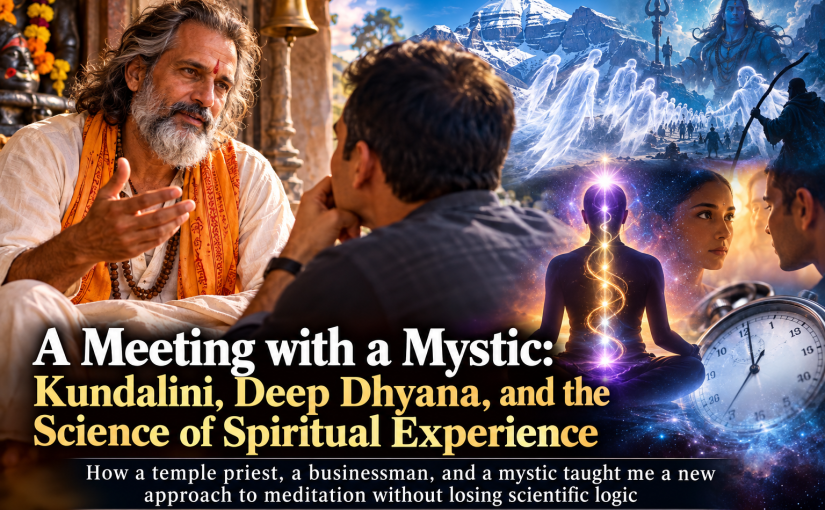
The Hidden Link Between Mindfulness, Sexual Energy, Nonduality, and Spiritual Awakening: My Personal Self-Realization Experience

Mindfulness as an Alternative to Meditation Images

Over the years I have reflected deeply on the difference between mindfulness-based awakening and awakening through a meditation image. My own experiences suggest that mindfulness can serve as a direct path to self-realization, especially for people who do not feel comfortable with symbolic meditation, deity forms, visualization practices, or any mental image that appears strange or culturally unfamiliar.

A method that gradually became clear to me begins with a brief contemplation of Sharirvigyan Darshan or what I sometimes call Quantum Darshan. The contemplation itself need not be long. It only has to shift the mind away from ordinary worldly identification and toward a deeper understanding of reality. After a short period of contemplation, a subtle accumulation of energy may begin. Ordinarily, this accumulated energy gets attached to thoughts, desires, memories, fantasies, worries, ambitions, or even spiritual goals. In many meditation traditions, it may also become linked to a meditation image, mantra, deity, chakra symbol, or another chosen object.

My experience suggests another possibility. Instead of allowing the energy to become attached to a meditation image, one may simply remain mindful of whatever is occurring in the present moment. Attention stays open and receptive. The energy that would otherwise become concentrated around a mental object instead strengthens mindfulness itself. In this way, awareness becomes increasingly stable without dependence upon any symbolic focus.

Mindfulness tries to recreate awakening glimpse

What I experienced during my awakening glimpses was that all mental and external forms appeared equal to one another. There was perfect nonduality. It felt like the highest level of mindfulness. This suggests that just as an awakening glimpse creates mindfulness, cultivating mindfulness can also lead to awakening. When, through constant mindfulness practice, nonduality reaches a certain threshold, it reveals its unified underlying existence in the form of an awakening glimpse.

How My First Awakening Was Different

Looking back, my first awakening appears very different from my later experiences. At that time there was no deliberate spiritual ambition. I was not seeking enlightenment, awakening, samadhi, liberation, or any special spiritual achievement. There was no conscious attempt to attain a higher state. What happened seemed to emerge naturally from the way my attention functioned.

At that stage of life, egolessness did not arise directly through Sharirvigyan Darshan or Quantum Darshan. Instead, it appears to have developed through deep engagement with science, combined with the influence of spiritual company and spiritually inclined thinking. Scientific inquiry gradually weakened rigid assumptions about reality. Spiritual association softened the boundaries of personal identity. Together they created conditions in which a glimpse of something deeper became possible.

Most importantly, I did not intentionally cultivate devotion toward a single meditation image. I did not select one inner form and treat it as a beloved object that deserved exclusive attention. Rather, my attention remained distributed across the entire field of experience.

The Power of Equal Attention to All Sensations

One insight that seems central to my experience is that mindfulness has the ability to accommodate all sensations and feelings simultaneously. Thoughts, emotions, bodily sensations, attractions, fears, pleasures, discomforts, desires, and perceptions can all be held within awareness together.

This creates an important shift. Normally the mind spends enormous energy judging experiences. It labels some experiences good and others bad. It pursues some and avoids others. It compares, analyzes, evaluates, condemns, and desires. Such activity consumes attention and fragments awareness.

When mindfulness becomes sufficiently strong, there is little time or energy left for judgment. The available energy is devoted to accommodating the entire field of experience. Awareness remains with all sensations equally. Instead of separating experiences into categories, mindfulness simply observes them.

As this process deepens, the apparent differences between experiences begin to lose their dominance. Pleasure and pain remain different in content, but they appear increasingly similar in nature. Attraction and aversion remain different in expression, but they are both recognized as sensations arising within awareness. Thoughts and emotions remain distinct phenomena, yet both reveal themselves as temporary appearances.

When all experiences are viewed without judgment, a remarkable possibility emerges. One begins to sense that the background underlying all experiences may be the same. If every sensation appears within awareness and every feeling is known by awareness, then perhaps awareness itself is the common foundation.

From Non-Judgment to Nonduality

This recognition naturally points toward nonduality. Nonduality does not initially appear as a philosophical doctrine. Instead, it emerges as a direct observation.

When awareness remains open to everything equally, the divisions created by preference gradually weaken. Experiences continue to arise, yet the observer becomes less occupied with deciding which experiences deserve attention and which do not. Because all experiences are welcomed into the same field of mindfulness, they begin to reveal a shared nature.

The realization may arise that all sensations are simply different expressions of one underlying reality. Different forms continue to exist, but they are recognized as movements occurring within the same background. This insight does not require intellectual analysis. It emerges naturally through observation.

At an appropriate moment, the common background itself may become evident. Many traditions describe this background as pure awareness, witnessing consciousness, Buddha nature, Atman, or simply consciousness itself. Regardless of terminology, the experience involves recognition of that which remains present while all sensations come and go.

Sexual Energy, Mindfulness, and Awakening

Another aspect of my experience concerns the role of sexual attraction. Many spiritual systems regard sexual energy either as a distraction or as something that must be redirected toward a chosen spiritual object. My experience was somewhat different.

The energy generated by attraction did not become dispersed through endless fantasy or emotional indulgence. At the same time, it was not deliberately redirected into a meditation image. Instead, that energy appeared to strengthen mindfulness itself.

Because attention remained broad and inclusive, the energy associated with attraction became available to awareness rather than to mental fixation. It contributed to the intensity and stability of observation. Rather than feeding imagination, it nourished presence.

This may have been one of the important factors behind my first awakening glimpse. The available energy was not fragmented among numerous mental activities. Nor was it concentrated exclusively upon a symbolic object. It remained within awareness itself.

The Dream-State Awakening Glimpse

Ultimately, this process culminated in what I can best describe as a dream-state awakening glimpse during adolescence. It was not the result of a carefully designed spiritual program. It was not the product of systematic concentration upon a chosen image. It emerged through a combination of scientific inquiry, spiritual influence, accumulated energy, inclusive mindfulness, and the gradual weakening of egoic identification.

The experience carried a sense of self-realization. Awareness seemed to recognize itself directly. The glimpse was brief, yet it left a lasting impression. Looking back, it appears that the pathway involved broad mindfulness rather than exclusive concentration.

The sequence, as I understand it today, may be described as follows: contemplation weakens ordinary identification, energy begins to accumulate, mindfulness receives that energy, judgment decreases, all sensations are accommodated equally, differences lose their dominance, the common background becomes apparent, and awareness recognizes itself.

My Second Awakening and the Role of Meditation Images

My later awakening experience appears to have followed a somewhat different route. In that case, self-realization occurred through a meditation image. The energy that accumulated became connected with a chosen spiritual focus. Concentration deepened through that object, and awakening unfolded through the resulting absorption.

At the same time, Sharirvigyan Darshan played a major role in the development of egolessness during this later phase. Whereas scientific inquiry and spiritual company seemed especially influential before the first awakening glimpse, Sharirvigyan Darshan contributed more directly to ego dissolution during the second awakening process.

Afterward, my perspective gradually shifted toward Quantum Darshan, though elements of Sharirvigyan Darshan remained present. With increasing age and maturity, however, extremely energetic states became less suitable. Stability, balance, and integration gained greater importance than the pursuit of intense energetic experiences.

Chakra Dynamics During Mindfulness

Another observation concerns the movement of energy through the chakra system. During mindfulness, energy does not necessarily remain fixed in one center. Different feelings appear to gather energy within different chakras. Other feelings seem to move that energy elsewhere. As experiences arise and pass, the energetic emphasis changes accordingly.

Mindfulness allows these shifts to be observed without interference. Rather than forcing energy toward a predetermined destination, awareness witnesses its natural movement. In this way, energy circulates through the system according to the changing landscape of experience.

A Personal Understanding of Direct Self-Realization

Today, my understanding is that both object-based meditation and objectless mindfulness can lead toward awakening. One path gathers energy around a chosen image and proceeds through concentration and absorption. The other path allows mindfulness itself to become the recipient of accumulated energy. Through equal attention to all sensations, judgment weakens, nonduality becomes evident, and awareness may eventually recognize its own nature.

My first awakening seems closest to the second path. My second awakening appears closer to the first. In this, meditation image became so strong and crossed a threshhold level beyond which it starts revealing background pure awareness. Both contributed to my understanding, yet the mindfulness-based glimpse remains especially significant because it emerged without deliberate pursuit of a spiritual goal. It arose naturally through observation, inclusiveness, scientific inquiry, spiritual influence, and the simple willingness to remain present with all experience.

For me, this remains one of the clearest demonstrations that self-realization can emerge not only through devotion to a meditation object but also through open mindfulness that embraces every sensation equally and reveals the single awareness in which all experiences arise.

Quantum Darshan, Kundalini Meditation, and My Second Awakening: How a Living Meditation Image Led to Nondual Awareness

From Sharirvigyan Darshan to Quantum Darshan

After my first awakening experience during adolescence, many years passed before I experienced another glimpse of awakening. During those years, my understanding of spirituality gradually matured through contemplation and direct observation.

One of the most important developments was what I later called Sharirvigyan Darshan. Through this contemplation, I began to see the body’s cells not as lifeless components serving a central self, but as equal participants within a larger living system. This simple shift had a profound effect on the mind. The sense of being a separate controller standing above everything else gradually weakened.

Over time, this contemplation naturally expanded beyond the body itself. If body cells could be viewed as equal participants in existence, why stop there? This question eventually led me toward what I later called Quantum Darshan.

Quantum Darshan was never intended as a scientific theory. Its purpose was contemplative rather than scientific. I did not require scientific proof for it to be useful. In spiritual practice, effectiveness is often more important than verification. A contemplative framework only needs enough plausibility for the mind to engage with it deeply.

From ordinary observation and intuitive reasoning, I felt that existence displayed continuity from the smallest to the largest scales. Whether science ultimately agrees or disagrees was secondary. What mattered was that the contemplation reduced separation and expanded awareness.

Why Spiritual Effectiveness Matters More Than Scientific Proof

Many contemplative methods throughout history have operated in this manner. Their value lies not in laboratory confirmation but in their transformative effect upon consciousness.

For me, the practical question became simple.

Does a contemplation reduce separation?

Does it increase mindfulness?

Does it help dissolve judgment?

Does it make awakening more accessible?

If the answer is yes, then the contemplation has value regardless of scientific debates.

This was how I approached Quantum Darshan. The contemplation encouraged a sense of equality throughout existence. Human beings, body cells, thoughts, sensations, objects, and the countless expressions of reality could all be viewed as participating within the same existence.

The contemplation did not attempt to prove anything scientifically. Instead, it served as a practical support for expanding awareness and reducing the sense of isolation.

Nondual Contemplation as a Support for Mindfulness

Over time, I also discovered that nondual contemplation and mindfulness support one another.

During awakening itself, there is no need to think, “I am everything” or “I am everywhere.” The experience speaks for itself. Everything already appears equal and interconnected.

However, ordinary life is different. Mindfulness does not always remain equally strong. Daily activity can weaken it.

Whenever mindfulness diminished, I often found it helpful to contemplate, “Whatever exists, I am already therein.” Such contemplations, helped by the nondual philosophies described above, naturally replenished mindfulness and reduced the sense of separation.

What happens is that clinging to any specific sensation or thought with attachment or aversion produces a block to mindfulness. In my experience, resistance to mindfulness appears to be a natural safety response of both the mind and the body. Judgment tends to pull a person away from the deeper self by creating division, preference, and separation. So, when judgment is applied to one thought, the mind resists all thoughts, thinking that this will further push it away from pure awareness.

Although mindfulness reduces this process of judgment, the mind does not believe it in the beginning. It thinks that if judgment of one thought made it fall down, what will happen if the full mind tends to be judged? It may be that the mind unconsciously fears that if even one judgment is made, hundreds can also be judged. Since the mind is accustomed to maintaining its familiar patterns, it tries to avoid mindfulness in the very beginning.

However, when a person becomes genuinely nonjudgmental toward even a single thought, a small movement toward the fuller self takes place. The mind then experiences a subtle benefit from this reduction in conflict and separation. Motivated by this, it gradually becomes willing to include other thoughts, sensations, and experiences as well. One acceptance encourages another. The field of awareness slowly expands, collecting more and more of what was previously rejected. In this way, mindfulness grows naturally, progressing from acceptance of a single thought toward increasing inclusiveness, fullness, and ultimately the realization of the full self.

Looking back, the trigger for my mindfulness during adolescence appears to have been the mental image of Devrani. For some reason, the mind remained naturally nonjudgmental toward that image. There was neither strong rejection nor deliberate effort to sustain it. Because the image was allowed to remain as it was, without judgment, it gradually encouraged the same nonjudgmental attitude toward other thoughts, sensations, memories, and experiences. In this way, mindfulness continued to grow naturally and eventually culminated in my first awakening experience.

In the case of my second awakening, the trigger was different. There, the central meditation image was that of Dadaguru. Unlike the first case, this image was deliberately nourished through spiritual practice and gradually became vivid, alive, and powerful within awareness. It gathered attention, reduced mental fragmentation, and helped expand mindfulness. Yet, as in the first awakening, the final awakened state itself was not centered on any particular image. The image functioned as a trigger and doorway, but during the awakening experience everything appeared equal within a vast, nonjudgmental, and blissful field of awareness.

Earlier in my adolescence, I practiced nondual contemplation passively and continuously, mainly through studying science deeply enough to generate a reduction in the sense of personal doership and ego. However, the effectiveness of such contemplation increased significantly later through the more active philosophical frameworks of Sharirvigyan Darshan and, subsequently, Quantum Darshan. These frameworks gave practical depth and structure to nondual thinking and helped make mindfulness more stable and sustainable. In my view, the effectiveness of Sharirvigyan Darshan was demonstrated by its role in preparing the ground for my second awakening. The effectiveness of Quantum Darshan itself also appears to be at least partially supported, since both contemplative frameworks seem closely correlated and contributed to the same overall movement toward greater mindfulness, nonduality, and awakening.

In this way, I came to view mindfulness and nondual contemplation not as competing methods but as complementary supports. Nondual contemplation helps establish mindfulness, and mindfulness naturally moves toward awakening.

The Deliberate Cultivation of a Meditation Image

Unlike my first awakening, which arose spontaneously, my second awakening involved deliberate spiritual practice.

This practice centered around a meditation image. Over time, the image became increasingly vivid, alive, and attractive within awareness. Yet even then, the process differed from ordinary concentration techniques. It was more of technical advanced tantric yoa.

But in earlier years before first awakening, I was not merely forcing attention upon a single object. Many images, memories, impressions, and forms continued to exist within awareness. They appeared naturally and often possessed equal brightness.

Among these images, two stood out more strongly than the others. One was associated with Devrani, while the other was associated with Dadaguru. These appeared especially bright and vivid within the mind. Yet even these were not deliberately forced into existence. They simply appeared naturally.

The meditation image that eventually became central was not sustained through strain or effort. It gradually developed through attraction, devotion, and repeated presence. As the image matured, it seemed increasingly alive.

Kundalini and the Living Meditation Image

My understanding eventually became that a Kundalini image is essentially a meditation image strengthened by Kundalini Shakti residing at the base.

As the tantra-yoga assisted meditation image grew stronger, more and more mental energy flowed toward it. This produced an unexpected effect.

Because so much energy was absorbed by the image, less energy remained available for judgment, comparison, analysis, and mental fragmentation.

The mind naturally became quieter.

Mindfulness appeared without deliberate effort.

Nonduality appeared without deliberate effort.

I did not need to continuously repeat philosophical ideas.

The image itself performed much of the work.

Its presence gradually gathered the mind into a more unified condition.

Interestingly, whenever I try to become nondual or mindful, the meditation image naturally expresses itself and lingers in the mind. It often appears without deliberate effort, as if it is closely connected with the movement toward mindfulness itself. From my personal experience, this provides psychological evidence that yoga and mindfulness are not entirely separate processes but may be different expressions of the same underlying movement of consciousness. The meditation image seems to support mindfulness, while mindfulness naturally nourishes the meditation image. As a result, both appear to work together toward greater inclusiveness, reduced judgment, and a deeper awareness of the self. Although their methods may differ, their essential direction and effect often seem to be the same.

How the Second Awakening Emerged

Eventually, this process culminated in a second awakening experience during waking consciousness.

The awakening itself lasted approximately ten seconds, much like the first one.

Before the awakening, the meditation image functioned as a powerful focal point. It gathered attention, energy, and awareness. In this sense, it acted as a doorway.

However, once the awakening actually occurred, something important happened.

The special status of the meditation image disappeared.

Everything became equal.

The image remained present, but it no longer occupied a privileged position.

Thoughts, sensations, memories, objects, inner experiences, and outer experiences all appeared within the same field.

The doorway dissolved into the whole.

The Equality of All Appearances

One of the most remarkable similarities between my two awakening experiences was the complete equality of all appearances.

During awakening, there was no central object.

There was no special image.

There was no preferred experience.

Everything stood on equal ground.

In my first awakening, natural scenes appeared first and human forms appeared later.

In my second awakening, a meditation image served as the trigger.

Yet in both cases, the awakened state itself was characterized by equality.

The trigger and the awakening were not the same thing.

The trigger helped initiate the transition.

The awakening itself transcended the trigger.

Infinite Fullness and Infinite Void

As in my first awakening, the second awakening involved a profound sense of fullness.

This fullness was not created merely by thoughts and sensations.

Instead, awareness seemed connected to an infinite void.

Paradoxically, the void did not feel empty.

It felt limitless.

Because it was limitless, awareness felt completely full.

Thoughts and perceptions appeared like waves moving within an infinite ocean.

The mind contained everything while remaining connected to something beyond all limits.

This produced a state of extraordinary bliss and completeness.

The Common Essence of Both Awakenings

Although the methods differed, the essential nature of both awakenings was remarkably similar.

The first awakening emerged from natural mindfulness, inclusiveness, curiosity, and openness during adolescence.

The second awakening emerged through deliberate practice, Kundalini energy, and a living meditation image.

Yet both culminated in the same fundamental qualities.

Everything became equal.

Judgment disappeared.

Separation weakened.

Mind and world appeared together.

Fullness merged with infinite void.

Bliss became overwhelming.

For a brief period lasting about ten seconds, reality revealed itself as a single, all-inclusive field of awareness.

Looking back, I do not see Sharirvigyan Darshan, Quantum Darshan, mindfulness, nondual contemplation, Kundalini practice, and awakening as separate subjects. They appear as different expressions of the same movement toward greater inclusiveness. As awareness becomes increasingly full, separation decreases. As separation decreases, the infinite becomes more accessible. And when fullness finally extends into the limitless void, awakening reveals itself directly.

Mindfulness, Nonduality, and My First Awakening: How a Full Mind Opened into Infinite Bliss

Mindfulness and Nonduality: Are They Really Different?

For a long time, I felt that Buddhist mindfulness and nondual contemplation were much closer than many people assume. At first glance, they appear different. Nondual teachings often use ideas such as “everything is one” or “I am everywhere.” Mindfulness, on the other hand, appears much simpler. It asks us to observe thoughts, sensations, emotions, and external events without judgment.

Yet when I looked at my own experience, I found that mindfulness itself seemed to contain the seed of nonduality.

In mindfulness, both inner and outer experiences are allowed to appear together. Thoughts, emotions, sensations, sounds, sights, people, objects, and events are all given space within awareness. The mind does not immediately reject one thing and accept another. Judgment gradually weakens because thoughts and objects themselves do not judge. They simply exist.

As more and more experiences are allowed into awareness, the mind becomes increasingly full. In this sense, mindfulness can be understood literally. The mind becomes full of inner and outer conditions together. Nothing is deliberately excluded. Everything is allowed to express itself within awareness.

This naturally creates a sense of equality. Thoughts become equal to sensations. Inner experiences become equal to outer experiences. Objects become equal to feelings. The usual hierarchy created by the mind begins to weaken.

At this stage, nonduality may begin to emerge naturally.

Why I Found Some Nondual Contemplations Artificial

Many nondual teachings encourage contemplation through ideas such as “I am everything” or “I am everywhere.” Such contemplations may be useful in certain stages of practice. They can help establish a nondual orientation within the mind.

However, I personally found that these statements sometimes felt artificial.

During actual awakening experiences, there was no thought repeating, “I am everything.” There was no need to mentally convince myself of anything. The experience itself revealed a state in which everything already appeared equal.

For this reason, I gradually felt that mindfulness seemed more practical and more natural. Instead of forcing a philosophical conclusion, mindfulness simply allows reality to become present. If nonduality is genuine, it can emerge naturally from that openness.

In my own experience, mindfulness appeared closer to awakening than conceptual affirmations. You could add it as:

Looking back, I no longer feel that nondual contemplation and mindfulness are opposed to each other. During awakening itself, there was no need to think, “I am everything” or “I am everywhere.” The experience was direct and self-evident. However, in ordinary life mindfulness does not always remain equally strong. When mindfulness weakens, nondual contemplation can help restore it. I often find that contemplating, “Whatever exists, I am already therein,” naturally replenishes mindfulness and reduces the sense of separation. Earlier, I practiced such contemplations continuously, and their effectiveness increased greatly through Sharirvigyan Darshan and later Quantum Darshan. These contemplative frameworks gave practical depth and logic to nondual thinking, helping the mind become more inclusive, less judgmental, and more mindful. In my experience, nondual contemplation serves as a powerful support for establishing and renewing mindfulness, while mindfulness itself naturally grows toward awakening.

My Natural Mindfulness During Adolescence

Looking back again, I can now see that a natural form of mindfulness developed during my adolescence, especially during my secondary school years.

At that time, I was not consciously pursuing spirituality. I was not practicing nondual philosophy. I was not trying to become enlightened. Nor was I deliberately cultivating or sustaining a meditation image. If a meditation image appeared in the mind, it arose naturally through affection, devotion, or attraction rather than through intentional effort. There was no attempt to force, maintain, or strengthen it. Whatever emerged did so spontaneously, as a natural part of life and experience.

Therefore, instead, many different things gradually became present in my mind. Different friends, teachers, subjects, ideas, books, experiences, and observations all seemed to coexist within awareness. There was curiosity, but there was no particular goal behind it.

Life itself was entering the mind.

Nothing was being deliberately contemplated. Nothing was being forced. The mind simply became increasingly inclusive.

Many different kinds of knowledge and experience accumulated naturally. Looking back, this resembles mindfulness in a broad sense. Awareness was becoming fuller without deliberate effort.

How Fullness Gradually Developed

As this process continued, I noticed that the mind became increasingly spacious and inclusive.

It seemed that mindfulness was not merely paying attention to one thing. Instead, it was allowing more and more of reality to be present simultaneously.

First the mind becomes somewhat full.

Then it becomes more full.

Then even more full.

Everything in nature tends to grow. In a similar way, fullness itself seemed to grow.

The more inclusive awareness became, the less room remained for rigid judgment and separation.

Without realizing it, I was moving toward a completely different state of consciousness.

My First Awakening in a Dream State

Eventually, during adolescence, this process culminated in a brief awakening experience that occurred in a dream state.

The experience lasted only about ten seconds, yet it remains one of the most significant moments of my life.

During those few seconds, something extraordinary happened.

Everything inside and outside appeared equal.

Thoughts and external scenes seemed to exist within the same field.

Judgment disappeared.

The usual sense of separation weakened dramatically.

Most importantly, the mind felt completely full.

This fullness was unlike ordinary mental activity. It was not simply a collection of thoughts and sensations. Instead, it felt as though the mind had become connected to an infinite void.

Infinite Void and Infinite Fullness

Ordinarily, people think of fullness and emptiness as opposites.

However, during that awakening glimpse, they seemed to become one.

The void did not feel empty in the ordinary sense. Instead, it felt limitless.

Because awareness appeared connected to something infinite, the mind simultaneously felt completely full.

Thoughts, sensations, memories, and external scenes appeared within that vastness like waves appearing within an ocean.

The experience did not require any philosophical conclusion.

There was no thought saying:

“I am everything.”

“I am everywhere.”

The understanding was direct rather than conceptual.

Everything simply appeared equal within a limitless field of awareness.

The Absence of Judgment

One of the most striking aspects of the experience was the complete absence of judgment.

Normally, the mind constantly evaluates.

This is good.

That is bad.

This should stay.

That should go.

During the awakening glimpse, this activity vanished.

Objects did not judge.

Sensations did not judge.

Thoughts did not judge.

Everything simply appeared.

This absence of judgment created a profound sense of equality throughout experience.

Inner and outer reality seemed to stand on equal ground.

Human Forms and Natural Scenes

The awakening did not begin through deliberate contemplation of a meditation image.

Natural scenes appeared first.

Later, a few human forms appeared.

Among them were images that resembled a devotee and a goddess-like Devrani figure.

These may have arisen from memory.

However, they did not function as meditation objects.

They were not the cause of awakening.

They simply appeared within the experience like everything else.

Nothing possessed special status.

Everything appeared equally within awareness.

This is important because it distinguished the experience from later meditation practices that involved deliberate concentration upon a meditation image.

Mindfulness as Preparation for Awakening

Looking back, I increasingly felt that mindfulness functions as a preparation for awakening.

As mindfulness deepens, awareness becomes more inclusive.

Judgment weakens.

Rejection weakens.

The mind becomes fuller.

Eventually, fullness may become so complete that it opens into the infinite.

At that point, awakening can arise naturally.

For this reason, mindfulness appears to me not merely as a technique but as a developmental process leading toward deeper states of consciousness.

In this sense, mindfulness may be understood as preparation for awakening, samadhi, and increasingly nondual states of awareness.

A Reflection

My first awakening did not arise from philosophical study. It did not arise from repeating nondual formulas. It did not arise from deliberate meditation upon a particular image.

Instead, it emerged from a gradual expansion of awareness.

Friends, teachers, knowledge, books, lectures, experiences, observations, memories, and life itself became increasingly present within the mind.

The mind became full.

That fullness continued to expand.

Then, for a brief moment lasting about ten seconds, fullness extended into the infinite.

In that moment, everything appeared equal.

Judgment disappeared.

Bliss arose.

The infinite void and infinite fullness became one.

And awakening revealed itself directly.

Kundalini Awakening, Heart Chakra Breathing, Infinite Void Contemplation, and a Naturally Ending Dhyana Session

Kundalini Energy Begins Moving Toward the Heart Center

Today I noticed a new development during my morning meditation session. After completing my normal yoga warm-up, I sat for Dhyana. Meditation began very quickly, much faster than usual. There was no significant pressure anywhere in the body, including the head. This itself felt unusual because in many earlier sessions the movement of energy toward higher centers was often accompanied by pressure sensations.

Instead of any activity in the head, I felt a kind of suffocation or energetic hunger on the left side of the chest, in the region commonly associated with the physical heart. My attention naturally moved there. As I observed it, it appeared to function like a separate chakra or energetic center. From that point, energy seemed to connect toward the rear spinal region associated with the Anahata Chakra.

The sensation was so prominent that my awareness repeatedly returned there. Rather than forcing anything, I simply observed the area and allowed the process to unfold naturally.

Scanning the Spine and Feeding Deprived Chakras

As the meditation continued, I frequently scanned the spinal column with awareness and then returned attention to the chakra or region that appeared to be experiencing energetic hunger or deprivation. Whenever I focused on such an area after scanning the spine, the energy of the entire spinal column seemed to rush toward that location.

An interesting pattern became visible. When one chakra or energetic center received a large amount of energy, another area would sometimes begin to feel deprived. Then my attention would naturally shift to that newly deprived region. Again, after awareness moved there, the energy appeared to flow toward it.

This process continued repeatedly. It felt as if the body possessed its own intelligence and was attempting to balance itself. Awareness simply followed the points of need.

During this process, energy seemed to move through almost all the chakras. However, Swadhisthana and Muladhara did not show much activity. My impression was that these centers might become more active primarily during periods of sexual arousal or when their specific functions are required. During this particular meditation session, they remained relatively quiet. Yesterday there was much writing, contemplation, editing, and intellectual work. Writing is also a subtle form of speech. The words are not spoken aloud, but they are continuously chanted within the mind before being written. Therefore, the throat chakra may have expended more energy yesterday. During today’s meditation, it appeared somewhat less hungry and attracted less energy toward itself. Less writing had resulted in less demand from that center.

Deep Calmness Changes the Nature of Energy Movement

Another observation emerged after approximately half an hour. Once sufficient calmness had developed through breathing and meditation, it became difficult to raise energy toward the upper chakras.

This was surprising because many spiritual discussions focus heavily on raising energy upward. Yet my experience suggested something different. The calmness seemed to have been achieved mainly through the lower and middle centers, especially the heart center. The meditation image was expressing itself through these regions with a quiet blissfulness.

It appeared that the chaotic mental energy that normally remains scattered was gradually converging into the meditation image itself. Rather than energy being aggressively pushed upward, the mind seemed to be becoming unified around a single point of contemplation.

This produced a stable and peaceful state.

Contemplating the Infinite Void and the Meaning of Ekarnava

The most remarkable development occurred when I began passively chanting “Ekarnava” while contemplating the idea that the void is endless in every direction—above and below, right and left, in front and behind, extending infinitely without boundary.

Whenever this contemplation became active, energy naturally rushed toward the upper chakras. Unlike previous experiences, this movement occurred without generating any appreciable pressure in the head.

The result was striking. Bliss increased. Clarity increased. Awareness became sharper. The sense of the infinite void became more vivid and expansive.

This observation suggested something important. The ascent of energy was not being produced through force. It was being produced through contemplation itself.

The experience reinforced an understanding that had been developing over time. Dhyana, the meditation image or contemplative focus, appears capable of guiding energy more effectively than direct attempts to manipulate energy. When the mind expands into vastness, energy seems to follow naturally.

Less Forcing and More Natural Integration

Looking back on the experience, several patterns became clear. There was very little head pressure. The meditation launched quickly. The heart region became the central focus of energetic activity. Awareness naturally moved toward areas that appeared deprived or incomplete. Energy distributed itself accordingly.

The difficulty in deliberately raising energy after deep calmness suggested that upward movement is not always the primary objective. Sometimes a stable and integrated state may be more important than dramatic energetic ascent.

The contemplation of infinite void appeared to represent a more refined process. Instead of attempting to push energy upward, consciousness expanded. As awareness expanded into limitless space, energy rose by itself. This occurred without friction and without the uncomfortable pressure that often accompanies effortful concentration.

At the same time, it remains important to remember that sensations such as tightness, pressure, or suffocation in the left chest should not automatically be interpreted as chakra activity. Physical causes should always be considered if such sensations become persistent, intense, or occur outside meditation.

Nevertheless, within the context of this meditation session, the experience suggested a movement toward greater balance, less force, stronger heart-centered integration, and a more effortless relationship between consciousness and energy.

A Dhyana Session Lasting Much Longer Than Usual

Another significant feature of the session was its duration.

The meditation continued for approximately one and a half hours beyond my usual sitting time. The state remained active and stable. It did not end because of distraction, discomfort, restlessness, or loss of concentration.

Instead, the meditation was still continuing when I personally decided that it was time to end the session.

This distinction felt important.

The Dhyana did not collapse. It did not fade away. It remained present.

The decision to stop came from me rather than from the meditation ending on its own.

The Natural Process of Returning from Deep Meditation

Once the intention to end the meditation arose, a fascinating sequence unfolded naturally.

First, a long deep breath appeared by itself.

Then Kapalabhati-like breathing began spontaneously.

After that, another long deep breath emerged naturally.

Finally, the eyes opened.

The entire process seemed orderly and effortless.

From a yogic perspective, it appeared that Dhyana was still active while the intention to finish arose. Prana then reorganized itself through deeper breathing patterns, and external awareness gradually returned.

From a modern physiological perspective, the nervous system may have been transitioning from a deeply absorbed state back toward ordinary waking awareness. During prolonged meditation, breathing often becomes extremely subtle. Deep breaths and spontaneous respiratory adjustments may simply represent the body’s way of re-establishing its normal operating rhythm.

What stood out most was that the meditation image did not suddenly disappear. There was no abrupt break in concentration. The transition felt gradual and intelligent.

When Consciousness Expands, Energy Follows

Reflecting upon the entire session, one theme seems to unite all the experiences.

The meditation began quickly without pressure. The heart center became active. Awareness moved naturally toward deprived energetic regions. The spine appeared to supply those regions with energy. Deep calmness emerged. Deliberate attempts to raise energy became less effective. Then the contemplation of Ekarnava—the endless void extending infinitely in all directions—caused energy to rise naturally without force.

Bliss increased. Clarity increased. Awareness sharpened.

The meditation then continued far longer than usual, eventually lasting until I chose to return. Even the ending occurred through spontaneous deep breathing, natural Kapalabhati-like activity, another deep breath, and the gradual opening of the eyes.

The overall impression was not one of controlling energy. Rather, it was an experience of allowing awareness to expand and permitting energy to organize itself.

Perhaps the most valuable insight from the session was that expansion of consciousness may sometimes accomplish what forceful energy manipulation cannot. When awareness enters the contemplation of the infinite, the movement of energy becomes natural. Pressure decreases. Effort decreases. Dhyana deepens. Bliss, clarity, and spacious awareness emerge together.

For this particular session, it seemed that consciousness was leading and energy was following. The contemplation of boundless void was not merely a thought. It became a living experience that quietly transformed the entire meditation.

Discovering the Power of Attention Beyond the Power of Prana

Another important development became clear during today’s meditation. Previously, I often relied on breath regulation to calm the mind and settle the energy. However, I gradually noticed that deliberate attempts to quiet the breath could sometimes create strange pressure within the system. Today I experimented differently. Instead of controlling the breath, I simply placed attention on the points along the spine and chakras that appeared to need energy. To my surprise, the breath became calm almost immediately and naturally, without any pressure, effort, or discomfort.

This experience revealed something profound. Earlier in my journey, I considered prana to be more powerful than attention. Energy movement seemed to be the primary force, while attention merely followed it. Today the opposite appeared true. Attention itself seemed capable of directing and balancing the energy system. Wherever attention rested with sensitivity and patience, energy naturally flowed, and the breath adjusted on its own.

This understanding may have emerged gradually through years of practice. Perhaps one cannot fully appreciate the power of attention without first discovering the power of prana. Prana is easier to notice because its effects are tangible through movement, pressure, vibration, heat, and energetic sensations. Attention is subtler. It works quietly behind the scenes and is therefore easier to overlook. Yet today’s experience suggested that attention may be the deeper organizing principle, with prana responding to it rather than the other way around.

The same principle seemed present in my recent contemplation of the infinite void. Energy rose toward the higher centers not because it was forced upward, but because attention expanded into boundless space. Likewise, today’s breath became calm not because it was controlled, but because attention was placed where it was needed. These experiences increasingly suggest that as practice matures, attention takes the leading role while prana follows naturally. Less force becomes necessary, pressure decreases, and the body-mind system appears capable of organizing itself through the intelligent application of awareness alone.

Attention-Induced Stillness, Yoganidra, and Rapid Recovery from Mental Fatigue

A similar experience occurred again at noon after an extended period of writing, contemplation, and intellectual work. Sleepiness had begun to set in, and the mind felt naturally drawn toward rest. Instead of attempting to regulate the breath, I simply placed gentle attention where it seemed needed. The breath became still and quiet on its own. Along with this natural stillness came a slight increase in clear awareness and a mild Yoganidra-like state. Although there was some tendency toward sleep, awareness remained present in the background. The experience felt neither like ordinary waking nor like complete sleep, but rather a restful state somewhere in between. After remaining seated in this condition for about half an hour to forty-five minutes, the need for sleep appeared largely fulfilled. Mental fatigue diminished, freshness returned, and the mind felt sufficiently restored without requiring a longer period of conventional sleep.

Does Breathing Have a Double Role? A Yogic Reflection on Prana, Oxygen, and the Hidden Purpose of Breath

A Question That Arose During Meditation

For many years I accepted the common explanation that breathing exists mainly to supply oxygen to the body and remove carbon dioxide. This explanation is obviously true and is supported by modern science. Yet repeated observations during meditation, daily life, intellectual work, emotional disturbances, and states of deep calm gradually led me to wonder whether breathing might be performing a second function as well.

This is not an attempt to reject science. Nor is it an attempt to prove ancient yogic theories through speculation. It is simply a reflection born from observation. My intention is not to offer proof but to present a clue that may inspire further thought.

An Observation About Oxygen

One observation repeatedly attracted my attention. The human body does not absorb all the oxygen present in inhaled air. A significant portion of oxygen still remains in exhaled air.

This naturally raised a question in my mind.

If oxygen delivery were the sole purpose of breathing, why did evolution not push the respiratory system toward extracting a much larger percentage of available oxygen from every breath?

The body certainly had millions of years to improve efficiency.

Instead, nature seems to have created a system in which large amounts of air continuously move in and out while only a portion of the available oxygen is actually utilized.

Of course, there are well-known scientific explanations involving safety margins, carbon dioxide regulation, diffusion processes, changing metabolic demands, and many other physiological factors. Yet the observation itself remains interesting.

The body appears designed not merely to absorb oxygen but also to maintain continuous movement of air.

A Simple Thought Experiment

This observation led me to a simple thought experiment.

Suppose the body extracted nearly all available oxygen from every breath.

In such a case, very little airflow might be required under many circumstances. Rapid breathing could potentially create excessive oxygen loading and other imbalances.

Instead, nature appears to prefer a design in which substantial airflow continues even though only part of the oxygen is utilized.

This does not prove anything about prana.

However, it raises an interesting possibility.

What if breathing serves purposes beyond oxygen exchange alone?

The Yogic View of Breath

According to Yoga, breath is closely connected with prana.

Prana is not exactly the same thing as oxygen. A person may breathe oxygen yet still feel exhausted, emotionally disturbed, mentally scattered, or energetically depleted. Yogic traditions therefore distinguish between the physical air and the subtle life force associated with it.

From this perspective, breathing performs two functions simultaneously.

The first function is physical. It supplies oxygen, removes carbon dioxide, and sustains biological life.

The second function is energetic. It helps distribute and regulate prana throughout the system according to changing needs.

Whether one accepts this view or not, it provides an interesting framework for interpreting many common experiences.

Breathing Changes With Every Mental State

One fact is difficult to deny.

Breathing changes continuously according to mental and emotional conditions.

When a person becomes angry, breathing changes.

When fear appears, breathing changes.

When desire becomes intense, breathing changes.

When anxiety increases, breathing changes.

When love arises, breathing changes.

When concentration deepens, breathing changes.

When meditation becomes profound, breathing changes.

When deep sleep arrives, breathing changes.

When intellectual work becomes intense, breathing changes.

Breath appears to participate in every major shift of consciousness.

If breathing existed only to supply oxygen, this extraordinary sensitivity to mental and emotional conditions seems worthy of reflection.

My Own Observations

Repeated observation led me to notice that fast and agitated breathing was often accompanied by increased mental chatter.

Thoughts became more active.

Emotions became more reactive.

Old tendencies such as attachment, anger, greed, desire, jealousy, ego, impatience, and restlessness seemed to find greater expression.

The mind became scattered.

In contrast, when breathing became slow, calm, and consciously directed, something different occurred.

Old impressions still surfaced, but they surfaced in a more orderly way.

Instead of becoming trapped in them, I could witness them.

The witnessing itself seemed to weaken their influence.

As this process continued, qualities such as patience, compassion, love, understanding, contentment, and inner balance appeared to grow naturally.

This observation does not prove a theory, but it strongly suggests that breath participates in processes far deeper than oxygen exchange alone.

Prana Regulation and Nervous System Regulation

Modern science explains many of these effects through the nervous system.

Breathing influences heart rate.

Breathing influences stress responses.

Breathing influences attention.

Breathing influences emotional regulation.

Breathing influences brain activity.

Breathing influences states of calmness and arousal.

Yoga explains similar observations through the language of prana, nadis, and chakras.

Science speaks of nervous system regulation.

Yoga speaks of prana regulation.

The words are different.

The practical observations often appear remarkably similar.

This raises an interesting possibility.

Perhaps these are not necessarily competing explanations.

Perhaps they are different ways of describing different aspects of the same living reality.

A Clue Rather Than a Conclusion

I do not claim that unused oxygen scientifically proves the existence of prana.

Nor do I claim that modern neuroscience has already validated ancient yogic descriptions of chakras and nadis.

My purpose is much simpler.

I am merely presenting a clue.

The clue is that breathing appears far too intimately connected with thought, emotion, attention, awareness, and consciousness to be viewed as nothing more than an oxygen pump.

Science explains part of this mystery.

Yoga explains another part.

Perhaps both perspectives still have more to learn.

Final Reflection

The deeper I observe breathing, the more difficult it becomes to separate body, mind, emotion, attention, and energy into independent categories.

A disturbed breath often accompanies a disturbed mind.

A calm breath often accompanies a calm mind.

A scattered breath often accompanies scattered attention.

A balanced breath often accompanies balanced awareness.

Whether one prefers the language of neuroscience or the language of Yoga, one fact remains undeniable: breath occupies a unique position between the physical and psychological dimensions of human life.

For this reason, I increasingly view breathing not merely as a mechanism for survival but as a bridge between body and consciousness.

The idea that breath may simultaneously support oxygen exchange and the redistribution of prana remains only a hypothesis. Yet it is a hypothesis born from repeated observation, and perhaps that is how many worthwhile investigations begin—not with certainty, but with a simple clue that invites deeper exploration.

When Awareness Takes Over the Work of Breath: Ajna Chakra, Prana Flow, Yoga Nidra, and Recovery from Mental Exhaustion

A Surprising Noon Meditation After Intense Intellectual Work

Today at noon again, after a long period of intellectual work, I decided to rest for a while. The work had been mentally demanding and I could clearly feel its effects. My breathing was faster than normal, yet it felt unsatisfying. Although the breath was moving rapidly, it did not seem to be providing the sense of refreshment or replenishment that I expected. Something felt incomplete.

Instead of trying to force relaxation, I returned to a method that has been proving useful recently. I brought my awareness back to the spinal column. Almost immediately, I noticed something interesting. The rear Ajna Chakra seemed hungry for prana. The sensation was clear enough that it felt as though the region was demanding nourishment.

I placed my attention there and remained with it.

Discovering That Awareness Can Draw Prana Independently of Breath

As I continued observing, prana appeared to start collecting around the rear Ajna region. What surprised me most was that breathing was still continuing in its usual way. It had become slightly calmer than before, but it was still functioning normally. Yet the process of prana gathering at Ajna did not seem dependent on the breath. However, breath was following awareness and adjusting itself lttle or more to help pouring prana at awareness site.

This was an important observation.

The transfer of prana toward Ajna appeared to continue because awareness remained fixed there. The breath was not interfering with the process. The breath was not directing the process. Awareness itself seemed to be drawing prana toward the location that required it.

This felt very different from my previous understanding.

Earlier, I often experienced breath as the main mover of prana. Inhalation seemed to push energy upward and exhalation seemed to encourage downward movement. But today another possibility revealed itself. Awareness itself appeared capable of directing the flow.

It seemed that as long as awareness remained steadily established in a particular location, prana naturally began gathering there regardless of the ordinary movements of breathing.

Why Ordinary Breathing Sometimes Struggles to Nourish a Chakra

As I continued reflecting during the session, another understanding emerged.

In normal breathing, prana appears to swing continuously upward and downward. The movement is constantly changing. Because of this oscillation, prana does not always remain focused long enough on a demanding chakra.

When a chakra requires replenishment, the continuous swinging of prana with the breath may not be the most efficient method of supplying it.

This seemed particularly relevant to the condition I was experiencing after prolonged intellectual work.

My breathing had become fast and somewhat agitated. Looking closely, it seemed as though the breath was trying to collect and deliver prana but was not fully succeeding. Because the replenishment remained incomplete, the breathing continued becoming faster in an attempt to avoid a reversal or loss of available prana.

Some benefit was certainly occurring. The breath was helping to a degree. However, it appeared that the effort being expended by the body was greater than the amount of replenishment being achieved.

In other words, the cost-benefit ratio appeared negative.

Eventually the breathing method would probably have worked if enough time were allowed, but it seemed inefficient. The body was spending a great deal of energy in the process.

Fast Breathing, Thoughts, and Emotional Disturbance

Another aspect became obvious during this observation.

Rapid breathing was not acting alone.

With the rapid oscillation of breath, thoughts became more active, emotions became more restless, and mental chatter increased. Along with this, deeper mental tendencies and defects such as attachment, anger, greed, excessive desire, illusion, ego, jealousy, impatience, and various forms of inner agitation began surfacing more strongly. The mind appeared scattered and reactive. In contrast, when the breath became slow, calm, and consciously directed toward a particular needy chakra, old impressions and stored mental patterns surfaced in a more orderly manner. Because they arose in the presence of awareness and witnessing, they could be observed without being immediately acted upon. This gradual process seemed to help purify the mind. As mental agitation decreased, qualities such as patience, love, compassion, understanding, contentment, and inner balance naturally found more room to develop and express themselves.

Everything seemed interconnected.

As the breath accelerated, thoughts and emotions appeared to receive additional momentum. As thoughts and emotions became active, they further disturbed the process of gathering prana where it was needed. It is because they spend energy in useless body actions and reactions. It is all energy trade.

The entire mechanism appeared circular.

Fast breathing contributed to mental movement.

Mental movement contributed to energetic scattering.

Energetic scattering encouraged further breathing activity.

The cycle continued until awareness intervened.

Once awareness became firmly established at the demanding location, the cycle began slowing naturally.

Subtle Hunger at Vishuddha and Anahata Chakra

While most of the demand was clearly centered around the rear Ajna Chakra, I also noticed a small amount of energetic hunger at Vishuddha Chakra.

The demand there was much weaker.

Once attention was directed appropriately, it seemed to replenish quickly. Only a few subtle pumps of prana appeared sufficient to satisfy the requirement.

A similar process occurred around Anahata Chakra.

There was a slight demand there as well, but nothing compared to the intensity that had been present around Ajna. Once awareness and prana reached the area, the deficiency appeared to resolve fairly quickly.

This created the impression that different regions of the subtle system may require different amounts of replenishment depending upon the activities that have recently been performed.

After prolonged intellectual work, Ajna seemed to be the primary consumer.

The other centers required only minor balancing.

The Heart Suffocation Sensation and the Central Channel

One observation that has appeared repeatedly in recent experiences emerged once again.

A slight suffocation sensation around the heart region was present.

However, it did not feel like an isolated phenomenon.

The sensation appeared related to the Ida channel.

As awareness rested in the central spinal column and energy seemed to flow through the central pathway, the heart discomfort gradually calmed.

The impression was that the central channel supplies balance to both Ida and Pingala. When the central flow becomes stable, both side channels receive support.

As this balancing occurred, the suffocation sensation eased naturally without requiring direct attention to the heart itself.

This reinforced my growing sense that the system operates as an interconnected network rather than as isolated energetic locations.

When Awareness Takes Over the Work of Breath

Perhaps the most important insight of the entire session was the realization that awareness appeared capable of taking over a function that breathing had previously been performing.

Earlier in my practice, breath often seemed responsible for directing prana.

Today the process felt different.

Awareness located the demanding region.

Awareness remained there.

Prana gathered there.

Breathing gradually relaxed because it no longer needed to perform the task itself.

This did not happen through force.

There was no attempt to suppress breathing.

There was no attempt to hold the breath.

There was no attempt to create artificial stillness.

Instead, awareness quietly assumed responsibility for the process.

The breath seemed free to calm down because the required work was already being accomplished.

The Natural Arrival of Breath Stillness

As the replenishment continued, the breathing gradually became calmer.

There was no struggle.

There was no manipulation.

The calming seemed to occur by itself.

Eventually a point arrived where considerable breath stillness appeared.

This stillness felt natural rather than imposed.

The body no longer seemed to require the earlier rapid breathing pattern.

The energetic demand had diminished.

The agitation had diminished.

The need for excessive breathing had diminished.

Everything appeared to settle simultaneously.

Yoga Nidra While Sitting Upright

As peace and calmness increased, another development occurred.

Yoga Nidra appeared naturally.

What made this interesting was that it happened while sitting with a straight back.

I often sleep during the daytime while sitting upright because lying down frequently aggravates GERD symptoms. Experience has taught me that remaining upright is usually more comfortable.

Therefore, even the Yoga Nidra unfolded in a seated position.

The transition felt smooth.

Awareness gradually moved into a deeply restful state while the body remained sitting upright.

There was no deliberate attempt to enter Yoga Nidra.

It simply emerged as a consequence of the calmness that had developed.

Emerging from Yoga Nidra and the Breathless Condition

After some time, the Yoga Nidra naturally ended.

When it broke, another interesting phase followed.

For a period, I remained in what can only be described as a breathless-type condition.

The body appeared extremely quiet.

Breathing was minimal.

Everything felt peaceful and still.

There was no urgency.

There was no agitation.

The earlier fast breathing had completely disappeared.

After remaining in that condition for some time, I eventually stood up and went for lunch.

The entire session lasted approximately forty-five minutes.

During the evening session of about 20–30 minutes, there was no noticeable hunger for prana from any particular chakra. Manipura, Anahata, and Vishuddha appeared to draw breath-energy naturally and almost equally, alternating among themselves. Ajna showed no demand for additional prana, so there was no attempt to force energy upward. The experience felt less like an ascent and more like a spontaneous redistribution of energy throughout the system. This suggested that a natural grounding and balancing process was taking place rather than a concentration of energy in the head.

Reflections on the Session

Looking back, the most important discovery was not merely that prana collected around Ajna Chakra. The most important discovery was that awareness itself appeared capable of directing and organizing the process.

The session began with mental exhaustion, rapid breathing, and energetic dissatisfaction.

It progressed through spinal awareness, recognition of Ajna’s demand for prana, replenishment of Vishuddha and Anahata, balancing of the heart-related discomfort, calming of breath, emergence of breath stillness, spontaneous Yoga Nidra, and finally a peaceful breathless-type condition.

Most significantly, it revealed a possible distinction between two modes of practice.

In one mode, breath attempts to direct prana.

In the other mode, awareness directs prana and breath gradually follows.

Today’s experience belonged unmistakably to the second category.

Rather than breath leading awareness, awareness appeared to lead breath.

The result was not force, struggle, or effort, but increasing calmness, increasing stillness, and a natural movement toward rest and peace.

Kundalini at Vishuddha and Ajna Chakra: Breath, Void Awareness, and Meditation in a Busy World

A New Development in My Meditation Practice

Today a new development took place in my meditation practice. Yesterday, while sitting in a temple, the strongest sensation seemed to be centered around Vishuddha Chakra. The feeling of breathing, pressure, and what I can only describe as a subtle suffocation point appeared predominantly in the throat region. Today, however, the center of activity felt different. The dominant sensation was around Ajna Chakra, especially around the rear side of Ajna.

Many people say that breath should never be forcibly withheld. I generally agree with this. However, practical life does not always allow unlimited time for meditation. Sometimes a person is surrounded by responsibilities, noise, family interactions, and worldly duties. In such situations, waiting indefinitely for the breath to calm down naturally may not always be possible. I noticed that certain subtle adjustments helped the process move toward breath suspension much more quickly.

During meditation, I simply placed attention on the spinal column while maintaining normal breathing. After some time, a knot-like sensation appeared around the rear Ajna region. It felt as though something had moved upward from the neck area toward Ajna Chakra. Whether this was Kundalini itself or simply the movement of awareness, I cannot say with certainty, but the experience was unmistakable.

The Connection Between Ajna Chakra and Anahata Chakra

An interesting observation emerged during the sitting. At times I felt a suffocation-like sensation near the left side of Anahata Chakra close to the heart. Surprisingly, this sensation seemed connected to the rear Ajna region. Whenever the pressure or blockage around the rear Ajna eased, the suffocation near the heart eased as well.

The effect was not limited to the front of the chest. Sometimes it seemed to radiate toward the rear Anahata region and sometimes toward the front. This created the impression that the subtle system operates more like an interconnected network than as isolated centers functioning independently. It felt like an intricate web of channels where activity in one location immediately influenced activity elsewhere.

This observation reinforced the feeling that the chakras may not always function as separate compartments. Instead, they often appear as parts of a living and interconnected energetic field.

Upward Gaze, Ekarnava Meditation, and Rapid Breath Suspension

One of the most striking aspects of today’s sitting was that the upward gaze toward Ajna Chakra seemed to work much more effectively than before. Ekarnava meditation was also functioning with unusual ease and depth.

By combining awareness of the spinal column with natural breathing, breath suspension appeared within approximately fifteen minutes despite being in a chaotic joint-family environment. This surprised me because such conditions are usually not considered ideal for deep meditation.

Rather than forcing the breath, it seemed as though concentration itself gradually reduced the need for breathing. The breath became subtler and subtler until suspension emerged naturally.

An interesting insight arose from this. It seemed that a small inhalation while awareness rested around Vishuddha Chakra pushed the energy or awareness upward toward Ajna Chakra. This observation repeated itself enough times that it began to appear as a consistent pattern.

Breath as an Upward and Downward Force

Another realization emerged from observing the breath carefully. It appeared that inhalation functioned as an upward push while exhalation functioned as a downward push.

When awareness rested on a chakra, inhalation seemed to encourage an upward movement toward higher centers. Exhalation appeared to have the opposite effect, encouraging a downward movement or settling process.

From direct observation, Kundalini appeared to shift according to the state of the breath. Sometimes the dominant sensation was at Vishuddha. At other times it was at Ajna. The position did not seem fixed. Instead, it seemed responsive to the rhythm and quality of breathing.

This led to a broader insight. Perhaps breath, thoughts, emotions, and subtle energetic sensations are not separate processes at all. Perhaps they are different expressions of the same underlying movement.

Why Breath, Emotions, and Thoughts Are Related

The relationship between breath, emotions, thoughts, and awareness became increasingly obvious.

A change in attention influenced breathing.

A change in breathing influenced subtle sensations.

As breathing became subtler, thoughts became weaker.

As thoughts weakened, a deeper calm emerged.

This observation supports the ancient yogic understanding that breath and mind are deeply connected. When emotions become disturbed, breathing changes. When breathing changes, mental activity changes. When breathing becomes calm, thoughts naturally begin losing momentum.

Instead of viewing thoughts, emotions, breath, and energy as separate departments of human experience, it may be more accurate to view them as parts of one interconnected process.

The Emergence of Void Awareness

Perhaps the most important part of the meditation occurred much later.

The breath suspension itself appeared within roughly fifteen minutes. However, the deeper experience emerged approximately thirty to forty minutes after the beginning of the session. The total sitting lasted around seventy to eighty minutes.

What emerged was not bliss, ecstasy, visions, revelations, or grand spiritual conclusions.

There was no sense of “I.”

There was no sense of “we.”

There was no sense of “that.”

There was simply a calm void-like feeling.

It was difficult to describe because there was almost nothing present to describe. There was only a quiet and spacious absence of ordinary mental activity.

This state felt very different from energetic movements, chakra sensations, breathing patterns, or meditative techniques. Those processes seemed to belong to an earlier phase of the session. The calm void felt like something beyond them.

Doubt and the Decision to End the Session

At a certain point, I chose to end the meditation voluntarily.

The reason was not discomfort but doubt. The void-like state seemed to deepen, and I became uncertain about remaining in it for longer.

To return to ordinary functioning, I deliberately began taking deeper breaths. After a few intentional breaths, spontaneous Kapalbhati-like breathing appeared.

Gradually, thoughts started returning.

However, they returned in a weakened form.

Thoughts were sparse.

Thoughts lacked their usual force.

The body felt somewhat weak.

There was mild pressure in the head.

The entire experience felt like a gradual re-entry into ordinary consciousness after spending time in a much quieter state.

The Challenge of Deep Meditation in a Busy World

One practical challenge became obvious through this experience.

It is difficult to sit for long periods in a busy worldly environment.

A householder does not live in a monastery. There are conversations, responsibilities, family members, duties, and endless interactions. Deep meditation naturally moves toward silence, stillness, and inwardness, whereas ordinary life constantly demands engagement.

This contrast creates a challenge.

Sometimes the meditation deepens just when practical life demands attention elsewhere.

Yet today’s experience demonstrated something important. Even within a noisy and busy environment, a deep meditative state can still emerge. External conditions may not be as decisive as they initially appear.

The Role of Speech and Conservation of Energy

Another insight became increasingly clear.

Talking appears to consume a significant amount of energy.

Not all speech is unnecessary, of course. Practical communication is part of life. However, excessive talking seems to scatter attention and dissipate inner stability.

Limiting unnecessary speech may be one of the simplest yogic disciplines available.

Animals provide an interesting contrast. They do not engage in endless conceptual discussions, arguments, explanations, and self-commentary. Whether this gives them a form of heightened sensitivity is difficult to say with certainty, but it does highlight how much energy human beings devote to continuous mental and verbal activity.

Perhaps silence conserves energy not because speech is bad, but because silence allows awareness to remain gathered rather than dispersed.

From Vishuddha to Ajna and Beyond

Looking back at the entire experience, a clear sequence emerges.

Yesterday, the dominant point of breathing-related tension appeared at Vishuddha Chakra.

Today, the dominant point shifted toward Ajna Chakra.

A small inhalation seemed to encourage upward movement.

Awareness gathered around the rear Ajna region.

The upward gaze became effortless.

Breath became subtle.

Natural suspension emerged.

Thoughts weakened.

The sense of ordinary identity faded into the background.

A calm void appeared.

Eventually, doubt arose and the session was voluntarily ended.

Whether these events are interpreted as Kundalini movement, energetic shifts, attentional changes, or meditative stages is less important than the direct experience itself.

What remains most significant is the discovery that breath, attention, emotions, thoughts, and subtle sensations appear deeply interconnected. As one becomes quiet, the others naturally follow. Beyond all these movements, there sometimes appears a simple and silent void that asks for nothing, explains nothing, and merely remains present in its own stillness.

Vishuddhi Chakra Awakening During Temple Meditation: How Breath, Prana, and Awareness Transformed a Difficult Dhyana Session

A Temple Visit That Turned Into an Unexpected Meditation Experience

Today I went to a Devsthanam with my family. While the family remained occupied with traditional worship rituals, prayers, and devotional activities, I decided to sit quietly for meditation. I expected an ordinary meditation session, but what unfolded became a valuable lesson about awareness, breath, prana, Vishuddhi Chakra, and the relationship between subtle energy and the mind.

At the beginning of the meditation, concentration was difficult. My mind would not settle. Breathing felt unusually distressed. Although there was plenty of fresh air available, the breath felt heavy, fast, and almost suffocating. It was a strange experience because there was no actual shortage of air, yet there was a persistent sensation that something was not flowing correctly.

I attempted to steady the mind through familiar spiritual concepts. I brought thoughts such as Ekarnava and Narayana into awareness and tried to establish concentration through them. Normally such methods help create stability, but on this occasion they failed completely. Instead of producing calmness, the effort seemed to increase the feeling of inner distress.

When Traditional Concentration Failed

Realizing that mental effort was not helping, I tried a simpler approach. I attempted to place attention on the breath itself. Many meditation traditions recommend observing breathing as a direct path to awareness. Yet even this was not working properly. The breath remained uncomfortable, and attention could not settle.

At that point, I changed my approach completely. Instead of trying to control the mind or force concentration, I became curious about the actual sensation of suffocation. I asked myself where exactly this feeling was located in the body.

The answer appeared quickly. The sensation seemed concentrated around the throat region, particularly near the glottis and epiglottis area. Once this location became clear, I allowed awareness to rest there.

Discovering the Source of the Disturbance

Something interesting happened almost immediately. As attention remained on the throat region, breathing began to calm naturally. There was no force involved. The breath simply started regulating itself.

At the same time, sensations began appearing around the Vishuddhi Chakra area. Sometimes the sensation felt located in the front of the throat. At other times it seemed to shift toward the back of the throat. Occasionally it appeared around the glottis region. Rarely, the sensation extended upward toward the rear portion of the Ajna region.

The important observation was that concentration had not been achieved through force. Rather, awareness had settled because attention found the actual location of the disturbance.

An important insight emerged from this observation. Sometimes focusing on a chakra because one thinks it is important does not work. Sometimes focusing on a chosen meditation object does not work either. What works is direct observation of what is truly present in experience.

The Resonance Between External Sound and Internal Prana

As the meditation deepened, a new factor entered the experience. Nearby, women began singing bhajans while drums were being played.

The effect was immediate and noticeable.

The drum sounds appeared to amplify the energetic vibration already present within the throat region. It felt as though the external sound was resonating with an internal current of prana. When the drumming stopped, the energetic flow reduced. When the drumming resumed, the energetic flow intensified again.

The experience created a strong impression that external nada and internal nada were interacting with each other.

Although I was not completely satisfied with the depth of energy flow and wished it had become even stronger, I remained seated for approximately forty to forty-five minutes. Eventually I stood up because I thought my family might be waiting.

The Aftereffects of the Meditation

Even though the session did not unfold according to my expectations, its effects became obvious afterward.

I felt refreshed.

I felt relaxed.

A strange underlying tension had disappeared.

Later, while sitting on a stone beside the river, the flow of prana toward the throat region appeared again along with a sense of calmness. Even during the return journey in the car, the experience would occasionally reappear.

The meditation seemed to continue in the background long after the formal sitting session had ended.

Is It a Throat Problem or a Vishuddhi Chakra Experience?

One natural question emerged from the experience. Was there something wrong with the throat physically, or was this a common yogic phenomenon?

The answer was not entirely straightforward. Sensations such as pressure, vibration, fullness, pulsation, warmth, coolness, or energetic movement are frequently reported by meditators in the throat region. In yogic language these experiences are often associated with Vishuddhi Chakra.

At the same time, a meditation experience alone cannot diagnose a physical condition.

However, certain details suggested that the experience was more meditative than pathological. The sensations were accompanied by calmness, clearer awareness, easier breathing, reduced tension, and a lingering feeling of well-being rather than pain or dysfunction.

Why Ajna Concentration Failed

Another important part of the experience involved Ajna concentration.

Normally upward gaze fixation toward Ajna is used as a meditation aid. On this day, however, it was ineffective.

Attempts to fix awareness through upward gaze did not stabilize the mind.

Even deliberate attention on the throat chakra was initially unsuccessful.

What eventually worked was not concentration on Ajna and not concentration on Vishuddhi as a concept. What worked was direct awareness of the actual sensation of disturbance located in the throat region.

This distinction became crucial.

The breakthrough came through investigation rather than force.

How Awareness Cleared and Thoughts Dissolved

As the throat region settled, another transformation occurred.

Breathing felt as though it was pouring prana upward.

Awareness became clearer.

Thoughts began dissolving naturally.

The silence was not produced through suppression. It emerged on its own.

This observation suggested that the most meaningful part of the meditation was not the energetic sensation itself but the resulting clarity of awareness.

The experience moved through several stages: distress, investigation, relaxation, energetic flow, thought dissolution, and clear awareness.

Among these stages, thought dissolution and clarity of awareness appeared to be the most significant.

Is It Easier to Calm a Chakra Than to Calm the Mind?

The experience led to a deeper reflection.

Many spiritual seekers struggle for years attempting to tame the mind directly. They try to stop thoughts, force concentration, or suppress mental activity.

Yet during this session something different occurred.

The mind was not calmed directly.

Instead, an energetic or tension center appeared to calm first. May be this is what a knot on chakra is called.

Then the mind became quiet automatically.

This suggested that in some situations calming the underlying energetic disturbance may be easier than fighting thoughts directly.

Rather than stopping waves one by one, the source of the wind creating the waves becomes calm.

The session illustrated a practical example of the ancient yogic observation that prana and mind are deeply connected.

Dhyana chain reaction

One additional observation emerged during the meditation. In the beginning, thoughts appeared to be obstacles. The mind was restless, breathing felt disturbed, and concentration would not stabilize. However, as awareness became clearer and the throat-centered disturbance settled, the role of thoughts seemed to change completely. Instead of distracting attention, a few thoughts would arise briefly and then dissolve naturally into awareness almost as soon as they appeared.

What was striking was that these dissolving thoughts did not interrupt meditation. On the contrary, they seemed to initiate or deepen the meditative process. A thought would arise, dissolve into the background of awareness, and leave behind greater stillness. That stillness would then make the next thought dissolve even more quickly. Rather than creating a chain of thinking, the process created a chain of increasing clarity and absorption.

It felt as though meditation had entered a self-sustaining phase. At first, effort was required to remain present. Later, awareness appeared to gain its own momentum. Each thought that arose seemed to be absorbed back into the Self before it could develop into a mental story. Instead of becoming distractions, these thoughts acted like small triggers that reinforced the meditative state and carried it deeper.

The experience resembled a cascade of reactions. One dissolving thought strengthened awareness. Stronger awareness caused the next thought to dissolve more rapidly. This, in turn, further strengthened awareness, creating a continuous cycle of deepening stillness. The process no longer felt driven primarily by personal effort. Once the initial conditions were established, meditation appeared to unfold by itself.

Looking back, this was one of the most significant aspects of the entire session. The transformation was not simply a reduction in the number of thoughts. Rather, thoughts themselves changed their function. They arose, dissolved into awareness, and seemed to support the movement toward deeper dhyana. The sequence felt natural and spontaneous, as though awareness had become so stable that even the appearance of thought contributed to meditation rather than disrupting it.

Why Many Yogic Traditions Focus on Chakras and the Spine

This experience also highlighted why many yogic systems pay attention to chakras, prana, and the spine.

Some meditation traditions focus almost entirely on thoughts and awareness.

Other traditions propose that mental activity is linked to subtle energetic processes.

From this perspective, if prana becomes balanced, the mind often follows naturally.

Today’s meditation seemed to support this understanding. Direct control of the mind was difficult. Direct observation of an energetic knot produced relaxation, and mental quietness emerged on its own.

When the Spine Scan Reached Vishuddhi

Toward the later part of the exploration, I scanned the spine for any remaining disturbance.

The scan eventually stopped in the throat region.

At that point something unusual happened.

Breathing no longer felt centered at the physical nostrils.

Instead, Vishuddhi seemed to become the primary location through which breathing was experienced.

Physically, the body was still breathing through the nose. Subjectively, however, the throat chakra appeared to function as the center of respiration.

The normal awareness of breathing at the nostrils faded into the background.

Vishuddhi felt like the nose.

The spine seemed to breathe through the throat center.

This shift was accompanied by greater calmness, reduced thought activity, and enhanced clarity of awareness.

Final Reflections on a Spontaneous Vishuddhi Meditation

Looking back, the most important lesson from the entire experience was not about forcing concentration, manipulating energy, or achieving a dramatic mystical state.

The lesson was simpler.

Neither Ajna fixation nor deliberate chakra concentration succeeded.

The breakthrough occurred when attention became interested in what was actually present.

A sensation of suffocation led to investigation.

Investigation led to awareness.

Awareness led to relaxation.

Relaxation led to energetic flow.

Energetic flow led to quieter thoughts.

Quieter thoughts led to clearer awareness.

The experience suggested that awareness sometimes deepens not by imposing a spiritual technique upon the moment but by fully meeting the reality of the moment itself.

What began as a difficult meditation session at a temple eventually became a practical demonstration of how breath, prana, Vishuddhi Chakra, and awareness can interact. It revealed that when the underlying energetic disturbance settles, the mind may not need to be controlled at all. It simply becomes quiet on its own.

Midnight Dhyana, Breathless Awareness and Ekarnava: My Deepest Meditation Experience Between Night Silence and Morning Consciousness

How Physical Tiredness, Breathless Dhyana and Night Silence Changed the Depth of Meditation

Recently I observed a very interesting difference between my late-night Dhyana and early morning Dhyana. The difference was not merely about meditation timing, but about the entire condition of consciousness, sensory withdrawal, breathless awareness, environmental influence, and the subtle relationship between effort and Ekarnava-like absorption.

One day I had a long tiring journey by car to and fro my hill office. Along with that there was heavy checking work related to some recruitment forms. The body and nervous system were naturally tired. Still, all work was being done with a background feeling of quantum-darshan-like nonduality. At night I had eaten slightly undercooked broken maa-chana pulse, which created some gastric disturbance. Sleep broke around one-thirty to two o’clock at night. Instead of sleeping again, I sat for Dhyana around 2 AM.

That late-night Dhyana became very deep, peaceful and Ekarnava-like. There was a natural inward merging and continuity in awareness. Breath gradually became very subtle and breathless intervals arose naturally. There was no aggressive attempt to force concentration. The awareness simply moved inward in a very complete and unified manner.

After meditation I did some book work on the laptop for around half to one hour and then slept on the ground. At that time I felt that perhaps I should not sleep because sleep might weaken the continuity of the meditative state in memory and awareness. Later I woke around five-thirty in the morning. After waking I did full yoga and pranayama practice. Then I again sat for Dhyana from around seven to eight-ten in the morning.

Why Morning Dhyana Felt Different from Night Meditation

During the morning meditation, deep breathless pauses again appeared at intervals. However, the quality of awareness was different from the night experience. At night awareness had moved naturally toward Ekarnava, but in the morning there was more complexity.

Initially I thought perhaps trying to put awareness into Ekarnava was creating dullness in the breathless awareness. But later I observed more carefully and realized the opposite was happening. The intentional movement toward Ekarnava was actually preventing dullness. Without that intentional inward merging, awareness would become somewhat dull or less vivid. The willful movement toward nondual continuity was helping preserve luminous awareness.

But there was also a side effect. Along with that intentional inward movement, thoughts and mental images also started expressing themselves. During this morning meditation, images connected to the previous day’s work environment, including boss-related impressions, started appearing. Interestingly, even small environmental sounds or sensory inputs were able to slightly interact with awareness.

At night this had not happened. During the 2 AM meditation there was no dullness, and even when awareness moved toward Ekarnava there was no strong expression of thoughts or mental imagery. The absorption was smoother, more silent and less fragmented.

This led to an important observation. The difference was not necessarily psychological stress from work itself. The real difference appeared connected to the sensory and environmental field.

The Role of Night Silence, Darkness and Sensory Withdrawal in Deep Dhyana

At 2 AM the environment was naturally silent and dark. There were no daytime activities, social interactions or sensory disturbances. Darkness itself reduced visual processing. Silence reduced orienting responses of the nervous system. The social identity connected to daytime functioning was weaker. Awareness therefore moved inward more easily and continuously.

In contrast, the morning environment contained passive sensory activity. There was light, bird chirping, subtle sounds and environmental movement. These were not emotionally disturbing sounds. They were natural and peaceful. But even peaceful sensory inputs create subtle differentiation inside awareness. They create multiple points of attention.

During the morning meditation, the disturbance was not active mental stress from work. It was the passive sensory richness of the morning atmosphere itself. Light, bird sounds and subtle environmental stimulation continuously kept some part of sensory mapping active in consciousness.

This created an important distinction. At night awareness flowed directly toward Ekarnava. In the morning awareness was simultaneously trying to maintain unified continuity while also interacting with a more active sensory field.

The interesting thing was that the intentional inward movement toward Ekarnava was not weakening awareness. It was strengthening and sharpening it. It was preventing meditation from slipping into tamasic dullness or blankness. But because the morning nervous system was already more alert and externally activated after yoga, pranayama and environmental stimulation, the same intentional force also kept subtle cognitive activity alive.

Thus two simultaneous processes were happening together. One process preserved luminous breathless awareness and prevented dullness. The second process allowed subtle thought-expression and associative imagery to remain partially active.

Breathless Awareness and the Difference Between Clear Stillness and Dull Stillness

This experience revealed a very subtle distinction between clear stillness and dull stillness. Sometimes meditation becomes quiet not because consciousness has become deeply unified, but because awareness becomes energetically dull or passive. In my experience, the intentional inward merging toward Ekarnava in the morning prevented such dullness.

However, unlike the night meditation, the morning state also allowed thoughts to express alongside the expanded awareness. Thus breathless awareness alone was not the determining factor. Deep pauses in breath appeared in both sessions. The difference lay in the structure of awareness itself.

At night there was effortless inward continuity with minimal thought expression. In the morning there was luminous inward awareness along with subtle cognitive activation.

This also showed that external sound itself is not always the real disturbance. The deeper issue is whether awareness is functioning inside a sensory-empty field or a sensory-active field. Even peaceful natural sounds like bird chirping maintain subtle duality because they continuously stimulate object-awareness and directional attention.

This explains why many meditators throughout history preferred caves, darkness, midnight meditation, or pre-dawn silence. The purpose was not hatred of nature or sound, but reduction of sensory multiplicity so that awareness could remain in a more unified state.

How Yoga, Pranayama and Morning Activation Changed the Meditation State

Another observation was related to the role of yoga and pranayama before morning meditation. Full yoga practice and pranayama increased bodily activation, sensory sharpness and alertness. While this helped create strong breathless pauses, it also increased outward orientation of the nervous system.

Therefore, even though breath became very subtle, consciousness itself was more externally distributed compared to the night meditation. The morning state balanced between absorption and wakeful cognition.

At night the system had already moved naturally toward inward withdrawal due to exhaustion, silence, darkness and partial sleep interruption. Therefore no additional effort was needed to sustain vivid awareness. The inward movement happened almost spontaneously.

In the morning, however, awareness needed intentional inward direction to remain vivid and unified. Otherwise it risked drifting into dullness. Yet because the nervous system was more awake and sensory-active, thoughts could also arise alongside that intentional merging.

My Final Understanding About Ekarnava and Dhyana

This entire experience taught me something very subtle about Dhyana. Not every deep meditation arises through force or intense control. Sometimes deep absorption emerges naturally when the external sensory field becomes quiet and the ordinary operational personality weakens.

At the same time, complete absence of intentionality can sometimes produce dullness instead of luminous awareness. A certain inward intentional movement toward Ekarnava may preserve clarity and continuity. However, under sensory-active conditions this same force may also keep subtle thought-capacity alive.

Thus the issue is not simply effort versus effortlessness. The real issue is the total condition of consciousness, environment, sensory activity, bodily state, nervous activation and the quality of awareness itself.

My late-night Dhyana revealed effortless inward continuity without much thought-expression. My morning Dhyana revealed luminous breathless awareness preserved by intentional inward movement, but accompanied by subtle sensory and cognitive activation. Both experiences revealed different dimensions of meditation, nonduality and Ekarnava.

The experience also deepened my understanding that breathlessness alone does not define the deepest state. Sometimes ordinary quiet breath inside a deeply withdrawn consciousness can produce greater continuity than aggressive breath-control inside a sensory-active environment. However, breath and state of mind are deeply interconnected. Changes in consciousness naturally influence breathing, and changes in breathing also influence consciousness. When awareness becomes inward, unified and deeply absorbed, breath often slows down, softens or temporarily pauses naturally. When the mind becomes externally active, sensory-engaged or thought-oriented, breathing usually becomes more noticeable and dynamic. In my experience, the deep night Dhyana created effortless breathless awareness because the mind had naturally moved toward inward continuity and Ekarnava. In contrast, the morning environment with light, bird sounds and subtle sensory activity kept some cognitive and sensory engagement alive, which slightly altered both the state of mind and the rhythm of breath together. Thus breath and awareness were not functioning separately, but as two interconnected expressions of the same meditative process.

I also observed that during the morning meditation, the breath stasis felt slightly forced compared to the natural breathlessness of the night Dhyana. This appeared to influence the quality of awareness itself. When breathlessness arose spontaneously during deep inward absorption at night, the void-like awareness remained clear, luminous and naturally unified. In contrast, when breath retention became even slightly effortful in the morning, the void awareness developed a mild dullness despite remaining deep and quiet. This suggested that the more spontaneous the breathless state becomes, the greater the clarity, vividness and continuity of awareness. Forced or partially controlled breath stasis may quiet the mind externally, but it can also introduce subtle heaviness or dullness into consciousness, whereas naturally arising breathlessness during genuine Dhyana preserves both stillness and clarity together.

These observations continue to refine my understanding of Dhyana, awareness and the movement between individuality and nondual continuity.

Kaliya Naag, Kundalini and Krishna: A Yogic Interpretation of the Poisoned Yamuna

There are some Puranic stories that appear simple in childhood, devotional in adulthood, and deeply psychological only after inner experience begins to unfold. The story of Kaliya Naag from the life of Krishna is one such mysterious episode. Traditionally it is narrated as the story of a poisonous serpent living in the Yamuna river whose venom made the waters deadly for humans and animals. But when viewed through the lens of Kundalini, yoga, consciousness, vasanas, and awakening, the entire story starts appearing like a coded map of inner transformation.

The story begins with Kaliya Naag living inside Kaliya Hrada, a deep pit-like region of the Yamuna river. The serpent constantly spit poison into the waters. People, cows, birds, and animals who drank the water either became unconscious or died. One day the ball of the gwalas or cowheards fell into the poisonous waters. Krishna jumped into the river to retrieve it. Kaliya attacked him violently. Krishna subdued the serpent by dancing upon its thousand heads and crushing them beneath his feet. The wives of Kaliya then prayed to Krishna for mercy. Krishna spared the serpent on one condition: Kaliya must leave Yamuna and go to Ramanaka Island, where it would no longer remain hidden from Garuda.

When this story is viewed symbolically, the serpent immediately starts resembling Kundalini energy. A serpent naturally symbolizes coiled life-force. Kaliya living in dark poisonous waters resembles dormant life-energy trapped in unconscious lower tendencies. The serpent living in fluid is also important because the lower chakras are connected with bodily fluids, instincts, desires, and reproductive energies. The poison entering the Yamuna resembles life-force flowing downward and outward into ignorance instead of upward toward awakening.

In this interpretation, Yamuna is not merely a river. It resembles the subtle channel through which energy flows. The downward poisoned flow represents energy wasted through uncontrolled desires, compulsions, emotional intoxication, scattered thoughts, and outward attachment. The people and animals becoming unconscious after drinking the water symbolize ordinary worldly consciousness becoming trapped in illusion, ignorance, sleep-like existence, and mortality. The poison here is not merely physical death but spiritual unconsciousness.

The thousand heads of Kaliya are especially meaningful. A serpent with one head would represent a single instinct. But a serpent with a thousand heads resembles countless vasanas, desires, cravings, emotional impulses, and thought-streams constantly arising in the human mind. These heads continuously spit poison into consciousness. The poison is not only lust or attachment but every scattered tendency that pulls awareness outward and downward. These many heads also symbolize immense potential power. Kundalini energy, if mastered, can transform consciousness completely. Left uncontrolled, the same force becomes toxic.

The ball of the gwalas falling into the Yamuna also becomes deeply symbolic. The ball can be understood as desire itself, or the lost center of consciousness. Ordinary beings cannot retrieve it because once consciousness falls into unconscious instinctive depths, it becomes difficult to recover through ordinary effort. Only Krishna enters the poisonous waters fearlessly. In yogic symbolism, Krishna represents divine consciousness, awakened intelligence, or the yogi capable of entering the unconscious depths without becoming consumed by them.

Kaliya first attacks Krishna because the egoic life-force resists transformation. The serpent does not want its poisonous dominance to end. Krishna dancing upon the thousand heads symbolizes mastery over mental modifications and vasanas. It is important that Krishna does not kill the serpent immediately. Instead he subdues it. This reflects an important yogic principle. Kundalini itself is not evil. Life-energy is not destroyed in yoga. It is purified, redirected, elevated, and transformed.

One of the deepest insights in this symbolism is the role of Garuda. In the story Kaliya hides in Yamuna because there it remains safe from Garuda. Symbolically, Garuda resembles transcendence, divine ascent, higher intelligence, or the force that carries consciousness toward the infinite cosmos. The serpent fears Garuda because egoic energy fears dissolution into infinity. As long as Kundalini remains trapped in lower unconscious regions, awakening cannot fully occur. The energy remains safe from transcendence there.

Ramanaka Island then becomes symbolic of Sahasrara or higher awakened consciousness. Krishna does not destroy Kaliya but orders it to relocate there. This is profound. The same energy that was poisonous below becomes harmless and spiritually transformed above. Kundalini rises through the inner channel like a serpent swimming through the Yamuna toward higher consciousness. In Sahasrara awakening no longer appears dangerous. There transcendence feels natural, effortless, and divine.

Another subtle but meaningful part of the story is the role of Kaliya’s wives. They beg Krishna to spare their husband. Symbolically these wives can be understood as subsidiary energies, thoughts, emotional currents, and expressions dependent upon the main life-force. If the root energy were completely annihilated, all associated movements would also collapse. Therefore Krishna chooses transformation instead of destruction. The energies are not killed but spiritualized. The thoughts that were previously chaotic, instinctive, and worldly become refined into spiritual tendencies once the serpent ascends to higher consciousness.

This interpretation also reveals why many yogic traditions do not advocate suppression of life-energy. Suppression alone creates inner conflict. Transformation creates awakening. The same energy that creates bondage can create liberation when redirected upward. This is why serpents appear throughout yogic and tantric symbolism. Sheshnag, Kundalini, Vasuki, and many serpent forms represent hidden cosmic power.

In this framework, Krishna’s dance on Kaliya’s heads becomes an image of consciousness gaining mastery over fragmented mental impulses. The crushing of the heads does not mean violent destruction of life but the ending of poisonous dominance. The poison-spitting tendencies lose their control. The energy becomes available for awakening rather than outward dissipation.

There is also psychological depth in the symbolism of unconsciousness and death caused by the poisoned waters. Ignorance itself is a form of unconscious living. Most human beings live mechanically through habit, desire, fear, attraction, and emotional conditioning. In yogic language this is spiritual sleep. The poisoned Yamuna therefore symbolizes a consciousness polluted by lower tendencies where true awareness cannot easily survive.

The interpretation further aligns with many esoteric methods of reading the Puranas. In several yogic and tantric traditions rivers symbolize nadis, mountains symbolize states of consciousness, demons symbolize egoic forces, gods symbolize awakened principles, and cosmic battles symbolize inner transformation. Stories that appear mythological outwardly become maps of consciousness inwardly.

Krishna lifting Govardhan, Shiva drinking poison, Samudra Manthan, Devi slaying Mahishasura, Vishnu resting on Sheshnag — all these stories can be understood not only historically or devotionally but psychologically and spiritually. The ancient sages often encoded subtle truths in symbolic narratives so that different levels of people could derive different meanings from the same story.

The Kaliya episode especially captures the yogic truth that the greatest danger is not energy itself but unconscious direction of energy. Downward-moving life-force becomes poison. Upward-moving life-force becomes awakening. The serpent remains the same. Only its direction changes.

This is why Krishna does not destroy Kaliya. He transforms its destiny.

The story therefore becomes not merely a childhood miracle tale but a profound inner map of Kundalini, vasanas, consciousness, egoic resistance, spiritual ascent, and the transformation of poison into awakening. When read this way, the ancient Puranic world suddenly feels less like mythology and more like encoded inner science preserved in symbolic language for generations of seekers.