The Puranic Story of Sage Chyavana and Sukanya
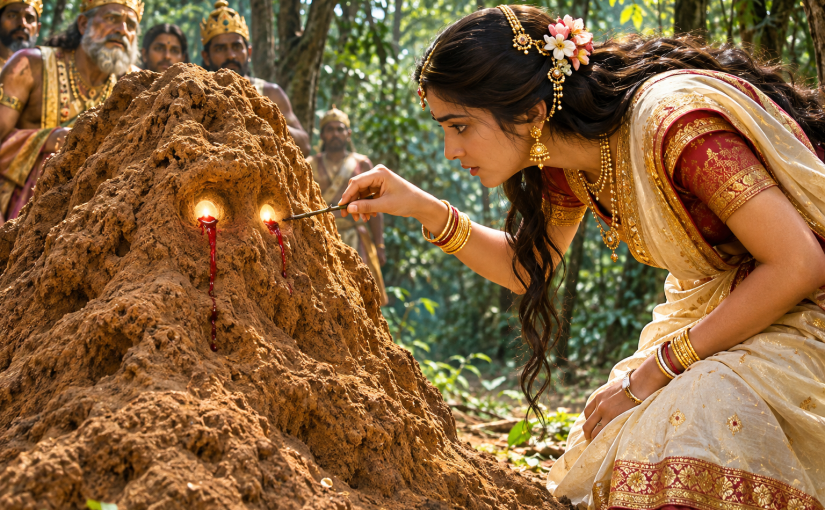
Ancient Puranic stories may contain meanings beyond their familiar narratives. The story of Sage Chyavana and Sukanya is one such example. According to the traditional account, King Sharyati enters a forest with his army and daughter, Sukanya, for hunting. There, they encounter a sage absorbed in deep dhyana samadhi. He has remained motionless for so long that an anthill has grown around his body. Only two points of light are visible through it. Sukanya, out of curiosity, mistakes them for luminous insects and pierces them with thorns. These points are the sage’s eyes, and they begin to bleed.
The king and his party return to their camp, but soon everyone becomes unable to pass excreta. Their suffering continues for days. This may seem like a ridiculous detail in the story, but it is part of the beauty of the original Sanskrit, composed in rhythmic verses or shlokas, in which such an incident seems perfectly acceptable. The king seeks an explanation from a yogi, who tells him that the trouble has arisen because his daughter injured the meditating sage in the forest. The king returns with his party and asks the sage for forgiveness. Chyavana agrees to forgive them on the condition that Sukanya marry him and serve him throughout his life, as he continues his spiritual practice despite his blindness. Unable to see, he depends on her for many everyday tasks that he could perform independently before losing his vision. Although the family is unwilling to marry the young princess to the apparently old sage, it eventually accepts the condition.
This familiar story can also be examined through a different interpretation that connects the anthill with the human body, the sage’s injured eyes with romantic attachment, the king’s suffering with an unresolved social burden, and the marriage with tantric practice.
The Anthill as a Symbol of the Human Body
The human body is full of chambers, cavities, channels, and openings, much like an anthill. An anthill is constructed by miniature ants through countless small activities. Similarly, the human body is formed, maintained, and repaired through the tiny constituents obtained from food and the air we breathe. The food we eat is digested, its nutrients are absorbed, and countless molecular and cellular processes sustain the body. The oxygen we breathe also supports these processes. Moreover, cells that construct this whole body are minute like nts.
Thus, a structure that appears to be a single, unified body is actually the result of numerous small components working together. Just as tiny ants construct an elaborate anthill, the invisible processes involving molecules, cells, and nutrients help maintain the complex structure of the human body. The comparison does not mean that ants and human cells work in identical ways. It offers a way to contemplate how complex structures arise from the coordinated activities of smaller components.
This connection is particularly relevant to Animal Darshan, which examines the animal kingdom, from insects and other invertebrates to lower and higher vertebrates, as a source of insight into nature, intelligence, organisation, and human life.
Chyavana as a Young Yogi and the Blindness of Romantic Love
My interpretation differs from the familiar image of Chyavana as simply an old sage who marries a beautiful young princess. I see him as a young man who is already a yogi by nature or through his established spiritual practice. Actually also, one before marriage is like a Yogi in thinking and actions. He appears old mainly in comparison with Sukanya, whose youth, beauty, and soft body create a striking contrast with his appearance. Even the name Sukanya may be understood not merely as the name of a particular girl but as a meaningful word. It combines su, meaning good, and kanya, meaning girl or maiden. In this symbolic interpretation, a girl who assists in yoga and supports a yogi’s spiritual journey can be considered a genuinely good girl, in keeping with traditional values and beliefs. The king and his entourage roaming through the forest can symbolize aggressive engagement with worldly life. In Hindu scriptures, the world is also compared to a forest because both are filled with diversity, colours, challenges, actions and their fruits.
The sage’s injured eyes can be understood symbolically as the blindness caused by falling in love. A young man who was previously established in his yogic state loses his clear vision when romantic attachment enters his life. A Yogi already has glowing eyes by default. The piercing of the eyes represents more than physical injury in this interpretation. It suggests how love and attachment can affect perception and disturb a person’s previous freedom. Serving the blind sage lifelong does not mean serving someone without eyes, but someone whose mind remains permanently fixed on the image of Sukanya, like in samadhi, keeping him blind to the worldly attachments that ordinary eyes perceive.
This does not mean that love always destroys spiritual progress. Rather, the story raises a question about the relationship between romantic attachment and yogic life. Can a person who has attained a degree of spiritual freedom remain unaffected by attachment? Can an experience that first appears to disturb spiritual practice later become part of a deeper transformation?
The King’s Inability to Relieve Himself as a Symbolic Burden
The king and his companions become unable to pass their excreta after Sukanya injures the sage. They seek the reason for this unusual suffering and learn that it is connected with the offence committed in the forest. The king then returns to seek forgiveness.
In my interpretation, this incident can also represent the burden that an social insult or wrongful act places on the people connected with it. The girl’s action creates a predicament not only for herself but also for her parents and relatives. They become unable to escape the consequences until the matter is resolved.
Their inability to relieve themselves can therefore be read symbolically as an inability to release an unresolved burden. The family is forced to face the situation and seek forgiveness from the injured sage. This symbolic interpretation is distinct from the supernatural explanation given in the traditional narrative and should not be confused with a medical explanation of constipation or other bodily symptoms. However, scientifically also, brain and gut are connected, so some stress or worry in brain inevitbly result in little or more malfunctioning of the gut.
Marriage as a Transformation into Tantric Practice
The king and his family eventually agree to marry Sukanya to Chyavana, although they initially find the arrangement difficult because of the apparent difference in their ages and appearances. Sukanya then serves the sage while he continues his spiritual practice.
My interpretation gives this relationship a tantric dimension. The marriage is not viewed merely as the union of an apparently old man and a beautiful young woman. It represents a situation in which a young yogi’s established life has been disturbed by romantic attachment, but the relationship that follows may become a means of further spiritual development.
Sukanya’s service to Chyavana can be interpreted in the context of tantric practice, in which the relationship between a man and a woman may become connected with yogic discipline and spiritual accomplishment. What first appears to be an obstacle in the yogi’s life can thus become part of his further development.
This is a symbolic interpretation of the story, not a claim that the traditional narrative explicitly describes a particular tantric method. Its significance lies in the possibility that worldly relationships and spiritual practice need not always remain separate.
It is not an exaggeration or a boast to say that I have personally experienced this exact situation in my life that is why I can draw similar conclusion from the ancient story.
Animal Darshan: Connecting Nature, Physiology, Psychology and Spirituality
The story offers several points of connection with Animal Darshan. The anthill provides an example of how small organisms construct a complex structure through their activities. The human body offers another example of complexity arising from smaller components and processes. The sage’s injured eyes suggest the loss of clear perception through romantic attachment, while the king’s suffering can be interpreted as the burden of an unresolved wrong. The eventual marriage opens the possibility of transforming a troubled relationship into a setting for tantric practice.
These connections bring together animal behaviour, human physiology, psychology, yogic practice, and philosophical inquiry. They also raise broader questions about intelligence, agency, attachment, and spiritual freedom. Nature contains many examples of complex organisation that do not require us to assume that every component independently controls the whole. Similarly, human beings may examine how their thoughts, desires, and relationships influence their actions without reducing every aspect of human experience to a single biological explanation.
The story should not be treated as scientific proof of these connections. Its value lies in the questions that emerge when its symbols are examined alongside scientific knowledge and contemplative experience.
Conclusion: Looking Beyond the Familiar Narrative
The story of Chyavana and Sukanya can be read at several levels. Its traditional narrative describes a sage in deep meditation, a princess who injures him through curiosity, a king who seeks forgiveness, and a marriage that follows. My interpretation adds another perspective: the anthill represents the complex organisation of the human body; the sage represents a young yogi whose apparent old age is relative to the princess’s youth; the injured eyes symbolise the blindness of romantic attachment; the king’s inability to relieve himself represents the burden of an unresolved offence; and the marriage becomes a possible means of resolving social conflict and further yogic development through tantric practice.
These meanings are offered as philosophical interpretations rather than established explanations of the original story. They show how an ancient narrative can become a starting point for exploring animal architecture, human physiology, romantic psychology, social responsibility, tantric yoga, and spiritual development.
This is the approach behind Animal Darshan: observing nature with animals, examining human experience, and using both in a comparative way to explore deeper questions about life, consciousness, attachment, and self-realisation.