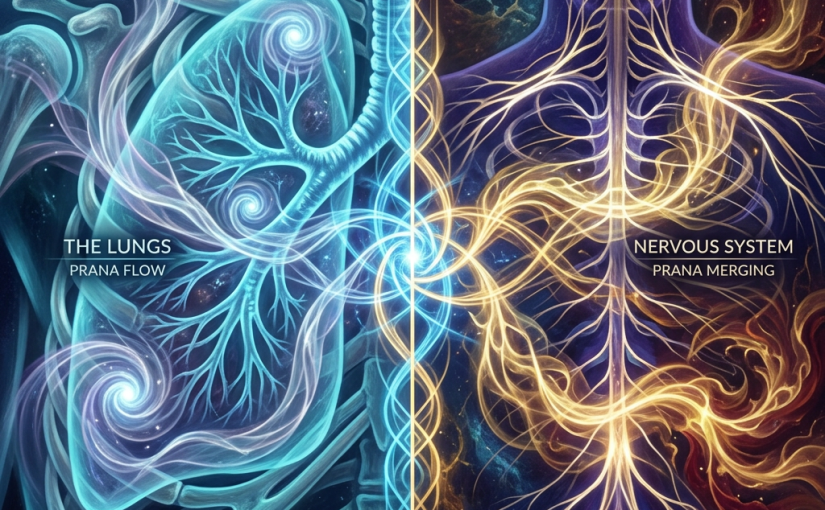
Does Breathing Have a Double Role? A Yogic Reflection on Prana, Oxygen, and the Hidden Purpose of Breath

A Question That Arose During Meditation

For many years I accepted the common explanation that breathing exists mainly to supply oxygen to the body and remove carbon dioxide. This explanation is obviously true and is supported by modern science. Yet repeated observations during meditation, daily life, intellectual work, emotional disturbances, and states of deep calm gradually led me to wonder whether breathing might be performing a second function as well.

This is not an attempt to reject science. Nor is it an attempt to prove ancient yogic theories through speculation. It is simply a reflection born from observation. My intention is not to offer proof but to present a clue that may inspire further thought.

An Observation About Oxygen

One observation repeatedly attracted my attention. The human body does not absorb all the oxygen present in inhaled air. A significant portion of oxygen still remains in exhaled air.

This naturally raised a question in my mind.

If oxygen delivery were the sole purpose of breathing, why did evolution not push the respiratory system toward extracting a much larger percentage of available oxygen from every breath?

The body certainly had millions of years to improve efficiency.

Instead, nature seems to have created a system in which large amounts of air continuously move in and out while only a portion of the available oxygen is actually utilized.

Of course, there are well-known scientific explanations involving safety margins, carbon dioxide regulation, diffusion processes, changing metabolic demands, and many other physiological factors. Yet the observation itself remains interesting.

The body appears designed not merely to absorb oxygen but also to maintain continuous movement of air.

A Simple Thought Experiment

This observation led me to a simple thought experiment.

Suppose the body extracted nearly all available oxygen from every breath.

In such a case, very little airflow might be required under many circumstances. Rapid breathing could potentially create excessive oxygen loading and other imbalances.

Instead, nature appears to prefer a design in which substantial airflow continues even though only part of the oxygen is utilized.

This does not prove anything about prana.

However, it raises an interesting possibility.

What if breathing serves purposes beyond oxygen exchange alone?

The Yogic View of Breath

According to Yoga, breath is closely connected with prana.

Prana is not exactly the same thing as oxygen. A person may breathe oxygen yet still feel exhausted, emotionally disturbed, mentally scattered, or energetically depleted. Yogic traditions therefore distinguish between the physical air and the subtle life force associated with it.

From this perspective, breathing performs two functions simultaneously.

The first function is physical. It supplies oxygen, removes carbon dioxide, and sustains biological life.

The second function is energetic. It helps distribute and regulate prana throughout the system according to changing needs.

Whether one accepts this view or not, it provides an interesting framework for interpreting many common experiences.

Breathing Changes With Every Mental State

One fact is difficult to deny.

Breathing changes continuously according to mental and emotional conditions.

When a person becomes angry, breathing changes.

When fear appears, breathing changes.

When desire becomes intense, breathing changes.

When anxiety increases, breathing changes.

When love arises, breathing changes.

When concentration deepens, breathing changes.

When meditation becomes profound, breathing changes.

When deep sleep arrives, breathing changes.

When intellectual work becomes intense, breathing changes.

Breath appears to participate in every major shift of consciousness.

If breathing existed only to supply oxygen, this extraordinary sensitivity to mental and emotional conditions seems worthy of reflection.

My Own Observations

Repeated observation led me to notice that fast and agitated breathing was often accompanied by increased mental chatter.

Thoughts became more active.

Emotions became more reactive.

Old tendencies such as attachment, anger, greed, desire, jealousy, ego, impatience, and restlessness seemed to find greater expression.

The mind became scattered.

In contrast, when breathing became slow, calm, and consciously directed, something different occurred.

Old impressions still surfaced, but they surfaced in a more orderly way.

Instead of becoming trapped in them, I could witness them.

The witnessing itself seemed to weaken their influence.

As this process continued, qualities such as patience, compassion, love, understanding, contentment, and inner balance appeared to grow naturally.

This observation does not prove a theory, but it strongly suggests that breath participates in processes far deeper than oxygen exchange alone.

Prana Regulation and Nervous System Regulation

Modern science explains many of these effects through the nervous system.

Breathing influences heart rate.

Breathing influences stress responses.

Breathing influences attention.

Breathing influences emotional regulation.

Breathing influences brain activity.

Breathing influences states of calmness and arousal.

Yoga explains similar observations through the language of prana, nadis, and chakras.

Science speaks of nervous system regulation.

Yoga speaks of prana regulation.

The words are different.

The practical observations often appear remarkably similar.

This raises an interesting possibility.

Perhaps these are not necessarily competing explanations.

Perhaps they are different ways of describing different aspects of the same living reality.

A Clue Rather Than a Conclusion

I do not claim that unused oxygen scientifically proves the existence of prana.

Nor do I claim that modern neuroscience has already validated ancient yogic descriptions of chakras and nadis.

My purpose is much simpler.

I am merely presenting a clue.

The clue is that breathing appears far too intimately connected with thought, emotion, attention, awareness, and consciousness to be viewed as nothing more than an oxygen pump.

Science explains part of this mystery.

Yoga explains another part.

Perhaps both perspectives still have more to learn.

Final Reflection

The deeper I observe breathing, the more difficult it becomes to separate body, mind, emotion, attention, and energy into independent categories.

A disturbed breath often accompanies a disturbed mind.

A calm breath often accompanies a calm mind.

A scattered breath often accompanies scattered attention.

A balanced breath often accompanies balanced awareness.

Whether one prefers the language of neuroscience or the language of Yoga, one fact remains undeniable: breath occupies a unique position between the physical and psychological dimensions of human life.

For this reason, I increasingly view breathing not merely as a mechanism for survival but as a bridge between body and consciousness.

The idea that breath may simultaneously support oxygen exchange and the redistribution of prana remains only a hypothesis. Yet it is a hypothesis born from repeated observation, and perhaps that is how many worthwhile investigations begin—not with certainty, but with a simple clue that invites deeper exploration.
When Awareness Takes Over the Work of Breath: Ajna Chakra, Prana Flow, Yoga Nidra, and Recovery from Mental Exhaustion

A Surprising Noon Meditation After Intense Intellectual Work

Today at noon again, after a long period of intellectual work, I decided to rest for a while. The work had been mentally demanding and I could clearly feel its effects. My breathing was faster than normal, yet it felt unsatisfying. Although the breath was moving rapidly, it did not seem to be providing the sense of refreshment or replenishment that I expected. Something felt incomplete.

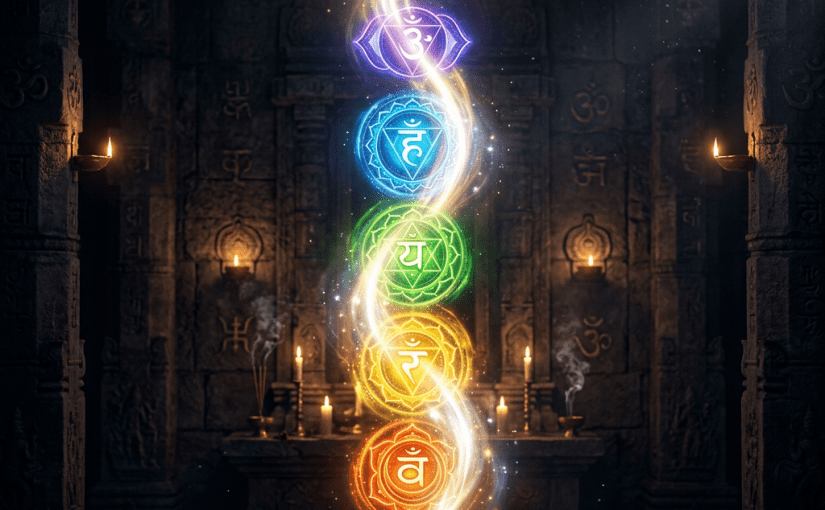
Instead of trying to force relaxation, I returned to a method that has been proving useful recently. I brought my awareness back to the spinal column. Almost immediately, I noticed something interesting. The rear Ajna Chakra seemed hungry for prana. The sensation was clear enough that it felt as though the region was demanding nourishment.

I placed my attention there and remained with it.

Discovering That Awareness Can Draw Prana Independently of Breath

As I continued observing, prana appeared to start collecting around the rear Ajna region. What surprised me most was that breathing was still continuing in its usual way. It had become slightly calmer than before, but it was still functioning normally. Yet the process of prana gathering at Ajna did not seem dependent on the breath. However, breath was following awareness and adjusting itself lttle or more to help pouring prana at awareness site.

This was an important observation.

The transfer of prana toward Ajna appeared to continue because awareness remained fixed there. The breath was not interfering with the process. The breath was not directing the process. Awareness itself seemed to be drawing prana toward the location that required it.

This felt very different from my previous understanding.

Earlier, I often experienced breath as the main mover of prana. Inhalation seemed to push energy upward and exhalation seemed to encourage downward movement. But today another possibility revealed itself. Awareness itself appeared capable of directing the flow.

It seemed that as long as awareness remained steadily established in a particular location, prana naturally began gathering there regardless of the ordinary movements of breathing.

Why Ordinary Breathing Sometimes Struggles to Nourish a Chakra

As I continued reflecting during the session, another understanding emerged.

In normal breathing, prana appears to swing continuously upward and downward. The movement is constantly changing. Because of this oscillation, prana does not always remain focused long enough on a demanding chakra.

When a chakra requires replenishment, the continuous swinging of prana with the breath may not be the most efficient method of supplying it.

This seemed particularly relevant to the condition I was experiencing after prolonged intellectual work.

My breathing had become fast and somewhat agitated. Looking closely, it seemed as though the breath was trying to collect and deliver prana but was not fully succeeding. Because the replenishment remained incomplete, the breathing continued becoming faster in an attempt to avoid a reversal or loss of available prana.

Some benefit was certainly occurring. The breath was helping to a degree. However, it appeared that the effort being expended by the body was greater than the amount of replenishment being achieved.

In other words, the cost-benefit ratio appeared negative.

Eventually the breathing method would probably have worked if enough time were allowed, but it seemed inefficient. The body was spending a great deal of energy in the process.

Fast Breathing, Thoughts, and Emotional Disturbance

Another aspect became obvious during this observation.

Rapid breathing was not acting alone.

With the rapid oscillation of breath, thoughts became more active, emotions became more restless, and mental chatter increased. Along with this, deeper mental tendencies and defects such as attachment, anger, greed, excessive desire, illusion, ego, jealousy, impatience, and various forms of inner agitation began surfacing more strongly. The mind appeared scattered and reactive. In contrast, when the breath became slow, calm, and consciously directed toward a particular needy chakra, old impressions and stored mental patterns surfaced in a more orderly manner. Because they arose in the presence of awareness and witnessing, they could be observed without being immediately acted upon. This gradual process seemed to help purify the mind. As mental agitation decreased, qualities such as patience, love, compassion, understanding, contentment, and inner balance naturally found more room to develop and express themselves.

Everything seemed interconnected.

As the breath accelerated, thoughts and emotions appeared to receive additional momentum. As thoughts and emotions became active, they further disturbed the process of gathering prana where it was needed. It is because they spend energy in useless body actions and reactions. It is all energy trade.

The entire mechanism appeared circular.

Fast breathing contributed to mental movement.

Mental movement contributed to energetic scattering.

Energetic scattering encouraged further breathing activity.

The cycle continued until awareness intervened.

Once awareness became firmly established at the demanding location, the cycle began slowing naturally.

Subtle Hunger at Vishuddha and Anahata Chakra

While most of the demand was clearly centered around the rear Ajna Chakra, I also noticed a small amount of energetic hunger at Vishuddha Chakra.

The demand there was much weaker.

Once attention was directed appropriately, it seemed to replenish quickly. Only a few subtle pumps of prana appeared sufficient to satisfy the requirement.

A similar process occurred around Anahata Chakra.

There was a slight demand there as well, but nothing compared to the intensity that had been present around Ajna. Once awareness and prana reached the area, the deficiency appeared to resolve fairly quickly.

This created the impression that different regions of the subtle system may require different amounts of replenishment depending upon the activities that have recently been performed.

After prolonged intellectual work, Ajna seemed to be the primary consumer.

The other centers required only minor balancing.

The Heart Suffocation Sensation and the Central Channel

One observation that has appeared repeatedly in recent experiences emerged once again.

A slight suffocation sensation around the heart region was present.

However, it did not feel like an isolated phenomenon.

The sensation appeared related to the Ida channel.

As awareness rested in the central spinal column and energy seemed to flow through the central pathway, the heart discomfort gradually calmed.

The impression was that the central channel supplies balance to both Ida and Pingala. When the central flow becomes stable, both side channels receive support.

As this balancing occurred, the suffocation sensation eased naturally without requiring direct attention to the heart itself.

This reinforced my growing sense that the system operates as an interconnected network rather than as isolated energetic locations.

When Awareness Takes Over the Work of Breath

Perhaps the most important insight of the entire session was the realization that awareness appeared capable of taking over a function that breathing had previously been performing.

Earlier in my practice, breath often seemed responsible for directing prana.

Today the process felt different.

Awareness located the demanding region.

Awareness remained there.

Prana gathered there.

Breathing gradually relaxed because it no longer needed to perform the task itself.

This did not happen through force.

There was no attempt to suppress breathing.

There was no attempt to hold the breath.

There was no attempt to create artificial stillness.

Instead, awareness quietly assumed responsibility for the process.

The breath seemed free to calm down because the required work was already being accomplished.

The Natural Arrival of Breath Stillness

As the replenishment continued, the breathing gradually became calmer.

There was no struggle.

There was no manipulation.

The calming seemed to occur by itself.

Eventually a point arrived where considerable breath stillness appeared.

This stillness felt natural rather than imposed.

The body no longer seemed to require the earlier rapid breathing pattern.

The energetic demand had diminished.

The agitation had diminished.

The need for excessive breathing had diminished.

Everything appeared to settle simultaneously.

Yoga Nidra While Sitting Upright

As peace and calmness increased, another development occurred.

Yoga Nidra appeared naturally.

What made this interesting was that it happened while sitting with a straight back.

I often sleep during the daytime while sitting upright because lying down frequently aggravates GERD symptoms. Experience has taught me that remaining upright is usually more comfortable.

Therefore, even the Yoga Nidra unfolded in a seated position.

The transition felt smooth.

Awareness gradually moved into a deeply restful state while the body remained sitting upright.

There was no deliberate attempt to enter Yoga Nidra.

It simply emerged as a consequence of the calmness that had developed.

Emerging from Yoga Nidra and the Breathless Condition

After some time, the Yoga Nidra naturally ended.

When it broke, another interesting phase followed.

For a period, I remained in what can only be described as a breathless-type condition.

The body appeared extremely quiet.

Breathing was minimal.

Everything felt peaceful and still.

There was no urgency.

There was no agitation.

The earlier fast breathing had completely disappeared.

After remaining in that condition for some time, I eventually stood up and went for lunch.

The entire session lasted approximately forty-five minutes.

During the evening session of about 20–30 minutes, there was no noticeable hunger for prana from any particular chakra. Manipura, Anahata, and Vishuddha appeared to draw breath-energy naturally and almost equally, alternating among themselves. Ajna showed no demand for additional prana, so there was no attempt to force energy upward. The experience felt less like an ascent and more like a spontaneous redistribution of energy throughout the system. This suggested that a natural grounding and balancing process was taking place rather than a concentration of energy in the head.

Reflections on the Session

Looking back, the most important discovery was not merely that prana collected around Ajna Chakra. The most important discovery was that awareness itself appeared capable of directing and organizing the process.

The session began with mental exhaustion, rapid breathing, and energetic dissatisfaction.

It progressed through spinal awareness, recognition of Ajna’s demand for prana, replenishment of Vishuddha and Anahata, balancing of the heart-related discomfort, calming of breath, emergence of breath stillness, spontaneous Yoga Nidra, and finally a peaceful breathless-type condition.

Most significantly, it revealed a possible distinction between two modes of practice.

In one mode, breath attempts to direct prana.

In the other mode, awareness directs prana and breath gradually follows.

Today’s experience belonged unmistakably to the second category.

Rather than breath leading awareness, awareness appeared to lead breath.

The result was not force, struggle, or effort, but increasing calmness, increasing stillness, and a natural movement toward rest and peace.

Kundalini at Vishuddha and Ajna Chakra: Breath, Void Awareness, and Meditation in a Busy World

A New Development in My Meditation Practice

Today a new development took place in my meditation practice. Yesterday, while sitting in a temple, the strongest sensation seemed to be centered around Vishuddha Chakra. The feeling of breathing, pressure, and what I can only describe as a subtle suffocation point appeared predominantly in the throat region. Today, however, the center of activity felt different. The dominant sensation was around Ajna Chakra, especially around the rear side of Ajna.

Many people say that breath should never be forcibly withheld. I generally agree with this. However, practical life does not always allow unlimited time for meditation. Sometimes a person is surrounded by responsibilities, noise, family interactions, and worldly duties. In such situations, waiting indefinitely for the breath to calm down naturally may not always be possible. I noticed that certain subtle adjustments helped the process move toward breath suspension much more quickly.

During meditation, I simply placed attention on the spinal column while maintaining normal breathing. After some time, a knot-like sensation appeared around the rear Ajna region. It felt as though something had moved upward from the neck area toward Ajna Chakra. Whether this was Kundalini itself or simply the movement of awareness, I cannot say with certainty, but the experience was unmistakable.

The Connection Between Ajna Chakra and Anahata Chakra

An interesting observation emerged during the sitting. At times I felt a suffocation-like sensation near the left side of Anahata Chakra close to the heart. Surprisingly, this sensation seemed connected to the rear Ajna region. Whenever the pressure or blockage around the rear Ajna eased, the suffocation near the heart eased as well.

The effect was not limited to the front of the chest. Sometimes it seemed to radiate toward the rear Anahata region and sometimes toward the front. This created the impression that the subtle system operates more like an interconnected network than as isolated centers functioning independently. It felt like an intricate web of channels where activity in one location immediately influenced activity elsewhere.

This observation reinforced the feeling that the chakras may not always function as separate compartments. Instead, they often appear as parts of a living and interconnected energetic field.

Upward Gaze, Ekarnava Meditation, and Rapid Breath Suspension

One of the most striking aspects of today’s sitting was that the upward gaze toward Ajna Chakra seemed to work much more effectively than before. Ekarnava meditation was also functioning with unusual ease and depth.

By combining awareness of the spinal column with natural breathing, breath suspension appeared within approximately fifteen minutes despite being in a chaotic joint-family environment. This surprised me because such conditions are usually not considered ideal for deep meditation.

Rather than forcing the breath, it seemed as though concentration itself gradually reduced the need for breathing. The breath became subtler and subtler until suspension emerged naturally.

An interesting insight arose from this. It seemed that a small inhalation while awareness rested around Vishuddha Chakra pushed the energy or awareness upward toward Ajna Chakra. This observation repeated itself enough times that it began to appear as a consistent pattern.

Breath as an Upward and Downward Force

Another realization emerged from observing the breath carefully. It appeared that inhalation functioned as an upward push while exhalation functioned as a downward push.

When awareness rested on a chakra, inhalation seemed to encourage an upward movement toward higher centers. Exhalation appeared to have the opposite effect, encouraging a downward movement or settling process.

From direct observation, Kundalini appeared to shift according to the state of the breath. Sometimes the dominant sensation was at Vishuddha. At other times it was at Ajna. The position did not seem fixed. Instead, it seemed responsive to the rhythm and quality of breathing.

This led to a broader insight. Perhaps breath, thoughts, emotions, and subtle energetic sensations are not separate processes at all. Perhaps they are different expressions of the same underlying movement.

Why Breath, Emotions, and Thoughts Are Related

The relationship between breath, emotions, thoughts, and awareness became increasingly obvious.

A change in attention influenced breathing.

A change in breathing influenced subtle sensations.

As breathing became subtler, thoughts became weaker.

As thoughts weakened, a deeper calm emerged.

This observation supports the ancient yogic understanding that breath and mind are deeply connected. When emotions become disturbed, breathing changes. When breathing changes, mental activity changes. When breathing becomes calm, thoughts naturally begin losing momentum.

Instead of viewing thoughts, emotions, breath, and energy as separate departments of human experience, it may be more accurate to view them as parts of one interconnected process.

The Emergence of Void Awareness

Perhaps the most important part of the meditation occurred much later.

The breath suspension itself appeared within roughly fifteen minutes. However, the deeper experience emerged approximately thirty to forty minutes after the beginning of the session. The total sitting lasted around seventy to eighty minutes.

What emerged was not bliss, ecstasy, visions, revelations, or grand spiritual conclusions.

There was no sense of “I.”

There was no sense of “we.”

There was no sense of “that.”

There was simply a calm void-like feeling.

It was difficult to describe because there was almost nothing present to describe. There was only a quiet and spacious absence of ordinary mental activity.

This state felt very different from energetic movements, chakra sensations, breathing patterns, or meditative techniques. Those processes seemed to belong to an earlier phase of the session. The calm void felt like something beyond them.

Doubt and the Decision to End the Session

At a certain point, I chose to end the meditation voluntarily.

The reason was not discomfort but doubt. The void-like state seemed to deepen, and I became uncertain about remaining in it for longer.

To return to ordinary functioning, I deliberately began taking deeper breaths. After a few intentional breaths, spontaneous Kapalbhati-like breathing appeared.

Gradually, thoughts started returning.

However, they returned in a weakened form.

Thoughts were sparse.

Thoughts lacked their usual force.

The body felt somewhat weak.

There was mild pressure in the head.

The entire experience felt like a gradual re-entry into ordinary consciousness after spending time in a much quieter state.

The Challenge of Deep Meditation in a Busy World

One practical challenge became obvious through this experience.

It is difficult to sit for long periods in a busy worldly environment.

A householder does not live in a monastery. There are conversations, responsibilities, family members, duties, and endless interactions. Deep meditation naturally moves toward silence, stillness, and inwardness, whereas ordinary life constantly demands engagement.

This contrast creates a challenge.

Sometimes the meditation deepens just when practical life demands attention elsewhere.

Yet today’s experience demonstrated something important. Even within a noisy and busy environment, a deep meditative state can still emerge. External conditions may not be as decisive as they initially appear.

The Role of Speech and Conservation of Energy

Another insight became increasingly clear.

Talking appears to consume a significant amount of energy.

Not all speech is unnecessary, of course. Practical communication is part of life. However, excessive talking seems to scatter attention and dissipate inner stability.

Limiting unnecessary speech may be one of the simplest yogic disciplines available.

Animals provide an interesting contrast. They do not engage in endless conceptual discussions, arguments, explanations, and self-commentary. Whether this gives them a form of heightened sensitivity is difficult to say with certainty, but it does highlight how much energy human beings devote to continuous mental and verbal activity.

Perhaps silence conserves energy not because speech is bad, but because silence allows awareness to remain gathered rather than dispersed.

From Vishuddha to Ajna and Beyond

Looking back at the entire experience, a clear sequence emerges.

Yesterday, the dominant point of breathing-related tension appeared at Vishuddha Chakra.

Today, the dominant point shifted toward Ajna Chakra.

A small inhalation seemed to encourage upward movement.

Awareness gathered around the rear Ajna region.

The upward gaze became effortless.

Breath became subtle.

Natural suspension emerged.

Thoughts weakened.

The sense of ordinary identity faded into the background.

A calm void appeared.

Eventually, doubt arose and the session was voluntarily ended.

Whether these events are interpreted as Kundalini movement, energetic shifts, attentional changes, or meditative stages is less important than the direct experience itself.

What remains most significant is the discovery that breath, attention, emotions, thoughts, and subtle sensations appear deeply interconnected. As one becomes quiet, the others naturally follow. Beyond all these movements, there sometimes appears a simple and silent void that asks for nothing, explains nothing, and merely remains present in its own stillness.

How Spinal Breathing and Keval Kumbhak Opened My Door to Stillness: A Personal Journey Through Subtle Transformation

During a recent week-long spiritual ceremony — Shrimad Bhagavat Puran Saptah Shravan — I experienced something so profound yet natural that words may only scratch its surface. Each morning, I would sit silently in front of the Vyas (the orator), lay down my asana, and begin watching the breath gently move in and out. Very soon, it would begin to calm, slow, and gradually dissolve.
In that serene flow, I noticed something subtle: thoughts and old mental impressions arose not as distractions but as waves perfectly synced with the breath itself. The pace of thinking was no longer random — it was breathing itself. The passage of time changed too. An entire hour felt like just a few minutes. It wasn’t imagination — it was happening.
Then, something rarer occurred.
Infrequently, but unmistakably, the breath would entirely stop. Mind stilled completely. There was no effort to hold breath. It simply ceased, and with it, the world became a still pond. This was Keval Kumbhak — spontaneous breath suspension without control or intention. The experience was so still, it felt like someone might have left the body, yet it was deeply aware, rooted, and intimate. A sense of absorption that made even the thought of breath unnecessary. Means I was so deeply absorbed in stillness that even thinking about breathing felt unnecessary. It was as if breath didn’t matter — only silence remained. Prior to and after this stage, the feeling of the in-breath and out-breath was deeply absorbing. As I gradually moved toward full Keval Kumbhak, it began to feel as though no air was actually moving in or out — and yet, an inner breathing movement continued. The physical breath had nearly disappeared, but within, it felt as if something subtle was flowing like inner inbreathing and outbreathing movements along the spine. Also chest, abdomen and whole body was showing breath movements as usual but too subtly to allow physical air movement in and out. There was a gentle, rhythmic motion — more experiential and less overt or physical, but energetic — as if the energy itself were silently rising and falling, instead of air. This wasn’t imagined; it was vividly real. It felt as though prana had taken over the role of breath, flowing upward and downward through the central channel, the sushumna, without any air exchange. In that stillness, this inner current became more obvious — as if life itself was now circulating directly through the spine, without the need for breath. One major contributing factor that appeared to produce this state was that I was producing and conserving energy at lower chakras without releasing it outside through Tantric practice.

This experience I went through — of spontaneous stillness, subtle inner flow, and natural suspension of breath — is likely what ancient yogic texts describe using terms like “balancing prana and apana,” “the upward and downward currents,” or “the tug-of-war between prana and apana.” While these descriptions are accurate from the perspective of subtle physiology, in reality, they are just linguistic frameworks — conceptual attempts to explain what is essentially a practical and direct experience.
When we approach yoga only through these theoretical terms, it can create confusion or even fear. For a practitioner standing at the threshold of deep inner states, words like “prana-apana conflict” or “kundalini shock” can feel intimidating, and may discourage continued practice. But yoga is not meant to be a battlefield of concepts — it is a living, breathing path of experience. The body, breath, and awareness already know what to do when approached with sincerity and steadiness.
Once a genuine practical foundation is established through methods like Tantric or simple kriya yoga, spinal breathing, asana, and chakra meditation, these ancient terms begin to make intuitive sense after the fact — not before. They are meant to be confirmations, not prerequisites. When you actually feel the subtle energy dynamics within, you recognize that theory has its place, but practice is the true teacher. It’s only through consistent practice that one comes to realize: there is no need to wrestle with technical jargon. The inner intelligence of life — prana itself — begins to guide you, far more reliably than any book can.
So instead of getting caught in mental acrobatics or fearing whether prana and apana are balanced, just keep practicing. Let the breath slow, let the spine align, let stillness come. Everything else will follow naturally — not through intellectual effort, but through the quiet wisdom of the inner self.

The Hindi explanations in the afternoon had similar effects. The ambience played its part too — the sound of bells, the conch, the continuous chanting of Vedic mantras, incense, flames, and the presence of devoted priests doing their japa. The whole environment supported and gently deepened the inner silence. Some people noticed my unmoving posture and wondered how one could sit so still for so long — but I myself felt like I wasn’t doing anything.
This deep state, however, didn’t just arise from attending the event. It had a silent preparation behind it.
Every morning, I continued my routine as usual: 15 minutes of Kriya Yoga spinal breathing, followed by one hour of yogasana including chakra meditation. What I noticed over time is that spinal breathing created a sort of “potential difference” between the lower and upper chakras — a real energetic tension, not just symbolic. As this potential rose, the breath naturally became subtle and eventually stopped — Keval Kumbhak again, this time without any willful breath retention.
At first, this kriya process brought heaviness to the head — a sign that energy had risen and accumulated in the upper centers, especially Ajna. But this was not a disturbance. Interestingly, this head pressure would later discharge on its own — sometimes during Keval Kumbhak or a spontaneous moment of stillness — and the mind would become crystal clear.
On one such morning, I did my spinal breathing at 5 a.m. and then lay down on the bed. Though I had gotten little sleep the night before, I slipped into a beautiful, restful sleep for half to one hour — not drowsy, but deeply silent. On waking, the heaviness in the head was completely gone, but I could still feel the energy axis — the same potential difference — humming quietly. It felt like this charge was preserved and would discharge later at any quiet moment during the day through spontaneous Keval Kumbhak.
This left me thinking deeply: perhaps it is not always necessary to push toward stillness. The energy, once awakened, seems to have its own intelligence. It knows when to rest, when to flow, when to stop — like a river that doesn’t need help to find its sea.
As I reflected on all this, I realized: this is not an achievement but a stage of unfolding. I haven’t yet reached the full stability of Nirvikalpa Samadhi. My earlier experience of cosmic consciousness in a dream during adolescence felt even more transformative than this. That adolescent glimpse left me craving renunciation and freedom — a longing that shook my sense of reality. What I’ve experienced now, in contrast, is more peaceful, more grounded, and more systematic. The craving has lessened, but the understanding has deepened.
I now believe that Kriya Yoga is gently reintroducing what I had once touched too suddenly. Earlier, I had tried to raise energy quickly — from base to brain — skipping over the chakras, focusing only on the endpoint. Now, with more awareness, I see the importance of balance. I’ve started grounding practices as well — not through force, but simply being in the world while staying anchored in that silent current.
Sometimes the bliss is strong, sometimes it’s subtle. The energy goes up and down — and I let it. I no longer feel the need to force it into permanence. I’ve realized this: the real maturity is when bliss doesn’t chase us, nor do we chase it — it becomes a quiet companion.
These subtle breathless moments, these silent pauses — whether during a ritual, after kriya, or randomly in the day — have taught me more than many words ever could. I now see spiritual growth not as something I must accomplish, but something I must allow.
And perhaps, that’s what it means to truly begin the inner journey.

The Power of Breath and Meditation: A Personal Journey

I’ve found that the simplest things, when practiced with awareness, have the potential to shift our entire experience. One such practice is yoga breathing, something that has helped me transform my daily life in ways I never anticipated. It’s not just a matter of breathing; it’s about becoming deeply aware of the breath throughout the day and learning to regulate it, creating a natural flow of calm and clarity. This realization started with a deep connection to the breath itself, something that yoga breathing nurtures effortlessly.

I began noticing that yoga breathing makes an ordinary breath feel regular and perceptible all day long. When you practice breathing with intention, it becomes something you can always be aware of, a constant thread running through your day. It’s like it’s always present, just waiting to help you center yourself in any moment. This presence and awareness of the breath naturally create a sense of inner peace and connection to the present, even amidst distractions.

One thing I’ve experienced is that, as I become more attuned to my breath, everything in life seems to become peaceful. Not just a passing sense of calm, but a deep, lasting peace. It’s as if the regular practice of being mindful of the breath is starting to shape my intellect and intelligence, making me approach everything with greater clarity. The more I breathe with awareness, the more I feel my thoughts becoming clearer and my emotions more balanced. This change is especially noticeable in my relationships, where there’s now a sense of understanding and no enmity felt for anyone, no matter what might have happened before. I’ve learned to let go of bad experiences rather than holding onto them, allowing them to slip away and fade into the background.

This doesn’t mean everything is perfect. There are still moments where that peace fades, and it becomes challenging to maintain that clarity. I’ve noticed that the peace I feel after practicing breathwork can fade if I don’t consistently dedicate time to the practice. The solution, I found, is daily practice of Kriya breathing, a technique that provides enough strength and focus to anchor that sense of inner peace for a longer period. Without it, the effects are temporary. But when I practice regularly, especially with deep commitment, I can feel the lasting effects not just for hours but through the day.

I’ve also noticed that spinal breathing is incredibly effective for me, particularly when I wake up around 3-4 AM. This time feels sacred, as if the world around me is quieter, and the energy within me is more accessible. When I engage in spinal breathing at this hour, a sense of head pressure develops after some breathins, likely from the energy rising through the sushumna nadi. It’s a familiar sensation, one that tells me something is shifting. After some time, I let myself sleep again with help of chanting soham mentally with breathings, and when I wake, the head pressure is relieved, but the effect of the breathing practice lingers, adding a sense of lightness, clarity, and peace that carries me through the day. It’s almost as if the energy becomes deeply embedded within me, and its effects continue, even without active focus.

That lingering effect—where the peaceful, grounding sensation stays with me—is perhaps the most profound aspect of this practice. Even when I’m not consciously thinking about it, I can feel a subtle undercurrent of calm and clarity throughout my day. It’s as though my entire energy field is recalibrated each time I practice. This has been especially noticeable in how I approach tasks. Things that might have once caused stress or frustration now feel lighter, and I can move through them with more ease.

But, of course, I’m still on a journey. I haven’t yet achieved everything I envision for myself. Nirvikalpa Samadhi still feels distant, and I haven’t fully arrived at that state of unchanging bliss I once glimpsed. But I’ve experienced enough glimpses to know the truth of its potential. The practices, like Kriya Yoga, continue to shape me, helping me refine my approach to both life and spiritual growth.

Every day, I find myself stepping closer to the state I aim for, and I’m learning to integrate this practice not as a goal, but as an ongoing process. It’s not about reaching some final destination but rather about allowing this energy and peace to infiltrate every moment. The more I practice, the more I experience a shift in my relationship with myself and the world around me. The breath, once an unconscious process, has become a tool for transformation—spiritually, mentally, and emotionally.

I believe that anyone can experience this transformation, no matter where they are on their journey. The practice of yoga breathing, especially when paired with spinal breathing and Kriya Yoga, creates a gateway to deeper awareness and inner peace. And even if you’re just starting, you don’t need to wait for the perfect moment to begin. Every breath is an opportunity to align yourself with the present and to let go of what no longer serves you. And through that, the world becomes a little brighter, and we become a little lighter.

In the end, it’s not about achieving a perfect state but about becoming more fully present in the unfolding of life—breathing in peace, breathing out clarity, and allowing the rhythm of the breath to carry us through each day. The journey, I believe, is just beginning.