A Question That Arose During Meditation
For many years I accepted the common explanation that breathing exists mainly to supply oxygen to the body and remove carbon dioxide. This explanation is obviously true and is supported by modern science. Yet repeated observations during meditation, daily life, intellectual work, emotional disturbances, and states of deep calm gradually led me to wonder whether breathing might be performing a second function as well.
This is not an attempt to reject science. Nor is it an attempt to prove ancient yogic theories through speculation. It is simply a reflection born from observation. My intention is not to offer proof but to present a clue that may inspire further thought.
An Observation About Oxygen
One observation repeatedly attracted my attention. The human body does not absorb all the oxygen present in inhaled air. A significant portion of oxygen still remains in exhaled air.
This naturally raised a question in my mind.
If oxygen delivery were the sole purpose of breathing, why did evolution not push the respiratory system toward extracting a much larger percentage of available oxygen from every breath?
The body certainly had millions of years to improve efficiency.
Instead, nature seems to have created a system in which large amounts of air continuously move in and out while only a portion of the available oxygen is actually utilized.
Of course, there are well-known scientific explanations involving safety margins, carbon dioxide regulation, diffusion processes, changing metabolic demands, and many other physiological factors. Yet the observation itself remains interesting.
The body appears designed not merely to absorb oxygen but also to maintain continuous movement of air.
A Simple Thought Experiment
This observation led me to a simple thought experiment.
Suppose the body extracted nearly all available oxygen from every breath.
In such a case, very little airflow might be required under many circumstances. Rapid breathing could potentially create excessive oxygen loading and other imbalances.
Instead, nature appears to prefer a design in which substantial airflow continues even though only part of the oxygen is utilized.
This does not prove anything about prana.
However, it raises an interesting possibility.
What if breathing serves purposes beyond oxygen exchange alone?
The Yogic View of Breath
According to Yoga, breath is closely connected with prana.
Prana is not exactly the same thing as oxygen. A person may breathe oxygen yet still feel exhausted, emotionally disturbed, mentally scattered, or energetically depleted. Yogic traditions therefore distinguish between the physical air and the subtle life force associated with it.
From this perspective, breathing performs two functions simultaneously.
The first function is physical. It supplies oxygen, removes carbon dioxide, and sustains biological life.
The second function is energetic. It helps distribute and regulate prana throughout the system according to changing needs.
Whether one accepts this view or not, it provides an interesting framework for interpreting many common experiences.
Breathing Changes With Every Mental State
One fact is difficult to deny.
Breathing changes continuously according to mental and emotional conditions.
When a person becomes angry, breathing changes.
When fear appears, breathing changes.
When desire becomes intense, breathing changes.
When anxiety increases, breathing changes.
When love arises, breathing changes.
When concentration deepens, breathing changes.
When meditation becomes profound, breathing changes.
When deep sleep arrives, breathing changes.
When intellectual work becomes intense, breathing changes.
Breath appears to participate in every major shift of consciousness.
If breathing existed only to supply oxygen, this extraordinary sensitivity to mental and emotional conditions seems worthy of reflection.
My Own Observations
Repeated observation led me to notice that fast and agitated breathing was often accompanied by increased mental chatter.
Thoughts became more active.
Emotions became more reactive.
Old tendencies such as attachment, anger, greed, desire, jealousy, ego, impatience, and restlessness seemed to find greater expression.
The mind became scattered.
In contrast, when breathing became slow, calm, and consciously directed, something different occurred.
Old impressions still surfaced, but they surfaced in a more orderly way.
Instead of becoming trapped in them, I could witness them.
The witnessing itself seemed to weaken their influence.
As this process continued, qualities such as patience, compassion, love, understanding, contentment, and inner balance appeared to grow naturally.
This observation does not prove a theory, but it strongly suggests that breath participates in processes far deeper than oxygen exchange alone.
Prana Regulation and Nervous System Regulation
Modern science explains many of these effects through the nervous system.
Breathing influences heart rate.
Breathing influences stress responses.
Breathing influences attention.
Breathing influences emotional regulation.
Breathing influences brain activity.
Breathing influences states of calmness and arousal.
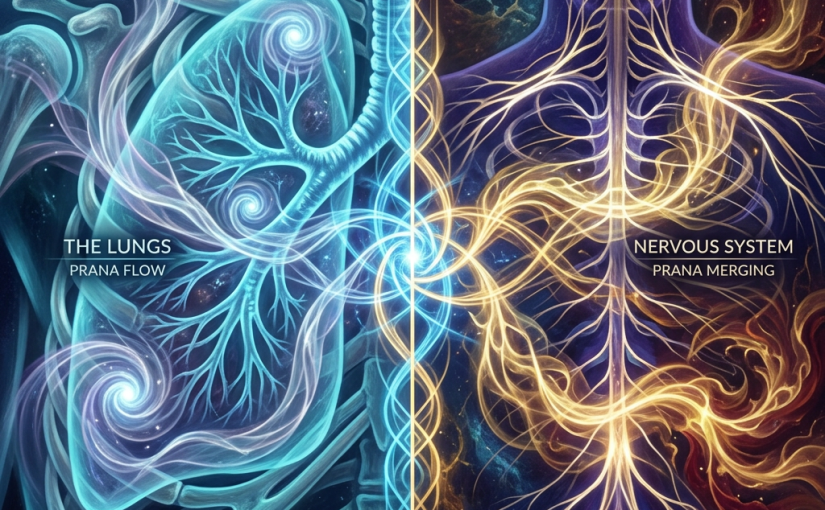
Yoga explains similar observations through the language of prana, nadis, and chakras.
Science speaks of nervous system regulation.
Yoga speaks of prana regulation.
The words are different.
The practical observations often appear remarkably similar.
This raises an interesting possibility.
Perhaps these are not necessarily competing explanations.
Perhaps they are different ways of describing different aspects of the same living reality.
A Clue Rather Than a Conclusion
I do not claim that unused oxygen scientifically proves the existence of prana.
Nor do I claim that modern neuroscience has already validated ancient yogic descriptions of chakras and nadis.
My purpose is much simpler.
I am merely presenting a clue.
The clue is that breathing appears far too intimately connected with thought, emotion, attention, awareness, and consciousness to be viewed as nothing more than an oxygen pump.
Science explains part of this mystery.
Yoga explains another part.
Perhaps both perspectives still have more to learn.
Final Reflection
The deeper I observe breathing, the more difficult it becomes to separate body, mind, emotion, attention, and energy into independent categories.
A disturbed breath often accompanies a disturbed mind.
A calm breath often accompanies a calm mind.
A scattered breath often accompanies scattered attention.
A balanced breath often accompanies balanced awareness.
Whether one prefers the language of neuroscience or the language of Yoga, one fact remains undeniable: breath occupies a unique position between the physical and psychological dimensions of human life.
For this reason, I increasingly view breathing not merely as a mechanism for survival but as a bridge between body and consciousness.
The idea that breath may simultaneously support oxygen exchange and the redistribution of prana remains only a hypothesis. Yet it is a hypothesis born from repeated observation, and perhaps that is how many worthwhile investigations begin—not with certainty, but with a simple clue that invites deeper exploration.


Brilliant post, interesting and well reasoned 👍 I much prefer reading and following blogs with posts based on personal experience and observation. 🙏🕉️
LikeLiked by 1 person
Thank you so much for your kind words and encouragement. I am glad you found the post interesting and meaningful. Most of what I write comes from personal observation, contemplation, and direct experience rather than theory alone. It is always heartening to know that such reflections resonate with fellow seekers. Thank you for reading and for taking the time to share your thoughts. Your mindfulness specially drew my attention. It’s just reflection of full awakening with self realisation being maintained in daily life. I’m soon making an experiential post connecting this to awakening and nonduality. Hope you’ll find that too interesting. 🙏🕉️
LikeLike