Introduction: The Hidden Value of Changing Environments
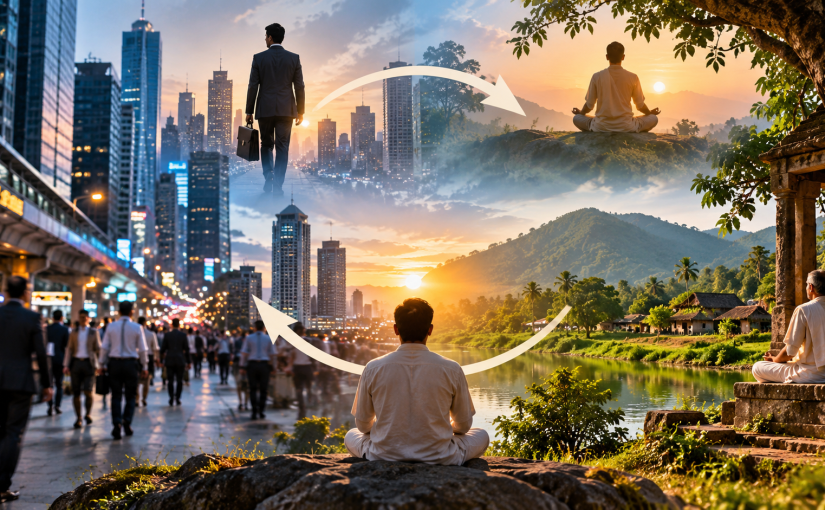
I have gradually come to see cyclicity as an important factor in spiritual growth and the development of an all-round personality. Different environments offer different experiences, and their effects may complement one another over time. A fast-paced, materialistic environment, a peaceful rural setting, a spiritual atmosphere and a place focused on earning and social responsibilities can each contribute something different to human development. Perhaps the important point is not to remain permanently in one environment, but to understand what different environments offer and how their combined influence can enrich life.
This observation emerged from my own life, which has passed through several contrasting phases. I spent approximately the first eighteen years in a fast and materialistic environment, followed by five years in a slower, nonmaterial environment. I then returned to a materialistic home environment for three years, experienced another six years in a slow and peaceful setting, and eventually entered the spiritual environment in which I have now spent about ten years. Interestingly, these latest ten years have felt almost like ten days.
Worldly Activity and Spiritual Detachment Can Exist Together
My experience has taught me that worldly engagement and spiritual detachment do not necessarily belong to separate stages of life. They can operate simultaneously. Even while living in fast-paced environments, I was practising contemplation through Sharirvigyan Darshan. I contemplated my actions and their results as activities of the dehpurusha, the bodily principle responsible for the body’s functions, rather than continuously identifying myself as the individual doer. This understanding of action, detachment and nonduality helped reduce unnecessary mental involvement in worldly affairs, even when external life remained active.
During the latest ten years, meditation, tantra and a peaceful environment have further reduced my preoccupation with worldly thoughts. The difference is not that I was attached to the world earlier and became detached only later. Detachment was present even during the faster phases, but the overall movement of life was greater. In the present environment, both external activity and mental preoccupation are comparatively reduced. I suspect that the effects of earlier experiences have also accumulated, contributing to the present condition.
How Contrasting Environments May Complement Each Other
A single environment may not provide every kind of experience needed for a broad understanding of life. A busy city exposes people to competition, administration, livelihood, social relationships and practical challenges. A peaceful village may offer simplicity, closer contact with nature, fewer distractions and more opportunities for contemplation. A spiritual setting may support meditation and self-inquiry, while active social environments may reveal aspects of human behaviour that remain less visible in solitude. A materialistic environment can serve two complementary purposes in spiritual growth. It can lay the foundation of spirituality through nondual living and karmayoga, in which a person performs worldly actions without excessive attachment to the doer or the results. At the same time, it tests the depth of spiritual progress by exposing a person to worldly pressures, desires and responsibilities. Thus, materialistic life is not necessarily opposed to spirituality; when approached with awareness and detachment, it can become both a ground for spiritual development and a test of how firmly that development is established.
Neither environment is necessarily superior in every respect. Their value may lie in their complementary qualities. Experience of one can reveal the benefits and limitations of another. A person accustomed to city life may discover the importance of peace after spending time in a village, while someone living in solitude may better appreciate the practical value of worldly engagement after returning to an active environment.
This does not mean that everyone must experience every type of place to grow spiritually. Rather, contrasting environments provide different opportunities for learning, and their effects may become more meaningful when a person reflects on them. This cyclicity also occurs naturally in human life. Innumerable villagers leave their homes to earn a living in cities and later return with their savings to enjoy the peace of nature and village life. After experiencing the pressure and chaos of the city, they appreciate the value of peace more deeply. Yet this appreciation is relative and may gradually diminish with prolonged exposure to a peaceful environment. They may then begin to miss the activity, opportunities or social engagement of city life, bringing them back into contact with it. In this way, people may alternate between contrasting environments without consciously intending to do so for personal or spiritual development. Life itself exposes them to different conditions, allowing them to experience their benefits and limitations. The same principle may extend to spiritual growth: active worldly life can provide both a foundation for nondual karmayoga and a test of detachment, while peaceful surroundings offer opportunities for deeper contemplation for furthering spiritual growth. Their complementary influence may become clearer through repeated experience.
How People Carry Different Environments Into a Home
Physical movement between places is not the only way to encounter different environments. People themselves can carry the influence of the places in which they have lived. Someone who has spent years in a foreign country, a busy city or a remote village may bring different habits, attitudes, experiences and perspectives into a household.
When such a person joins a family accustomed to another way of life, the household receives some of the influence of that person’s previous environment. A person accustomed to an active urban lifestyle may introduce new approaches to work and social interaction, while someone from a peaceful and contemplative setting may bring different habits of living and thinking. The influence depends on the individual, but this process allows complementary experiences to enter a place without everyone having to travel.
Thus, environmental diversity can reach people indirectly through relationships. A household may remain physically stable while its members encounter a wider world through one another.
The Temple Pujari: From Repeated Movement to Conscious Integration
I see this principle in the life of a temple pujari who first travelled to a distant city to earn a living. After several years, he returned to a remote village temple, where the calm environment allowed him to devote himself to yogic practices and attainments that he associated with that period. However, earning too little in the village made it difficult to support his family, so he eventually returned to the city and resumed a more active life.
After experiencing both conditions, he understood the value of changing locations and began alternating between city and village living. The city offered better opportunities for livelihood, while the village provided peace and favourable conditions for yogic practice.
His experience illustrates how a person may initially move between environments because circumstances demand it, but later learn to use their complementary benefits consciously. What once appeared to be a choice between earning and spiritual peace became an opportunity to accommodate both. This is not a universal solution, but it shows how experience can transform repeated movement into a more considered way of living.
The Tribal-Area Minister: Frequent Movement and a Broader Outlook
I also notice a similar pattern in a minister from a tribal area who frequently move between the state capital and his village home. The capital involve active public responsibilities and administrative work, while the village offer direct contact with local communities and a different way of life. His frequent movement expose him to contrasting social conditions and a wide range of experiences.
Such movement can help a person understand different perspectives and adapt to changing circumstances. Administrative experience may reveal one set of problems, while direct contact with village life may reveal others that are less visible from an office. However, frequent travel does not automatically produce wisdom. Its value depends on how a person observes, understands and uses the experiences gained.
The pujari and the minister follow different patterns, but both examples raise the possibility that people who regularly encounter different environments can develop a broader understanding than those whose experience remains confined to one setting.
Mobility, Nonattachment and the All-Round Personality
I have observed that people who move between different places can sometimes develop an all-round personality and become less dependent on a particular living environment. They may learn to function in contrasting conditions without requiring one place to provide everything they need. Such flexibility can support practical judgement, social understanding and psychological adaptability.
However, physical mobility should not be confused with spiritual detachment. A person may travel extensively while remaining attached to status, comfort or particular experiences. Another person may remain in one home while practising profound nonattachment. The deeper issue is not how often someone changes location, but how they relate to the circumstances in which they live.
When mobility and inward detachment develop together, a person may appreciate different environments without becoming psychologically confined to any one of them. This can allow the benefits of contrasting experiences to be integrated rather than treated as competing alternatives.
Wandering Ascetics and the Traditional Search for Freedom
Traditional Indian wandering ascetics, including parivrajakas, often moved between forests, mountains, villages, towns and pilgrimage centres. These different settings could provide solitude, contact with ordinary people, opportunities for spiritual discussion and repeated adaptation to unfamiliar circumstances. Some ascetics wandered extensively, while others remained in monasteries, forests or particular religious centres. Their practices and purposes varied.
Wandering could expose ascetics to a wide range of human experiences and loosen dependence on familiar surroundings. Yet travel alone did not guarantee spiritual attainment. Its value depended on the discipline, contemplation and nonattachment cultivated by the individual.
The same distinction applies to householders and working people. A person need not become a wanderer to benefit from different environments. Travel, relationships and changing responsibilities can also provide contrasting experiences. Conversely, remaining in one place need not prevent spiritual development if the person can observe life without excessive attachment.
Cyclicity as a Principle of Human Development
These observations suggest that cyclicity may be understood as more than repeated movement between places. It can be a process through which contrasting experiences reveal their complementary value. A person may encounter different environments over many years, move between them within a short period, or receive their influence through other people. In each case, the important question is what is learned and how that understanding shapes later choices.
Cyclicity does not necessarily produce growth by itself. Its benefits depend on reflection, adaptability and the ability to carry lessons from one situation into another. Repeated exposure to contrasting conditions may help integrate practical experience, psychological understanding and spiritual contemplation.
Perhaps the most useful outcome is not permanent attachment to a peaceful place or endless movement between active places. It is the ability to benefit from different conditions while maintaining an inner orientation that is not entirely dependent on any one of them.
A person can benefit from both environments by practising active karmayoga through Sharirvigyan Darshan in a busy, materialistic setting and passive, Kundalini-oriented yoga in a peaceful environment. The former allows spirituality to develop through worldly action, nondual contemplation and detachment, while also testing their stability amid everyday pressures. The latter provides favourable conditions for meditation, inwardness and deeper yogic experiences. By experiencing both, a person may grasp the spiritual essence of each environment and integrate active engagement with passive contemplation in a balanced way.
Conclusion: Different Places, One Continuous Journey
My experience suggests that different environments can contribute to the same continuing process of spiritual development. Worldly engagement and detachment can coexist, while meditation, tantra and nondual contemplation may deepen an inward orientation across changing circumstances. The influence of earlier phases may also continue into later life, so that growth is cumulative rather than confined to one period.
The temple pujari, the frequently travelling minister and the traditional wandering ascetic, even my own journey too illustrate different ways of encountering contrasting environments. Their lives suggest that diversity of experience can broaden understanding, while detachment may help a person benefit from that diversity without becoming dependent on any single place.
The central possibility is simple: different environments can complement one another, and cyclic movement can help integrate their benefits. The ultimate value may lie not in choosing one environment over all others, but in learning how to live wisely in different conditions while preserving inner freedom.
Discover more from Demystifying Kundalini
Subscribe to get the latest posts sent to your email.


