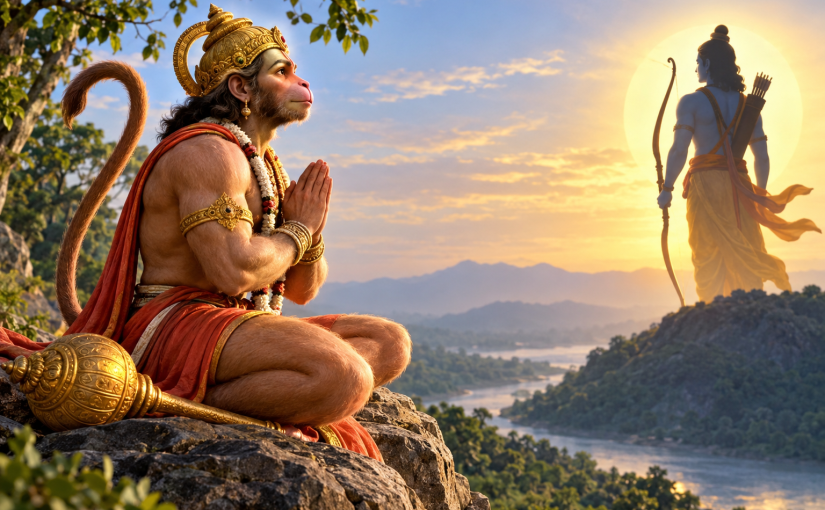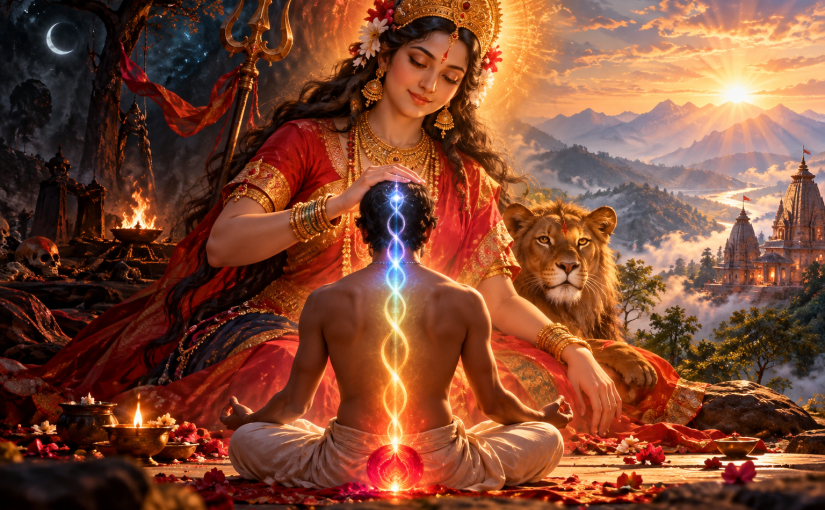
Hanuman Ansh: The Hidden Spiritual Symbolism Behind Neem Karoli Baba’s Miracles

Watching Hanuman Ansh Through a Spiritual Lens

Friends, I went today to the theatre to see the blockbuster movie Hanuman Ansh. The emotions in the movie are powerful, but what interested me even more was how many of the apparently miraculous events can also be understood as symbolic expressions of inner spiritual experiences. I do not feel that every event has to be forced into either a literal miracle or a fictional story. Some may have been experienced as extraordinary events, while at the same time carrying a deeper psychological and yogic meaning.

One scene that particularly affected me was the freedom fighter eating chana-puri. On the surface it is only a simple meal, but emotionally it becomes almost an ultimate expression of hunger and satiety. Hunger is one of the most basic limitations of the body, and the satisfaction that comes from food can communicate relief, dignity and joy without requiring elaborate words. The simplicity of the scene is precisely what gives it such emotional strength.

Baba Standing in Cold Water and the Symbolism of Kundalini

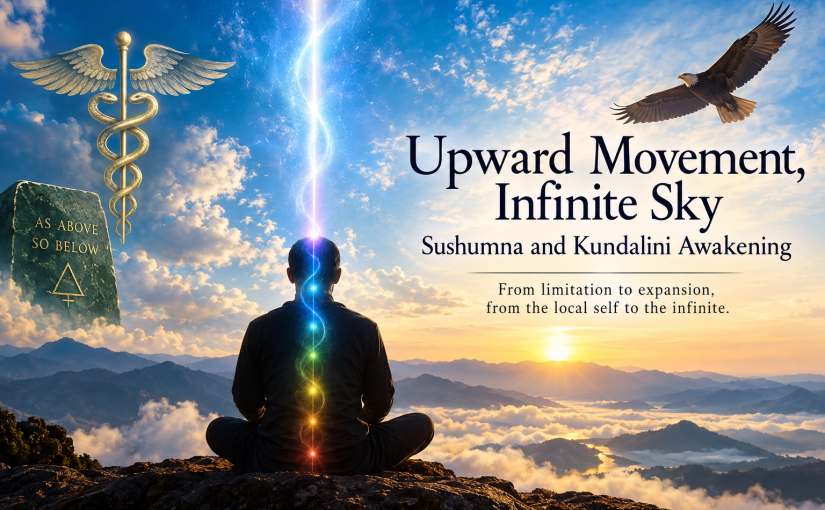
Another scene showed Baba standing in water and remaining in samadhi for an extended period. My own feeling while watching it was that the cold water could symbolically represent a powerful stimulus to the body, with the resulting inward movement being portrayed through yogic language as energy rising from Muladhara through Sushumna. In the traditional Kundalini understanding, the awakening and upward movement of Shakti is associated with the transformation of consciousness and deeper states of meditation.

Of course, this should be understood as a yogic interpretation rather than as an established physiological explanation. Cold water produces strong bodily and autonomic responses, whereas science has not demonstrated that such responses are literally Kundalini moving through Sushumna. Still, as a symbolic reading of the scene, the connection is meaningful: the body is exposed to an intense experience while awareness appears to become increasingly inward and absorbed.

The Prison Lock as Liberation From Limited Identification

The events that appear miraculous in Baba’s life can similarly be understood as symbolic. When the prison lock opens by itself and Baba wanders outside, I see something more than simply a miraculous opening of a physical lock. The prison can represent the limited identification of consciousness with the body, personality and circumstances. The opening of the lock can therefore symbolize the breaking of that limitation.

Baba walking out of the prison becomes an image of consciousness moving beyond confinement into something much vaster. If this is connected with samadhi, the symbolism becomes even deeper: the body may remain in the world, but awareness is no longer experienced as confined to the ordinary boundaries of individual identity. The movement is from prison, to locked identity, to the opening of the lock, to freedom and finally to the vastness of existence.

The Serpents Around Baba and Awakened Kundalini Shakti

I also remembered the account in which a devotee saw Neem Karoli Baba covered with hooded snakes while he was in samadhi. To me, this too can be understood as a powerful representation of awakened Kundalini Shakti. The serpent is one of the oldest symbols associated with Kundalini in Indian yoga. Therefore, seeing serpents surrounding a yogi absorbed in samadhi can naturally be interpreted as the devotee perceiving the immense Shakti associated with his spiritual state.

We cannot know from such an account whether actual snakes were physically present, whether the devotee experienced a visionary perception, or whether the experience was influenced by familiar spiritual symbolism. But the symbolic meaning remains striking: serpent, Kundalini Shakti, awakening, ascent of consciousness and samadhi all come together in a single image.

The Train That Would Not Move and the Power of Guilt

Another event has an equally interesting psychological interpretation. Baba was pushed out of a train, but afterward the train would not start. This can be seen symbolically as the train of life itself stopping after an innocent person has been wronged. The person may have thought that he had simply removed an unwanted passenger, but suddenly the entire movement of the train comes to a halt.

It resembles the way guilt can stop the inner movement of a person. An innocent person is hurt, conscience becomes disturbed, guilt arises, and the normal momentum of life is interrupted until there is recognition and remorse. In this sense, what we reject or hurt outwardly can become an obstruction within ourselves. The story is therefore not merely about punishment; it can also represent the power of innocence, compassion and spiritual presence to interrupt the unconscious momentum of the ego.

Miracles, Telepathy and the Traditional Yogic View of Siddhis

There may also be other events in Baba’s life that appear telepathic or clairvoyant. I do not think we should automatically dismiss such accounts. In the traditional yogic framework, extraordinary perceptions and abilities, called siddhis, are described as possibilities arising from profound concentration and samadhi. Patanjali’s Yoga Sutras, particularly the Vibhuti Pada, discusses such capacities.

At the same time, not being disproved is not the same as being scientifically established. Modern science has not established telepathy, teleportation or clairvoyance as reliable supernatural abilities, and individual stories can have different explanations. So I would leave the question open rather than making an absolute claim. A spiritual account may be interpreted literally by a devotee, symbolically by a contemplative, psychologically by a modern reader, or perhaps, in some cases, as an extraordinary phenomenon that we do not yet understand.

The important point in yoga is also that siddhis are not themselves liberation. Even when such abilities arise, attachment to them can become another distraction from samadhi and realization. The purpose of spiritual practice remains freedom, not the acquisition of extraordinary powers.

The Child Who Wanted to Reach God

Perhaps the most touching part for me is the story of how Baba’s spiritual search was inspired in childhood. When people told him that his deceased mother had gone to God, he apparently took the statement with the directness of a child. If his mother had gone to God, then he too wanted to go there. This desire became strong enough that he eventually left home in search of yoga and the means of reaching that state.

There is something profound in this simplicity. He did not begin with complicated theories about chakras, Kundalini or enlightenment. He began with longing: if there is a place called God, I want to reach it. From that simple question came the search for yoga, renunciation, spiritual practice and eventually samadhi. It reminds me that the deepest spiritual journey may begin not with philosophy but with an intense longing to know what lies beyond ordinary existence. I still remember my childhood, when my family tried to console me after my elder sister was gone, telling me that she had gone to God. As a child, I accepted those words with a simple heart, imagining that she had only gone somewhere beyond my reach.

The Essence of Tantra in a Few Words

Another thing that struck me was the simplicity of the instruction given to the child Baba by his guru: to leave dhyana at the Ajna chakra and place it at the Muladhara chakra. The deeper implication is that this can establish strong dhyana at the Ajna chakra by itself, without continuously forcing attention there. To me, this is perhaps one of the most basic and complete essences of Tantra expressed in an extraordinarily few words. The teaching does not need a long philosophical explanation; a simple direction contains an entire method, which the practitioner can discover through practice. Teaching Tantra in such simple and little words is itself amazing.

The Psychology of the Bahelia Scene

One scene is particularly profound from a psychological and spiritual point of view. A Bahelia, meaning a bird-catcher or fowler, is shown catching birds and imprisoning them. When Baba asks him why he does this, the Bahelia gives a surprisingly philosophical answer. He says, in effect, that just as nature has imprisoned human beings and entangled them in troubles, he is simply doing the same to the birds. It also helps him earn bread and butter for his children.

This is remarkable because the Bahelia does not even believe in God. Yet, at some deeper level, he feels that something is trapping human beings and making them suffer. Since he sees himself as a victim of this mysterious force, he feels justified in reproducing the same pattern with the birds—imprisoning them because he himself feels imprisoned.

Baba then completely changes his perspective. Instead of allowing him to blame God or nature for his suffering, Baba points him toward his own actions. Baba asks him why he had beaten his wife when she was pregnant. The implication is profound: it is not God or nature that is arbitrarily entangling a person; one’s own actions can become the very cause of one’s bondage and suffering.

The Bahelia had been looking outward for the cause of his troubles. Baba makes him look inward. What he experienced as an external force imprisoning him could actually be the consequence of his own actions. Thus, the scene transforms the idea of “I am being imprisoned by nature” into “I may be bound by what I myself have done.”

The psychological transformation that follows is equally beautiful. When Baba reveals details of the Bahelia’s past that he could not ordinarily have known, his disbelief begins to break down. He develops faith in Baba and eventually becomes one of his principal devotees.

The scene therefore works on a very subtle psychological level. Baba does not simply tell the Bahelia to believe in God. He first breaks his habit of projecting the cause of his suffering onto the outside world and brings his attention back to his own life and actions. That inward turning becomes the beginning of his transformation.

The symbolism is especially powerful: the bird-catcher himself feels caught. He imprisons birds because he feels imprisoned by life. Baba shows him that the real trap may not be nature at all—it may be the bondage created by one’s own actions.Seeing the

The Symbolism of the Germinating Seeds

Another beautiful incident occurs when Baba’s wife becomes annoyed by his long periods away from home, absorbed in deep dhyana and samadhi, and by his apparent lack of attention to family life. She asks him what he actually gains from spending so much time in meditation and samadhi.

Baba does not answer her verbally. Instead, he extends his tongue, places a few grains of seeds on it, and, within moments, they germinate and grow into tiny seedlings or plants. His answer is symbolic rather than literal: this is what he gains through such intense spiritual practice—extraordinarily rapid spiritual development.

The symbolism is simple yet profound. Under ordinary conditions, a seed takes time to germinate, grow, and eventually become a plant. In the same way, an ordinary human life may involve a gradual process of inner development through experience, relationships, worldly responsibilities, and spiritual practice. But Baba’s life of exceptionally intense meditation and samadhi is portrayed as accelerating that process dramatically—as though a seed that normally takes a long time to become a plant could mature in moments.

Thus, without explaining anything in words, Baba gives his wife a visual answer: the time spent in deep meditation is not simply time taken away from life; for him, it is a means of accelerating the growth of consciousness.

Miracles as a Language of Inner Experience

After watching Hanuman Ansh, I therefore feel that the miraculous stories surrounding Baba can be approached on several levels at once. The chana-puri scene expresses the bodily movement from hunger to satiety; the cold water and samadhi can suggest the inward movement of energy; the opening prison can symbolize liberation from limited identification; the serpents can represent awakened Kundalini Shakti; the stopped train can represent conscience and guilt interrupting the momentum of life; and the accounts of telepathic or clairvoyant perception can be considered in the context of the traditional yogic descriptions of siddhis, while leaving their literal interpretation open.

For me, this makes the story more meaningful rather than less miraculous. What appears outwardly as a miracle may also be a language through which an inner spiritual event is being communicated. The physical story, the devotional interpretation, the symbolic meaning, the psychology of consciousness and the possibility of extraordinary yogic experience do not necessarily have to cancel one another. They can exist together, allowing us to watch the life of a yogi not merely as a collection of miraculous incidents, but as a possible symbolic map of the movement from bodily limitation toward freedom, expanded awareness and the divine.

Black Hole and the Human Self: Imprints, Detachment, Yoga and Liberation

The idea began with a simple question about black holes: is there any evidence that a black hole disappears more quickly than expected? The answer is that there is still no direct observational proof that an ordinary astrophysical black hole is actually evaporating and dying through Hawking radiation. Hawking evaporation is a theoretical prediction, not yet a practically demonstrated fact for real astronomical black holes. Small black holes are theoretically expected to evaporate much faster as they become smaller and hotter, while large black holes should lose mass so slowly that their lifetimes are enormously longer than the present age of the universe. This distinction between theoretical prediction and practical proof became important for my own intuition. I feel that a black hole should also ultimately die rather than remain forever. Yet I do not mean only the physical black hole. I began to see the black hole as a possible metaphor for something much closer to human existence: the self.

The Human Self as a Structure of Imprints

My intuition is that the human self is not necessarily an independent physical substance. It can be understood as a structure formed from worldly experience, memory, identification, conditioning and repeated psychological impressions. In this sense, the self is built from what it has experienced and retained. It imitates the experienced world through accumulated imprints. The more deeply these experiences are identified with and stored, the more stable and substantial the self appears to become. When the self is strongly imprinted by the gross physical world, the black hole becomes an interesting symbolic comparison: both can be imagined as structures that accumulate and concentrate what enters them. I do not mean that a physical black hole is literally a human self or that modern physics has established a connection between black holes and consciousness. The comparison is philosophical rather than scientific. What interests me is the similarity between accumulation and dissolution.

Imprint Formation and Imprint Dissolution

The self can then be viewed through two opposing processes: the formation of new imprints and the dissolution of previous ones. If imprint formation is greater than imprint dissolution, the accumulated structure of self remains stable or becomes stronger. If both processes are roughly equal, the self remains comparatively stable without major transformation. But when imprint dissolution exceeds imprint formation, the accumulated structure gradually becomes lighter and weaker. This gives a simple way of understanding the movement toward liberation. Liberation, in this framework, is not merely having fewer experiences. It is the reduction of the total accumulation of psychological impressions.

This distinction is important because preventing new impressions and dissolving old impressions are not the same thing. A person may isolate themselves from the world and thereby reduce new imprint formation. Fewer worldly contacts mean fewer opportunities for fresh conditioning. But if previously accumulated impressions are not being dissolved, those old impressions simply remain. Isolation may produce quietness, but quietness by itself is not necessarily liberation. When the person returns to ordinary life, old conditioning may still reactivate. The storehouse has not disappeared merely because nothing new has been added to it.

Detachment as Prevention of New Imprints

There is another way to prevent new imprint formation: remaining in the world while becoming detached from identification. Instead of withdrawing from experience, one continues to live, work, relate and encounter pleasure and pain, but does not allow every experience to become another layer of psychological identity. Pleasure need not become an insistence that it must be repeated. Insult need not become a permanent story of “I was insulted.” Success need not become a definition of “who I am.” Experience can arise and pass without being appropriated. In this sense, isolation reduces the input, whereas detachment reduces the imprinting mechanism itself. The world continues to provide experience, but experience increasingly fails to become new conditioning.

This seems more radical because the world itself becomes the field of practice. One does not need to escape life in order to prevent new imprints; one learns to experience without accumulating identity. Eventually, even deliberate detachment may become unnecessary if witnessing becomes sufficiently established. Experience can simply arise, be known and pass without leaving a strong psychological residue.

Yoga, Samadhi and the Dissolution of Old Imprints

Yet even perfect detachment would not by itself complete the process. If no new impressions are formed while old ones remain untouched, the old structure persists. Therefore something more is required: the dissolution of previously accumulated imprints. This is where practices such as yoga, deep meditation, witnessing and samadhi become important within this model. Existing conditioning is brought into awareness without identification, and through repeated non-attachment its psychological force can gradually diminish. Thus there are really two complementary movements: detachment prevents the creation of new conditioning, while deep yogic practice dissolves conditioning that has already accumulated.

The relationship can be expressed very simply. If imprint formation is greater than dissolution, the self becomes more conditioned. If formation and dissolution balance each other, the self remains relatively stable. If dissolution becomes greater than formation, the total conditioning steadily decreases. The ideal direction is therefore not merely to stop adding new impressions but to allow the old ones to disappear as well. Liberation requires both processes working together: less new imprinting and greater dissolution of existing imprints.

The Self as a Black-Hole Analogy

This is where the black-hole analogy becomes meaningful for me. A black hole can gain mass when matter and energy enter it. It can theoretically lose mass through Hawking radiation. If the inflow is greater than the outflow, the black hole grows. If the outflow eventually becomes greater than the inflow, its mass decreases and it moves toward evaporation. The same pattern can be used metaphorically for the self. New experience identified with becomes new psychological imprint, just as incoming matter adds to a black hole. Witnessing, detachment and deep yogic dissolution act like the opposite movement. If new imprint formation is greater than dissolution, the self grows in psychological density. If dissolution exceeds new imprint formation, the accumulated self becomes progressively lighter.

This also clarifies why simply avoiding the world is insufficient. If matter stops entering a black hole but nothing causes its existing mass to leave, the black hole does not disappear merely because inflow has stopped. Likewise, if new impressions are prevented but old impressions are never dissolved, the self remains. Existing conditioning has to be released. Therefore preventing imprint formation and dissolving previous imprints are not competing methods but complementary necessities within this model.

From Conditioned Self to Unimprinted Awareness

The final possibility is what I would call the unimprinted self. As new imprint formation approaches zero and the existing accumulation continues to dissolve, the self becomes progressively less conditioned. The world may still be experienced, but experiences no longer become deeply embedded as identity. The process can therefore be understood as a gradual movement from a heavily conditioned self toward an increasingly pure and unimprinted state.

There is, however, a deeper question at the end of this process. If all accumulated identification finally dissolves, is what remains really a purified self, or is it awareness without the separate structure that previously called itself “me”? Perhaps the stages are better understood as conditioned self, purified self, and finally the disappearance of the separate self-structure. In that sense, the death of the self is not necessarily the destruction of consciousness. It may mean the dissolution of the structure that had identified consciousness with a personal accumulation of experience.

This gives a simple definition of liberation: not freedom from the world itself, but freedom from the world continually becoming psychological imprint and from those imprints continually becoming self. Experience can continue, but it no longer has to become identity. New accumulation declines while old accumulation dissolves. The self becomes less dense, less reactive and less dependent on what it has stored. Like the black hole in the metaphor, what matters is not merely that something stops entering, but that what has already accumulated is progressively released. In this sense, liberation is the point at which dissolution consistently exceeds accumulation, until the constructed, imprinted self approaches its own disappearance.

Smaller Imprints, Faster Liberation: Why Meditation in Childhood May Matter

There is an interesting parallel between black-hole evaporation and the gradual dissolution of psychological imprints through meditation. A smaller black hole is theoretically expected to evaporate faster as its mass decreases, because its temperature rises and its rate of mass loss increases. In a similar way, it may be possible to think of a meditator as progressing faster toward liberation once the accumulated structure of worldly imprint has already become smaller. This is a philosophical analogy, not an established scientific equivalence, but the parallel is striking.
It may also help explain why meditation is traditionally encouraged from childhood. A child has had less time to accumulate deep worldly conditioning and identification. If meditation, spiritual companionship and a supportive environment begin early, the formation of new impressions may be reduced while existing impressions are comparatively few. In that sense, the inner “mass” that has to be dissolved is smaller from the beginning.
My own experience gives me a personal example of this possibility. Meditation began in my childhood through close association with a spiritual guru and through the environment at home. This early foundation continued to influence me and was followed by an awakening experience during adolescence. Yet complete dissolution did not occur at that stage. The needs and attractions of worldly life continued to create new impressions and prevented the process from reaching its full conclusion.
Traditional accounts sometimes describe exceptionally early liberation. Shukadeva, for example, is portrayed in Indian spiritual tradition as being liberated while still very young. Whether such accounts are taken historically, spiritually or symbolically, they fit naturally into the idea that a person who begins with fewer accumulated worldly impressions may reach deep realization more quickly.
There may also be another important similarity. In black-hole physics, the evaporation rate becomes greater as the black hole becomes smaller. In meditation, once a practitioner has become sufficiently familiar with meditation and a significant portion of accumulated conditioning has already dissolved, progress may also become easier and faster. Earlier experiences of inner clarity can strengthen confidence, reduce fear of the unknown and make deeper meditation more natural. The meditator no longer approaches the process as something completely unfamiliar; familiarity itself becomes a support for further dissolution.
Thus the process may have an accelerating character: less accumulated imprint → easier meditation → greater dissolution → greater confidence → deeper meditation → still less imprint. In this sense, childhood meditation may provide an especially favorable beginning because the psychological structure that has to be dissolved is still comparatively small. The analogy with an evaporating black hole therefore suggests an interesting possibility: as the accumulated imprint becomes smaller, the movement toward complete freedom may itself become progressively faster.

Shiva, Shakti and the Cyclic Universe: A Personal Intuition About Branes, Conception and Cosmic Rebirth

From Two Hands to Two Cosmic Branes

I began to understand the idea of a cyclic universe through a very simple image: two hands slowly moving toward each other in position of cosmic prayer, touching, separating, and then coming together again. In some versions of string-inspired cosmology, our universe can be pictured as a three-dimensional brane, or membrane, existing within a higher-dimensional space. Another brane may exist alongside it, and the two can move relative to one another. Instead of imagining the Big Bang simply as an explosion of matter from one point into already existing space, this picture allows us to imagine the changing relationship between the branes themselves as part of the cosmic story. When the two branes separate, the universe can pass through an immense phase of expansion. When they eventually come back together, their collision can produce a new hot, dense beginning, creating a Big Bang-like state. The whole process can then repeat again and again.

The Cosmic Clap: Collision and a New Big Bang

The most striking image is the final clap. After the branes have drifted apart to their maximum distance and the universe has expanded enormously, they begin moving toward each other. Their meeting represents a catastrophic collision, or bounce. In the simplified picture, the old universe is not preserved in its familiar form. Galaxies, stars, planets and other large-scale structures do not simply pass intact into the next cycle. Instead, the previous organized universe is replaced by an extremely hot and energetic state, a kind of plasma inferno in which the familiar structures of the old cosmos have disappeared. From that hot state, the universe can expand and begin forming structure again. Thus the Big Bang is no longer necessarily imagined as the unique beginning of everything. It can be one phase of an endless sequence: separation, expansion, convergence, collision, hot rebirth, and expansion once more. That is the basic appeal of the cyclic or ekpyrotic picture, although it remains a speculative cosmological model rather than an established description of our universe. The “cosmic applause” is simply the repeated meeting of the branes: clap, rebirth, separation, and another clap.

My Shiva-Shakti Intuition

What made this picture especially meaningful to me was that I could see it through an entirely different symbolic language: the ancient idea of Shiva and Shakti. In scriptural traditions, creation is associated with the union of Shiva and Shakti. Shiva can be understood as the still, enduring principle, while Shakti is the dynamic power through which manifestation takes place. I began to see the two branes not merely as two identical physical sheets, but as two complementary symbolic principles. The right and left hands became a simple image of this union. When the hands meet, conception occurs. When they separate, development begins.

This made me think of Shiva as the father principle and Shakti, the mother or goddess, as the creative womb. The union of the two is conception, and the newly conceived universe is then like something growing within a cosmic womb. The important point for me is that the universe does not have to appear fully formed at the moment of conception. After conception comes development. When the two branes separate, Shakti can symbolically be understood as carrying the developing universe, while Shiva remains associated with the essential principle, identity or recognition from which that manifestation arose. In this interpretation, separation is not the opposite of creation. Separation is what allows creation to unfold.

Shakti as the Developing Universe

This makes the female brane, in my symbolic reading, especially interesting. It is not simply another universe identical to the male brane. After the union, Shakti carries the manifested creation and allows it to develop. The universe grows within this cosmic womb, moving from an intensely energetic beginning toward increasing differentiation and complexity. What begins as a hot and chaotic state can eventually become particles, atoms, stars, galaxies, planets and perhaps life. Shiva, by contrast, represents the enduring essence or recognition behind the manifestation. In this picture, Shakti is the movement and development of creation, while Shiva is the principle that remains comparatively still.

This is only a symbolic interpretation; physics does not describe one brane as male and another as female, nor does it assign them the attributes of Shiva and Shakti. The physical model and the spiritual symbolism belong to different levels. What I find meaningful is the structural resemblance between the two pictures: union, creation, separation, development and return.

The Return of Shakti and the Death of the Universe

The idea becomes even more interesting when the universe reaches old age. After a vast period of development and expansion, the universe can be imagined as moving toward exhaustion. In my intuition, Shakti then begins to return toward Shiva. She does not return carrying the old universe as a fully functioning world. The recognizable universe is almost dead. Its galaxies, stars and other structures have lost their former organization, and what remains is increasingly reduced to underlying energetic potential. Yet this does not mean that everything has become meaningless residue. The remains of the old universe can be imagined as carrying the potential for another beginning.

This gives the reunion a different meaning. The approaching Shakti is like a cosmic mother returning to Shiva with the exhausted remains of their previous creation. The purpose is not to preserve the old universe in its previous form, but to allow its remaining essence, now concentrated in energetic form, to participate in another conception. The old universe therefore ends as a recognizable world but survives, in this symbolic picture, as potential. The new universe does not emerge as a completely unrelated event. Its birth is connected to the death and dissolution of the previous cycle.

Conception, Growth, Death and Rebirth

Seen this way, the entire cosmic process becomes almost like one continuous act of reproduction at the scale of the universe. Shiva and Shakti unite, conception occurs, and then they separate. Shakti carries and develops the universe. The universe expands, differentiates, lives through its vast history and eventually approaches death. Shakti then returns toward Shiva carrying the dying creation in a reduced energetic form. Their reunion becomes both dissolution and the preparation for another conception. The old manifestation disappears, but the creative process begins again.

The cycle can therefore be understood in a very simple sequence: union is conception, separation is gestation, expansion is life, aging is exhaustion, return is dissolution, and reunion is rebirth. Then the hands separate again, and the whole process begins once more.

Between Physics and Metaphor

I would not claim that this proves Shiva and Shakti are the physical explanation of brane cosmology, or that ancient scriptures scientifically predicted modern string theory. That would go beyond what either tradition can establish. The brane collision model is a speculative idea in theoretical physics, while the Shiva-Shakti framework is a spiritual and metaphysical language. My point is different. When I placed the two pictures beside each other, I found a striking pattern: two complementary principles come together, something is conceived, creation develops through separation, the manifested world eventually dissolves, and the remaining potential returns to the source for another beginning. My interpretation is closely aligned with the creation symbolism described in the scriptures, particularly the Shiva Purana, where Shiva and Shakti are understood as father and mother in relation to the origin and manifestation of the universe as a fetus growing in cosmic womb.

What began for me as a simple image of two hands coming together therefore became a much larger intuition about the universe. The cosmic clap is no longer merely a collision. Symbolically, it is conception through the death of the previous creation. The separation of the hands is not merely distance; it is the opening of the cosmic womb. And the return is not simply destruction. It is the movement of Shakti back toward Shiva with the almost dead universe, carrying whatever remains of its energetic potential toward a new union. In that sense, the universe becomes a repeating rhythm of union and separation, manifestation and dissolution, death and rebirth: an eternal cosmic cycle in which every ending is also the preparation for another beginning.

How Worship of Different Gods Can Purify Different Emotions and Prepare the Mind for Nondual Meditation and Kundalini Yoga

Happy Krishna Janmashtami Festival to All

Different Gods as Different Doors of Emotional Surrender

I have been looking at worship of gods and goddesses in a somewhat different way. I do not see all idols only as objects to whom one offers flowers, prayers and devotion. I also see them as different symbolic forms through which different kinds of emotions can be surrendered. The human shape, face and familiar stories of a deity make this easier for the mind. An emotion is otherwise invisible and difficult to hand over to something abstract, but when I stand before a recognizable divine form, I can consciously place a particular class of emotions, memories and experiences before that form. The idol therefore becomes a practical meeting point between my personal emotional life and a larger spiritual symbol.

My experience with Hanuman made this especially clear to me. I stood in front of Hanuman and surrendered all kinds of emotions and incidents connected with bravery. I did not surrender only the idea of courage. I surrendered the emotional burden associated with being brave, the memories of situations in which bravery had been expressed, and the feelings that had gathered around those experiences. After doing this I felt quite relieved and disburdened. This was important because it showed me that surrender does not necessarily mean destroying a quality. I was not trying to lose courage or become weak. I was trying to release my attachment to carrying all the psychological material connected with courage.

This idea then became broader. Hanuman can be one form for one class of emotional material, but other gods and goddesses can serve as suitable forms for other classes. In this way, worship need not be psychologically identical every time. The particular deity gives the mind a particular symbolic direction.

Lakshmi, Rama, Shiva and Vishnu as Different Emotional Purifiers

For me, Lakshmi can become a focus for purification of money-related emotions. Money carries many kinds of psychological material: greed, fear, insecurity, pride, attraction, competition, status-consciousness and anxiety about losing what one has. Instead of allowing all these feelings to remain mixed together inside the mind, I can bring them before Lakshmi and surrender them. The purpose is not to reject money or prosperity. It is to reduce the emotional burden and attachment surrounding them so that money can remain a practical part of life without becoming an excessive psychological identity.

Rama can similarly become a focus for emotions connected with superiority, righteousness and even sattvik identity. This is important because not every difficult emotion is obviously negative. A person can become proud of being good, pure, disciplined, spiritual or morally superior. Even sattvik qualities can therefore become material for ego. By surrendering these emotions before Rama, I can retain the quality of righteousness without carrying the feeling that I am superior because of it.

Shiva, in my framework, can become a focus for tamasic emotions and heavier inner tendencies. This includes dullness, darkness, destructive impulses, heaviness and other forms of emotional material that may be difficult to approach directly. Instead of constantly fighting such tendencies mentally, I can place them before Shiva as a symbolic act of surrender and purification.

Vishnu can represent another kind of emotional burden, especially that connected with hard work, preservation, responsibility and the effort required to continue one’s worldly duties. Work itself is not the problem, just as courage itself is not the problem. The burden may come from attachment to achievement, pressure, exhaustion, pride in one’s effort or the feeling that everything depends personally on me. Surrendering this material can allow work to continue while reducing the psychological weight carried with it.

Radha and Krishna, Kali, Brahma and Ganesha

Radha and Krishna can serve as a focus for love-related emotions. Love can be beautiful, but it can also become attachment, longing, possessiveness, jealousy, fear of separation, emotional dependence and repeated mental involvement with another person. By bringing these emotions before Radha and Krishna, the aim can be to purify the emotional intensity without rejecting love itself. Love may remain, but the clinging around love can become lighter.

Kali provides a particularly powerful symbolic form for emotions connected with danger, fear, threat and intense vulnerability. When the mind carries danger-related emotions, it can remain prepared for something bad even when no immediate danger exists. Bringing such emotions before Kali can create a strong symbolic act in which fear and the feeling of threat are consciously surrendered. The terrifying form itself can make this surrender psychologically meaningful because it does not require fear to be hidden or softened before approaching the symbol.

Brahma can become a focus for knowledge-related emotions. Knowledge is valuable, yet knowledge can also create pride, intellectual superiority, attachment to being right, the need to display understanding and an identity built around knowing. Surrendering knowledge-related emotions before Brahma does not mean rejecting knowledge. It means trying to separate knowledge from the ego that can grow around knowledge.

Ganesha can become useful for another category of emotions, including feelings connected with one’s appearance, obstacles, embarrassment, unfavorable self-image or the sense that one’s face or body has something wrong with it. A form that itself differs from ordinary human appearance can become a particularly meaningful symbol here. Instead of remaining ashamed of an appearance-related feeling or repeatedly fighting it, I can bring it into the presence of Ganesha and surrender the emotional burden attached to it.

There can naturally be many more such associations. The list does not have to end with the major deities. Different forms, stories and qualities can provide different symbolic containers for different emotional burdens. What matters is the relationship between the deity and the emotional material being surrendered.

Worship as Emotional Purification Rather Than Mere Ritual

In this understanding, idol worship becomes a practical method of emotional purification. Different gods do not necessarily have to be understood as mechanically removing different emotions from the mind. Rather, the traditional qualities and forms associated with them help the mind organize and surrender different kinds of psychological material. One form may naturally draw courage-related emotions, another wealth-related emotions, another love, another fear, another knowledge, another ego connected with virtue, another heaviness and so on.

The physical idol itself is only the outer support. The deeper process happens in the mind. I stand before the form, recognize what I have been carrying, consciously offer it, and allow myself not to hold it so tightly. The emotional burden may then become weaker. Repeated practice can make this process more familiar. The emotions do not necessarily vanish permanently, and there is no requirement that the mind become emotionless. What changes is the amount of unnecessary attachment, repetition and identification surrounding them.

This is why I find the word purification useful. A purified mind does not mean a blank mind or a mind incapable of strong feeling. It means a mind in which emotions can arise without every emotion becoming another object of possession, struggle or identity. Courage can remain courage without becoming a burden. Knowledge can remain knowledge without becoming superiority. Love can remain love without becoming excessive attachment. Money can remain useful without becoming the center of psychological security. Hard work can continue without carrying endless pressure. Spirituality itself can remain without creating the feeling of being better than others.

From Emotional Clearing to Nondual Contemplation

Once emotional burdens have been eased, I can see how the mind may become more suitable for meditation. A mind constantly occupied by unresolved memories, fears, pride, attachment, achievement and personal stories has less attention available for subtle contemplation. When some of this material is surrendered, the mind can feel quieter and less crowded.

This gives a natural place to the nondual practices that I follow, including what I call sharirvig darshan and quantum darshan. These forms of contemplation require a different quality of attention from ordinary emotional thinking. The less the mind is pulled around by personal emotional material, the easier it may become to stay with a subtle idea, observation or contemplative image. In this sense, devotional worship and nondual meditation do not have to be competing paths. Worship can prepare the emotional ground on which deeper contemplation becomes easier.

The idol also has another role here. The physical form provides a stable image for the mind. By repeatedly looking at the face, posture and overall form of the deity, the image may gradually become established inwardly. With concentration, the physical idol is no longer the only place in which the form exists for the practitioner. The image can become increasingly available in meditation. Emotional surrender may make this easier because a less burdened mind is less easily distracted.

Thus there can be a practical progression: emotion is recognized, emotion is surrendered, emotional burden becomes lighter, the mind becomes cleaner, attention becomes steadier, the meditation image becomes stronger, and deeper contemplation becomes possible.

How This May Support Kundalini Yoga

I therefore see worship of gods and goddesses as potentially supportive of Kundalini yoga. I do not mean that worship automatically raises Kundalini or that a particular idol mechanically produces a particular energetic effect. The connection is more practical and experiential. Kundalini-oriented meditation requires sustained attention, inner stability and the ability to remain with subtle bodily and mental experiences. Emotional turbulence can make this difficult. Emotional purification may therefore help prepare the mind for the practice.

When different emotional burdens are consciously surrendered through different divine forms, the mind may become less entangled in its own history. This does not mean abandoning ordinary life. In fact, the qualities represented by the deities can remain fully available. Hanuman can represent courage, Vishnu work and preservation, Lakshmi prosperity, Rama righteous conduct, Shiva the transformation of heavy tendencies, Radha and Krishna love, Kali confrontation with danger, Brahma knowledge and Ganesha the overcoming of obstacles and difficult self-image. The goal is not to get rid of these qualities but to reduce the emotional ownership and burden associated with them.

This also connects with ego. A positive quality can become a source of bondage when it turns into identity. “I am brave,” “I am knowledgeable,” “I am spiritual,” “I am righteous,” “I am successful,” or “I am the one who works hardest” can all become heavy identities. Surrender allows the quality to remain while softening the claim of ownership around it. The person can still be brave when bravery is needed, work when work is needed, love when love is present and use knowledge when knowledge is useful, without constantly carrying the psychological demand to prove that identity.

The Spiritual Symbol and the Quantum Idea

I also connect this understanding with the physical nature of idols. An idol is made of matter, just as the human body and the rest of the physical world are made of matter. From a philosophical point of view, this can be contemplated as part of a common physical reality. I sometimes use the language of quantum particles to think about this deeper commonality. The human form of the deity then becomes a practical appearance through which consciousness relates to something that, in a deeper philosophical view, is not fundamentally separate from the rest of existence.

At the same time, I find it important to distinguish my contemplative interpretation from a scientific claim. It is reasonable to say that physical idols consist of ordinary matter and ultimately of physical constituents described by physics. It is not an established scientific fact that particular gods or specific emotions are literally particular quantum particles. The quantum language can therefore be kept as a philosophical or meditative way of understanding unity and interconnectedness rather than presented as proof of a specific religious interpretation.

This distinction does not reduce the value of the experience. The practical effect can still be meaningful. A symbol can change the way the mind relates to an emotion without requiring a scientific theory to validate every aspect of the symbol. The relief I experienced before Hanuman is a direct example. I surrendered my bravery-related emotions and incidents and felt lighter afterward. That experience itself is the foundation of my understanding.

However, as per Quantum Darshan every emotion resides in quantum particle. It is other thing they are not aware of them, leave alone attachement to these. That is why ancient saying god resides in every particle. They even not knowing quantum science knew its spiritual essence it seems. So it is like technique to become detached with all emotions by surrendering them to quantum particles. Different outer forms like different masks applied to them.

All emotions are basically in nature and we have only learnt these from there. Idol worship is like returning that all emotional burden back to nature that have been obtained from it.

Many Divine Forms, One Movement Toward Inner Freedom

Seen as a whole, my understanding of god worship is therefore not about choosing one deity as the only correct emotional purifier. Different forms can provide different doors into the same larger process. Lakshmi can help me examine money-related attachment. Rama can help me soften superiority and even pride in sattvik qualities. Shiva can help me surrender heavy and tamasic tendencies. Vishnu can receive the burdens attached to work and responsibility. Radha and Krishna can receive love-related attachment. Kali can receive fear and danger-related emotions. Brahma can receive knowledge-related pride. Ganesha can receive emotions connected with obstacles and unfavorable self-image. Hanuman can receive bravery-related experiences and the burden of identifying too strongly with courage. Many other deity forms can naturally occupy similar roles according to their qualities and according to the particular emotional material of the practitioner.

The deeper movement is the same: what has been psychologically carried as “mine” can be consciously surrendered. When this is repeated, the mind may become cleaner and less burdened. A cleaner mind may contemplate nonduality more easily. A steadier mind may develop meditation imagery more strongly. Deeper meditation may then provide a better foundation for Kundalini-oriented practice.

For me, this makes idol worship far more than an external religious activity. It can become a practical psychology of surrender. The idol gives a face to the abstract, the deity gives a symbolic direction to the emotion, surrender reduces the burden of personal ownership, and the resulting lightness can prepare the mind for deeper contemplation. I do not have to destroy my emotions, nor do I have to destroy the qualities associated with them. I can allow courage, love, knowledge, work, prosperity, righteousness and strength to remain while surrendering the unnecessary psychological weight around them.

My experience before Hanuman gave me the clearest starting point for this understanding. I stood before the image, gave away the emotions and incidents connected with bravery, and felt relief and disburdenment. From there I began to see a larger possibility: perhaps every divine form can become a doorway for surrendering a different emotional burden. Through many such doors, the mind can gradually become lighter. And when the mind becomes lighter, it may become more capable of the stillness, imagery, nondual contemplation and subtle awareness through which my meditation and Kundalini practice can continue to deepen.

Kundalini, Tantra and Alchemy: The Hidden Parallel Between the Emerald Tablet and the Birth of Kartikeya

The Common Pattern of Alchemy, Tantra and Kundalini

A striking correspondence appears when the symbolism of the Emerald Tablet, tantric ideas of kundalini, and the traditional narratives of Kartikeya’s birth are examined together. This does not mean that the Emerald Tablet is literally a tantric text, that Kartikeya’s story was deliberately written as a chakra diagram, or that the two traditions necessarily influenced one another. Their histories are distinct. The important observation is structural: each can be read as describing a concentrated generative potential that is produced through complementary principles, carried by an intermediary force, progressively nourished or refined, and ultimately transformed into a higher or perfected state.

The Emerald Tablet is a short Hermetic text rather than a complete description of the whole alchemical process. Its central teaching begins with a unified principle, the “One Thing,” from which multiplicity arises. It describes the Sun as Father and the Moon as Mother, followed by the statement that the wind carries the generated principle in its womb and that the Earth nourishes it. The text then speaks of separating the subtle from the gross, ascending from earth toward heaven and bringing the powers of above and below together. Later alchemical traditions developed such imagery into the Magnum Opus, the great work of purification, separation, transformation and reunion, culminating symbolically in perfected matter, the Philosopher’s Stone and the transmutation of base metal into gold.

The phrase concerning the wind is especially important. The wind is not presented merely as something that transports an object; it carries the principle “in its womb.” The imagery therefore combines movement with containment and gestation. In a comparative yogic reading, this is reminiscent of prāṇa or vāyu: not simply physical air, but the vital movement associated with breath and subtle activity. The parallel should not be turned into the claim that the author of the Emerald Tablet was describing Indian prāṇāyāma. The historical evidence does not establish that. The meaningful comparison is functional: an already generated potential requires a medium through which it can be carried, developed and transformed. Similarly, earth symbolizes the Muladhara Chakra because it provides the constant foundation and nourishment necessary for its growth and ascent. Earth, or grounding, is also symbolically associated with the Muladhara in Tantra. This does not mean that the earth described in the Emerald Tablet refers specifically to the Muladhara Chakra; rather, the symbolic parallel between the two is clear.

The Tantric Parallel

Tantric and yogic traditions provide a different vocabulary for a similar transformational pattern. Kundalini is traditionally described as a latent power that can be awakened and directed through the subtle body, particularly through Suṣumṇā, the central channel. The chakra systems vary between traditions, and the familiar seven-chakra model is not universal across all historical yoga, but the later widely known model presents successive centers from the base of the subtle axis toward the crown. Within this framework, the process is not simply transportation from one point to another. Each stage can be understood as a transformation of the original potential.

This is why the correspondence becomes more precise when the chakras are regarded as stages of refinement rather than as seven physical containers. The generative potential associated symbolically with the lower center is progressively transformed as it passes through successive levels. Prāṇa provides the mediating movement, while Suṣumṇā represents the central route of ascent. The culmination is associated with the highest state of consciousness, traditionally symbolized by Sahasrāra. This should not be confused with a claim that chakras or Suṣumṇā are physical anatomical structures. They belong to a traditional subtle-body model and can be studied scientifically as a phenomenological and contemplative system without being presented as established anatomy.

The role of breathing must likewise be stated precisely. Yogic breathing practices regulate breath and prāṇic activity, but kundalini awakening is not traditionally reduced to mechanically pushing an energy upward by respiration alone. Different traditions combine breath regulation with concentration, meditation, purification, bodily locks and other practices. Thus the useful analogy with the Emerald Tablet is not “air physically carries semen through seven organs,” but rather that a concentrated potential is mediated and transformed through a regulated vital process.

The Birth of Kartikeya

The Kartikeya birth narratives provide a striking mythological parallel. There is no single uniform version: the Rāmāyaṇa, Mahābhārata and Purāṇic traditions arrange the roles of Śiva, Agni, Gaṅgā, the Kṛttikās, Svāhā and the reeds differently. Yet several versions share the central idea that an extraordinary generative power associated with Śiva cannot proceed through ordinary reproduction. It must be transferred, contained, carried and developed through several intermediary stages before Kartikeya is born.

The seven Kṛttikās are traditionally maternal figures who nourish Kartikeya and are associated with the Pleiades. The identification of these seven mothers with the seven chakras is not an explicit statement of the ancient myth and should therefore be treated as an esoteric interpretation, not a historical fact. Nevertheless, the symbolic correspondence is unusually coherent. If the seven Kṛttikās are interpreted as seven successive centers or stages, their nursing represents the nourishment and maturation of an already generated potential. The original essence is not merely transported unchanged; it is developed through successive levels until it can manifest in a new form.

This gives the Kṛttikās a particularly interesting symbolic relation to the chakras. The chakras, in this interpretation, are not merely passages. They are stages of gestation and refinement. What begins as a concentrated generative potential at the lower level is progressively transformed into increasingly subtle expression. The “nursing” of the seven mothers therefore becomes a mythic image of progressive development.

Himalaya, Gaṅgā and Suṣumṇā

The later stages of the Kartikeya narrative can also be read through a yogic symbolic framework. The Himalaya may be interpreted as an image of the great spinal axis, the mountain being the archetypal vertical structure of Indian sacred geography. Gaṅgā, which carries the developing essence in relevant versions of the story, can then be compared symbolically with Suṣumṇā, the central current of the subtle body. The comparison is not that the myth literally defines Gaṅgā as Suṣumṇā; it is that both function within their respective symbolic systems as a central route through which something transformative is carried.

The reeds at the final stage can similarly be read as an image of the place of culmination, corresponding symbolically to the highest region of the subtle ascent and, in a later tantric vocabulary, to Sahasrāra. Again, the reeds do not historically have to mean Sahasrāra for the comparison to be meaningful. The sequence itself is what matters: origin, transmission, sevenfold nourishment, central passage, culmination and birth.

Kartikeya’s birth can consequently be interpreted as the birth of an awakened principle. The significance is not ordinary biological reproduction but transformation: a powerful potential that begins in an unmanifest or unstable state passes through containment, nourishment and refinement until it emerges as a qualitatively different being. This is closely analogous to the alchemical movement from crude matter toward gold.

The Meaning of the Generative Essence

The sexual terminology in these traditions should therefore be understood primarily as symbolic language for concentrated generative potential. Where Kartikeya traditions speak of Śiva’s semen or reproductive essence, it is unnecessary—and scientifically unjustified—to claim that physical semen literally travels upward through the spine and becomes kundalini. The stronger interpretation is that reproductive substance represents concentrated creative potential: something capable of generating new life and therefore an effective symbol for energy that is retained, transformed and redirected toward another form of manifestation.

The same principle helps clarify the Father and Mother of the Emerald Tablet. They need not signify ordinary biological parents. They can represent complementary principles, such as active and receptive, conscious and transformative, or solar and lunar aspects. Their conjunction generates the potential; the wind carries it; the Earth nourishes it; and the process of separation (from worldly lust) and refinement (with help of meditation image constantly in mind) brings it toward perfection.

Thus the central subject is not sexual activity but generation, retention, mediation, refinement and rebirth.

The Alchemical and Yogic Meaning of Transmutation

This also explains why the alchemical transformation of base metal into gold is such a powerful parallel. Taken literally, historical alchemy sought material transformation and the Philosopher’s Stone. Taken symbolically, the same language describes the movement from the crude to the perfected, the impure to the purified, and the divided to the unified. Gold becomes an image of completion and incorruptibility.

In the tantric interpretation, the corresponding transformation is from an unawakened or conditioned human state into awakened consciousness. In the Kartikeya myth, an extraordinary generative power passes through a process of transmission and nourishment before becoming Kartikeya. In alchemy, the raw material becomes gold. The outward symbols differ, but the underlying narrative is similar: potential is not merely released; it is transformed.

This distinction is important. Kundalini should not simply be equated with semen, the Philosopher’s Stone should not simply be equated with Sahasrāra, and Kartikeya should not simply be equated with awakened consciousness, and Kritika not to be equated with an anatomically located chakra. The deeper correspondence is between processes rather than objects.

The Most Precise Comparative Model

The three systems can therefore be placed beside one another in a single sequence. In the Emerald Tablet, the One expresses itself through complementary Father and Mother principles; a generative essence arises; the wind carries it in its womb; the Earth nourishes it; the subtle is separated from the gross; ascent and descent bring higher and lower powers together; and perfection is achieved. In the tantric model, latent potential is awakened; prāṇa mediates its movement; successive chakras refine it; Suṣumṇā provides the central route; and the culmination is awakening. In the Kartikeya narratives, Śiva’s extraordinary generative power is transferred, contained, nourished through the Kṛttikās in relevant versions, associated with the mountain and Gaṅgā, and finally manifested as Kartikeya.

The common structure can therefore be expressed without forcing one tradition into another: unity or concentrated potential → complementary principles → generation → carrying medium → nourishment and progressive refinement → central ascent or transformation → culmination → emergence of a perfected state.

This is stronger than the simple assertion that “alchemy is Tantra” because it does not depend on proving an uncertain historical connection. It identifies a functional similarity in the way different traditions represent transformation.

A Scientific Boundary

A scientifically responsible interpretation must also distinguish experience from physical mechanism. Modern research can investigate breathing, meditation, attention, autonomic regulation, sensory changes, altered states of consciousness and the subjective experiences practitioners associate with kundalini. It cannot presently establish chakras as physical organs, Suṣumṇā as an anatomical channel, or the literal conversion of semen into an independently measurable substance called kundalini. The traditional subtle-body system is therefore best treated as a religious, contemplative and phenomenological model unless specific claims acquire independent empirical evidence.

That limitation does not make the model meaningless. A disciplined spiritual tradition can contain repeatable practices, defined procedures, recognizable stages and recurring experiences without being identical to modern physical science. What may legitimately be called experiential knowledge is knowledge obtained through structured practice and observation of experience. Whether such knowledge qualifies as “science” in the strict modern sense is a separate question requiring reproducibility, operational definitions and independent measurement.

The Full Meaning of the Parallel

The most compelling insight is therefore not that an ancient alchemist secretly knew the chakra system or that an Indian myth secretly describes modern physiology. It is that three very different symbolic traditions repeatedly use the same broad image of transformation. Something primordial or generative is concentrated; complementary principles participate in its formation; a medium carries it; successive stages nourish and refine it; the transformed potential moves toward a higher condition; and something new is born.

In the Emerald Tablet, the result is expressed through alchemical perfection and gold. In Tantra, it is expressed through the awakening and ascent of kundalini toward higher consciousness. In the Kartikeya narrative, it appears as the extraordinary birth of a divine being after a prolonged process of transmission, nourishment and maturation. The correspondence is therefore best understood neither as proof of identity nor as a coincidence to be dismissed, but as a meaningful comparative pattern: what is latent can be retained, carried, refined and transformed until it emerges as a higher state of being.

That is the deepest point at which the alchemical, tantric and Kartikeya narratives meet. Their languages differ, their histories differ, and their literal claims must remain distinct, but their central transformational imagination is remarkably close: the crude becoming refined, the latent becoming manifest, the divided becoming integrated, and the ordinary becoming awakened.

Kaliya Naag, Kundalini and Krishna: A Yogic Interpretation of the Poisoned Yamuna

There are some Puranic stories that appear simple in childhood, devotional in adulthood, and deeply psychological only after inner experience begins to unfold. The story of Kaliya Naag from the life of Krishna is one such mysterious episode. Traditionally it is narrated as the story of a poisonous serpent living in the Yamuna river whose venom made the waters deadly for humans and animals. But when viewed through the lens of Kundalini, yoga, consciousness, vasanas, and awakening, the entire story starts appearing like a coded map of inner transformation.

The story begins with Kaliya Naag living inside Kaliya Hrada, a deep pit-like region of the Yamuna river. The serpent constantly spit poison into the waters. People, cows, birds, and animals who drank the water either became unconscious or died. One day the ball of the gwalas or cowheards fell into the poisonous waters. Krishna jumped into the river to retrieve it. Kaliya attacked him violently. Krishna subdued the serpent by dancing upon its thousand heads and crushing them beneath his feet. The wives of Kaliya then prayed to Krishna for mercy. Krishna spared the serpent on one condition: Kaliya must leave Yamuna and go to Ramanaka Island, where it would no longer remain hidden from Garuda.

When this story is viewed symbolically, the serpent immediately starts resembling Kundalini energy. A serpent naturally symbolizes coiled life-force. Kaliya living in dark poisonous waters resembles dormant life-energy trapped in unconscious lower tendencies. The serpent living in fluid is also important because the lower chakras are connected with bodily fluids, instincts, desires, and reproductive energies. The poison entering the Yamuna resembles life-force flowing downward and outward into ignorance instead of upward toward awakening.

In this interpretation, Yamuna is not merely a river. It resembles the subtle channel through which energy flows. The downward poisoned flow represents energy wasted through uncontrolled desires, compulsions, emotional intoxication, scattered thoughts, and outward attachment. The people and animals becoming unconscious after drinking the water symbolize ordinary worldly consciousness becoming trapped in illusion, ignorance, sleep-like existence, and mortality. The poison here is not merely physical death but spiritual unconsciousness.

The thousand heads of Kaliya are especially meaningful. A serpent with one head would represent a single instinct. But a serpent with a thousand heads resembles countless vasanas, desires, cravings, emotional impulses, and thought-streams constantly arising in the human mind. These heads continuously spit poison into consciousness. The poison is not only lust or attachment but every scattered tendency that pulls awareness outward and downward. These many heads also symbolize immense potential power. Kundalini energy, if mastered, can transform consciousness completely. Left uncontrolled, the same force becomes toxic.

The ball of the gwalas falling into the Yamuna also becomes deeply symbolic. The ball can be understood as desire itself, or the lost center of consciousness. Ordinary beings cannot retrieve it because once consciousness falls into unconscious instinctive depths, it becomes difficult to recover through ordinary effort. Only Krishna enters the poisonous waters fearlessly. In yogic symbolism, Krishna represents divine consciousness, awakened intelligence, or the yogi capable of entering the unconscious depths without becoming consumed by them.

Kaliya first attacks Krishna because the egoic life-force resists transformation. The serpent does not want its poisonous dominance to end. Krishna dancing upon the thousand heads symbolizes mastery over mental modifications and vasanas. It is important that Krishna does not kill the serpent immediately. Instead he subdues it. This reflects an important yogic principle. Kundalini itself is not evil. Life-energy is not destroyed in yoga. It is purified, redirected, elevated, and transformed.

One of the deepest insights in this symbolism is the role of Garuda. In the story Kaliya hides in Yamuna because there it remains safe from Garuda. Symbolically, Garuda resembles transcendence, divine ascent, higher intelligence, or the force that carries consciousness toward the infinite cosmos. The serpent fears Garuda because egoic energy fears dissolution into infinity. As long as Kundalini remains trapped in lower unconscious regions, awakening cannot fully occur. The energy remains safe from transcendence there.

Ramanaka Island then becomes symbolic of Sahasrara or higher awakened consciousness. Krishna does not destroy Kaliya but orders it to relocate there. This is profound. The same energy that was poisonous below becomes harmless and spiritually transformed above. Kundalini rises through the inner channel like a serpent swimming through the Yamuna toward higher consciousness. In Sahasrara awakening no longer appears dangerous. There transcendence feels natural, effortless, and divine.

Another subtle but meaningful part of the story is the role of Kaliya’s wives. They beg Krishna to spare their husband. Symbolically these wives can be understood as subsidiary energies, thoughts, emotional currents, and expressions dependent upon the main life-force. If the root energy were completely annihilated, all associated movements would also collapse. Therefore Krishna chooses transformation instead of destruction. The energies are not killed but spiritualized. The thoughts that were previously chaotic, instinctive, and worldly become refined into spiritual tendencies once the serpent ascends to higher consciousness.

This interpretation also reveals why many yogic traditions do not advocate suppression of life-energy. Suppression alone creates inner conflict. Transformation creates awakening. The same energy that creates bondage can create liberation when redirected upward. This is why serpents appear throughout yogic and tantric symbolism. Sheshnag, Kundalini, Vasuki, and many serpent forms represent hidden cosmic power.

In this framework, Krishna’s dance on Kaliya’s heads becomes an image of consciousness gaining mastery over fragmented mental impulses. The crushing of the heads does not mean violent destruction of life but the ending of poisonous dominance. The poison-spitting tendencies lose their control. The energy becomes available for awakening rather than outward dissipation.

There is also psychological depth in the symbolism of unconsciousness and death caused by the poisoned waters. Ignorance itself is a form of unconscious living. Most human beings live mechanically through habit, desire, fear, attraction, and emotional conditioning. In yogic language this is spiritual sleep. The poisoned Yamuna therefore symbolizes a consciousness polluted by lower tendencies where true awareness cannot easily survive.

The interpretation further aligns with many esoteric methods of reading the Puranas. In several yogic and tantric traditions rivers symbolize nadis, mountains symbolize states of consciousness, demons symbolize egoic forces, gods symbolize awakened principles, and cosmic battles symbolize inner transformation. Stories that appear mythological outwardly become maps of consciousness inwardly.

Krishna lifting Govardhan, Shiva drinking poison, Samudra Manthan, Devi slaying Mahishasura, Vishnu resting on Sheshnag — all these stories can be understood not only historically or devotionally but psychologically and spiritually. The ancient sages often encoded subtle truths in symbolic narratives so that different levels of people could derive different meanings from the same story.

The Kaliya episode especially captures the yogic truth that the greatest danger is not energy itself but unconscious direction of energy. Downward-moving life-force becomes poison. Upward-moving life-force becomes awakening. The serpent remains the same. Only its direction changes.

This is why Krishna does not destroy Kaliya. He transforms its destiny.

The story therefore becomes not merely a childhood miracle tale but a profound inner map of Kundalini, vasanas, consciousness, egoic resistance, spiritual ascent, and the transformation of poison into awakening. When read this way, the ancient Puranic world suddenly feels less like mythology and more like encoded inner science preserved in symbolic language for generations of seekers.

Sati Burnt in Daksha’s Yagya as a Metaphor: Love Marriage, Lost Love, Shiva Consciousness and the Psychology of Shakti Peethas

Ancient stories often survive not because they are only historical or religious narratives, but because they hold emotional truths that repeat in every age. The story of Sati, Daksha, Shiva, Parvati and the Shakti Peethas can be read in many ways. One person may see it as sacred mythology, another as cosmic symbolism, and another as the hidden story of human love, separation, memory and transformation. In this reflective interpretation, the episode of Sati burning in Daksha’s yagya becomes a metaphor for the pain caused when a father’s ego blocks his daughter’s chosen love marriage. It becomes the story of how love may be denied outwardly, yet remain alive inwardly forever.

Daksha’s Ego as Social Pride and Family Control

In this reading, Daksha does not only represent a mythological king or father. He represents the rigid ego of family authority, social pride, status consciousness and control over the personal choices of children. Such fathers may believe they know what is best, but often what appears as duty is mixed with prestige, fear of society and attachment to image. When a daughter loves someone outside expected norms, conflict begins. The father stands for order, respectability and approval, while Shiva stands for freedom, authenticity and unconventional love.

Thus, Daksha’s rejection of Shiva can be understood as the refusal of living love in favor of social ego. It is the old battle between family honor and inner truth, between reputation and genuine emotional destiny.

Sati Burnt in Daksha’s Yagya as Inner Death

The burning of Sati need not be seen only as literal self-immolation. It can symbolize the inner death of a woman whose love is denied, humiliated or made impossible. She may remain physically alive, but something essential within her is consumed by grief. A person can continue breathing, smiling and performing duties while an entire inner world has turned to ash.

It may also mean that after separation she undergoes the funeral rites of her youthful identity. The girl who once dreamed freely is gone. In many lives this happens silently. Society sees marriage, ceremony and continuation of life, but does not see the inward burning that preceded it.

Another possibility in this interpretation is that she may later be married to another man, yet inwardly she remains unmarried because her heart is still united with the lost beloved. Outward relations may change, but inward belonging can remain untouched.

Shiva Carrying Sati’s Corpse as Memory of Lost Love

One of the most powerful symbols in the myth is Shiva carrying Sati’s corpse and wandering in grief. Read psychologically, this means a person moving through worldly life while carrying the preserved image of lost love within. The body of Sati becomes the memory-image that refuses to dissolve.

Many people live like this without admitting it even to themselves. They marry, work, laugh, travel and fulfill responsibilities, yet somewhere inside they still carry an unburied image of someone once loved. The world sees movement, but inwardly they are wandering with the corpse of memory.

This is not always unhealthy. Sometimes it is simply the human way of honoring what deeply shaped the soul. Love once real does not disappear because circumstances changed.

Shakti Peethas as Body Centers of Memory and Emotion

The falling of Sati’s organs across the land and the creation of Shakti Peethas can be understood as the distribution of memory through the whole being. In this interpretation, Shiva as Atma, or inner consciousness, has absorbed the image of Sati so completely that her presence becomes fixed in different body centers, emotions and functions.

When the eyes of Sati fall at Naina Devi, it means Shiva looks upon the world, yet the image of Sati remains present in perception. In a poetic sense, the eyes now belong to Sati rather than Shiva. The world is seen through memory. Vision itself is colored by love.

The same principle extends to all organs and actions. The throat may carry unspoken words. The heart may hold tenderness or ache. The hands may perform worldly duties while remembering someone else. The feet may walk many roads, yet move under the influence of an old longing. In this sense, the sacred shrines symbolize centers where emotional energy lodges itself in the embodied person.

Rather than reducing the symbolism to a literal count of fifty-two organs, it may be more elegant to say that the many Peethas represent many sacred centers of human feeling, perception and function like chakras, channels etc.

Shiva as Atma Absorbing the Image of Sati

A profound line in this interpretation is that Shiva is Atma and has imbibed the image of Sati into himself. This means the beloved no longer remains merely outside as another person. She becomes internalized within consciousness itself.

At first, love seeks the other externally. Later, through separation, longing or maturity, the image enters the self. Then the person carries not another body, but another presence within. Actions continue in the world, yet a hidden companion lives in consciousness.

This idea has deep spiritual echoes. In many traditions, what is loved outwardly eventually becomes realized inwardly. Separation turns attachment into subtle energy. Memory becomes Shakti.

Parvati Taking Birth and Marrying Shiva as Love Returning in New Form

When Sati takes rebirth as Parvati and again marries Shiva, the symbolism becomes even richer. In one life reading, this means that though she may marry elsewhere outwardly, inwardly she keeps the image of Shiva alive. In a deeper sense, she ultimately remains united with him.

Another reading is that love denied in one form returns in a more mature form later. Youthful passion dies, but transformed devotion is reborn. What could not happen under one set of conditions may happen inwardly, symbolically or in another chapter of life.

Thus Parvati is not merely another character. She is love reborn after burning, dignity restored after humiliation, union after fragmentation.

Jungian Psychology of Sati, Shiva and Daksha

Modern psychology also offers a lens for such myths. Carl Jung might see Sati as the inner beloved image, Shiva as consciousness carrying the feminine principle within, and Daksha as the oppressive father-authority structure of society and ego. Shiva carrying the corpse would symbolize fixation upon lost psychic content that still demands integration.

Parvati then becomes the return of that same energy in healed and mature form. In Jungian language, the myth can describe individuation: the process through which rejected emotional truth is eventually reintegrated into a fuller self.

Why Such Myths Still Feel True Today

This symbolic reading touches people because it mirrors real life. Many individuals outwardly accept one destiny while inwardly belonging to another. Some fulfill social duty while carrying silent love. Some lose a person but keep the image alive in perception, action and emotion. Some are separated in youth only to rediscover the same essence later in transformed ways.

That is why ancient myths never become old. They speak in images what ordinary language struggles to express.

Final Reflection on Love, Memory and Inner Union

The story of Sati, Daksha, Shiva, the corpse, the wandering, the Peethas and the rebirth as Parvati can therefore be read not only as theology but as the psychology of love surviving ego, separation, marriage, grief and time. It becomes the journey from outer union to inner union.

What society prevents externally may still live inwardly. What burns may return purified. What is lost as form may remain as presence. What was once another person may become part of consciousness itself.

In that sense, the final union of Shiva and Parvati means more than marriage. It means the reconciliation of love with life, memory with action, and soul with its own deepest image.

Krishna Living: When Play, Love, and Life Become Yoga

Some lives do not follow a straight line.
They unfold like rivers—sometimes playful, sometimes forceful, sometimes quiet, but always guided by a deeper terrain beneath the surface.

This is the story of such a life.

Not a saint’s biography.
Not a philosophy.
Not a method.

But a lived exploration of what Sanātana Dharma looks like when it happens naturally—through childhood, love, confusion, failure, attraction, restraint, devotion, awakening, withdrawal, and maturity.

Early Life: When Survival Itself Is Yoga

Before conscious seeking begins, life itself often prepares the ground.

In Premyogi’s early years, survival was not guaranteed. Illness, loss, and narrow escapes marked childhood. Siblings did not survive. Circumstances were harsh. Yet something endured quietly, without panic, without grasping.

Even at birth, there was no cry.

It was as if prāṇa had already learned to settle.

From a yogic lens, this was not tragedy alone. It was tapas—not imposed, but lived. Yamas and niyamas enforced not by discipline, but by circumstance. Attachment loosened early. Fear visited, but did not dominate.

Sanskaras formed not through teaching, but through atmosphere—scriptures read aloud at home, rituals performed with humility, service offered without discrimination, dignity maintained without wealth.

Krishna-living does not begin with devotion.
It begins with resilience without bitterness.

Childhood and Play: Līlā Before Knowledge

As childhood unfolded, Premyogi did not become serious or withdrawn. Quite the opposite.

There was mischief, wandering, curiosity, frankness, and play. He observed people more than books. He roamed markets and parks. He learned human behavior instinctively. Authority was questioned—not rebelliously, but naturally.

This is an often-missed truth:
Krishna-consciousness is not solemn.
It is playful clarity.

Play is not distraction when awareness is present.
It is līlā.

Even conflicts, accidents, and encounters with danger carried lessons—not moral ones, but energetic ones. When to act. When not to interfere. When force worsens imbalance. When restraint is intelligence.

Without knowing the language of yoga, life itself taught it.

Adolescence: When Attraction Becomes a Teacher

Then came attraction.

Not romance as society understands it, but a powerful inner stirring triggered by a feminine presence. There was no contact. No confession. No possession. And yet the energy was intense—strong enough to awaken deeper layers of the psyche.

This was not repression.
It was fullness without discharge.

Held in nonduality, attraction refined itself. Energy rose instead of spilling outward. Desire did not fragment attention; it sharpened it. The mind became clearer, studies deeper, confidence steadier.

Here rasa was born—not as lust, but as sustained joy.

Rasa, in this sense, was not excitement. It was taste—the deep savoring of life without ownership. Beauty was neither rejected nor consumed. It was allowed to act as a yogic force.

This phase revealed a crucial insight:
love without contact can rotate energy rather than dissipate it.

Bhakti: When Love Loses Its Object

As time passed, physical separation happened naturally. The outer form disappeared.

Yet something unexpected occurred.

The inner presence did not fade—it spread.

Attraction completed its work and transformed into bhakti. Not devotion to a deity or belief, but devotion to presence itself. Remembrance flowed without effort. Meditation happened without posture.

Life itself became the practice.

This bhakti did not withdraw Premyogi from the world. It made him more attentive, more capable, more grounded. Stillness coexisted with movement. Silence lived inside activity.

This was bhakti born of lived rasa—not learned, not adopted, not chosen.

Gopī Samādhi: When Love Becomes Ground

As remembrance deepened, a threshold was crossed.

The beloved dissolved as an object. Love remained without direction. Attention forgot itself. Samādhi arose—not from silence, but from love.

Then came a brief, decisive moment.

In a dream-like waking state, Premyogi experienced a total collapse of observer and observed. River, bridge, mountain, sun, and self appeared as one unified reality. Everything was equally luminous. Nothing was higher or lower.

It lasted only seconds.
But it changed everything.

This was savikalpa-samādhi—a glimpse of self-realisation. Not sustained, not repeatable by will, but unmistakable.

And then it faded.

Not as loss.
As completion.

Withdrawal: When Sweetness Finishes Its Work

Krishna-living, by nature, does not last forever.

Its intensity softened. The inner image faded gently. There was no grief, no clinging. Readiness replaced longing.

This withdrawal was not renunciation. It was maturity.

What remained was fragrance—guidance without attraction. Protection without effort. The inner refinement guarded Premyogi through education, work, marriage, responsibility, temptation, and pressure.

Krishna-living no longer burned.
But it kept him safe.

Transition: From Sweetness to Power

Eventually, even sweetness felt insufficient.

Not wrong—just complete.

A new need arose: structure, direction, power. The feminine tone gave way to a masculine clarity. The image of Dada Guru replaced the consort. Ritambharā—truth-bearing intelligence—began to dominate.

There was no visible austerity. No public practice. Yet inwardly, discipline and tantra began quietly.

Krishna had refined the heart.
Now Shakti would build the spine.

The Deeper Pattern

Looking back, Premyogi saw that nothing was accidental.

Flooded rivers crossed safely. Lineages tested. Play, love, loss, awakening, withdrawal—all followed an intelligent sequence.

Water and energy behaved the same way. When consciousness accompanied intensity, even floods made way. When awareness guided energy, danger turned into passage.

In this light, the Bhāgavata Purāṇa no longer appeared as mythology—but as ancient spiritual case studies. Patterns repeating across time, expressed differently in different lives. All the scriptures evolved from the Vedas, the Vedas are called Shrutis. Shruti means knowledge gained through listening over ages. These Shrutis are different cases of awakenings. By studying them, an average pattern of events experienced by awakened beings was identified and written in a style simple enough for the general public. This became the timeless Bhagavata Purana. In it, the main event was love, so it is love-dominated.

Similarly, Tantra-type listenings formed the Shiva Purana, with Shiva as the main character. Since the primary events in such awakenings were Tantric in nature, the Shiva Purana is Tantra-oriented. Likewise, Shakti-oriented and Rama-oriented scriptures were created, all evolved from the Vedas as listenings.

It was a scientific age—not material science, but spiritual science. Data collection, segregation, averaging, and analysis were the same as today, but they were applied to spirituality in the form of boundless human growth, not the limited physical growth of today.

The Essence

This journey does not argue for belief.
It does not offer technique.
It does not promise permanence.

It reveals something simpler and deeper:

  • Awakening often comes through intensity, not avoidance
  • Love can be yogic when held without collapse
  • Sweetness is a phase, not a destination
  • Withdrawal can be intelligence, not loss
  • Power becomes safe only after the heart is refined

Krishna-living is not the end.

It is the preparation.

When play teaches awareness,
when love teaches restraint,
when devotion teaches stillness,
and when sweetness teaches when to leave—

life itself becomes the guru.

And the river, however flooded, always finds a way forward.

Krishna Living is not about imitating the divine, but dissolving the ego that stands between life and love. When play, love, and life become yoga, they do so in the spirit Krishna revealed—effortless, spontaneous, and free of self-importance. The river of life flows playfully yet powerfully, just as His leelas flowed from pure awareness, not from desire to prove or possess. Childhood joy, mischief, and curiosity here are reminders of innocence, not identity—signposts pointing toward surrender rather than superiority. To live this way as a premyogi is to walk lightly, love deeply, and act joyfully, knowing that all beauty belongs to Krishna alone, and we are merely participants in His rhythm, not claimants of His grace.

Sanatan Dharma as Lived Experience: When Scriptures Become a Life

A personal preface

This is not a claim, not a declaration of divinity, and not an attempt to place myself above any tradition. This is only a record of lived experience — how scriptures, relationships, stages of life, and inner practices unfolded naturally inside one ordinary human life. I write this because many people think our scriptures are theory, mythology, or outdated philosophy. My life has shown me that they are a practical way of living, happening even in the age of supercomputers, aeroplanes, and high technology.

If divine permission comes, a full book may come later. For now, this is the nutshell — for curious readers who want to understand how Sanātana Dharma actually works in living human beings.

Scriptures are not theory — they are living maps

I have seen that the great god lineages are not isolated historical events limited to one time and place. They are stages of human spiritual evolution that keep happening again and again, everywhere, in different people, in different forms. That is why this dharma is called sanātana — eternal — unlike systems tied to one prophet, one story, or one century.

Technology does not block these stages. A needle, an aeroplane, a supercomputer — none of these stop consciousness from evolving. Outer tools change, inner laws do not.

The Śiṣya phase: childhood discipline and listening

My first phase was the śiṣya phase, in childhood.

I was an observer by nature. Disciplined. Non-revolting. Whatever teachers and elders taught that felt good and right, I accepted happily and with devotion, without criticism. I now see that this phase is common to all great lineages — before anyone becomes a knower, they must become a learner.

Rama, Krishna, Buddha, Shankara — all began as disciples. Ego must soften before it can dissolve.

Dada Guru: the power of sound and atmosphere

My grandfather used to read scriptures aloud for hours every day to listeners. Those words falling on my ears shaped my inner world long before I understood them. I did not study scriptures — I absorbed them.

That is why I call him Dada Guru.

He did not give me a mantra, but he gave me atmosphere, rhythm, reverence, and sound — śabda-brahma. Those sounds later pushed me naturally toward practical living, not theoretical belief.

Krishna phase: adolescence, attraction, and refined desire

In adolescence came the Krishna phase, lasting about 1–1.5 years during senior secondary school. This phase was intense and energetic — attraction to girls, being attracted by girls, social charm, indirect sexual fun — but never vulgar indulgence.

The purpose was not enjoyment but learning the essence of kāma. Attraction was raised but held in a sattvic environment, with social distance and inner discipline. Slowly, attraction turned into bhakti. A meditation image developed by itself in the mind — Radha and Krishna appearing in each other — and this led to spontaneous samādhi, exactly as described in Bhāgavata Purāṇa through the gopīs.

This phase cannot last long; it is too volatile and needs continued physical presence. The continued physical presence of attracting partners became difficult to tolerate, and maintaining control by consciously preventing physical contact for long periods required great inner discipline. But it is essential. Without it, later renunciation becomes dry and incomplete.

Shakti / Durga phase: courage, love, and inner femininity

After Krishna phase came the Shakti phase, lasting nearly five years during university life, and continuing even after marriage due to the support of my wife.

Internally, I lived a feminine reality — sensitivity, softness, devotion — while externally I became brave, ready to fight evil in sattvic, nonviolent, tactical, and lawful ways. This is the Durga function: courage without brutality, strength without hatred. Together, the meditation image of the mental consort anchored in the mind matured even further — not merely as a thought, but as a fully living inner presence, just as Radha lived within Krishna even in her physical absence, and even while he was living his worldly life with his wife, Rukmini. In Vaishnava understanding, Radha is the hlādinī-śakti — the inner bliss-consciousness of Krishna — and when sustained joy, devotion, and fullness arose naturally from this meditation image, that experiential bliss could be understood as the same hlādinī current described in the scriptures. It was not an identity or a divine claim, but the recognition that a human inner process was unfolding exactly as the ancient maps had described: bliss arising from continuous remembrance and inwardly residing devotion.

I succeeded a little — not by force, but by alignment, what I call divine help.

Life as gurukula: gods as living people

I slowly realized that gods did not come from heaven — they came through people around me.

A naughty relative boy living at our home carried the Krishna role.
My father carried the Rama role — discipline, responsibility, order.
My uncle carried the Shiva role — depth, silence, detachment.
All the sweet girls who were part of attraction carried the Shakti role.

These were not fantasies. They were living transmissions. I merged all these roles into one integrated life. It felt as if all gods joined their powers to destroy one demon — ignorance.

Shiva phase: tantra, isolation, and upward energy

When Shakti phase reached its peak, worldly energy naturally declined and pushed me into isolation. This was the beginning of Shiva phase.

Shiva here means not only worldly isolation but tantric transformation — raw base energy rising as Kundalini toward awakening. As energy turned upward, my inner imagery changed: the feminine consort image was replaced by a male guru image. This gave me the feeling of being male again, grounded and directed.

To the world, this can look strange or misunderstood. But it was not indulgence or confusion — it was pure Kundalini meditation in tantric style, where imagery changes to match energy direction.

This Shiva phase is most dominant in my recent books because it is the most recent and intense lived phase. Older phases are less vivid and more integrated.

Rama phase: rest, order, and balance (still unfolding)

The Rama phase has just begun.

After kevala kumbhaka and small glimpses of nirvikalpa-type samādhi, this phase appeared. Rama literally means rest, āram, balance. It is not heroic drama; it is stable living after turbulence.

This phase cannot be written fully yet because it must be lived fully first. It will come as the final integration stage. Now it is up to the divinely operating world to decide how long it allows me to remain settled in this phase, though there is no doubt that personal effort also matters.

Why the world misunderstands these experiences

People see only sexuality, repression, gender, or indulgence. They do not see sublimation. That is why tantra was always kept subtle and symbolic.

I never say “I am Shiva” or “I am Krishna.” I say: that phase unfolded. Language is the thin line between wisdom and misunderstanding.

Final understanding: Sanātana Dharma is human evolution

My life has shown me that scriptures are not to be believed — they are to be lived.

They are maps of consciousness written in symbolic language. When lived, they dissolve ignorance naturally.

I am not above humanity. I am an example of how humanity evolves when sound, discipline, love, and relationships support growth.

If divine permission comes, a book will come. Until then, this blog is the nutshell — a lived proof that Sanātana Dharma is eternal because it is always happening.

Four Incarnations, Four Pillars of One Building
(Why All Paths of Sanātana Dharma Are Complementary, Not Opposing)


These four Sanātana incarnations are like the four pillars of a single building. Just as a building cannot stand if even one pillar is missing, the sense of wholeness and salvation does not feel achievable unless all these forms are embodied within a single person. This also reveals a deeper truth: the many sects and paths of Sanātana Dharma are not rivals or contradictions, but complementary forces. Even Sikhism and Jainism, which fully support Rama-like ideals of character, can be seen as sects or streams of the single Hindu civilizational tradition, rather than completely separate religions. If we expand this understanding further, even religions such as Islam and Christianity can be seen, in a broader sense, as supporting branches of the same eternal flow—so long as they uphold humanity, compassion, and moral order. In that sense, they are not completely unconnected from other dharmic streams, but participate in the same universal movement toward righteousness, truth, and human upliftment, each expressing it through its own language, symbols, and historical context. Just as the pillars together support one structure, these traditions together support one human awakening — and this is exactly how they have always functioned in living practice.

Gayatri Mantra, Kundalini Yoga, and Caste: Sushumna Awakening and Brahman Awareness Beyond Birth

Initial Thought About the Meaning of Gayatri

Today, a yogin visited me at my request to show some techniques of sutra neti. He is OBC by caste, as I asked him, and while responding, he said that there is no caste of yogins. While discussing it, an idea came to me that the word Gayatri contains “tri,” meaning three. I felt that this three could represent Ida, Pingala, and Sushumna. These three nadis are the fundamental energy channels in the yogic body. Ida and Pingala are both feminine in nature as they belong to Shakti, and Sushumna is the unified and highest form of Shakti. All nadis belong to Prakriti and not Purusha. Gayatri is therefore always addressed as Devi. This threefold Shakti is the basis of yogic practice and the inner origin of Vedic knowledge. That is why Gayatri is traditionally connected with yogis and Brahmins.

Gayatri as the Mother of the Vedas

It is said in tradition that Gayatri is the mother of the Vedas. This does not mean that she created books or texts. It means that Gayatri represents the state of consciousness from which Vedic knowledge arises. When Ida and Pingala are balanced, Sushumna opens. When Sushumna opens, the perception of cosmic order, called ṛta, becomes possible. This perception is Veda. Therefore Gayatri is not only a mantra but the condition through which Vedic seeing becomes available to human awareness.

Why Both Yogi and Brahmin Practice Gayatri

Originally, Brahmin did not mean caste. It meant one who abides in Brahman-awareness. Yogi means one who unites the energies through yoga. Both are describing the same inner process using different language. Gayatri japa regulates the breath, balances Ida and Pingala, and gradually activates Sushumna. For this reason, Gayatri is whispered, practiced at dawn and dusk, and given during upanayana to begin inner discipline. It is a yogic process expressed in mantra form.

Meaning of Gayatri as That Which Saves Through Singing

Gayatri is defined as “gāyantam trāyate iti gāyatrī,” meaning that which saves the one who sings or recites. Gāyana refers to rhythmic japa, especially inner recitation. Trāṇa refers to protection or release from bondage. Bondage in yogic terms is the imbalance of Ida and Pingala, which produces mental duality and repetitive samskaras. When japa is practiced, breath becomes subtle, nadis harmonize, and Sushumna opens. Awareness then shifts from mind to witness. This shift itself is liberation in a small but real form. That is how Gayatri saves.

Gayana as Inner Vibration and Its Effect on Awareness

True gāyana is not loud singing but manasika japa, inner repetition. Gayatri works best at sandhya times, when natural nadi junctions occur, and when attention is steady at Ajna or the heart. Through personal experience, it becomes clear that when attention stabilizes in this way, Brahman-awareness appears naturally without effort.

Mantra Governs Nadis, Not the Other Way Around

A necessary correction is that Gayatri is not created by Ida, Pingala, and Sushumna. Rather, she governs and regulates them. Mantra is primary, and energy follows. This maintains the correct hierarchy and keeps practice safe. The mantra acts as a regulator of the entire energetic system.

Meaning of Bhuh, Bhuvah, and Svah as Inner States

The words Bhuh, Bhuvah, and Svah represent levels of consciousness, not physical locations. Bhuh corresponds to the physical body and gross awareness. Bhuvah corresponds to prana, mind, and subtle activity. Svah corresponds to buddhi, light, and causal awareness. When Ida and Pingala dominate, awareness moves between Bhuh and Bhuvah. When Sushumna opens, awareness naturally rises to Svah.

Savitur as the Inner Illuminating Sun

Savitur refers not to the external sun but to the inner illuminator that lights all three states of consciousness. This is the central witness-light experienced when energy flows in Sushumna. It is the reflection of Brahman in buddhi and the source of inner clarity. Just as the sun is not affected by whatever abodes it illuminates, similarly pure Brahman awareness during Sushumna flow is not affected by any of the three worlds but only witnesses them.

Bhargo Devasya Varenyam as the Chosen Light

Bharga means the burning clarity that removes ignorance. It is not physical heat but luminous understanding. When Sushumna stabilizes, samskaras dissolve naturally in this light. Therefore the mantra declares this light as varenyam, worthy of choosing above all others, because other forms of light such as sensory, emotional, and mental illumination are unstable.

Dhiyo Yo Nah Prachodayat and Transformation of Intellect

Dhi refers to buddhi, the faculty of discrimination. Prachodayat means to impel, awaken, or reorganize. When Sushumna flows, buddhi is no longer personal but becomes universal. This transformation of intellect is the direct experience of Brahman-awareness. The Brahman referred to in the Gayatri mantra is the same Brahman realized through the opening of Sushumna.

Mantra, Nadi, and Awareness as One Process

Mantra, nadi, and awareness are three expressions of the same process. Mantra is the sound-form, nadi is the energy-form, and awareness is the realized state. Gayatri does not merely describe Brahman. It creates the pathway for perceiving Brahman. That is why mantra experience and Sushumna experience feel identical. They are two ways of expressing the same inner truth.

Why This Knowledge Is Encoded and Not Explained

This knowledge was traditionally encoded rather than openly explained because explanation can create desire for experience, while encoding allows only practitioners to discover it through practice. In this case, experience came first and meaning came later, which is the correct order of realization.

Personal Caution and Grounding

From personal experience, it is known that forcing Sushumna can destabilize life. Therefore mantra is the safest and most natural regulator of energy. Gayatri allows awakening to occur without loss of balance in worldly life.

Conclusion: Gayatri and Brahman Are the Same Realization

The Brahman described in the Gayatri mantra is the same Brahman realized when Sushumna opens. Gayatri is therefore the mother of the Vedas, the regulator of nadis, the awakener of buddhi, and the inner sun of awareness. She does not promise liberation as an idea but enacts it as a lived process through japa and awareness.

A Yogi is the real Brahmin

It seems that caste is not by birth in this sense. One who is a Brahmin by birth but does not do yoga does not look like a real Brahmin. But a man born in any caste who practices yoga seems to be a Brahmin. Many examples are there. Dasi-putra Vidur, Valmiki, Vishvamitra, Shabari, Kabir, Rahim, and many more were from different religions and castes, but all were awakened like yogis and are still revered like Brahmins.