Quantum Darshan: From Atmavat Sarvabhuteshu to the Unity of Consciousness

There is a Sanskrit teaching that has suddenly appeared to me in a new light: “Atmavat sarvabhuteshu yah pashyati sa panditah” — one who sees all beings as oneself is truly wise. I have often approached spiritual ideas through direct observation rather than through belief, and this verse now appears to me as one of the deepest philosophical foundations of what I spontaneously call my “Quantum Darshan.” What interests me is not merely its familiar ethical meaning, as though it simply advises us to treat others as we would like to be treated. Its deeper possibility is ontological. It suggests that beneath the apparent multiplicity of individual beings there may be a fundamental commonality of consciousness. In that sense, the verse becomes much more than a moral instruction. It becomes an observation about reality itself: many beings may appear separate at the level of body, mind and personality, while the underlying principle by which experience is known may not be as divided as the external world suggests.

Atmavat Sarvabhuteshu and the Mystery of One Consciousness in Many Beings

This understanding fits closely with the direction of my wider writings on Kundalini, meditation, awareness, non-duality and spiritual psychology. Again and again, my own experience has led me toward a distinction between the changing individual structure and the awareness in which that structure is experienced. Normally, the world encounters consciousness only through its association with a particular body. We therefore naturally think of consciousness as belonging to separate individuals: this person has consciousness, that person has consciousness, and every being appears to have its own isolated center. But when attention turns inward through meditation, this assumption can become less obvious. The body remains, sensations remain, thoughts may remain, but awareness itself can be experienced in a way that seems less restricted by ordinary personal identification. This is also connected with my earlier experiences of deep dhyana, breathlessness, Keval Kumbhak, Savikalpa and the movement toward states I have described in relation to Nirvikalpa. The essential question becomes whether consciousness is truly fragmented or whether fragmentation is largely a feature of embodiment and identification.

It is not limited to living beings but extends to non-living beings as well. All matter, whatever its nature or external appearance, also holds a deeper existence that remains unaffected by its outward form. In casual living, we generally consider outer forms as real, but their inner, deeper and pure existence is their true nature. This is why we speak of Paramatman as Atman present in everything.

Even in Sharirvigyan Darshan, the body’s cells, tissues and structures are contemplated as non-distinct from the meditator’s own sense of being. Quantum Darshan simply extends this inquiry further, to every fundamental particle, and ultimately even to the underlying space in which everything exists. A brick, for example, is not ultimately separate from the soil and material from which it is formed. In the same way, no material form can be considered completely separate from the deeper existence underlying it.

Therefore, there is a reason to regard Sharirvigyan Darshan and Quantum Darshan as practical modern extensions of the ancient insight expressed in the verse, “Atmavat sarvabhuteshu yah pashyati sa panditah.” This does not mean that only when the meditator reaches a purified state of the Self can he meditate on his similarity with the world. The sense of selfhood associated with every thought, emotion, bodily structure and interaction also needs to be included in this inquiry. Every cell and every fundamental particle participates in the innumerable interactions that collectively constitute what we call a human being, just as they participate in the interactions of the wider material world. Thus, the same principle can be followed progressively from the human level to the cellular level, from the cellular level to the quantum level, and ultimately to the very ground of space itself up to fundamental pure existence, extending the contemplative insight from the individual body to everything that exists.

Moreover, atmvat literally means “like oneself,” not “fully oneself.” Different beings and things express consciousness to different degrees, so they are not entirely equal in their expression of consciousness. However, their basic structure and fundamental functions are similar, just as a bus and a car are not equal in size or capacity but share the same basic structural principles and serve similar functions.

From Kundalini Experience to a Quantum-Like Vision

My use of the word “Quantum” is therefore philosophical rather than a claim that ancient scripture has scientifically proved modern quantum mechanics. I am not presenting Kundalini or this Sanskrit verse as experimental evidence from physics. Rather, I find that some modern scientific ideas provide a useful language for expressing an intuition that arose independently through contemplation and experience. In my spontaneous formulation, the sequence is simple: one underlying consciousness, apparently expressed through many observers, each associated with a separate body and mind. The multiplicity is real at the empirical level, but perhaps not final at the deepest level of awareness. This is where the phrase “Atmavat sarvabhuteshu” becomes especially powerful. To see all beings as oneself can mean not merely developing sympathy toward them, but recognizing a deeper continuity of being. The individual remains individual in practical life, yet the ultimate subjectivity behind experience may be understood as less divided than the personalities through which it appears.

I even feel that this verse is the core of every secret of spiritual development. Without this understanding, there can be no real spiritual development, while with it, spiritual development can continue in every condition of life. It gives a direction in which every experience and every condition can become part of spiritual development. However, one still has to do good karmas, because the fruits of karmas are inevitable and have to be tolerated when they come. Spiritual understanding does not make one free from the fruits of one’s actions; therefore, good karmas remain necessary while progressing on the spiritual path.

I feel that my first awakening came through this verse, which entered my life naturally through a Sanatana family environment. My second awakening came through the same verse again, but this time in a completely different and unexpected form, disguised as Sharirvigyan Darshan and later as Quantum Darshan. The outer forms were different, but I now feel that the underlying insight was the same. This is what makes the mahima of this verse indescribable and apparently infinite to me.
Because of this personal experience, I find it difficult to compare this verse with other mantras or spiritual teachings, even with Gayatri Mantra. To me, it stands at the top of everything that existed, exists, or will exist. This is not a claim that others must accept, nor do I intend to diminish the importance of other mantras or paths. It is simply how the verse has revealed itself through my own life and spiritual development. Others may experience another mantra or teaching as supreme, and I have no doubt about that. For me, however, the same simple insight has appeared again and again in different forms, first through my family environment and later through my own contemplative discoveries, making me feel that its depth is far beyond what I had understood when I first encountered it.

The amazing thing is that it does not say that the Atma, or pure Self, is similar to everything, as many religions and sects do. Such an idea can become impractical because one cannot live ordinary worldly life while constantly remaining established in the pure Self. Instead, it says atmavat—whatever self-status you actually have is similar to everything. This makes the teaching practical, workable, and effective in ordinary worldly life. Interestingly, the same core message is carried by both of my nondual philosophies as their very foundation—not deliberately or intellectually, but through experiential understanding alone.

The beauty is that ātmavat does not necessarily point to an abstract, pure Ātma that no one can ordinarily observe; with paśyati, it can point to the self as actually experienced—whatever self-status one inhabits. Thus, instead of merely saying “the Ātma is in all,” it offers a practical principle: see others as you see yourself, making nonduality workable in ordinary life.

Had the intended meaning been the pure Ātma itself, the expression could have used ātmanam in an appropriate grammatical construction; the use of ātmavat instead emphasizes “like oneself” or “as oneself.”

On final analysis, the single reason for the principle’s practical ineffectiveness appears to be that people first try to experience the pure Self and then meditate on making that Self similar to everything. But the principle seems to work in the opposite direction: the pure Self cannot be approached experientially without first meditating on the similarity between oneself and everything outside. That “oneself” is not the yet-unexperienced pure Self, but the experiential self-status—the gross self containing all the thoughts, actions, emotions, sensory feelings, and other experiences present at a particular time. If one has already attained the pure Self, why would one need to meditate on making it similar to everything, when nothing other than the pure Self is then experienced? Thus, ātmavat points more naturally to this experiential self-status rather than the pure Self, making the principle practical and workable in ordinary life.

The Core of Quantum Darshan

Seen in this way, the Sanskrit verse becomes a remarkably concise starting point for the whole inquiry. “Atmavat sarvabhuteshu” begins with the perception that the self seen within oneself is not fundamentally absent from other beings. From there, the question naturally expands: if consciousness is experienced as the subject here, what exactly makes it fundamentally different there? Individual bodies, memories, personalities, nervous systems and life histories clearly differ, yet the bare fact of awareness presents a deeper philosophical puzzle. My Quantum Darshan or earlier sharirvigyan darshan grows spontaneously from this tension between apparent multiplicity and possible underlying unity. It does not claim to have converted spirituality into physics. It attempts something more modest and, to me, more meaningful: to place direct meditation experience, ancient symbolic wisdom, non-duality and contemporary scientific thinking into one field of inquiry without forcing any of them to become something they are not. The Sanskrit sages expressed the insight in the language of the self and all beings; my own experiences have led me to approach the same mystery through looking at similarity between scince and spirituality.

Why Puranic Stories Have Endless Layers of Spiritual Meaning

The Many Layers of a Puranic Story

Puranic stories are amazing psychology because they can benefit almost every kind of reader, even when different readers understand completely different things from the same story. I have been thinking particularly about the stories of Ganga and how they seem to work at many levels at once. A child may simply enjoy them as wonderful fictional stories filled with extraordinary events, characters, imagination and adventure. There is no need for the child to understand philosophy or yoga for the story to give joy. As the same person grows older, however, the story can begin to provide moral, social, cultural, devotional and spiritual meaning. The remarkable thing is that discovering a deeper meaning does not make the earlier meaning useless. The story can continue to operate at several levels simultaneously. Thus in a way these stories are wonderful spiritual sanskar builders since the childhood so that yoga doesn’t look strange in later life but well known since quite earlier. Ganga story is just one example among plethora of such awe inspiring stories.

Ganga as Nature Worship and Spiritual Practice

The first important layer I see is the nature-worshipping layer. A person who does not understand yoga or symbolism may simply regard the physical Ganga as sacred. He worships the river, respects it, visits it and develops reverence toward nature. In this sense, he may unknowingly participate in something close to a nondual spiritual attitude: nature is not treated merely as an object outside oneself but as something worthy of sacred recognition. He does not need to intellectually understand nonduality or quantum philosophy for this attitude to influence him. By regarding the natural world as sacred, he is indirectly prepared for a more spiritual relationship with existence.

This is especially interesting because the Puranic tradition repeatedly gives sacred significance to rivers, mountains, forests, animals and other aspects of nature. The ordinary person therefore receives a spiritual orientation through something immediately accessible. Spirituality does not have to begin with an abstract philosophical concept. It can begin with a river.

The Same Ganga as a Yogic Symbol

At another level, the same Ganga story can be approached by a yogi. The river can be understood symbolically as an inner current, and its descent, flow and relationship with Shiva can be contemplated as representations of an inner spiritual process. In my own way of looking at Kundalini and yoga, such imagery can be related to the movement of consciousness and the Sushumna. The physical river remains a real river, but it can simultaneously become an inner map. Although inside is same as outside like microcosm inside macrocosm. So Ganga as sushumna also give similar nonduality effect when revered. Additionally it gives direct yoga benefit too. Together, Nonduality and yoga lives together in cause and effect relationship.

This makes me wonder whether nature worship and yogic symbolism are not accidental additions but two especially important layers of Puranic storytelling. Both belong to major spiritual domains, and the Puranas are known primarily for dealing with religious and spiritual subjects, although they also cover cosmology, mythology, ethics, ritual, sacred geography, devotion and social life. The possibility therefore arises that the stories were designed to communicate spirituality through forms that could be understood at very different levels. I would not claim that every particular yogic correspondence was consciously encoded by an original storyteller without textual evidence, but the structure certainly allows such a reading.

The Social and Behavioral Education Hidden in the Story

The same narrative can also work at a social and behavioral level. A woman reading a revered female figure may find respect for womanhood and may receive an example of qualities considered admirable, such as courage, dignity, devotion, responsibility, compassion or strength. A man may receive another kind of lesson. Seeing a feminine figure treated with reverence can encourage him to understand that externally visible physical strength does not determine human worth. A woman’s lesser average physical strength cannot become a justification for domination, humiliation or mistreatment.

The story therefore does not have to be understood as a yogic text to influence conduct. Someone interested only in ordinary human behavior can still receive ethical education from it. The important point is not that every person must literally imitate every action of a mythological character, but that the narrative can provide models from which people draw principles appropriate to their lives.

From Childhood Imagination to Yoga

This suggests a gradual ladder of reception. A child enters through imagination and fictional joy. An ordinary adult may receive moral and cultural instruction. A person concerned with social behavior may learn respect, duty and appropriate conduct. A devotee may develop reverence for the sacred. A nature-oriented person may learn to see the natural world as worthy of respect. A spiritual seeker may discover symbolic and psychological meanings. A yogi may recognize an inner map involving consciousness, prana, chakras or Sushumna. A deeper contemplative may eventually use the same imagery in nondual contemplation. Although all these steps of ladder complement each other beautifully.

One possible limitation, especially in the modern context, is that a person may become too fascinated by the miracles, supernatural events and extraordinary fictional world of Puranic stories. Instead of using the stories as symbolic, devotional or ethical pathways, some readers may begin to take every extraordinary element literally. In a modern life that depends heavily on practical reasoning, scientific understanding and evidence-based thinking, this could sometimes create tension with a person’s ordinary intellectual and practical outlook. This does not mean that Puranic stories necessarily produce such an effect, nor that everyone is affected by them. For many people, the imaginative and miraculous elements may remain simply part of the storytelling tradition while the deeper values are retained. The concern is that, for some readers, excessive attachment to the supernatural surface may overshadow the symbolic and practical dimensions of the stories, at least to some degree. In earlier traditional societies, where religious, mythological and everyday life were much more closely integrated, the same tension may not have appeared in the same form. Modern readers, however, live simultaneously in a scientific, technological and highly practical world, so maintaining a distinction between symbolic mythology and empirical fact can sometimes be important. The challenge, therefore, is not necessarily to reject the miraculous dimension of Puranic storytelling, but to allow imagination and spirituality to coexist with scientific reasoning and practical life.

These layers need not replace one another. A child who once enjoyed the story can later discover its moral meaning, then its devotional meaning, and perhaps much later its yogic significance. The story grows with the reader.

Why the Layers May Be Practically Endless

I think the layers can go almost endlessly. This does not necessarily mean that every possible interpretation was deliberately placed inside the story by its original composer. Rather, a rich symbolic narrative can interact with different ages, personalities, life situations and levels of understanding, producing new meaningful readings. Its depth is therefore not exhausted when one hidden meaning is discovered.

Perhaps this is one of the great strengths of Puranic storytelling. The story does not demand that everyone understand spirituality in the same language. The child receives wonder; the ordinary person receives values; the devotee receives sacredness; the nature-lover receives reverence for the world; the socially oriented person receives behavioral lessons; and the yogi can discover an inner spiritual map. The same narrative can entertain, educate, shape behavior, cultivate devotion and prepare consciousness for yoga.

The Outer River and the Inner River

The Ganga example brings the whole idea together for me. The outer Ganga can remain an actual physical river and at the same time become sacred nature, an object of devotion, a cultural symbol and an inner yogic metaphor. The ordinary worshipper does not need to know the yogic interpretation for the practice to have value. The yogi does not need to reject the physical river after discovering the inner meaning.

Perhaps this is the deeper genius of Puranic storytelling: it gives spirituality an outer form that almost anyone can approach while leaving room for an inner meaning that can unfold progressively. Nature can be sacred outside, while the same sacred geography can become yoga within. What begins for one person as a child’s wonderful story can become for another a moral education, for another a way of relating to nature, for another a devotional practice, and finally for a yogi a doorway into the mystery of consciousness.

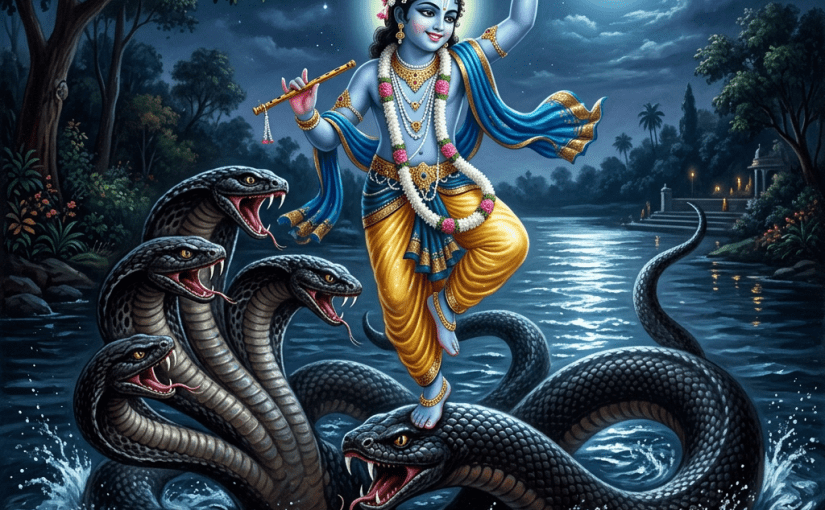
Kaliya Naag, Kundalini and Krishna: A Yogic Interpretation of the Poisoned Yamuna

There are some Puranic stories that appear simple in childhood, devotional in adulthood, and deeply psychological only after inner experience begins to unfold. The story of Kaliya Naag from the life of Krishna is one such mysterious episode. Traditionally it is narrated as the story of a poisonous serpent living in the Yamuna river whose venom made the waters deadly for humans and animals. But when viewed through the lens of Kundalini, yoga, consciousness, vasanas, and awakening, the entire story starts appearing like a coded map of inner transformation.

The story begins with Kaliya Naag living inside Kaliya Hrada, a deep pit-like region of the Yamuna river. The serpent constantly spit poison into the waters. People, cows, birds, and animals who drank the water either became unconscious or died. One day the ball of the gwalas or cowheards fell into the poisonous waters. Krishna jumped into the river to retrieve it. Kaliya attacked him violently. Krishna subdued the serpent by dancing upon its thousand heads and crushing them beneath his feet. The wives of Kaliya then prayed to Krishna for mercy. Krishna spared the serpent on one condition: Kaliya must leave Yamuna and go to Ramanaka Island, where it would no longer remain hidden from Garuda.

When this story is viewed symbolically, the serpent immediately starts resembling Kundalini energy. A serpent naturally symbolizes coiled life-force. Kaliya living in dark poisonous waters resembles dormant life-energy trapped in unconscious lower tendencies. The serpent living in fluid is also important because the lower chakras are connected with bodily fluids, instincts, desires, and reproductive energies. The poison entering the Yamuna resembles life-force flowing downward and outward into ignorance instead of upward toward awakening.

In this interpretation, Yamuna is not merely a river. It resembles the subtle channel through which energy flows. The downward poisoned flow represents energy wasted through uncontrolled desires, compulsions, emotional intoxication, scattered thoughts, and outward attachment. The people and animals becoming unconscious after drinking the water symbolize ordinary worldly consciousness becoming trapped in illusion, ignorance, sleep-like existence, and mortality. The poison here is not merely physical death but spiritual unconsciousness.

The thousand heads of Kaliya are especially meaningful. A serpent with one head would represent a single instinct. But a serpent with a thousand heads resembles countless vasanas, desires, cravings, emotional impulses, and thought-streams constantly arising in the human mind. These heads continuously spit poison into consciousness. The poison is not only lust or attachment but every scattered tendency that pulls awareness outward and downward. These many heads also symbolize immense potential power. Kundalini energy, if mastered, can transform consciousness completely. Left uncontrolled, the same force becomes toxic.

The ball of the gwalas falling into the Yamuna also becomes deeply symbolic. The ball can be understood as desire itself, or the lost center of consciousness. Ordinary beings cannot retrieve it because once consciousness falls into unconscious instinctive depths, it becomes difficult to recover through ordinary effort. Only Krishna enters the poisonous waters fearlessly. In yogic symbolism, Krishna represents divine consciousness, awakened intelligence, or the yogi capable of entering the unconscious depths without becoming consumed by them.

Kaliya first attacks Krishna because the egoic life-force resists transformation. The serpent does not want its poisonous dominance to end. Krishna dancing upon the thousand heads symbolizes mastery over mental modifications and vasanas. It is important that Krishna does not kill the serpent immediately. Instead he subdues it. This reflects an important yogic principle. Kundalini itself is not evil. Life-energy is not destroyed in yoga. It is purified, redirected, elevated, and transformed.

One of the deepest insights in this symbolism is the role of Garuda. In the story Kaliya hides in Yamuna because there it remains safe from Garuda. Symbolically, Garuda resembles transcendence, divine ascent, higher intelligence, or the force that carries consciousness toward the infinite cosmos. The serpent fears Garuda because egoic energy fears dissolution into infinity. As long as Kundalini remains trapped in lower unconscious regions, awakening cannot fully occur. The energy remains safe from transcendence there.

Ramanaka Island then becomes symbolic of Sahasrara or higher awakened consciousness. Krishna does not destroy Kaliya but orders it to relocate there. This is profound. The same energy that was poisonous below becomes harmless and spiritually transformed above. Kundalini rises through the inner channel like a serpent swimming through the Yamuna toward higher consciousness. In Sahasrara awakening no longer appears dangerous. There transcendence feels natural, effortless, and divine.

Another subtle but meaningful part of the story is the role of Kaliya’s wives. They beg Krishna to spare their husband. Symbolically these wives can be understood as subsidiary energies, thoughts, emotional currents, and expressions dependent upon the main life-force. If the root energy were completely annihilated, all associated movements would also collapse. Therefore Krishna chooses transformation instead of destruction. The energies are not killed but spiritualized. The thoughts that were previously chaotic, instinctive, and worldly become refined into spiritual tendencies once the serpent ascends to higher consciousness.

This interpretation also reveals why many yogic traditions do not advocate suppression of life-energy. Suppression alone creates inner conflict. Transformation creates awakening. The same energy that creates bondage can create liberation when redirected upward. This is why serpents appear throughout yogic and tantric symbolism. Sheshnag, Kundalini, Vasuki, and many serpent forms represent hidden cosmic power.

In this framework, Krishna’s dance on Kaliya’s heads becomes an image of consciousness gaining mastery over fragmented mental impulses. The crushing of the heads does not mean violent destruction of life but the ending of poisonous dominance. The poison-spitting tendencies lose their control. The energy becomes available for awakening rather than outward dissipation.

There is also psychological depth in the symbolism of unconsciousness and death caused by the poisoned waters. Ignorance itself is a form of unconscious living. Most human beings live mechanically through habit, desire, fear, attraction, and emotional conditioning. In yogic language this is spiritual sleep. The poisoned Yamuna therefore symbolizes a consciousness polluted by lower tendencies where true awareness cannot easily survive.

The interpretation further aligns with many esoteric methods of reading the Puranas. In several yogic and tantric traditions rivers symbolize nadis, mountains symbolize states of consciousness, demons symbolize egoic forces, gods symbolize awakened principles, and cosmic battles symbolize inner transformation. Stories that appear mythological outwardly become maps of consciousness inwardly.

Krishna lifting Govardhan, Shiva drinking poison, Samudra Manthan, Devi slaying Mahishasura, Vishnu resting on Sheshnag — all these stories can be understood not only historically or devotionally but psychologically and spiritually. The ancient sages often encoded subtle truths in symbolic narratives so that different levels of people could derive different meanings from the same story.

The Kaliya episode especially captures the yogic truth that the greatest danger is not energy itself but unconscious direction of energy. Downward-moving life-force becomes poison. Upward-moving life-force becomes awakening. The serpent remains the same. Only its direction changes.

This is why Krishna does not destroy Kaliya. He transforms its destiny.

The story therefore becomes not merely a childhood miracle tale but a profound inner map of Kundalini, vasanas, consciousness, egoic resistance, spiritual ascent, and the transformation of poison into awakening. When read this way, the ancient Puranic world suddenly feels less like mythology and more like encoded inner science preserved in symbolic language for generations of seekers.

Kundalini Tantra’s uncontrolled power is causing Muslim Jihadis mob to torture minority Hindus in Bangladesh

Hearty congratulations to all dear readers on Shri Krishna Janmashtami

Friends, there are many secrets hidden in this post. To me, it seems like an ocean in a pot. The Muladhara Chakra is not only a special place at the base of the spine. It is also a state of the soul or mind, in which the garbage of worldliness is left in negligible quantity. The Sahasrar Chakra has the garbage of ego related to knowledge or sattvikta that’s purity. The Agya Chakra has the garbage of intelligence. The Vishuddhi Chakra has the garbage related to speech. The Anahat Chakra has the garbage related to emotions. The Manipura Chakra has the garbage of worldly thoughts related to food. The Swadhisthana Chakra has the garbage related to reproduction and sexuality. The Muladhara Chakra has the worldly garbage related to defecation and cleanliness. It means that when all the garbage of the world accumulated on the mind is destroyed, then the mind comes in its original ancient form. That primitive or primordial form of the mind is the original nature aka mool prakriti itself. This is the original base i.e. Muladhara. This is the lowest level of consciousness. That is why it has been given the lowest place in the body. If it slowly climbs up from the Mooladhara through the sequential chakras, then it again starts collecting worldly waste. This is what often happens with man. You must have heard about it. For example, a certain man had become completely bankrupt or penniless or had come on the road. Then he gradually progressed and collected immense wealth. He had actually reached Mooladhara, having lost everything. There is immense meditation power in Mooladhara. This is because there is no interference of worldly waste there. He did not use that meditation power in Kundalini Yoga Sadhana, but used it in collecting abundant wealth. One cannot get everything. Even power has a limit. If you use it here, it will not be left for there. If you use it there, it will not be left for here. If you use it a little on both sides, then neither here nor there will be anything achieved. This is because for every achievement, a liberation velocity i.e. escape velocity is required. This is achieved only with maximum power. Many people deliberately reject Kundalini Sadhana because they are helpless. Feeding the stomach is more important, Kundalini awakening comes later. Many people foolishly reject Kundalini Sadhana in spite of having enough means to live. But most people do not have the knowledge of Kundalini Sadhana. This is because it has been hidden from the common man since ancient times. Especially it has been completely hidden from children and teenagers. In youth, he is caught in the complexities of work and is not able to gain information about it. When he starts becoming mature and old, then he is given information about it. But then Tantric Kundalini Sadhana cannot be done due to the weakness of the body. In his old age, if a man keeps the mouth of the Mooladharvasini Naagin that’s mooladhar residing serpent always turned upwards, then the prostate will definitely enlarge. That is why Maharaj Osho lifted the veil from Tantric sex and made it public. I appreciate him for that work.

I feel the main reason for hiding Tantric Kundalini Yoga is that sometimes it becomes difficult to control the power that comes from it. It can make a person violent, even mad. What is happening in Bangladesh? I feel that the Jihadis have the same uncontrolled Kundalini power, which is targeting the minority Hindus there and making them commit countless misdeeds. Just look at the condition of ISKCON Krishna temple, everything is broken and the idols are destroyed. Moreover, their way of adopting Kundalini Tantra is also wrong and incomplete. Little knowledge is a dangerous thing. That is why the Vedas and Puranas of Hindus were made so that people, while living their basic life according to them, could reach Kundalini Tantra comfortably and safely and adopt it and be successful in it without any side effects. But what is this, people with Jihadi mentality directly reach the last stage of Sadhana i.e. formless Brahma without taking the help of Vedas, that too with acts like tantric rituals. This will definitely cause harm. If they did not have to read the Vedas and Puranas, they would have read Sharirvigyan Darshan, because it seems to me to be a modern and concise explanation of the Vedas and Puranas. Just think, can a person do PhD in English without learning ABC? If he starts doing it, he will definitely get confused or mad. Meaning that despite trying to hide it, this knowledge is not hidden, and it is also not reaching the deserving people. Even otherwise, extremists are learning it in the wrong way, if scholars had not hidden it, they would have learnt it in the right way. It would have been better if ways to control it were found and made public.

Democracy has many benefits, but it is unable to curb the atrocities committed by the majority population mainly by extremist jihadists. When Sheikh Hasina tried, she had to flee to save her life. Even if she had curbed it, the majority population would have defeated her in the upcoming elections, and then by putting pressure on the opposition, would have got her life imprisonment or death sentence or would have killed itself through conspiracy. Due to this fear, the head of state allows the violent mob to create havoc as per their will. After all, everyone loves their life.

There are two types of people who do Kundalini Sadhana on the Muladhara. The first type of people raise the Kundalini slowly by meditating on each chakra for a long time or on a single chakra for months. It seems that such people cannot succeed these days. In today’s hurried era, one cannot have a peaceful and uninterrupted life for years. It is a blessing if one gets one or two months or even one or two years. In such a case, the Kundalini can remain stuck in the middle chakras. The other type of people are like bullet trains. They immediately make the Kundalini rise from the Mooladhara to the Sahasrar through sex-based tantric Kundalini yoga. For such people, even a month is enough. If one gets a suitable life of one or two years, then what can be said.

It is clear that the common man keeps oscillating between the Mooladhara and the Sahasrar, passing through various chakras, without getting awakened. He never becomes free. Kundalini awakening is also not a guarantee of liberation. Liberation is achieved by completely renouncing the mind like a sanyasi or renunciate, which is not possible in practical life. It is a different matter that liberation is achieved by itself in some miraculous and unknown way, of course efforts must be made for it. Looking at the equivalence of the Mooladhara and the mool prakriti, it seems that man’s worldly bondage is eternal, of course it can come to an end.

Kundalini Yoga transforms advanced cognition into basic cognition

Friends, man is an advanced creature. Advanced cognition is present in it. But one side effect of improved cognition is that it creates attachment, due to which the person becomes bound to it. It is like a life-saving medicine is the most helpful, but it also has the most side effects.

Basic cognition is present in all the cells of our body. Similarly, all the lowest and most microscopic organisms also have basic cognition. All of them adapt themselves according to their surrounding environment. To survive they follow a lifestyle similar to ours. Learn new things, and remember old things. But for this, no brain like structure has been seen in them yet. Meaning that they are controlled by a series of different and countless chemical reactions. So why not consider those chemical reactions as their brain. Our brain also runs on chemical reactions only. It is possible that even inanimate objects like stones and air may have a lower level of basic cognition than this, which science has not yet been able to understand. The flow of air is controlled by atmospheric pressure. So why not consider air pressure as the basic cognition of air. Similarly, every time air has a specific reaction at a particular air pressure. So why not consider it as the memory power of air pressure. With basic cognition there is no sense of good and bad. For example, due to low air pressure at a place, air entering there does not give a good experience to the air. Nor does the movement of air from there when there is high air pressure give a bad experience to the air. Similarly, a bacteria does not feel happy when it receives a particle of food and does not feel sad when faced with an enemy. Meaning that with basic cognition there is no attachment or hatred. At the same time, in higher cognition, that intermediate state of equality turns into attachment and hatred. Just like a neutron gets converted into a positive proton and a negative electron. When both are mixed, a neutral neutron is formed again. The plus and minus charges cannot be destroyed separately. These two will be destroyed only when they meet each other. Similarly, we cannot eliminate attachment and hatred by keeping them separate. If we keep attachment to passion and aversion, they will remain separate and grow stronger. When passion arises, hatred will also arise somewhere, because like electric charges, these also arise in pairs, not alone. Detachment is the process which connects positive passion and negative hatred and destroys both. Call positive Yang and negative Yin. Their union is the much talked about confluence, or Advaita.

The development of cognition is like a necessary evil. When man was only in the form of air, water or micro-organism, he had basic cognition. There was neither passion nor hatred in him. He was neutral. He was neither happy nor sad. But as cognition developed, he started experiencing good and bad. Due to this, happiness and sorrow arose in him. Life and death came into existence. Earlier he neither lived nor died. Perhaps this is the indescribable liberation which has been talked about in the Vedas. There was neither light nor darkness in it. Meaning there was no conflict in it. That situation can also be understood in such a way that in that situation all the conflicts were there together. A neutron contains both a proton and an electron, yet not both. Similarly it is said that everything is there in God and also not there.

Now the description of the universe in the Vedas which is similar to that of human society, and the description of various animate gods and demons etc. in it is exactly like that of the people of human society, actually seems to be an attempt to return towards basic cognition. Similarly, in Tantra based physiology philosophy aka Sharirvigyan darshan, the description of the body like the universe and human society is also an attempt to achieve the same primitive basic cognition. Both have the same theme, but the philosophy of physiology seems more contemporary and scientific. However, both methods work better when combined with each other. According to a previous post, Kundalini Yoga strengthens the philosophy of physiology. This means that Kundalini Yoga strengthens the basic i.e. pure cognition.

So will we accept the existence of only electrons and protons and not neutrons? Meaning, will we accept the existence of consciousness only in advanced organisms and not in lower organisms and inanimate substances? The meaning is clear that there is no such time, place and substance in the universe which does not have consciousness.

Kundalini image takes over the entire creation by taking the incarnation of Lord Vamana, awakens and sends the egoistic King Bali to the underworld

Friends, in the previous post, there was a little talk about religion. Religion or Dharma in Sanskrit literally means lifestyle. Whose lifestyle is fanatic, he lags behind. Nokia didn’t keep up with the times. At the same time, it was also concluded that many people who are thought to be psychopaths and are suppressed by drugs, exploitation or social ostracism, are actually patients of awakening. I wish psychology could differentiate between the symptoms of Kundalini and the symptoms of psychiatry or foolishness. I think it is difficult for a culture like western civilization to make this difference, but people of eastern culture are comparatively habitual in it as they have experienced it since ancient times. So, You must have seen, how lion had become a Yogi in a recent previous post. By the way, there is also a Yogasan named Singhasan. Anyway, Kundalini Yogi has been given a dragon-like form, whose mouth is also open like a lion. Yoga is a game of breath, and even a lion roars with the power of breath and makes his face menacing. There is a similar mythical story in Hindu Puranas that Lord Vamana had measured the whole earth in three steps. Actually the three steps are the symbols of the three gunas, sattva, rajas and tamas. Ida Nadi is mother Aditi, and Pingala Nadi is mother Diti. Pingala increases worldly discrimination, intelligence and ego, which means it increases demonic dualist gunas, Rajoguna and Tamoguna. But Ida Nadi creates divine feelings of sattvaguna like peace, tensionlessness, non duality and other pure qualities. That is why it is said that Aditi is the mother of all the gods and Diti is the mother of all the demons. These two were the wives of Kashyap Muni. Kashyapa was the son of Brahma. Brahma is the main expressed mind. Because the mind creates the whole world. He sits on a lotus, on a lotus in the form of sahasrar chakra. As the place of the soul is described as Sahasrar, the same has happened to the mind because both are interrelated, one isn’t without the other. Sage Kashyap is the subconscious mind, because it is born from the mind. He lives in hellish Muladhara as opposed to his father brahma who lives in heavenly sahasrara. Ka means water, and Shya is derived from the word Shayan or sleep, meaning one who sleeps in water. Water is in the form of semen and the cerebrospinal fluid flowing in the spinal cord, and the subconscious mind is shown as the sleeping man, because it is in it that all emotions remain suppressed. This subconscious mind resides in deep and dark pit like places like Muladhara and Swadhishthana Chakras. When its expressing feelings get the support of Advaita Bhava i.e. Ida Nadi, then they become his sons as gods, but when they get the support of Dvaita Bhava i.e. Pingala Nadi, then they become his sons as demons. These waking thoughts are the sons of Kashyapa and Aditi or Diti. Ida and Pingala nadis are his two wives in the form of Aditi and Diti respectively, because with their help he awakens in the form of thought-form sons, which means he becomes strong. Ida and Pingala nadis are his two wives, because with their help he becomes expressed, that means he becomes strong. The mental Kundalini image itself is Lord Vamana. It is the best among all thought-form sons, hence it is called the incarnation of Lord Vishnu. Very cool psychology. Brahma is the original mind. In fact, it is He who builds various worldly creations like houses, gardens, roads, bridges etc. He does not give birth straight to thought-form sons. He first creates the subconscious mind-like Kashyapa Muni. Thought-form sons are made from that. You must have also seen that if you do not do any work in the world, then no strong thoughts will be formed directly. By doing work, its memories get absorbed in the subconscious mind, which later keep on emerging in the form of powerful thoughts. The left brain under the jurisdiction of Pingala Nadi is under the authority of the demon king Bali, the Ida-ruled right brain is under the authority of the gods. Raja Bali is ego. The name Bali seems to have been given to him because he sacrifices (means giving bali in sanskrit) living beings, commits violence to maintain the power of his ego. Also, Bali name originates from Sanskrit word Balin that means powerful. Ego is too powerful in fact. Kundalini image is formed by the influence of Ida. Although both Ida and Pingala should be in a balanced form, because the existence of both is dependent on each other, but Ida should be comparatively more effective. Under the influence of Ida Nadi, a person becomes calm, stress-free, with good appetite and good digestion. In this state of peace, the picture of Kundalini resides in the mind, which means Lord Vamana is born from Mother Goddess Aditi. To see, he is a small lonely mental picture, that is why he is called a dwarf or vamana. He asks King Bali for only three steps of land in the universe. How much space will a mental image take up? Like every mental object, that meditation picture is also made of three gunas, sattva, rajas and tamas. These are the three steps. Man as ego promises to give him even that much space, and thinks what harm it will do to him. Ego is very powerful. He does the biggest things in the world. He takes the small Kundalini picture as a joke. The backbone is secretly depicted as the conch shell. It has the same shape as a conch shell, wide at the head and thin at the tail or bottom. The spinal cord or Sushumna Nadi located in it is the drain inside the conch. The word nadi is derived from the word river (Nadi in Hindi). The water flowing in that drain is the sensation of Kundalini Shakti. Energy also flows like water flow. Because Kundalini-meditation or kundalini-thought as Sankalpa that’s sharp thought or resolution is mixed in it, hence it is called Sankalpa-Jal. Meditation itself is called resolution or sankalpa in Sanskrit. During every religious ritual in Hinduism, while pouring water from a conch or argha (a special vessel for worship), a sankalpa is made for a few moments about the reason for the ritual, the process of the ritual, the priest, and its resulting fruit. Deep meditation itself occurs with it for a moment. Due to this, the karma becomes fruitful quickly and more. While sitting in the Yagya, Bali had pledged to give three steps of land to Lord Vaman while pouring water from the conch. It is possible that by pouring water, the Kundalini energy starts flowing, because there is a similarity between the two, which strengthens the meditation. Along with the falling stream of water from the Arghe or conch, the Kundalini Shakti also starts flowing down the front channel, due to which it passes through the back channel and climbs up the back, taking with it the additional and special orgasmic Kundalini Shakti of Muladhara. It also carries along Vamana in the form of the meditation image because vamana is the main purpose, in the Sushumna-conch channel in the form of a thin spinal cord, with the push of the flowing water or Shakti in the form of meditation or Sankalp, and this way vamana keeps on growing through Yogasadhana, and finally awakens and pervades the entire creation. This is to measure the three worlds with three steps. Due to this the ego itself gets buried in the underworld in the form of subconscious. It has been said this way that Vamana placed the third step on the head of Bali. This story continues in the next post as well.

Kundalini Yoga does not talk about rejecting the world

Friends, there is a lot to write, words are few. The riddles of spirituality are very strange, which have been written hard to understand. How everyone can believe. It is said that don’t run outside, feel inside yourself. It is like a double edged sword. If someone sits down with his eyes completely closed, he is sure to suffocate and die, but if someone pretends to keep his eyes closed even with his eyes open, he will survive. Now I have become Premyogi Vajra. I have nothing to hide about myself. I have seen countless beautiful sights of all kinds. But I kept distance from those views. I didn’t even speak a word to some, but drank them with my mind’s eye. It also happened because of my family’s spiritual environment, and there must have been many other favorable circumstances due to the influence of previous lives. But theory being theory, it applies knowingly as much as unknowingly. What happened is that by not running obsessively towards the beautiful sights, the principle felt that I was experiencing all the sights inside myself, inside my mind, inside my body or inside my soul. This is also true. The external views are just a means to reveal the inner view. As I have been trying to go to the root of the body’s blissful kosha through the last several posts. Don’t know why it feels like something is missing. The scriptures need scientific explanation. It is said that Yoga is scientific. But it doesn’t happen just by saying. Today it needs to be proved. Sexual love is at the top in worldly colors and sights. If one can remain detached from sex even with love, then what can be greater detachment than that? From that the soul will get miraculous power and it will be awakened the fastest, just within a year or two. Lord Shiva was also like that. Goddess Parvati used to shower her life on him, but he remained unattached and immersed in his meditation. He also used to love Goddess Parvati very much, but used to pretend to be neutral. Due to this, according to the above psychological principle, all his love used to be attached to his soul itself. Then why doesn’t his soul always remain awake? This shows that no one can be a greater actor than a Yogi, especially a Tantra Yogi. Contrary to Lord Shiva, if someone was a fanatic or an idealist or a scripturalist etc or mindless, then he would have rejected a girlfriend like Goddess Parvati calling her a spiritual obstacle and gone away or would have become attached to her like a bumble bee on a flower. You can understand what would have happened then. The meaning is clear that the middle path of Shiva or Buddhist is the best. Well easy to say, difficult to do. In the scriptures the term rejection has been given to non-attachment because it is closer to rejection than to adoption. The scriptures are emotional. People do not understand their feelings and start blindly following them. If a common man had seen Mahadev Shiva, he would have said that he has rejected Goddess Parvati. To say that he got married later means that it happened after the attainment of knowledge. At first he used to be meditating somewhere and Goddess Parvati searching for him somewhere else. Of course, Shiva had settled Parvati in his mind as meditation image and always remained blissful in her meditation. People must have thought that was his penance. Little do they know that the matter is something else. Who has seen by going into the mind? Actually the real detached man has adopted the whole world as his soul. He does not feel that he has rejected the world. But the people of the world feel like this. That’s why common people with little understanding start talking about rejecting the world they see. Even the lover sometimes feels that his lover is rejecting or ignoring her. That’s why when this happened, Shiva used to appear in front of Parvati for a few moments to console her, and then disappeared. Let me tell you that the power of expression reaches the soul through Kundalini i.e. meditation. You can say that with non-attachment you feel the meditation picture manifesting, no soul etc. The pure soul is like the empty sky, it cannot be felt directly in the presence of the body, it can be felt only in the form of meditation. Shiva became the biggest Rasbihari or spiritually romancing. How can anyone compete with him? It takes many years for the common man to gain ultimate knowledge through love. Till then he cannot even console his girlfriend like Shiva. If he starts giving, he gets carried away by feelings and remains deprived of attaining knowledge. Worldly honour related restrictions are also there. Everything changes after years, even the mind of the girlfriend. Some even distance themselves in the beginning by accusing them of infidelity. Haha. Wow to Lord Shiva’s luck and leela with the love of Goddess Parvati, getting complete knowledge from her, then marriage with her and romancing only with her. No one else should come in the way of love. If this happens in common worldliness, then there will be a shower of heaven and nectar. In the same way, one should keep on loving God without considering him unfaithful. They love humans a lot, that’s why they keep on showering countless facilities like air, sunlight, water etc. on man, of course they remain completely unattached and like distant. Someday or the other they will definitely adopt.

Kundalini Yogi is like a truly quantum scientist who is the master of subtle physical world

Kundalini Yoga can fulfill man’s curiosity to learn and move forward

Friends, in the previous post I was telling about the space-form nature of the soul. In practice it is seen that everything keeps on breaking down to below and below to successive finer constituents. In the end the smallest thing will be remaining which will not break. That is the sky. Then again in the beginning of the creation when things start to be made from it, the first thing to be made will be a virtual wave in the sky because there was nothing except the sky. There is only one way to make it look like a wave or a particle by making a running or standing wave respectively. I was also telling in the previous post that when the medium and the particle are the same thing and the particle is nothing other than the medium, then the particle will also be called a wave. A particle of water can be formed inside the air, but how can a particle of water be formed inside the water. The only way is to make it look like a particle by creating a virtual standing wave. That’s why in the scriptures that Chidakash i.e. conscious sky has been called as Neti-Neti. The Sanskrit word neti is made up of two words, na and iti. Na means no, and iti means this. That’s what neti means, this is not, means this is not God. Whatever is seen, will be considered neti. All the particles and waves will also be considered neti, as long as they are found. In the end, the invisible dark sky that remains will also be neti. That is because we are able to see or know it in another from self form. Any kind of thought or feeling will be considered as neti. In the end, such an element will remain, towards which we will not be able to point, that means it will be our own self. Because we will not be able to address it by saying iti i.e. this, therefore it cannot be neti. Neti can be what we call iti. It means, the silence is the top knowledge. This self is experienced during Kundalini awakening. Nonliving or dark sky can’t be self-sky because it can’t show glistening world inside it as its waves. Only living or conscious sky can be the self-sky as it does so. Means a mental feeling of light and consciousness is a small wave inside infinite ocean of it, not as a particle inside unrelated base medium as per physical experiments and awakening experiences. Both goes side by side to prove fully. Although inner experience of awakening is alone enough for more philosophicals and intellectuals. What can be a bigger proof about God than this? Most of the scientists and modernists who think that such-and-such particle will be found or such-and-such force will be known or such-and-such theory will be proved, then probably all the secrets of the universe will be exposed. But this is not true. Whatever you get will be iti, that’s why it will come under neti. There will always be something left to find. Means the origin of the universe will not be known. The ultimate origin means the ultimate soul will be known only when one will feel his self-form without meeting any iti i.e. something different from oneself. This is possible only through Kundalini Yoga. This proves that only through Kundalini Yoga, all the mysteries of the universe can be revealed at the root level and it fulfills the curiosity of man to learn and move forward. A long-standing mental thirst appears having been quenched.

As many creatures as the universe means multiverse

The universe is like a disorderless wave inside the Chidakash that’s conscious sky. It is as pure as Brahman. What can be the difference between water and water wave. But man colors it with his feelings, beliefs, and thoughts. That’s why this universe is different for each person or creature. That is why it is said that the universe is not somewhere outside, it is only the product of man’s mind. This point has been made clear in the entire Yogavasishtha book with many stories and examples. We can also call this the multiverse. With Kundalini Yoga, when the mind’s thoughts and feelings are purified, means the attachment to these is removed, then the noise of the restlessness of the mind calms down, then only the experience of the original Brahma-like universe along with its wavy world is realized, due to which the person starts living as self-satisfied. Kundalini itself is Advaita. Advaita is to see all the things of the world as same and inseparable from self meaning as waves in the self-form sky. Quantum scientists also see true nature of subtle substances as inseparable from space, wave-like and similar to each other. There’s no difference between light or photon wave and electron wave. Both are waves. But particle nature varies. This means duality resides in untrue particle nature and nonduality resides in true form wave nature. Also, it’s only possible to show a wave as particle, not particle as a wave. This also proves that wave nature is true nature of the quantum objects. This is the true view of gross world too, because it is only the subtle substances that join together to form the gross world. This means the wave form of the world is the truth, the particle or physical form is imaginary and unreal, as it has been said everywhere in the scriptures. The particle view is dualistic vision that’s full of falsehood, illusion, distraction and saddening virtues in the world, and arises from looking at the world with attachment. It is like if you try to see the elementary particles in the double slit experiment, they behave like particles, otherwise they are in their true wave form. If you want to enjoy double, then stand near the double slit and sometimes look at it with a slant and sometimes turn away shyly. Haha.

Innumerable universes at one place means the existence of parallel universe

The existence of infinite dimensions

because the physical world is a virtual wave inside the space, so innumerable types of virtual waves can be formed at the same place. One type of wave may not interact at all with another type of wave. Therefore there can be innumerable independent universes located simultaneously at one place. It is possible that where I am sitting at this moment, exactly there means in the space occupied by me, all the things of the universe and all the activities of the universe are present, because there will be something in the universe of one dimension, and something in another, like this, everything will be covered in countless universes. It may also happen that there are countless entire universes present in this same place, because small and big are also relative, not real. This means that in this way innumerable dimensions exist. We can never know them, because the virtual wave dimension in which our universe is located will not be affected at all by the dimensions created by other types of virtual waves. It is possible that the Great Attractor, which is inflating the universe like a balloon, may be in the form of countless and enormous universes in unknown dimensions. We are considering it to be the natural gravitational force of space, while it is being created from invisible universes.

Scientific experiment in the form of personal experience of the dual nature of matter

Once a spark of lightning struck my hand. I felt as if someone had hit a stone hard on the back surface of my hand. Even I started looking here and there for who had thrown the stone. That sparkling electric ring fell on an iron sheet about ten meters away around which children were also playing but they were saved luckily. Amazing thing that there was no scratch on that iron sheet, it was exactly like before. There was no sound of hitting anything etc. This means that the fundamental particle of matter, the electron, behaved like a particle on my hand, while it behaved like a wave on the iron sheet. Photoelectric effect and double slit experiment was an experiment with inanimate substances, but I felt this experiment on my living body. You must have also seen how the whole building collapses due to lightning, or a big hole is formed on its roof. Also as it happens with a tall tree, a lot of its wood gets chipped from the middle or the tree falls down in two pieces. It is called Vajrapata in Sanskrit, meaning the falling of an iron-like sphere from the sky, like a bomb falling. This means that the people of ancient times had knowledge of the particle effect of the electron-wave. There is a Bijli Mahadev temple in Kullu of Himachal Pradesh. The stone Shivling located in it is struck by lightning once every year, due to which it splits into two pieces. Then both those pieces are joined with butter by the priests of the temple. This is also a particle nature of electron. A fundamental particle is so small that it can only be detected indirectly at the Large Hadron Collider by measuring the impact of its collision, just as it produced the sensation of a collision on my hand. Even it can never be detected directly, it is a distant thing to be seen.

Kundalini Yoga as the Varaha avatar of Lord Vishnu mythological story

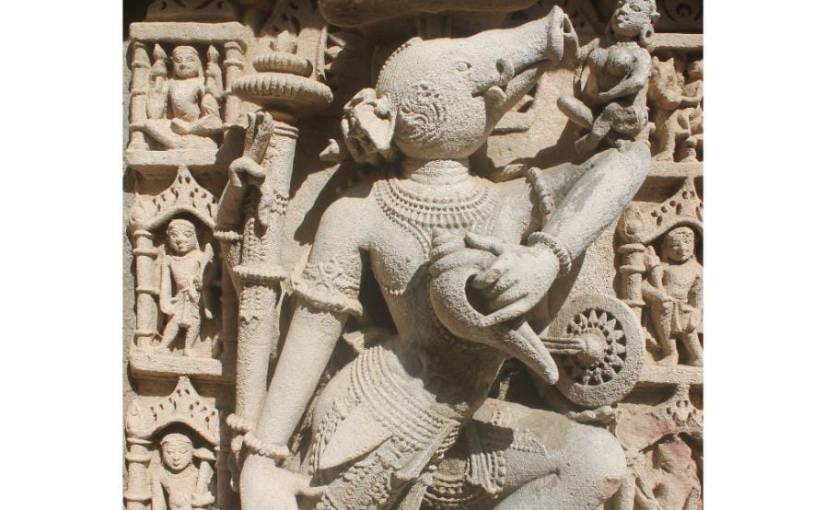
Friends, in the previous post I was sharing some spiritual secrets related to nose and Ida-pingala. I remembered a mythological story related to this, so thought that in this post, let’s try to make its yoga-based revelation. It is said that in the olden days, the demon Hiranyaksha stole the earth and hid it deep inside the ocean. Distressed by this, all the gods took Brahma along with them to Lord Vishnu and obtained a promise of help from him. Only then a small pig came out of Brahma’s nose. Actually Lord Vishnu had taken the form of that boar. As soon as he saw it, it grew up and entered the sea. There he saw the demon Hiranyaksha hiding in the depths and started fighting with him. In no time, he killed Hiranyaksha and by extending both his long and sharp edged molars one at each corner of mouth forward he picked up the earth along with the Vedas and balanced the round earth on them. Then he came over the ocean and he set the earth in place. Even then Lord Varah was not getting calm. Lord Shiva pacified him by taking an avatar.

Yoga based mystical analysis of Varaha Avatar story

By meditating on the nostrils and especially on the breath coming in and out of the nostrils, the rising energy shifts to the central line that’s in the way of the Sushumna Nadi. It is said that the boar came out through the exhaled breath going out of the nasika. By paying attention to the outgoing breath, the energy descends through the front channel, and penetrates all the chakras and reaches the Muladhara. This is Varaha’s going under the sea to reach Patal Lok. Even if Muladhara is considered as an ocean instead of Patal Lok, then the lowest rung of the ocean of the world is Muladhar, because the whole world is settled in different chakras. Probably it has been called sea because the reservoir of water in the form of semen comes under Muladhar area only, where shakti is hidden as subconscious mind. Hiranyaksha means ignorance in the form of duality. Hiranya means gold, Aksha means eye. The one who has respect for gold i.e. prosperity in his eyes, and behind it who is blinded by duality, he is Hiranyaksha. Due to this, Kundalini Shakti hides in the darkness of Mooladhara, that is, it sleeps. Means the shakti of the thoughts of the mind becomes unmanifested in the form of subconscious thoughts and gets buried in the base chakra. It’s the kundalini sleeping there. Along with that mental world, the Vedas also get buried in the Muladhar, because pure and sattvaguni or light-full conducts and thoughts are in the form of Vedas. After reaching Muladhar, shakti starts turning upwards passing through the back. Shakti prefers Ida and Pingala to rise, mostly try to rise through Ida Nadi, as there is less blockage in it. Sometimes the energy starts swinging alternately in Ida and Pingala for a few moments in each. In such a situation, by keeping attention on the Ajna Chakra also, the energy stays in the Sushumna too for a few moments in between. Ida and Pingala are shown metaphorically as the two sharp teeth on both sides of Varaha’s mouth. The Sushumna Nadi or Ajna Chakra is the round earth balanced on top of those two teeth. The chakra is also round like earth. Sushumna has been called earth because all the experiences of the world take place in the brain, nowhere outside, and energy is transmitted to the brain only through the Sushumna nadi. Varah is the Kundalini-Purush i.e. meditation image. This is the meditation of Lord Vishnu. Like Vishnu, he is also shown in quadrilateral form with conch, chakra, mace, padma, one thing in each hand. That is why it is said that Lord Vishnu incarnated in the form of a boar. The boar has been chosen for the metaphor because it is the boar that digs the ground in search of its shakti hidden in the form of food in the depths. That is why the earth is dear to the boar. That’s why he even enters the sea to bring it up. In order to get the sleeping or suppressed earth or shakti in the form of mind, he gropes and digs the muladhara and carries up it with the teeth in the form of Ida and Pingala channels. Then by balancing it in the form of Sushumna, it brings it out of the water that’s nadi or channel as it also flows like water, and restores it to its original place. Its real place is the Sahasrara of the brain, because that is the center of all experiences. Sushumna Nadi also goes directly from Muladhar to Sahasrar straight up. With this, the thoughts buried in the subconscious mind start coming back to experience, and starts merging into the blissful emptiness of the Self. Means cleansing happens. Means sleeping shakti in the form of subconscious thoughts starts waking up. This is Vipassana. Vipassana can be done in any part of the brain, except the Sahasrara, as it requires less energy. In Sahasrar, only the Kundalini picture is meditated upon, which is in the form of an idol or a Guru or a transcendental body etc. This picture feels almost like a real physical form with practice, that is why it takes much more energy than Vipassana. Although it happens in Sahasrara only, but due to less energy, it appears outside. The less energy a thought has, the further away it seems from the Sahasrara. By the way, the place of the soul has been described as Sahasrar. If someone starts awakening the image of a common man in Sahasrar, then he will reach him or her automatically while walking in his sleep at night. Then how will meditation happen? Then all the gods and sages are happy and praise Lord Varah with folded hands. Anyway, the purpose of all these is to remove the living beings from the beginning less suffering in the form of birth and death, which is only possible in the Sahasrar Chakra in the form of awakening, that is why they are happy. To pacify or kill the boar by Shivji means that Yogi left the fascination of Kundalini and became a non-dual Tantrik like Shiva. Anyway, the principle is that after the awakening of the Kundalini, the non-dual tantra is the supreme understanding, which Osho Maharaj also explains to the world in the form of one of his books, “tantra- a supreme understanding “..

Kundalini Yoga dhyana having Vipassana i.e. witnessing meditation as an important component

Kapalbhati Pranayama is very useful for Vipassana Sadhana

In the last post, I was also telling about Vipassana. According to my experience Kapalbhati Pranayama also helps a lot in Vipassana. Only the breath has to be pushed out. Let go as you go inside. Don’t let yourself get tired. Be relaxed. The colorful thoughts that are arising, let them arise. Whatever old memories are coming, let them come. They themselves will merge into the void form soul. Actually this happens because with appearance of thoughts in one’s mind without the help of any material things, man comes to know that they are unreal and as subtle as the sky, but coming in contact with the material world, they become true and gross by illusion. This is also the principle of Vipassana. That is why it has been repeatedly said in the scriptures that the world is unreal. Probably it is written for Vipassana, because when Vipassana makes the world seem unreal, then knowing the world as unreal will lead to Vipassana itself. Vipassana is more obvious with Kapalbhati Pranayama because even in our busy daily routine we breathe in such rapid and jerky ways as kapalbhati. As soon as a thought comes, one feels that the appetite for breath increases, and the inward breath also feels deep, sweet, flavored and satisfying. If the thought is not repressed forcefully, then it becomes a chain of thoughts by joining one by one further and further, and almost all the mind comes out of the pitcher, which is said in the previous post story that hundreds or thousands of sons have been born from one pitcher. The thought picture that is already lightly imprinted emerges less. The meaning is clear that garbage gets accumulated in the mind only because of attachment-filled behavior. To bring it out with vipassana again and again means to clean the garbage. Just like the solidified dirt in a pan has to be washed out again and again, in the same way the thought with attachment has to be removed again and again.

One should live like a wanderer, because Vipassana practice becomes stronger by coming in contact with new places and people

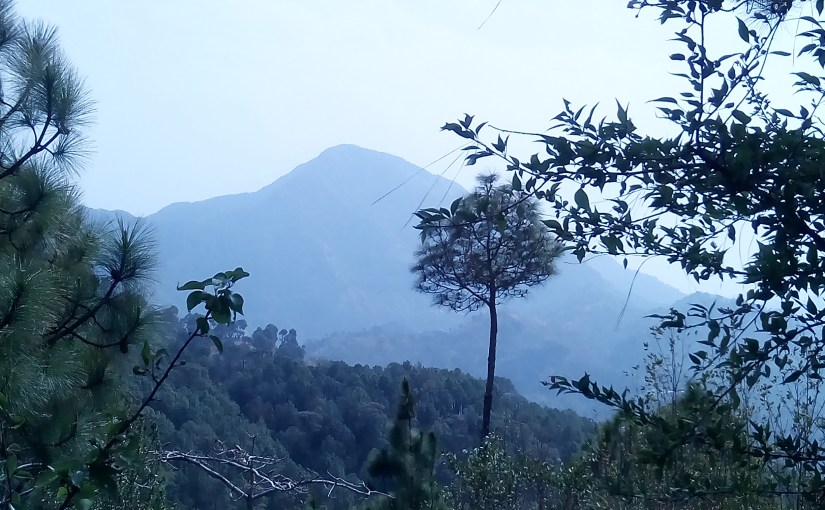
Looking at that colorful program of previous post, new and old thoughts were overflowing in my mind with witnessing and joy, and were merging in the void form soul. Means Vipassana meditation was happening by itself. In fact, that area itself became a Vipassana area for me. This happens when an old and unknown relationship is associated with a place, which is similar to one’s home area, but the people there remain neutral towards the new man considering him as a stranger and an outsider. They are not able to protest him because they also feel affinity with the new person. Due to this, man’s power itself keeps being spent in Vipassana by staying away from the unnecessary hassle of worldliness and relationships. The gods of our village used to be our old kings. They were also our ancestors in a way. With them our forefathers came from the old state to the new state. In the new princely state, king built his house at a place from where he could see the hill of his old princely state directly and at all times. Most of the doors and windows of his house were also made by him in the direction of the same hill. When his temple was built there after his death, even then its door was placed in the same direction. Similarly my grandmother used to tell that a recluse Sadhu Baba used to live in her village, who loved her like a daughter. My grandmother’s village was near the top of a high mountain. The mountain was very high, and the surrounding mountains were no match for it. His main purpose in coming to the peak of that mountain was to remain in constant sight of his old village situated near its base, so that the spiritual practice could be done properly, and the memory of the old house would not become a hindrance in the spiritual practice. In fact, unfortunately, all the members of his family had passed away gradually due to various calamities. Due to this, a lot of wealth was also gifted to death. In response to this, he was completely detached from the fascination of the world. The same spiritual psychology works in the case of personal relationships as well. If one’s this kind of affinity towards a person creates attraction towards him, but if he remains neutral towards him or ignores him considering him as an outsider and a foreigner, then Vipassana starts happening on its own. I do not hesitate to say that this second type of personal relationship Vipassana had a great deal to do with my experience of awakening in my sleep.

Hindu classical stories have two forms together, nature protector in physical form and psychological or spiritual in subtle form

We were also talking about the fact that the full enjoyment of reading these stories comes when along with their puzzle-like physical form, their real psychological meaning is also understood. One can easily say that superstition grows from these stories. But those who believed in them did not follow much of their real or physical form, although by having unwavering faith in them, they maintained their divinity and transcendence. They were understood as sacred and otherworldly stories, not worldly and physical. By the way, these stories are not too inhuman. It is said to worship the river Ganges, not to pollute it. This awakens love for nature. Anyway, the Nadi especially the Sushumna Nadi flows like a river ganga. By meditating on the river ganga, it is possible that the attention itself goes towards the sushumna nadi. Meaning whatever the stories are, they are beneficial in both ways, preserving nature in physical form, and upliftment in the form of spiritual metaphor. In some rare cases, it may even appear to be in the disinterest of humanity, as some sentences of Manu Smriti are accused of. But in response to the allegation, mostly their spiritual or transcendental meaning is applied, not physical. We have not seen anyone following them in our life, we have only seen allegations leveled against them. It is quite possible that those sentences were not in the original text and were later added under the conspiracy. On the contrary, in some other religions, I see most of the people walking exactly on the same mystical stories, in their perverted physical form. They do not even allow spiritual analysis and revelation of those stories, and do not spare those who forcefully do so. Examples like Jihad, unnecessary killing of infidels, forced conversions are in front of everyone today. We had written a post in which the similarity between the Holy Spirit and Kundalini was shown. Two or four people started denying that post, even denying any scientific logic. A gentleman started telling that the work of the devil or demon or or Satan or enemy. He did not understand that it was an attempt to create friendship and equality among different religions. He was considering the tantra shown in this website as occult or ghostly practice. We should be open minded without prejudice in any subject. More importance has been given to scientific thinking and rationality than others in Hindu philosophy, and less to maintain superstition by force, as far as I understand. By the way, some or the other shortcomings are found everywhere. Together he told me that I identify myself with some religion etc. Since I am a Hindu, why should I not identify with my Hindu religion? All religions have their own specialties. The world appears to be full of colors and beautiful with different religions, although the humanity religion essentially inculcated in them is the same for all. But still I keep my independent views, and I don’t believe in what I think is wrong or superstitious. Almost every post of mine has a scientific and humane explanation of one or the other Hindu belief. What can be a more direct proof of the liberal and all-religion thinking of my religion than this. Once I had met a scholar and philosopher teacher on WhatsApp, who was teaching Hindi language. I told him how westerners are taking more interest in yoga than the local Hindus here. So he wrote that they do not have sanskars. Sanskar means cultural tradition passed on from generations. Now I understand his point that how due to lack of culture, a man can suddenly go against the tradition, which he is following wholeheartedly. Rituals keep a man connected to tradition.