Shiva, Shakti and the Cyclic Universe: A Personal Intuition About Branes, Conception and Cosmic Rebirth

From Two Hands to Two Cosmic Branes

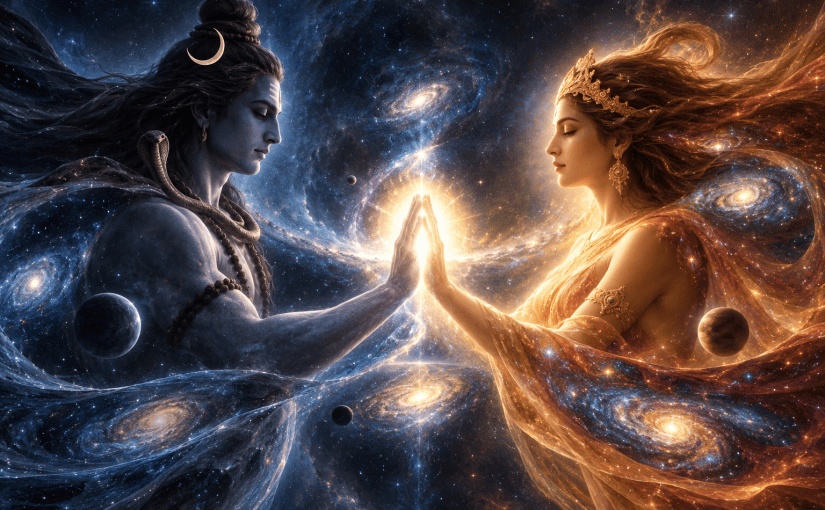
I began to understand the idea of a cyclic universe through a very simple image: two hands slowly moving toward each other in position of cosmic prayer, touching, separating, and then coming together again. In some versions of string-inspired cosmology, our universe can be pictured as a three-dimensional brane, or membrane, existing within a higher-dimensional space. Another brane may exist alongside it, and the two can move relative to one another. Instead of imagining the Big Bang simply as an explosion of matter from one point into already existing space, this picture allows us to imagine the changing relationship between the branes themselves as part of the cosmic story. When the two branes separate, the universe can pass through an immense phase of expansion. When they eventually come back together, their collision can produce a new hot, dense beginning, creating a Big Bang-like state. The whole process can then repeat again and again.

The Cosmic Clap: Collision and a New Big Bang

The most striking image is the final clap. After the branes have drifted apart to their maximum distance and the universe has expanded enormously, they begin moving toward each other. Their meeting represents a catastrophic collision, or bounce. In the simplified picture, the old universe is not preserved in its familiar form. Galaxies, stars, planets and other large-scale structures do not simply pass intact into the next cycle. Instead, the previous organized universe is replaced by an extremely hot and energetic state, a kind of plasma inferno in which the familiar structures of the old cosmos have disappeared. From that hot state, the universe can expand and begin forming structure again. Thus the Big Bang is no longer necessarily imagined as the unique beginning of everything. It can be one phase of an endless sequence: separation, expansion, convergence, collision, hot rebirth, and expansion once more. That is the basic appeal of the cyclic or ekpyrotic picture, although it remains a speculative cosmological model rather than an established description of our universe. The “cosmic applause” is simply the repeated meeting of the branes: clap, rebirth, separation, and another clap.

My Shiva-Shakti Intuition

What made this picture especially meaningful to me was that I could see it through an entirely different symbolic language: the ancient idea of Shiva and Shakti. In scriptural traditions, creation is associated with the union of Shiva and Shakti. Shiva can be understood as the still, enduring principle, while Shakti is the dynamic power through which manifestation takes place. I began to see the two branes not merely as two identical physical sheets, but as two complementary symbolic principles. The right and left hands became a simple image of this union. When the hands meet, conception occurs. When they separate, development begins.

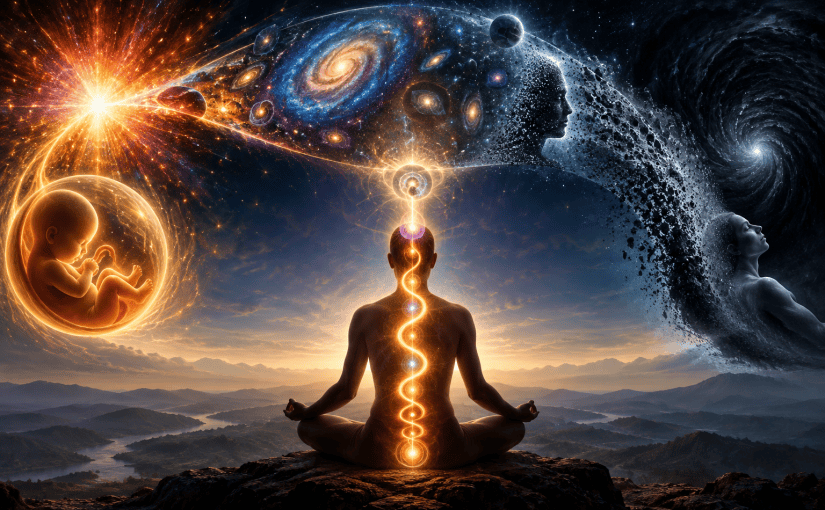
This made me think of Shiva as the father principle and Shakti, the mother or goddess, as the creative womb. The union of the two is conception, and the newly conceived universe is then like something growing within a cosmic womb. The important point for me is that the universe does not have to appear fully formed at the moment of conception. After conception comes development. When the two branes separate, Shakti can symbolically be understood as carrying the developing universe, while Shiva remains associated with the essential principle, identity or recognition from which that manifestation arose. In this interpretation, separation is not the opposite of creation. Separation is what allows creation to unfold.

Shakti as the Developing Universe

This makes the female brane, in my symbolic reading, especially interesting. It is not simply another universe identical to the male brane. After the union, Shakti carries the manifested creation and allows it to develop. The universe grows within this cosmic womb, moving from an intensely energetic beginning toward increasing differentiation and complexity. What begins as a hot and chaotic state can eventually become particles, atoms, stars, galaxies, planets and perhaps life. Shiva, by contrast, represents the enduring essence or recognition behind the manifestation. In this picture, Shakti is the movement and development of creation, while Shiva is the principle that remains comparatively still.

This is only a symbolic interpretation; physics does not describe one brane as male and another as female, nor does it assign them the attributes of Shiva and Shakti. The physical model and the spiritual symbolism belong to different levels. What I find meaningful is the structural resemblance between the two pictures: union, creation, separation, development and return.

The Return of Shakti and the Death of the Universe

The idea becomes even more interesting when the universe reaches old age. After a vast period of development and expansion, the universe can be imagined as moving toward exhaustion. In my intuition, Shakti then begins to return toward Shiva. She does not return carrying the old universe as a fully functioning world. The recognizable universe is almost dead. Its galaxies, stars and other structures have lost their former organization, and what remains is increasingly reduced to underlying energetic potential. Yet this does not mean that everything has become meaningless residue. The remains of the old universe can be imagined as carrying the potential for another beginning.

This gives the reunion a different meaning. The approaching Shakti is like a cosmic mother returning to Shiva with the exhausted remains of their previous creation. The purpose is not to preserve the old universe in its previous form, but to allow its remaining essence, now concentrated in energetic form, to participate in another conception. The old universe therefore ends as a recognizable world but survives, in this symbolic picture, as potential. The new universe does not emerge as a completely unrelated event. Its birth is connected to the death and dissolution of the previous cycle.

Conception, Growth, Death and Rebirth

Seen this way, the entire cosmic process becomes almost like one continuous act of reproduction at the scale of the universe. Shiva and Shakti unite, conception occurs, and then they separate. Shakti carries and develops the universe. The universe expands, differentiates, lives through its vast history and eventually approaches death. Shakti then returns toward Shiva carrying the dying creation in a reduced energetic form. Their reunion becomes both dissolution and the preparation for another conception. The old manifestation disappears, but the creative process begins again.

The cycle can therefore be understood in a very simple sequence: union is conception, separation is gestation, expansion is life, aging is exhaustion, return is dissolution, and reunion is rebirth. Then the hands separate again, and the whole process begins once more.

Between Physics and Metaphor

I would not claim that this proves Shiva and Shakti are the physical explanation of brane cosmology, or that ancient scriptures scientifically predicted modern string theory. That would go beyond what either tradition can establish. The brane collision model is a speculative idea in theoretical physics, while the Shiva-Shakti framework is a spiritual and metaphysical language. My point is different. When I placed the two pictures beside each other, I found a striking pattern: two complementary principles come together, something is conceived, creation develops through separation, the manifested world eventually dissolves, and the remaining potential returns to the source for another beginning. My interpretation is closely aligned with the creation symbolism described in the scriptures, particularly the Shiva Purana, where Shiva and Shakti are understood as father and mother in relation to the origin and manifestation of the universe as a fetus growing in cosmic womb.

What began for me as a simple image of two hands coming together therefore became a much larger intuition about the universe. The cosmic clap is no longer merely a collision. Symbolically, it is conception through the death of the previous creation. The separation of the hands is not merely distance; it is the opening of the cosmic womb. And the return is not simply destruction. It is the movement of Shakti back toward Shiva with the almost dead universe, carrying whatever remains of its energetic potential toward a new union. In that sense, the universe becomes a repeating rhythm of union and separation, manifestation and dissolution, death and rebirth: an eternal cosmic cycle in which every ending is also the preparation for another beginning.

Kundalini, the Soul and the Big Bang: Is Consciousness Repeating the Birth and Death of the Universe?

The Big Bang, Inflation and the Question of Origin

When we ask how the universe began, the usual image is of a tiny point exploding outward. But modern cosmology gives us a subtler picture. Inflation describes an extremely early phase in which the cosmos underwent a dramatic stretching during a tiny fraction of a second. Space itself expanded rapidly; it was not matter simply exploding into an already existing empty space. A useful but limited analogy is compressed air expanding, because stored energy can drive expansion, but inflation is fundamentally different: there was no external container and no pre-existing space into which the universe was expanding. The geometry of space itself was changing.

What drove that expansion is generally described in terms of an inflaton field in a high-energy state. Its energy behaved approximately like vacuum energy and, because such a state has strongly negative pressure, it could produce accelerated expansion according to general relativity. When inflation ended, the inflaton transitioned toward a lower-energy state, and its energy was transferred into particles and radiation. This process is called reheating. The inflaton could oscillate, decay and interact with other fields, producing enormous numbers of particles that eventually interacted and approached thermal equilibrium, giving rise to the hot plasma from which the later universe evolved. The precise identity of the inflaton and the exact mechanism of reheating remain unknown.

This immediately raises the deeper question: where did the inflaton, its high-energy state, or even the initial conditions come from? Science does not presently have a complete answer. If we mathematically run the simplest classical Big Bang model backward, we reach what is called a singularity, where quantities such as density and spacetime curvature become infinite. But a singularity is probably better understood as a sign that our present theory, general relativity, has reached its limit rather than as proof that there was literally a tiny ball of infinitely compressed matter. We therefore have a major gap between the earliest describable universe and whatever deeper quantum-gravitational reality may have preceded it, if “preceded” is even meaningful there.

A Human Analogy of Cosmic Expansion

I began wondering whether a similar pattern could be imagined within a human being. God, or Brahman, is often called infinite. I imagine it not as ordinary physical space but as something indescribable and unlimited in every aspect, a ground more fundamental than any individual object, space or energy. Perhaps what we call an individual soul emerges within that infinite reality as a confined and highly energetic state. Birth could then be imagined as a kind of personal Big Bang. The initially concentrated inner space begins to expand, and as it expands its energy decreases while the released potential appears as the experienced world.

The first experiences of a person could metaphorically resemble fundamental particles: the simplest constituents from which later structures are formed. As life proceeds, the inner space continues expanding and new experiences fill it. Yet newer experiences are not necessarily entirely new creations. They can be growths, combinations and increasingly complex expressions of the earliest structures, just as complex physical structures develop from more elementary constituents. Memory, knowledge, relationships, skills, desires, understanding and identity gradually build an extensive inner universe.

The initial expansion also seems to slow. Yet there can come another stage in which one’s accumulated world begins to expand almost by itself. A person who has grown greatly in business may find that new opportunities generate further opportunities without conscious effort at every step. Knowledge produces more questions and connections. Art produces new possibilities from what has already been created. Intellectual growth creates the conditions for still more growth. This resembles, metaphorically, the role of dark energy in cosmology: an expansion that is no longer simply the continuation of the original impulse of birth but appears to possess its own further momentum. This is only an analogy, not a claim that human development is literally governed by dark energy.

Death as a Return of the Expanded Inner Universe

At death, the expanded inner world of a person would, in this speculative picture, no longer continue its ordinary outward development through the body. Instead, the enormous space of accumulated knowledge and experience could be imagined as contracting toward the concentrated high-energy state from which its journey began. The visible world of the individual would then be transformed back into a more concentrated potential. The amount of this remaining potential would correspond metaphorically to the richness and extent of the world accumulated during life. This would also explain why different souls could retain different identifying signatures: each would represent a unique configuration of experiences rather than an identical undifferentiated state.

Here the analogy with vacuum decay becomes interesting, though it must be used carefully. In physics, vacuum decay specifically refers to a hypothetical transition from a metastable false vacuum to a lower-energy vacuum. Some inflationary models involve such a transition, but the end of inflation in general is not simply synonymous with vacuum decay. Likewise, reheating is the transfer of inflationary energy into particles and radiation. My proposal is extending these physical ideas into a metaphysical analogy: a high-energy confined state gives rise to an expanded differentiated world, while movement toward a more stable state releases its stored potential into manifestation.

Creation, then, could be imagined as a cycle in which a concentrated high-energy state differentiates into an experiential universe, while dissolution returns that differentiated universe toward its original ground. The outer universe and the inner universe would be two scales of the same pattern.

A Personal Experience of a Departed Soul

This model became much more vivid for me because of an experience during a dream visitation in which I seemed to encounter directly the freshly departed soul of a close acquaintance. What I experienced did not resemble an unlimited, already dissolved consciousness. It felt more like a confined region of extremely high-energy space, limited in extent and apparently bounded. Most striking was the sense of enormous internal pressure, almost like a bubble trying to grow from within itself. It felt as though the space contained something intensely concentrated that naturally wanted to expand.

I do not take this experience as scientific proof of a physical mechanism. It was an experience, and its interpretation remains speculative. But phenomenologically it gave me a remarkably clear image for the model: perhaps a newly departed individual consciousness is still a highly concentrated configuration carrying the accumulated structure of a lifetime. In that sense it would resemble a universe immediately after its own beginning—bounded, intensely energetic and possessing an inherent tendency toward expansion.

Kundalini, Dissolution and the Final Direction of the Cycle

The deepest possibility in this model comes from Kundalini yoga and the practice of witnessing. If ordinary life continually expands the inner world, perhaps spiritual practice can reverse the process while one is still alive. Through deep witnessing, memories, identities, desires, attachments and distinctions are progressively seen without being reinforced. Instead of adding more structure to the inner universe, the practitioner allows that structure to dissolve into the indescribable ground.

This would make liberation fundamentally different from ordinary death. The ordinary person dies carrying an extensively differentiated inner world. The yogic practitioner may, through realization, dissolve that inner world before death. There is then no elaborate structure left to generate or sustain another cycle of inner expansion. In this metaphor, the ultimate state is not a larger universe but the absence of the separate world altogether.

This also gives a possible meaning to the idea that the void is the most stable and fundamental state. Rather than imagining the void as an empty container filled with nothing, it may be understood as that which remains when all distinctions have disappeared. It is not merely low-energy space in the scientific sense; it is the metaphysical ground beyond the distinctions of space, energy, object and individual identity.

From Individual Dissolution to Mahapralaya

The same pattern can finally be imagined on a cosmic scale. Perhaps one day the outer universe too could undergo its own form of dissolution. In the scriptural vision of Mahapralaya, everything returns into the Divine: not simply stars and matter disappearing, but all separate forms, distinctions and identities losing their independent existence. Space, energy and the differentiated universe itself would no longer stand apart as separate realities. In a way it is like the entire cosmos doing kundalini yoga to be liberated.

In that sense, creation and dissolution become two movements of one cycle: the One appearing as many, and the many returning to the One. The individual soul is then a miniature cosmos, birth is a kind of expansion, life is the filling of an inner universe with differentiated experience, death is a return toward concentration, and spiritual realization is the possibility of consciously reversing the process. The ultimate destination is not another object or another world but the indescribable ground from which all worlds appear.

Kundalini, Gravity and the Theory of Everything: Can the Four Fundamental Forces Reveal the Hidden Structure of Consciousness?

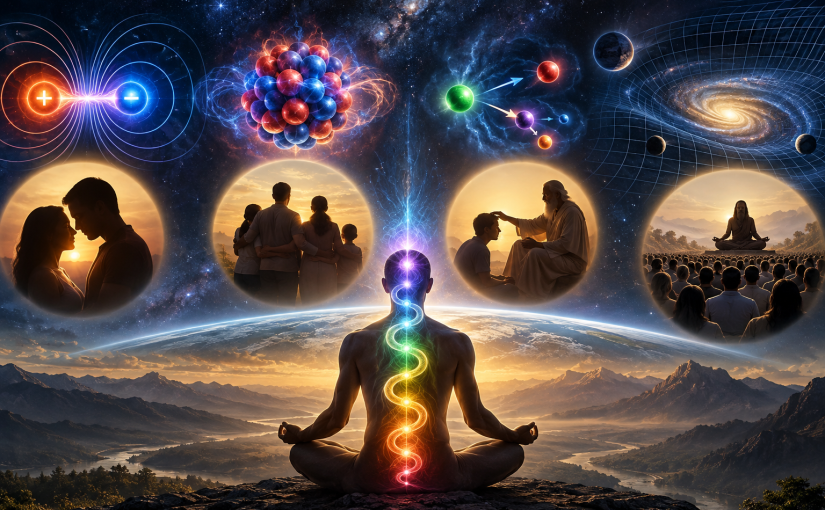
When I began thinking about the fundamental forces of nature, one difference kept standing out to me. In the familiar picture of the electromagnetic, strong, and weak interactions, there is some form of exchange. Particles interact through fields, and in quantum field theory this interaction is described in terms of exchange quanta. Electromagnetism is mediated by photons, the strong force by gluons, and the weak interaction by W and Z bosons. Gravity seems different. In general relativity, it is not ordinarily described as one object exchanging something with another in the same way. Instead, mass-energy changes the geometry of spacetime, and objects move through that curved geometry. This made me wonder whether the difference between gravity and the other forces could also be understood through the human world, through the old idea of understanding the macrocosm through the microcosm.

The attraction between two lovers gives me an image of electromagnetism. There is attraction and repulsion, but there is also exchange. Love, affection, attention, touch, companionship, gifts, care, and sometimes material support continually pass between the two. Their relationship is not simply an invisible attraction; something moves between them and sustains the relationship. In this sense, it resembles the electromagnetic picture, where interaction is associated with an exchange process.

The strong nuclear force suggests another kind of human relationship to me: the family. Family members may love each other, quarrel with each other, dislike each other, and sometimes even strongly repel each other emotionally, yet they remain bound together by an unusually powerful connection. There is also exchange here: food, money, shelter, protection, security, responsibility, inheritance, care, and other forms of support. The family bond can remain powerful even when personal feelings fluctuate. That makes it a useful human analogy for the strong force, not because the two are literally the same thing, but because both suggest an extraordinary form of binding.

The weak nuclear force seems to belong to a different category altogether. It is not primarily a force of binding. One of its defining features is transformation: particles can change from one type into another through weak interactions. That gives me an analogy with those human encounters that alter what a person is. A teacher, a crisis, a profound relationship, a spiritual experience, or some decisive insight can enter a person’s life and leave that person fundamentally changed. Before the encounter one is one kind of person; afterward one is no longer quite the same. In that sense, the weak force can serve as a metaphor for transformation rather than simple attraction or binding.

Gravity then appears to me as the most unusual of the four. My thought is about the attraction that people sometimes feel toward a mystic, sage, or kundalini yogi. A person may be drawn toward such an individual without romance, possession, material exchange, social ambition, or any obvious personal gain. People may become crowded in the discourse hall simply because they want to be in his presence. Yet the relationship can remain strangely non-personal. They may listen, sit quietly, and eventually leave without trying to possess him. There can be attraction without the kind of obvious give-and-take that characterizes ordinary relationships.

This is why gravity provides the most interesting analogy for me. In general relativity, gravity is not simply a force transmitted through space in the ordinary Newtonian sense. Mass-energy changes the geometry of spacetime itself, and bodies move according to that geometry. As a metaphor, I can imagine the mystic as someone who has profoundly transformed the geometry of his own inner space—almost as though he has curved and extended the space-time of consciousness within himself. A curved surface can contain more area than a corresponding flat projection, giving an intuitive image of how an apparently limited inner space might become vast through transformation. Mystics are traditionally described as experiencing Brahman, the pure and unlimited reality beyond the ordinary boundaries of individual consciousness, which can be contemplated as an experience of boundless inner space—not physical space in the scientific sense, but an immeasurable field of awareness. When other people enter such a mystic’s presence, their own inner movement may be altered; they are drawn toward him not necessarily because he is exchanging something with them or because they expect personal gain, but because his presence seems to change the space in which they experience themselves. In this sense, they are drawn not merely toward the person but toward the expanded field of consciousness associated with him, much as people have traditionally been drawn toward figures such as Krishna or Buddha. The analogy is not that consciousness literally curves physical spacetime, but that a transformed consciousness may create an expanded experiential space into which others feel naturally drawn, much as physical bodies move according to the geometry of curved spacetime.

Of course, this must remain an analogy. There is no established scientific evidence that a mystic literally curves physical spacetime through consciousness. Nor can we scientifically say that the attraction toward a spiritual teacher is gravity. The useful point is structural: the mystic gives a human image of attraction that does not obviously depend upon a transaction between two individuals. It resembles gravity as a metaphor because the presence of one changes the space through which another moves.

This also led me to another curious observation. Gravity is enormously weaker than the other fundamental interactions at the particle scale. Humanly, the attraction toward a mystic can likewise appear very gentle and distant. No one necessarily rushes forward to embrace or possess the mystic. People may simply remain at a respectful distance, listen, and still feel strongly drawn toward him. The attraction does not have to produce ordinary attachment.

From this perspective, the four interactions suggest four different patterns: electromagnetism attracts through interaction and exchange; the strong force binds despite opposition; the weak force transforms; and gravity changes the geometry in which movement takes place. These are not literal correspondences between physics and psychology, but they provide a way of contemplating different forms of relationship.

This is where the idea of the macrocosm and the microcosm becomes meaningful to me. The small can sometimes provide a language for thinking about the large. A pattern observed in the physical world can become a symbolic mirror for patterns in human life and consciousness. The microcosm does not prove anything about the macrocosm, but it can help us recognize structures that otherwise remain abstract.

It also makes the problem of a Theory of Everything appear even more profound. The difficulty may not simply be that gravity is another force whose particle has not yet been found. The deeper problem is that the other three interactions have quantum-field descriptions that operate within spacetime, whereas gravity, in general relativity, is itself associated with spacetime geometry. We are therefore not merely trying to put four similar forces into one theory. We may be trying to understand the relationship between the actors and the stage on which they act.

A graviton is expected in some approaches that quantize weak gravitational fields, but no graviton has been experimentally detected, and there is still no complete experimentally confirmed quantum theory of gravity. So perhaps gravity is not merely the fourth member of a group of otherwise similar forces. Perhaps it is pointing toward something deeper in the structure of reality.

That is why gravity feels special to me. Electromagnetism, the strong interaction, and the weak interaction can be imagined through exchange, binding, and transformation. Gravity seems to say something different: the presence itself can alter the space of relationship. Whether that remains only a metaphor or someday proves to reflect a deeper truth about nature is an open scientific question. But the analogy offers a simple way of looking from the human inward to the physical outward, and then back again—from the microcosm toward the macrocosm.

Chapter 7-b: The Hidden Symphony – From Localized Ripples to the Field of Pure Awareness

Friends,
I felt myself sufficiently transformed while writing this chapter. It dissolved a few deep doubts, like those related to Sankhya Vivek Khyati. Initially, I used to think it was something special, but now it feels like nothing other than Nirvikalpa Samadhi in yoga, with only the difference in words differentiating the two philosophies. Similarly, the subtle science behind the union of Purush and Prakriti, and the ignorance found in that, became clearer. I gained a new dimension regarding the witnessing. I got amazing similarity between cosmos and human body. Let us walk together again to see what unfolds ahead.

Just as a quiet lake might mirror the sky with such clarity that one forgets the water is even there, so too the cosmic field, in its truest form, is a smooth, undisturbed presence—pure, serene, and boundless. The seventh chapter previously unfolded the concept of energy and wave-fields within and beyond the human body, culminating in the realization that what appears material is, in truth, a vibrant play of non-material patterns—fields and waves interwoven through space. Now, seamlessly extending from that exploration, this chapter descends deeper—into the hidden movements of those fields, into the invisible architecture of space, and toward the sublime recognition of a field so pure, so untouched by ripple, that it stands apart: the field of pure awareness.

Begin with a single stationary charge, a fundamental entity in physics. It sits silently, yet not inert. Around it radiates an electric field—a subtle tension in space, like a barely stretched fabric. This field is localized, forming around the charge like an invisible cocoon. But disturb this silence, let the charge move—and something changes. Now it does not just sit; it dances. It begins to generate ripples in its surrounding field. Accelerate it, and those ripples deepen, becoming self-sustaining waves—electromagnetic waves, to be precise. These waves are not static imprints but dynamic travelers, pulsing outward at the speed of light, weaving through the vastness of space.

Yet, a curious condition arises here. For a charge to keep producing such waves, it must accelerate—not just move at constant speed, but continuously shift its direction or speed. Similarly, a human brain activity or learning should not be at a constant pace but should be increasing in speed day by day to spread in the world like a wave. But how could one do that without chasing the particle or brain activity endlessly? The solution is profoundly elegant: oscillation. Instead of pursuing a charge endlessly in space, let it swing rhythmically in place—forward and back, like a pendulum of light. And lo, this rhythmic movement becomes the source of continuously emitted electromagnetic waves. In a wire carrying alternating current, electrons do not travel far; they merely oscillate locally, producing ripples that propagate far and wide. But whether in wire or in space, it is this dance—this play of acceleration—that gives rise to light. The same happens in brain to. It keeps on changing subject and direction of activity rapidly instead of chasing a single subject endlessly with increasing speed that can make him mad instead of wavy. Rapdly changing gunas between satoguna, rajoguna and tamoguna also produce oscillating brain. That is why rapidly changing person is often seen successful in worldly matters.

And now arises a philosophical beauty. That which seems so material—light, heat, visibility—is not an object but a disturbance, a ripple in an invisible field. And this ripple has its twin nature: it is both electric and magnetic, each feeding the other in perfect rhythm, a cosmic choreography of mutual arising. What begins as a local ripple in the electric field gives birth to a magnetic field, which in turn regenerates the electric one, and so on, endlessly, as the wave moves. It is like Ida and Pingla nadis in the body that runs alternating with help of each other like a dancing girl, and creating central sushumna wave like em wave propagating to produce spark in consciousness. Why not call electric field ida and magnetic field pingla, and wave propagating ahead sushumna. When ida pulses strong, only then it produces pingla pulsing and vice versa alternatingly pushing ahead the sushumna pulse in between till pulsation is strong, otherwise subtle pulsation of ida or pingla like separate electric or magnetic field goes on happening always without producing perceptible sushumna pulse as em wave. Duality-full worldly working with nondual attitude produces this strong pulsation. Duality provides strong oscillation of charged brain, while nondual attitude keeps mind away from attachment to any special worldly act that can fix charged brain on single matter thus hindering its rapid and continuous oscillation. It is amazing. We keep admiring non-duality always, but duality is also not any lesser participant in spiritual evolution.

But this brings another subtle question to the surface. Are these fields already present in space, waiting to be disturbed, or are they created anew each time a charge dances? The scientific understanding leans toward the former. Space is not empty; it is already a field, a vast and subtle playground, waiting to carry any ripple with ease. The field is there even before the wave arises—smooth, serene, and unmanifest. It is only when something moves—a charge, a particle, a disturbance—that the latent potential becomes kinetic, that the ripple emerges. Similarly, ida and pingla are always there. It is the movement of meditational charged brain that determines the extent of energy transmission in these.

This is precisely why alternating current in household wires does not flood the surroundings with radiation despite its oscillating nature. The wavelength of powerline current (50 or 60 Hz) is enormous—thousands of kilometers long—while the wire, even if spanning cities, remains minuscule in comparison. As a result, the radiated waves do not build up coherently. They cancel and collapse in themselves, barely escaping into space. Only when a structure—like an antenna—is crafted in harmony with the wavelength does radiation become organized and efficient.

And now the stars begin to whisper their secrets. Without human intelligence, without deliberate design, natural celestial bodies become perfect antennas. A pulsar spins with mathematical precision, its magnetic fields aligned just so. Charged particles trapped in its magnetic grip accelerate fiercely, spiraling and spinning—emitting powerful beams of electromagnetic radiation, sweeping the cosmos like lighthouse beams. Even the sun, seemingly chaotic, hides organized thermonuclear rhythms beneath its surface. The intense heat at its core generates photons—packets of electromagnetic energy—which, after a long diffusion through solar layers, emerge as sunlight. This light, this familiar warmth touching the skin on Earth, is the ultimate evidence that the universe knows how to organize waves without needing wires, circuits, or blueprints.

But step back now from particles and stars, from wires and waves, and return to the deeper insight that began this journey—the field. All of these waves, fields, and ripples are disturbances on something. A wave cannot exist without a medium, even if that medium is intangible. In classical terms, the electromagnetic field is that medium—a subtle tension that exists throughout space. But if this field itself has ripples, then is it truly smooth? No. It is already filled with potential disturbances, like a pond ruffled by breezes. A truly smooth field must be beyond even these—beyond motion, beyond polarity, beyond opposites.

This brings forth the concept of the cosmic field of pure awareness. Unlike the electromagnetic field, which carries ripples of energy, pure awareness is undisturbed, motionless, timeless. It is not made of charge or mass. It does not require oscillation to propagate. It simply is. And yet, everything else arises from it—not as an effect arises from a cause, but as a dance arises on a stage. The stage remains unmoved by the drama played upon it. In this sense, the electromagnetic field is a playground, and its waves are the players, but pure awareness is the ground beneath the playground itself. Then why not call this vast, supreme playground Shiva, and the playground that fits within it Shakti? This is the eternal union — yet there is the Leela, the divine play of Shakti dancing and then merging once again into Shiva. This process of expansion and recession repeats endlessly. That is why the male and female enjoy the play of separation and union — to dance and to merge repeatedly. This repeated separation and union is the very essence of love.

If one looks inward, tracing perception back through sensation, energy, and thought, one reaches a similar realization. The mind moves like an oscillating charge, like up and down moods, like up and down breath movements, producing thoughts like em waves. Emotions ripple like magnetic feedback loops. The body radiates energy like a living antenna. But what receives it all? What watches the movement without moving? That is pure awareness. It is the witness field—ever present, never disturbed, beyond vibration.

What is astonishing is how closely the outer physics reflects the inner spiritual path. A charge must be accelerated to emit energy, just as the motivated sou-space must be stirred to produce thoughts and actions. Just as interaction of particle with others produce charge on it, the motivation and inspiration got by soul-space from others create a type of tension or strech on it. Yet, beyond all physical patterns lies stillness—not dormancy, but fullness. In the same way, the ultimate state of being is not a storm of experience but a quiet presence—a state where the field is known not by what it does but by what it is.

And so, as the earlier chapters explored how the body itself behaves like an energy field, like a dynamic hologram of atomic dance, this chapter brings an even deeper recognition—that all these dances, all these waves, point toward something more profound. They are signs of a deeper field, one not of energy, but of being.

Every ripple in the electromagnetic field, every ray of light, every whisper of electricity, is a visible expression of an invisible truth. That truth is that space is not empty. It is filled with potential, with presence, with the ability to express form without being form itself. And beyond even that potential is a state where no wave arises, where no charge is present, where awareness rests in itself—whole, pure, and unmoving.

This is why the body can feel energy not just in the brain but along the spine, in the chakras, in the very cellular presence of being. These are not hallucinations but inner ripples in a subtle field—a field that mirrors the outer electromagnetic field but is rooted in consciousness. Just as light arises from the dance of electrons, so too inner light of mind arises from the subtle awakening of awareness within through dancing moods and thoughts to and fro.

There is wonder in this symmetry. The same laws that govern stars and antennas apply to the self. The same ripples that leave a distant star and travel light-years to reach the Earth are echoed by the ripples of thought crossing the inner space of a mind. But both ultimately point toward the silent field—the pure field that is never disturbed, never touched, and yet allows all experience to arise.

And so the journey continues—from charge to wave, from wire to light, from body to awareness. The path winds through the outer cosmos and the inner self, always returning to the same mysterious truth: that reality is not made of things but of fields, and the final field—the field behind all fields—is pure awareness. It is the cosmic mother-field, upon which all players play, unaware sometimes that they are all made of the same eternal silence.

Many people look confused when the talk of witnessing arises. Many think the ever changing mind is the witness. But in fact, only that which is changeless can watch changing things. How can something that itself keeps changing witness or remember another changing entity? Suppose A is watching object 1. Now, if A suddenly becomes B, how can B remember the experience of watching 1—unless there is something unchanging in A that continued into B? This shows that the real witness is not the changing body or mind, but a stable, unchanging awareness. Another perspective is that everything in the world is not truly created new, but simply a rearrangement of the same underlying substance into different shapes and forms. In this view, the only real “stuff” that exists is pure awareness. The only witness possible is also this very same. Other everything that do not have even their own existence, how can they become witness. Whether see at cosmic level or at body level, the rule does not change. At both places, witness is only that same single one. It is not made from anything else—it is the source, the base, and the material of all appearances. True existence belongs only to this so called dark, silent field of unchanging, pure awareness. The luminous world also called Prakriti—what we see, feel, and think—is made up of waves, fields or charges constantly shifting and passing. How can something that is always changing be said to truly exist? And if it has no independent existence, how can it hold real knowledge and bliss? These three—existence, knowledge, and bliss—always living together, appear in the luminous, changing world because of illusion. In truth, their source lies in the silent, unshaken, dark field—the foundational sky also called Purusha—upon which all waves play like fleeting ripples. And Sankhya philosophy rightly says to separate purusha from prakriti. A mixture of both is world-originating though being a nightmare for liberation seekers. Unconscious Prakriti becomes like conscious with company of conscious purusha. But when it perishes as it being perishable by default, it becomes unconscious, because how can one remain conscious if it is even not existing. Perished can not be conscious. Due to this, purusha also start considering itself unconscious or perished or dead because it was snugly attached to prakriti. And the prakriti perishes every moment, so the purusha feels itself unconscious every moment. However, full perish is at the time of death of the body. The world is based on a lie. We purushas give existence to everything or prakriti in the world, but in reality, nothing truly exists. We share the real existence of our own souls with everything, and in return, we forget even our own existence and become non-existent—just like the worldly things we associate with. It is truly said: beware of bad company. But don’t worry. Through regular practice of Yoga, Keval Kumbhak, and Nirvikalp Samadhi, the soul gradually remembers this existence of its own pure awareness. This path is both worldly and practical—because denying the world is neither wise nor truly possible. Keeping detached and non-dual attitude with help of suitable philosophies like sharirvigyan darshan during worldly indulgment seems the only middle path for a business minded and worldly progressive person to be saved from the bite of this prakriti-serpent.

One day, I got a good example of the middle path. In the evening, I had spent around 15 minutes in Padmasana. As I sat, my breathing gradually slowed down. Just then, my tiffin arrived, and my mind rushed toward thoughts of food and hunger. Somehow, I tried to continue and spent another 15 minutes attempting to regain Dhyana, but eventually, I stood up and had my dinner. Due to the calming effect of meditation, my appetite had reduced significantly, so I ate only half the usual portion. At the same time, I regretted my foolishness for breaking the state of Dhyana. After dinner, I sat in Vajrasana, and suddenly, my breath almost came to a complete standstill—for 20 minutes. Then I shifted to Sukhasana for about 30 minutes, and even with surrounding noise or slight body movements, the breath remained still and subtle, barely regaining any motion. At that moment, I remembered Buddha—how, when he had been meditating with an empty belly, his Dhyana was not reaching completion. But on the day a devotee lady offered him a bowl of dessert, and he accepted and ate it, he attained perfect Samadhi and Nirvana.

Purusha is attracted by the shimmer of Prakriti just as an insect is attracted towards the candle flame and both get perished. Prakriti is cheater. It first enjoys everything with company of purusha. Once it perishes, purush can not be saved then because both are snuggly joined to each other. That is why it is called thagini, dakini, pishachini, maya, sofia etc. in scriptures. That is why sankhya thought of school advises to separate purusha from prakriti and rest in purusha in peace. However, it is only possible with yoga that emerged from sankhya due to this very same reason. This all has been detailed only to evoke interest in yoga, otherwise blank philosophy can never reveal the truth. The state of nirvikalp samadhi is the state of this isolated pure purusha.

True liberation is not achieved by bypassing form, but by passing through it with full awareness. Only after Purusha consciously experiences the complete union with Prakriti — as in Savikalpa Samadhi — can it effortlessly transcend into Nirvikalpa Samadhi. This is why the Sanatana path, with its emphasis on idol worship, mantra, and gradual inner refinement, is not only spiritual but deeply scientific. It honors the natural journey from the manifest to the unmanifest — from form to formless.

In the cosmic state too, the same process as soul development unfolds—when the expanding world reaches its outer limit, it begins to dissolve back into the same pure mother field from which it had originally emerged.

Up to the stage of Nirvikalp Dhyana, there still remains a subtle potential for the world to arise. You can call it a weak electromagnetic field, from which the electromagnetic wave—appearing as the world—can emerge. In this deep meditative absorption, the seed of manifestation—the quiet power to perceive or imagine a world—still exists in a dormant state. But when one goes deeper and enters Nirvikalp Samadhi, even this potential is transcended. It is the stage where even the faintest tremors of the electromagnetic field vanish. In that state, there is no observer, no imagined world, and no seed of creation. That is why it is called Nirbeej or seedless samadhi. Only pure awareness remains—formless, actionless, and beyond the cycle of appearance and disappearance. From here, there is no automatic return to world-experience unless awareness itself chooses to veil itself again. The potential to form the world in pure existence is not physical—unlike the vibrations seen in earlier stages—but is entirely immaterial and experiential, existing only as pure presence, nothing else. As per another view, even in deep meditative states such as Nirvikalp Dhyana, one may experience a subtle sense of potentiality—a precondition for experience—but this may not be physical in the sense of measurable waves or energy fields. Unlike earlier states where internal experience may correlate with neural activity, subtle vibrations, or sensory imagery, this deep state transcends such phenomena. The ‘potential’ here refers to the pure capacity for awareness to manifest experience—not through energy or vibration, but through the sheer presence of consciousness itself. From a neuroscience or physics standpoint, this cannot be described as an electromagnetic field or wave. Rather, it’s better viewed as a subjective, non-material awareness—an experiential space in which forms might later arise. Any attempt to link this directly to electromagnetic fields would be metaphorical unless supported by measurable brain states or field interactions.

The term charge carries meaning beyond just particle physics—it implies a type of stress, potential, or readiness to act, much like when we say someone has been ‘given charge’ of a position. It doesn’t inherently mean a physical entity, but a dynamic condition. In this way, just as a particle becomes charged, the brain too can become charged. This creates a kind of tension or polarization within self-awareness—like a stretching or subtle stress in the fabric of inner space. This tension is experienced as the electric field. These are the finest tremors of potential—subtle fluctuations that, with a slight stimulus, are ready to unfold as electromagnetic waves, as thoughts or sensations. Without charge, there is no field, no ripple, no wave—only a clean, smooth, unperturbed state of space externally, or pure awareness internally. Charge is the seed of all movement, all experience. What we call work stress seems to be the same kind of stretch or tension in the inner sky of awareness.

Just like an officer taking charge of an office is quick to respond in office work, but a layman will take much more time to adapt to the environment first and then work through interaction with different people—similarly, a charged particle, having its surrounding space already stressed as an electric field produced by itself, is much quicker to produce an EM wave with the slightest motion, while an uncharged particle will have to create charge in itself first through interaction with other particles. In the mental sector, a charged brain, having inner space stressed as so-called darkness or ignorance produced by itself, is quick enough to produce working thoughts with the slightest energy stimulus, while an uncharged brain of a samadhistha yogi will take much more time, first developing charge inside it through people’s interactions, inspirations, and motivations. Just as small length of antenna helps oscillating charged particles to produce effective em wave, similarly, focused meditation, rather than widespread and haphazard thinking, helps in the origination of long-lasting and effective thought waves. That is why, after samadhi, there is clarity in thoughts.

If we recall the psychological essence of this whole lengthy chapter in a single paragraph, it becomes the following.

Departed soul-space, although smooth and without ripples, is stressed. We can liken it to the faintest of electric fields. It is very faintly charged. It is a localized space, although always connected to the infinite supreme space. Yet, the soul feels itself restricted locally. No doubt, space is space—there is literally no difference between local and non-local space. Both are smooth and without ripples. There’s no actual boundary between both possible. But soul-space is charged. The ego, desires, attachments, and dual lifestyle of the previous birth acted like a charged particle and made the soul-space charged and localized, virtually isolating it—through illusion—from the vast, endless, and uncharged space of the supreme soul. It has the potential to develop similar ripples of ego, desire, karma, and thoughts as were present in its previous lifetime. Hence, it takes rebirth—unlike the liberated soul, which is uncharged and feels fully one with the supreme soul. This proves that every thought and action of ours goes on being recorded in the form of the soul’s charge. This charge is what the scriptures refer to as ignorance (agyana), the veiling of the soul, bondage of soul, karma bandhana etc. and so on. This is literal bondage—like an animal gathered from open fields and tied to a peg, the infinitely existing soul is similarly localized. This description is not only literal, but based on my own experience of encountering a departed soul in a dream visitation, as described in detail at many places. The brain or soul space also becomes charged after yoga. This is because gross thoughts become reduced to mere potential or charge. That’s why it is advised to discharge it through nirvikalpa dhyana by sitting calmly at the end for an hour or two. This leads to nirvikalp samadhi or merging with supreme soul as with this even hidden potential or charge of soul space gets smoothed out. Otherwise, it will be discharged through worldly activities during the day. This worldly discharge further increases hidden charge of the soul space through new karmas and thoughts. However, this discharge—especially when helped by sharirvigyan darshan dhyana—will be centered in detachment and non-duality, as the process of charging through yoga was done with the same mental attitude. So built up charges and subsequent discharges will be less gruesome. This is opposite to the ordinary worldly charging of the brain, which is associated with attachment, desire for results, ego, and duality. Therefore, the same negative qualities remain during discharge too, which keeps increasing the soul’s bondage more and more. A similar miracle occurs through Sharirvigyan Darshan-based Karma Yoga. With it, mental EM waves produced during worldly activities are subdued to a mere charged potential. Given the right opportunity, this potential can even smooth out into a glimpse of samadhi, as happened to me. It’s a heartfelt experience—not just a literal or intellectual exercise. In a non-yogic lifestyle, charge is produced forcefully, compressing prior mental garbage and hiding it in a corner of the soul-space. This later manifests as various psychological and physiological complications, including the progressive bondage of the soul. But yogic charging is of a releasing nature. It doesn’t hide prior mental garbage or create new charge from scratch. Rather, it reduces existing mental impressions to the level of subtle potential. In this way, mental cleansing also happens. With this approach, we find readymade charge and don’t have to struggle to produce it afresh. Moreover, the charge naturally aligns with our personality and environment. We can even screen these charges—eliminating the harmful ones and nurturing the beneficial—thus allowing continuous soul development in a streamlined way. This process is deeply rooted in self-experience. In contrast, creating fresh charge is risky, and the guidance of a quality guru becomes essential. It’s well known that no one can read another’s mind; it’s wiser to mold our own charge according to our situation. It may take a little more time, but it is well-proven and deeply experienced already. In a nutshell, If the charge, potential or electric field gained through yoga by being reduced from em waves of gross thoughts isn’t smoothed out, it again redevelops into mental EM waves of thoughts through worldly activities, which then need to be subdued once more—first by reducing them back to potential state to head towards the nirvikalp state of pure awareness. It’s not hard to believe that mental EM waves produce pictures of experience on the screen of soul-space, especially when science has already shown that EM waves can produce images on a TV screen.

This insight is not just for physicists or mystics. It is a truth open to anyone willing to look closely—at the stars, at light, at thought, or at breath. For behind it all, there is a field not of matter, not of energy, but of presence. And that presence is who one truly is—not the ripple, not the player, but the ground upon which the game is played.
Chapter 3: Can a Whole Body Fit Inside an Atom?

In the last chapter, we asked: if the entire universe is a holographic projection, then who is observing this cosmic screen?

That question is not separate from science. It’s the very heart of it.

Everything we see — the planets, the people, the pain, the play — all of it might be appearing on a kind of invisible surface, just like a 3D movie on a flat cinema screen. But unless someone is watching that screen, the movie doesn’t truly exist. So the most important question isn’t about how the movie appears, but who is sitting in the audience — silently witnessing the show.

This witness is not your eyes. Not your brain. It is the soul — the spacious, aware presence behind all perception. And it is not passive. It does something magical. It translates a flat image into a living, breathing experience.

That’s why we don’t just see shapes and colours. We feel love. We feel distances. We experience space. Why? Because the soul itself is not flat. It is three-dimensional space, infinite, silent, conscious — and from it, all volume and depth arise.

The brain helps process signals, but the soul gives depth to reality. Without it, everything would be flat and meaningless. That’s the secret behind our experience of life as a deep, vast, unfolding mystery.

This insight also helps us approach the central question of this chapter — can a whole body fit inside an atom?

At first glance, it sounds ridiculous. Our body has bones, skin, blood, thoughts, breath — how can all of that fit inside something smaller than a speck of dust?

But if you look deeper, you’ll discover a quiet miracle. Every cell of your body carries the entire blueprint of your form — your DNA. And DNA itself is smaller than what we can imagine, yet it contains everything — your eye shape, your voice, your sleep patterns, your tendencies. And DNA is made of atoms.

So, in a simple yet astonishing truth — your entire body is already folded inside the atom. Not physically, but informationally. Like a movie is stored inside a memory chip, your whole being is encoded inside the atomic architecture of your cells.

And the more we understand information, the more we realise that information doesn’t need volume. It only needs pattern. A single holographic pixel can carry the image of the whole — and this is true not just of science, but of our very existence.

In ancient Yogic vision, this was never news. The Rishis saw that the subtle body (sukshma sharira) holds the full record of all our lifetimes — not just the current one. These records aren’t written in ink, but in subtle ripples — samskaras — which move through our soul-space like gravitational impressions.

These ripples don’t die when the body dies. They stay. They vibrate quietly in the background of consciousness, waiting for conditions to rise again. Just like ripples in space don’t disappear after a star collapses — they stretch as gravitational waves, holding memory across eternity.

This means the human soul is a personal holographic space, containing subtle ripples, vibrational patterns, and emotional waves from countless lives. It is like a microcosmic version of the cosmos. And these ripples are held by prana — the subtle life force, just as in the universe, cosmic prana may be holding all gravitational memory after the end of galaxies.

So what scientists now begin to say — that the universe stores its history as stable gravitational waves — was already intuited by ancient seers. Our individual soul-space is a smaller echo of cosmic space — each carrying memory, pattern, and subtle desire. The universe is the macro-soul. We are its holographic reflections.

And now I must tell you something that confirmed this to me beyond theory.

I once had a powerful experience — a visitation in a dream — of a freshly departed soul. But it didn’t appear merely as the person I knew in this life; it was much more than that. It came as a deeply encoded field of identity. It felt like the average of all its lifetimes, distilled into a single compact vibration — heavy and dark, but not in an evil sense. More like dense light wrapped in darkness, or a sacred knot of memory — a concentrated bundle of impressions woven from countless experiences, identities, and emotions across time. It wasn’t chaotic, but felt intentionally held together, like a spiritual DNA preserving the soul’s essence. Sacred, because it bore the silent weight of eons — yet still a knot, because it hadn’t fully unraveled into freedom.

It was alive — more alive than ever, in a strange and quiet way. Yet I could see that its soul-space was compressed. It wasn’t empty, but it was concealing its personal identity within itself, folding inward like a lotus closed at night. Its core felt heavy, as if burdened by unresolved identity — by samskaras carried across eons. Simply put, or in a nutshell, it was like a space filled with complete darkness, yet invisibly encoding an individual identity within. Because of this encoding, I could unmistakably feel it as that same individual — fully alive — even though nothing was present except sheer, expansive darkness and silence. It was an astonishing kind of encoding. Perhaps it is akin to subtle gravitational ripples in space.

It was not tortured, but it was not free. Its experiential light — its vastness, its bliss, its clarity — was present, yet covered, veiled, or diminished. It appeared lesser than the state of a living human body. Had it appeared more — more radiant, more open — it would have been recognized as liberated. Though it believed itself to be liberated, this belief was shaped by illusion and carried a subtle doubt. It even asked me to confirm its liberation, but I denied. That subtle compression of soul-space — that invisible binding — was its true suffering. It didn’t recognize it as suffering, but I did. A man who has lived in a well for eons cannot know what lies beyond, but someone outside the well can see it — and point toward the truth. It wasn’t pain in the usual sense, but rather the quiet ache of being less than what one truly is — that is, absolute.

In that moment, I understood something profound — liberation is simply the release of these samskaras. It is the melting away of these inner gravitational waves. Liberation is not the end of life, but the end of compression. One may be sitting in a cave yet still be bound and compressed by samskaras, while another, even as a king amidst the world, may be entirely free of such compressions.

Just as a black hole may one day dissolve its trapped information into open space again, the bound soul too can release its encoded ripples and return to satchitananda — being, consciousness, and bliss — in their natural, free, shining form.

So what does this say about the universe?

The scriptures say even Brahma, the cosmic creator, has a lifespan. When the cosmic play ends, even he dissolves. But just like a soul, Brahma doesn’t vanish. He merges into infinite stillness — into Brahman, the pure, ripple-free field.

This is Mahapralaya — the Great Dissolution. But it’s not destruction. It is deep sleep. And from that silent space, one day, a new Brahma emerges — and with him, a new universe, a new screen, a new holograph.

Why? Because the infinite never runs out of potential. It doesn’t need desire to create. It simply flowers.

And so it is with you. When your samskaras melt, when your inner ripples calm, when your soul becomes like clear, still space — you don’t vanish. You shine. You become the screen and the observer — at once.

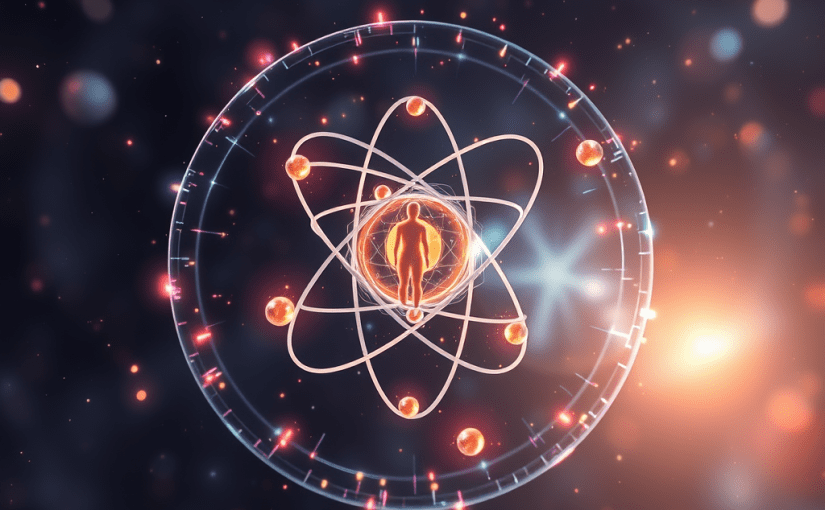
So yes — a whole body can fit inside an atom. Because the body is not merely flesh and bone; it is a vibration, a subtle blueprint, a densely compressed field of infinite memory and possibility. What we perceive as the physical body is only the outermost layer. At its core, it is energy — encoded with the entire history of one’s being across lifetimes — all folded into a single point of consciousness, much like how a vast hologram can be stored in a tiny fragment of space. Just as the energies and impressions of infinite lifetimes can remain encoded in the soul, the same kind of encoding can be stored within the space bound by the boundary of an atom. In that minuscule realm, unimaginable depth and memory can reside, hidden yet alive. Just as the portion of infinite space within the human head can hold unlimited energy patterns as encoded impressions, then why can’t the part of infinite space bound within an atom also hold the same — the energy patterns of a human, or even of the entire cosmos? It is not a matter of size; it is a matter of structure — of holography. In a holographic reality, the whole is reflected in every part. So even the smallest boundary, like that of an atom, can encode the vastness of existence within it.

And inside that atom — there may be a holograph of not just your form, but of your past, your future, and the entire cosmos.

You are not a fragment — not a broken or isolated piece of existence. You are a portal: a living doorway through which the infinite expresses itself. You do not merely belong to the universe; the universe flows through you. Within you lies access to all dimensions of being — from the deepest silence to the highest awareness. You are not a small part of reality; you are the point where reality opens, unfolds, and becomes self-aware.

You are not inside space. Space is inside you.

And the one watching all this — the one reading these words now — is not a character on the screen. It is the eternal observer, patiently waiting for you to remember:

You were never just the story.
You were the light behind it all.

Individual Soul as Space — Ripples, Prana, and Cosmic Memory

I’ve been deeply fascinated by the idea that the information of a lifetime doesn’t just vanish after death. Instead, it remains as imprints — subtle and stable — like ripples frozen in space. These ripples, I feel, are what the Yogic tradition calls the Sukshma Sharira, the subtle body. Even Patanjali’s definition of Yoga as Chitta Vritti Nirodha — the cessation of the mind’s modifications — is essentially about dissolving these exact ripples. Once they dissolve, the space-like soul becomes fully pure again — free, mindless, and liberated. These ripples are what cover the natural infinity, knowledge, and bliss that is the nature of the soul. The more ripples there are, the more limited and distorted the experience becomes. Interestingly, I’m seeing scientists talk similarly about the physical universe — how ripples in space-time, like gravitational waves, store information and preserve memory of cosmic events. The parallel feels profound.

I asked myself — can this insight be translated into something structured and communicable? A diagram perhaps? And yes, the core idea is that in both ancient yogic philosophy and modern physics, ripples hold memory. In the human soul, they’re subtle thoughts and impressions. In the cosmos, they’re gravitational or quantum ripples. When they’re stilled, either through deep meditation or natural cosmic stillness, what remains is pure being.

Then came a deeper insight. Just like the human soul stores the mental formations in its subtle layers and carries them forward, could the universe itself — after its death — retain its memory in the form of stable gravitational waves? Could these waves be like the soul’s sanskaras? This would mean that the universe, too, is reborn with characteristics similar to what it previously held — just as a human being is reborn with a tendency pattern from earlier lives. It seemed clearer now: both the human and the cosmos are memory-bearing entities. In humans, that memory is preserved in the subtle pranic structure. In the cosmos, that memory is stored in the fabric of space-time itself.

But the pattern doesn’t stop there. Just as the human soul is sustained by prana — the subtle life force — even after death, that prana does not perish. It stays in an unmanifest form, sustaining the subtle impressions or ripples. So, shouldn’t cosmic prana also survive after the death of the universe? It makes sense to think that the pranic energy of the cosmos — perhaps what science refers to as dark energy or vacuum energy — doesn’t disappear. Instead, it sustains the subtle ripples in the vastness of space. The same mechanism seems to repeat: subtle energy sustains subtle form, whether in the microcosm of a soul or the macrocosm of a universe.

This led to a bigger question — if the human soul can be liberated by dissolving its ripples, what about the cosmic soul? Can Brahma — the creator — be liberated? And if yes, does that liberation happen after many cycles of creation and destruction as the scriptures say? The answer in traditional cosmology is yes. Even Brahma, after living a span of unimaginable length and creating countless universes, ultimately merges into Brahman — the absolute. Just like the individual soul, Brahma too is not absolutely free until the very last ripple is stilled — when even the desire to create dissolves. This is the true Mahapralaya — the final dissolution, not just of matter and space, but of all mental intention, even divine ones.

This brings up an essential doubt. If Brahma — the cosmic mind — is liberated, then how can a new universe emerge again? Isn’t the story over? But the scriptures and philosophies say that the play is beginningless and endless. Even after the dissolution, the potential remains in Brahman. A new Brahma arises — not from karmic bondage, but spontaneously — from the freedom of infinite stillness. It’s a divine pulse, a self-expression, not a necessity. In the same way that waves naturally arise from still water without any karma, a new cosmos arises from the infinite potential of Brahman.

This aligns with some scientific models too. Quantum field theory tells us that the vacuum is never empty — it always retains the potential for particles, energy, even new universes to emerge. Some cosmologists believe that universes are cyclic — they collapse, leave an imprint, and then arise again. So the philosophical and scientific views seem to be converging on this one mysterious truth: nothing ever truly begins, and nothing ever truly ends.

And then came perhaps the most integrated insight of all. If the human soul is carrying ripples, and the universe is carrying ripples, then maybe the soul isn’t just a “drop of consciousness” — maybe it’s a space unto itself. A localized field. An individual bubble of space-time carrying its own gravitational ripples (samskaras), sustained by its own dark energy (subtle prana). This would mean that the individual soul is nothing fundamentally different from the cosmic soul — just a localized, individualized expression. It’s the same ocean appearing as a unique wave. The same infinite field, just folded into a personal experience. The Sukshma Sharira becomes a field space — full of memory (ripples), energy (prana), and consciousness (Atman) — just like the universe.

This realization made everything fit. In science, the holographic principle tells us that each part of space contains the whole. In Vedanta, Atman is Brahman — the soul is not different from the whole. The soul becomes bounded not because it is lesser, but because it identifies with its ripples. And liberation — for both the Jiva and Brahma — is the return to boundary-less awareness. The field collapses into itself. No more ripples, no more time, no more cycles. Just the infinite, again.

And yet — from that infinite, new ripples arise. A new soul, a new Brahma, a new universe. The play never ends.

Kundalini Yoga makes dark matter behave as dark energy

Friends, both the beingness of physical world and its non-beingness do not exist. Man gives existence to both. World beingness or jagatbhaav is an undivided part of Purush. Hence, Jagat-Abhaav or world’s non-beingness also proved to be a part of Purush. Of course, much smaller than Bhaav. If we call Jagat-Bhaav an undivided part of Purush, then there is no problem in calling Abhaav an undivided part of Prakriti. With knowledge and sadhana, man can become Purna Purush, but how will he become Purna Prakriti? Purna Purush exists, but Purna Prakriti does not exist. By the way, even the complete Jagatbhaav does not exist. Meaning, only partial Jagatbhaav can exist. This is because Jagatbhaav gets its existence from the experience of the living beings. And there is no such living being that can experience the complete Jagatbhaav together. All the living beings of the universe cannot do this even together. Similarly, the existence of complete Jagat-Abhaav i.e. Prakriti is also not possible. This means that though the entire world of existence and the entire world of absence have a physical existence, they do not have a soul and no living being experiences them.

Because Purusha never gets destroyed, therefore it does not have an absence. This means that the shadow of Purusha cannot be formed. Shadow is actually called absence. The shadow of a tree is actually not of the tree but of light rays. The shadow of the tree is considered to be in the area where there is an absence of light rays. Similarly, the shadow that is formed by the world is formed by the absence of Purusha offcourse virtual absence. This means that the world is like a tree and Purusha is like the Sun. Similarly, the shadow of the entire creation is Prakriti, Purusha has nothing to do with it. The absence of the entire world will be called mool prakriti. Because the entire world is also an undivided part of Purusha, That is why in practice the original nature aka mool prakriti is called the shadow of Purusha. The shadow-like absence created by Laghu, that is, the individual or the small world, will be called Laghu or the individual or the small prakriti. This means that only the individual world gets experiential existence and not the collective world. Although both have a physical existence.

Prakriti cannot directly reach the purusha. It has to climb up gradually through the purusha elements. Therefore, it keeps on increasing the undivided purusha element gradually. The smallest organisms like bacteria etc. do not have any Purusha element. But this is the first step of the body-like ladder that produces the purusha element. Then in organisms like frog, fish etc., the soul that had once become Prakriti starts feeling the purusha element. In creatures like dog, monkey, this element increases considerably. In man, this element is at the highest level. From this level, Prakriti can directly jump to the purusha through kundalini yoga. This means that a body more developed than the human body is not required. In this case, Superman etc. seem to be mythical concepts, which do not seem to have any special purpose.

We can never experience the gross world directly. Neither its presence nor its absence. We can only feel the subtle picture of the gross world that is formed on our soul. We feel the picture of the beingness of the gross world in the form of various objects like mountain, river, sun etc. We feel the non-beingness of these substances in the form of darkness. It is the subtle form of darkness. But its gross form also exists outside, just as the gross form of the subtle world experienced in the soul is in the form of the gross world outside. That gross darkness is probably called dark energy, dark matter etc.

Like the physical body, the physical world also has a life limit. Just as the body dies when it touches that limit, similarly the world also perishes when its life span is over. The gross body merges into the vyashti or individual prakriti in the form of the subtle body. The gross world merges into the collective or samashti prakriti i.e. the mool prakriti with names like dark energy and dark matter. A new body is born again from that subtle body. Similarly, a new world is also born from the mool prakriti. This trend continues cyclically for ever.

Many people say that this world originated from the Supreme Soul. In reality, nothing is born from Purusha. He is absolutely unattached. He is amazing and unique. Yes, the world gets experiential existence from his proximity. World is eternal and infinite like the purusha. The difference here is that the purusha always remains perfect and unchanging, while the world keeps changing. The world is sometimes in the form of beingness and sometimes in the form of non-beingness. It has countless levels of expression in the form of beingness and also countless levels of expression in the form of non-beingness. This world is called prakriti. When it gets proximity to the purusha, then it comes within the realm of experience, otherwise it keeps moving without experience, as if a dancer is dancing in the darkness. That is why it is said that the entire world that can be experienced is created with the cooperation of prakriti and purusha.

Similarly people say that children come from God and hence are the visible form of God. As soon as a man is born, he starts feeling the pictures of the world in his mind. They can be felt in the mind only if they are already present in the subtle body of the child, otherwise those pictures will definitely be formed but no one will feel them. What is meant to say is that those luminous pictures can be formed only on the subtle body of darkness. If the soul of a child is in the form of a luminous purusha instead of a dark subtle body, then how can luminous pictures be made on it? Sketches cannot be made with light on a luminous wall. First, the wall has to be made black or dark. Yes, it is definitely true that children are closest to God, because they have very little feeling of ego.

Prakriti keeps manifesting and unmanifesting. This is an eternal cycle. Purusha has nothing to do with it. It is a stable, eternal and conscious element. Prakriti gets power and motion with its proximity, just like iron gets power and motion with its proximity to a magnet. Unmanifest prakriti can be called dark matter. Dark matter has only gravity, nothing else. This means that dark matter exists and even does not exist. It “does not exist” because it does not have any characteristic of an existing object. It cannot be seen, heard or touched. It is not within the reach of the senses. It “exists” because it has gravitational force. Gravitational force is also a common or small characteristic of beingness or existence. That is why it is said that the words of so and so have weight or gravity. This means that the words of so and so have practical existence. Dark energy can also be the mool prakriti. This too is indescribable like dark matter and original nature aka mool prakriti . It “is not” because it has no characteristics of a physical object. It “is” because it produces an effect like energy. So it is possible that both are the same thing. The existence of a thing is also associated with its effect. Existence is incomplete without effect. If a hard rock cannot cause injury, then there is no point in the existence of that rock. Dark matter is like that hard rock, and dark energy is the injury caused by it, which is pushing the universe outwards. Just as a rock lying in a river can stop a flowing man, and can also carry a man away with it, in the same way the original nature can bind all the celestial bodies together by behaving like dark matter, and can also push them away from each other by behaving like dark energy. The darkness of the mind of a common man is like dark matter, which pulls and binds his world towards itself. But the darkness of the mind of a Kundalini Yogi behaves like dark energy, which keeps trying to push his world out of itself. That world then comes out and keeps re-emerging in his mind, and keeps merging into the luminous soul. A balanced man has the balanced ratio of dark matter and dark energy just as in the outside stable universe.

In this sense, the creation of man’s mind should also be swinging between the expressed and the unexpressed, since time immemorial. Meaning, man’s bondage should be eternal. We will analyze this in the next post.

कुंडलिनी योग विवाह, रोमांस और संतानोत्पत्ति में सहायक है

दोस्तों, प्रकृति एक विशालकाय मां की तरह है। अंतरिक्ष इसका पेट है। जब पुरुष-पिता के द्वारा इसमें गर्भाधान किया गया, तब सूक्ष्मतम मूल कण इसके गर्भ में स्थापित हो गया। उसमें महा-विस्फोट अर्थात बिग बैंग के रूप में विभाजन और विकास की शुरुआत हो गई। जैसे-जैसे यह सृष्टि रूपी महा-भ्रूण बढ़ता गया, वैसे-वैसे इसके पेट का आकार भी बढ़ता गया। इसे ही वैज्ञानिक अंतरिक्ष का फैलना कहते हैं। आज भी अंतरिक्ष फैलता ही जा रहा है। जब यह सृष्टि रूपी बच्चा बड़ा होकर पूरी तरह विकसित हो जाएगा, तब उसका और आगे बढ़ना रुक जाएगा। उस समय प्रकृति के उदर का आकार भी स्थिर हो जाएगा। लंबे समय तक यही स्थिति बनी रहेगी। फिर यह सृष्टि रूपी आदमी बूढ़ा और कमजोर होने लगेगा। इससे इसका आकार भी घटने लगेगा। इससे प्रकृति मां के पेट का आकार भी घटने लगेगा। इसे ही वैज्ञानिक बिग क्रंच अर्थात महा सिकुड़न कहते हैं, जब अंतरिक्ष का फैलना रुक जाएगा और वह धीरे-धीरे सिकुड़ने लगेगा। फिर अंत में यह महा विशालकाय आदमी मर कर उसी मूल भ्रूण कोशिका के रूप में सिकुड़ जाएगा, जहां से इसका विकास शुरू हुआ था। फिर वह अंतिम मूल कोशिका भी उसी प्रकृति में मिल जाएगी, जिससे वह बनी थी। अंतिम मूल कण प्रकृति से ही बना था, और वह प्रकृति से ही पोषण प्राप्त करके बढ़ता गया था। इसीलिए प्रकृति को मां भी कहते हैं। पुरुष ने तो केवल जरा सा सहयोग किया प्रकृति का। उसके प्रार्थना करने पर उसे अपना बीज प्रदान किया है। सृष्टि-पुत्र की ज्यादा जरूरत प्रकृति को ही है, क्योंकि वह उस के माध्यम से अपनी कल्पित कमी और हीनता की भरपाई करना चाहती है। पुरुष तो मस्त मलंग है। वह अपने आप में पूर्ण है। उसे किसी की कोई जरूरत नहीं है। असली दुनियादारी में भी तो कुछ-कुछ ऐसा ही दिखता है। हां, चतुर लोग प्रतिदिन कुंडलिनी योग के माध्यम से प्रकृति-पुरुष का मिलन कराते रहते हैं, और अपनी मनचाही सृष्टि-संतान का निर्माण करते रहते हैं।

खाली अंडा कभी नहीं फूटता। खाली मादा-बीज कभी वृक्ष नहीं बनता। खाली मिट्टी भी कभी वृक्ष नहीं बना सकती। वृक्ष में नर-बीज, मादा-बीज और मिट्टी, तीनों के अंश होते हैं। पर सृष्टि में पुरुष और प्रकृति, केवल दोनों के ही अंश होते हैं। भूमि बीज को पोषण प्रदान करती है। नर-बीज को विविधता मादा-बीज के साथ मिश्रित होने से मिलती है। मादा-बीज को भी विविधता नर-बीज के साथ मिश्रित होने से ही मिलती है। उधर प्रकृति मादा-बीज भी है, और मिट्टी भी वही है। मतलब वह पुरुष-बीज अर्थात नर-बीज को विविधता भी प्रदान करती है, और उसे बढ़ाने के लिए मिट्टी का काम भी करती है। ऐसा इसलिए है, क्योंकि सृष्टि के प्रारंभ में पुरुष और प्रकृति के इलावा अन्य कुछ भी नहीं था। प्रकृति में अव्यक्त रूप में छिपे हुए अति सूक्ष्म तत्त्व पुरुष-बीज और मादा -बीज के मिश्रण से बने मूल कण को बढ़ाते रहते हैं। प्रलय के समय सारी सृष्टि खत्म होकर प्रकृति में सूक्ष्म रूप में समा जाती है। उसे सांख्य की भाषा में अव्यक्त कहते हैं। उसी अव्यक्त से पुनः नई सृष्टि का निर्माण होता है। यह ऐसे ही है, जैसे सारे जीव-जंतु और पेड़-पौधे मर कर और सड़-गल कर सूक्ष्म तत्त्वों के रूप में मिट्टी में समा जाते हैं, और फिर मिट्टी के उन्हीं सूक्ष्म तत्त्वों से पोषण प्राप्त करके नए जीव-जंतु पैदा हो जाते हैं, और नए पेड़-पौधे उग आते हैं। साथ में अलग-अलग मात्राओं में और अलग-अलग तरीके से संयोग करके, पुरुष-बीज और प्रकृति-बीज संसार में विविधता भी पैदा करते हैं। वृक्ष के मादा-बीज और नर-बीज भी इसी तरह आपस में अलग-अलग मात्रा में और अलग-अलग तरीके से जुड़कर वृक्षों की विभिन्न प्रकार की किस्में पैदा कर देते हैं।

Kundalini Yoga can reunite the son with his father most easily

Friends, Lord Krishna says in Geeta that he is the father of the universe, who in the form of Brahma puts his semen as seed inside his wife Prakriti. The entire creation originates from him. Come, let us understand this scientifically. If we go deeper into the scriptures, we will find many secrets hidden in them. A ring was formed with the luminous line of Purusha or luminous sky within the tamas-sky means dark or unconscious sky or Prakriti. That virtual sphere was the original fundamental particle. It was like drawing a ring with chalk on a blackboard. It is made up of light meaning Purusha and darkness meaning nature. Even in the ring made on the black board, the circular area inside the boundary wall of the line of light is in the form of darkness. The semen of the purushottam was in the form of the luminous boundary wall of that ring-shaped drawing. That semen was called Purusha. Actually, all the essence of an male organism is hidden in its semen. So basically, there’s no difference purusa and purushottam. It’s like just as the whole tree is hidden inside its seed.

The dark circular area inside the ring was the egg of Mother prakriti. Similarly, all the essence of a female organism is hidden in its egg or ovum. So, basically there’s no difference between orginal limitless prakriti and an egg bound prakriti. This combination of both means the egg was fertilized by the sperm. That is why in Gita, Prakriti has been called Kshetra meaning field and Purusha has been called Kshetragya meaning one who knows the field or is also called a seed sowing farmer. Only the one who understands the field will want to plow it and also want to sow seeds in it. Then in the womb of Mother Nature, that fertilized egg became the original fundamental particle and became active for growth and development. It created more fundamental particles like itself by its repeated divisions. Those fundamental particles started joining together to form bigger and bigger structures. Perhaps it was the only fundamental particle formed just before the Big Bang at the beginning of the universe. The explosion in it and its further expansion means the formation of a unicellular zygote in the womb and its outward expansive growth through rapid and explosive divisions. Note that the development of the fetus takes place in the mother’s womb in exactly the same way. Till today this growth and development of the universe is going on continuously, and will continue in future also. Because Mother Nature’s womb is in the form of infinite sky, there is no shortage of space in it. That is why creation never needs to come out of the womb. On the contrary, due to limited space in the womb of a woman, the child has to be taken out of the womb after some time. Its subsequent development takes place outside the womb. A child is also made up of parts of both the mother and father. The first round cell called zygote, which is formed by the union of sperm and egg, has half the characteristics of the mother and half the characteristics of the father. Due to this, the qualities of each of the both parents are added in half and equal proportion in the entire new body of the child. That is why the child’s appearance resembles that of both the parents. In the same way, because the first fundamental particle contains half and equal qualities of each of its parents that’s Purusha and Prakriti, the entire creation has equal and half qualities of both, because from that single original particle the entire creation developed. That is why seeing anything reminds us of God and nature. It happens just like seeing a child, one gets an idea about his/her parents. That is why idols made of metal, stone etc. are worshipped. We cannot see God the Father, but we can definitely see the physical creation as his children. Children always try to be like their parents by imitating their parents, growing and developing and taking over their work and business. In the same way, the creation, which is the child of Prakriti and Purusha, and all its substances keep on developing, inspired by the supreme height of their father, the Supreme Soul, and also keep taking strength from their mother Prakriti to create the best creation.

Just as the Purusha-Father resides in the Sahasrara of the body, in the same way Mother Nature also remains asleep in the form of Shakti in the Muladhara of the body. Children have more direct contact with their mother. The father is busy in his work, business etc. It is the mother who keeps him in touch with his father. Similarly, man also cannot directly meet the Father-purusha or Shiva located in the Sahasrara Chakra. To meet him, he has to take the help of peaceful lap of Mother Prakriti or Shakti located in Muladhar. Mother Shakti unites him with father Shiva. This is called Kundalini Yoga and Kundali Jagran.

Kundalini Yoga transforms advanced cognition into basic cognition

Friends, man is an advanced creature. Advanced cognition is present in it. But one side effect of improved cognition is that it creates attachment, due to which the person becomes bound to it. It is like a life-saving medicine is the most helpful, but it also has the most side effects.

Basic cognition is present in all the cells of our body. Similarly, all the lowest and most microscopic organisms also have basic cognition. All of them adapt themselves according to their surrounding environment. To survive they follow a lifestyle similar to ours. Learn new things, and remember old things. But for this, no brain like structure has been seen in them yet. Meaning that they are controlled by a series of different and countless chemical reactions. So why not consider those chemical reactions as their brain. Our brain also runs on chemical reactions only. It is possible that even inanimate objects like stones and air may have a lower level of basic cognition than this, which science has not yet been able to understand. The flow of air is controlled by atmospheric pressure. So why not consider air pressure as the basic cognition of air. Similarly, every time air has a specific reaction at a particular air pressure. So why not consider it as the memory power of air pressure. With basic cognition there is no sense of good and bad. For example, due to low air pressure at a place, air entering there does not give a good experience to the air. Nor does the movement of air from there when there is high air pressure give a bad experience to the air. Similarly, a bacteria does not feel happy when it receives a particle of food and does not feel sad when faced with an enemy. Meaning that with basic cognition there is no attachment or hatred. At the same time, in higher cognition, that intermediate state of equality turns into attachment and hatred. Just like a neutron gets converted into a positive proton and a negative electron. When both are mixed, a neutral neutron is formed again. The plus and minus charges cannot be destroyed separately. These two will be destroyed only when they meet each other. Similarly, we cannot eliminate attachment and hatred by keeping them separate. If we keep attachment to passion and aversion, they will remain separate and grow stronger. When passion arises, hatred will also arise somewhere, because like electric charges, these also arise in pairs, not alone. Detachment is the process which connects positive passion and negative hatred and destroys both. Call positive Yang and negative Yin. Their union is the much talked about confluence, or Advaita.

The development of cognition is like a necessary evil. When man was only in the form of air, water or micro-organism, he had basic cognition. There was neither passion nor hatred in him. He was neutral. He was neither happy nor sad. But as cognition developed, he started experiencing good and bad. Due to this, happiness and sorrow arose in him. Life and death came into existence. Earlier he neither lived nor died. Perhaps this is the indescribable liberation which has been talked about in the Vedas. There was neither light nor darkness in it. Meaning there was no conflict in it. That situation can also be understood in such a way that in that situation all the conflicts were there together. A neutron contains both a proton and an electron, yet not both. Similarly it is said that everything is there in God and also not there.

Now the description of the universe in the Vedas which is similar to that of human society, and the description of various animate gods and demons etc. in it is exactly like that of the people of human society, actually seems to be an attempt to return towards basic cognition. Similarly, in Tantra based physiology philosophy aka Sharirvigyan darshan, the description of the body like the universe and human society is also an attempt to achieve the same primitive basic cognition. Both have the same theme, but the philosophy of physiology seems more contemporary and scientific. However, both methods work better when combined with each other. According to a previous post, Kundalini Yoga strengthens the philosophy of physiology. This means that Kundalini Yoga strengthens the basic i.e. pure cognition.

So will we accept the existence of only electrons and protons and not neutrons? Meaning, will we accept the existence of consciousness only in advanced organisms and not in lower organisms and inanimate substances? The meaning is clear that there is no such time, place and substance in the universe which does not have consciousness.