Spirituality Made Simple: Yoga, Paramatman, Quantum Verse and the Selfhood of Everything

The more I look at spirituality, the more I feel that it is remarkably simple, but has been made complicated by an enormous amount of overlapping, contradictory and often confusing literary material. Different traditions have described inner experience through different languages, symbols, philosophies, metaphysics, rituals and doctrines. With time, the descriptions have become so numerous that the literature can sometimes appear more difficult than the reality it tries to describe. I increasingly see a distinction between the actual experience and everything built around it: first there is experience, then interpretation, then doctrine, and finally a vast literature preserving all of it, including disagreements. The experience may remain simple even when its description becomes enormous.

Yoga Is Simply Union with Paramatman

For me, the simplest meaning of spirituality is yoga. Yoga means union, or merging, and in the spiritual sense I mean merging with Paramatman. Even the word Paramatman can be made much simpler than the way it is often treated in philosophy. Literally, parama means supreme and atma means self. Individual selves are limited by body, identity, place, time and circumstance. But there can be understood to be a Self that transcends every individual limitation, every boundary of time and space and every separate identity. It is the Supreme Self, the highest possible level of selfhood. No self can be higher than this. It is the top self, and that is Paramatman.

Once this is understood, the direction of yoga becomes remarkably clear. The goal is the Supreme Self. The ordinary obstacle is our identification with the limited individual self. The practice is therefore not some mysterious search for an entirely foreign reality, but a movement beyond limited selfhood toward the Supreme Self.

Simple Does Not Mean Effortless

I do not mean that realization is obtained without effort. Realization may require sustained practice, discipline, meditation, contemplation and transformation. What I mean is that the effort itself can be simple, straight and direct. A path can be difficult without being complicated. This distinction is easily lost in spiritual literature. The method may require persistence, but its essential direction need not be intellectually elaborate.

I would put it simply as: know the limited self, turn awareness toward the deeper Self, experience that Self more directly, become established in it and live from it. Understanding the idea is not the same as realizing it, just as knowing that fire is hot is different from actually touching it. Conceptual knowledge gives the direction; practice makes the knowledge experiential.

See Yourself in Everything

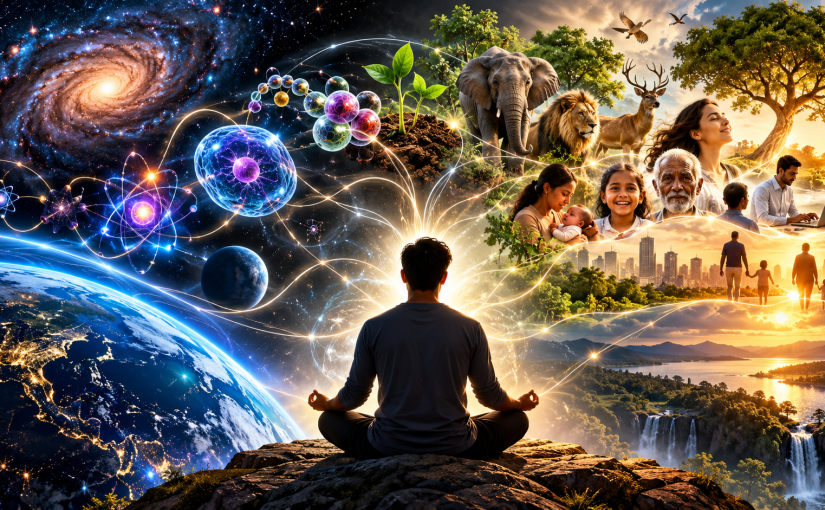
This is why one sentence increasingly expresses the whole movement for me: simply see yourself in everything. It is not that you see only your thoughtless state in everything. Rather, you see yourself in every state, whatever it may be—thoughts, emotions, actions, sensations, perceptions, and every other form of experience. This is not merely an intellectual exercise. It means progressively moving beyond the narrow feeling of “I am only this individual” and recognizing a common fundamental selfhood in everything. It also gives a practical interpretation to the old expression atmavat sarvabhuteshu: see beings as yourself, not necessarily as identical individual persons, but as sharing the same fundamental basis of selfhood. Different beings clearly differ in their capacities, forms and expressions, just as a bus and a car are not the same, yet they can share a basic structure and function. In the same way, individual selves are limited and different, while the deeper principle of selfhood can be understood as universal. Keeping only a limited similarity in view may yield little, because any single aspect can be absent or misleading. But keeping the full similarity in view gives a much greater possibility of recognition. It is like trying to catch many apples: even if we cannot catch all of them, the wider reach may at least help us catch one, whereas by aiming at only one apple, we may miss it altogether.

This makes spirituality practical. It does not require escaping ordinary life. It is a matter of recognizing the same underlying reality within ordinary existence.

The Quantum Verse and a Larger Pattern

This understanding unexpectedly meets what I have called the Quantum Verse. The Quantum Verse is expressed through four simple lines: No religion better than humanity. No worship better than work. No teacher better than problem. No hermit better than householdship. These lines were initially meant as guidance for human life, but I now see a larger possibility in them. Just as we are inspired by the same underlying “verse” to live, act, learn and develop, perhaps every level of existence is also participating in that same underlying order.

I do not mean that a quantum particle literally reads or consciously remembers a verse. I mean something deeper: the same underlying principle that operates through us may also be operating through the development of everything else. A quantum particle follows its nature without remembering any philosophy. A human being also lives according to deeper natural principles, knowingly or unknowingly, whether or not the person remembers the Quantum Verse. We do not have to consciously recall a principle for our existence to participate in it.

From Quantum Activity to Conscious Self-Recognition

This leads to a striking way of looking at progressive development: vacuum, quantum activity, particles, matter, life, consciousness and finally conscious self-recognition can be seen as stages in one continuous unfolding rather than completely disconnected events. Even the vacuum, and whatever may lie conceptually beyond it, can be regarded in this philosophical picture as belonging to the same underlying process from which quantum particles and the observable world progressively emerge.

The human being would then not be an outsider suddenly introduced into the universe. We would be a later, self-aware expression of the very process that produced the universe. The same “line of action” runs through both. Whatever we become through development, the universe has already been expressing the underlying principle through its own progressive development. The seeker and the universe are therefore not moving according to two unrelated principles.

This also explains the difference between unconscious participation and conscious spirituality. We already participate in the universal process simply by existing. The remarkable thing is that the same process has been operating through us unknowingly for eons, yet we remain bound by it because we do not recognize what is happening. Liberation, in this view, does not come merely from recognizing it once and then forgetting it. The recognition has to be contemplated continuously until it becomes a living and increasingly stable awareness. It is like a thief who is imprisoned without really understanding what a prison is or how it works. Once he begins to understand the prison and continuously contemplates its structure, a point may come when he discovers a way out even without originally knowing how to escape. In a material prison, one can also deliberately look for weaknesses and manipulate its physical structure because its nature is relatively concrete. In spirituality, however, the difficulty is far greater. We cannot fully grasp the nature of the self or the exact mechanism of its bondage, much less intellectualize it completely. The bondage is too subtle to be understood merely as an object of thought. Therefore, the most direct possibility of release is to keep recognizing, again and again, the fundamental equality of oneself with everything, in every state of experience. It is not enough to see only a thoughtless or peaceful state as one’s true nature; thoughts, emotions, actions, sensations and every other experience must also be included. By continuously holding this complete similarity in contemplation, a stage may eventually arise in which the limited individual sense of self gives way to the Supreme Self without the need for some separate special achievement. Yoga can accelerate this process because practices such as dhyana deliberately work toward stillness, concentration and expansion of self-awareness, but even yogic states can fade when the recognition is not continually reinforced in ordinary life. A nondual way of living therefore becomes important: the recognition must continue not only in meditation but through the whole range of everyday experience. We are not importing a new principle into life; we are gradually recognizing and embodying the universal principle that was already operating through us all along.

A Philosophical Insight, Not a Claim That Physics Has Proved Spirituality

There is an important boundary here. Quantum physics gives us a scientific description of quantum fields, particles, vacuum states and their interactions. It does not, by itself, establish Paramatman, universal selfhood or a conscious cosmic verse. The Quantum Verse, in this sense, is a philosophical interpretation of a perceived pattern, not a scientific conclusion derived from quantum equations. The value of the comparison lies in the conceptual parallel, not in claiming that modern physics has proved a spiritual doctrine.

What feels newly important to me is the possibility that spirituality, human life and cosmic development may be understood through one continuous principle rather than through separate compartments. If we can really see ourselves in everything, then yoga is no longer an obscure collection of doctrines. It becomes a direct movement from limited selfhood toward Supreme Selfhood, from unconscious participation toward conscious recognition.

The literature may remain vast, contradictory and fascinating. But beneath it, the essential direction can still be simple: live, observe, become aware, see yourself in everything, and move beyond the limits of the individual self toward Paramatman, the Supreme Self. This is perhaps why spirituality can be both demanding and surprisingly straightforward: the realization may require a lifetime of effort, yet the fundamental direction of that effort may be almost astonishingly simple.

The Dual Nature of the Soul

The soul, like matter, has a dual nature. Just as matter appears either as a particle or a wave depending on how we observe it, the soul too shifts its form based on our inner awareness. When it carries the weight of sanskaras—the subtle impressions of countless thoughts, actions, and experiences—it feels like a localized, separate identity. In this state, it appears as a finite dark sky, shaped and bounded by its karmic history. This is the “particle” side of the soul—individual, embodied, and defined.

But when we enter deep states of meditation, keval kumbhak (breathless awareness), or samadhi, these sanskaras begin to dissolve. As they fade, the soul reveals its original nature: an infinite, all-pervading void-like sky—silent, calm, and free from identity. This is the “wave” aspect of the soul, its formless presence beyond time and space. The two aspects cannot be experienced simultaneously. When sanskaras dominate, the infinite is veiled. When stillness takes over, individuality fades.

I witnessed this duality firsthand during a profound encounter with a freshly departed soul. It didn’t appear as just the imprint of a recent life, but as a condensed presence—an essence carrying the average personality traits of countless lifetimes. It was vivid, more alive than its last worldly form, yet deeply compressed—almost bound—by the gravitational pull of its own sanskaras. Its soul-space felt covered, like a dense hologram of all it had ever been. In that moment, I realized this was the “particle” soul—intensely real, yet trapped in its accumulated patterns.

Yet beneath that compression, I could also sense the same soul’s vast, hidden potential—its wave nature—an omnipresent being waiting to be released through purification and inner stillness. The soul was both: deeply personal, and yet, beneath the veils, entirely universal.

This experience reminded me that we all carry within us these two layers. The soul plays as a person when clothed in sanskaras, and rests as presence when freed from them. Recognizing this dual nature brings clarity—not just about ourselves, but also about death, liberation, and the great journey beyond.

Certainly! Here’s a corrected and refined version of your paragraph with a more poetic and philosophical tone:

Supreme vastness is the very essence of supreme existence—Satta.
From this boundless existence arise Gyana (pure knowledge or consciousness) and Ananda (bliss); they are not separate qualities but are inherently woven into the fabric of Satta. The endless sky is not just a metaphor but a direct reflection of the purest state of the soul—Paramatma—infinite, unbounded, and self-luminous. Even in worldly life, we find glimpses of this truth: as one travels far and wide, crossing horizons and expanding boundaries, there is a natural surge in joy, awareness, and a sense of awakening. This outward expansion mirrors the inner truth—that true knowledge, consciousness, and bliss arise from the realization of our own infinite nature.

What Is the Light of the Self? A Conversation from the Depths of Experience

After certain intense spiritual experiences, a question kept echoing in me: After death, is there not pure self-awareness—whatever form the self takes—unlike deep sleep, where there’s no self-awareness? This wasn’t just a philosophical question. I had experienced something that wouldn’t let me rest until it found articulation.

There was a dream visitation from a departed soul. It wasn’t visual or physical but felt like a deeply encoded presence. It carried its individuality from its lifetime, but in a form that was compacted, compressed, like darkness itself. Glistening darkness. As if its entire personality had been shrunk into a concentrated essence. A mascara-like, subtle blackness—a self folded into itself.

It asked me, confused: Is this liberation?

It felt to me as if that soul wanted to escape out of that encoded envelope. And I noticed something else—the state of that soul was entirely different from my own awakening experience. In my deepest moment of inner realization, I had experienced a self that was one with mental formations, like waves in a vast ocean. But those waves were not separate from the Self. They were the Self. That was light. That was bliss. That was ultimate.

And yet, I must admit: that wasn’t the pure Self. It was the Self with content. An ocean full of shimmering movement. I did not experience the ocean without waves. And that makes a difference.

When I was asked by that dreamlike soul about liberation, I found myself unable to describe the real nature of the pure Self—because I myself hadn’t achieved it. I had only experienced a vastness filled with blissful movement. I had not yet known the silence beyond even bliss. I only replied that it is not light and it seems compressed and stressed although it was infinitely vast and dark sky. Probably as I remember I advised it to move further ahead to light just guessing from my own experience as I had moved ahead and ahead in yoga to reach awakening. It had also told that it used to be afraid of death in vain but this state is not so called death like and it feels it is good enough and living like.

Still, my sadhana continues. I do advanced kundalini yoga. My meditation image is often the soul or essence of a departed one, the one closest or nearest in relation to it. It feels like this in itself becomes a prayer—an automatic offering beyond words to help it to be liberated if it is lingering somewhere inbetween. There’s something deeply natural in that.

But one doubt remained. In that visitation, I had seen darkness—the kind that doesn’t feel evil, but also doesn’t feel free. Yet, I realized: pure awareness cannot be called dark. Neither can it be called light. Because both darkness and light are properties of reflective material.

Even space itself is a kind of material. The pure Self is not space, though space-like. It’s not dark, not luminous. When we call it “self-luminous,” it makes the mind think of it like some glowing thing. But it isn’t.

“Self-luminous” is just a pointer. It simply means: it knows itself without help. It doesn’t reflect. It doesn’t shine on. It doesn’t receive light. It simply is.

It is awareness being aware. But not in the way we usually think of “being aware.”

I recalled the Upanishadic truth:

“It is not known by the mind, but by which the mind is known.”

“It shines not, neither sun, nor moon, nor fire. It alone gives light to all. By its light all else is seen.”

These statements aren’t about light. They’re about presence prior to perception.

And then something beautiful settled into my understanding. I realized that metaphors can help if used delicately. And some traditional metaphors suddenly made deep sense to me:

1. The Mirror That Reflects Nothing
Like a mirror that reflects no object—but remains the potential to reflect. Still. Unmoving. Unused. That’s the Self.

2. The Eye That Sees But Cannot See Itself
It sees all, but can’t become its own object. Like awareness. It knows all, but is never an object of knowing.

3. The Silence Behind All Sound
Sound comes and goes, but silence remains. Not silent as absence, but as eternal background.

4. The Sky Untouched by Clouds
Clouds come and go. Sky remains. Not even made of space. Self is subtler than space.

5. A Flame That Doesn’t Burn
Like the idea of flame without heat or glow. No wick, no oil. Just presence without quality.

These helped me not as knowledge, but as living orientation.

Still, I find that when the mental waves subside, the bliss subsides too. That ultimate peak cannot be held by force. And yet, that doesn’t feel like a failure anymore. It feels like a natural return.

What I experienced was likely Savikalpa Samadhi—where Self and waves are one. Blissful, yes. Transformative, yes. But not final. Not the ocean without waves. Not the pure Self beyond even bliss.

There’s still something lacking. I don’t pretend to have reached the final goal. The experience felt like the peak of existence, the ultimate moment of union. But I know that I haven’t merged into the unconditioned ocean of pure awareness.

What remains then is trust. Gentle remembrance. Resting. Not trying to grab the ocean. Just to be the presence that always was.

I let this be my guide:

“I am that which saw the waves. Let me rest as that.”

This means: I am not the movement, not even the blissful play of awakening. I am the witnessing reality behind it—the one that never moves, never becomes. The one that knows even the subtlest wave is still an appearance in Me.

Sometimes I forget to stay aware of who I really am. But even in that forgotten state, I can still see the reflection of my true self—sometimes in my own hand or face—because everything, even this body, holds the whole within it, like a hologram. This simple recognition instantly brings me back to awareness, without effort. So whenever I drift, I gently return—again and again—knowing that even the forgetting happens inside that same awareness.

That is the path now. Not chasing light. Not escaping darkness. Just resting in That which is neither—and beyond.

Kundalini Yoga makes dark matter behave as dark energy

Friends, both the beingness of physical world and its non-beingness do not exist. Man gives existence to both. World beingness or jagatbhaav is an undivided part of Purush. Hence, Jagat-Abhaav or world’s non-beingness also proved to be a part of Purush. Of course, much smaller than Bhaav. If we call Jagat-Bhaav an undivided part of Purush, then there is no problem in calling Abhaav an undivided part of Prakriti. With knowledge and sadhana, man can become Purna Purush, but how will he become Purna Prakriti? Purna Purush exists, but Purna Prakriti does not exist. By the way, even the complete Jagatbhaav does not exist. Meaning, only partial Jagatbhaav can exist. This is because Jagatbhaav gets its existence from the experience of the living beings. And there is no such living being that can experience the complete Jagatbhaav together. All the living beings of the universe cannot do this even together. Similarly, the existence of complete Jagat-Abhaav i.e. Prakriti is also not possible. This means that though the entire world of existence and the entire world of absence have a physical existence, they do not have a soul and no living being experiences them.

Because Purusha never gets destroyed, therefore it does not have an absence. This means that the shadow of Purusha cannot be formed. Shadow is actually called absence. The shadow of a tree is actually not of the tree but of light rays. The shadow of the tree is considered to be in the area where there is an absence of light rays. Similarly, the shadow that is formed by the world is formed by the absence of Purusha offcourse virtual absence. This means that the world is like a tree and Purusha is like the Sun. Similarly, the shadow of the entire creation is Prakriti, Purusha has nothing to do with it. The absence of the entire world will be called mool prakriti. Because the entire world is also an undivided part of Purusha, That is why in practice the original nature aka mool prakriti is called the shadow of Purusha. The shadow-like absence created by Laghu, that is, the individual or the small world, will be called Laghu or the individual or the small prakriti. This means that only the individual world gets experiential existence and not the collective world. Although both have a physical existence.

Prakriti cannot directly reach the purusha. It has to climb up gradually through the purusha elements. Therefore, it keeps on increasing the undivided purusha element gradually. The smallest organisms like bacteria etc. do not have any Purusha element. But this is the first step of the body-like ladder that produces the purusha element. Then in organisms like frog, fish etc., the soul that had once become Prakriti starts feeling the purusha element. In creatures like dog, monkey, this element increases considerably. In man, this element is at the highest level. From this level, Prakriti can directly jump to the purusha through kundalini yoga. This means that a body more developed than the human body is not required. In this case, Superman etc. seem to be mythical concepts, which do not seem to have any special purpose.

We can never experience the gross world directly. Neither its presence nor its absence. We can only feel the subtle picture of the gross world that is formed on our soul. We feel the picture of the beingness of the gross world in the form of various objects like mountain, river, sun etc. We feel the non-beingness of these substances in the form of darkness. It is the subtle form of darkness. But its gross form also exists outside, just as the gross form of the subtle world experienced in the soul is in the form of the gross world outside. That gross darkness is probably called dark energy, dark matter etc.

Like the physical body, the physical world also has a life limit. Just as the body dies when it touches that limit, similarly the world also perishes when its life span is over. The gross body merges into the vyashti or individual prakriti in the form of the subtle body. The gross world merges into the collective or samashti prakriti i.e. the mool prakriti with names like dark energy and dark matter. A new body is born again from that subtle body. Similarly, a new world is also born from the mool prakriti. This trend continues cyclically for ever.

Many people say that this world originated from the Supreme Soul. In reality, nothing is born from Purusha. He is absolutely unattached. He is amazing and unique. Yes, the world gets experiential existence from his proximity. World is eternal and infinite like the purusha. The difference here is that the purusha always remains perfect and unchanging, while the world keeps changing. The world is sometimes in the form of beingness and sometimes in the form of non-beingness. It has countless levels of expression in the form of beingness and also countless levels of expression in the form of non-beingness. This world is called prakriti. When it gets proximity to the purusha, then it comes within the realm of experience, otherwise it keeps moving without experience, as if a dancer is dancing in the darkness. That is why it is said that the entire world that can be experienced is created with the cooperation of prakriti and purusha.

Similarly people say that children come from God and hence are the visible form of God. As soon as a man is born, he starts feeling the pictures of the world in his mind. They can be felt in the mind only if they are already present in the subtle body of the child, otherwise those pictures will definitely be formed but no one will feel them. What is meant to say is that those luminous pictures can be formed only on the subtle body of darkness. If the soul of a child is in the form of a luminous purusha instead of a dark subtle body, then how can luminous pictures be made on it? Sketches cannot be made with light on a luminous wall. First, the wall has to be made black or dark. Yes, it is definitely true that children are closest to God, because they have very little feeling of ego.

Prakriti keeps manifesting and unmanifesting. This is an eternal cycle. Purusha has nothing to do with it. It is a stable, eternal and conscious element. Prakriti gets power and motion with its proximity, just like iron gets power and motion with its proximity to a magnet. Unmanifest prakriti can be called dark matter. Dark matter has only gravity, nothing else. This means that dark matter exists and even does not exist. It “does not exist” because it does not have any characteristic of an existing object. It cannot be seen, heard or touched. It is not within the reach of the senses. It “exists” because it has gravitational force. Gravitational force is also a common or small characteristic of beingness or existence. That is why it is said that the words of so and so have weight or gravity. This means that the words of so and so have practical existence. Dark energy can also be the mool prakriti. This too is indescribable like dark matter and original nature aka mool prakriti . It “is not” because it has no characteristics of a physical object. It “is” because it produces an effect like energy. So it is possible that both are the same thing. The existence of a thing is also associated with its effect. Existence is incomplete without effect. If a hard rock cannot cause injury, then there is no point in the existence of that rock. Dark matter is like that hard rock, and dark energy is the injury caused by it, which is pushing the universe outwards. Just as a rock lying in a river can stop a flowing man, and can also carry a man away with it, in the same way the original nature can bind all the celestial bodies together by behaving like dark matter, and can also push them away from each other by behaving like dark energy. The darkness of the mind of a common man is like dark matter, which pulls and binds his world towards itself. But the darkness of the mind of a Kundalini Yogi behaves like dark energy, which keeps trying to push his world out of itself. That world then comes out and keeps re-emerging in his mind, and keeps merging into the luminous soul. A balanced man has the balanced ratio of dark matter and dark energy just as in the outside stable universe.

In this sense, the creation of man’s mind should also be swinging between the expressed and the unexpressed, since time immemorial. Meaning, man’s bondage should be eternal. We will analyze this in the next post.

Kundalini Awakening Presents the Basic Principle of Sankhya Philosophy

Friends, it is from Purusha that virtual prakriti got experiential existence. Before the experiential brain was formed, prakriti was running the universe despite being virtual like a shadow. It means it had no existence of its own, like the shadow of a tree. When the first experiential brain was formed, its nerve impulses generated waves inside Purusha. The purusha felt it, due to which darkness engulfed Purusha’s own infinite light-form soul. It means Purusha became Prakriti. However, the nerve impulses in the form of thoughts that kept emerging in the brain, were felt luminous and conscious like Purusha. It means the Prakriti-Purusha pair was born. It is like a tree broke down in a storm and fell on its own shadow and became non-existent like the shadow. Earlier, due to the shaking of the tree due to the storm, its sketches were being made and erased on its shadow. But due to the emergence of new buds from the stump of that tree, a new tree was formed again. Now the silhouettes of that new tree started forming on that old fallen tree. Meaning, the shadow of the tree had also come into existence and the shadow-images of the new tree on it also started feeling like a real tree. Same thing happened with Purusha. Of course, Purusha in the form of light became Prakriti in the form of darkness by feeling his waves. But there was also an original Purusha who never feels anything except himself, that is, his pure soul, not even his waves being created inside him. Therefore, he can never become Prakriti by losing his soul. He can be called Scriptures based Purushottam. Purusha is just like the sky. You can make as many skies as you want from one sky.

The proof of the above fact is found in Kundalini awakening. During Kundalini awakening, the soul feels in the form of infinite light, and the entire creation is felt in it in the form of waves. But as soon as the man starts getting attached to those waves of creation, the infinite light of the soul disappears. Means the shadow of the purusha comes into existence. Actually it existed even before physically, this gave it experiential means self-form existence. Meaning now the shadow has started to feel that it exists. Earlier it was like clay and stone. Similarly they also do not feel that they exist in the spiritual or self form, but they exist in the physical form. Man again, like before, starts feeling his soul as dark prakriti and the mental thoughts flowing in it as luminous purusha-waves. Purusha-waves are created only when an ever stable purusha, that is, Purushottam, is sitting in the background. Otherwise, where will the waves come from? In this way sometimes, I feel that Kundalini awakening is the basic principle of Sankhya philosophy.

Kundalini awakening makes seed a full grown tree

Friends, the mystery of creation has been explained best by Sankhya philosophy. Perhaps the scriptures mean that even if prakriti created the creation in the beginning, it was the prakriti-purusha couple who created it, because prakriti created the creation inspired by the possibility of union with the purusha. What Buddha did not explain to his inquisitive disciple in the olden days due to lack of time that where did the disease of life and death start from, can be understood from Sankhya philosophy. Man has always been suffering from this disease of bondage and also not. The bondage started when the first experiential brain was formed. It means that the soul came into existence then. But the prakriti on which the luminous sketch was made by the purusha, that prakriti is eternal. It means that the soul was in the form of prakriti since time immemorial.
It means that the soul was in bondage since time immemorial, but it is not so either, because prakriti is like a shadow which does not exist. Something that is eternal cannot have an end. I do not understand this thing written in many places in the scriptures which says that bondage is eternal, but it can end. This is impossible. Only that which has had a beginning can end. Perhaps they are right but we misunderstand. One of their purposes in saying this is to scare us with bondage and not make the mistake of considering it weak. The second purpose is to rule out the possibility that purusha can get into bondage at any time after liberation. If this were so, then people would not make much effort to eradicate bondage because they would have the fear of getting into bondage again. Perhaps what they mean by saying that bondage is eternal is that prakriti is eternal, not that the soul is eternal. Perhaps what they mean is that this tradition of bondage is eternal and does not end with a single man getting free. Besides, God cannot be so cruel that he has kept all living beings bound since time immemorial. The final purpose seems to be that people should avoid the hassle of esoteric philosophy and focus only on sadhana. By the way, it has been said in many places in the scriptures that a certain person has become or becomes free in just one human birth, someone else has to take ten births, someone else has to take a hundred etc. This means that the bondage started at some point of time and it is not eternal.

Actually prakriti exists and does not exist even. That is why it is called indescribable in the scriptures. The shadow of a tree is also indescribable. It seems existing because it’s visible, but in reality it does not exist. Meaning the bondage of a living being or a man is both eternal and not eternal either. Theoretically it is eternal but experientially it had its beginning. When the soul is formed then its merger in the purusha is only possible final event, otherwise it will keep wandering experiencing happiness and sorrow even though it is non-existent. It is surprising that how does the soul come into existence even though it does not exist? This is the game of prakriti-purusha. The soul is just an illusion. Meaning the soul is not created but an illusion is created. When the illusion ends then the bondage ends.

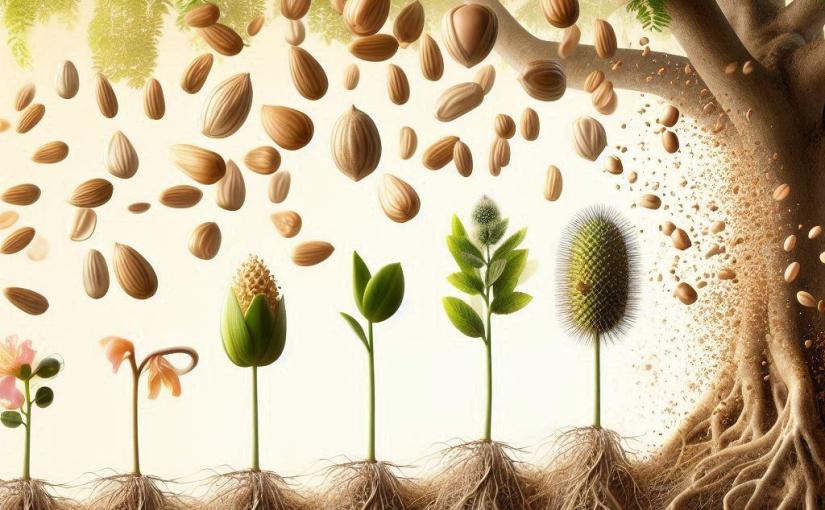
If prakriti is the land then the purusha is the tree. When the seed of a tree falls on the ground then it starts growing and by growing it becomes a tree. As the tree grows, the land becomes less visible and the tree becomes more visible. In the end the tree spreads so much that the land is not visible at all from the top of its clumps of leaves. It seems that both the land and the seed have become a tree. But in reality only the seed becomes a tree. The land remains the same as before. The land does not get destroyed or merged anywhere by a seed becoming a tree, but it remains the same to make other seeds trees. Similarly, there is Prakriti which is like virtual land even though it does not exist.

The land was at the bottom most. It wanted to touch the heights of the sky. If not the sky, at least up to the height of the tree. But it could not do this directly. So it took the help of the tree. It grew the seed of the tree and raised it high. Although the land could not rise high itself, it got the credit of raising the trees, which was enough to console it. Similarly, the shadow of the purusha, i.e. prakriti also wanted to become great like the purusha. It could not do this directly because the shadow of a tree can never become a tree and even can never merge with it. So it took the help of the seed of the purusha. It started growing the seed of the purusha, i.e. the soul and raised it as high as the purusha by awakening the Kundalini. Of course Prakriti herself could not become purusha, but she got the credit of uplifting the living souls, which was enough to give her solace. A mother is also almost like this, that is why Prakriti and earth both are also called Maa.

Kundalini Shakti makes the meditation picture kept in the mool prakriti awakened

Friends, this is a very short but very meaningful post. Is Mooladhar the fundamental nature aka mool prakriti itself? This thought came to my mind. Why not analyze it. The adhar or base of man is the individual nature i.e. the soul. It is different for all living beings. The quality, size, height of the building depend on the base. It means that all the information of the future building is recorded in the base. Similarly, all the future information of the man is recorded in his soul, such as his birth, qualities or gunas, deeds, results or fruits etc.

The adhar is different and special for every living being, but Mooladhar is the same for everyone. The adhar should be considered synonymous with prakriti and the mool adhar should be considered synonymous with the mool prakriti. It is also said that what is the nature or prakriti of a certain man. That is, what is his habits or lifestyle? All the individual adharas are formed from the Mooladhar. The adhar should first be transformed into the Mooladhar. Only then will the real beginning of Kundalini Yoga take place. Through Karma Yoga, the information buried in the soul of a man will emerge and be destroyed through detachment. When the box of the soul becomes almost empty, then it will become the Mooladhar. Meaning that there will be no worldly information buried in it. It is just like purusha. The only difference is that unlike the purusha, it will be dark. Meaning that it will be like the virtual shadow of the purusha. When the mental picture of the form of Guru etc. is meditated upon when the soul of a man is in the Mooladhar state, then meditation happens easily. This is because there is no other buried garbage in the soul that can absorb the power of meditation and become powerful or manifest. When Kundalini power is also given to that meditation picture through Tantric Kundalini Yoga, then it starts flaring like a flame of fire. Due to this, it awakens quickly.

Kundalini Yoga pushes prakriti towards Purusha

Friends! Mythical imaginations have always been attractive. It is human psychology which is greatly influenced by myths. Even in the olden times, except for learned people, common people did not give much importance to philosophy. They found philosophy mainly spirituality related boring. That is why the sages created mythical stories based on true philosophy, which the Vedas and Puranas are full of. Even today, people are crazy about mythical stories related to scientific theories like time travel, space travel etc. The media is full of these. The era changes but human psychology remains the same. Therefore, to spread the truth in the world, mutual cooperation of two types of people is required. One is the one who presents the theory on the basis of direct experience, and the other is the one who creates mythical stories based on it. It may be that the scriptures based spiritual scientific theories of this website emerge as mythical stories in accordance with the era.

In today’s comfortable and scientific age, people have enough time and energy to understand any subject in detail. It was not so earlier. Once a disciple of Mahatma Buddha asked him how this worldly suffering in the form of birth and death begins. So Mahatma Buddha said that there is no need to waste time in knowing this. Just understand that this suffering can be ended and make efforts for that. Nowadays people have enough time to understand black holes and time machines, but not to understand the spiritual philosophy which is related to the main goal of human life. This is an irony.

Friends, the discussion we have started is completely in accordance with the scriptures. Therefore, it can also be considered authentic. This is not a pipe dream. According to Vedic Sankhya philosophy, prakriti and purusha are two immortal and omnipresent elements. Pure purusha can never run the universe because he is the Supreme God. He has no inclination in the world. It is often seen in the world that a saint who is in supreme Samadhi has no inclination in the world. Of course, he has a motivating power. People take inspiration from him or say to become perfect like him, they do big and good worldly works and conduct themselves. The same happens in the case of God too. Prakriti keeps getting inspiration from him to develop, that is, to become perfect like him. Due to this, all the works of the universe keep moving. It is prakriti that does the work. It is prakriti that makes the universe work, and it is the ego or the soul that makes the body work willfully.

People say that all the works of creation are happening in darkness, which means that there is no luminous consciousness to do them. This is both true and false. If seen, it is the darkness that is getting the work done. But light also has an indirect contribution in this. For whom is darkness getting the work done? Darkness is getting the work done for light. Prakriti is getting the work done for Purush. Purush is pulling prakriti. Ego is getting the work done for non ego. The living soul is getting the work done for Parmatma. Parmatma is pulling the living soul. The living soul will become Parmatma someday. So will prakriti also become Purush someday? If one living soul becomes Parmatma, then another living soul will be born again. If prakriti becomes Purush, then where will the other prakriti come from because Prakriti is only one. There are many living souls. If new Prakriti is not formed, then the creation will also stop. Living souls also keep getting formed from Prakriti.

The living soul is a mixture of Prakriti and Purush. If Prakriti becomes Purush, then new living beings will also not be able to be born, because the living soul will not be formed. It means that Prakriti never merges with Purush. Or if it merges, then a new prakriti is formed again. Kundalini yoga is there to give additional and escaping push to prakriti towards Purusha. But how will it be formed? We will analyze it in detail in the next post.

Kundalini awakening is possible only through the subtle body of a human being

Friends, finally the discussion comes back to the subtle body. It is clear from the previous discussions that the world shrinks and reaches the ego. It means that only the ego remains in the form of the transcendental subtle body. Of course, the mundane subtle body also includes intellect, mind, prana and senses. In many places, it has been said that it is made up of only ego, intellect and mind. In many places, Panch Tanmatras and Panch Mahabhutas have also been added to it. All this is fine for the worldly subtle body, but in the transcendental subtle body, all these should not be there. It should only have ego. In many places, this ego has been considered as the causal body. Karma and sanskars are hidden in it, which determine the next birth. Suppose, the transcendental subtle body is made up of mind, intellect and ego. But how can it think and contemplate without the gross body. If it cannot, then what is the need to believe in mind and intellect in it. This is a complex subject.

Let us take a single-celled bacterium. It is the tiniest living creature, which cannot be seen with the naked eye. Let us assume that its soul or its self is a transcendental subtle body. This is because such a small physical body cannot have a perceiving brain. Even scientists have not found any clue about it yet. That bacterium does all the activities of a normal life like a creature with a developed brain like man. It walks, eats, drinks, hunts, fears, runs, mates, produces children, fights, understands friendship and enmity and maintains it, etc. The list is very long. Understand, it does all the things. In some places, it does even more than a man. This means that it has everything along with the soul, ego, intellect, mind, prana, five sense organs, five work organs, five tanmatras and five mahabhutas. But it does not feel all these. So is it necessary to feel all these to have all these? Absolutely not. Meaning that the soul itself behaves like a subtle body. Let us assume that the living soul behaves like this. That is because the living soul is trapped in the darkness of ignorance. It has to evolve. That evolution can only happen through the body. But why does God behave like a microscopic body, He is fully evolved. The inanimate world also behaves like a living being. For example, stars are also born, grow, fight, reproduce, eat, spit, hunt, fight, run away, maintain friendship and enmity, etc. So, do inanimate objects also have a living soul? Of course they do. Sankhya philosophy also says that Prakriti is also eternal, infinite and omnipresent like Purush i.e. God. Meaning this Prakriti is also a living soul. A huge, omnipresent, global or collective living soul. It can also be called the subtle body of Brahma. Brahma also does not feel it. Still the subtle body exists and works. In a way, for the development of the soul, it is necessary to have ego, intellect, mind, prana, ten senses, five tanmatras, and five mahabhutas. Anyway, the ego itself is in the form of the soul. Because all these are necessary, that is why all these elements came together. By their coming together, a body was formed. The soul got attached to it. The soul was already present everywhere and at all times in the form of prakriti. Understand that an imaginary part of it got attached to the newly formed body. That was the first soul. That first body was of a bacterium. Then the body of the bacterium evolved and became the body of insects. Then of fish, frog, then of big animals, monkeys and finally of humans. The subtle body is the same in all. There has been no development in the subtle body. The same senses, the same prana, the same mind, the same intellect etc. This means that for the development of the soul, no other element other than the subtle body is necessary. What definitely happened was that the scope of the subtle body increased in big creatures and humans. Therefore, the development of the soul also accelerated. But the subtle body was the same primordial one. The one thing that is special in the subtle body of man, which is not present in the subtle body of any other living being, is the ability to practice Kundalini Yoga. With this, a man can raise his subtle body so high that Kundalini awakening happens.

Kundalini yoga with television films and cinema movies

Friends, we can understand the illusion of senses with one more example. When we listen to the sound of a television placed far away through Bluetooth earbuds, we feel that the sound is being produced in the television, whereas it is being produced in our ears. The more we are attached to a scene on television, the more we feel that scene inside the television. When we start watching without attachment or get bored, or our ears get tired, then we feel that sound inside our ears. Meaning, the sounds produced in the ears and the images formed in the eyes together had created the Pancha Mahabhutas present in the scenes shown on television. When we got bored or tired, we did not pay much attention to the scenes on TV, due to which only the sounds and images remained, as if the Pancha Mahabhutas merged into Tanmatras. When we got bored of the sounds in our ears and the images in our eyes, we stopped paying attention to them. Our ears and eyes were tired, that is why we were feeling tired. Or you can say we fell asleep or switched off the TV. Due to this, the tanmatras also vanished, and only the ears and eyes remained. It means that the tanmatras merged with the senses. After waking up, the senses became fresh, but those sounds and images were no longer there. The senses did not have the strength to start working immediately, because they were still compensating for themselves. When the senses became calm, the prana vayu started flowing properly. When the senses were busy watching TV, the attention was diverted from the breath and was on the TV. You must have noticed that when we are watching an entertaining program on TV, our breaths get stuck. If at that time we try to take long and regular breaths while concentrating on the breath, then watching TV becomes less enjoyable and we feel like switching it off. This also proves the importance of breathing and pranayam for becoming introvert. This also gives the message that when the senses are tired, one should do pranayam. This also relaxes the senses, and when the mind becomes active, happiness and light remain in life. Yes, so when the senses became calm, the sensations that were being felt by them, got merged in the prana. Prana is just the breath and those sensations cannot remain in it for long. Prana in a way takes the sensations from the senses to the mind. It does not feel those sensations. We can understand it like a postman who carries letters from here to there, but does not read them himself. The mind comes into action with support of the prana. The sensations felt by the senses start overflowing in it, although now in the form of the mind, because now the TV scenes that helped in the creation of those sensations are no longer there. This is like remembering. Then along with those sensations, other various thoughts also start overflowing in the mind. This is the merging of prana in the mind. Then after getting lost in the dream world of such thoughts for some time, the man realizes that he should also do some worldly work. Meaning the intellect becomes active. The mind does not get destroyed but it starts transforming into intellect or starts merging into intellect. Meaning his intellect will start working in the same way as his mind was. That is why it is said that if you keep your mind good, then only your work will be good. Children of today who watch and play video games full of horrific violence day and night, how will they be able to do good work in future. They must be taught and explained this post. With a good intellect, he maintains good worldliness for some days, and also makes good progress. Then he gets tired, and also gets bored of worldliness. Due to this his intellect starts becoming calm, due to which darkness starts increasing inside his soul. Meaning his intellect gets transformed into his ego. Then if any Kundalini Yogi wants, he can attain the soul after this. But the common man returns from here. After spending a few days comfortably and restfully in the darkness of ego, he returns to worldliness, and with the help of intellect, he again establishes his foothold. Then after making some progress, he takes the refuge of the mind again followed by harboring hundreds of desires. It means that the intellect merges with the mind. Then, under the instigation of the mind, he goes to the cinema theatre to watch a movie. He would like to watch a movie that is similar to his intellect and worldliness, because the intellect itself appeared in the form of the mind. The farther the cinema hall is from home, the more enjoyable it is, because the mind also needs time to transform into the form of life by force or prana. On the way to the cinema, he breathes very nicely, long, regularly and pleasurably, because the mind’s desire to watch a movie is ending as the goal is near, meaning the mind is ending, and its power is being given to the prana. Even then, the subtle thoughts of the mind remain in the prana, because the cause is never destroyed, but remains present in the form of the effect. As soon as he starts watching the movie, his breath comes to near halt, and he starts enjoying the sweet sensations in his eyes and ears. It means that his prana transforms into the senses. As long as the advertisements are running on the screen, he does not observe those scenes deeply. It means that he feels the sensations in his eyes and ears only, they do not seem to be coming from anywhere outside. This is the state of expression of the senses. After a while, when the movie starts and he starts understanding the movie, then he feels those sensations as coming from the cinema screen. It means that his senses dissolve into tanmaatras. Later, when he gets deeply immersed in the film, the mountains, palaces etc. shown on the screen start appearing real to him. It means that the tanmatras appear in the form of the five elements. It means that the creation of his universe is complete.

Now the film ends. All the scenes end. Means the pralay or holocaust of his personal mini universe is set up. Advertisements start appearing on the screen. Now the mountains and palaces shown in those advertisements do not seem real to him, because he does not watch them carefully. He is just seeing something with his eyes and hearing with his ears. Man likes to watch them for a while. Because everyone likes to come and go from grossness to subtlety in a sequential manner. It means that the five elements have merged into tanmatras. Then after a while, man starts feeling those sensations in his senses only, not outside. Getting bored of that too and feeling tiredness in his eyes and ears, he comes out of the cinema hall. It means that the tanmatras have merged into the senses. He refreshes himself by drinking some tea. Then his breathing becomes good, deep and regular. When attention is drawn to the eyes and ears by rubbing them, the breath starts moving on its own to give them strength. However, they can only be refreshed by this, but cannot work again. Because they are repairing their damage after doing so much work. Then the extra power of the breath gets applied to the mind. It means that the senses have merged into Prana and prana into mind. Then the mind starts running here and there due to the power of Prana or breath. By chasing away the mind, the breath again becomes shallow and irregular. It means that Prana has transformed into the mind. Inspired by the hustle and bustle of that mind, he enters the shopping mall. There, while checking the quality of various things with bargaining scope, his intellect becomes active and the mind becomes lethargic. It means that the mind has transformed into the intellect. When the darkness of ego starts increasing in his soul due to the intellect also getting tired, then he sits in the car with his family and leaves for home. It means that the intellect has transformed into the ego. In that ego, the outline of his entire day’s activities gets recorded in a subtle form. Coming home, he illuminates the darkness of his soul with tantric Kundalini meditation through Kundalini Yoga. It means that the ego dissolves in the soul. Of course, if not the complete soul, then at least a part of it. The next day, even if he does not want to, he has to gradually fall down from the soul, so that he can once again live the worldly life properly. This all continues in a cyclic manner. This happens with all kinds of experiences, all kinds of activities, all kinds of worldliness, all kinds of people, all senses and all kinds of bodies. This is a general principle. Many such principles have been described in the scriptures with great subtlety and depth, to the extent that I doubt modern psychology has not been able to reach even today. The above example of a movie or television is just a small point to explain. Whatever a man does, he does it under the influence of his nature i.e. ego, although he may feel that he does it freely. This is ego, this is nature, this is subconscious mind, this is sanskar. All this is a play of words. The thing is the same. The one who has not conquered the ego, he always remains under its control. Complete freedom is attained only by the yogi.