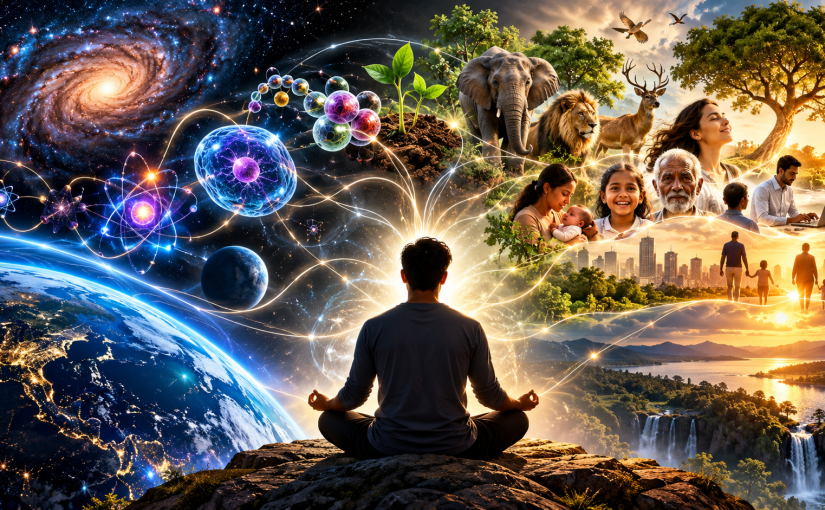
The more I look at spirituality, the more I feel that it is remarkably simple, but has been made complicated by an enormous amount of overlapping, contradictory and often confusing literary material. Different traditions have described inner experience through different languages, symbols, philosophies, metaphysics, rituals and doctrines. With time, the descriptions have become so numerous that the literature can sometimes appear more difficult than the reality it tries to describe. I increasingly see a distinction between the actual experience and everything built around it: first there is experience, then interpretation, then doctrine, and finally a vast literature preserving all of it, including disagreements. The experience may remain simple even when its description becomes enormous.
Yoga Is Simply Union with Paramatman
For me, the simplest meaning of spirituality is yoga. Yoga means union, or merging, and in the spiritual sense I mean merging with Paramatman. Even the word Paramatman can be made much simpler than the way it is often treated in philosophy. Literally, parama means supreme and atma means self. Individual selves are limited by body, identity, place, time and circumstance. But there can be understood to be a Self that transcends every individual limitation, every boundary of time and space and every separate identity. It is the Supreme Self, the highest possible level of selfhood. No self can be higher than this. It is the top self, and that is Paramatman.
Once this is understood, the direction of yoga becomes remarkably clear. The goal is the Supreme Self. The ordinary obstacle is our identification with the limited individual self. The practice is therefore not some mysterious search for an entirely foreign reality, but a movement beyond limited selfhood toward the Supreme Self.
Simple Does Not Mean Effortless
I do not mean that realization is obtained without effort. Realization may require sustained practice, discipline, meditation, contemplation and transformation. What I mean is that the effort itself can be simple, straight and direct. A path can be difficult without being complicated. This distinction is easily lost in spiritual literature. The method may require persistence, but its essential direction need not be intellectually elaborate.
I would put it simply as: know the limited self, turn awareness toward the deeper Self, experience that Self more directly, become established in it and live from it. Understanding the idea is not the same as realizing it, just as knowing that fire is hot is different from actually touching it. Conceptual knowledge gives the direction; practice makes the knowledge experiential.
See Yourself in Everything
This is why one sentence increasingly expresses the whole movement for me: simply see yourself in everything. It is not that you see only your thoughtless state in everything. Rather, you see yourself in every state, whatever it may be—thoughts, emotions, actions, sensations, perceptions, and every other form of experience. This is not merely an intellectual exercise. It means progressively moving beyond the narrow feeling of “I am only this individual” and recognizing a common fundamental selfhood in everything. It also gives a practical interpretation to the old expression atmavat sarvabhuteshu: see beings as yourself, not necessarily as identical individual persons, but as sharing the same fundamental basis of selfhood. Different beings clearly differ in their capacities, forms and expressions, just as a bus and a car are not the same, yet they can share a basic structure and function. In the same way, individual selves are limited and different, while the deeper principle of selfhood can be understood as universal. Keeping only a limited similarity in view may yield little, because any single aspect can be absent or misleading. But keeping the full similarity in view gives a much greater possibility of recognition. It is like trying to catch many apples: even if we cannot catch all of them, the wider reach may at least help us catch one, whereas by aiming at only one apple, we may miss it altogether.
This makes spirituality practical. It does not require escaping ordinary life. It is a matter of recognizing the same underlying reality within ordinary existence.
The Quantum Verse and a Larger Pattern
This understanding unexpectedly meets what I have called the Quantum Verse. The Quantum Verse is expressed through four simple lines: No religion better than humanity. No worship better than work. No teacher better than problem. No hermit better than householdship. These lines were initially meant as guidance for human life, but I now see a larger possibility in them. Just as we are inspired by the same underlying “verse” to live, act, learn and develop, perhaps every level of existence is also participating in that same underlying order.
I do not mean that a quantum particle literally reads or consciously remembers a verse. I mean something deeper: the same underlying principle that operates through us may also be operating through the development of everything else. A quantum particle follows its nature without remembering any philosophy. A human being also lives according to deeper natural principles, knowingly or unknowingly, whether or not the person remembers the Quantum Verse. We do not have to consciously recall a principle for our existence to participate in it.
From Quantum Activity to Conscious Self-Recognition
This leads to a striking way of looking at progressive development: vacuum, quantum activity, particles, matter, life, consciousness and finally conscious self-recognition can be seen as stages in one continuous unfolding rather than completely disconnected events. Even the vacuum, and whatever may lie conceptually beyond it, can be regarded in this philosophical picture as belonging to the same underlying process from which quantum particles and the observable world progressively emerge.
The human being would then not be an outsider suddenly introduced into the universe. We would be a later, self-aware expression of the very process that produced the universe. The same “line of action” runs through both. Whatever we become through development, the universe has already been expressing the underlying principle through its own progressive development. The seeker and the universe are therefore not moving according to two unrelated principles.
This also explains the difference between unconscious participation and conscious spirituality. We already participate in the universal process simply by existing. The remarkable thing is that the same process has been operating through us unknowingly for eons, yet we remain bound by it because we do not recognize what is happening. Liberation, in this view, does not come merely from recognizing it once and then forgetting it. The recognition has to be contemplated continuously until it becomes a living and increasingly stable awareness. It is like a thief who is imprisoned without really understanding what a prison is or how it works. Once he begins to understand the prison and continuously contemplates its structure, a point may come when he discovers a way out even without originally knowing how to escape. In a material prison, one can also deliberately look for weaknesses and manipulate its physical structure because its nature is relatively concrete. In spirituality, however, the difficulty is far greater. We cannot fully grasp the nature of the self or the exact mechanism of its bondage, much less intellectualize it completely. The bondage is too subtle to be understood merely as an object of thought. Therefore, the most direct possibility of release is to keep recognizing, again and again, the fundamental equality of oneself with everything, in every state of experience. It is not enough to see only a thoughtless or peaceful state as one’s true nature; thoughts, emotions, actions, sensations and every other experience must also be included. By continuously holding this complete similarity in contemplation, a stage may eventually arise in which the limited individual sense of self gives way to the Supreme Self without the need for some separate special achievement. Yoga can accelerate this process because practices such as dhyana deliberately work toward stillness, concentration and expansion of self-awareness, but even yogic states can fade when the recognition is not continually reinforced in ordinary life. A nondual way of living therefore becomes important: the recognition must continue not only in meditation but through the whole range of everyday experience. We are not importing a new principle into life; we are gradually recognizing and embodying the universal principle that was already operating through us all along.
A Philosophical Insight, Not a Claim That Physics Has Proved Spirituality
There is an important boundary here. Quantum physics gives us a scientific description of quantum fields, particles, vacuum states and their interactions. It does not, by itself, establish Paramatman, universal selfhood or a conscious cosmic verse. The Quantum Verse, in this sense, is a philosophical interpretation of a perceived pattern, not a scientific conclusion derived from quantum equations. The value of the comparison lies in the conceptual parallel, not in claiming that modern physics has proved a spiritual doctrine.
What feels newly important to me is the possibility that spirituality, human life and cosmic development may be understood through one continuous principle rather than through separate compartments. If we can really see ourselves in everything, then yoga is no longer an obscure collection of doctrines. It becomes a direct movement from limited selfhood toward Supreme Selfhood, from unconscious participation toward conscious recognition.
The literature may remain vast, contradictory and fascinating. But beneath it, the essential direction can still be simple: live, observe, become aware, see yourself in everything, and move beyond the limits of the individual self toward Paramatman, the Supreme Self. This is perhaps why spirituality can be both demanding and surprisingly straightforward: the realization may require a lifetime of effort, yet the fundamental direction of that effort may be almost astonishingly simple.


