# The Hidden Yogic Psychology of Dussehra: Ravana’s Ten Heads, Nonduality and Deep Dhyana ## How Worldly Life Can Support Deep Meditation **Happy Dussehra!** May this festival of the victory of good over evil also inspire us to discover the deeper victory within ourselves: the victory of awareness over uncontrolled impulses, detachment over unnecessary attachment, and inner peace over mental conflict. I have noticed something interesting about the relationship between worldly life, detachment and deep dhyana. After a demanding day filled with worldly struggles, meditation sometimes becomes deeper the following day. This initially seemed strange, because one might expect worldly disturbances to weaken meditation. However, I observed that worldly life need not be a distraction if it is lived with patience, detachment and nondual awareness. The difficulty begins when an unpleasant interaction becomes fixed in the mind, producing repeated thoughts, resentment and emotional agitation. From the yogic perspective, this may be experienced as disturbed prana, making it difficult to settle into calmness. When unnecessary arguments are avoided, duties are performed without excessive attachment, and disagreements are handled patiently, the mind may carry fewer unresolved reactions into meditation. This does not mean tolerating injustice or abandoning necessary boundaries. It means responding appropriately without creating unnecessary inner conflict. Worldly life can therefore become a field for practising detachment, rather than something that must always be escaped to achieve deeper dhyana. ## Dussehra and the Ten Heads of Ravana: An Inner Interpretation Last year, I experienced good dhyana on Dussehra, and this year, on Dussehra again, I entered deep dhyana while remembering the previous year's experience. This recurring association made me contemplate the spiritual psychology behind the festival. Dussehra is commonly associated with the victory of Lord Rama over Ravana, but I began exploring its possible inner meaning. The word *dus* means ten, and Ravana is traditionally depicted with ten heads. I interpreted these ten heads as symbolising the ten sense faculties: five organs of perception and five organs of action. These faculties are necessary for ordinary life, but when their demands become uncontrolled, they can dominate our decisions and make us behave as though sensory attraction, desire and aversion are more important than discrimination. The heads may symbolically represent their false supremacy. The problem is not the existence of the senses, but their ability to hijack the intellect and make it serve their impulses. ## Lord Rama as Guru and Ravana as the Undisciplined Disciple I developed this interpretation further by viewing Lord Rama as a guru who is established in yoga and balanced worldly living, while Ravana represents a newly formed disciple whose mind is being stormed by the senses. In this contemplative reading, Rama's victory becomes a metaphor for the guru guiding the disciple towards yogic balance. Beheading Ravana does not mean destroying the senses. It means removing their false authority, symbolically shifting them from their imagined position of supremacy in the head to their natural functional roles. The senses continue to perceive and act, but the intellect regains its freedom to discriminate and guide behaviour. In this sense, Rama's arrows represent the power of wisdom, disciplined practice and dharma that restores the proper order within a human being. This is a personal spiritual interpretation rather than the only established meaning of the Ramayana, but it offers a practical way of contemplating the festival. ## How Sensory Mastery Supports Detachment and Nonduality When the senses dominate the mind, the intellect may spend its energy justifying impulses, pursuing gratification or repeatedly reacting to people and circumstances. When their domination decreases, the intellect can examine experiences more clearly. Detachment becomes easier because a person can fulfil worldly responsibilities without becoming psychologically bound to every outcome. Nondual contemplation may also become more accessible when attraction, aversion and unnecessary conflict no longer occupy so much mental space. The intellect can clarify nondual understanding, although deeper realization is not merely an intellectual conclusion. It must also become an inwardly lived experience. The victory over Ravana can thus be contemplated as the restoration of a proper inner order: the senses serve, the intellect discriminates, and consciousness becomes less entangled in repetitive worldly reactions. ## Dussehra, Remembered Experience and Breathless Dhyana The fact that I experienced deeper dhyana on Dussehra in two successive years seems personally meaningful. Remembering the previous year's meditation may have helped orient my mind towards the same inward state. Memory can revive not only an earlier event but also its associated calmness, attention and spiritual understanding. This does not prove that remembering Dussehra caused the deeper experience, but it suggests that meaningful recollection can sometimes support meditation. The spiritual contemplation of the festival may have offered another connection between everyday understanding and inward stillness. During breathless dhyana, breathing can become extremely subtle or seem to pause spontaneously, but such a state should never be forced or prolonged deliberately. It is better to allow breathing to remain unforced and return naturally whenever needed. ## Ganapati Worship: Three Philosophies in One Brass Idol After rising from approximately two hours of dhyana, I went to worship Ganapati. While looking at the brass idol and ringing a small hand-held bell, I began contemplating my own status through three philosophical perspectives together: Sharirvigyan Darshan, Quantum Darshan and AI Darshan. Through Sharirvigyan Darshan, I contemplated the idol as a physical body made of brass. Through Quantum Darshan, I considered its material form in terms of microscopic constituents and quantum particles. Through AI Darshan, I compared the brain's information processing with computer processing. These three approaches began from different aspects of existence: physical substance, microscopic reality and information processing. Yet I was using all three to return to a common inquiry into the self and nondual awareness. The scientific comparisons are contemplative starting points, not proof that quantum physics establishes nonduality or that the brain and a computer operate identically. ## How a Small Temple Bell Continued the Earlier Meditation The bell's sound felt sweet and sattvik to my ears. I experienced it as helping redirect my attention upwards towards the brain after my attention had shifted outward on emerging from dhyana. In yogic language, I understood this as prana becoming oriented upwards again. Although this subjective experience cannot establish a literal movement of energy, the sense of renewed inward attention was clear to me. The ringing may also have masked some external noise, reducing interruptions while I contemplated the idol. After ringing the bell for about one or two minutes, I stopped, yet the contemplation continued. By then, the process seemed to have ignited independently of the sound, and I settled further into a blissful sense of self. The bell had served as an initial sensory support rather than something on which the whole experience depended. ## From Deep Dhyana to Everyday Nondual Awareness Looking at these experiences together, I see a possible continuity between meditation, worship, philosophical inquiry and worldly living. Deep dhyana on Dussehra led me to reflect on sensory mastery, the guru-disciple relationship and the value of non-attachment. After meditation, the Ganapati idol provided a focus for bringing Sharirvigyan Darshan, Quantum Darshan and AI Darshan together, while the hand-held bell helped gather attention and partly mask surrounding noise. Once contemplation became established, the sound was no longer needed. Perhaps the broader lesson is that meditation need not remain confined to a particular posture or secluded setting. Worldly duties, remembered spiritual experiences, sacred symbols and simple sounds may all become supports when approached without unnecessary attachment. The bell may initiate contemplation, the intellect may guide it, and a deeper inward calm may follow. My experience does not prove a universal formula, but it has encouraged me to explore how balanced worldly life, yogic discipline and nondual contemplation can reinforce one another. The real victory symbolised by Dussehra may then be contemplated not merely as the defeat of an external demon, but as the gradual ending of the senses' uncontrolled rule over the mind, making room for discrimination, detachment and deeper awareness.

The Hidden Yogic Psychology of Dussehra: Ravana’s Ten Heads, Nonduality and Deep Dhyana

How Worldly Life Can Support Deep Meditation

Happy Dussehra! May this festival of the victory of good over evil also inspire us to discover the deeper victory within ourselves: the victory of awareness over uncontrolled impulses, detachment over unnecessary attachment, and inner peace over mental conflict. I have noticed something interesting about the relationship between worldly life, detachment and deep dhyana. After a demanding day filled with worldly struggles, meditation sometimes becomes deeper the following day. This initially seemed strange, because one might expect worldly disturbances to weaken meditation. However, I observed that worldly life need not be a distraction if it is lived with patience, detachment and nondual awareness. The difficulty begins when an unpleasant interaction becomes fixed in the mind, producing repeated thoughts, resentment and emotional agitation. From the yogic perspective, this may be experienced as disturbed prana, making it difficult to settle into calmness. When unnecessary arguments are avoided, duties are performed without excessive attachment, and disagreements are handled patiently, the mind may carry fewer unresolved reactions into meditation. This does not mean tolerating injustice or abandoning necessary boundaries. It means responding appropriately without creating unnecessary inner conflict. Worldly life can therefore become a field for practising detachment, rather than something that must always be escaped to achieve deeper dhyana.

Dussehra and the Ten Heads of Ravana: An Inner Interpretation

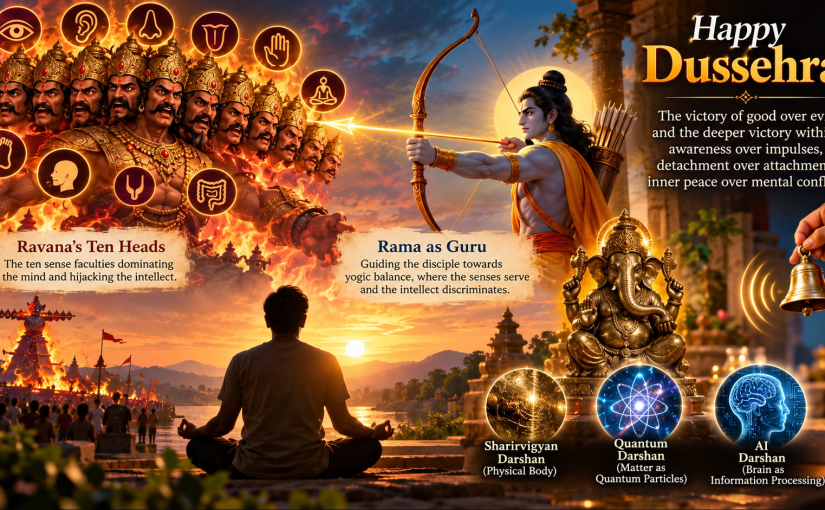
Last year, I experienced good dhyana on Dussehra, and this year, on Dussehra again, I entered deep dhyana while remembering the previous year’s experience. This recurring association made me contemplate the spiritual psychology behind the festival. Dussehra is commonly associated with the victory of Lord Rama over Ravana, but I began exploring its possible inner meaning. The word dus means ten, Hara means to grab, and Ravana is traditionally depicted with ten heads. I interpreted these ten heads as symbolising the ten sense faculties: five organs of perception and five organs of action. These faculties are necessary for ordinary life, but when their demands become uncontrolled, they can dominate our decisions and make us behave as though sensory attraction, desire and aversion are more important than discrimination. The heads may symbolically represent their false supremacy. The problem is not the existence of the senses, but their ability to hijack the intellect and make it serve their impulses.

Lord Rama as Guru and Ravana as the Undisciplined Disciple

I developed this interpretation further by viewing Lord Rama as a guru who is established in yoga and balanced worldly living, while Ravana represents a newly formed disciple whose mind is being stormed by the senses. In this contemplative reading, Rama’s victory becomes a metaphor for the guru guiding the disciple towards yogic balance. Beheading Ravana does not mean destroying the senses. It means removing their false authority, symbolically shifting them from their imagined position of supremacy in the head to their natural functional roles. The senses continue to perceive and act, but the intellect regains its freedom to discriminate and guide behaviour. In this sense, Rama’s arrows represent the power of wisdom, disciplined practice and dharma that restores the proper order within a human being. This is a personal spiritual interpretation rather than the only established meaning of the Ramayana, but it offers a practical way of contemplating the festival.

How Sensory Mastery Supports Detachment and Nonduality

When the senses dominate the mind, the intellect may spend its energy justifying impulses, pursuing gratification or repeatedly reacting to people and circumstances. When their domination decreases, the intellect can examine experiences more clearly. Detachment becomes easier because a person can fulfil worldly responsibilities without becoming psychologically bound to every outcome. Nondual contemplation may also become more accessible when attraction, aversion and unnecessary conflict no longer occupy so much mental space. The intellect can clarify nondual understanding, although deeper realization is not merely an intellectual conclusion. It must also become an inwardly lived experience. The victory over Ravana can thus be contemplated as the restoration of a proper inner order: the senses serve, the intellect discriminates, and consciousness becomes less entangled in repetitive worldly reactions.

Dussehra, Remembered Experience and Breathless Dhyana

The fact that I experienced deeper dhyana on Dussehra in two successive years seems personally meaningful. Remembering the previous year’s meditation may have helped orient my mind towards the same inward state. Memory can revive not only an earlier event but also its associated calmness, attention and spiritual understanding. This does not prove that remembering Dussehra caused the deeper experience, but it suggests that meaningful recollection can sometimes support meditation. The spiritual contemplation of the festival atmosphere all around may have offered another connection between everyday understanding and inward stillness. During breathless dhyana, breathing can become extremely subtle or seem to pause spontaneously, but such a state should never be forced or prolonged deliberately. It is better to allow breathing to remain unforced and return naturally whenever needed.

Ganapati Worship: Three Philosophies in One Brass Idol

After rising from approximately two hours of dhyana, I went to worship Ganapati. While looking at the brass idol and ringing a small hand-held bell, I began contemplating my own status through three philosophical perspectives together: Sharirvigyan Darshan, Quantum Darshan and AI Darshan. Through Sharirvigyan Darshan, I contemplated the idol as a physical body made of brass. Through Quantum Darshan, I considered its material form in terms of microscopic constituents and quantum particles. Through AI Darshan, I compared its brain’s information processing with computer processing. These three approaches began from different aspects of existence: physical substance, microscopic reality and information processing. Yet I was using all three to return to a common inquiry into the self and nondual awareness. As a result I became one with Ganapati getting nondual bliss like a top up on earlier nirvikalp dhyana. The scientific comparisons are contemplative starting points, not proof that quantum physics establishes nonduality or that the brain and a computer operate identically.

How a Small Temple Bell Continued the Earlier Meditation

The bell’s sound felt sweet and sattvik to my ears. I experienced it as helping redirect my attention upwards towards the brain after my attention had shifted outward on emerging from dhyana. In yogic language, I understood this as prana becoming oriented upwards again. Although this subjective experience cannot establish a literal movement of energy, the sense of renewed inward attention was clear to me. The ringing may also have masked some external noise, reducing interruptions while I contemplated the idol. After ringing the bell for about one or two minutes, I stopped, yet the contemplation continued. By then, the process seemed to have ignited independently of the sound, and I settled further into a blissful sense of self for just two or three minutes as I was going late for general holiday routine. The bell had served as an initial sensory support rather than something on which the whole experience depended.

From Deep Dhyana to Everyday Nondual Awareness

Looking at these experiences together, I see a possible continuity between meditation, worship, philosophical inquiry and worldly living. Deep dhyana on Dussehra led me to reflect on sensory mastery, the guru-disciple relationship and the value of non-attachment. After meditation, the Ganapati idol provided a focus for bringing Sharirvigyan Darshan, Quantum Darshan and AI Darshan together, while the hand-held bell helped gather attention and partly mask surrounding noise. Once contemplation became established, the sound was no longer needed. Perhaps the broader lesson is that meditation need not remain confined to a particular posture or secluded setting. Worldly duties, remembered spiritual experiences, sacred symbols and simple sounds may all become supports when approached without unnecessary attachment. The bell may initiate contemplation, the intellect may guide it, and a deeper inward calm may follow. My experience does not prove a universal formula, but it has encouraged me to explore how balanced worldly life, yogic discipline and nondual contemplation can reinforce one another. The real victory symbolised by Dussehra may then be contemplated not merely as the defeat of an external demon, but as the gradual ending of the senses’ uncontrolled rule over the mind, making room for discrimination, detachment and deeper awareness.

Published by

Unknown's avatar

demystifyingkundalini by Premyogi vajra- प्रेमयोगी वज्र-कृत कुण्डलिनी-रहस्योद्घाटन

I am as natural as air and water. I take in hand whatever is there to work hard and make a merry. I am fond of Yoga, Tantra, Music and Cinema. मैं हवा और पानी की तरह प्राकृतिक हूं। मैं कड़ी मेहनत करने और रंगरलियाँ मनाने के लिए जो कुछ भी काम देखता हूँ, उसे हाथ में ले लेता हूं। मुझे योग, तंत्र, संगीत और सिनेमा का शौक है।

Leave a Reply