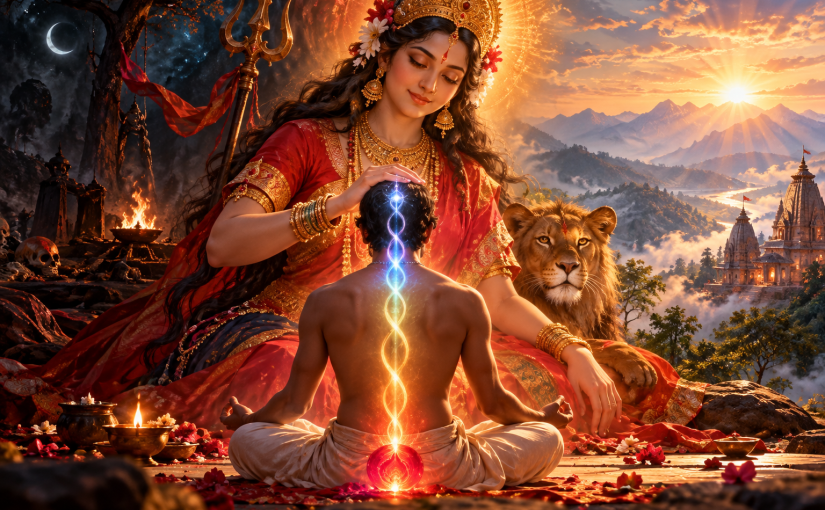
On this Dussehra, I find myself reflecting on a deeper aspect of Navratri, Shakti worship and Kundalini awakening. Two or three days ago, during Navratri, I worshipped the Divine Mother through a little Panchamakara ritual. As a result, I experienced deeper and more nourishing dhyana again on Dussehra after many days. Some staunch Sattvic devotees might object to such practices, but my understanding of the Shakta tradition is that the Goddess represents a power beyond conventional ideas of purity and impurity. My intention was to revere, respect, console, serve, contemplate and please the Divine Mother through a practice conducted in a limited and humane way. This experience led me to reflect on Tantra as a possible connection between devotion, energy and spiritual awakening.
Shakta Tantra and the Mystery of Fierce Goddess Worship
Many forms of traditional Goddess worship employ imagery that can appear frightening to an ordinary observer. Kali and other fierce manifestations of Shakti are associated in certain traditions with cremation grounds, skulls, funeral ashes, death and blood offerings. Why would a spiritual tradition use such disturbing symbols if its ultimate objective were peace and enlightenment? Scholarly studies of Bengali Shaktism explain that these practices and images can represent encounters with mortality, fear, attachment and the limitations of ordinary consciousness. The fierce Goddess can embody both the terrifying realities of existence and the compassionate power that helps devotees face them. The Oxford Academic study Offering Flowers, Feeding Skulls by June McDaniel explores these dimensions of Goddess worship and Tantric practice.
The apparent contradiction is fascinating. A path that looks frightening from outside may aim at an inner state of luminous awareness, fearlessness, compassion and humanity. This does not mean that every disturbing ritual leads to awakening. Rather, within certain Tantric traditions, confronting fear and social taboos can become a means of transforming one’s relationship with them. The external appearance of a practice and its intended spiritual destination are not necessarily the same.
Panchamakara, Sattvic Worship and the Purpose of Tantra
Panchamakara is associated with five ritual elements in particular Tantric traditions, although their interpretation and use differ between lineages. Some traditions use literal forms, while others adopt symbolic or substituted interpretations. Therefore, Tantra cannot be reduced to one ritual or one method of worship.
My own reflection is that the Divine Mother need not be approached only through conventional ideas of gentleness, restraint and ritual purity. Shakta worship can also involve intense devotion and unusual experiences. I feel that special energy is needed to approach the Goddess with sustained reverence, to console and serve her inwardly, and to contemplate her presence deeply. In my spiritual understanding, devotion is not merely the performance of an outward ritual. It is the mobilisation of attention, feeling and vitality towards the Divine.
Ultimately, the Divine becomes the gateway to awakening, while the deeper aim is to honour, serve and please the Goddess in her human form and, with her grace, move towards spiritual realization through relationships that are humane, blissful, detached and grounded in nonduality. In this approach, human relationships are not merely worldly attachments but potential paths to awakening when guided by mutual respect, compassion, freedom and the recognition of the Divine in one another.
However, it is important to distinguish personal spiritual understanding from established fact. We cannot objectively establish that the Goddess prefers a particular offering. Different devotees understand divine worship differently, and sincere devotion can flourish through many paths, including strictly Sattvic practices.
Animal Sacrifice, Religious Controversies and the Misuse of Spiritual Practices
Vaishnava traditions and other Hindu religious authorities have, at different times, objected to practices they considered incompatible with nonviolence, purity or proper devotion. There have also been disagreements within broader Tantric and Shakta traditions themselves. Some lineages accept animal sacrifice as a religious offering, while others reject it or reinterpret sacrifice symbolically.
I find it important to distinguish the spiritual aspiration of a tradition from the possible misuse of its methods. When ritual killing becomes indiscriminate and inhumane, or when the pursuit of supernatural powers replaces the aim of spiritual transformation, serious ethical questions arise. Proper guidance and ritual procedure may be important within a tradition, but neither can automatically make every action spiritually justified.
Claims that condemned prisoners or abandoned people were used as human sacrificial victims require careful, case-specific historical evidence. They should not be treated as proof that Shakta worship generally involved human sacrifice. Whatever the historical circumstances, treating a human being as disposable contradicts the humane awakening that spiritual practice is supposed to cultivate.
Kundalini Awakening and the Divine Mother as Shakti
My understanding of Tantra is closely connected with Kundalini Yoga. I see the Goddess not merely as an external object of worship but also as a representation of the living power that assists consciousness in its journey from Muladhara towards Sahasrara. The symbolism of rising Kundalini expresses a movement from embodied existence towards expanded awareness and spiritual realization.
In this framework, devotion and meditation become complementary. The practitioner invokes the Goddess through worship and seeks inner transformation through contemplation. Shakti represents the dynamic aspect of existence, while Kundalini provides a framework for understanding how this power may be experienced within the subtle body. Whether interpreted theologically, symbolically or psychologically, the relationship between Goddess worship and inner awakening offers a rich subject for spiritual philosophy. In simple terms, the Goddess is the divine embodiment of the subtle Kundalini energy within us, and through devotion to her, we seek awakening with her grace.
Kundalini experiences, however, should not automatically be treated as proof of a measurable energy travelling through the body. The language of subtle energy belongs to a spiritual framework, while physical energy, emotional intensity and physiological activity are different concepts that require their own explanations.
Tantra, Human Intimacy and the Importance of Energy
Reflecting frankly on the subject, I feel that neither Kundalini practice nor intimate human experience can be reduced to technique alone. Both may depend on energy, vitality, attention, responsiveness and a living engagement with the experience. In spiritual practice, mechanical repetition of asanas etc. without energy and concentration may feel empty. In human intimacy, physical vitality and desire can contribute to arousal and pleasure, but emotional connection, comfort, mutual willingness and individual differences are equally important. No amount of intensity guarantees a particular response.
The parallel interests me because Tantra explores the relationship between body, mind, desire, awareness and spiritual aspiration. Yet spiritual awakening should not be confused with sexual excitement, and human intimacy should never be treated merely as a tool for generating spiritual power. The value lies in awareness and sensitivity, not in intensity alone.
Is Tantra the Fastest Source of Spiritual Energy?
From my own perspective, Tantra appears to be a particularly powerful and potentially rapid way of mobilising energy. It can bring together devotion, bodily awareness, emotional intensity, sensory experience, mantra, ritual and contemplation. When these elements converge, spiritual practice may feel more dynamic than meditation performed mechanically.
Still, the word energy has several meanings. It may refer to a felt sense of vitality, concentrated attention, emotional intensity, or what a practitioner experiences as Shakti or Kundalini. These experiences may interact, but they are not interchangeable, and Tantra cannot be declared universally the fastest route to awakening.
However, this energy may also retain something of the dark-pit nature of Muladhara, meaning that it may not be entirely Sattvic, clean, humane and shimmering in its original form. The more these qualities are present in the energy, the better and more refined its expression becomes. This may be more psychological than physical, as the deeper sources of energy, rooted in our instinctual nature, have often carried some stigma or blame. Perhaps these darker or less refined aspects cannot be eliminated entirely but can be kept to a minimum through awareness, transformation and humane conduct, allowing the same primordial energy to express itself through bliss, detachment, nonduality and spiritual awakening.
The deeper possibility is that Tantra helps integrate aspects of life that are often kept separate: body and consciousness, devotion and contemplation, desire and self-understanding, the fierce and the compassionate. Its methods vary greatly, and its effectiveness depends on the practitioner, the tradition and the nature of the practice.
The Deeper Purpose of Shakta Tantra Is Inner Transformation
My reflection has brought me to a simple but meaningful distinction. Fierce Goddess imagery, unconventional rituals and intense experiences are not necessarily the final objective of Shakta Tantra. In some traditions, they serve as means of confronting fear, loosening attachment and seeking a more expansive state of awareness. In others, surrender, compassion, mantra and devotional worship provide the central path.
I see a possible connection between this Tantric approach and Kundalini awakening: energy gives movement to the process, awareness gives it direction, and sensitivity allows the experience to unfold naturally. The ultimate measure of spiritual progress is not how unconventional a ritual appears or how intense an experience becomes, but whether it leads towards clarity, compassion, self-mastery and freedom from compulsive attachment.
Perhaps this is the most important insight emerging from my experience during Navratri. The fierceness of a spiritual path should not be confused with the nature of its destination. The deeper aspiration is a luminous, awakened and humane state of consciousness.


