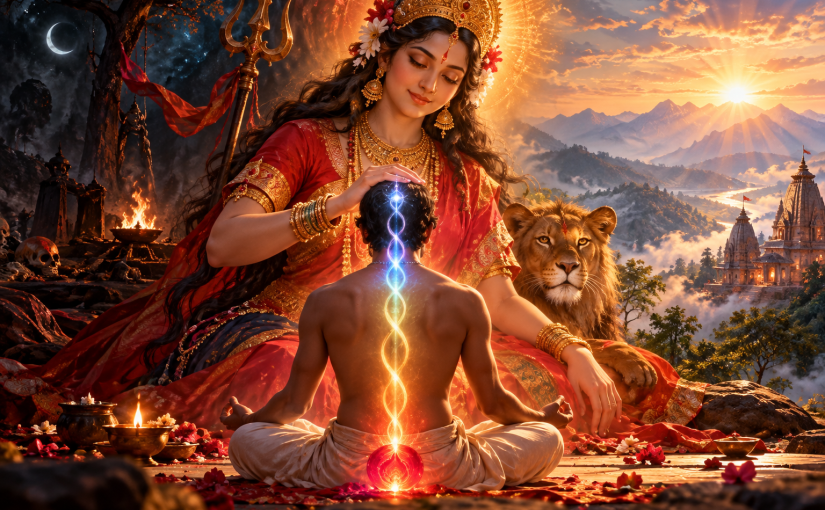
Shakta Tantra and Kundalini Awakening: The Hidden Connection Between Goddess Worship, Spiritual Energy and Human Transformation

On this Dussehra, I find myself reflecting on a deeper aspect of Navratri, Shakti worship and Kundalini awakening. Two or three days ago, during Navratri, I worshipped the Divine Mother through a little Panchamakara ritual symbolically. As a result, I experienced deeper and more nourishing dhyana again on Dussehra after many days. Some staunch Sattvic devotees might object to such practices, but my understanding of the Shakta tradition is that the Goddess represents a power beyond conventional ideas of purity and impurity. My intention was to revere, respectfully love, console, serve, contemplate and please the Divine Mother through a practice conducted in a limited and humane way. This experience led me to reflect on Tantra as a possible connection between devotion, energy and spiritual awakening.

Shakta Tantra and the Mystery of Fierce Goddess Worship

Many forms of traditional Goddess worship employ imagery that can appear frightening to an ordinary observer. Kali and other fierce manifestations of Shakti are associated in certain traditions with cremation grounds, skulls, funeral ashes, death and blood offerings. Why would a spiritual tradition use such disturbing symbols if its ultimate objective were peace and enlightenment? Scholarly studies of Bengali Shaktism explain that these practices and images can represent encounters with mortality, fear, attachment and the limitations of ordinary consciousness. The fierce Goddess can embody both the terrifying realities of existence and the compassionate power that helps devotees face them. The Oxford Academic study Offering Flowers, Feeding Skulls by June McDaniel explores these dimensions of Goddess worship and Tantric practice.

The apparent contradiction is fascinating. A path that looks frightening from outside may aim at an inner state of luminous awareness, fearlessness, compassion and humanity. This does not mean that every disturbing ritual leads to awakening. Rather, within certain Tantric traditions, confronting fear and social taboos can become a means of transforming one’s relationship with them. The external appearance of a practice and its intended spiritual destination are not necessarily the same.

Panchamakara, Sattvic Worship and the Purpose of Tantra

Panchamakara is associated with five ritual elements in particular Tantric traditions, although their interpretation and use differ between lineages. Some traditions use literal forms, while others adopt symbolic or substituted interpretations. Therefore, Tantra cannot be reduced to one ritual or one method of worship.

My own reflection is that the Divine Mother need not be approached only through conventional ideas of gentleness, restraint and ritual purity. Shakta worship can also involve intense devotion and unusual experiences. I feel that special energy is needed to approach the Goddess with sustained reverence, to console and serve her inwardly, and to contemplate her presence deeply. In my spiritual understanding, devotion is not merely the performance of an outward ritual. It is the mobilisation of attention, feeling and vitality towards the Divine.

Ultimately, the Divine becomes the gateway to awakening, while the deeper aim is to honour, serve and please the Goddess in her human form and, with her grace, move towards spiritual realization through relationships that are humane, blissful, detached and grounded in nonduality. In this approach, human relationships are not merely worldly attachments but potential paths to awakening when guided by mutual respect, compassion, freedom and the recognition of the Divine in one another.

However, it is important to distinguish personal spiritual understanding from established fact. We cannot objectively establish that the Goddess prefers a particular offering. Different devotees understand divine worship differently, and sincere devotion can flourish through many paths, including strictly Sattvic practices.

Animal Sacrifice, Religious Controversies and the Misuse of Spiritual Practices

Vaishnava traditions and other Hindu religious authorities have, at different times, objected to practices they considered incompatible with nonviolence, purity or proper devotion. There have also been disagreements within broader Tantric and Shakta traditions themselves. Some lineages accept animal sacrifice as a religious offering, while others reject it or reinterpret sacrifice symbolically.

I find it important to distinguish the spiritual aspiration of a tradition from the possible misuse of its methods. When ritual killing becomes indiscriminate and inhumane, or when the pursuit of supernatural powers replaces the aim of spiritual transformation, serious ethical questions arise. Proper guidance and ritual procedure may be important within a tradition, but neither can automatically make every action spiritually justified.

Claims that condemned prisoners or abandoned people were used as human sacrificial victims require careful, case-specific historical evidence. They should not be treated as proof that Shakta worship generally involved human sacrifice. Whatever the historical circumstances, treating a human being as disposable contradicts the humane awakening that spiritual practice is supposed to cultivate.

Kundalini Awakening and the Divine Mother as Shakti

My understanding of Tantra is closely connected with Kundalini Yoga. I see the Goddess not merely as an external object of worship but also as a representation of the living power that assists consciousness in its journey from Muladhara towards Sahasrara. The symbolism of rising Kundalini expresses a movement from embodied existence towards expanded awareness and spiritual realization.

In this framework, devotion and meditation become complementary. The practitioner invokes the Goddess through worship and seeks inner transformation through contemplation. Shakti represents the dynamic aspect of existence, while Kundalini provides a framework for understanding how this power may be experienced within the subtle body. Whether interpreted theologically, symbolically or psychologically, the relationship between Goddess worship and inner awakening offers a rich subject for spiritual philosophy. In simple terms, the Goddess is the divine embodiment of the subtle Kundalini energy within us, and through devotion to her, we seek awakening with her grace.

Kundalini experiences, however, should not automatically be treated as proof of a measurable energy travelling through the body. The language of subtle energy belongs to a spiritual framework, while physical energy, emotional intensity and physiological activity are different concepts that require their own explanations.

Tantra, Human Intimacy and the Importance of Energy

Reflecting frankly on the subject, I feel that neither Kundalini practice nor intimate human experience can be reduced to technique alone. Both may depend on energy, vitality, attention, responsiveness and a living engagement with the experience. In spiritual practice, mechanical repetition of asanas etc. without energy and concentration may feel empty. In human intimacy, physical vitality and desire can contribute to arousal and pleasure, but emotional connection, comfort, mutual willingness and individual differences are equally important. No amount of intensity guarantees a particular response.

The parallel interests me because Tantra explores the relationship between body, mind, desire, awareness and spiritual aspiration. Yet spiritual awakening should not be confused with sexual excitement, and human intimacy should never be treated merely as a tool for generating spiritual power. The value lies in awareness and sensitivity, not in intensity alone.

Is Tantra the Fastest Source of Spiritual Energy?

From my own perspective, Tantra appears to be a particularly powerful and potentially rapid way of mobilising energy. It can bring together devotion, bodily awareness, emotional intensity, sensory experience, mantra, ritual and contemplation. When these elements converge, spiritual practice may feel more dynamic than meditation performed mechanically.

Still, the word energy has several meanings. It may refer to a felt sense of vitality, concentrated attention, emotional intensity, or what a practitioner experiences as Shakti or Kundalini. These experiences may interact, but they are not interchangeable, and Tantra cannot be declared universally the fastest route to awakening.

However, this energy may also retain something of the dark-pit nature of Muladhara, meaning that it may not be entirely Sattvic, clean, humane and shimmering in its original form. The more these qualities are present in the energy, the better and more refined its expression becomes. This may be more psychological than physical, as the deeper sources of energy, rooted in our instinctual nature, have often carried some stigma or blame. Perhaps these darker or less refined aspects cannot be eliminated entirely but can be kept to a minimum through awareness, transformation and humane conduct, allowing the same primordial energy to express itself through bliss, detachment, nonduality and spiritual awakening.

The deeper possibility is that Tantra helps integrate aspects of life that are often kept separate: body and consciousness, devotion and contemplation, desire and self-understanding, the fierce and the compassionate. Its methods vary greatly, and its effectiveness depends on the practitioner, the tradition and the nature of the practice.

The Deeper Purpose of Shakta Tantra Is Inner Transformation

My reflection has brought me to a simple but meaningful distinction. Fierce Goddess imagery, unconventional rituals and intense experiences are not necessarily the final objective of Shakta Tantra. In some traditions, they serve as means of confronting fear, loosening attachment and seeking a more expansive state of awareness. In others, surrender, compassion, mantra and devotional worship provide the central path.

I see a possible connection between this Tantric approach and Kundalini awakening: energy gives movement to the process, awareness gives it direction, and sensitivity allows the experience to unfold naturally. The ultimate measure of spiritual progress is not how unconventional a ritual appears or how intense an experience becomes, but whether it leads towards clarity, compassion, self-mastery and freedom from compulsive attachment.

Perhaps this is the most important insight emerging from my experience during Navratri. The fierceness of a spiritual path should not be confused with the nature of its destination. The deeper aspiration is a luminous, awakened and humane state of consciousness.

Kundalini loss caused Parvati’s anger and the wrath of the Russian ruler~ A comparative psychological study

Friends, many mythologies cannot be decoded completely. So you have to guess there. Something is better than nothing. From a light beginning, these stories also get decoded later. One such mysterious story is about Ganesh Dev. I think Ganesha is the Kundalini Purush of Parvati. Parvati was bored while being supported by Shiva’s Kundalini Purush. She started considering herself as dependent on Shiva. Especially she was provoked by her friends. That is why Parvati says that she was living like a subordinate, living under the protection of Shivaganas. She decided that now she would create a dedicated Gana for herself. Once she was bathing naked, but Lord Shiva scolded the gatekeeper Nandi and entered, which made her embarrassed. That’s why she created the perfect and flawless Ganesha out of the filth of her body. The scum is also called raja, and the vaginal fluid equivalent to semen is also called raja. Possibly Ganesha is the psychic Purusha created from the transformation of the sexual energy of Goddess Parvati, just as Kartikeya is the mental Kundalini Purusha created from the sexual energy of Lord Shiva. It was called son, because it was made of vaginal fluid like a normal son, but certainly not in the womb but in the brain or in the mind. For this reason, the secretion of menstrual fluid or the secretion of Raja becomes very less or even zero in the woman due to the practice of sexual tantra. This also protects the woman from weakness. Her Kundalini develops from this Raja or the dirt of her body. It would be appropriate to make it clear here that for us Goddess Parvati is reverred, worshipped, and respected. We cannot say anything directly about her. We are talking only about human beings with nature like Goddess Parvati. Because everywhere it cannot be written like, “Man with the nature of Goddess Parvati”, because this will increase the scope of writing without need, and at the same time people will be confused and unable to understand. Therefore, in compulsion, one has to write Goddess Parvati or simply Parvati for abbreviation. In a way, we describe particular personality or nature, not any particular god or person. Similarly, one should also understand about all the deities like Shiva etc. Hope and believe that the common man and the gods and goddesses will not take it otherwise. Parvati gave Ganesh a stick and instructed that no one should enter inside her house without her permission. Parvati is actually a soul. Sahasrar is its home. To make Ganesha stand outside the house means to be engrossed in the meditation of Kundalini at all times. From this nothing else can come into focus, that is, anything cannot enter inside the house of its own free will. When the soul desires and withdraws its attention from the Kundalini, then only the other thing will be able to enter the house of meditation. Before that she did not have Kundalini in her mind. That’s why she had to allow Shiva and his worldliness to enter meditation hall of her brain even if she didn’t want to. While bathing she was naked, that is, lost in intimate thoughts of the depths of the soul. This is a good answer for those who have a misconception that women are considered inferior to men in Tantra. In fact, men and women are equal in tantra, and similar types of practices have been prescribed for both. Once Nandi was stopped by Ganesha at the door. Surprised by this, Shiva asked his Nandi and other ganas to enter Parvati’s house turn by turn, but the Ganesh boy beat everyone with his stick. Meaning that Kundalini is soft like a child, who does not have special weapons to protect the soul, but has an affectionate fear depicting stick. Nandi etc. Ganas here are the thoughts of Shiva, who want to introduce themselves to parvati’s soul before joining of Shiva’s soul with Parvati’s soul. This is often the case in the world. It is only through thoughts that a warm meeting of people with each other is possible. Intimidating or beating the ganas with stick by Ganesha means that Parvati, the soul, concentrates on the Kundalini without paying attention to the thoughts coming from outside. Ideas or thoughts are neither to be welcomed, nor should they be shunned. This is what it means to have a fear filled with love. This is to maintain a witnessing attitude towards thoughts or worldliness. This is Vipassana, or vipashyana. The defeat of all the gods and ganas by Ganesha in turn shows that the Kundalini meditation of Parvati is unaffected by all the thoughts and feelings transmitted by Shiva. Then all the deities take it as an insult to Shiva. So they all make a strategy and fight together, and deceitfully kill Ganesha. Meaning that Shiva entangles Parvati in worldly affairs so much that she forgets Kundalini. Filled with immense anger, Parvati turns black and becomes Kali, and sets out to destroy the universe. Meaning that due to the destruction of the unwavering Kundalini picture of the mind, Parvati gets filled with anger, and falls into the darkness. It is like losing one’s favorite thing, or the fear of losing it, and without it he becomes blind. It is just like losing toy by a baby. In such a situation, a person can do any wrong thing, if he is not handled with consolation. Has the Russian power head suffered a similar shock? In this way, man can destroy the world, and himself too. Because the whole universe is settled in the body, that is why perhaps the attempt of suicide by Parvati has been called an attempt to destroy the universe. The meaning of name Kali is “black or dark”. Then she turns into goddess Kali and tells Shiva that if you revive Ganesha, she will be pleased. The point is clear that only by getting the lost favorite thing or Kundalini, a person attains his former happy state. It is now necessary to ask the Russian ruler what his favorite thing has been lost, for which he is putting the whole earth at stake by reaching for the nuclear button, and which he will be happy to find. I had also said in the previous post that the Kundalini of today’s advanced age is stuck in the Agya Chakra. The nature of Kundalini is to move. She cannot stay in one place for long. Its next and advanced stage is the Sahasrara Chakra. But to raise the Kundalini up to there, a lot of energy is required, which can be found only through sexual tantra. that’s why I write about Tantra with divine inspiration. At the same time, there is also a need to reduce the material world, so that the energy saved from it can be used for uplifting the Kundalini. The destruction produced by this war is a subconscious attempt to reduce the worldliness, so that the energy needs of Kundalini can be fulfilled. Counting other causes of war are mere excuses. A nuclear-armed and largest country in terms of area can be afraid of what. The real and only cause of war is the lack of that precious prana energy or life energy by which man moves on the path of humanity and spirituality. To convince the wise, it is enough to show the fear of war, the foolish will not understand even by war, only harm will happen. At the most, he would show a little fighting power, so that the enemy would get a chance to recover and improve. Then the world would also appreciate the diplomacy and war strategy of the warrior. What is it that the whole nation is bent on making hell. On the one hand, the poor do not get a roof to cover their heads, they chill in the open all night, on the other hand you have been destroying luxurious buildings. Think how much blood and sweat would have gone into making them. How much of that vital energy must have been wasted in making them, which could have awakened the Kundalini. This subconscious effort to meet the energy needs of Kundalini is uncontrolled and inhuman, like uncontrolled nuclear energy. What is it that the Kundalini is descending instead of ascending, without achieving its highest goal. Therefore, the change in worldliness or ways of living or lifestyle towards minimalism should be gradual and humane, not abrupt and inhuman. I am not attacking any one nation here. All nations behave like full of war craving. Why such conditions are created by all the countries in the world, which force a country towards war. Most of the countries are engaged in collecting weapons. They want to make money from arms business. They are keeping the dream of imperialism alive. Kundalini is the best medicine for this. With the help of Kundalini, the whole creation starts appearing inside oneself. Man begins to be satisfied with himself, no matter what he is, and no matter what the circumstances. When a head of state feels the whole universe inside him, then why would he want to loot the land of others. He will find the solution to his problem within himself. Then he would not even need weapons in most cases, and neither would war. I know only one country in the world, which has never started a war, nor attacked anyone, even after a lot of provocations. That country is India. Perhaps this has been possible in India only due to Kundalini Yoga and the religion based on it. That is why the whole world should learn a lesson from this soft power nation in this regard, if a peaceful world is to be established. I’m not bragging about anyone. Nor am I looking at sides other than war related. Truth is truth, which no one can deny. Well, Shiva sent his ganas in the east direction in the morning, and said that whichever creature they meet first, get its head cut off, and attach it to the trunk of Ganesha. This means that one has to speculate, but somehow Parvati’s lost Kundalini can be recovered. The ganas first got an elephant cub. They revived Ganesha with the help of Shiva by attaching his head to the torso of Ganesha. Goddess Parvati was satisfied with this, due to which the whole world was saved from her wrath.

Kundalini is the interplay of energies

Friends, I watched three movies last week. It kept my brain very active. Possibly due to this there was also a slight headache at times. However, there remained a lot of peace in the mind, and a lot of joy dominated. This happened due to the non-dual spirit created from Kundalini Yoga. Still, I reduced yoga a bit, because I was feeling a little tired and lethargic. Due to this the headache also reduced a little and the tremors of the body also decreased. By the way, it is better when the number of postures is not reduced, but the time spent on them is reduced. Yoga should not be taken as work. It should not be taken as fatigue. It should be taken as a rest. The body and mind should be let loose. In fact, yoga reduces fatigue, not increases it. Each asana in a particular way uplifts and rotates the prana energy. Anyway, due to less sleep, more waking up late in the night, due to change in food timings, excessive air intake from fans or a.c., stress and headache arise. There was more activity in my left brain, for which energy was rising from the Ida Nadi. However, by simultaneously meditating on the Ajna Chakra and Muladhara, the energy was transferred to the Sushumna, thereby activating the right brain, revealing the Kundalini picture in Sahasrara. After a while that energy would again enter the Ida Nadi. It had to be taken again to Sushumna in the same way. This sequence continued. In fact, the left brain is active from worldliness and the right brain is active from spirituality. A balance of materiality and spirituality is necessary for the balance of both the brains. I was telling in the previous post that how the women of Devlok or god abode get attracted towards Rati or lust sports by drinking the water of Nanda and Alaknanda alternately and feel great satisfaction. In fact, they are immersed in worldliness. So they don’t have much energy left. They cannot directly reach the river Ganges. That’s why they work only from the Nanda and Alaknanda rivers. Almost the same thing happened with me. Due to the heavy workload, I did not have enough energy to lift the Kundalini straight up to Sahasrar. Due to this force, my head was hurting a bit. So I let the Kundalini energy rise up in the back at her own free will. Then I noticed that it started going through the Ida nadi to the left brain with a thrilling sensation going. I just used to pay light attention in the intervening moments to the front agya chakra and the straight tongue resting behind the teeth. With this, I was rarely able to pay attention to Mooladhara, because from this the prana energy goes to Sahasrara and Sushumna straight. She would try to go to Pingala or Sushumna Nadi with him, but she was not able to go. Meaning there was a lack of energy. After a long time she used to go to Pingala and right brain for a while, and again to Ida. Kundalini stays on the Agya chakra most of the time, and does not go above it. She used to stay only for a moment in Sushumna and Sahasrara. The point is clear that the Kundalini should be rotated according to the amount of energy inside. It should not be forced.

The Urdhvareta Purush should be considered a Brahmachari or a Tantrik

I also got a new information this week in Shivpuran. In one verse the word ‘Urdhvreta’ was found written. The Urdhvareta man was equated with the great jnani or the enlightened one or the great spiritual seeker. Urdhva means ‘upwards’, and Reta means ‘semen’. Therefore, Urdhvareta means a person who pours his semen upwards. This is the same sexual sublimation, which is the basic action of Tantra Yoga. In the name of tantra, it dominates these days, although it is only a major contributory factor to tantra with a wider perspective. That is not all in itself. While translating it into Hindi, it has been written as Urdhvreta Brahmachari. One who is a celibate, how can he become an Urdhvreta, because there is no production of semen in a celibate. The production of semen is done through sexual stimulation, but the brahmacari stays away from it. Even if semen is produced in it under normal bodily functions, it remains very little and unnoticed. What can a man not even notice in the body, how can he uplift it? Another thing is known from this is that there is mention of tantra everywhere in the Puranas, and in the Puranic period, tantra science was prevalent among the common people. Brahmacharya is also a tantra science. If the brahmachari does not keep raising the semen energy with the help of yogasadhana, then it will disturb him, and may also cause disorder in his mind and body. It is a different matter that in the leftist system this celibacy is given a limitless and fierce form. Although this leads to rapid spiritual growth, but if it is not done properly, it also leads to a rapid spiritual decline. Nowadays, mostly only this sexual tantra is considered as tantra.

The faults of great people are also auspicious like ornaments

Nothing is true in this world. Everything is relative to each other. The defects which have been called Kulakshan in common people, the same defects are Sulakshana in Lord Shiva. That is why in Shiv Purana, Narada Muni, while explaining to Parvati’s parents, says that the faults of the wise and great people are also like the virtues. In fact Narad Muni tells them that their daughter Parvati will be married to a ghostly, naked, wild and anti-social person. This makes them worried. Then Narada removes their worries and says that Shiva is also like this, so get Parvati married to Shiva. Parvati will erase the restlessness of his mind. This is the description of Tantra Yoga itself. Then why most of the people say that tantra came from here or there; Or the tantra is like this, the tantra is like that. Shivpuran is a completely dedicated Tantra-Purana. Its tantric principles are not easily caught because it has a high degree of social, metaphoric and mystical styling of expression.

Humiliation and respect are two sides of the same coin

Last week got a sad news that Mahant Narendra Giri, president of Akhara Sangh, ended his life by hanging himself. According to sources, in his last written and video document, he attributed this work to his disciple Anand Giri. Anand Giri was brought up by him from childhood, and he had a special attachment to him. According to sources, he had made him humiliated in the society in the past, and was still going to make a false video viral, in which his mentor Narendra Giri was to be shown in an objectionable position with a woman. Fearing this humiliation, he took this step. However, it is still under investigation, and the final conclusion has not been revealed. There is a verse in the Gita ~Jitatmanah Prashantasya—॥6-7॥ meaning,One who has conquered himself in cold and heat, happiness and sorrow and honor and dishonor, such a person is rightly situated in the Supreme Soul.Then what kind of spirituality can we call being afraid of humiliation? I am not taking sides here. I am describing only one side of the event, because thoughts related to that are arising in my mind. There are many sides to every event. But it is not possible for a single man to think about each and every aspect. It is meaningless for anyone to say why only one side of the incident was taken. To know the other side, one must know the views of other people. Everything cannot be found at one place. Anyway, complete information is available only after knowing all the aspects. Little Knowledge is a Dangerous Thing. If I talk about the other side in a nutshell, then it is this that one should never insult the Guru, the Gnani and the devotee. Kundalini makes a man extremely sensitive. Therefore Kundalini Yogi should not be disturbed. They should be treated with love. Probably, the women are more sensitive due to this same Kundalini principle. In the next post I will elaborate a bit on why this happens. First of all, why should you be so proud of yourself that you can’t bear the humiliation after that? If you can’t live being taunted by someone, then why should you get yourself respected. Kundalini helps and protects man in such situations. Apart from Kundalini, there is selfishness in everything in the universe. No man shows friendship without selfishness. The tree also gives fruit for selfishness. To get milk from the cow, one has to feed grass. Even in exchange for getting benefits from non-living things like rivers and mountains, these have to be kept clean. But Kundalini does not expect anything in return. She supports even in bad times, and provides consolation and sympathy. Kundalini is a bubble of unbroken energy. It does not have a separate existence from the eternal energy. What can it need as it’s the conscious sky that’s empty. The more one remembers it, the more it gets along with him. Everything is temporary and impure except Kundalini. Everything except Kundalini is bound by material constraints and limitations. Kundalini is a pure mental picture, a bubble of zero energy-sky. It cannot even be touched by the physical dimension. That’s why a well-nourished Kundalini is very useful in bad times. When there is an increase in stress due to physical activities and relationships, then the functioning of the whole body gets disturbed. This happens because there is a lack of energy in the brain. At that time Kundalini starts manifesting in the mind due to feeling of Advaita in the discouraged man’s mind. This is because the body relaxes a bit with Advaita, which reduces energy consumption. With the excess energy, Kundalini starts appearing in the mind. To maintain that Kundalini, energy starts climbing up from the Muladhara. With this, the physical functioning gets corrected, and the anger etc. of the mind are erased by it. In fact, this happens only due to the creation of sufficient availability of energy in the brain. I had written in the previous post also by referring to Shiv Purana that Sahasrara Chakra supplies energy to the whole brain. Therefore, when the Kundalini appears in the brain, it is said to centralize it by meditating on the Agya chakra and the Muladhara chakra together with it, so that it enters the Sahasrara. The reason why a thousand petals are depicted in the Sahasrara Chakra is because it supplies energy to countless or thousands of places throughout the body, including the brain.

The benefits of meditation on breathing are obtained only through Kundalini

One day I was feeling tired. I could not even sleep, because I have gastric acid reflux on sleeping after a meal during the day. The mouth gets sour from the stomach, due to which the teeth also look wear out. Sitting empty-handed, began to pay attention to the breath, especially with the word HANS. Due to this fatigue also disappeared and Kundalini joy also appeared. While inhaling, the sound of the breath was of thin music, and the sound of the exhaled breath was of thick music. You could say that the inhalation sound had a higher treble or frequency, but the outgoing breath had less treble and more bass. M’s or HAN’s voice is high treble and S’s voice is low treble. That is why the attention is given to the breath in the form of HANS. Therefore the attention of HAN is done with the inhaling breath, and the attention of S is done with the outgoing breath. It gives a lot of benefits.

Vedic philosophy is a practical philosophy

I am saying practical philosophy because it is not a nihilistic philosophy. Vedic rituals are a living example of this. In this, yoga and meditation are achieved through worldliness, not escapism. I myself grew up in this environment. It is a different matter that for the last leap of awakening, I took the help of Tantra Yoga. But it is also true that Tantra Yoga only helps if one has attained the initial spiritual stage in the loving atmosphere of Vedic rituals and likewise.

Spiritually every man is Shiva and every woman is Parvati

Sati attains Shiva by doing penance. When she becomes Parvati in the next birth, she still pleases Shiva by doing penance and attains him. To me, it seems only a metaphor for Tantric household life. Parvati’s penance here is the life of a wife, full of sacrifice and dedication, at the beginning of the householder’s life. That is why it is seen that after the initial disturbance of the household, the real household life begins. Some households get back on track in a few months, some take a few years. For many, the real tuning is made when their children also grow up. It depends on the proper participation of both the husband and wife as to how much time it will take. Husbands who are attached to many women do not make their wife do penance at all, nor do they do it themselves. Although they seem fully tuned in the beginning, but it is more of a pretense. In this haste, they do not get to know each other deeply and thoroughly. Due to this, some tantric deficiency remains till later. Before marriage, one undoubtedly wants that his future wife should not be less than goddess Parvati in qualities, even after marriage, he wants his wife to serve him whole-heartedly, love him deeply and be completely devoted to him. Meaning that the husband wants his wife to do severe penance for him first, only then he will surrender himself to her. Lord Shiva also wants the same from Sati or Parvati. That is why Parvati does severe penance, constantly remembering Shiva. After that Shiva accepts her. Even Shiva does a little penance. He constantly wander here and there in remembrance of Parvati. This is his penance. Actually it is the psychology of human life, which is explained by the stories of gods and goddesses in the Puranas.

Goddess of War Kali

There is a ritual to worship Bhagwati Mata or goddess Kali in times of war etc. and in other dire circumstances. In fact, the source of energy is the woman. During war etc., a lot of vital energy is required, more than twice as much as during normal times. A separate energy supply is needed to keep the body moving, and a separate one to keep the mind stable. If there is a desire for liberation, then even more energy is needed, because for that, along with the nadis and other chakras, the Sahasrara has to be kept awake. Kali has been given a gruesome form because the energy derived from it is also used for bloodshed in war etc. Secondly it also means that Shakti can be thirsty for blood.