Sati Burnt in Daksha’s Yagya as a Metaphor: Love Marriage, Lost Love, Shiva Consciousness and the Psychology of Shakti Peethas

Ancient stories often survive not because they are only historical or religious narratives, but because they hold emotional truths that repeat in every age. The story of Sati, Daksha, Shiva, Parvati and the Shakti Peethas can be read in many ways. One person may see it as sacred mythology, another as cosmic symbolism, and another as the hidden story of human love, separation, memory and transformation. In this reflective interpretation, the episode of Sati burning in Daksha’s yagya becomes a metaphor for the pain caused when a father’s ego blocks his daughter’s chosen love marriage. It becomes the story of how love may be denied outwardly, yet remain alive inwardly forever.

Daksha’s Ego as Social Pride and Family Control

In this reading, Daksha does not only represent a mythological king or father. He represents the rigid ego of family authority, social pride, status consciousness and control over the personal choices of children. Such fathers may believe they know what is best, but often what appears as duty is mixed with prestige, fear of society and attachment to image. When a daughter loves someone outside expected norms, conflict begins. The father stands for order, respectability and approval, while Shiva stands for freedom, authenticity and unconventional love.

Thus, Daksha’s rejection of Shiva can be understood as the refusal of living love in favor of social ego. It is the old battle between family honor and inner truth, between reputation and genuine emotional destiny.

Sati Burnt in Daksha’s Yagya as Inner Death

The burning of Sati need not be seen only as literal self-immolation. It can symbolize the inner death of a woman whose love is denied, humiliated or made impossible. She may remain physically alive, but something essential within her is consumed by grief. A person can continue breathing, smiling and performing duties while an entire inner world has turned to ash.

It may also mean that after separation she undergoes the funeral rites of her youthful identity. The girl who once dreamed freely is gone. In many lives this happens silently. Society sees marriage, ceremony and continuation of life, but does not see the inward burning that preceded it.

Another possibility in this interpretation is that she may later be married to another man, yet inwardly she remains unmarried because her heart is still united with the lost beloved. Outward relations may change, but inward belonging can remain untouched.

Shiva Carrying Sati’s Corpse as Memory of Lost Love

One of the most powerful symbols in the myth is Shiva carrying Sati’s corpse and wandering in grief. Read psychologically, this means a person moving through worldly life while carrying the preserved image of lost love within. The body of Sati becomes the memory-image that refuses to dissolve.

Many people live like this without admitting it even to themselves. They marry, work, laugh, travel and fulfill responsibilities, yet somewhere inside they still carry an unburied image of someone once loved. The world sees movement, but inwardly they are wandering with the corpse of memory.

This is not always unhealthy. Sometimes it is simply the human way of honoring what deeply shaped the soul. Love once real does not disappear because circumstances changed.

Shakti Peethas as Body Centers of Memory and Emotion

The falling of Sati’s organs across the land and the creation of Shakti Peethas can be understood as the distribution of memory through the whole being. In this interpretation, Shiva as Atma, or inner consciousness, has absorbed the image of Sati so completely that her presence becomes fixed in different body centers, emotions and functions.

When the eyes of Sati fall at Naina Devi, it means Shiva looks upon the world, yet the image of Sati remains present in perception. In a poetic sense, the eyes now belong to Sati rather than Shiva. The world is seen through memory. Vision itself is colored by love.

The same principle extends to all organs and actions. The throat may carry unspoken words. The heart may hold tenderness or ache. The hands may perform worldly duties while remembering someone else. The feet may walk many roads, yet move under the influence of an old longing. In this sense, the sacred shrines symbolize centers where emotional energy lodges itself in the embodied person.

Rather than reducing the symbolism to a literal count of fifty-two organs, it may be more elegant to say that the many Peethas represent many sacred centers of human feeling, perception and function like chakras, channels etc.

Shiva as Atma Absorbing the Image of Sati

A profound line in this interpretation is that Shiva is Atma and has imbibed the image of Sati into himself. This means the beloved no longer remains merely outside as another person. She becomes internalized within consciousness itself.

At first, love seeks the other externally. Later, through separation, longing or maturity, the image enters the self. Then the person carries not another body, but another presence within. Actions continue in the world, yet a hidden companion lives in consciousness.

This idea has deep spiritual echoes. In many traditions, what is loved outwardly eventually becomes realized inwardly. Separation turns attachment into subtle energy. Memory becomes Shakti.

Parvati Taking Birth and Marrying Shiva as Love Returning in New Form

When Sati takes rebirth as Parvati and again marries Shiva, the symbolism becomes even richer. In one life reading, this means that though she may marry elsewhere outwardly, inwardly she keeps the image of Shiva alive. In a deeper sense, she ultimately remains united with him.

Another reading is that love denied in one form returns in a more mature form later. Youthful passion dies, but transformed devotion is reborn. What could not happen under one set of conditions may happen inwardly, symbolically or in another chapter of life.

Thus Parvati is not merely another character. She is love reborn after burning, dignity restored after humiliation, union after fragmentation.

Jungian Psychology of Sati, Shiva and Daksha

Modern psychology also offers a lens for such myths. Carl Jung might see Sati as the inner beloved image, Shiva as consciousness carrying the feminine principle within, and Daksha as the oppressive father-authority structure of society and ego. Shiva carrying the corpse would symbolize fixation upon lost psychic content that still demands integration.

Parvati then becomes the return of that same energy in healed and mature form. In Jungian language, the myth can describe individuation: the process through which rejected emotional truth is eventually reintegrated into a fuller self.

Why Such Myths Still Feel True Today

This symbolic reading touches people because it mirrors real life. Many individuals outwardly accept one destiny while inwardly belonging to another. Some fulfill social duty while carrying silent love. Some lose a person but keep the image alive in perception, action and emotion. Some are separated in youth only to rediscover the same essence later in transformed ways.

That is why ancient myths never become old. They speak in images what ordinary language struggles to express.

Final Reflection on Love, Memory and Inner Union

The story of Sati, Daksha, Shiva, the corpse, the wandering, the Peethas and the rebirth as Parvati can therefore be read not only as theology but as the psychology of love surviving ego, separation, marriage, grief and time. It becomes the journey from outer union to inner union.

What society prevents externally may still live inwardly. What burns may return purified. What is lost as form may remain as presence. What was once another person may become part of consciousness itself.

In that sense, the final union of Shiva and Parvati means more than marriage. It means the reconciliation of love with life, memory with action, and soul with its own deepest image.

Sanatan Dharma as Lived Experience: When Scriptures Become a Life

A personal preface

This is not a claim, not a declaration of divinity, and not an attempt to place myself above any tradition. This is only a record of lived experience — how scriptures, relationships, stages of life, and inner practices unfolded naturally inside one ordinary human life. I write this because many people think our scriptures are theory, mythology, or outdated philosophy. My life has shown me that they are a practical way of living, happening even in the age of supercomputers, aeroplanes, and high technology.

If divine permission comes, a full book may come later. For now, this is the nutshell — for curious readers who want to understand how Sanātana Dharma actually works in living human beings.

Scriptures are not theory — they are living maps

I have seen that the great god lineages are not isolated historical events limited to one time and place. They are stages of human spiritual evolution that keep happening again and again, everywhere, in different people, in different forms. That is why this dharma is called sanātana — eternal — unlike systems tied to one prophet, one story, or one century.

Technology does not block these stages. A needle, an aeroplane, a supercomputer — none of these stop consciousness from evolving. Outer tools change, inner laws do not.

The Śiṣya phase: childhood discipline and listening

My first phase was the śiṣya phase, in childhood.

I was an observer by nature. Disciplined. Non-revolting. Whatever teachers and elders taught that felt good and right, I accepted happily and with devotion, without criticism. I now see that this phase is common to all great lineages — before anyone becomes a knower, they must become a learner.

Rama, Krishna, Buddha, Shankara — all began as disciples. Ego must soften before it can dissolve.

Dada Guru: the power of sound and atmosphere

My grandfather used to read scriptures aloud for hours every day to listeners. Those words falling on my ears shaped my inner world long before I understood them. I did not study scriptures — I absorbed them.

That is why I call him Dada Guru.

He did not give me a mantra, but he gave me atmosphere, rhythm, reverence, and sound — śabda-brahma. Those sounds later pushed me naturally toward practical living, not theoretical belief.

Krishna phase: adolescence, attraction, and refined desire

In adolescence came the Krishna phase, lasting about 1–1.5 years during senior secondary school. This phase was intense and energetic — attraction to girls, being attracted by girls, social charm, indirect sexual fun — but never vulgar indulgence.

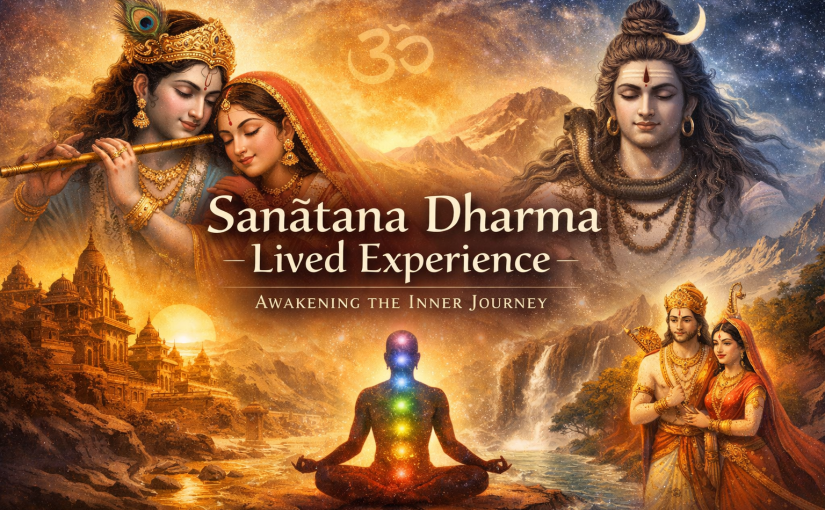
The purpose was not enjoyment but learning the essence of kāma. Attraction was raised but held in a sattvic environment, with social distance and inner discipline. Slowly, attraction turned into bhakti. A meditation image developed by itself in the mind — Radha and Krishna appearing in each other — and this led to spontaneous samādhi, exactly as described in Bhāgavata Purāṇa through the gopīs.

This phase cannot last long; it is too volatile and needs continued physical presence. The continued physical presence of attracting partners became difficult to tolerate, and maintaining control by consciously preventing physical contact for long periods required great inner discipline. But it is essential. Without it, later renunciation becomes dry and incomplete.

Shakti / Durga phase: courage, love, and inner femininity

After Krishna phase came the Shakti phase, lasting nearly five years during university life, and continuing even after marriage due to the support of my wife.

Internally, I lived a feminine reality — sensitivity, softness, devotion — while externally I became brave, ready to fight evil in sattvic, nonviolent, tactical, and lawful ways. This is the Durga function: courage without brutality, strength without hatred. Together, the meditation image of the mental consort anchored in the mind matured even further — not merely as a thought, but as a fully living inner presence, just as Radha lived within Krishna even in her physical absence, and even while he was living his worldly life with his wife, Rukmini. In Vaishnava understanding, Radha is the hlādinī-śakti — the inner bliss-consciousness of Krishna — and when sustained joy, devotion, and fullness arose naturally from this meditation image, that experiential bliss could be understood as the same hlādinī current described in the scriptures. It was not an identity or a divine claim, but the recognition that a human inner process was unfolding exactly as the ancient maps had described: bliss arising from continuous remembrance and inwardly residing devotion.

I succeeded a little — not by force, but by alignment, what I call divine help.

Life as gurukula: gods as living people

I slowly realized that gods did not come from heaven — they came through people around me.

A naughty relative boy living at our home carried the Krishna role.
My father carried the Rama role — discipline, responsibility, order.
My uncle carried the Shiva role — depth, silence, detachment.
All the sweet girls who were part of attraction carried the Shakti role.

These were not fantasies. They were living transmissions. I merged all these roles into one integrated life. It felt as if all gods joined their powers to destroy one demon — ignorance.

Shiva phase: tantra, isolation, and upward energy

When Shakti phase reached its peak, worldly energy naturally declined and pushed me into isolation. This was the beginning of Shiva phase.

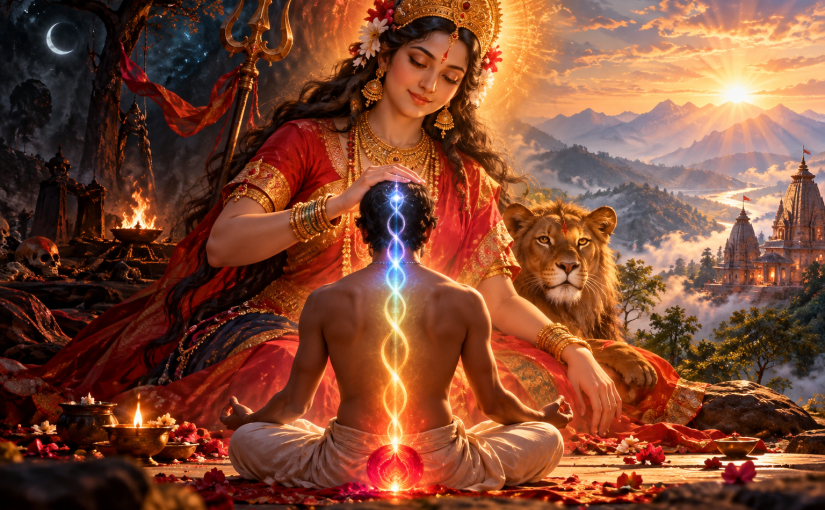
Shiva here means not only worldly isolation but tantric transformation — raw base energy rising as Kundalini toward awakening. As energy turned upward, my inner imagery changed: the feminine consort image was replaced by a male guru image. This gave me the feeling of being male again, grounded and directed.

To the world, this can look strange or misunderstood. But it was not indulgence or confusion — it was pure Kundalini meditation in tantric style, where imagery changes to match energy direction.

This Shiva phase is most dominant in my recent books because it is the most recent and intense lived phase. Older phases are less vivid and more integrated.

Rama phase: rest, order, and balance (still unfolding)

The Rama phase has just begun.

After kevala kumbhaka and small glimpses of nirvikalpa-type samādhi, this phase appeared. Rama literally means rest, āram, balance. It is not heroic drama; it is stable living after turbulence.

This phase cannot be written fully yet because it must be lived fully first. It will come as the final integration stage. Now it is up to the divinely operating world to decide how long it allows me to remain settled in this phase, though there is no doubt that personal effort also matters.

Why the world misunderstands these experiences

People see only sexuality, repression, gender, or indulgence. They do not see sublimation. That is why tantra was always kept subtle and symbolic.

I never say “I am Shiva” or “I am Krishna.” I say: that phase unfolded. Language is the thin line between wisdom and misunderstanding.

Final understanding: Sanātana Dharma is human evolution

My life has shown me that scriptures are not to be believed — they are to be lived.

They are maps of consciousness written in symbolic language. When lived, they dissolve ignorance naturally.

I am not above humanity. I am an example of how humanity evolves when sound, discipline, love, and relationships support growth.

If divine permission comes, a book will come. Until then, this blog is the nutshell — a lived proof that Sanātana Dharma is eternal because it is always happening.

Four Incarnations, Four Pillars of One Building
(Why All Paths of Sanātana Dharma Are Complementary, Not Opposing)


These four Sanātana incarnations are like the four pillars of a single building. Just as a building cannot stand if even one pillar is missing, the sense of wholeness and salvation does not feel achievable unless all these forms are embodied within a single person. This also reveals a deeper truth: the many sects and paths of Sanātana Dharma are not rivals or contradictions, but complementary forces. Even Sikhism and Jainism, which fully support Rama-like ideals of character, can be seen as sects or streams of the single Hindu civilizational tradition, rather than completely separate religions. If we expand this understanding further, even religions such as Islam and Christianity can be seen, in a broader sense, as supporting branches of the same eternal flow—so long as they uphold humanity, compassion, and moral order. In that sense, they are not completely unconnected from other dharmic streams, but participate in the same universal movement toward righteousness, truth, and human upliftment, each expressing it through its own language, symbols, and historical context. Just as the pillars together support one structure, these traditions together support one human awakening — and this is exactly how they have always functioned in living practice.

Kundalini loss caused Parvati’s anger and the wrath of the Russian ruler~ A comparative psychological study

Friends, many mythologies cannot be decoded completely. So you have to guess there. Something is better than nothing. From a light beginning, these stories also get decoded later. One such mysterious story is about Ganesh Dev. I think Ganesha is the Kundalini Purush of Parvati. Parvati was bored while being supported by Shiva’s Kundalini Purush. She started considering herself as dependent on Shiva. Especially she was provoked by her friends. That is why Parvati says that she was living like a subordinate, living under the protection of Shivaganas. She decided that now she would create a dedicated Gana for herself. Once she was bathing naked, but Lord Shiva scolded the gatekeeper Nandi and entered, which made her embarrassed. That’s why she created the perfect and flawless Ganesha out of the filth of her body. The scum is also called raja, and the vaginal fluid equivalent to semen is also called raja. Possibly Ganesha is the psychic Purusha created from the transformation of the sexual energy of Goddess Parvati, just as Kartikeya is the mental Kundalini Purusha created from the sexual energy of Lord Shiva. It was called son, because it was made of vaginal fluid like a normal son, but certainly not in the womb but in the brain or in the mind. For this reason, the secretion of menstrual fluid or the secretion of Raja becomes very less or even zero in the woman due to the practice of sexual tantra. This also protects the woman from weakness. Her Kundalini develops from this Raja or the dirt of her body. It would be appropriate to make it clear here that for us Goddess Parvati is reverred, worshipped, and respected. We cannot say anything directly about her. We are talking only about human beings with nature like Goddess Parvati. Because everywhere it cannot be written like, “Man with the nature of Goddess Parvati”, because this will increase the scope of writing without need, and at the same time people will be confused and unable to understand. Therefore, in compulsion, one has to write Goddess Parvati or simply Parvati for abbreviation. In a way, we describe particular personality or nature, not any particular god or person. Similarly, one should also understand about all the deities like Shiva etc. Hope and believe that the common man and the gods and goddesses will not take it otherwise. Parvati gave Ganesh a stick and instructed that no one should enter inside her house without her permission. Parvati is actually a soul. Sahasrar is its home. To make Ganesha stand outside the house means to be engrossed in the meditation of Kundalini at all times. From this nothing else can come into focus, that is, anything cannot enter inside the house of its own free will. When the soul desires and withdraws its attention from the Kundalini, then only the other thing will be able to enter the house of meditation. Before that she did not have Kundalini in her mind. That’s why she had to allow Shiva and his worldliness to enter meditation hall of her brain even if she didn’t want to. While bathing she was naked, that is, lost in intimate thoughts of the depths of the soul. This is a good answer for those who have a misconception that women are considered inferior to men in Tantra. In fact, men and women are equal in tantra, and similar types of practices have been prescribed for both. Once Nandi was stopped by Ganesha at the door. Surprised by this, Shiva asked his Nandi and other ganas to enter Parvati’s house turn by turn, but the Ganesh boy beat everyone with his stick. Meaning that Kundalini is soft like a child, who does not have special weapons to protect the soul, but has an affectionate fear depicting stick. Nandi etc. Ganas here are the thoughts of Shiva, who want to introduce themselves to parvati’s soul before joining of Shiva’s soul with Parvati’s soul. This is often the case in the world. It is only through thoughts that a warm meeting of people with each other is possible. Intimidating or beating the ganas with stick by Ganesha means that Parvati, the soul, concentrates on the Kundalini without paying attention to the thoughts coming from outside. Ideas or thoughts are neither to be welcomed, nor should they be shunned. This is what it means to have a fear filled with love. This is to maintain a witnessing attitude towards thoughts or worldliness. This is Vipassana, or vipashyana. The defeat of all the gods and ganas by Ganesha in turn shows that the Kundalini meditation of Parvati is unaffected by all the thoughts and feelings transmitted by Shiva. Then all the deities take it as an insult to Shiva. So they all make a strategy and fight together, and deceitfully kill Ganesha. Meaning that Shiva entangles Parvati in worldly affairs so much that she forgets Kundalini. Filled with immense anger, Parvati turns black and becomes Kali, and sets out to destroy the universe. Meaning that due to the destruction of the unwavering Kundalini picture of the mind, Parvati gets filled with anger, and falls into the darkness. It is like losing one’s favorite thing, or the fear of losing it, and without it he becomes blind. It is just like losing toy by a baby. In such a situation, a person can do any wrong thing, if he is not handled with consolation. Has the Russian power head suffered a similar shock? In this way, man can destroy the world, and himself too. Because the whole universe is settled in the body, that is why perhaps the attempt of suicide by Parvati has been called an attempt to destroy the universe. The meaning of name Kali is “black or dark”. Then she turns into goddess Kali and tells Shiva that if you revive Ganesha, she will be pleased. The point is clear that only by getting the lost favorite thing or Kundalini, a person attains his former happy state. It is now necessary to ask the Russian ruler what his favorite thing has been lost, for which he is putting the whole earth at stake by reaching for the nuclear button, and which he will be happy to find. I had also said in the previous post that the Kundalini of today’s advanced age is stuck in the Agya Chakra. The nature of Kundalini is to move. She cannot stay in one place for long. Its next and advanced stage is the Sahasrara Chakra. But to raise the Kundalini up to there, a lot of energy is required, which can be found only through sexual tantra. that’s why I write about Tantra with divine inspiration. At the same time, there is also a need to reduce the material world, so that the energy saved from it can be used for uplifting the Kundalini. The destruction produced by this war is a subconscious attempt to reduce the worldliness, so that the energy needs of Kundalini can be fulfilled. Counting other causes of war are mere excuses. A nuclear-armed and largest country in terms of area can be afraid of what. The real and only cause of war is the lack of that precious prana energy or life energy by which man moves on the path of humanity and spirituality. To convince the wise, it is enough to show the fear of war, the foolish will not understand even by war, only harm will happen. At the most, he would show a little fighting power, so that the enemy would get a chance to recover and improve. Then the world would also appreciate the diplomacy and war strategy of the warrior. What is it that the whole nation is bent on making hell. On the one hand, the poor do not get a roof to cover their heads, they chill in the open all night, on the other hand you have been destroying luxurious buildings. Think how much blood and sweat would have gone into making them. How much of that vital energy must have been wasted in making them, which could have awakened the Kundalini. This subconscious effort to meet the energy needs of Kundalini is uncontrolled and inhuman, like uncontrolled nuclear energy. What is it that the Kundalini is descending instead of ascending, without achieving its highest goal. Therefore, the change in worldliness or ways of living or lifestyle towards minimalism should be gradual and humane, not abrupt and inhuman. I am not attacking any one nation here. All nations behave like full of war craving. Why such conditions are created by all the countries in the world, which force a country towards war. Most of the countries are engaged in collecting weapons. They want to make money from arms business. They are keeping the dream of imperialism alive. Kundalini is the best medicine for this. With the help of Kundalini, the whole creation starts appearing inside oneself. Man begins to be satisfied with himself, no matter what he is, and no matter what the circumstances. When a head of state feels the whole universe inside him, then why would he want to loot the land of others. He will find the solution to his problem within himself. Then he would not even need weapons in most cases, and neither would war. I know only one country in the world, which has never started a war, nor attacked anyone, even after a lot of provocations. That country is India. Perhaps this has been possible in India only due to Kundalini Yoga and the religion based on it. That is why the whole world should learn a lesson from this soft power nation in this regard, if a peaceful world is to be established. I’m not bragging about anyone. Nor am I looking at sides other than war related. Truth is truth, which no one can deny. Well, Shiva sent his ganas in the east direction in the morning, and said that whichever creature they meet first, get its head cut off, and attach it to the trunk of Ganesha. This means that one has to speculate, but somehow Parvati’s lost Kundalini can be recovered. The ganas first got an elephant cub. They revived Ganesha with the help of Shiva by attaching his head to the torso of Ganesha. Goddess Parvati was satisfied with this, due to which the whole world was saved from her wrath.