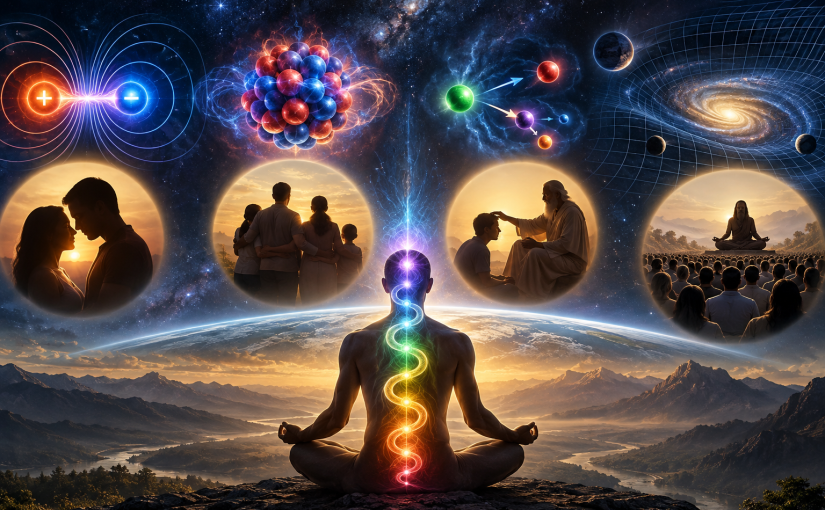
When I began thinking about the fundamental forces of nature, one difference kept standing out to me. In the familiar picture of the electromagnetic, strong, and weak interactions, there is some form of exchange. Particles interact through fields, and in quantum field theory this interaction is described in terms of exchange quanta. Electromagnetism is mediated by photons, the strong force by gluons, and the weak interaction by W and Z bosons. Gravity seems different. In general relativity, it is not ordinarily described as one object exchanging something with another in the same way. Instead, mass-energy changes the geometry of spacetime, and objects move through that curved geometry. This made me wonder whether the difference between gravity and the other forces could also be understood through the human world, through the old idea of understanding the macrocosm through the microcosm.
The attraction between two lovers gives me an image of electromagnetism. There is attraction and repulsion, but there is also exchange. Love, affection, attention, touch, companionship, gifts, care, and sometimes material support continually pass between the two. Their relationship is not simply an invisible attraction; something moves between them and sustains the relationship. In this sense, it resembles the electromagnetic picture, where interaction is associated with an exchange process.
The strong nuclear force suggests another kind of human relationship to me: the family. Family members may love each other, quarrel with each other, dislike each other, and sometimes even strongly repel each other emotionally, yet they remain bound together by an unusually powerful connection. There is also exchange here: food, money, shelter, protection, security, responsibility, inheritance, care, and other forms of support. The family bond can remain powerful even when personal feelings fluctuate. That makes it a useful human analogy for the strong force, not because the two are literally the same thing, but because both suggest an extraordinary form of binding.
The weak nuclear force seems to belong to a different category altogether. It is not primarily a force of binding. One of its defining features is transformation: particles can change from one type into another through weak interactions. That gives me an analogy with those human encounters that alter what a person is. A teacher, a crisis, a profound relationship, a spiritual experience, or some decisive insight can enter a person’s life and leave that person fundamentally changed. Before the encounter one is one kind of person; afterward one is no longer quite the same. In that sense, the weak force can serve as a metaphor for transformation rather than simple attraction or binding.
Gravity then appears to me as the most unusual of the four. My thought is about the attraction that people sometimes feel toward a mystic, sage, or kundalini yogi. A person may be drawn toward such an individual without romance, possession, material exchange, social ambition, or any obvious personal gain. People may become crowded in the discourse hall simply because they want to be in his presence. Yet the relationship can remain strangely non-personal. They may listen, sit quietly, and eventually leave without trying to possess him. There can be attraction without the kind of obvious give-and-take that characterizes ordinary relationships.
This is why gravity provides the most interesting analogy for me. In general relativity, gravity is not simply a force transmitted through space in the ordinary Newtonian sense. Mass-energy changes the geometry of spacetime itself, and bodies move according to that geometry. As a metaphor, I can imagine the mystic as someone who has profoundly transformed the geometry of his own inner space—almost as though he has curved and extended the space-time of consciousness within himself. A curved surface can contain more area than a corresponding flat projection, giving an intuitive image of how an apparently limited inner space might become vast through transformation. Mystics are traditionally described as experiencing Brahman, the pure and unlimited reality beyond the ordinary boundaries of individual consciousness, which can be contemplated as an experience of boundless inner space—not physical space in the scientific sense, but an immeasurable field of awareness. When other people enter such a mystic’s presence, their own inner movement may be altered; they are drawn toward him not necessarily because he is exchanging something with them or because they expect personal gain, but because his presence seems to change the space in which they experience themselves. In this sense, they are drawn not merely toward the person but toward the expanded field of consciousness associated with him, much as people have traditionally been drawn toward figures such as Krishna or Buddha. The analogy is not that consciousness literally curves physical spacetime, but that a transformed consciousness may create an expanded experiential space into which others feel naturally drawn, much as physical bodies move according to the geometry of curved spacetime.
Of course, this must remain an analogy. There is no established scientific evidence that a mystic literally curves physical spacetime through consciousness. Nor can we scientifically say that the attraction toward a spiritual teacher is gravity. The useful point is structural: the mystic gives a human image of attraction that does not obviously depend upon a transaction between two individuals. It resembles gravity as a metaphor because the presence of one changes the space through which another moves.
This also led me to another curious observation. Gravity is enormously weaker than the other fundamental interactions at the particle scale. Humanly, the attraction toward a mystic can likewise appear very gentle and distant. No one necessarily rushes forward to embrace or possess the mystic. People may simply remain at a respectful distance, listen, and still feel strongly drawn toward him. The attraction does not have to produce ordinary attachment.
From this perspective, the four interactions suggest four different patterns: electromagnetism attracts through interaction and exchange; the strong force binds despite opposition; the weak force transforms; and gravity changes the geometry in which movement takes place. These are not literal correspondences between physics and psychology, but they provide a way of contemplating different forms of relationship.
This is where the idea of the macrocosm and the microcosm becomes meaningful to me. The small can sometimes provide a language for thinking about the large. A pattern observed in the physical world can become a symbolic mirror for patterns in human life and consciousness. The microcosm does not prove anything about the macrocosm, but it can help us recognize structures that otherwise remain abstract.
It also makes the problem of a Theory of Everything appear even more profound. The difficulty may not simply be that gravity is another force whose particle has not yet been found. The deeper problem is that the other three interactions have quantum-field descriptions that operate within spacetime, whereas gravity, in general relativity, is itself associated with spacetime geometry. We are therefore not merely trying to put four similar forces into one theory. We may be trying to understand the relationship between the actors and the stage on which they act.
A graviton is expected in some approaches that quantize weak gravitational fields, but no graviton has been experimentally detected, and there is still no complete experimentally confirmed quantum theory of gravity. So perhaps gravity is not merely the fourth member of a group of otherwise similar forces. Perhaps it is pointing toward something deeper in the structure of reality.
That is why gravity feels special to me. Electromagnetism, the strong interaction, and the weak interaction can be imagined through exchange, binding, and transformation. Gravity seems to say something different: the presence itself can alter the space of relationship. Whether that remains only a metaphor or someday proves to reflect a deeper truth about nature is an open scientific question. But the analogy offers a simple way of looking from the human inward to the physical outward, and then back again—from the microcosm toward the macrocosm.


