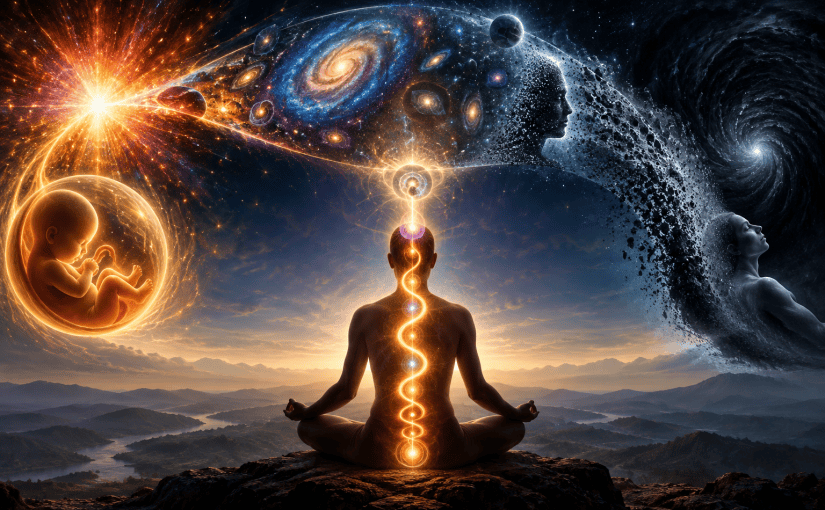
The Big Bang, Inflation and the Question of Origin
When we ask how the universe began, the usual image is of a tiny point exploding outward. But modern cosmology gives us a subtler picture. Inflation describes an extremely early phase in which the cosmos underwent a dramatic stretching during a tiny fraction of a second. Space itself expanded rapidly; it was not matter simply exploding into an already existing empty space. A useful but limited analogy is compressed air expanding, because stored energy can drive expansion, but inflation is fundamentally different: there was no external container and no pre-existing space into which the universe was expanding. The geometry of space itself was changing.
What drove that expansion is generally described in terms of an inflaton field in a high-energy state. Its energy behaved approximately like vacuum energy and, because such a state has strongly negative pressure, it could produce accelerated expansion according to general relativity. When inflation ended, the inflaton transitioned toward a lower-energy state, and its energy was transferred into particles and radiation. This process is called reheating. The inflaton could oscillate, decay and interact with other fields, producing enormous numbers of particles that eventually interacted and approached thermal equilibrium, giving rise to the hot plasma from which the later universe evolved. The precise identity of the inflaton and the exact mechanism of reheating remain unknown.
This immediately raises the deeper question: where did the inflaton, its high-energy state, or even the initial conditions come from? Science does not presently have a complete answer. If we mathematically run the simplest classical Big Bang model backward, we reach what is called a singularity, where quantities such as density and spacetime curvature become infinite. But a singularity is probably better understood as a sign that our present theory, general relativity, has reached its limit rather than as proof that there was literally a tiny ball of infinitely compressed matter. We therefore have a major gap between the earliest describable universe and whatever deeper quantum-gravitational reality may have preceded it, if “preceded” is even meaningful there.
A Human Analogy of Cosmic Expansion
I began wondering whether a similar pattern could be imagined within a human being. God, or Brahman, is often called infinite. I imagine it not as ordinary physical space but as something indescribable and unlimited in every aspect, a ground more fundamental than any individual object, space or energy. Perhaps what we call an individual soul emerges within that infinite reality as a confined and highly energetic state. Birth could then be imagined as a kind of personal Big Bang. The initially concentrated inner space begins to expand, and as it expands its energy decreases while the released potential appears as the experienced world.
The first experiences of a person could metaphorically resemble fundamental particles: the simplest constituents from which later structures are formed. As life proceeds, the inner space continues expanding and new experiences fill it. Yet newer experiences are not necessarily entirely new creations. They can be growths, combinations and increasingly complex expressions of the earliest structures, just as complex physical structures develop from more elementary constituents. Memory, knowledge, relationships, skills, desires, understanding and identity gradually build an extensive inner universe.
The initial expansion also seems to slow. Yet there can come another stage in which one’s accumulated world begins to expand almost by itself. A person who has grown greatly in business may find that new opportunities generate further opportunities without conscious effort at every step. Knowledge produces more questions and connections. Art produces new possibilities from what has already been created. Intellectual growth creates the conditions for still more growth. This resembles, metaphorically, the role of dark energy in cosmology: an expansion that is no longer simply the continuation of the original impulse of birth but appears to possess its own further momentum. This is only an analogy, not a claim that human development is literally governed by dark energy.
Death as a Return of the Expanded Inner Universe
At death, the expanded inner world of a person would, in this speculative picture, no longer continue its ordinary outward development through the body. Instead, the enormous space of accumulated knowledge and experience could be imagined as contracting toward the concentrated high-energy state from which its journey began. The visible world of the individual would then be transformed back into a more concentrated potential. The amount of this remaining potential would correspond metaphorically to the richness and extent of the world accumulated during life. This would also explain why different souls could retain different identifying signatures: each would represent a unique configuration of experiences rather than an identical undifferentiated state.
Here the analogy with vacuum decay becomes interesting, though it must be used carefully. In physics, vacuum decay specifically refers to a hypothetical transition from a metastable false vacuum to a lower-energy vacuum. Some inflationary models involve such a transition, but the end of inflation in general is not simply synonymous with vacuum decay. Likewise, reheating is the transfer of inflationary energy into particles and radiation. My proposal is extending these physical ideas into a metaphysical analogy: a high-energy confined state gives rise to an expanded differentiated world, while movement toward a more stable state releases its stored potential into manifestation.
Creation, then, could be imagined as a cycle in which a concentrated high-energy state differentiates into an experiential universe, while dissolution returns that differentiated universe toward its original ground. The outer universe and the inner universe would be two scales of the same pattern.
A Personal Experience of a Departed Soul
This model became much more vivid for me because of an experience during a dream visitation in which I seemed to encounter directly the freshly departed soul of a close acquaintance. What I experienced did not resemble an unlimited, already dissolved consciousness. It felt more like a confined region of extremely high-energy space, limited in extent and apparently bounded. Most striking was the sense of enormous internal pressure, almost like a bubble trying to grow from within itself. It felt as though the space contained something intensely concentrated that naturally wanted to expand.
I do not take this experience as scientific proof of a physical mechanism. It was an experience, and its interpretation remains speculative. But phenomenologically it gave me a remarkably clear image for the model: perhaps a newly departed individual consciousness is still a highly concentrated configuration carrying the accumulated structure of a lifetime. In that sense it would resemble a universe immediately after its own beginning—bounded, intensely energetic and possessing an inherent tendency toward expansion.
Kundalini, Dissolution and the Final Direction of the Cycle
The deepest possibility in this model comes from Kundalini yoga and the practice of witnessing. If ordinary life continually expands the inner world, perhaps spiritual practice can reverse the process while one is still alive. Through deep witnessing, memories, identities, desires, attachments and distinctions are progressively seen without being reinforced. Instead of adding more structure to the inner universe, the practitioner allows that structure to dissolve into the indescribable ground.
This would make liberation fundamentally different from ordinary death. The ordinary person dies carrying an extensively differentiated inner world. The yogic practitioner may, through realization, dissolve that inner world before death. There is then no elaborate structure left to generate or sustain another cycle of inner expansion. In this metaphor, the ultimate state is not a larger universe but the absence of the separate world altogether.
This also gives a possible meaning to the idea that the void is the most stable and fundamental state. Rather than imagining the void as an empty container filled with nothing, it may be understood as that which remains when all distinctions have disappeared. It is not merely low-energy space in the scientific sense; it is the metaphysical ground beyond the distinctions of space, energy, object and individual identity.
From Individual Dissolution to Mahapralaya
The same pattern can finally be imagined on a cosmic scale. Perhaps one day the outer universe too could undergo its own form of dissolution. In the scriptural vision of Mahapralaya, everything returns into the Divine: not simply stars and matter disappearing, but all separate forms, distinctions and identities losing their independent existence. Space, energy and the differentiated universe itself would no longer stand apart as separate realities. In a way it is like the entire cosmos doing kundalini yoga to be liberated.
In that sense, creation and dissolution become two movements of one cycle: the One appearing as many, and the many returning to the One. The individual soul is then a miniature cosmos, birth is a kind of expansion, life is the filling of an inner universe with differentiated experience, death is a return toward concentration, and spiritual realization is the possibility of consciously reversing the process. The ultimate destination is not another object or another world but the indescribable ground from which all worlds appear.


