From Two Hands to Two Cosmic Branes
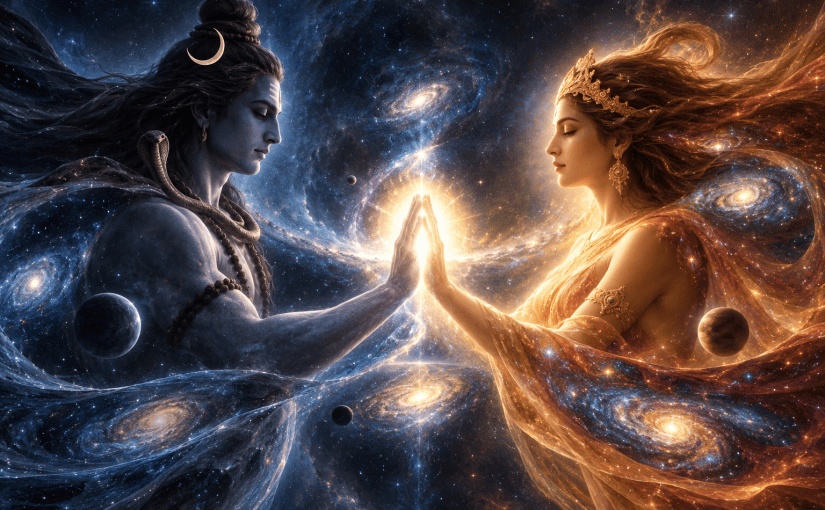
I began to understand the idea of a cyclic universe through a very simple image: two hands slowly moving toward each other in position of cosmic prayer, touching, separating, and then coming together again. In some versions of string-inspired cosmology, our universe can be pictured as a three-dimensional brane, or membrane, existing within a higher-dimensional space. Another brane may exist alongside it, and the two can move relative to one another. Instead of imagining the Big Bang simply as an explosion of matter from one point into already existing space, this picture allows us to imagine the changing relationship between the branes themselves as part of the cosmic story. When the two branes separate, the universe can pass through an immense phase of expansion. When they eventually come back together, their collision can produce a new hot, dense beginning, creating a Big Bang-like state. The whole process can then repeat again and again.
The Cosmic Clap: Collision and a New Big Bang
The most striking image is the final clap. After the branes have drifted apart to their maximum distance and the universe has expanded enormously, they begin moving toward each other. Their meeting represents a catastrophic collision, or bounce. In the simplified picture, the old universe is not preserved in its familiar form. Galaxies, stars, planets and other large-scale structures do not simply pass intact into the next cycle. Instead, the previous organized universe is replaced by an extremely hot and energetic state, a kind of plasma inferno in which the familiar structures of the old cosmos have disappeared. From that hot state, the universe can expand and begin forming structure again. Thus the Big Bang is no longer necessarily imagined as the unique beginning of everything. It can be one phase of an endless sequence: separation, expansion, convergence, collision, hot rebirth, and expansion once more. That is the basic appeal of the cyclic or ekpyrotic picture, although it remains a speculative cosmological model rather than an established description of our universe. The “cosmic applause” is simply the repeated meeting of the branes: clap, rebirth, separation, and another clap.
My Shiva-Shakti Intuition
What made this picture especially meaningful to me was that I could see it through an entirely different symbolic language: the ancient idea of Shiva and Shakti. In scriptural traditions, creation is associated with the union of Shiva and Shakti. Shiva can be understood as the still, enduring principle, while Shakti is the dynamic power through which manifestation takes place. I began to see the two branes not merely as two identical physical sheets, but as two complementary symbolic principles. The right and left hands became a simple image of this union. When the hands meet, conception occurs. When they separate, development begins.
This made me think of Shiva as the father principle and Shakti, the mother or goddess, as the creative womb. The union of the two is conception, and the newly conceived universe is then like something growing within a cosmic womb. The important point for me is that the universe does not have to appear fully formed at the moment of conception. After conception comes development. When the two branes separate, Shakti can symbolically be understood as carrying the developing universe, while Shiva remains associated with the essential principle, identity or recognition from which that manifestation arose. In this interpretation, separation is not the opposite of creation. Separation is what allows creation to unfold.
Shakti as the Developing Universe
This makes the female brane, in my symbolic reading, especially interesting. It is not simply another universe identical to the male brane. After the union, Shakti carries the manifested creation and allows it to develop. The universe grows within this cosmic womb, moving from an intensely energetic beginning toward increasing differentiation and complexity. What begins as a hot and chaotic state can eventually become particles, atoms, stars, galaxies, planets and perhaps life. Shiva, by contrast, represents the enduring essence or recognition behind the manifestation. In this picture, Shakti is the movement and development of creation, while Shiva is the principle that remains comparatively still.
This is only a symbolic interpretation; physics does not describe one brane as male and another as female, nor does it assign them the attributes of Shiva and Shakti. The physical model and the spiritual symbolism belong to different levels. What I find meaningful is the structural resemblance between the two pictures: union, creation, separation, development and return.
The Return of Shakti and the Death of the Universe
The idea becomes even more interesting when the universe reaches old age. After a vast period of development and expansion, the universe can be imagined as moving toward exhaustion. In my intuition, Shakti then begins to return toward Shiva. She does not return carrying the old universe as a fully functioning world. The recognizable universe is almost dead. Its galaxies, stars and other structures have lost their former organization, and what remains is increasingly reduced to underlying energetic potential. Yet this does not mean that everything has become meaningless residue. The remains of the old universe can be imagined as carrying the potential for another beginning.
This gives the reunion a different meaning. The approaching Shakti is like a cosmic mother returning to Shiva with the exhausted remains of their previous creation. The purpose is not to preserve the old universe in its previous form, but to allow its remaining essence, now concentrated in energetic form, to participate in another conception. The old universe therefore ends as a recognizable world but survives, in this symbolic picture, as potential. The new universe does not emerge as a completely unrelated event. Its birth is connected to the death and dissolution of the previous cycle.
Conception, Growth, Death and Rebirth
Seen this way, the entire cosmic process becomes almost like one continuous act of reproduction at the scale of the universe. Shiva and Shakti unite, conception occurs, and then they separate. Shakti carries and develops the universe. The universe expands, differentiates, lives through its vast history and eventually approaches death. Shakti then returns toward Shiva carrying the dying creation in a reduced energetic form. Their reunion becomes both dissolution and the preparation for another conception. The old manifestation disappears, but the creative process begins again.
The cycle can therefore be understood in a very simple sequence: union is conception, separation is gestation, expansion is life, aging is exhaustion, return is dissolution, and reunion is rebirth. Then the hands separate again, and the whole process begins once more.
Between Physics and Metaphor
I would not claim that this proves Shiva and Shakti are the physical explanation of brane cosmology, or that ancient scriptures scientifically predicted modern string theory. That would go beyond what either tradition can establish. The brane collision model is a speculative idea in theoretical physics, while the Shiva-Shakti framework is a spiritual and metaphysical language. My point is different. When I placed the two pictures beside each other, I found a striking pattern: two complementary principles come together, something is conceived, creation develops through separation, the manifested world eventually dissolves, and the remaining potential returns to the source for another beginning. My interpretation is closely aligned with the creation symbolism described in the scriptures, particularly the Shiva Purana, where Shiva and Shakti are understood as father and mother in relation to the origin and manifestation of the universe as a fetus growing in cosmic womb.
What began for me as a simple image of two hands coming together therefore became a much larger intuition about the universe. The cosmic clap is no longer merely a collision. Symbolically, it is conception through the death of the previous creation. The separation of the hands is not merely distance; it is the opening of the cosmic womb. And the return is not simply destruction. It is the movement of Shakti back toward Shiva with the almost dead universe, carrying whatever remains of its energetic potential toward a new union. In that sense, the universe becomes a repeating rhythm of union and separation, manifestation and dissolution, death and rebirth: an eternal cosmic cycle in which every ending is also the preparation for another beginning.


