Understanding Entropy as Nature’s Tendency
When I first heard the scientific statement that “in an isolated natural system entropy always increases,” I found the explanation unnecessarily complicated. The basic idea became clearer when I understood an isolated system as one that exchanges neither matter nor energy with its surroundings. In such a system, the total entropy cannot decrease. It may remain unchanged in an ideal reversible process, but natural processes generally produce an increase.
A simple example is heat. If a hot object and a cold object are placed together in an insulated system, heat naturally moves from the hot object toward the cold object until the temperature becomes more evenly distributed. Similarly, perfume spreads through a room, ink disperses in water, and a broken glass does not spontaneously return to its original form. Energy is not destroyed in these processes; rather, it becomes distributed among a greater range of possible arrangements. This is why “disorder” is often used as a simple explanation of entropy, although scientifically entropy is more closely related to the number of microscopic states available to a system.
This made me think of entropy as a general tendency toward greater freedom of possible arrangement. The word freedom here is only an intuitive analogy. Nature does not consciously seek freedom, but states with vastly more possible microscopic arrangements are overwhelmingly more probable. A concentrated or restricted state therefore tends naturally toward a more widely distributed state.
Entropy in Non-Isolated Systems
This does not mean that every part of nature must become less organized. A local system can become more organized when it is not isolated and can exchange energy and matter with its surroundings. A refrigerator can make its interior colder while releasing heat outside. A living organism can maintain an extraordinarily organized structure because it continuously takes in energy and matter and releases heat and waste. The important scientific rule concerns the total isolated system, including the relevant surroundings.
This distinction led me to consider whether the same general pattern can be seen in human life. Humans also have a tendency to seek greater freedom of movement, choice, thought, experience and possibility. But unlike physical matter, a human being is conscious and can deliberately accept discipline. A person may restrict immediate freedom in order to gain a larger capacity later, as in meditation, education, skill development or any demanding practice. Therefore human freedom should not be treated as identical to thermodynamic entropy.
Social Order Creates Greater Possibilities
The connection becomes especially interesting when looking at society. Human civilization contains countless organized departments and institutions. Their workers have duties, schedules, procedures and responsibilities. In an everyday sense, these individuals may have less immediate freedom because they are bound to particular functions. Yet their organization creates convenience and freedom for others.
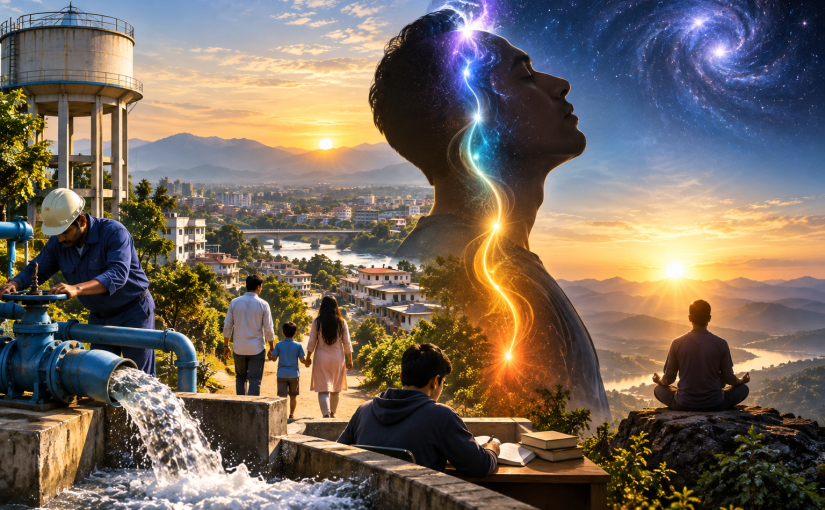
A water department is a simple example. Its employees must coordinate the supply system, maintain infrastructure, solve problems and perform their assigned duties. Their discipline allows water to reach the public without every individual having to obtain and transport water independently. The organization of a relatively small part of society therefore creates greater practical freedom for a much larger population.
The same principle operates through many other departments and services. People accept specialized duties so that society can function collectively. The result is that organization at one level can create possibilities at another level. This does not mean that these social arrangements literally possess low thermodynamic entropy; social order and physical entropy are different concepts. The connection is an analogy about restriction, organization and the expansion of possibilities.
From Social Freedom to Spiritual Practice
The most interesting extension comes when this socially created freedom is used for inner development. When basic facilities are available, a person does not need to spend all of their time meeting basic physical requirements. The time and energy made available by organized society can be directed toward work, creativity, education, enjoyment, contemplation or spiritual practice.
Some people may therefore use the conditions created by civilization to practice Kundalini Yoga or another spiritual discipline. From the perspective of that spiritual tradition and personal experience, such practice may lead toward awakening and liberation. In this sense, a chain can be imagined: individuals accept duties and create organized services; organized services make public life more convenient; convenience creates additional human possibilities; and some people use those possibilities for spiritual practice.
This is not a scientific claim that thermodynamic entropy causes Kundalini awakening. Thermodynamic entropy and spiritual liberation belong to different conceptual frameworks. Calling awakening “ultimate entropy” can therefore be meaningful as a philosophical metaphor, but it should not be presented as the scientific definition of entropy.
Local Order Within Overall Increase
The idea can now be stated more precisely. An individual or group within a larger non-isolated system can become highly organized while the larger process continues to involve entropy production. A water department may be highly coordinated, while its organized activity enables water, energy, time and convenience to flow outward through society. Likewise, social institutions can maintain internal order while making a wider range of activity possible for the people they serve.
Thus, what initially seemed like a contradiction becomes understandable: local order and overall entropy increase can exist together. The organized part does not have to become increasingly disordered merely because the larger system has increasing entropy. It can maintain its organization by participating in exchanges with its surroundings.
For human beings, this provides an interesting philosophical picture. Civilization uses organization and discipline to remove certain restrictions from ordinary life. The freedom produced by that organization can then be used in many directions. It may lead to more outward activity, more experiences and more choices, or it may be consciously turned inward.
That inward direction is where the spiritual interpretation begins. A person who has gained sufficient external freedom may choose to reduce distraction and voluntarily adopt discipline for Kundalini practice, meditation or contemplation. The apparent paradox is that one kind of restriction can create another kind of freedom. Social discipline can create practical freedom, and spiritual discipline can be understood as a path toward inner freedom.
The Larger Meaning
I therefore find entropy useful not because physics proves a spiritual doctrine, but because the concept provides a way of thinking about how restriction, organization and freedom can exist at different levels. The second law tells us that the total entropy of an isolated system cannot decrease. Means the general direction or tendency of creation is towards the freedom or liberation. Yoga does not produce this tendency, it is already there, it just speeds it up. Open systems can nevertheless develop and maintain local organization by exchanging energy and matter. Human society provides an analogous structure in which organized duties create services, services create convenience, convenience creates freedom, and that freedom can be used for purposes chosen by the individual.
At the farthest end of that possibility, a person may use the freedom created by the outer world not to seek more external possibilities but to turn inward toward awakening and liberation. This same happened to me in a way, I feel so. Whether that final state should be called “ultimate entropy” is a matter of philosophical language, not thermodynamics. The scientifically safe statement is that entropy concerns physical systems, while the spiritual journey concerns consciousness and experience.
The connection I see is therefore not an equation between entropy and liberation. It is a broader observation: nature can contain local organization within an overall process of increasing entropy, society can create freedom through organization, and human freedom can finally be used to pursue an inward form of liberation.


