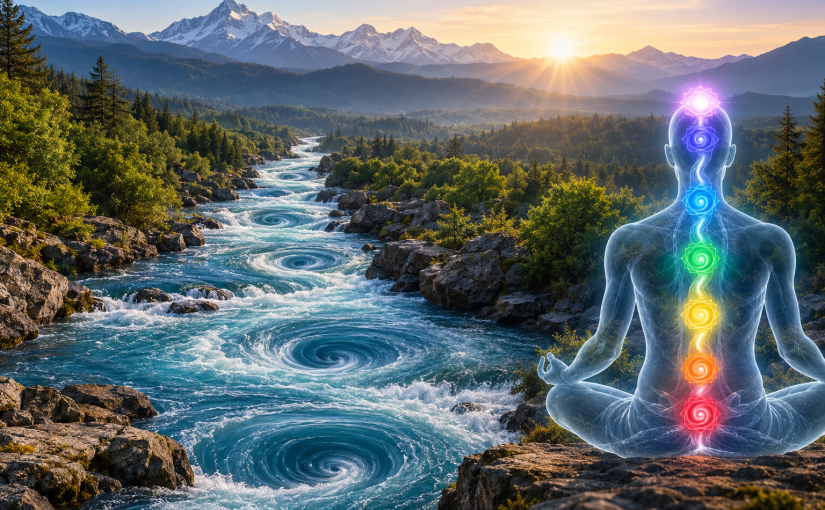
I have found the image of a river and its whirlpools useful for understanding my experience of kundalini and the chakras.
I experience kundalini as an ascending current moving through the central channel, or sushumna, along the spine. A river normally flows onward, but at certain places its water can circulate and form a whirlpool. The water remains part of the same river, yet its movement becomes concentrated and especially noticeable at that point before continuing onward.
In a similar experiential sense, I understand a chakra as a place where the ascending kundalini current seems to gather, circulate, intensify, and become particularly noticeable before continuing upward. The movement through sushumna may remain subtle, while activity at a chakra may appear as pressure, vibration, pulsation, rotation, warmth, expansion, or a distinct feeling of concentrated energy.
Thus, the chakra need not be imagined as a separate energy or independent storehouse. Within this metaphor, it is a more concentrated and noticeable pattern within the same ascending current.
Chakra Meditation and the Flow of Kundalini
The same image helps me understand chakra meditation. A weak whirlpool and a strong whirlpool are both part of the same river; the stronger one simply gathers more water into its circular movement and becomes easier to notice.
Likewise, when meditation strengthens a chakra, the kundalini experience may seem to gather and intensify there, circulate around the centre, and then continue upward through sushumna. The movement from the base may consequently feel stronger, smoother, more organized, and more continuous.
Meditation, therefore, need not be imagined as creating a completely new energy. Within the metaphor, the river is already flowing. Meditation makes a particular whirlpool stronger and the existing current more perceptible.
Different Places and Different Qualities
I have also come to feel that different places can stimulate different chakras—or, more carefully, bring forward qualities traditionally associated with different chakras.
If chakras represent different dimensions of human and spiritual experience, environments can also have different characters. Some places may feel emotional and relational, others devotional, intellectual, practical, social, or deeply contemplative. In the chakra framework, such differences can be described as an environment having an affinity with a particular centre.
The heart chakra is a useful example. A place filled with affection, human interaction, community, devotion, or emotional exchange may bring heart-like qualities more strongly into experience, while a quiet spiritual environment may make contemplative or higher-centre qualities more prominent.
This does not require the belief that a physical location objectively contains a measurable chakra field. People, atmosphere, symbolism, memories, habits, sensory surroundings, relationships, and activities can all influence which qualities become prominent. A place may therefore have a particular quality without containing a literal energetic vortex.
A socially diverse environment can be compared to khichadi: different people bring emotional, intellectual, practical, devotional, social, or worldly qualities, all mixed together. Such a place may stimulate many dimensions simultaneously and can therefore be valuable for someone seeking balance and integration.
Sequential Practice and Integrated Development
Another practitioner may prefer the opposite approach. Someone working sequentially through the chakras may deliberately develop one centre at a time and choose an environment suited to that centre. After that stage is sufficiently developed, another place or practice may be chosen for the next one.
For such a practitioner, a mixed environment may feel like spiritual mix-veg when concentrated work on one particular chakra is desired.
There is therefore no single ideal environment. A person seeking balance may benefit from varied influences, while someone deliberately cultivating one centre may need a focused environment. The same place can help one practitioner and distract another. Its suitability depends partly on what the practitioner is trying to develop at that stage.
My Change of Priority After Awakening
My own experience changed after what I understood as an awakening of the top chakra through kundalini awakening together with self-realisation.
Afterward, I began to feel that the lower chakras no longer needed deliberate strengthening in the same way. Within the yogic framework, my reasoning was that if the same kundalini current had already passed through the lower centres on its way upward and culminated in a powerful awakening at the highest centre, then those centres had already been traversed by the current.
The river-and-whirlpool metaphor made this intuitive. If the river has already passed through several lower whirlpools and finally formed a powerful whirlpool at the top, why must every smaller turbulence below it be made equally strong?
I began to regard the highest chakra as something like the strongest or master whirlpool of the ascending current. My question consequently changed from how to strengthen every smaller whirlpool to how to allow the whole river to flow well and deepen the realization associated with the strongest one.
This did not mean that I considered the lower chakras bad, unnecessary, or unworthy. My feeling was simply that the ascending current had already passed through them, while my attention had moved toward the highest realization.
Why I Preferred Isolation
This change naturally affected my choice of places. After awakening, I preferred relatively isolated environments with strong spiritual and contemplative qualities. I was drawn toward places that seemed to support the higher centre rather than places deliberately selected to stimulate lower centres.
I wanted to deepen and stabilize what had awakened rather than deliberately intensify every lower turbulence again.
Other people sometimes found this preference strange. Looking back, I think part of the misunderstanding came from comparing different stages of development. Someone deliberately cultivating a particular chakra may naturally prefer an environment that stimulates it. I was choosing from the perspective of an experience in which I felt that the current had already reached the top.
Two people can stand beside the same river while being interested in different parts of it. One may study a nearby whirlpool; another may be interested in the direction of the whole river and where it is going. Neither perspective is necessarily wrong. What appears strange from one stage may make sense from another.
Awakening Does Not Mean Complete Development
I now see an important qualification to my earlier understanding.
Experiencing awakening at the highest centre does not necessarily prove that every quality traditionally associated with the lower chakras has become perfectly developed or permanently integrated. Spiritual awakening and complete human maturity are not necessarily identical.
Emotional maturity, relationships, compassion, practical functioning, bodily stability, social adjustment, and other aspects of ordinary life can continue developing after profound spiritual realization.
Therefore, I do not conclude that everyone who experiences awakening at the highest centre should abandon lower-chakra development. Awakening changed my priority; it did not establish a universal rule.
Another practitioner may continue working with lower centres for integration, balance, emotional development, practical life, or other reasons.
Nor must everyone experience the chakras in exactly the same sequence. Some may experience a strong upward movement, some may work with centres individually, some may experience several centres together, and some may not experience chakra sensations in any clearly defined way.
The river-whirlpool model is therefore an explanatory metaphor, not a compulsory map of spiritual development.
Experience, Interpretation and Metaphor
This distinction is especially important when I speak about kundalini.
I am primarily describing something I experienced: an ascending movement, strong sensations, concentration at particular centres, and an awakening associated with the highest centre and self-realisation. I understand these experiences through the traditional yogic language of kundalini, chakras, and sushumna, while the river-and-whirlpool image helps me communicate their structure.
These are three different levels:
- Experience — what I directly experienced.
- Yogic interpretation — the framework through which I understand it.
- Metaphor — the language I use to communicate its pattern.
I can therefore speak firmly about my experience without claiming that the metaphor proves a physical mechanism.
When I say that a stronger chakra attracts more energy, the safest meaning is experiential: attention and sensation may become concentrated there, and the ascending movement may seem to gather around it. Within the yogic framework, this can be described as the chakra drawing more kundalini into itself.
It should not automatically be interpreted as a scientifically established force pulling a measurable substance upward through the spinal cord. It is like stronger whirlpool attracts more water towards it.
Similarly, saying that kundalini passed through the lower chakras before reaching the highest centre describes how I experienced and interpreted the process. It does not prove that every quality traditionally assigned to those centres became perfectly awakened or permanently integrated.
The Limits of the Metaphor
The river analogy is useful precisely when its limits are respected.
Kundalini is not being described as a literal liquid flowing through the spinal cord, and a chakra is not a literal hydraulic whirlpool. A physical whirlpool is a measurable fluid-dynamic phenomenon, whereas a chakra belongs to the traditional subtle-body framework and is being used here to describe spiritual and experiential phenomena.
The metaphor also does not establish that geographical places objectively contain different chakra energies. A place may evoke emotional, devotional, contemplative, intellectual, or other qualities because of its people, atmosphere, symbolism, sensory environment, relationships, habits, memories, and personal associations.
Most importantly, the metaphor describes the pattern of experience, not necessarily its ultimate nature. One person may understand an ascending current as kundalini, another as consciousness or attention, and another through a different spiritual framework.
The value of the metaphor is that it communicates how the experience seems to behave without requiring every part of the image to be taken literally.
What the River Means to Me
The simplest form of my understanding is this:
Kundalini is like a river, and chakras are like whirlpools formed within that river.
The current moves upward, while particular centres become places where the flow seems to gather, circulate, intensify, and become especially noticeable. Meditation may strengthen such a whirlpool. Different environments may bring different qualities into prominence. A mixed environment may suit someone seeking balance, while a focused environment may suit someone developing one centre at a time.
My own path led me toward a different priority after kundalini awakening and self-realisation. Once I experienced the strongest awakening at the highest centre, I felt that the lower centres had already been crossed by the ascending current and became less interested in deliberately strengthening their milder turbulences. I consequently preferred isolation and spiritually intense environments that seemed to support the higher centre.
I would now express this carefully:
Awakening at the highest centre changed my priority; it did not prove that every lower centre becomes permanently unnecessary.
The lower qualities may still need to be expressed, balanced, matured, and integrated in ordinary life. Daily yoga exercises do it well enough by keeping all chakras well energized and balanced. The river may reach its highest whirlpool while still flowing through the whole landscape.
Perhaps this is the deepest value of the metaphor. Before awakening, one may ask which whirlpool needs strengthening. During chakra practice, one may deliberately work with particular centres. After profound awakening, the question may change: instead of continually intensifying individual whirlpools, one may become more concerned with allowing the whole river to flow freely, steadily, naturally, and in harmony with the highest realization.
The metaphor does not require every practitioner to follow the same path. It simply gives me a way to understand how the same kundalini current can appear as a continuous upward movement, an intense concentration at a particular chakra, or, after awakening, as a movement whose deepest significance seems to lie not in any individual centre but in the realization toward which the whole current appears to lead.


