A Dream After the Death of Someone I Knew
A few days ago, a known friend who was also a distant brother took some herbicide and had to be hospitalized for a few days.
I had not met him for years, as I had been living far away from home due to my job and business commitments. When I heard the sad news, I was shocked for a moment. He was such a happy, smiling, and active person. It makes one wonder whether some people manage to hide deep inner depression beneath an outward appearance of happiness and liveliness.
I have now also heard that he had been consuming both cannabis and alcohol, which were reportedly believed to have played a major role in the incident. However being living in spiritual environment and so called high order caste, he also used to go to perform spiritual worships and rituals in people’s homes with other more or less similar team members as part time hobby with little earnings. For one tour of this kind even he was ready but missed due to reluctance of her wife in returning her true home from her maternal home with him where both had gone to celebrate rakshabandhan festival. Was this spiritualism and addiction a lethal combination or was he caught inside dominance of woman related ego. Both appear as the valid psychological possibilities together. He had already warned of consuming something lethal but the family almost ignored it.
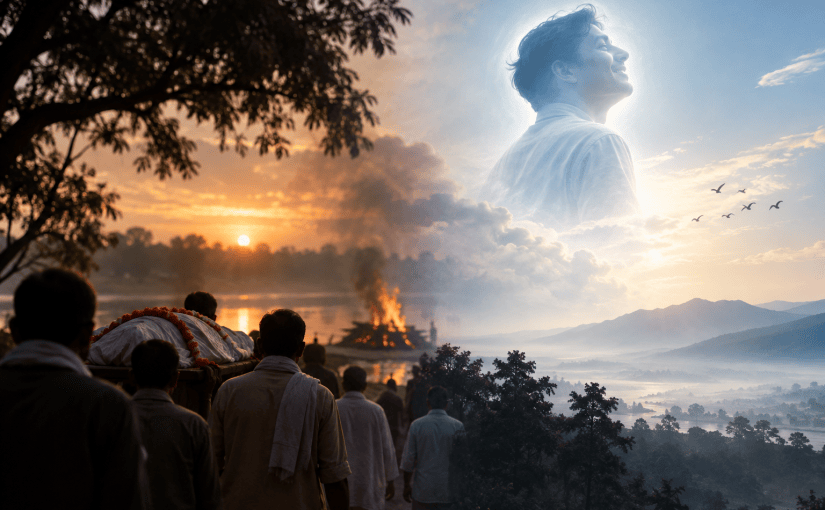
The event followed a quarrel between the couple throughout days of journey. After returning home the quarrel continued, and he reportedly beaten his wife and she also attacked back although male is male in strength. Even he hit his mother too in anger while she came to protect her and control him too. So she made them sleep in different rooms separate from each other. At night, God knows from where he got that 500 ml poison bottle and drank entire. In the morning naked due to heating up by poison and blood vomit everywhere. He opposed to be carried to hospital as he was already determined to die but was carried forcefully. Then his partner went back to report to police out of fear. He eventually passed away. When I saw the news on Facebook, I later had a strange dream. I saw a shavayatra moving toward the place of funeral, with people carrying a dead body, but I could not find out who had actually died. The person I had heard about appeared to me as if he were still alive, smiling and happy as he had been earlier. I asked people who had died, but nobody answered me. Instead, everyone seemed to be telling me to remain silent. I could not identify the dead person. At one point I thought that perhaps his younger brother had died because he was not clearly visible and, in the dream, he seemed to be the one showing the greatest grief. Yet this itself became strange, because the person whom I expected to be dead did not appear dead at all.
When the Dream Changed the Meaning of Death
The dream made me think that perhaps death is not as simple as the death of the body. The funeral procession clearly represented physical death, yet I could not locate the person who had supposedly died. The one whom I associated with death appeared alive, smiling, peaceful and recognizable. This contradiction became the central point of the dream for me. I began to feel that perhaps no one dies in the deepest sense merely because the physical body dies. What dies may instead be the bodily form and the world of physical relations connected with that form.
The younger brother’s grief seemed to deepen this interpretation. I had initially guessed that he was the one who had died because he was experiencing the greatest grief. This suggested another possibility: perhaps the person who undergoes a kind of death is not necessarily the one whose body has stopped functioning, but the person who thinks that everything he loved has become zero. When someone believes that the person he loved has completely disappeared, his own inner world can collapse. In that sense, the deepest psychological death may occur in the one who remains behind but becomes overwhelmed by the belief that everything meaningful has been lost.
This does not mean that physical death is unreal. The body certainly dies. The point is different: physical death need not necessarily mean annihilation of the person. The funeral belongs to the body, while the question of what happens to the person or soul belongs to a deeper level of existence.
The Soul May Remain Fully Alive After Bodily Death
I am not thinking only about the way the dead survive in the memories of other people. My meaning is more direct. I am referring to the possibility that the person himself, as a disembodied soul, remains fully alive after bodily death. I have also once experienced what I understood as a dream visitation of a soul, so my understanding of this possibility does not come only from abstract thinking. I experienced something personally that led me to consider the possibility that a person may remain present after the body has died.
My dream after this recent death therefore appeared meaningful to me because the physical body was being carried toward cremation, while the person I associated with that body was nevertheless appearing alive. This created a distinction between the body and the person inhabiting or experiencing through that body. The body may become lifeless, but the soul may not therefore become lifeless.
This gives another meaning to the statement that perhaps no one really dies even after death. It does not have to mean that biological death does not happen. Rather, it can mean that the death of the physical body is not necessarily the death of the person at the level of the soul.
Why the Disembodied Soul Might Feel More Alive
I then began to see another possibility. During embodied life, consciousness is continually surrounded by the distractions of the physical world. The body produces sensations, hunger, thirst, pleasure, pain, fatigue and other needs. The mind is occupied by relationships, social circumstances, memories, desires, fears, reactions and the ordinary stream of thoughts. Much of what we experience as ourselves may therefore be mixed with the activity and limitations of the physical body.
After disembodiment, this entire field of gross physical distraction may no longer dominate consciousness in the same way. If the soul continues after death, it may therefore become more directly aware of its own state of development. Without the same degree of sensory distraction and physical involvement, it could perhaps see and feel its own condition much more clearly.
In that sense, the disembodied soul might be more alive in one respect than the embodied person. This does not mean that it would continue thinking exactly as a living human thinks. Ordinary discursive thoughts, bodily sensations and many emotional reactions may themselves belong to embodied existence. They may be dharmas, or characteristics and activities, of the body-mind condition. The subtler experience of the soul would therefore not necessarily resemble ordinary human thinking.
Instead, the soul may experience reality as a subtle spiritual essence. What is experienced may be less gross, less sensory and less conceptual. It may be closer to direct seeing, feeling or knowing at a spiritual level. What is experienced during embodiment through the body and mind could, after disembodiment, be experienced in a much subtler form.
This is why the smiling and living appearance of the person in my dream seemed significant to me. The dream did not portray him as diminished or extinguished. It portrayed him as alive, even though the funeral procession was taking place. The body seemed to be going toward death, while the person himself did not appear to have become dead.
Physical Death, Psychological Death, and Spiritual Continuity
This way of looking at the dream also suggests three different meanings of death. Physical death is the end of the functioning body. Psychological death can occur in a living person when grief, attachment and the belief in complete loss make the person’s inner world collapse. Spiritual death, however, would be something different altogether. If a soul exists independently of the body and continues after bodily death, then physical death would not automatically mean spiritual death.
This distinction is important because the statement that “no one dies” can otherwise be misunderstood as denying the physical reality of death. I do not mean that. The body dies. What remains open is whether the deepest identity of the person also ends.
My dream cannot prove what happens to a soul after death. It is a personal experience and a source of philosophical reflection rather than scientific evidence. The same applies to my earlier dream visitation. I experienced it as a visitation, but that experience by itself cannot establish the metaphysical fact that souls survive bodily death. Still, an experience can be meaningful without being presented as scientific proof.
Kundalini Yoga and the Continuity of Spiritual Development
This understanding naturally connects with Kundalini Yoga. If consciousness is more than the physical body, then spiritual development may also be more than the temporary development of the body and personality. Ordinary life develops many things that belong to one particular embodiment: physical abilities, possessions, social identities, habits, memories and patterns of thought. These may end or change with the body.
Kundalini Yoga can be understood as working at a deeper level. Its purpose, in this interpretation, is not merely to produce unusual sensations, powers or altered states. It is a process of transforming consciousness and developing subtler levels of awareness. The deeper the transformation, the less it can be understood simply as something belonging to the physical body.
This leads to an important possibility. If the soul continues beyond bodily death, then spiritual development cultivated through Yoga may not necessarily disappear when the body dies. The physical instruments used for the practice belong to one lifetime, but the deeper transformation of consciousness may belong to the soul itself. In a spiritual understanding of rebirth, that development could therefore be carried subtly into the next birth.
The idea is not that every memory or ordinary thought survives in exactly the same form. Rather, what may continue is the deeper spiritual development. A person might lose the particular body, circumstances and personality through which development occurred, while still carrying forward the effect of that development at a subtler level.
In that sense, Yoga can always be seen as helping growth. Even if outward achievements end with the body, genuine inner development may not be lost. What is cultivated at the deepest level may become part of the continuing being.
Why Yoga May Not Require Escape from Society
This also gives another perspective on spiritual practice. One may imagine that leaving society is necessary in order to seek Kundalini or spiritual growth, but that need not follow. Society itself provides the circumstances through which consciousness can be tested and transformed. Relationships, attachment, desire, conflict, responsibility, distraction, loss and ordinary human interaction all reveal the condition of one’s consciousness.
The important question is therefore not simply whether one has escaped society, but what one is developing while living in it. A person may remain in ordinary life while gradually cultivating deeper awareness. The physical and social world can become the field through which spiritual development takes place rather than merely an obstacle to it.
This is also consistent with the central insight of the dream. The ordinary world may contain many distractions, but those same circumstances can become opportunities for growth. Kundalini Yoga does not necessarily require rejecting the world; it may instead involve learning to move through the world without allowing its gross distractions to completely determine consciousness.
What the Dream Means to Me
For me, the deepest meaning of the dream is not simply that a dead person can appear alive in a dream. It is that the dream reversed the ordinary assumption about death. We normally see the body as the person and therefore assume that when the body dies, the person is gone. In the dream, the body was moving toward the funeral, but I could not find the person who had supposedly died. The person was smiling and appeared alive. Nobody would tell me who had died. The one who seemed most visibly affected was the grieving person who believed that someone had been lost.
This makes me wonder whether the tragedy of death belongs primarily to the body and to the attachments surrounding the body, while the deeper person may continue in another condition. Perhaps what appears to us as the end is actually a transition from one mode of experience to another.
The disembodied soul, in this view, does not remain occupied in exactly the same way as the embodied person. Freed from much of the physical world’s distraction, it may experience its own spiritual condition more directly. It may see what it has become more clearly. It may feel reality not through the gross senses and ordinary thought but through a subtler spiritual essence.
And if spiritual development has been cultivated through Kundalini Yoga or another genuine path of inner transformation, perhaps that development does not simply become zero when the body dies. It may continue with the soul and, in a doctrine of rebirth, influence the next embodiment.
This is why I see Yoga as a form of growth that can never be completely wasted. The body is temporary, circumstances are temporary, thoughts are temporary, and personalities are temporary. But if there is something deeper that continues beyond them, then what is developed at that deeper level may have a continuity that ordinary physical achievements do not have.
The funeral procession in my dream therefore came to represent something different from simple annihilation. The body may be carried toward the funeral, but the person may continue. What we call death may be the ending of one form of embodiment rather than the ending of the being itself. And perhaps the greater spiritual task in life is to discover and develop that deeper dimension before the body is finally left behind.
I do not take this dream as proof of a metaphysical fact, nor do I think the death of my friend should be interpreted as something other than the tragedy that it was. His physical death was real, and his suffering before it was real. But the dream led me to ask whether the person who died physically may nevertheless continue in another form of existence, and whether spiritual development can therefore extend beyond a single lifetime.
For me, that possibility gives a deeper meaning to Yoga. It suggests that spiritual practice is not merely an attempt to become more peaceful or powerful within one temporary life. It may be a way of developing what can continue when the temporary body, its distractions and its ordinary mental processes finally fall away. In that sense, perhaps the deepest aim of Kundalini Yoga is not to escape life but to use life to cultivate the part of oneself that may not end with it.
This should not be taken as glorification of death in any way. The point is simply that when worldly activity and its associated mental noise temporarily subside, one may experience a sense of relief and a more direct feeling of the underlying Self. Such relief, however, can be temporary or illusory and should not be confused with genuine spiritual development or realization. The real emphasis is on understanding the nature of worldly impressions and mental noise, and how they can be dissolved through awareness and witnessing.


