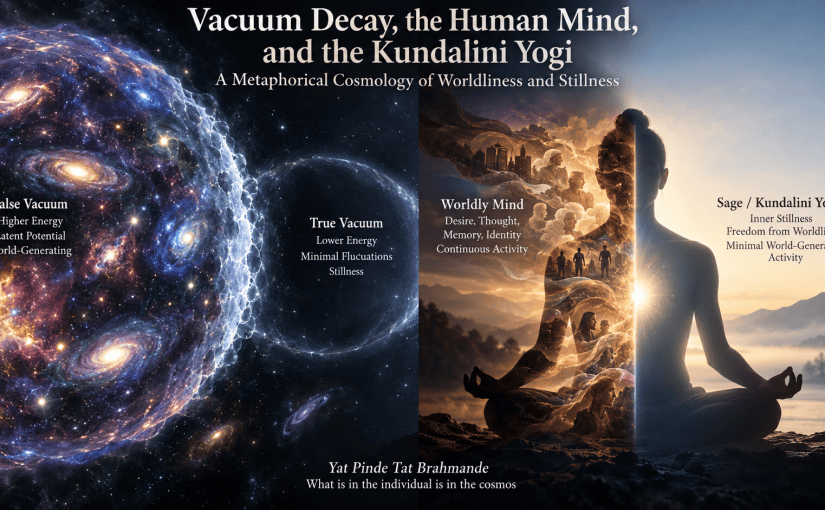
From the Physical Vacuum to the Inner World
Vacuum decay sounds as if empty space suddenly disappears, but in modern physics a vacuum is not simply empty space. Quantum fields exist throughout space, and what we call particles are excitations of those fields. A vacuum is a particular state of those fields. That state can, in some theories, be a local minimum of potential energy rather than the absolute lowest one. Such a state is called a false vacuum, while the lower-energy state is called the true vacuum. Quantum mechanics allows a metastable false vacuum to tunnel into a lower-energy state. The transition is described through a tunnelling or bounce solution and can produce a bubble of the new vacuum. If the bubble is too small it can collapse, but beyond a critical condition it can expand, potentially approaching the speed of light and replacing the old vacuum. When gravity is included, the situation becomes even more profound because vacuum energy affects spacetime itself. This physical picture led me to see a possible metaphorical correspondence with the human mind.
False Vacuum as Worldly Mind
I began thinking of the false vacuum as similar to the darkness of an ordinary worldly mind. Here darkness does not simply mean evil or absence of knowledge. It means the unseen, unexamined and latent structure through which worldliness is continually generated. The more strongly a person is identified with the world, the greater this darkness appears to be. Beneath conscious thought there are memories, expectations, fears, desires, habits, identity, comparison, social conditioning and countless subtle associations. Much of what maintains our ordinary mental world is therefore not consciously visible. It is already present in a subtle or encoded form, ready to produce further thoughts, emotions, desires and actions. In this sense I see worldliness as a kind of latent world-generating potential.
This also gives a useful metaphorical meaning to the high energy of a false vacuum. In physics, one should not simply say that every high-energy vacuum necessarily has larger quantum fluctuations, because fluctuation behavior depends on the particular fields, masses and couplings. Yet higher-energy field configurations can possess substantial potential for excitation and manifestation. This is the part of the analogy that interests me. The false vacuum is not itself the particles, just as the subtle structure of the mind is not itself every individual thought. Rather, it is the underlying condition from which manifestations can arise. Quantum excitations arise from the field configuration, while thoughts, emotions and worldly responses arise from the latent organization of the mind. Therefore I began to think of the subtle information of worldliness as something like the potential structure hidden within the false vacuum. It is not a literal storage of every object or event, but a hidden capacity from which the manifest world can continually be regenerated.
Quantum Fluctuations and the Mental World
In this metaphor, mental activity can be compared with fluctuations. An ordinary mind continually moves through memory, desire, anticipation, fear, pleasure, pain, identification and planning. One thought produces another, one emotion activates another, and the resulting actions produce fresh impressions. The process therefore becomes self-maintaining: desire produces thought, thought produces action, action produces consequences, and those consequences produce new desire. The worldly mind can thus be imagined metaphorically as a high-activity state with substantial capacity for generating further manifestations. This does not mean that psychological activity is literally caused by quantum fluctuations, nor that the human mind can be physically equated with a cosmological vacuum. The correspondence is structural and phenomenological: hidden potential gives rise to visible manifestations.
The Sage as True Vacuum
A profound transformation appears when an ordinary person becomes a sage, or what I also call a kundalini yogi in this metaphor. The change is not simply that the person has fewer thoughts. It is more radical. The underlying compulsion to continuously construct and maintain a personal worldly cosmos becomes quiet. A deep contemplative state can therefore be imagined as a true vacuum: a state of minimal psychological agitation, minimal compulsive fluctuation and minimal dependence on the continual generation of worldly experience.
This does not necessarily mean that the sage has lost all information. A Buddha can remember people, language and teachings, and a kundalini yogi may still function normally in the world. The deeper change is that information no longer has the same power to generate attachment, identity, craving and psychological continuation. Thus the useful distinction is not information versus no information, but information that actively generates worldliness versus information that remains without compulsive identification. In this sense the true vacuum metaphor represents the lowest world-generating activity rather than literal mental emptiness.
When an Individual Changes State
The transformation of an ordinary householder into a sage can therefore be compared metaphorically with false vacuum becoming true vacuum. The old worldly state is a metastable condition, apparently secure but still carrying the possibility of transition. A brief mystical experience may be like a subcritical bubble: an extraordinary moment appears, but the ordinary mental structure reasserts itself and the experience collapses. A deeper realization may cross a critical threshold. At that point the new state becomes sufficiently stable that the previous organization cannot easily restore itself.
The critical bubble in this analogy is not a physical radius. It represents the depth, stability and integration of realization. Below the threshold, worldliness is stronger than realization; above it, realization becomes strong enough to sustain itself. The “bubble wall” can be understood metaphorically as the resistance between the old and new states: attachment, identity, fear, habit, conditioning and the fear of losing the familiar self. Spiritual practice then becomes a gradual weakening of the barrier between the ordinary worldly state and inner stillness.
From One Mind to Many Minds
The analogy becomes even more interesting when realization spreads. One person’s transformation can affect others through speech, example, teaching and direct influence. A sage may become a source from which other people begin to observe their own minds, question their attachments and discover a quieter state. One transformed mind can therefore influence another, and that mind can influence another, creating a chain of transmission. In this metaphor the sage becomes a nucleation center of a different mental state.
This is where the idea of a critical bubble becomes collective. A person’s realization may remain localized if it does not spread beyond the individual. But if it becomes sufficiently powerful and transmissible, the psychological bubble can expand into a community, a tradition, a civilization and perhaps, over very long periods, a wider transformation of collective consciousness. Figures such as Buddha can be viewed in this philosophical sense as extraordinary examples of a personal realization becoming a lasting field of influence. Krishna can similarly be treated as a theological or archetypal representation of a consciousness that transforms the relationship between action, attachment and liberation. I do not mean that these figures literally altered the quantum vacuum; rather, their significance lies in the ability of a transformed mode of consciousness to propagate through human minds.
Two Different Meanings of Cosmic Destruction
This metaphor also clarifies what it means to say that a sage “destroys the cosmos.” The physical universe is not necessarily destroyed by enlightenment. Stars, planets, bodies and ordinary physical processes can continue. What is diminished is the mentally constructed cosmos: the personal world of “I,” “mine,” desire, fear, comparison, memory, expectation and attachment. In that sense spiritual liberation is not necessarily annihilation of the external universe but cessation of the psychological machinery that continually recreates one’s experienced worldly universe.
The idea can therefore be expressed at three scales. At the level of physics, a metastable vacuum can theoretically transition into a lower-energy vacuum through quantum tunnelling and bubble nucleation. At the level of an individual, a worldly mind can metaphorically transition into profound stillness. At the collective level, a deeply realized person can transmit that transformation to others. The common pattern is a seemingly stable state containing hidden potential for transition, followed by a movement toward a state of lower activity and a possible expansion of the new state.
The Larger Cosmological Question
This metaphor naturally raises a much larger possibility. Perhaps the physical cosmos and the experienced cosmos should be distinguished: one is the universe described by quantum fields and spacetime, while the other is the universe constructed in consciousness through sensation, memory, interpretation, desire and identity. Vacuum decay belongs to the physical description, whereas enlightenment belongs to the phenomenological and spiritual description. There is currently no established scientific evidence that a sage’s mental realization causes physical vacuum decay. That would be a speculative hypothesis, not accepted physics. Yet the structural similarity is striking: a high-potential state, hidden possibilities, manifestation through excitation, a transition to a lower-energy condition and, under certain circumstances, expansion of the new state.
This gives a final way of expressing the whole idea. The false vacuum is not merely “empty space with energy”; metaphorically, it is a latent world-generating condition. The worldly mind is similarly not merely a collection of conscious thoughts; it contains subtle structures capable of continually regenerating its experienced world. The true vacuum, by contrast, represents the deepest stillness, where the compulsive generation of that personal cosmos has greatly diminished. A householder becoming a sage is therefore metaphorically a false vacuum becoming a true vacuum. A temporary realization is a subcritical bubble; a stable realization crosses the critical threshold; and a rare, extraordinarily powerful sage may become a center from which a different mode of consciousness spreads through many minds. In this sense the language of vacuum decay becomes a powerful metaphor for the movement from worldliness to stillness, from latent psychological complexity to liberation, and from the continuous creation of a mental cosmos toward its profound inner dissolution.
It should not be surprising, then, if cosmic vacuum decay has a corresponding reflection in the individual mind, just as other cosmic principles can be reflected in the individual. This is also expressed in the scriptural idea “yat pinde tat brahmande”—what is in the individual is in the cosmos, or what exists in the microcosm is reflected in the macrocosm. From this perspective, the individual is not separate from the larger cosmic process but can be regarded as its smaller reflection. Therefore, studying the individual mind may provide a way to study corresponding principles of cosmology, just as studying cosmological processes may provide metaphors or models for understanding the individual. In this sense, the possibility that a cosmic vacuum transition could have an inner psychological counterpart is not an arbitrary comparison but follows naturally from the microcosm–macrocosm principle. The physical correspondence itself remains a hypothesis rather than established science, but the philosophical method of looking for the same pattern in the individual and the cosmos is ancient.
The Cosmic Apocalypse Reflected Within the Individual
Thus the cosmic apocalypse may have its corresponding reflection within the individual as a mental apocalypse. According to the scriptural vision, God first brought forth the universe and then entered into it in order to experience and sustain it. The Upanishadic idea that the Divine, having created the world, then entered into it expresses this profound principle. If the human being is itself a miniature form of the universe, then the Divine did not merely enter the vast cosmos from outside; it first created a miniature cosmos in the form of the individual and entered that miniature through the individual soul, thereby entering the universe in concentrated form. The human body by itself is inert; it becomes a living centre of perception, thought, action and experience when animated by the soul. In this sense, the individual is a microcosm through which the macrocosm experiences and operates itself. Therefore, if the universe can undergo its own cosmic processes, including a possible transition from one vacuum state to another, a corresponding process may also be contemplated within the individual as a transformation of the mental cosmos. The worldly mind continuously maintains its experienced universe through memory, desire, identity, perception, thought and subtle tendencies; when these world-generating processes become profoundly quiet, that inner cosmos can undergo its own apocalypse—not necessarily the destruction of the physical world, but the dissolution of the mental world through which it is experienced. Thus the individual can be studied as a miniature expression of the cosmos, and the transformation occurring within the individual can offer a way of contemplating corresponding transformations in the larger universe. This remains a metaphysical interpretation rather than an established scientific description of cosmology, but within the scriptural understanding of the microcosm and macrocosm, the correspondence is natural: the Divine enters the cosmos through its living miniature, and the dissolution of the worldly cosmos can therefore be contemplated not only in the vastness of space but also in the deepest stillness of the individual mind.


