Can Sexual Release Awaken Kundalini? The Hidden Connection Between Semen Retention, Breathlessness and Sudden Samadhi

When Prana Needs Stabilization Rather Than Force

In my meditation practice I have noticed that prana does not always permit nirvikalpa dhyana while sitting. At such times, if I try to force breathlessness, it may create strain rather than deeper meditation, and I have come to feel that forced breathlessness is not the right approach. Instead, when I allow breathing to continue naturally and simply give attention to the breath, a different picture emerges. Old and new thoughts begin to appear in awareness like waves. They are not sharply separate from awareness; they seem to arise within it in a subtle form, sometimes with a distinct quality of bliss. By giving more strength to pure awareness and less to the content of thought, these thoughts seem to lose their strength. In this way meditation can continue for hours because there is no need to fight with the mind or force breathing to stop. The body, however, cannot remain in one posture indefinitely. After sufficient sitting, the posture can be changed simply to prevent stiffness, while awareness continues without treating the change of posture as a break in meditation.

Sexual Experience, Retention and the Upward Movement

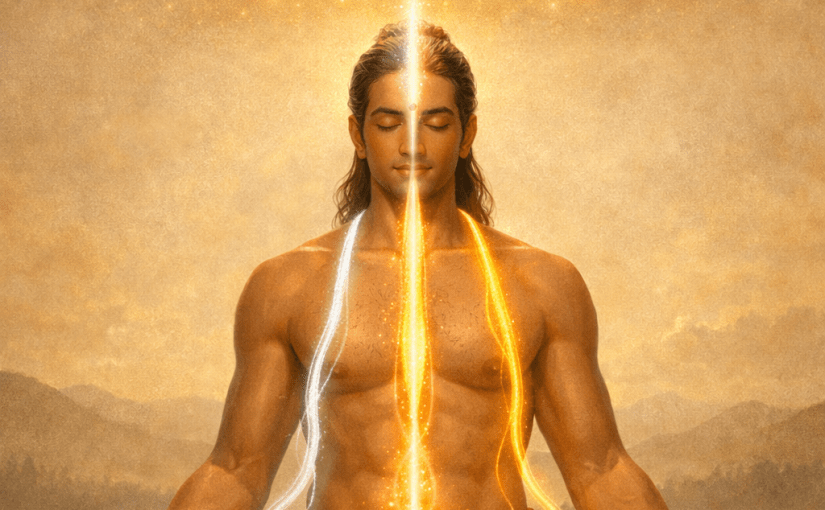
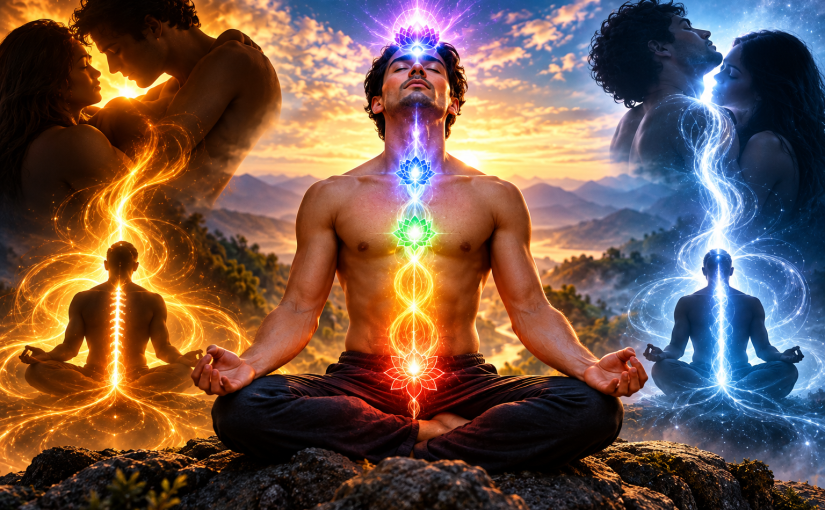
Another striking observation has occurred after sexual activity with semen retention. In that condition, the breath can become agitated and I experience what seems like an upward movement through the back, as though the breath or prana is carrying Kundalini energy upward. The sensation may become concentrated at different centres: sometimes around the heart chakra, sometimes at Ajna, and sometimes at Sahasrara. Although the underlying sensation may initially look sexual, at these upper centres it seems purified or filtered. The basic intensity is still recognizable, but its quality becomes subtler, more blissful and less obviously sexual. I began to see this not simply as sexual excitation but as a possible transformation in the way bodily sensation, attention and awareness are experienced.

This also brought to mind the Emerald Tablet, especially the line that the Wind carries the mysterious principle in its belly. To me, the Wind can naturally suggest breath, particularly when considered beside the yogic idea of prana. The Tablet also speaks of ascent from Earth to Heaven and of separating the subtle from the gross. I do not take this as proof that the Emerald Tablet literally describes Kundalini, but its symbolism seems remarkably compatible with the kind of process I am experiencing: a bodily beginning, the movement associated with breath, an upward transition and a refinement of experience into subtler awareness.

The Unexpected Difference Between Release and Retention

There is, however, a twist in my observations. When sexual discharge occurs, the breath does not become agitated in the same way. Instead, breathless dhyana can arise almost immediately after sitting and meditating on the breathing. This led me to question the usual assumption that an energy reserve at Muladhara must always be pushed upward through intense pranic effort. In my own experience, after release there seems to be no reason to keep generating a strong upward push. Whatever I call the experiential essence of the sexual process seems to rise immediately, while the physical component alone is discharged. I experience this as a sudden opening of the back channel, allowing the experiential essence to pass upward in a single movement. Afterward, however, the effect does not remain in the same sustained form because there is no continuing sexual reserve being retained.

With retention, my experience appears different. I feel that the channel is already partly open and remains available for tantric practice. The retained sexual state seems to release its experiential essence gradually over time. In the initial period, the quantity or intensity seems greater, so prana becomes more agitated and the breath appears to work harder. Later, once the passage feels sufficiently open, the process becomes smoother and meditation can be sustained without the breath needing to act as a forceful pusher. In this model, the retained semen acts as a continuing source for experiential release, whereas sexual discharge produces an immediate and more concentrated transition but does not provide the same prolonged supply.

Why a Dual Approach Seems Meaningful to Me

This led me to the idea that repeatedly seeking sexual release just to recreate the immediate entry into breathless dhyana would not be a practical path. It can feel physically tiring and cannot realistically be repeated every day merely as a meditation technique. Retention alone, on the other hand, may produce a slower and steadier process. Therefore I began to see a possible complementary approach: a period of retention in which tantric meditation continues and the back channel remains open, followed eventually by release rather than endless retention. In my interpretation, this allows the gradual experiential development of the retention phase to be followed by a sudden upward transition, while also preventing the feeling of excessive accumulation or stagnation in the lower organs.

The Possibility of a Sudden Kundalini Awakening

I further feel that this dual approach may create a greater possibility of a sudden Kundalini awakening or at least an awakening glimpse. In my model, retention alone provides a slow and steady supply of experiential essence moving upward, but a sudden awakening requires a much larger volume of this experiential essence to reach the brain quickly. Sexual release appears to open the back channel fully and allows the accumulated tantric meditation essence of the retention phase to move upward in a single rush. If the channel is already prepared and unobstructed, the movement may be smooth rather than producing disturbing head pressure. This is important to my interpretation because I experienced my second awakening in a way that seemed similar to this pattern: sustained tantric development during retention followed by a sudden, smooth upward event and an awakening glimpse.

At the same time, I recognize the difference between an experience and the explanation given to it. The sensations, bliss, breathing changes and sense of upward movement are directly experienced, while the idea of a stored semen depot releasing a subtle experiential essence through a physical or subtle back channel remains my interpretation rather than an established physiological mechanism. Sexual activity can influence autonomic arousal, breathing, muscle tension, attention and emotional state, and these may contribute to the experience without cancelling its spiritual significance. Likewise, a sensation at a chakra does not by itself prove that a chakra has objectively opened, nor does breathlessness alone prove nirvikalpa samadhi.

Letting the Process Remain Natural

The most useful lesson from these experiences may therefore be that meditation should not be forced into a single pattern. Breathlessness may arise spontaneously after sexual release; during retention, agitation may precede a more sustained and subtle absorption; and in ordinary sitting, simply allowing the breath to continue can let thoughts dissolve into waves within awareness. The common factor may be less the suppression of breath or thought and more the gradual transfer of attention from mental content and bodily excitation toward pure awareness. For that reason, I do not see forced breath-holding, deliberate hyperventilation or an attempt to push energy upward as necessary. Breathing should remain comfortable and spontaneous, and posture can be changed when the body stiffens. The deeper inquiry is not merely how to produce a dramatic Kundalini event, but how bodily energy, breath, thought and awareness can naturally move from excitation toward stillness, subtlety and sustained dhyana.
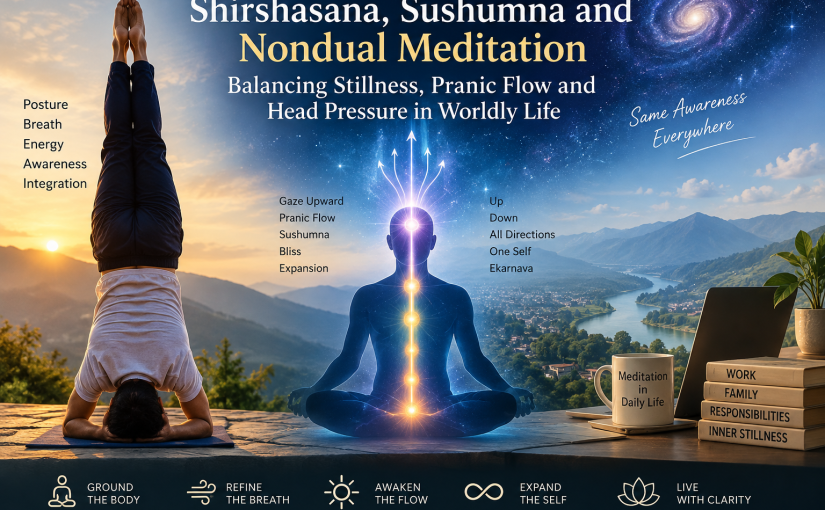
Shirshasana, Sushumna and Nondual Meditation: Balancing Stillness, Pranic Flow and Head Pressure in Worldly Life

Shirshasana has traditionally been regarded as a major or “top” asana because it reverses the body’s normal orientation and strongly changes bodily awareness. My experience has made me wonder whether familiarity with head-centered sensations may help during meditation, where awareness can sometimes become concentrated around the head. This should not be understood as a claim that increased intracranial pressure is desirable or necessary; the “pressure” I mean is an experiential sensation of fullness, heaviness or activity.

In shoulder stand and Halasana, I have noticed that small changes in position can markedly alter head discomfort. Slightly lifting the head or allowing the feet to touch a wall can change weight distribution and reduce the sensation. This shows me that posture, alignment, support and muscular effort strongly influence subjective experience. Discomfort, however, should not automatically be interpreted as spiritual progress; persistent, severe or unusual head pain deserves attention rather than spiritualization.

This becomes particularly relevant to my practice of nondual meditation, including what I call shavid or quantum darshan, especially during busy worldly days. Intense awareness can sometimes be accompanied by strong head sensations. Daily kundalini yoga postures and breathing exercises seem to complement this by conditioning the body and attention to controlled changes in posture, breathing, muscular effort and internal sensation. I find that this can make intense experiences less disturbing and increase my ability to remain present rather than react to every sensation.

I therefore see kundalini practice less as a search for dramatic energetic experiences and more as preparation, grounding and conditioning. Repeated exposure to controlled intensity may make unusual bodily and mental experiences feel less foreign, although this does not prove that every sensation is caused by kundalini energy.

Yoga and nondual meditation can consequently complement each other without requiring withdrawal from ordinary life. Yoga works through body and breath; meditation works directly with awareness. Work, responsibilities, conversation and stimulation become part of the practice when awareness is maintained amid them.

Most importantly, head pressure should never become the goal. Stronger pressure does not necessarily mean deeper meditation, stronger kundalini or spiritual advancement. The meaningful measure is greater clarity, steadiness and non-reactivity. If a posture causes discomfort, changing or stopping it is more sensible than forcing it. Persistent physical symptoms should not automatically be interpreted as awakening.

For me, Shirshasana and related practices are valuable not because they create a desired amount of pressure, but because they may help the body and attention become familiar with changing sensations. Daily yoga provides a grounding counterpart to nondual meditation: the busy world supplies stimulation, meditation reveals how awareness responds, and yoga disciplines the body, breath and attention. The deeper aim is therefore not greater intensity, but the ability to meet whatever arises—with steadiness, clarity and less reactivity. However, when there is enough stillness, nondual meditation in the midst of worldly activity becomes difficult. It feels almost like water cannot be both completely still and flowing at the same time: in one place there is stasis, while in another there is movement. How, then, can the two truly coexist?

Regarding head pressure, I also experience that a certain initial upward movement or “pumping” toward the head is needed to begin breathless meditation and initiate the flow through Sushumna. With the gaze turned upward and attention resting on the infinite, all-pervading sky as the Self, or Ekarnava, a rise in head pressure may arise together with bliss. This is not experienced as discomfort but as a positive sign of the meditation deepening.
However, if the pressure becomes uncomfortable, awareness can be lowered and expanded beyond the head. The sense of Self need not be extended only upward toward the infinite; it can also be expanded downward and sideways, in all directions. This reduces the head pressure while allowing the Sushumna flow to continue. Once established, the flow can sustain itself for roughly an hour, until, in my experience, the available prana becomes exhausted.

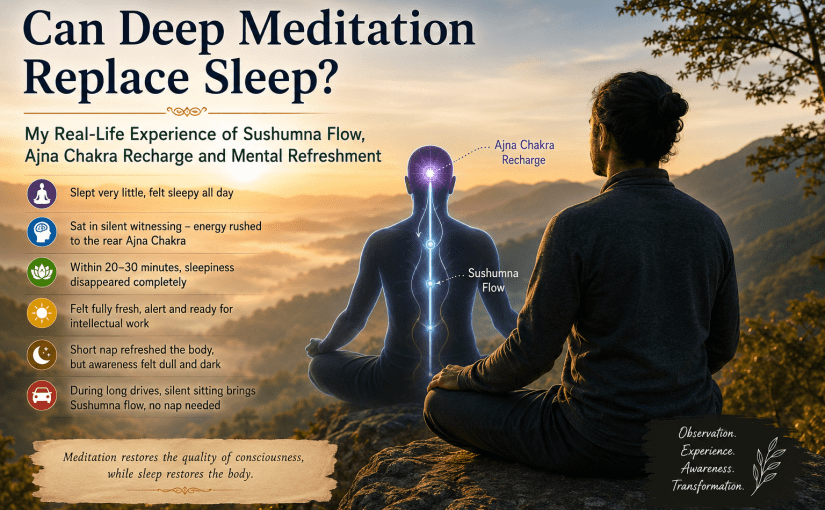
Can Deep Meditation Replace Sleep? My Real-Life Experience of Sushumna Flow, Ajna Chakra Recharge and Mental Refreshment

There are some experiences in meditation that are difficult to explain unless they happen repeatedly. They are not conclusions drawn from books but observations made quietly over time. Recently I had one such experience that made me think deeply about the relationship between meditation, sleep, awareness and inner energy.

One night I slept very little. The next day I remained sleepy almost throughout the day. Normally such sleep deprivation reduces concentration, mental sharpness and enthusiasm for work. However, whenever I sat quietly for meditation without making any effort, something remarkable happened. As soon as the mind became peaceful and settled into simple witnessing, I repeatedly felt a strong movement of energy towards the rear region of the Ajna Chakra. It did not feel imaginary. It was as if the back portion of the brain was being recharged from within.

Within about thirty minutes the sleepiness disappeared completely. Instead of feeling dull after a sleepless night, I became mentally fresh, alert and ready for intellectual work. It felt almost as though a new day had just begun. This happened more than once during the day and naturally raised a question in my mind. If meditation can refresh the brain so completely, is ordinary sleep always necessary? Can Sushumna flow and Ajna Chakra recharge become an alternative to sleep?

This question deserves careful thinking because the experience itself was genuine. Deep meditation seemed to restore mental clarity in a way that ordinary relaxation never could. During meditation my awareness became clean, bright and steady. There was no heaviness, no mental fog and no struggle to remain awake. The state felt more than ordinary wakefulness. It carried a quality of heightened self-awareness that is difficult to describe in words.

From the yogic point of view, such an experience can be understood as prana gradually withdrawing from scattered mental activity and becoming concentrated in the central channel. Many traditions describe that when prana begins to move through Sushumna, the mind naturally becomes quiet, inner awareness brightens and much less energy is wasted through constant thinking and sensory activity. The practitioner often feels inwardly nourished, refreshed and mentally light. My experience appeared to fit this description remarkably well.

At the same time, modern neuroscience also offers useful insight. Deep meditation activates relaxation mechanisms within the nervous system, reduces unnecessary mental activity and can restore attention after fatigue. This may explain why meditation can remove the feeling of sleepiness and greatly improve mental performance. However, science also reminds us that sleep performs important biological functions such as memory consolidation, tissue repair, hormonal regulation, immune support and the clearance of metabolic waste from the brain. Therefore, meditation and sleep may overlap in some benefits while still serving different purposes.

As I continued observing this phenomenon, another experience taught me an equally valuable lesson. After several cycles of becoming refreshed through meditation, I decided to lie down in Tribhangmurari Asana for further meditation. My intention was not to sleep but simply to continue witnessing in a relaxed posture. However, despite my efforts, I drifted into a short nap. After some time rising stomach acid woke me because of my tendency towards acid reflux.

The result surprised me even more than the earlier meditation. Physically I felt refreshed after the short sleep, but mentally I did not experience the same crystal-clear awareness that meditation had produced. Instead, I felt somewhat dull, dark and heavy. The body seemed rested, but the luminous self-awareness that had accompanied meditation was missing.

This comparison became very meaningful. Meditation had produced extraordinary clarity of consciousness, whereas the interrupted nap restored the body but not the same quality of awareness. It appeared that the two experiences were serving different functions.

One possible explanation is that deep meditation maintained a continuous stream of awareness while energy remained concentrated inwardly. The short sleep interrupted that continuity. On waking suddenly because of acid reflux, I may also have experienced ordinary sleep inertia, the temporary grogginess that often follows abrupt awakening from deeper stages of sleep. This could explain why I felt physically refreshed yet mentally less clear.

From the yogic perspective, another possibility is that meditation had organized the flow of prana in a stable manner, while unconscious sleep temporarily dissolved that organized state. Whatever the exact explanation may be, the contrast between the two states was unmistakable. Meditation refreshed consciousness itself, whereas the nap refreshed the body but not the same level of awareness.

Naturally I felt a little disappointed. I had hoped that meditation would continue providing complete refreshment without any need for sleep. I wanted sleepless meditative renewal to continue indefinitely. Yet the involuntary nap suggested that although the mind had repeatedly become fresh through meditation, the body still carried a physiological need for sleep after the previous night’s deprivation.

This realization itself became another lesson. Perhaps advanced meditation should not be judged by whether it eliminates sleep altogether. Many classical yogic traditions describe great practitioners gradually requiring less sleep, but they also suggest that this happens naturally rather than through deliberate effort. Reduced sleep is presented as a consequence of transformation, not as a goal to be forced. Chasing sleeplessness may therefore become a distraction from the deeper purpose of meditation, which is the refinement of awareness itself.

Another observation from daily life strengthened my understanding further. During long-distance driving, if I begin feeling sleepy, I never continue driving carelessly. Instead, I safely park the car at the roadside and sit quietly. I do not force concentration or repeat anything mentally. I simply remain silent, witnessing the inner play of consciousness.

Almost every time, after about twenty minutes, the same inward movement appears. The feeling of Sushumna becoming active and the rear Ajna region receiving energy gradually develops. The drowsiness disappears without taking a nap. I become mentally fresh once again, almost as if I have just started the day. The difference in alertness is remarkable and consistent enough that I have observed it repeatedly.

Even so, this experience should be understood carefully. Feeling mentally refreshed does not necessarily mean that all the biological consequences of insufficient sleep have disappeared. Meditation may restore subjective alertness very effectively while the body may still require proper sleep later. Therefore, the safest practice is exactly what I follow during driving: stop immediately when drowsiness appears, rest or meditate only after parking safely, and continue driving only when genuine alertness has returned. Meditation should never become an excuse to ignore serious sleep deprivation.

Looking back over these experiences, one distinction has become increasingly clear to me. Meditation and sleep are not identical. Meditation appears to restore the quality of consciousness, bringing exceptional clarity, stable awareness and renewed mental energy. Sleep, on the other hand, appears to restore many deeper physiological functions that meditation may not completely replace. The fact that my body eventually entered sleep despite repeated meditative refreshment suggests that both forms of restoration have their own place.

Perhaps the more important discovery is not whether meditation can eliminate sleep, but why meditation can produce a quality of awareness that even sleep does not always provide. The clean, luminous and deeply present state experienced after silent witnessing feels fundamentally different from ordinary wakefulness and also different from the refreshed feeling after a short nap. It is this difference that deserves continued observation.

For now, I do not see these experiences as final conclusions. They are simply careful observations from personal practice. They encourage humility rather than certainty. They also remind me that genuine meditation is not merely relaxation. When the mind becomes still and awareness settles naturally within itself, something profound seems to happen. Whether one describes it as Sushumna flow, Ajna Chakra activation, refined nervous system function or a combination of all these possibilities, the result is a state of extraordinary mental freshness that is difficult to compare with ordinary rest.

My journey continues with the same attitude that produced these observations in the first place: to witness carefully, avoid exaggerated conclusions, respect both ancient yogic wisdom and modern scientific understanding, and allow direct experience to remain the primary teacher. If meditation eventually reduces the need for sleep naturally, that will simply be another observation. But the greatest gift already received is not reduced sleep. It is the discovery that a silent mind can awaken a level of clarity, freshness and self-awareness that transforms the quality of consciousness itself.

Gayatri Mantra, Kundalini Yoga, and Caste: Sushumna Awakening and Brahman Awareness Beyond Birth

Initial Thought About the Meaning of Gayatri

Today, a yogin visited me at my request to show some techniques of sutra neti. He is OBC by caste, as I asked him, and while responding, he said that there is no caste of yogins. While discussing it, an idea came to me that the word Gayatri contains “tri,” meaning three. I felt that this three could represent Ida, Pingala, and Sushumna. These three nadis are the fundamental energy channels in the yogic body. Ida and Pingala are both feminine in nature as they belong to Shakti, and Sushumna is the unified and highest form of Shakti. All nadis belong to Prakriti and not Purusha. Gayatri is therefore always addressed as Devi. This threefold Shakti is the basis of yogic practice and the inner origin of Vedic knowledge. That is why Gayatri is traditionally connected with yogis and Brahmins.

Gayatri as the Mother of the Vedas

It is said in tradition that Gayatri is the mother of the Vedas. This does not mean that she created books or texts. It means that Gayatri represents the state of consciousness from which Vedic knowledge arises. When Ida and Pingala are balanced, Sushumna opens. When Sushumna opens, the perception of cosmic order, called ṛta, becomes possible. This perception is Veda. Therefore Gayatri is not only a mantra but the condition through which Vedic seeing becomes available to human awareness.

Why Both Yogi and Brahmin Practice Gayatri

Originally, Brahmin did not mean caste. It meant one who abides in Brahman-awareness. Yogi means one who unites the energies through yoga. Both are describing the same inner process using different language. Gayatri japa regulates the breath, balances Ida and Pingala, and gradually activates Sushumna. For this reason, Gayatri is whispered, practiced at dawn and dusk, and given during upanayana to begin inner discipline. It is a yogic process expressed in mantra form.

Meaning of Gayatri as That Which Saves Through Singing

Gayatri is defined as “gāyantam trāyate iti gāyatrī,” meaning that which saves the one who sings or recites. Gāyana refers to rhythmic japa, especially inner recitation. Trāṇa refers to protection or release from bondage. Bondage in yogic terms is the imbalance of Ida and Pingala, which produces mental duality and repetitive samskaras. When japa is practiced, breath becomes subtle, nadis harmonize, and Sushumna opens. Awareness then shifts from mind to witness. This shift itself is liberation in a small but real form. That is how Gayatri saves.

Gayana as Inner Vibration and Its Effect on Awareness

True gāyana is not loud singing but manasika japa, inner repetition. Gayatri works best at sandhya times, when natural nadi junctions occur, and when attention is steady at Ajna or the heart. Through personal experience, it becomes clear that when attention stabilizes in this way, Brahman-awareness appears naturally without effort.

Mantra Governs Nadis, Not the Other Way Around

A necessary correction is that Gayatri is not created by Ida, Pingala, and Sushumna. Rather, she governs and regulates them. Mantra is primary, and energy follows. This maintains the correct hierarchy and keeps practice safe. The mantra acts as a regulator of the entire energetic system.

Meaning of Bhuh, Bhuvah, and Svah as Inner States

The words Bhuh, Bhuvah, and Svah represent levels of consciousness, not physical locations. Bhuh corresponds to the physical body and gross awareness. Bhuvah corresponds to prana, mind, and subtle activity. Svah corresponds to buddhi, light, and causal awareness. When Ida and Pingala dominate, awareness moves between Bhuh and Bhuvah. When Sushumna opens, awareness naturally rises to Svah.

Savitur as the Inner Illuminating Sun

Savitur refers not to the external sun but to the inner illuminator that lights all three states of consciousness. This is the central witness-light experienced when energy flows in Sushumna. It is the reflection of Brahman in buddhi and the source of inner clarity. Just as the sun is not affected by whatever abodes it illuminates, similarly pure Brahman awareness during Sushumna flow is not affected by any of the three worlds but only witnesses them.

Bhargo Devasya Varenyam as the Chosen Light

Bharga means the burning clarity that removes ignorance. It is not physical heat but luminous understanding. When Sushumna stabilizes, samskaras dissolve naturally in this light. Therefore the mantra declares this light as varenyam, worthy of choosing above all others, because other forms of light such as sensory, emotional, and mental illumination are unstable.

Dhiyo Yo Nah Prachodayat and Transformation of Intellect

Dhi refers to buddhi, the faculty of discrimination. Prachodayat means to impel, awaken, or reorganize. When Sushumna flows, buddhi is no longer personal but becomes universal. This transformation of intellect is the direct experience of Brahman-awareness. The Brahman referred to in the Gayatri mantra is the same Brahman realized through the opening of Sushumna.

Mantra, Nadi, and Awareness as One Process

Mantra, nadi, and awareness are three expressions of the same process. Mantra is the sound-form, nadi is the energy-form, and awareness is the realized state. Gayatri does not merely describe Brahman. It creates the pathway for perceiving Brahman. That is why mantra experience and Sushumna experience feel identical. They are two ways of expressing the same inner truth.

Why This Knowledge Is Encoded and Not Explained

This knowledge was traditionally encoded rather than openly explained because explanation can create desire for experience, while encoding allows only practitioners to discover it through practice. In this case, experience came first and meaning came later, which is the correct order of realization.

Personal Caution and Grounding

From personal experience, it is known that forcing Sushumna can destabilize life. Therefore mantra is the safest and most natural regulator of energy. Gayatri allows awakening to occur without loss of balance in worldly life.

Conclusion: Gayatri and Brahman Are the Same Realization

The Brahman described in the Gayatri mantra is the same Brahman realized when Sushumna opens. Gayatri is therefore the mother of the Vedas, the regulator of nadis, the awakener of buddhi, and the inner sun of awareness. She does not promise liberation as an idea but enacts it as a lived process through japa and awareness.

A Yogi is the real Brahmin

It seems that caste is not by birth in this sense. One who is a Brahmin by birth but does not do yoga does not look like a real Brahmin. But a man born in any caste who practices yoga seems to be a Brahmin. Many examples are there. Dasi-putra Vidur, Valmiki, Vishvamitra, Shabari, Kabir, Rahim, and many more were from different religions and castes, but all were awakened like yogis and are still revered like Brahmins.

Kundalini and the Eight Vasus: The Secret Descent of Divine Energies

When one reads the Mahabharata through the eyes of Yoga, every myth becomes a mirror of inner evolution.
The story of Ganga and her eight sons—the Vasus—appears as an ancient drama of curse and compassion. Yet within it flows the hidden current of Kundalini Shakti, moving between heaven and earth, spirit and matter.

The eight Vasus were radiant beings of light, guardians of nature’s elemental powers. But once, out of a moment’s desire, they stole the celestial cow Nandini from Rishi Vashishtha’s ashram. The cow was not a mere creature—it was Maya, the wish-fulfilling field of creation itself. By desiring her, the divine energies turned toward possession, and thus, the fall began.

Vashishtha’s curse was not punishment—it was the law of descent. When pure pranic forces seek pleasure rather than purpose, they must enter the limitation of birth. The eight Vasus, once infinite, were destined to experience the density of form.

Ganga, the river of consciousness, took mercy. She agreed to bring them into the world and return them swiftly to her waters.
As she gave birth, each of the first seven sons was immersed back into her flow—symbolizing the seven levels of energy that dissolve into the Source when purified by surrender. These seven represent the seven chakras, released one by one as consciousness ascends beyond them.

But the eighth—Prabhasa, the chief offender—had to remain. He was born as Bhishma, the son who could not be freed. He became the embodied energy, the Kundalini retained—not dissolved, but disciplined. Bhishma’s legendary vow of celibacy mirrors the highest yogic restraint, where desire is transformed into awareness, and energy no longer flows outward but stands still in eternal witnessing.

Thus, in the language of Yoga:

  • The eight Vasus are the eight pranic currents that animate creation.
  • The theft of Nandini is consciousness seeking fulfillment in the external.
  • The curse is embodiment—karma’s necessity.
  • Ganga’s flow is the river of purification, where energies return to their origin.
  • Bhishma is the enlightened awareness that remains in the world but not of it—the realized yogi who lives amidst dharma yet stays untouched.

Kundalini, too, descends and ascends through these very layers. Seven streams rise and merge back into the ocean of spirit; the eighth, the witnessing consciousness, abides on earth as the dharmic flame.

When one reads this story not as history but as inner scripture, Bhishma’s silence on the bed of arrows becomes the silence of the awakened mind—pierced by the arrows of karma yet unmoved by pain, waiting only for the auspicious hour to return to the Eternal Ganga.

Breathing Through the Spine: A Living Inner Discovery

In silence—not by books, but by experience—I began to see how the energy inside responds more to awareness than to fixed rules.

What follows is not a doctrine, but a direct unfolding that happened in me. One layer opened, and then another. Breath, posture, energy—everything changed its meaning.


🔹 Ajna Chakra: The Pranic Pump

One day in meditation, I found something fascinating.

By lightly constricting the Ajna Chakra, prana pushed downward through the spine. When the Ajna relaxed, it pulled prana upward.

It felt like a real, intelligent pump. Not metaphorical. A living, energetic mechanism inside me.

It became clear—maybe this is the deeper meaning of Ajna Chakra meditation. Not just focusing in between the eyebrows, but using this center to circulate breathless breath through the spine.


🔹 The Void Through Upward Gaze

Along with this pumping action, the upward gaze produced something even subtler—a kind of mindless void. A peaceful, dark space opened. Thought faded, and awareness stayed.

It wasn’t frightening. It was empty yet alive. Like standing at the edge of the universe in stillness.

Maybe this is what some texts mean by Chidakasha—the space of consciousness.


🔹 A Blissful Gate Behind the Heart

Then another miracle happened.

When Ajna pressed prana downward, a blissful activation point appeared at the back of the heart—rear Anahata.

It felt like a valve. When it lit up, something opened in the Sushumna Nadi. Prana could rise freely, as if the gate was now unlocked.

This rear Anahata acted like a blissful switch, silently confirming: the central channel is now flowing.


🔹 A Living Circuit: Rear Chakras Breathing

Soon, more centers joined this inner circuit:

  • Rear Swadhisthana
  • Rear Anahata
  • Rear Vishuddhi
  • Ajna

They aligned like points in the spine, and I could feel pulsating prana flowing through them—as if the spine itself was breathing.

There was no effort. No external breath needed. It was natural kumbhak—the breath suspended, yet I was alive with subtle breathing inside.

Sometimes, even rear Manipura joined, though less often. Maybe it still holds fire or resistance. But when it aligns, the circuit feels whole.


🔹 Breaking the Myth of Posture

At first, I tried to maintain Padmasana and a straight spine. But as the state deepened, the need for form disappeared.

Even when tired, shifting to simple Sukhasana didn’t break the flow.

Even when the back bent like a bow, the inner current increased. In fact, Kevala Kumbhak (effortless breathlessness) became stronger in the bowed posture than in the rigid one.

This was a big shift.

It meant that posture is a medium, not a master. Once prana is flowing, awareness alone sustains it.


🔹 Bent Spine Releases, Straight Spine Gathers

Another rhythm revealed itself.

  • When I bent the spine, it felt like trapped energy at the navel was freed and rose upward.
  • After some time, straightening the spine was naturally needed again—to gather energy, to become a vessel.

This flow—bow and rod—became a cycle: Posture Effect Bent back Releases stored energy Straight back Gathers and concentrates energy

This was no longer asana—it was inner breathing through awareness. My body was moving with the natural rhythm of prana.


🌟 Conclusion: From Technique to Intuition

All this showed me something very humbling:

Once pranic intelligence awakens, the body becomes its instrument. Not the other way around.

Ajna became a pump, rear Anahata a valve, rear chakras a breathing channel, posture a fluid vessel.

This is not about discipline now. It is about listening—to the silent current that already knows the way.

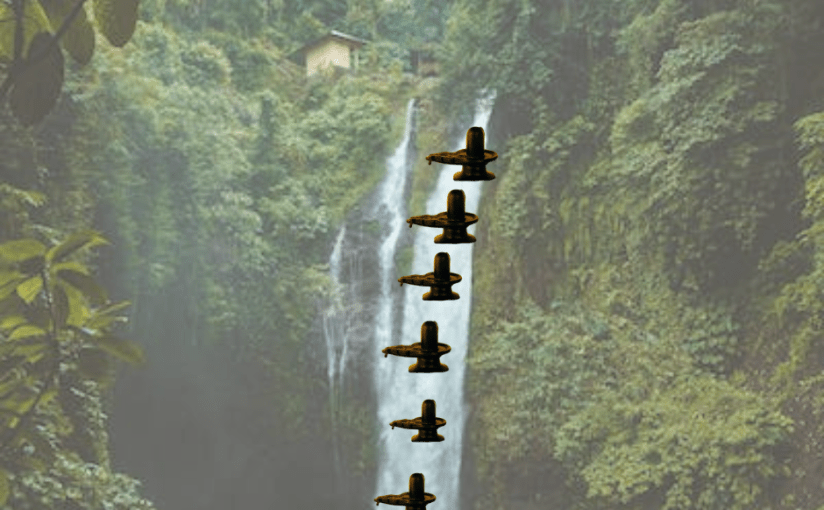
Kundalini Yoga powered Ganges flow irrigates the chakras in the form of Shivlinga

Famous legend of Atri-Anasuya

The story of Anasuya comes in Shivpuran. Anasuya means one who does not criticize or condemn anyone. Once there was a great famine. There was shortage of water everywhere. People and animals started dying due to thirst. Saints cannot see the sufferings of the world. Therefore, Sage Atri started doing penance for water. His disciples also left him. Only Anasuya continued to serve her husband and worshiped the Shivling everyday. One day Atri asked for water. Anasuya took the kamandal that’s sacred handheld pitcher and started searching for water. On the way she met Ganga. Ganga was pleased with Anasuya’s devotion to her husband. Anasuya asked for water from Ganga. Ganga asked her to dig a pit. That pit became filled with water. Anasuya went away with water. He gave water to Atri. Atri said that it was not like everyday drinking water. Anasuya told the whole story. She took Atri to that pit. Both of them took bath in it and drank it. All the people were satisfied with that. When Ganga started leaving, Anasuya prayed to her to stay there forever. Ganga in return demanded from her the fruit of her one year’s husband’s service and worship of Shiva. Ganga said that she likes husband service the most. When Anasuya gave it, Ganga settled there. Along with this, Shiva also sat there forever in the form of Atrishwar Linga.

the explanation for mythological story

Atri is a living soul. Atri literally means devoid of all three qualities or gunas. Only the soul is like this. Anasuya is intelligence or intellect. Intelligence does not condemn anyone, because it wants everyone to get its work done. Only a useless mind condemns. Intelligence is like a devoted wife to her husband as soul. She serves the living being soul in every way, along with worshiping Lord Shiva. An idle mind does nothing. Actually work is done by intellect, and work itself has been called worship. Work is the worship of Shivling because the world is made up of a combination of Purush meaning Shiva and Prakriti meaning Shakti. The body itself is that drought-stricken country. All the cells of the body are its people and creatures. They were thirsty means deprived of water in the form of energy. Energy flows like water. Intellect used to provide the soul in the form of Rishi Atri with enough energy or simple water for living. But the whole body country could not survive well with it. That’s why sage does penance i.e. Kundalini Yogasadhana for extra energy. One day, on asking for Shakti-jal by Rishi-jiva, Anasuya-buddhi started wandering all over the body in search of it. By the grace of Shivling, she felt the sexual based Kundalini Shakti i.e. Ganga around Muladhar. She inspired the prana of the body i.e. the workers of Dahdesh or body-country to make a pit there i.e. to press Muladhara with the heel in Siddhasana or to make a sensory pit in the front Manipur Chakra by yogasanas, massages etc. It seems to me that this pit is the deep pit above the base of the back or the hip bone prominence. At the time of massage, by pressing hard with the base of the straight palm and slowly sliding upwards, a sharp and blissful sensation is felt, which starts climbing upwards in the spinal cord. It seems to be directly related to the real or textual Mooladhara, because Mooladhara is also often referred to as the pit. Massage should not be done in the spine with the force of fingers, because there can be a fear of damage like injury to the delicate bone. Divine water was filled there, which means there was a feeling of blissful energy. She fed that water to the sage means the soul felt that sensation. The soul found it different and divine from other days because sexual pleasure was also mixed in it. Both of them took bath in it, which means that it climbed up from the coccyx to the brain, due to which both of them got refreshed along with the whole body. Both the intellect and the soul reside in the brain and are connected to each other, so they feel everything together. It can also be taken in another way that a tantric couple is consuming energy together in Yabyum posture. All living beings were satisfied after drinking water, which means all the cells of the body were refreshed and recharged with energy. Ganga liked Anasuya’s chastity. Surely she must have taken hes test, only then came to know. Nowadays there are many examiners of the religion of chastity. For women going to office or work, various men peeping at them and talking to them with love-filled obscenities, being in the mood to misbehave with them, etc. is their test. There will be no exam while sitting inside the house. The meaning is clear that stay with everyone but serve your husband only. Ganga asked Anasuya for a year’s good deeds in exchange for permanently settling there, which means that Sushumna can be permanently awakened by one year’s Tantric Yogasadhana and Shivling worship. There the Atriswar Linga was also established permanently. To me it seems to be the awakened Muladhar Chakra. Chakras are in the form of lingas, because the same sensation as linga-based is experienced there. Twelve Jyotirlingas are twelve chakras only. The light is created there by the shining of the meditation picture. That meditation picture can be the form of Shiva, Guru, lover etc. According to Shivpuran, there are many lingas and upalingas, but these twelve Jyotirlingas are the main ones. Other lingas are called sub or upa lingas only, not Jyotirlingas, because the brightness of the Kundalini picture is felt only on the chakras. By the way, every cell of the body can be called a linga, because they become active only when Ganges water in the form of energy falls on them. As far as the Kundalini Shakti in the form of Ganga reaches to bathe, there is linga’s presence. Anyway, cerebrospinal fluid flows in the spinal cord, which is just like water. Many scientists claim that energy flows in the same way as the flow of a fluid. Although at the time of Sushumna awakening, energy flows in the form of sensationally bright line. It is possible that flow can occur in both ways, especially in the common and simple energy flow, the contribution of fluid flow is more. From this story it seems that any sage discovered Kundalini Shakti and realized it, which he told in the form of a myth rather than telling it directly.

Kundalini Yoga is important for environmental protection

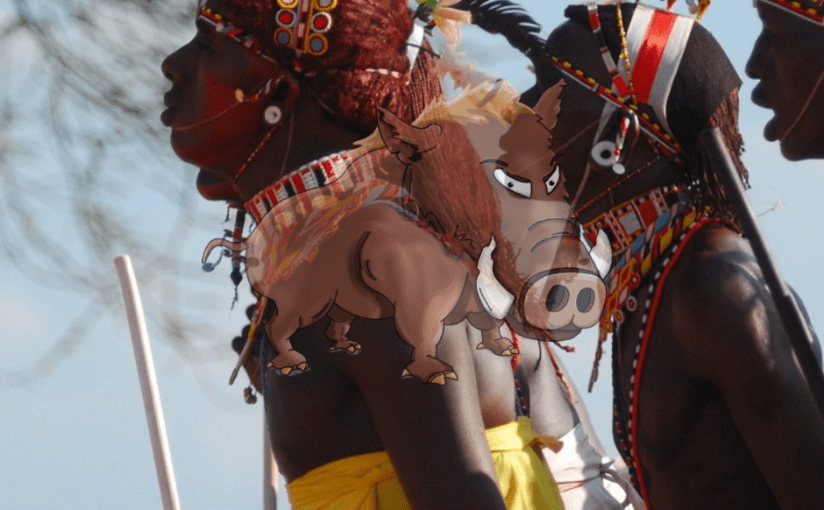
When Arjun was doing penance to Lord Shiva for the Pashupat weapon, a demon named Mook sent by Duryodhana came there in the form of a pig. He was going through the same route where Arjun was, breaking the peaks of the mountains, uprooting many trees and shouting various types of meaningless words. Seeing him, Arjun started remembering Shiva. Shiva came in the form of Bhilraj or jungle tribe’s king to kill him. That boar between Arjuna and Shiva looked like a wonderful peak. Both of them fired arrows together. Lord Shiva’s arrow entered the tail, came out of its mouth and soon disappeared into the earth. Arjun’s arrow (probably after entering the mouth) came out of its tail and fell on the ground in the side. The pig fell down dead at that very moment.

Explanation of the above myth

Duryodhana means ego makes Arjun’s Karmayogi soul do so much work that his Ida and Pingala nadis become active, meaning Arjun’s body itself becomes like a pig. The mooladhara itself is its tail. Ida and Pingala are the two sharp teeth on its sides. The diverse thoughts of the wandering mind in the duality-forest are its face. Only the wandering mind can break the mountains, not the body. The Mook name is Hindi word for dumb. Because the wandering mind never tells a man that he is his enemy and has come to fight with him, but keeps on attacking by deceit, that is why it is called dumb demon. Just as the mind feels like a mountain between the soul and the Supreme Soul, similarly it was feeling like a pig. Due to the alternate activation of Ida and Pingala nadis, a person becomes so active as if he is ready to break a mountain. When Ida is activated, he does the work of the world in a frenzy, and when Pingala is activated, he falls asleep. After waking up from sleep and so getting refreshed, again starts running to do sinful deeds like looting and hunting. He oscillates between this duality of darkness and light, and does not see the equanimity or non-duality of the sushumna nadi between them. The color of the Indian wild boar is also a mixture of black and brown, indicating the duality. Filled with stupidity like an animal, he keeps on doing bad and environmental-killing work. Nowadays man is like this. There is no brake on activity. He is hitting his head everywhere like a blind man. Hollowing out the ground. The forests are being destroyed. After polluting the air, land and water, he is roaming in it with joy and fun. All these are characteristics of a pig. Shiva inserted an arrow through its tail, which means Shiva caused activation of the sushumna channel through mooladhara. Actually, this is what happens by meditating and worshiping Shivalinga. That arrow came out of his mouth i.e. Sahasrar Chakra and merged into the body through the front channel called as getting lost in the earth.
Arjun was anyway meditating and worshiping Shivalinga. It is natural that his Sushumna became active. This Brahmashir arrow emerges out of the Brahmarandhra. The whole body of the pig is the face. It can also be understood that the arrow turned down and merged into the agya chakra. From there it reaches the mouth, through the secretions of the palate. There that secretion goes into the land, that is, the stomach, and there it is spent or merged in the form of energy in digesting food. Just as food is made in the soil, similarly it is made in the stomach too, of course in the form of light and broken micro pieces to be absorbed by the body.
By touching the tongue with the palate, Arjun brought down the energy of the brain through the front channel. Due to this, that previously ascended power went back to Muladhar down. That which is meditated by Arjuna by his will inside the brain, is the arrow released by Arjuna. It comes from top to bottom through the front channel. Suppose that Shaktibaan or energy arrow reached the Muladhar and came out and fell on the ground in the lateral part. But how did it fall out? There is a possibility that Shakti fell out in the form of semen. But why did Arjun have to run out to get it. By the way, great things are done with the power of semen, big industries and businesses run, and material prosperity spreads all around. Perhaps Arjun ran here and there to collect them, calling them his own. There is also a possibility that Shakti came in the form of semen to the Vajra tip, which Arjuna tried to pull back up through the yoga. But how did it fall to the ground? It may have fallen in the vagina, which is being pulled back through Vajroli Mudra. But Shivganas should not have objected in this, because it is a personal matter. Shivgan said that the pig was killed by Shiva’s arrow and it is the arrow of Shiva that fell to the ground. In fact, due to the effect of Shivlingam, the power of Mooladhar itself was going up to Sahasrar and then turning and coming down through the front channel. Arjuna thought that he created that power by meditating in his mind, but in reality he was able to meditate in the mind only by the power of the Shakti coming up from Muladhara, not by his self-power or will. With the awakening of Muladhara Chakra, Sushumna was activated, due to which Ida and Pingala became like inactive. Means the pig in the form of ignorance had died and also the mischief caused by ignorance alongwith. Arjuna leaving the shelter of Shivling forced to do so by his ego or not giving credit to Shivling for killing the ignorance form pig is his fighting with Shiva form Bhilraj. In the end, he has to understand the greatness of Shivling through his defeat by Bhilraj. The Shaktibaan that fell on the side of Arjuna could be in any form of food, grass, flower etc., which he had grown by walking with his legs. Energy descends mainly from the mooladhara to the legs. And Muladhar got power from Shivling. That’s why Shivgan was asserting his rights on them. The animals, birds and insects that eat food grains, grass, leaves, flowers etc. are Shivagana, who are dependent on the cooperation of man for their life.
Arjuna said that the arrow was painted with back lines and his name was inscribed on it. We can call the lines the ridges of the ribs situated transversely on the front channel, which are at its beginning. We can say that the name is engraved in the form of heart chakra, because in it the whole attitude of a man, meaning his identity, is hidden. Arrogant man would have fought only with God, to collect his wealth. God keeps on punishing him for that selfishness. This is the fight between Shiva and Arjuna which reaches to the wrestling match. Then a time comes when man rubs his head in the temple of God to fulfill his selfishness. This is the same part of the story, in which Arjuna grabs Shiva by his feet and tries to throw him around, but at the same time, pleased with his feet being held, Shiva reverts to his real form and gives him the Pashupat weapon as a boon. It is like when a man goes to the temple of God with any sense and attains good wisdom, and unknowingly obtains the boon of being saved from calamity. Pashupat Astra means Shiva had explained to him through the above incident that only Mooladhar can control Shakti well, not Sahasrara or brain. With this understanding, he calmed the irritation of the brain caused by the Brahmastra shot by Ashwatthama.
This phenomenon can be understood more clearly in the following way. Arjuna fought with Shiva in the form of Bhil for many years, first with arrows and then with wrestling. Actually such a war can happen only between ego and truth, because two persons cannot fight continuously for years. Ego first spends all the equipments and all the prosperity of its life in denying the God. God destroys them one by one so that man can improve. Of course he destroys them in his mind in the form of boredom with them, not in the outer physical form. In the end, when nothing is left, man fights with the Lord with the help of the memories and desires of those material achievements within him, that means he maintains his existence separate from the divine. If any member of the family leaves the house, he will go after fighting, not by hugging with love. Sanskrit word Vasna seems to be derived from the Punjabi word vashana or vice versa, which means smell. All the joy is in the smell. When there is no sense of smell due to cold etc., then food does not taste tasty at all. You must have noticed that sometimes an old memory comes to mind with great pleasure. It seems that the pleasure which might not have occurred even at the time of that actual physical event, comes in a very vague memory. This is the lust or smell of that event. It is just like the fragrance of a perfume. Perhaps this is the most subtle form of the world which is also called Tanmatra. If such smells of past events or the past world are coming, then understand that the Yogi is situated at a high stage of spiritual practice and his worldly waste is getting purified and merging into the soul. Soon he may even get a glimpse of awakening. When the last weapon of Vasana is destroyed, then one starts drowning in darkness, which is also called the Dark Night of the Soul. Then he goes to the temple of Lord Shiva to defeat him, which means he grabs Shiva’s feet to throw him away. It is like a man going to a temple to seek material prosperity. Then God becomes pleased and reveals His true form before him, due to which he accepts defeat at that very moment. The darkness of ego cannot stand in front of the light of God. Maybe this is awakening.

Kundalini help is sought out even by gods to succeed

Well, continuing with the previous post, that is why the branch of Tantra in Buddhism is named Vajrayana. That is why the name Premyogi Vajra has also been given. Basically, there is Premyoga in his practice, but Tantra also has a good contribution in it. The deities fought with Vritrasura for a long time. But they could not defeat him. In the end, accepting defeat, they left their weapons near Dadhichi Muni’s hermitage and ran away. It means that the gods put many organs like hands, feet, eyes, ears, brain etc. in the man’s body to avoid the thoughts of sorrows. Earlier man was a unicellular organism like a virus. It was a state full of sorrow. To remove that sorrow, the gods developed that primary creature for many ages. In the end, the human body became existant. Where did the sorrows end even after so much hard work? On the contrary, it started growing. Today, the more progress science is making, the more tampering with nature is increasing, due to which the devastation of life and property is also increasing. Natural disasters are increasing. Crimes like murder, robbery etc. are increasing. The main five defects of the mind, lust, anger, greed, attachment, pride, jealousy and the innumerable mental disorders arising from them such as depression, loneliness, violence, selfishness etc. are on the rise. Means Vritrasur attacked him in the form of a mountain of sorrows as ego. The gods were forced to raise their hands. Dadhichi Muni here called is the soul. Near his hermitage, the gods left their weapons, meaning they created all the parts of the body, because the body is closest to the soul. The gods accepted defeat, meaning that the supreme sorrow or enemy of the mind in the form of ego could never be destroyed by the power of senses and organs, it was completely proved, minor physical and mental sorrows would have definitely gone away. This supreme sorrow was the demon Vritrasur. Due to the boon of Shiva, the bones of Dadhichi Muni had become like a thunderbolt. It means that due to Shiva provided Yoga, there was so much elasticity and liveliness in the bones, especially in the spinal cord, that the Kundalini energy could easily flow in it. Just see the lightning. It breaks even the hard rock, and along with it electricity also flows in it. Similarly, the movement of the luminous energy line in the sushumna nadi of the spinal cord is like a lightning strike, and the destruction of the ego by it is like the breaking of a rock. Ego is the hardest thing in the world, which is the most difficult to break.
It is said that sage Dadhichi also had a wife named Suvarcha. When the deities went to Brahma seeking help, it was he who advised them to ask for the bones from Dadhichi. Suvarcha was in the inner chamber, and the deities demanded his bones from Dadhichi, who was sitting in the outer chamber. Dadhichi left the body after applying Yogasamadhi and he merged into Brahman. When Suvarcha found out she became very angry, and cursed the gods. Suvarcha was pregnant at that time. With the semen power of the sage, she got a son as great as another Shiva. His name was Pippalad. Brahma is the original creator of the universe. He knows that the gods may exert as much force as they like, but they cannot remove spiritual ignorance. He also knew that when the Kundalini is awakened by the energy flow in the Sushumna located in the spine of the Yogi, it can be destroyed. With awakening, not only will ignorance disappear, the ego will also vanish. Ego is the form of man’s own ordinary worldly experience. When there is no ego, then how can a human being exist. It is said that Dadhichi Muni himself left his body and went away. Actually the ego has already ended before awakening. Only then there is an experience of awakening. How can one experience awakening if there is even an iota of ego, because both are diametrically opposite to each other. When the yogi’s ego is destroyed by tantric yoga practice, then only the real awakening begins. Due to the elimination of ego, the worldly garbage in the mind of the yogi also remains to a minimum, due to which sufficient nervine power is available for the awakening of the Kundalini. Suvarcha, the wife of Rishi Dadhichi, is actually Buddhi or intellect. The destruction of the ego leads to the transformation of man. Through this, old thoughts and memories become destroyed like a roasted seed. but that luminous intelligence or good sense remains, which puts one on a good path. Old experiences are also remembered. The Sanskrit word varchas means shining. She cursed the gods, which means that the body does not act arbitrarily under the control of the gods, but behaves rationally under the guidance of good sense. After the transformation of a man, his new, awakened and godlike state comes, he is called son Pippalad. That state has a tantric nature like Rudra i.e. Shiva, that is why he is called Rudravatar.

Kundalini Shakti kills the demon Vritrasur by becoming Indra-Vajra

Friends, in the previous post we have seen how the worldly intelligence in the form of Shukracharya wants to deprive the soul as King Bali from awakening. Very beautiful story. One such yoga-mystical story of Vritrasura killing comes in the Puranas. The gods made a thunderbolt from the bones of Dadhichi Rishi to kill the demon Vritrasura. The word Vritra seems to be derived from the word Vritti. It means the thoughts of the mind. There are thoughts in the mind or chitta. Chitta means the collection of thoughts that happened physically earlier, and are now stored in memory. That’s why remembering is also called coming to mind or coming Cheta. Only Kundalini awakening can weaken or paralyze them. It seems that Kundalini awakening can be achieved only when Sushumna located in the spinal cord is activated, otherwise not. Vritrasura died due to thunderbolt, which means Kundalini was awakened only because of the awakening of Sushumna in the spinal cord. It is said that along with the thunderbolt, Vishwakarma also made an arrow. The shape of Vajra has been called Dandavat or cylindrical. The spinal cord is also a bit cylindrical. The name of the arrow is Brahmashir, meaning it goes up to Brahmarandhra, which is at the top of the head that’s the opening of sahasrar chakra. This arrow is the Sushumna Nadi. Vishwakarma had made many other weapons from the bones of Dadhichi Rishi. Meaning that Yogasanas are possible only with the help of bones. Different joints of bones help us to perform different postures. Then energy is transmitted in the body through those asanas, which helps in awakening the power. That Vritrasura used to trouble all the gods. This means that the body’s metabolism gets disturbed due to restlessness of the mind, and various diseases enter it. The body is made of gods only. The literal meaning of Vishwakarma is, the doer of all the work of the world, means the creator of the world. The whole world resides in the body only. It is said in the story that the Vajra and the arrow named Brahmashir were made from the bones of the spine. It is also said that Indra called Surbhi cow and made her lick the bones and then ordered Vishwakarma to make vajra from them. Indra, enhanced by the effulgence of Lord Shiva, picked up that thunderbolt and ran furiously at Vritrasura, as if Rudra was running towards Yama. After this, that Indra, being well prepared, quickly cut off Vritrasura’s head like a mountain peak with that thunderbolt. This is figurative language. With the glory of Shiva, it means with the help of Tantra, because Shiva is the originator of Tantra. This is the description of the energetic state of Kundalini awakening. Because the thoughts of the mind are born in the head, that is why it is said to behead Vritrasura. This story continues in the next post as well.

When all the gods work together, it is said that Indra did that work, because Indra is the king of the gods. Kundalini Yoga is accomplished only by the combined efforts of all the parts of the body, that is, all the deities. That is why it is said that Indra killed Vritrasura. I think khechari mudra is said as licking by surabhi cow, in which the opposite surface of tongue is touched with the soft palate. Because the head is directly connected with the spinal cord, hence it is a part of Vajra. Due to this the energy circulates easily in the channel loop. After that Vajra manufacturing starts, that means energy starts running in the spinal cord.

Vishwakarma made it, means it is made automatically by scientific principle, no man makes it. All you have to do is create favorable conditions for being itself. The world is also created by itself. The name of Vishwakarma has been given to decorate this very being.