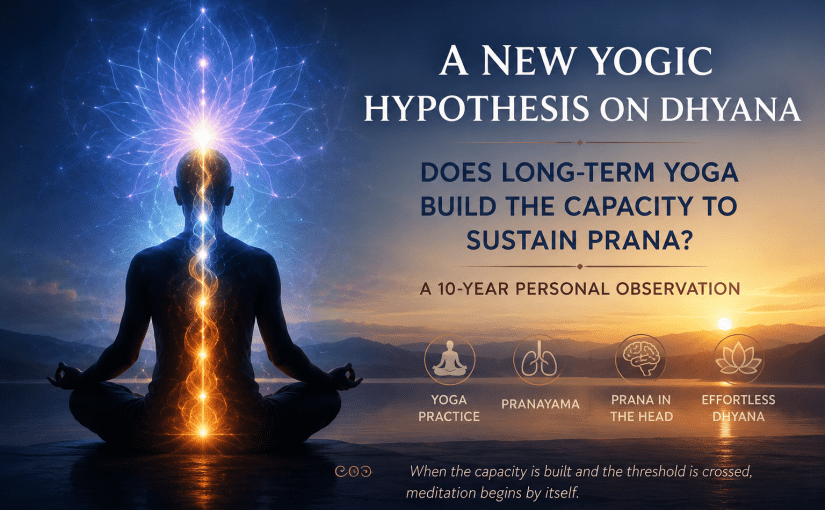
A New Yogic Hypothesis on Dhyana: Does Long-Term Yoga Gradually Build the Capacity to Sustain Prana? A 10-Year Personal Observation

Why Does Dhyana Become Effortless After Years of Yoga?

For nearly ten years, I have practised yogasanas, pranayama and meditation almost daily. Like many beginners, I initially struggled to enter dhyana. Simply sitting quietly did not naturally produce meditation. Sometimes there were thoughts, sometimes restlessness and sometimes only sleep. Over the years, however, I began noticing a remarkably consistent pattern that gradually changed my understanding of meditation.

I repeatedly observed that effortless dhyana was usually preceded by a gentle, pleasant feeling of fullness in the head. It was not an ordinary headache or painful pressure. Rather, it felt stable, comfortable and blissful. Whenever this fullness reached a certain level, merely sitting with light awareness of the breath became sufficient for meditation to arise almost automatically. It felt less like I was practising meditation and more like meditation itself was beginning.

I do not present this as scientific proof but as a long-term yogic observation based on repeated personal experience.

Yoga Appears to Prepare the Ground for Meditation

Recently, after several days of travel, I could not perform my usual yoga because of lack of time. My body became slightly less flexible, the internal flow experienced during practice seemed somewhat obstructed and meditation no longer settled naturally. When I resumed yogasanas and pranayama, even though I performed them quickly before leaving for office, the pleasant fullness returned and dhyana began almost unwillingly near the end of practice. I had to deliberately stop after about twenty to thirty minutes only because I was getting late for office. Otherwise it appeared capable of continuing much longer.

This experience strengthened an observation I had already made many times. Yoga itself does not seem to create meditation directly. Rather, it appears to prepare the internal conditions in which meditation naturally arises.

The Role of Head Fullness

Initially I called this experience head pressure, but later I realised that “fullness” described it more accurately because the feeling was pleasant rather than painful. Gradually another possibility occurred to me. Perhaps what I experience as head fullness is actually concentrated prana. From the traditional yogic perspective this interpretation seems reasonable. Science cannot presently measure prana directly, but yoga has always emphasised disciplined experience as an important means of understanding consciousness.

One important observation is that meditation does not require maximum fullness. There appears to be a threshold. Below that threshold, meditation struggles to settle. Once it is reached, dhyana begins effortlessly. Beyond that, increasing the sensation further does not appear necessary.

Mental Work Produces It More Than Physical Work

Another surprising observation concerns daily work. Physical work rarely produces this state, whereas prolonged intellectual work often does. Thinking, planning and sustained mental effort increase the feeling of fullness in the head far more than physical labour. Although physical work also produces it however it should be with baseline nonduality so that head fullness can develop.

However, this happens only if morning yoga has already prepared the body. In that case, intellectual work often pushes the system beyond the threshold where meditation naturally begins. Merely sitting quietly with gentle attention to the breath produces brief thoughtlessness, witnessing and calm.

Without morning yoga, the same intellectual work usually produces only tiredness or sleep rather than meditation. This suggests that mental work alone is insufficient. Yoga appears to create the necessary preparation.

Worldly Stress and the Natural Tendency Towards Meditation

I also observed that demanding worldly work sometimes creates a similar tendency. After yoga, sustained mental activity often reaches a point where I no longer feel capable of continuing intense intellectual work. Instead, there is a natural inward movement. The mind wants to become silent. Meditation seems to relieve this accumulated burden. Unfortunately, many times office work and social responsibilities rarely provide enough quiet time, so the resulting meditation remains shallow and short-lived. Only brief witnessing and reduction of thoughts occur before duties interrupt the process.

A New Working Hypothesis

These observations gradually led me to a new hypothesis. Perhaps one of the deeper purposes of long-term yoga is to gradually develop the body’s ability to comfortably sustain increasingly refined pranic activity in the head. Early in practice, even a comparatively small amount of this activity may feel intense. Years of yogasanas and pranayama appear to increase the comfortable capacity to sustain it. Once this capacity and the level of pranic concentration reach a certain threshold, dhyana begins almost spontaneously.

This may also explain why beginners struggle with meditation. The difficulty may not lie only in controlling thoughts. The necessary internal preparation may simply require years of regular practice.

Patanjali, the Bhagavad Gita and Long-Term Practice

This understanding also gives new meaning to the repeated emphasis on abhyasa in the classical yoga tradition. Patanjali teaches that the fluctuations of the mind are restrained through persistent practice and dispassion. Likewise, in the Bhagavad Gita, Krishna acknowledges that the mind is difficult to control but teaches that it becomes manageable through practice and detachment. Various yogic traditions also associate steadiness of mind with regulation of prana.

My proposal is not that these scriptures explicitly describe “prana accumulation in the head.” Rather, my own experiences seem to resonate with their emphasis on long-term disciplined practice as the foundation of meditation.

An Invitation for Further Observation

Everything described here arises from approximately ten years of regular yoga practice. It is neither a scientific claim nor an attempt to establish a universal law. It is a working yogic hypothesis based upon repeated experience.

The central question is simple: Could long-term yoga gradually increase the comfortable capacity to sustain what practitioners experience as concentrated prana in the head, allowing effortless dhyana to arise naturally once a certain threshold is reached?

I cannot answer this question for everyone. I can only say that this pattern has repeated itself consistently throughout my own journey. If other sincere practitioners begin carefully observing what actually happens before effortless meditation arises, they may confirm, modify or reject this hypothesis through their own direct experience. Yoga has always advanced through sincere practice, careful observation and inner verification. Perhaps this question deserves deeper attention from practitioners, philosophers, neuroscientists and consciousness researchers alike.
The Hidden Meaning of the Bells on the Door: Trust, Love, Tantra, Kundalini, and the Sound of Inner Awakening

A Simple Act of Hospitality That Revealed an Entire Spiritual Journey

Some experiences enter our lives quietly, almost unnoticed, yet within a few hours they begin revealing meanings far deeper than the event itself. They remind us that life often speaks through ordinary objects long before we understand its language. One such experience has remained with me ever since.

My old friend recently accommodated me in a room whose doorway was beautifully decorated with hanging bells. The room appeared to contain valuable belongings, yet he welcomed me with complete openness, leaving no trace of suspicion or hesitation. His gesture was not merely one of hospitality. It was an expression of trust. At that moment I simply appreciated his warmth, but within hours something extraordinary happened. The room remained the same, the bells remained the same, and the host remained the same. Only my perception changed. Suddenly, everything around me began revealing another dimension. What had seemed like a pleasant memory quietly transformed into a living lesson in Tantra, Kundalini, and consciousness.

The Greatest Treasure Was Never Inside the Room

Most people would naturally think that the valuables inside the room were its expensive possessions. Today I see the situation very differently. Whether costly objects were actually present or not has become almost irrelevant. The greatest wealth in that room was not material. It was the priceless trust with which another human being opened the door of both his room and his heart. Material possessions may have a market value, but trust has no price. The willingness to leave another person alone among one’s belongings without fear is itself a priceless gift. That invisible treasure remained with me long after I had forgotten every physical detail of the room.

The Bells Could Tell Many Different Stories

Those small bells hanging on the doorway gradually became the center of my contemplation. At first they appeared to be nothing more than attractive decorations. Then my mind smiled at another possibility. One could humorously imagine them as the simplest security system ever invented. Every time the guest entered or left the room, the bells faithfully announced his movements. If the guest quietly decided to leave carrying expensive belongings inside his bag, the bells would probably reveal the secret before anyone else could. The thought itself was amusing, but it lasted only for a moment because another interpretation appeared almost immediately.

Perhaps those bells had nothing to do with suspicion at all. Perhaps they simply informed the host that his guest had awakened, stepped outside, or returned safely. Every gentle chime gave him another opportunity to ask whether I had eaten, whether I needed tea, whether I was comfortable, or whether anything else could make my stay more pleasant. The same bells that one person might interpret as surveillance could equally be understood as expressions of care. The object never changes. Consciousness changes. A suspicious mind discovers suspicion. A humorous mind discovers comedy. A loving mind discovers affection. A spiritual seeker discovers symbols.

When Decorative Bells Became the Ghanta

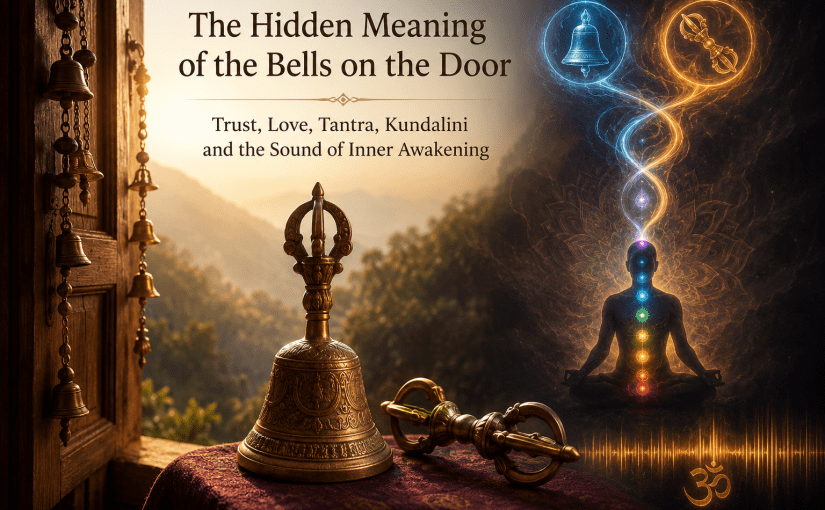
Within only a few hours another realization unfolded. Those bells were no longer merely decorative ornaments hanging from a doorway. They had become the Ghanta of Tantra. The moment Ghanta appeared within my contemplation, another symbol naturally emerged beside it—the Vajra. Suddenly the memory of that room connected itself with my own spiritual journey. What had begun as ordinary hospitality quietly transformed into a profound tantric metaphor.

Trust, Love, and Surrender Form the First Tantric Union

As I reflected more deeply, I realized that no authentic tantric journey begins merely with physical union. Before the body can unite meaningfully, something much deeper must unite first. Trust opens the first door. Love opens the second. Surrender opens the third. Only when trust becomes complete, love becomes unconditional, and surrender becomes effortless does the true tantric pair begin to emerge. It is this invisible union that prepares the ground for authentic tantric meditation. Without these foundations, outer union remains only physical. With them, the same union gradually becomes spiritual.

When Vajra Meets the Bell

The symbolism now became remarkably clear to me. The receptive Bell remains silent by itself. The phallic Vajra, representing the masculine principle, likewise remains silent alone. Only in their symbolic union does the Bell begin to ring. Only when Vajra and Bell unite does resonance begin. Yet this ringing is not immediate. Just as genuine spiritual awakening cannot be forced, neither does the symbolic bell begin ringing at the very first meeting. It is prolonged practice, deepening trust, maturing love, complete surrender, disciplined meditation, and inner purification that gradually awaken the resonance. The true ringing does not arise from metal striking metal. It arises from consciousness entering its own deeper dimensions.

The Ringing That Cannot Be Heard by the Ears

The longer I contemplated this symbolism, the more clearly I understood that the ringing of the Bell was never merely an external sound. It represented the subtle inner resonance that gradually becomes perceptible during sustained tantric and yogic practice. This is the beginning of the unstruck sound, the Anāhata Nāda. It is not produced by external impact but arises spontaneously within consciousness itself. As this subtle current deepens, the practitioner gradually becomes aware of an entirely different dimension of meditation.

The Awakening of Kundalini

In my own experience, sacred sexual union became the doorway through which this inner journey began. It was never merely an act of physical intimacy. It became the catalyst for awakening. Through prolonged tantric practice, the symbolic union of Vajra and Bell gradually expressed itself as an inner current flowing through the Sushumnā Nāḍī. As this subtle flow strengthened, Kundalini awakened. With that awakening came the direct recognition of the Self. For me, self-realization was not the conclusion of the journey but the beginning of a far greater one.

Beyond Self-Realization

The journey did not end with Kundalini awakening. Continued practice under the necessary inner conditions gradually revealed deeper stages of yogic experience. The natural suspension of breath known as Kevala Kumbhaka emerged spontaneously rather than through force. As meditation matured further, consciousness appeared to move beyond even this into a state that I can only describe as the profound silence traditionally associated with Nirvikalpa Samadhi. The experience was extremely brief, occurring only a few times, and so subtle that I still remain uncertain whether it was truly Nirvikalpa Samadhi or only a fleeting glimpse of that state. Whatever it was, it left a deep and lasting impression on my spiritual journey. These stages unfolded as living experiences rather than philosophical concepts. They taught me that the path of Tantra extends far beyond its outer forms. What begins as love and surrender gradually becomes meditation. Meditation becomes awakening. Awakening becomes silence. Silence finally becomes the direct experience of limitless consciousness.

The Hidden Meaning of the Bells

Today, whenever I remember those bells, I no longer see only decorations hanging from a doorway. I see trust becoming love, love becoming surrender, surrender becoming tantric meditation, meditation becoming the symbolic union of Vajra and Bell, that union gradually giving birth to the subtle resonance of the Anāhata Nāda, the current ascending through the Sushumnā, Kundalini awakening into Self-realization, and the continuing journey toward Kevala Kumbhaka and Nirvikalpa Samadhi. Yet none of these deeper meanings erase the outer event. The room was still a room. The host was still a gracious host. The bells were still ordinary bells. They simply became mirrors reflecting increasingly deeper layers of consciousness.

Perhaps this is how hidden meanings always reveal themselves. Life first offers us an experience. Understanding follows. A simple act of hospitality becomes a lesson in trust. Trust blossoms into love. Love matures into surrender. Surrender opens the gateway to Tantra. Tantra awakens meditation. Meditation gives voice to the silent Bell. The Bell begins to ring within. The ringing becomes the subtle current of the Sushumnā. The current awakens Kundalini. Kundalini reveals the Self. Continued practice carries consciousness beyond breath into Kevala Kumbhaka and ultimately into Nirvikalpa Samadhi. The bells hanging on that doorway have long since fallen silent in the outer world, yet within me their resonance continues even today, reminding me that the deepest spiritual teachings often arrive disguised as the simplest moments of ordinary life.

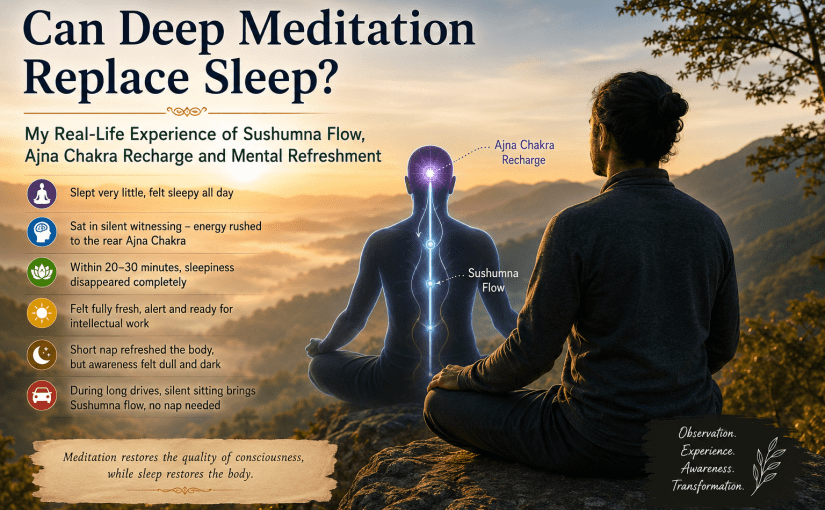
Can Deep Meditation Replace Sleep? My Real-Life Experience of Sushumna Flow, Ajna Chakra Recharge and Mental Refreshment

There are some experiences in meditation that are difficult to explain unless they happen repeatedly. They are not conclusions drawn from books but observations made quietly over time. Recently I had one such experience that made me think deeply about the relationship between meditation, sleep, awareness and inner energy.

One night I slept very little. The next day I remained sleepy almost throughout the day. Normally such sleep deprivation reduces concentration, mental sharpness and enthusiasm for work. However, whenever I sat quietly for meditation without making any effort, something remarkable happened. As soon as the mind became peaceful and settled into simple witnessing, I repeatedly felt a strong movement of energy towards the rear region of the Ajna Chakra. It did not feel imaginary. It was as if the back portion of the brain was being recharged from within.

Within about thirty minutes the sleepiness disappeared completely. Instead of feeling dull after a sleepless night, I became mentally fresh, alert and ready for intellectual work. It felt almost as though a new day had just begun. This happened more than once during the day and naturally raised a question in my mind. If meditation can refresh the brain so completely, is ordinary sleep always necessary? Can Sushumna flow and Ajna Chakra recharge become an alternative to sleep?

This question deserves careful thinking because the experience itself was genuine. Deep meditation seemed to restore mental clarity in a way that ordinary relaxation never could. During meditation my awareness became clean, bright and steady. There was no heaviness, no mental fog and no struggle to remain awake. The state felt more than ordinary wakefulness. It carried a quality of heightened self-awareness that is difficult to describe in words.

From the yogic point of view, such an experience can be understood as prana gradually withdrawing from scattered mental activity and becoming concentrated in the central channel. Many traditions describe that when prana begins to move through Sushumna, the mind naturally becomes quiet, inner awareness brightens and much less energy is wasted through constant thinking and sensory activity. The practitioner often feels inwardly nourished, refreshed and mentally light. My experience appeared to fit this description remarkably well.

At the same time, modern neuroscience also offers useful insight. Deep meditation activates relaxation mechanisms within the nervous system, reduces unnecessary mental activity and can restore attention after fatigue. This may explain why meditation can remove the feeling of sleepiness and greatly improve mental performance. However, science also reminds us that sleep performs important biological functions such as memory consolidation, tissue repair, hormonal regulation, immune support and the clearance of metabolic waste from the brain. Therefore, meditation and sleep may overlap in some benefits while still serving different purposes.

As I continued observing this phenomenon, another experience taught me an equally valuable lesson. After several cycles of becoming refreshed through meditation, I decided to lie down in Tribhangmurari Asana for further meditation. My intention was not to sleep but simply to continue witnessing in a relaxed posture. However, despite my efforts, I drifted into a short nap. After some time rising stomach acid woke me because of my tendency towards acid reflux.

The result surprised me even more than the earlier meditation. Physically I felt refreshed after the short sleep, but mentally I did not experience the same crystal-clear awareness that meditation had produced. Instead, I felt somewhat dull, dark and heavy. The body seemed rested, but the luminous self-awareness that had accompanied meditation was missing.

This comparison became very meaningful. Meditation had produced extraordinary clarity of consciousness, whereas the interrupted nap restored the body but not the same quality of awareness. It appeared that the two experiences were serving different functions.

One possible explanation is that deep meditation maintained a continuous stream of awareness while energy remained concentrated inwardly. The short sleep interrupted that continuity. On waking suddenly because of acid reflux, I may also have experienced ordinary sleep inertia, the temporary grogginess that often follows abrupt awakening from deeper stages of sleep. This could explain why I felt physically refreshed yet mentally less clear.

From the yogic perspective, another possibility is that meditation had organized the flow of prana in a stable manner, while unconscious sleep temporarily dissolved that organized state. Whatever the exact explanation may be, the contrast between the two states was unmistakable. Meditation refreshed consciousness itself, whereas the nap refreshed the body but not the same level of awareness.

Naturally I felt a little disappointed. I had hoped that meditation would continue providing complete refreshment without any need for sleep. I wanted sleepless meditative renewal to continue indefinitely. Yet the involuntary nap suggested that although the mind had repeatedly become fresh through meditation, the body still carried a physiological need for sleep after the previous night’s deprivation.

This realization itself became another lesson. Perhaps advanced meditation should not be judged by whether it eliminates sleep altogether. Many classical yogic traditions describe great practitioners gradually requiring less sleep, but they also suggest that this happens naturally rather than through deliberate effort. Reduced sleep is presented as a consequence of transformation, not as a goal to be forced. Chasing sleeplessness may therefore become a distraction from the deeper purpose of meditation, which is the refinement of awareness itself.

Another observation from daily life strengthened my understanding further. During long-distance driving, if I begin feeling sleepy, I never continue driving carelessly. Instead, I safely park the car at the roadside and sit quietly. I do not force concentration or repeat anything mentally. I simply remain silent, witnessing the inner play of consciousness.

Almost every time, after about twenty minutes, the same inward movement appears. The feeling of Sushumna becoming active and the rear Ajna region receiving energy gradually develops. The drowsiness disappears without taking a nap. I become mentally fresh once again, almost as if I have just started the day. The difference in alertness is remarkable and consistent enough that I have observed it repeatedly.

Even so, this experience should be understood carefully. Feeling mentally refreshed does not necessarily mean that all the biological consequences of insufficient sleep have disappeared. Meditation may restore subjective alertness very effectively while the body may still require proper sleep later. Therefore, the safest practice is exactly what I follow during driving: stop immediately when drowsiness appears, rest or meditate only after parking safely, and continue driving only when genuine alertness has returned. Meditation should never become an excuse to ignore serious sleep deprivation.

Looking back over these experiences, one distinction has become increasingly clear to me. Meditation and sleep are not identical. Meditation appears to restore the quality of consciousness, bringing exceptional clarity, stable awareness and renewed mental energy. Sleep, on the other hand, appears to restore many deeper physiological functions that meditation may not completely replace. The fact that my body eventually entered sleep despite repeated meditative refreshment suggests that both forms of restoration have their own place.

Perhaps the more important discovery is not whether meditation can eliminate sleep, but why meditation can produce a quality of awareness that even sleep does not always provide. The clean, luminous and deeply present state experienced after silent witnessing feels fundamentally different from ordinary wakefulness and also different from the refreshed feeling after a short nap. It is this difference that deserves continued observation.

For now, I do not see these experiences as final conclusions. They are simply careful observations from personal practice. They encourage humility rather than certainty. They also remind me that genuine meditation is not merely relaxation. When the mind becomes still and awareness settles naturally within itself, something profound seems to happen. Whether one describes it as Sushumna flow, Ajna Chakra activation, refined nervous system function or a combination of all these possibilities, the result is a state of extraordinary mental freshness that is difficult to compare with ordinary rest.

My journey continues with the same attitude that produced these observations in the first place: to witness carefully, avoid exaggerated conclusions, respect both ancient yogic wisdom and modern scientific understanding, and allow direct experience to remain the primary teacher. If meditation eventually reduces the need for sleep naturally, that will simply be another observation. But the greatest gift already received is not reduced sleep. It is the discovery that a silent mind can awaken a level of clarity, freshness and self-awareness that transforms the quality of consciousness itself.

Kundalini Yoga, Tantra, Kevala Kumbhaka and the Shift from Energy to Inner Peace: My Personal Meditation Experience

A New Phase Began with a Different Kind of Meditation Experience

Today I noticed something new in my meditation. After receiving a tantric energetic boost, I could clearly feel the flow through the sushumna. Along with it, anahata nada, the inner unstruck sound, became noticeable. However, one thing was different from many earlier experiences. Although the energy was active, the inner void lacked its usual clarity and depth. Sometimes the void was present but appeared dull and not very deep. At other times it almost disappeared, and my attention remained mainly occupied with the energetic flow and the inner sound. These two conditions kept alternating during the meditation.

This made me wonder whether energetic activity and deep meditation always develop together. The observation that emerged was that they may not. Sometimes energy becomes very active while the depth of meditation remains ordinary. At other times, profound silence appears with very little energetic activity. This particular meditation seemed to emphasize energetic activation rather than complete absorption into silence.

Extremely Subtle Breathing and the Appearance of Internal Humming

During the meditation my breathing gradually became extremely subtle. It almost seemed to happen by itself. The sensation appeared mainly around the throat and at times near the heart while the feeling of sushumna flow continued. Along with this, a continuous internal humming became noticeable.

The interesting part was that this humming resembled breathing in and breathing out, but it was entirely internal. It did not match the timing of my physical inhalation and exhalation. The physical breath and the internal humming appeared to function independently. I had first noticed this phenomenon during the previous day’s calm sitting, and it continued into today’s meditation as well.

One useful insight was that such inner sounds are described in yogic traditions as forms of nada, although their exact physiological basis cannot be established scientifically. Rather than chasing the sound or trying to increase it, it seemed wiser to simply allow it to remain in the background while awareness rested naturally.

The Feeling of Suffocation and What Happened Next

After nearly forty minutes of meditation, a slight feeling of suffocation gradually developed. Instead of trying to maintain the subtle breathing, I simply allowed natural breathing to return. As soon as normal breathing resumed, the discomfort disappeared completely.

What surprised me most was that the meditation did not end. Instead, the void became deeper and much clearer. This was an important observation. It suggested that deeper meditation was not dependent upon maintaining extremely subtle breathing. In fact, allowing the body to breathe naturally seemed to support rather than interrupt the meditation.

The suffocation did not appear to be related to the internal humming. The humming itself remained pleasant and satisfying. It appeared only during calm sitting with naturally slow breathing and focused meditation. The temporary urge to breathe seemed to be a separate bodily event rather than a consequence of the internal sound.

This also reinforced an important practical lesson. Whenever the body naturally asks for a fuller breath, it is wise to allow it immediately. Deep meditation does not require suppressing the body’s normal respiratory needs.

A Repeating Pattern in My Meditation

Looking back over many meditation sessions, I noticed a pattern that seems to repeat itself. For several days, tantric energetic phenomena become dominant. During these days I experience stronger energetic movement, clearer sushumna flow and more noticeable internal humming. Then, after this energetic phase settles, meditation naturally transforms into high-quality dhyana characterized by effortless stillness and natural breathlessness.

This sequence has repeated often enough that I have started recognizing it. However, one useful insight is not to expect this pattern during every practice. Meditation unfolds differently on different days, and expectations themselves can interfere with natural awareness. It is better simply to observe what happens without trying to reproduce previous experiences.

From Years of Tantra to the Emergence of Kevala Kumbhaka

For many years my life was dominated by intense tantric energy. Those years contained powerful energetic experiences and formed an important part of my spiritual journey.

Later my external circumstances gradually changed. My work responsibilities increased considerably. Living conditions shifted to a colder hilly environment where survival, routine and professional responsibilities naturally demanded greater attention. At the same time, my spiritual practice also changed. Instead of intense tantric methods, I increasingly practiced simpler Kundalini Yoga and meditation.

After these changes, something unexpected happened. Natural kevala kumbhaka began appearing spontaneously. It was not deliberately produced. Rather, it arose on its own after the energetic dominance had gradually settled.

Although it is impossible to prove that one directly caused the other, it seemed quite possible that these environmental and practical changes altered the conditions under which meditation unfolded. The observation that stood out was not that energy disappeared completely, but that awareness became quieter and meditation more effortless.

Peaceful Kundalini Yoga Versus Energetic Tantra

Another realization became increasingly clear. If tantra is set aside for some time, sincere Kundalini Yoga combined with deep meditation and supported by yogic cleansing creates remarkably peaceful days.

The result is not excitement or indulgence. Instead, ordinary daily life itself becomes peaceful. The mind remains calmer. Routine work feels lighter. Awareness carries over into daily living. This quiet contentment appears to become more valuable than extraordinary meditative experiences themselves.

Many contemplative traditions emphasize that the real value of meditation is not measured by dramatic inner experiences but by how peacefully one lives ordinary life. Looking at my own experience, this observation seems increasingly true.

How My Relationship with the World Changed

One interesting difference between my earlier tantric years and my present meditation became obvious.

During the years dominated by tantra, I experienced bliss, detachment and nondual awareness, yet worldly life remained attractive. I happily enjoyed cinema, television, travelling, comfortable living and many ordinary luxuries. Surprisingly, these enjoyments existed alongside spiritual practice without creating inner conflict. Looking back, this appears to be one remarkable quality of tantra.

The present phase feels different. Deep and quiet meditation naturally reduces attraction towards luxurious living and interactive worldly indulgence. The mind simply does not run toward such activities as before. This is not forced renunciation. Rather, the attraction itself gradually becomes weaker.

This difference resembles descriptions found in various contemplative traditions. Some emphasize remaining fully engaged with life while maintaining awareness. Others naturally lead practitioners toward simplicity because inner contentment itself becomes increasingly satisfying.

Neither approach necessarily appears superior. They simply represent different expressions of spiritual life.

Family Life Requires a Different Understanding

This observation also raised an important practical question. Family members and friends often need external satisfaction. They enjoy movies, outings, celebrations, travel and shared experiences. Relationships are nourished through these activities.

Meditation may reduce one’s own desire for such pleasures, but relationships still require participation.

One helpful understanding emerged from reflecting upon this. There is a difference between seeking enjoyment for oneself and participating lovingly for the happiness of others. Even if one personally feels complete in silence, joining family activities can become an expression of affection rather than personal craving.

The motivation changes. Earlier the activity itself may have been the source of enjoyment. Later the joy comes from sharing life with loved ones, even when the activity itself no longer carries the same attraction.

This allows inner peace and family life to coexist harmoniously instead of opposing each other.

The Continuing Journey

Looking at the entire sequence, my meditation appears to move through different phases. Strong tantric energy may dominate for several days with noticeable sushumna flow, subtle breathing and internal humming. Gradually this settles into deeper and clearer meditation where awareness becomes effortless and breathing naturally becomes extremely subtle. If the body asks for fuller breathing, allowing it naturally does not disturb meditation. Instead, clarity may actually increase.

Years of intense tantra gradually gave way to simpler Kundalini Yoga because of changes in work, environment and lifestyle. Unexpectedly, spontaneous kevala kumbhaka appeared after this transition. More importantly, the emphasis shifted from extraordinary energetic experiences to quiet inner peace that naturally continues throughout ordinary daily life.

Yet this quieter life also presents a new challenge. Family and society continue to value shared worldly experiences. Rather than rejecting them, it seems wiser to participate with love while remaining inwardly peaceful. In this way meditation does not become an escape from life but a way of living life with greater balance.

Perhaps the most valuable lesson from this entire journey is that spiritual growth does not always move in one direction. At one stage energy dominates. At another stage silence becomes more important. Sometimes meditation expresses itself through powerful inner experiences, and at other times through ordinary peace. Both phases may have their own place. The real measure of progress may not be the intensity of inner phenomena but the quiet stability, clarity and compassion that naturally begin to shape everyday life.

Quantum Darshan: Consciousness, Quantum Reality, and the Ancient Sanatana Vision of a Living Universe

Consciousness, Quantum Reality, and the Search for the Fundamental Nature of Existence

For centuries humanity has struggled with one profound question: What is consciousness? Modern neuroscience attempts to explain it through brain activity, while philosophers continue to debate whether consciousness is merely a by-product of matter or something more fundamental. At the same time, various quantum theories of consciousness suggest that awareness may be linked to the deepest levels of physical reality itself.

This possibility opens a fascinating doorway between modern science and ancient spiritual traditions. For thousands of years, the Sanatana tradition has encouraged reverence toward rivers, mountains, trees, stones, the Sun, the Moon, and other forms of nature. However, these practices are traditionally understood not as worship of inert objects themselves but as contemplation of the divine reality or consciousness believed to pervade all existence. The object serves as a visible symbol of an invisible universal principle.

What makes this noteworthy is that such practices have produced profound spiritual experiences in countless practitioners across generations, including states of inner peace, expanded awareness, nonduality, and awakening. While these outcomes do not constitute scientific proof of quantum-level consciousness, they may be regarded as indirect experiential evidence that consciousness is more fundamental than a mere by-product of biological processes. In this sense, the enduring effectiveness of Sanatana contemplative practices offers a philosophical bridge between modern theories that place consciousness at the foundation of reality and ancient teachings that view the entire universe as permeated by a single underlying existence.

The Concept of Quantum Darshan and Universal Consciousness

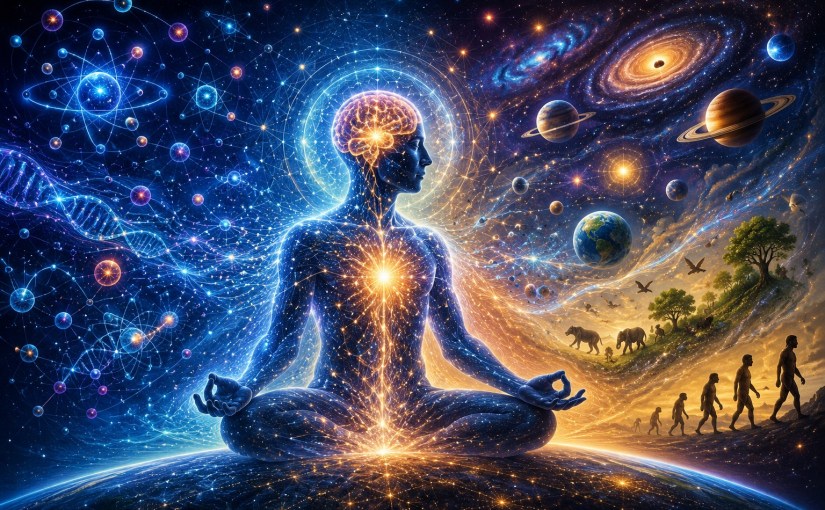
Quantum Darshan proposes that consciousness is woven into the very structure of existence. Every quantum particle participates in an underlying field of reality. The emergence of complex organisms does not create consciousness but provides increasingly sophisticated structures through which consciousness can express itself.

From this perspective, the universe may be understood as a continuum of conscious expression. Quantum particles represent the most fundamental level. Biological cells become the first organized expressions. Multicellular organisms demonstrate higher integration. Human beings display self-awareness. Mystical awakening represents perhaps the highest realization of the same underlying principle.

Such a view does not claim that every object experiences consciousness in the same way as a human being. A stone does not possess thoughts, emotions, memories, or self-reflective awareness comparable to those produced by the human brain. However, if consciousness is fundamental to reality, then its presence may extend even to the quantum level from which all forms emerge. In this perspective, inert objects may not consciously feel or recognize their own existence, yet they still participate in the same underlying conscious reality. The difference lies not in the presence or absence of consciousness itself, but in the degree to which it is organized, integrated, felt, and expressed.

In a broader sense, consciousness can be understood as regulated processing and action directed toward a higher developmental tendency or goal. From this perspective, quantum particles and human beings may be viewed as participating in the same fundamental process. Quantum particles continuously process information through their interactions and behave according to laws that contribute to the emergence of larger patterns of organization in nature. Although the universe often appears chaotic and random at the local level, over long periods it repeatedly gives rise to increasing order, complexity, life, and self-awareness. This suggests that there may be a subtle directional tendency inherent in reality, even if it is too faint to be directly observed or measured. The key difference is that quantum particles do not appear to possess subjective experience or the ability to feel these processes, whereas human beings do. This may be because the human brain has evolved a highly complex biological neural network through which pure existence, or Atman, becomes entangled with mental processes and becomes capable of self-awareness, perception, and feeling. Thus, the same underlying reality may be present throughout nature, but conscious experience emerges only when that reality is expressed through sufficiently organized structures such as the human brain.

From quantum particles to atoms, molecules, living cells, complex organisms, and awakened human beings, consciousness remains fundamentally the same underlying principle. Higher levels of organization do not create consciousness but enrich its manifestation, allowing increasingly sophisticated forms of experience, awareness, and self-recognition. Thus, consciousness may be viewed as a continuum extending throughout existence, while the capacity to experience and express it varies according to the complexity of the structure through which it operates.

How Quantum Darshan Connects with Sanatana Philosophy

This perspective creates an intriguing bridge to the ancient Sanatana worldview. The Sanatana tradition has long revered rivers, mountains, trees, stones, the Sun, the Moon, and countless manifestations of nature. To many modern observers this appears to be the worship of inert objects. However, through the lens of Quantum Darshan, a different interpretation becomes possible.

The reverence shown toward natural forms need not imply that a mountain or stone possesses human-like awareness. Rather, it reflects recognition that the same universal reality of consciousness permeates all existence. The worship is not necessarily directed toward the physical object itself but toward the deeper principle expressed through that object.

A river becomes sacred because it participates in the same underlying reality as the worshipper. A mountain becomes worthy of reverence because it is another expression of the universal existence. A tree, a stone, an animal, and a human being differ enormously in complexity and function, yet all may arise from the same foundational reality.

In this interpretation, Sanatana worship becomes an acknowledgment of unity rather than an idolization of matter. The object serves as a visible doorway through which one contemplates the invisible conscious principle underlying all existence.

Consciousness as a Continuum Rather Than a Human Possession

One of the most significant implications of Quantum Darshan is the rejection of the idea that consciousness suddenly appears only when a brain reaches a certain level of complexity. Instead, consciousness exists on a continuum.

At the most fundamental level are quantum entities. Above them emerge atoms and molecules. These organize into living cells. Cells organize into organisms. Organisms develop nervous systems. Human beings develop self-reflective awareness. Spiritual awakening reveals the deeper ground from which all these levels emerge.

In this model, life does not manufacture consciousness. Life becomes a vehicle through which consciousness expresses itself more clearly. Complexity increases the richness of expression, but the underlying reality remains continuous throughout the hierarchy of existence.

Ancient Wisdom and Modern Quantum Thought

The remarkable aspect of this framework is how it allows ancient spiritual insights and modern scientific speculation to engage in meaningful dialogue. Quantum theories of consciousness remain highly speculative and controversial within science. They have not yet established a definitive explanation for awareness. Yet they raise questions that resonate with philosophical and spiritual traditions that have contemplated consciousness for thousands of years.

Many ancient teachings describe the universe as permeated by a single reality. This reality has been expressed through concepts such as Brahman, Shiva-Shakti, universal consciousness, pure existence, or ultimate being. Quantum Darshan does not scientifically prove these teachings. Neither does it replace scientific investigation. Instead, it provides a philosophical framework in which these ancient ideas become intellectually approachable in a modern context.

The possibility emerges that what spiritual traditions discovered through direct inner experience and what science investigates through external observation may ultimately be examining different aspects of the same mystery.

The Meaning of Reverence Toward Nature

Viewed through Quantum Darshan, reverence toward nature acquires deeper significance. The sacredness attributed to rivers, mountains, forests, celestial bodies, and natural forces is not merely cultural symbolism. It becomes recognition that all forms participate in a shared underlying existence.

This perspective naturally encourages ecological respect and humility. If the same foundational reality manifests through every aspect of existence, then exploitation of nature becomes, in a sense, a failure to recognize our own deeper interconnectedness.

A person standing before a river is not simply observing flowing water. A person standing before a mountain is not simply looking at rock. Instead, one is encountering another expression of the same universal reality that gives rise to one’s own existence.

The Continuum from Matter to Awakening

Quantum Darshan suggests a grand continuum extending from quantum particles to awakened consciousness. The smallest entities participate in fundamental reality. Living cells organize that reality into biological systems. Organisms create increasing levels of integration. Human consciousness develops self-awareness. Spiritual realization reveals the universal ground beneath individual identity.

The continuum does not imply that all levels are identical. A human being clearly differs from a stone. Yet the distinction may lie in organization rather than in ultimate essence. Complexity influences expression, but the underlying reality remains shared.

This perspective allows one to understand how traditions that honor natural objects could emerge naturally from a worldview rooted in unity rather than separation.

Science, Philosophy, and the Future of Consciousness Studies

The scientific study of consciousness remains one of humanity’s greatest challenges. Despite tremendous advances in neuroscience, psychology, artificial intelligence, and quantum physics, no universally accepted explanation of consciousness exists. Questions concerning subjective experience, awareness, and the origin of consciousness remain open.

Quantum Darshan enters this discussion not as a completed scientific theory but as a philosophical proposal. It suggests that consciousness may be more fundamental than currently assumed. If future discoveries reveal deeper connections between consciousness and quantum reality, entirely new ways of understanding life, mind, and existence may emerge.

Even if such connections are never scientifically confirmed, the framework remains valuable because it encourages dialogue between scientific inquiry and ancient wisdom traditions. It reminds us that the search for truth need not be divided into opposing camps of science and spirituality.

Conclusion: A Universe United by an Underlying Reality

Quantum Darshan presents a vision of existence in which consciousness is fundamental rather than accidental. Quantum particles participate in the deepest fabric of reality. Living systems organize and amplify this reality. Human beings become capable of recognizing it consciously. Spiritual awakening represents the realization of unity beneath apparent diversity.

Through this lens, the Sanatana reverence for rivers, mountains, trees, stones, the Sun, the Moon, and other natural forms becomes understandable as recognition of a universal conscious principle rather than worship of inert matter. The object itself is not necessarily the focus. The deeper reality present within and through the object becomes the true subject of reverence.

Whether approached through science, philosophy, or direct spiritual experience, the possibility remains profoundly intriguing: that beneath the countless forms of the universe lies a single reality expressing itself in different degrees of organization, complexity, and awareness. Quantum Darshan offers one way of contemplating that possibility, providing a bridge between modern explorations of consciousness and the timeless vision that all existence is ultimately one.

From Inert Matter to Supreme Consciousness: A Journey Through Self

When we look up at the sky, it appears still, silent, and vast. It’s natural to see it as lifeless or jada—an inert physical space. In the same way, we label objects and even dead bodies as jada because they seem unconscious. There’s no movement, no response, no sign of inner awareness. But what if this stillness is not truly lifeless? What if what appears jada is actually holding a deep, silent potential within?

Traditionally, we consider something jada when it doesn’t show any signs of life. Even a human body, once the soul leaves, is referred to as jada because the expressions of consciousness are gone. But this jada state doesn’t mean emptiness. It’s more like a tightly packed capsule—where all the impressions, experiences, and memories are compressed and hidden, like data in a zip file. That’s why it feels dense, bound, and even suffocating.

On the other hand, when something is alive and expressive, we call it chetan—conscious. A living being breathes, feels, acts, and reflects. Its inner information is not hidden—it’s in motion, interacting with the world. This openness makes chetan appear far superior to jada. The life within it flows. It explores, it expresses, it evolves. That’s why we admire living beings—they are like windows through which consciousness shines.

But even chetan has its limitations. While the conscious being can act and interact, it still carries inner burdens—deep impressions called samskaras—that shape its personality, habits, and sufferings. The beauty, though, lies in the fact that a chetan being can work on itself. It can shed these burdens through inner work—whether through spiritual practice, self-inquiry, yoga, or meditation. This path leads to something even greater.

That greater state is param chetan—the supreme consciousness. It is not just living. It is fully awakened, totally free. It doesn’t carry any burden of impressions. It doesn’t suffer from ignorance or duality. It exists in its purest form: full of satta (existence), chitta (consciousness), and ananda (bliss). This is the real sky of the self—boundless and untouched.

Ironically, param chetan may still look like jada to the ordinary eye. A realized sage may appear calm and still like a rock or empty sky. But within that stillness lies a fullness beyond comprehension. What appears lifeless is, in fact, the most alive. It’s just not agitated or noisy. It’s like a silent ocean—motionless on the surface, yet infinitely deep.

So what we call jada may just be param chetan in disguise—consciousness in rest, not in absence. The journey of the soul is to move from being unconsciously bound, to consciously expressive, and finally to being consciously free. This is the hidden evolution—from inert matter, through active life, to divine being.

And in that ultimate state, the infinite sky within us is no longer veiled. It shines in its original light—pure, luminous, and complete.

कुण्डलिनी व प्रेम सम्बन्ध के बीच में आपसी रिश्ता- mutual relationship between Kundalini and love affair

कुण्डलिनी व प्रेम सम्बन्ध के बीच में आपसी रिश्ता (please browse down or click here to view this post in English)

कुण्डलिनी एक जीवनी शक्ति है। समाज में यादों के सहारे जीने की जो बात चलती है, वह कुण्डलिनी के सहारे जीने की ही बात है। इसी तरह, प्रेमसंबंध भी कुण्डलिनी को पैदा करता है, जिससे विभिन्न कुण्डलिनी-लक्षण पैदा होते हैं। कुण्डलिनी प्राणों (साँसों सहित) को बल प्रदान करती है। कुण्डलिनी मानसिक विचार का ही पर्याय है। इस प्रकार से सभी मानसिक विचार प्राणों को पुष्ट करते हैं।

किसी व्यक्ति विशेष का लगातार यादों में, अर्थात मन में बने रहना ही कुण्डलिनी-क्रियाशीलता है। उससे उस व्यक्ति विशेष के रूप से बनी मानसिक छवि को ही कुण्डलिनी कहते हैं, तथा उस मानसिक छवि से एकाकार होने को ही कुण्डलिनी जागरण कहते हैं।

जब कोई व्यक्ति कहता है कि वह अपने प्रेमी के बिना जी नहीं सकता, तब वह उसके रूप से बनी अपनी मानसिक कुण्डलिनी के बिना न जी सकने की ही बात करता है। वास्तव में वह अपने प्रेमी के भौतिक रूप के बिना भी जी सकता है, यदि प्रेमी की छवि उसके मन में बस गई हो। तभी तो बहुत से प्रेमी जोड़े एक-दूसरे से अलग रहकर, एक-दूसरे की यादों के सहारे ही पूरा जीवन सुखपूर्वक बिता लेते हैं। उनके मन में बसी एक-दूसरे की वही छवि तो कुण्डलिनी है। वह उनके पूरे अस्तित्व को चलायमान रखती है। प्रेमी उसे नहीं छोड़ सकता। यदि वह जबरदस्ती उसे हटाने का प्रयत्न करता है, तो वह अँधेरे में जैसे डूबने लगता है, क्योंकि उसका सभी कुछ उस कुण्डलिनी के साथ जुड़ गया होता है। इसलिए वह मजबूरी में उसे बना कर रखता है। जब समय के साथ वह छवि मिटने लगती है, तब कोई नई छवि उसका स्थान लेने लगती है। इसी से पता चलता है कि कुण्डलिनी एक जीवनी शक्ति है। यौनसंबंध से उस मानसिक छवि को शक्ति मिलती है। ऐसा ही ओशो महाराज भी कहते हैं। तभी तो जगत में यौनसंबंध को सबसे बड़ा सुख माना जाता है। यदि वह सम्बन्ध तांत्रिक विधि से हो, तब तो और भी अधिक शक्ति मिलती है, जिससे वह जागृत भी हो सकती है।

अतः उपरोक्त बातों से स्वयंसिद्ध है कि अंतर्लैंगिक प्रेमसंबंध में भी कुण्डलिनी लक्षण उत्पन्न होते हैं। प्रेमी के रूप से निर्मित मानसिक कुण्डलिनी लगातार मन में बसी रहती है। उससे व्यक्ति यौनसंबंध बनाने के लिए या विवाह सम्बन्ध बनाने के लिए प्रोत्साहित होता है, ताकि वह कुण्डलिनी शांत हो सके। यद्यपि वह कुण्डलिनी लाभदायक होती है, पर व्यक्ति उसके अस्थायी दुष्प्रभावों से विचलित हो जाता है। वे दुष्प्रभाव निम्नलिखित प्रकार के हैं। वह उसकी शारीरिक व मानसिक शक्ति का कम या ज्यादा रूप में भक्षण करती रहती है। उससे उसका मन दुनियादारी में कम लगता है। वह एकांत को पसंद करने लगता है। वह लोगों को बुझा-बुझा सा दिखता है। अन्य वे सभी लक्षण उत्पन्न होते हैं, जो कुण्डलिनी के लिए सामान्य हैं, जैसे कि शरीर में, मुख्यतः हाथों में कम्पन, सिरदर्द के साथ सिर में भारीपन, भावुकता, उत्तेजना आदि। तभी तो कई प्रेमी अपने प्रेम के असफल होने पर घातक कदम भी उठा लेते हैं, क्योंकि उन्हें लगता है कि कुण्डलिनी उनका पीछा ही नहीं छोड़ेगी, और उन्हें बिलकुल नकारा कर देगी। परन्तु वास्तविकता यह है कि वह कुण्डलिनी उनके सारे पाप धोकर उन्हें आत्मज्ञान तक पहुंचा देती है। प्रेमयोगी वज्र के साथ भी यही हुआ था, जो उसकी पुस्तक “शरीरविज्ञान दर्शन- एक आधुनिक कुण्डलिनी तंत्र (एक योगी की प्रेमकथा)” में विस्तार से वर्णित है। फिर बाद में उसके गुरु के रूप की कुण्डलिनी उसके मन में जागृत हो गई थी, जिसने उसकी प्रेमिका की कुण्डलिनी का स्थान ले लिया था। इस तरह से, लगभग 20 सालों के बाद उसका पीछा उसकी प्रेमिका के रूप की कुण्डलिनी से छूट पाया था।

विडम्बना है कि प्रेम के सफल होने पर भी व्यक्ति को संतुष्टि नहीं मिलती। विवाह के बाद प्रेमी का आकर्षण समाप्त हो जाता है, जिससे उसके रूप की कुण्डलिनी भी गायब हो जाती है। वह जीवनी शक्ति के लिए तरसने लगता है। फिर वह पछताता है कि क्योंकर उसने प्रेमी की यादों (कुण्डलिनी) से घबरा कर प्रेम को परवान नहीं चढ़ने दिया। वह सोचता है कि प्रेमी के भौतिक रूप से अच्छी तो उसके रूप से निर्मित मानसिक कुण्डलिनी ही थी। यद्यपि फिर भी कुछ नहीं बिगड़ा होता है, यदि वह मौके की नजाकत को समझे। क्योंकि वैसी पछतावे वाली स्थिति में वह संदर्भित तंत्र / अप्रत्यक्ष तंत्र का सहारा ले सकता है, जिसमें वह अपने जीवनसाथी-प्रेमी की सहायता से गुरु, देवता , इष्ट आदि के रूप की कुण्डलिनी को जागृत कर सकता है। इस तरह के समस्त तथ्य उपरोक्त पुस्तक में सविस्तार वर्णित हैं।

वैसे तो मन के सभी विचार जीवनी शक्ति देते हैं। एक बहिर्मुखी आदमी में ये विचार निरंतर जारी रहते हैं, इसलिए उसकी जीवनी शक्ति निरंतर बनी रहती है। जब उसका शरीर किसी कारणवश क्षीण हो जाता है, तब उसकी बहिर्मुखता भी क्षीण हो जाती है। इससे वह निर्विचार सा होकर जीवनी शक्ति के लिए तरस जाता है। फिर वह अकेली मानसिक छवि को योग से पुष्ट करने लगता है, ताकि वह जीवनी शक्ति प्राप्त करता रह सके। बुद्धिमान व्यक्ति बहिर्मुखता के साथ योग या प्रेम से या दोनों से कुण्डलिनी को भी पुष्ट करता रहता है, ताकि वह संकट के समय काम आवे। भाग्यहीन व्यक्ति न तो बदलते विचारों का पूरा लाभ उठाता है, और न ही कुण्डलिनी-रूपी अकेले यौगिक विचार का। इसलिए जीवनी शक्ति के अभाव के कारण उसका जीवन संकट में पड़ा रहता है।

यदि आपने इस लेख/पोस्ट को पसंद किया तो कृपया थोड़े और श्रम से “लाईक” बटन को क्लिक करें, इसे शेयर करें, इस वार्तालाप/ब्लॉग को अनुसृत/फॉलो करें, व साथ में अपना विद्युतसंवाद पता/ई-मेल एड्रेस भी दर्ज करें, ताकि इस ब्लॉग के सभी नए लेख एकदम से सीधे आपतक पहुंच सकें। कमेन्ट सैक्शन में अपनी राय जाहिर करना न भूलें।


Mutual relationship between Kundalini and love affair

Kundalini is a Life force. What is the matter of living in the society with the help of memories; it is only a matter of living with the help of Kundalini. Likewise, love affair also produces Kundalini, which causes various Kundalini-symptoms. Kundalini gives strength to pranas / subtle breath-power (including breaths). Kundalini is a synonym for mental thought. In this way, all mental thoughts affirm life.

A continuous memory of a particular person, that is to remain in the mind, is the Kundalini-activation. From that, the mental image created from the physical form of a particular person is called Kundalini, and Kundalini awakening is to be united with that mental image.

When a person says that he cannot live without his lover, then he talks about not living without the Kundalini. In fact, he can live without the physical nature of his lover, if the image of the lover has settled in his mind. Only then, many lover couples spend their whole life happily, living apart from each other, with the help of each other’s memories. The same image in the mind of lover is Kundalini. She keeps his whole existence moving. He cannot leave her. If he forcefully tries to remove her, then he starts drowning in the darkness, because his everything has gone attached with that image. That is why he maintains her in compulsion. When the image begins to dissolve over time, then a new image begins to take its place. This shows that Kundalini is a life force. Sexual mood gives strength to that mental image. Similar are also the words of Osho Maharaja. Only then, sexual relations are considered the greatest happiness in the world. If that relation is with the Tantric method, then kundalini gets even more power, so that she can also be awakened.

Therefore, there is axiom by the above things that kundalini symptoms arise in romantic love affair also. The mental kundalini built from the physical form of a lover constantly resides in the mind. The person is encouraged to make sexual relation or to create a marriage relationship, so that the Kundalini can calm down. Although the Kundalini is beneficial, the person gets distracted by its temporary side effects. These are the following types of side effects. She uses less or more of his physical and mental powers. His mind wants to be less in the world. He seems to like seclusion. It looks to people as if he has gone extinguished. Other all those symptoms are common, which are normal for the Kundalini, such as subtle tremors in the body, mainly vibrations in the hands, heaviness in the head with headache, emotionalism, excitement etc. Only then do many lovers take fatal steps when their love fails, because they think that Kundalini will not leave them normal, and will make them rejected altogether. However, the reality is that the Kundalini, by washing all their sins, leads them to enlightenment. This was the case with Premyogi Vajra, which is described in detail in his book (in Hindi) “shareervigyan darshan- ek adhunik kundalini tantra (ek yogi ki premkatha); Physiology philosophy – A Modern Kundalini tantra (The Love Story of a Yogi)”, and “love story of a yogi- what Patanjali says”. Both of these are also available on “shop” page of this website. Later, his Kundalini made of his Guru’s form had awakened in his mind, who had replaced his girlfriend’s Kundalini. In this way, after twenty years of pursuing it, he was exempted from the kundalini made of his girlfriend’s form.

Ironically, even after the success of love, the person does not get satisfaction. After marriage, the attraction of the lover ends, so that the Kundalini of her form also disappears. He seems longing for the force of life. Then he regrets why he did not allow love to go to peak out of fear of lover’s memories (the Kundalini). He thinks that the lover’s physical form is worse than the mental kundalini built from her that physical form. Although nothing is non repairable then too, if he understands the potential of the spot. Because in such a situation, he can resort to the contextual Tantra / indirect Tantra in which he can awaken the Kundalini of the form of Guru, God, favorite etc. with the help of loving life partner. All such facts are described in detail in the above book.

By the way, all thoughts of the mind give the force to life. These thoughts continue in an extroverted man, so his life force continues to be sustained. When his body gets impaired for some reason, then his extrovert nature also becomes impaired. This leads to a bit of gross thoughtlessness and yearns for life. Then he starts to consolidate the single mental image with the yoga, so that he can get the life force. The wise person keeps on strengthening the Kundalini along with his extrovert nature with help of yoga / meditation or love or both, so that she will work in times of crisis. An ill fated one does not take full advantage of changing thoughts, nor of the yogic thought alone, that is named as kundalini. Therefore, due to the absence of life force, his life remains in crisis.

If you liked this post then please work little more to click the “like” button, share it, and follow this blog while providing your e-mail address, so that all new posts of this blog could reach to you immediately via your e-mail. Do not forget to express your opinion in the comments section.